
keyword
visual storytelling
Visual storytelling is the practice of communicating a narrative, concept, or message primarily through visual media such as imagery, video, graphics, and spatial design. It organizes visual components into a structured, coherent sequence, using techniques like graphic composition, visual encoding, and cinematic pacing to guide audience comprehension and emotional engagement. Across both static formats like data-driven infographics and dynamic mediums like film and animation, visual storytelling integrates narrative principles with aesthetic and technical choices to convey complex information, ideas, and events clearly and impactfully.
2 items
InfoAlign: A Human-AI Co-Creation System for Storytelling with Infographics
Jielin Feng, Xinwu Ye, Qianhui Li, Verena Prantl, Jun-Hsiang Yao, Yuheng Zhao, Yun Wang, Siming Chen
Why you should read this
Introduces InfoAlign, a human-AI co-creation system that transforms unstructured text into coherent storytelling infographics through a structured workflow of story construction, visual encoding, and spatial composition while preserving user intent.
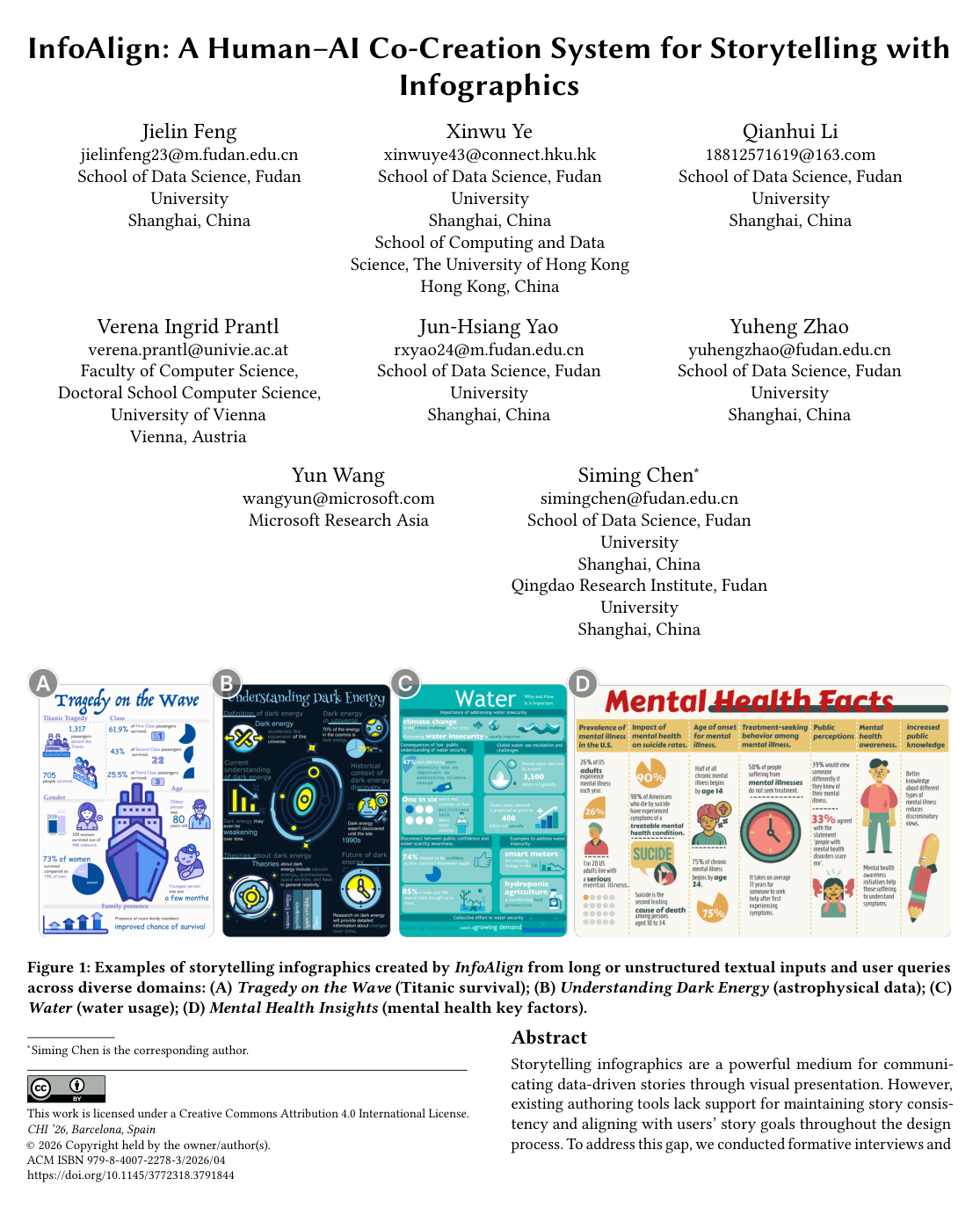
Storytelling infographics are a powerful medium for communicating data-driven stories through visual presentation. However, existing authoring tools lack support for maintaining story consistency and aligning with users' story goals throughout the design process. To address this gap, we conducted formative interviews and a quantitative analysis to identify design needs and common story-informed layout patterns in infographics. Based on these insights, we propose a narrative-centric workflow for infographic creation consisting of three phases: story construction, visual encoding, and spatial composition. Building on this workflow, we developed InfoAlign, a human-AI co-creation system that transforms long or unstructured text into stories, recommends semantically aligned visual designs, and generates layout blueprints. Users can intervene and refine the design at any stage, ensuring their intent is preserved and the infographic creation process remains transparent. Evaluations show that InfoAlign preserves story coherence across authoring stages and effectively supports human-AI co-creation for storytelling infographic design.
Added
2026-09-29
FilMaster: Bridging Cinematic Principles and Generative AI for Automated Film Generation
Kaiyi Huang, Yukun Huang, Xintao Wang, Zinan Lin, Xuefei Ning, Pengfei Wan, Di Zhang, Yu Wang, Xihui Liu
Why you should read this
Introduces AGUVIS, a unified vision-based framework that achieves state-of-the-art autonomous GUI interaction across web, desktop, and mobile platforms by combining direct screen perception with a structured inner monologue, establishing the first high-performance open-source alternative to agents dependent on closed-source models.
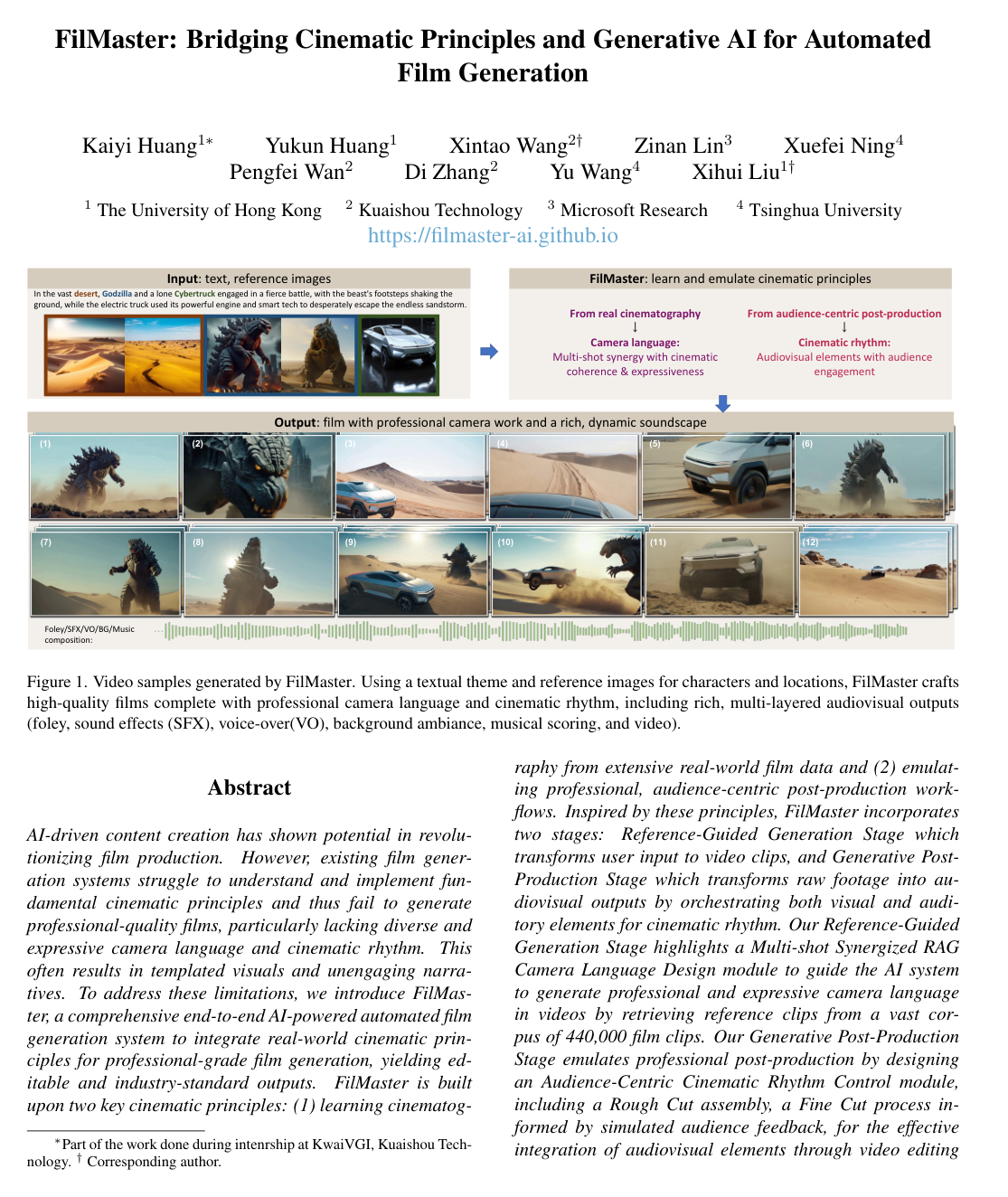
AI-driven content creation has shown potential in film production. However, existing film generation systems struggle to implement cinematic principles and thus fail to generate professional-quality films, particularly lacking diverse camera language and cinematic rhythm. This results in templated visuals and unengaging narratives. To address this, we introduce FilMaster, an end-to-end AI system that integrates real-world cinematic principles for professional-grade film generation, yielding editable, industry-standard outputs. FilMaster is built on two key principles: (1) learning cinematography from extensive real-world film data and (2) emulating professional, audience-centric post-production workflows. Inspired by these principles, FilMaster incorporates two stages: a Reference-Guided Generation Stage which transforms user input to video clips, and a Generative Post-Production Stage which transforms raw footage into audiovisual outputs by orchestrating visual and auditory elements for cinematic rhythm. Our generation stage highlights a Multi-shot Synergized RAG Camera Language Design module to guide the AI in generating professional camera language by retrieving reference clips from a vast corpus of 440,000 film clips. Our post-production stage emulates professional workflows by designing an Audience-Centric Cinematic Rhythm Control module, including Rough Cut and Fine Cut processes informed by simulated audience feedback, for effective integration of audiovisual elements to achieve engaging content. The system is empowered by generative AI models like (M)LLMs and video generation models. Furthermore, we introduce FilmEval, a comprehensive benchmark for evaluating AI-generated films. Extensive experiments show FilMaster's superior performance in camera language design and cinematic rhythm control, advancing generative AI in professional filmmaking.
Added
2026-05-16