
keyword
visual encoder
A visual encoder is a neural network component designed to process raw visual inputs, such as static images or video sequences, and convert them into dense, high-dimensional feature representations or token embeddings. Typically implemented using architectures such as Vision Transformers or convolutional neural networks, the visual encoder extracts essential spatial, semantic, and temporal patterns directly from pixel data. In multimodal machine learning and vision-language systems, these extracted representations are aligned, projected, or fed directly into downstream models like large language models and cross-modal retrieval networks, enabling computing systems to interpret scenes, reason over visual content, and perform tasks such as visual question answering, image captioning, and robotic perception.
10 items
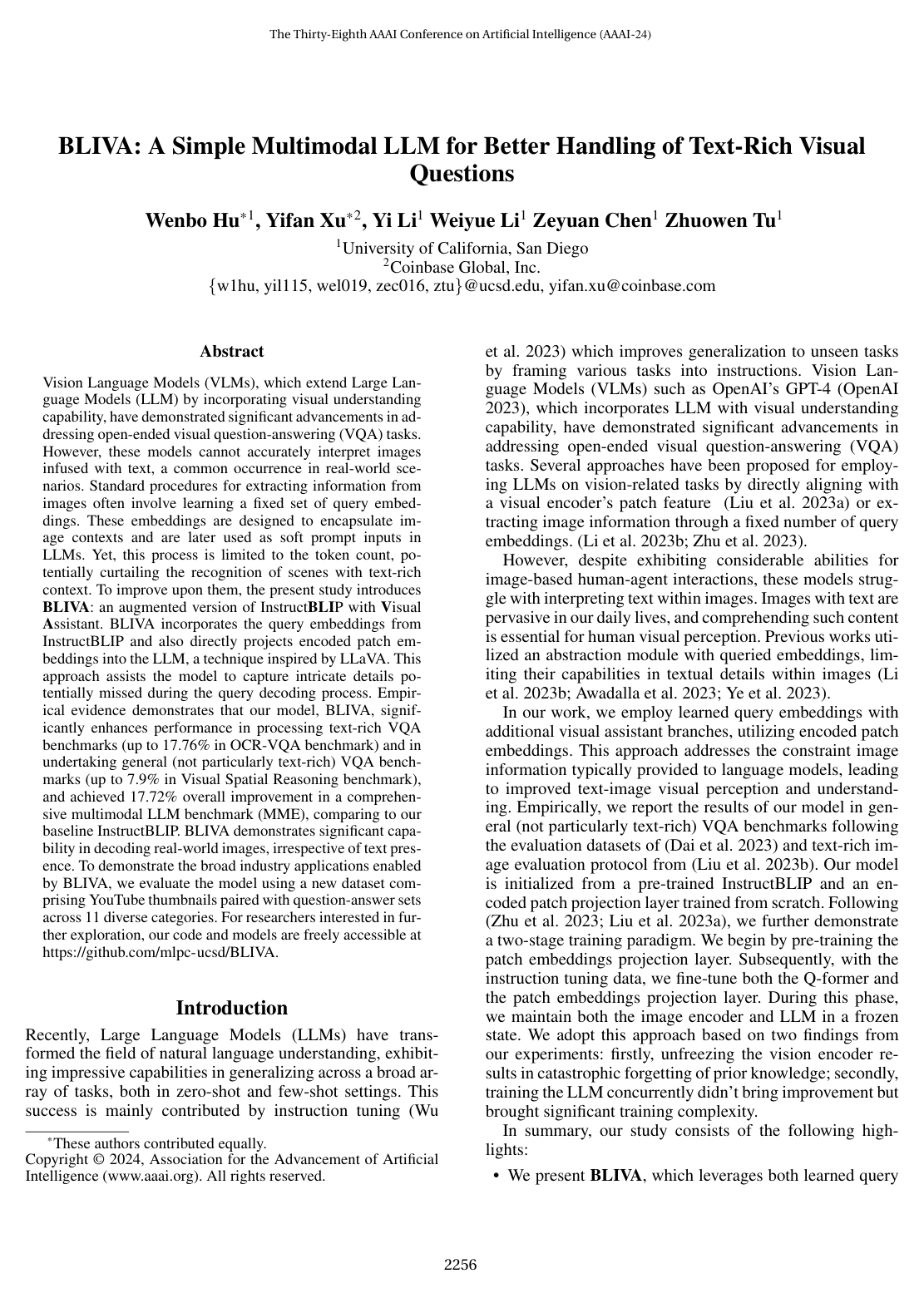
BLIVA: A Simple Multimodal LLM for Better Handling of Text-Rich Visual Questions
Wenbo Hu, Yifan Xu, Yi Li, Weiyue Li, Zeyuan Chen, Zhuowen Tu
Why you should read this
Proposes BLIVA, a multimodal architecture that combines learned query embeddings with directly projected visual patch embeddings to overcome token-bottleneck limitations and improve performance on text-rich visual question answering tasks.
Vision Language Models (VLMs), which extend Large Language Models (LLM) by incorporating visual understanding capability, have demonstrated significant advancements in addressing open-ended visual question-answering (VQA) tasks. However, these models cannot accurately interpret images infused with text, a common occurrence in real-world scenarios. Standard procedures for extracting information from images often involve learning a fixed set of query embeddings. These embeddings are designed to encapsulate image contexts and are later used as soft prompt inputs in LLMs. Yet, this process is limited to the token count, potentially curtailing the recognition of scenes with text-rich context. To improve upon them, the present study introduces BLIVA: an augmented version of InstructBLIP with Visual Assistant. BLIVA incorporates the query embeddings from InstructBLIP and also directly projects encoded patch embeddings into the LLM, a technique inspired by LLaVA. This approach assists the model to capture intricate details potentially missed during the query decoding process. Empirical evidence demonstrates that our model, BLIVA, significantly enhances performance in processing text-rich VQA benchmarks (up to 17.76% in OCR-VQA benchmark) and in understanding general (not particularly text-rich) VQA benchmarks (up to 7.9% in Visual Spatial Reasoning benchmark), and achieved 17.72% overall improvement in a comprehensive multimodal LLM benchmark (MME), comparing to our baseline InstructBLIP. BLIVA demonstrates significant capability in decoding real-world images, irrespective of text presence. To demonstrate the broad industry applications enabled by BLIVA, we evaluate the model using a new dataset comprising YouTube thumbnails paired with question-answer sets across 11 diverse categories. For researchers interested in further exploration, our code and models are freely accessible at https://github.com/mlpc-ucsd/BLIVA.
Added
2026-10-05
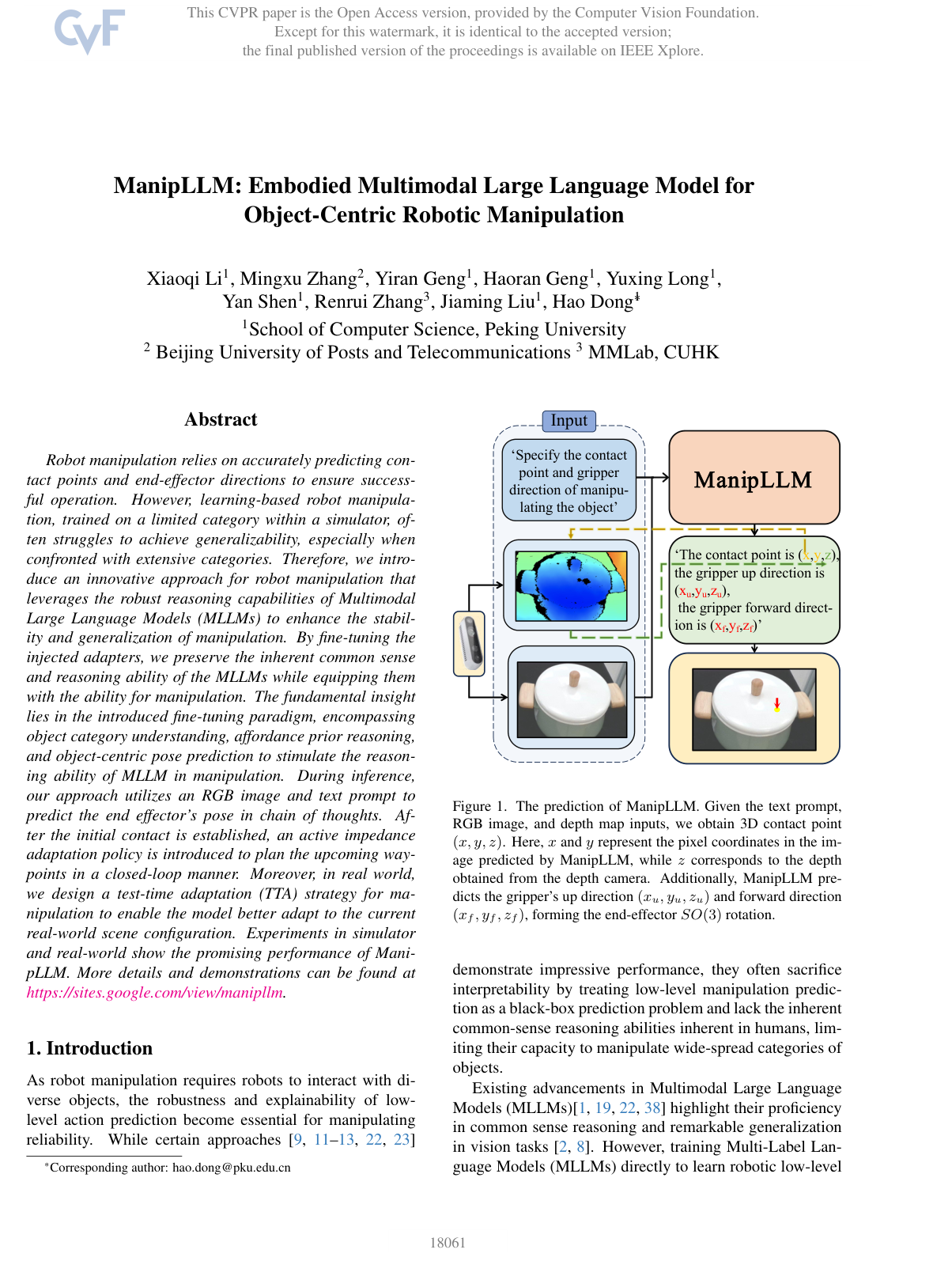
ManipLLM: Embodied Multimodal Large Language Model for Object-Centric Robotic Manipulation
Xiaoqi Li, Mingxu Zhang, Yiran Geng, Haoran Geng, Yuxing Long, Yan Shen, Renrui Zhang, Jiaming Liu, Hao Dong
Why you should read this
Presents ManipLLM, a framework that adapts multimodal large language models using chain-of-thought fine-tuning and test-time adaptation to generalize 3D end-effector pose prediction across diverse object categories for robotic manipulation.
Robot manipulation relies on accurately predicting contact points and end-effector directions to ensure successful operation. However, learning-based robot manipulation, trained on a limited category within a simulator, often struggles to achieve generalizability, especially when confronted with extensive categories. Therefore, we introduce an innovative approach for robot manipulation that leverages the robust reasoning capabilities of Multimodal Large Language Models (MLLMs) to enhance the stability and generalization of manipulation. By fine-tuning the injected adapters, we preserve the inherent common sense and reasoning ability of the MLLMs while equipping them with the ability for manipulation. The fundamental insight lies in the introduced fine-tuning paradigm, encompassing object category understanding, affordance prior reasoning, and object-centric pose prediction to stimulate the reasoning ability of MLLM in manipulation. During inference, our approach utilizes an RGB image and text prompt to predict the end effector's pose in chain of thoughts. After the initial contact is established, an active impedance adaptation policy is introduced to plan the upcoming waypoints in a closed-loop manner. Moreover, in real world, we design a test-time adaptation (TTA) strategy for manipulation to enable the model better adapt to the current real-world scene configuration. Experiments in simulator and real-world show the promising performance of ManipLLM. More details and demonstrations can be found at https://sites.google.com/view/manipllm.
Added
2026-10-05
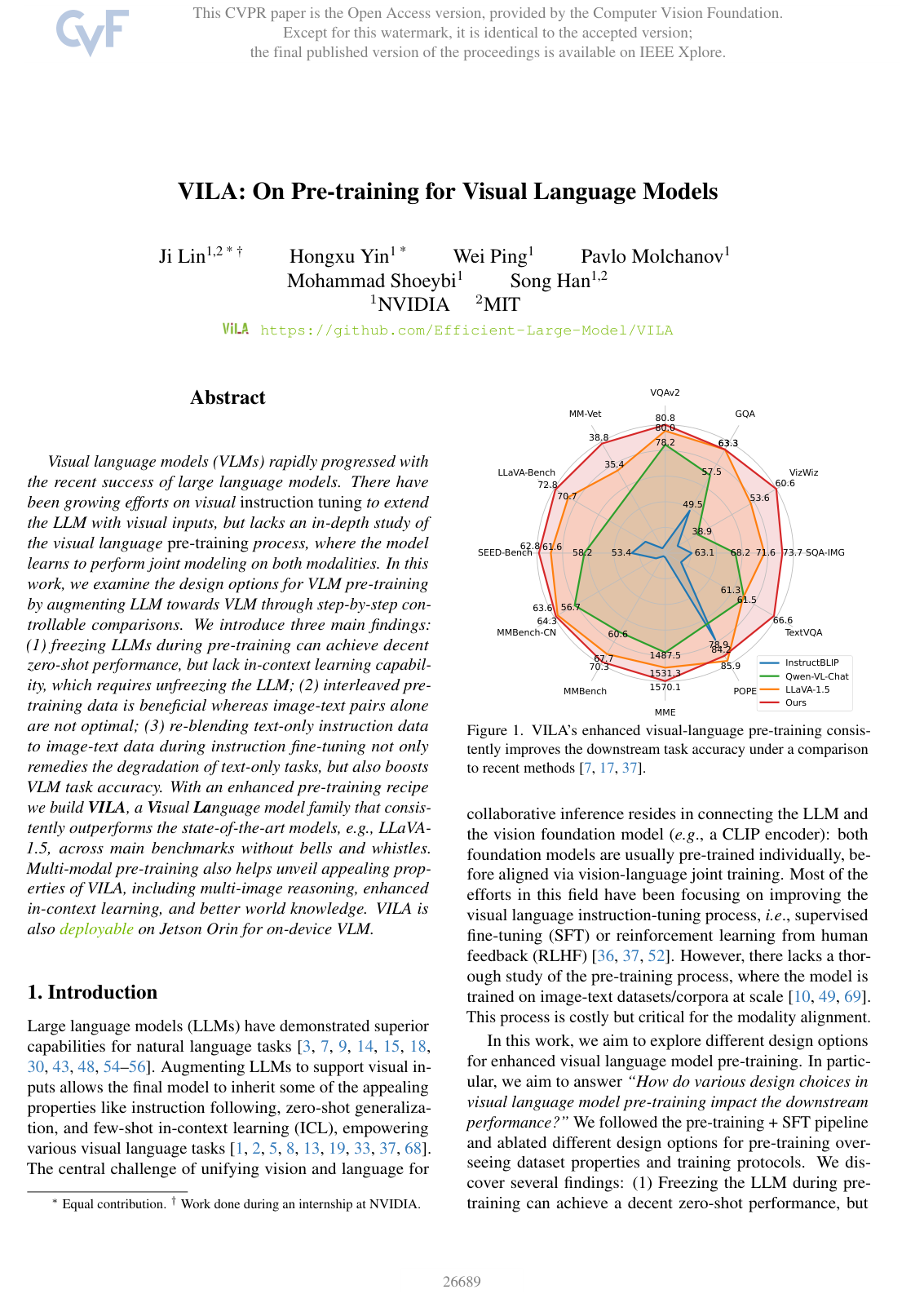
VILA: On Pre-training for Visual Language Models
Ji Lin, Hongxu Yin, Wei Ping, Pavlo Molchanov, Mohammad Shoeybi, Song Han
Why you should read this
Presents an effective pre-training recipe for vision-language models that unfreezes the base language model on interleaved multi-modal data, producing models that outperform LLaVA-1.5 in multi-image reasoning and in-context learning.
Visual language models (VLMs) rapidly progressed with the recent success of large language models. There have been growing efforts on visual instruction tuning to extend the LLM with visual inputs, but lacks an in-depth study of the visual language pre-training process, where the model learns to perform joint modeling on both modalities. In this work, we examine the design options for VLM pre-training by augmenting LLM towards VLM through step-by-step controllable comparisons. We introduce three main findings: (1) freezing LLMs during pre-training can achieve decent zero-shot performance, but lack in-context learning capability, which requires unfreezing the LLM; (2) interleaved pre-training data is beneficial whereas image-text pairs alone are not optimal; (3) re-blending text-only instruction data to image-text data during instruction fine-tuning not only remedies the degradation of text-only tasks, but also boosts VLM task accuracy. With an enhanced pre-training recipe we build VILA, a Visual Language model family that consistently outperforms the state-of-the-art models, e.g., LLaVA-1.5, across main benchmarks without bells and whistles. Multi-modal pre-training also helps unveil appealing properties of VILA, including multi-image reasoning, enhanced in-context learning, and better world knowledge. VILA is also deployable on Jetson Orin for on-device VLM.
Added
2026-10-05
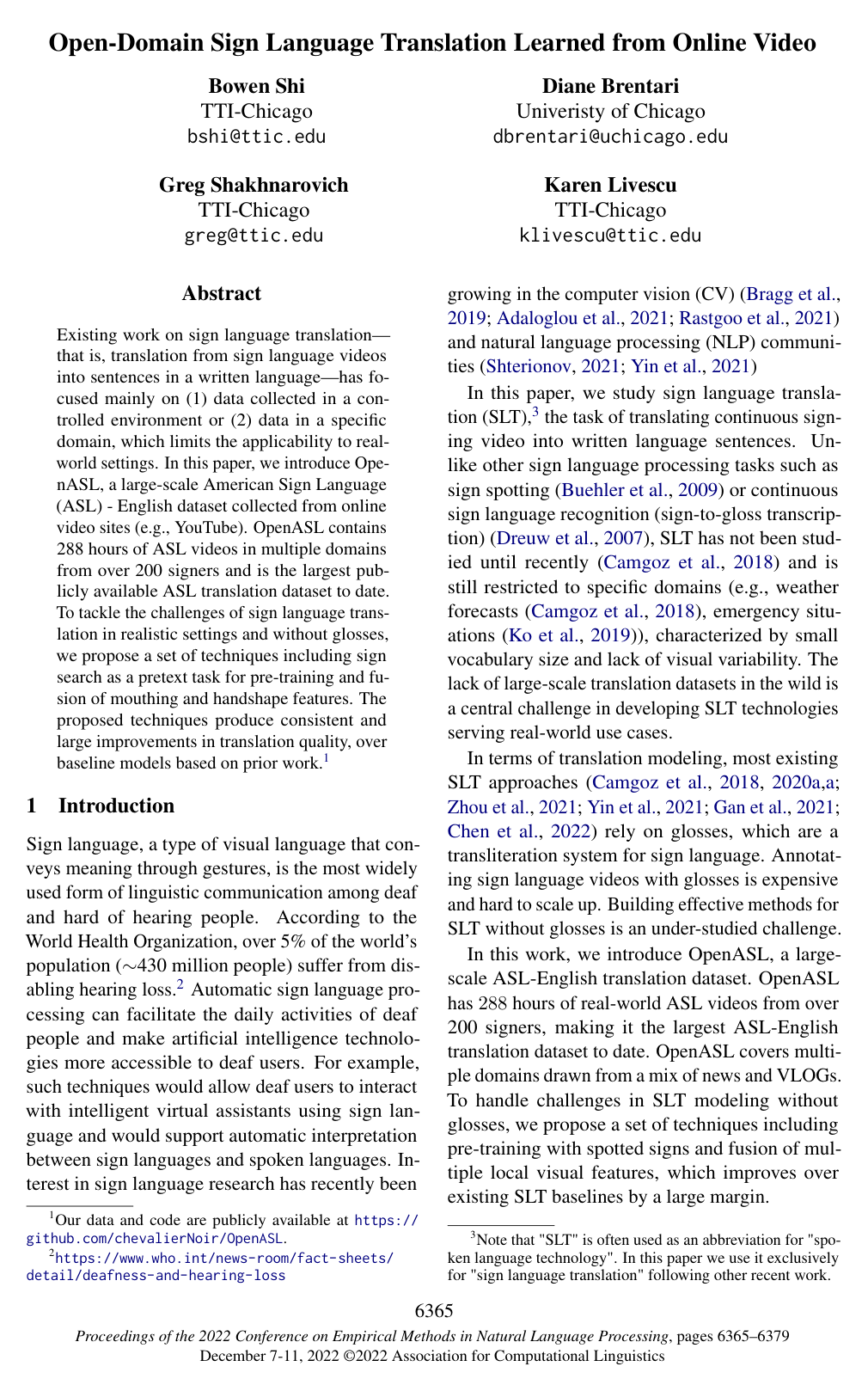
Open-Domain Sign Language Translation Learned from Online Video
Bowen Shi, Diane Brentari, Gregory Shakhnarovich, Karen Livescu
Why you should read this
Presents OpenASL, the largest open-domain American Sign Language dataset from online video, alongside pre-training and multi-feature fusion techniques that substantially improve gloss-free translation in unconstrained environments.
Existing work on sign language translation—that is, translation from sign language videos into sentences in a written language—has focused mainly on (1) data collected in a controlled environment or (2) data in a specific domain, which limits the applicability to real-world settings. In this paper, we introduce OpenASL, a large-scale American Sign Language (ASL) - English dataset collected from online video sites (e.g., YouTube). OpenASL contains 288 hours of ASL videos in multiple domains from over 200 signers and is the largest publicly available ASL translation dataset to date. To tackle the challenges of sign language translation in realistic settings and without glosses, we propose a set of techniques including sign search as a pretext task for pre-training and fusion of mouthing and handshape features. The proposed techniques produce consistent and large improvements in translation quality, over baseline models based on prior work.
Added
2026-10-02
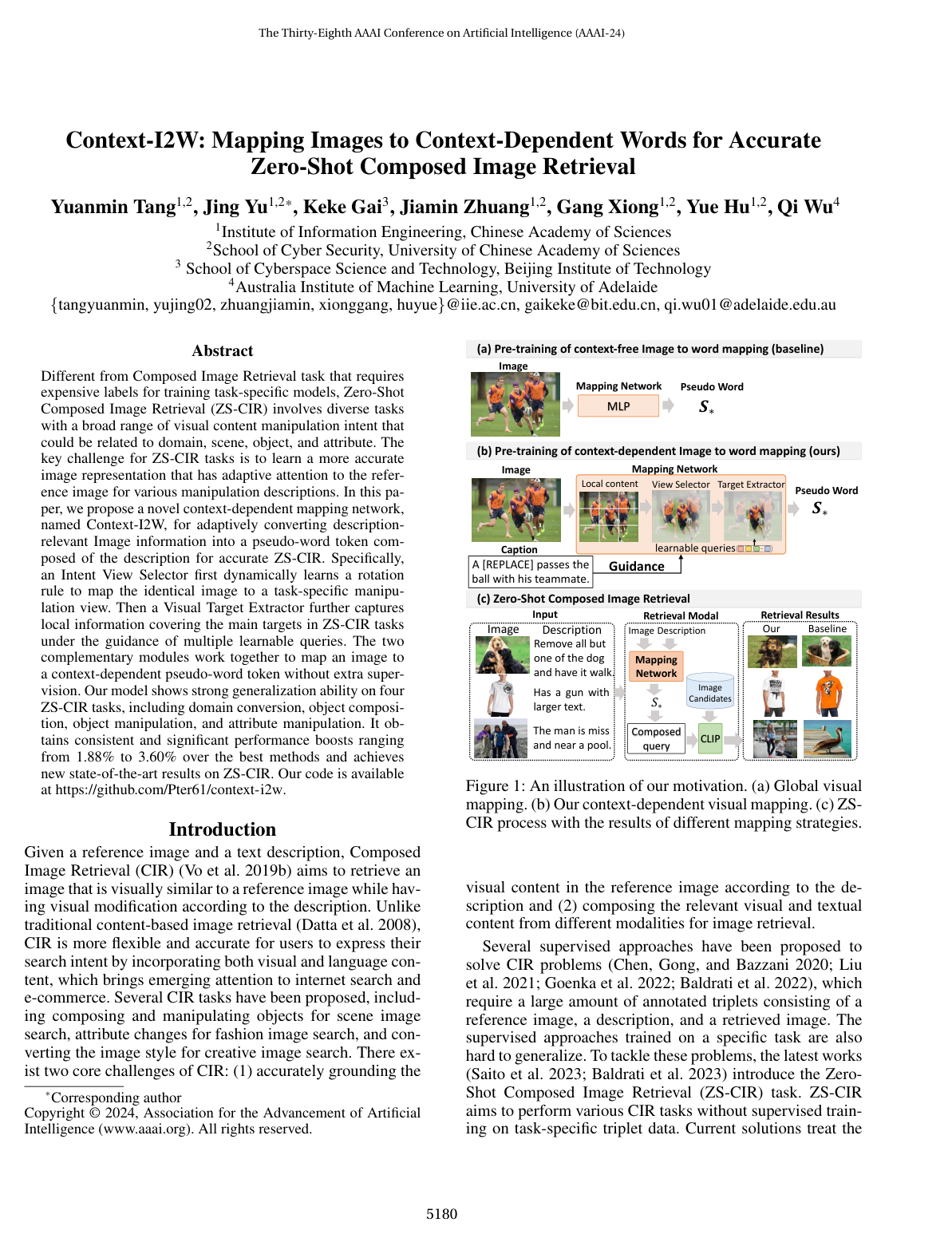
Context-I2W: Mapping Images to Context-Dependent Words for Accurate Zero-Shot Composed Image Retrieval
Yuanmin Tang, Jing Yu, Keke Gai, Jiamin Zhuang, Gang Xiong, Yue Hu, Qi Wu
Why you should read this
Proposes a context-dependent mapping network that converts description-relevant visual information into pseudo-word tokens using hierarchical view selection and target extraction, significantly advancing zero-shot composed image retrieval without requiring expensive supervised triplet annotations.
Different from Composed Image Retrieval task that requires expensive labels for training task-specific models, Zero-Shot Composed Image Retrieval (ZS-CIR) involves diverse tasks with a broad range of visual content manipulation intent that could be related to domain, scene, object, and attribute. The key challenge for ZS-CIR tasks is to learn a more accurate image representation that has adaptive attention to the reference image for various manipulation descriptions. In this paper, we propose a novel context-dependent mapping network, named Context-I2W, for adaptively converting description-relevant Image information into a pseudo-word token composed of the description for accurate ZS-CIR. Specifically, an Intent View Selector first dynamically learns a rotation rule to map the identical image to a task-specific manipulation view. Then a Visual Target Extractor further captures local information covering the main targets in ZS-CIR tasks under the guidance of multiple learnable queries. The two complementary modules work together to map an image to a context-dependent pseudo-word token without extra supervision. Our model shows strong generalization ability on four ZS-CIR tasks, including domain conversion, object composition, object manipulation, and attribute manipulation. It obtains consistent and significant performance boosts ranging from 1.88% to 3.60% over the best methods and achieves new state-of-the-art results on ZS-CIR. Our code is available at https://github.com/Pter61/context-i2w.
Added
2026-09-26
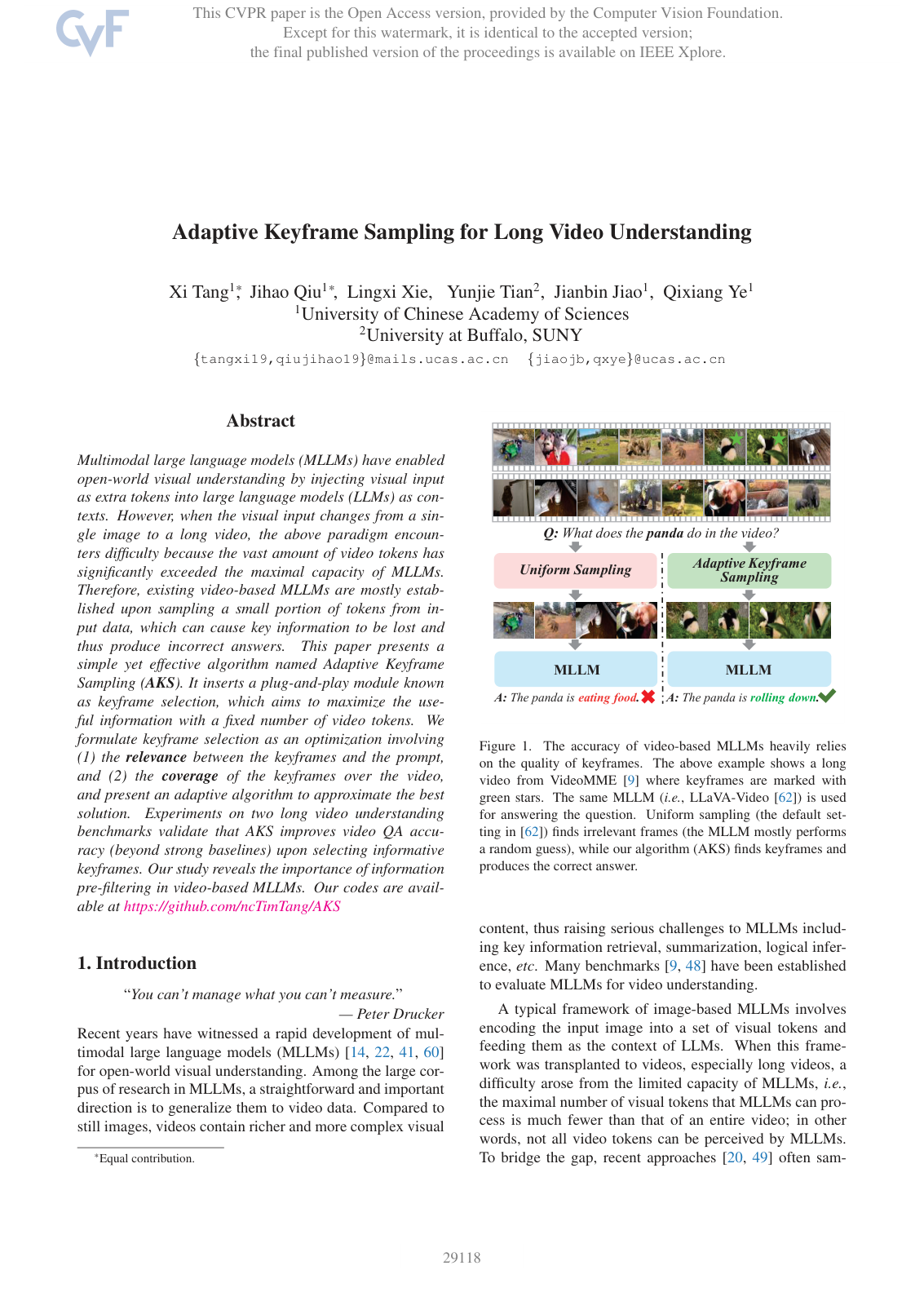
Adaptive Keyframe Sampling for Long Video Understanding
Xi Tang, Jihao Qiu, Lingxi Xie, Yunjie Tian, Jianbin Jiao, Qixiang Ye
Why you should read this
Proposes a plug-and-play keyframe selection algorithm that balances prompt relevance with temporal coverage to improve long video question-answering accuracy in multimodal large language models without exceeding token limits.
Multimodal large language models (MLLMs) have enabled open-world visual understanding by injecting visual input as extra tokens into large language models (LLMs) as contexts. However, when the visual input changes from a single image to a long video, the above paradigm encounters difficulty because the vast amount of video tokens has significantly exceeded the maximal capacity of MLLMs. Therefore, existing video-based MLLMs are mostly established upon sampling a small portion of tokens from input data, which can cause key information to be lost and thus produce incorrect answers. This paper presents a simple yet effective algorithm named Adaptive Keyframe Sampling (AKS). It inserts a plug-and-play module known as keyframe selection, which aims to maximize the useful information with a fixed number of video tokens. We formulate keyframe selection as an optimization involving (1) the relevance between the keyframes and the prompt, and (2) the coverage of the keyframes over the video, and present an adaptive algorithm to approximate the best solution. Experiments on two long video understanding benchmarks validate that AKS improves video QA accuracy (beyond strong baselines) upon selecting informative keyframes. Our study reveals the importance of information pre-filtering in video-based MLLMs. Our codes are available at https://github.com/ncTimTang/AKS
Added
2026-09-26
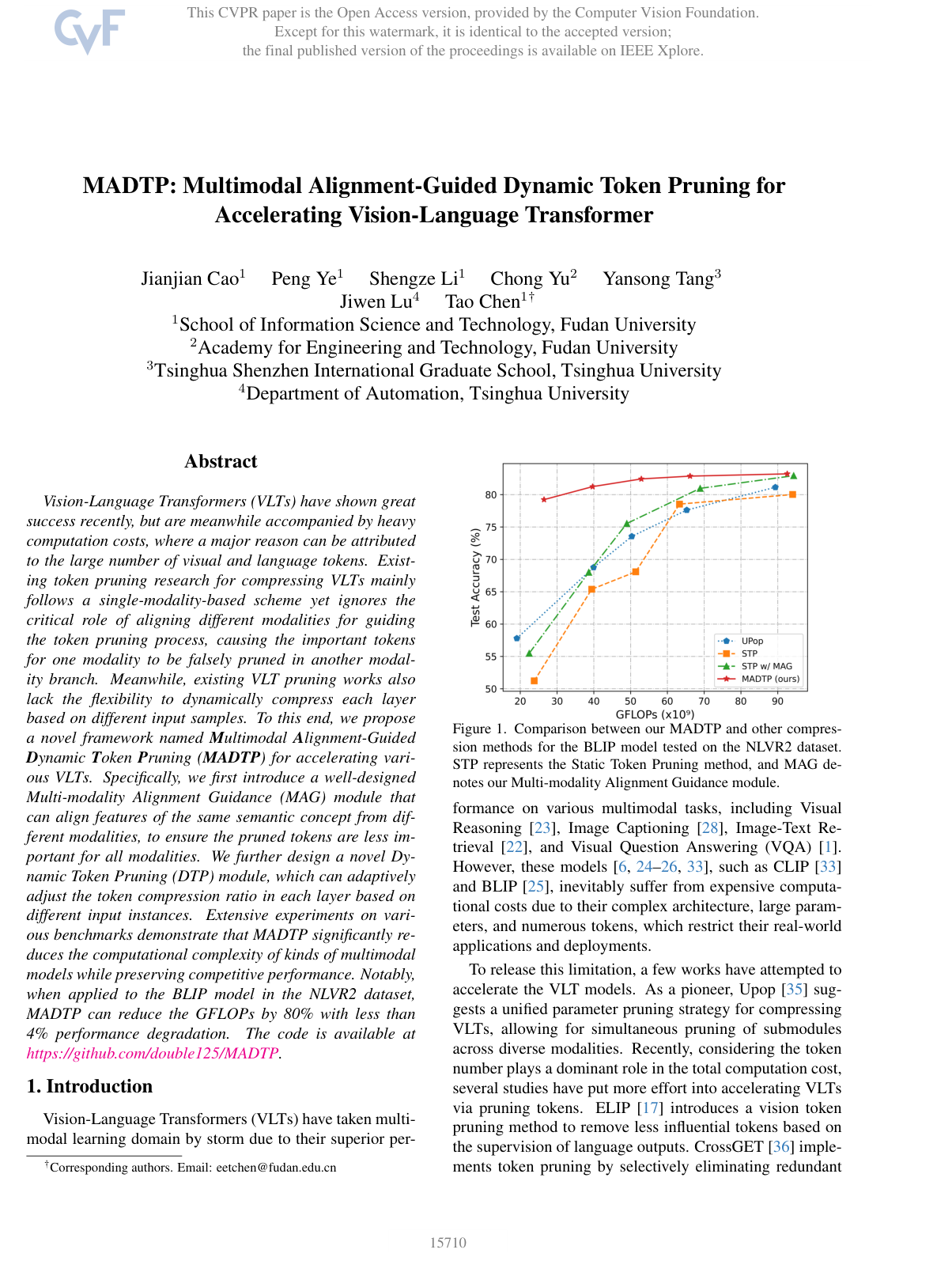
MADTP: Multimodal Alignment-Guided Dynamic Token Pruning for Accelerating Vision-Language Transformer
Jianjian Cao, Peng Ye, Shengze Li, Chong Yu, Yansong Tang, Jiwen Lu, Tao Chen
Why you should read this
Proposes a multimodal alignment-guided dynamic token pruning framework that cuts Vision-Language Transformer computation by up to 80% with minimal accuracy loss by aligning cross-modal representations to prevent false token removal and adaptively tuning layer-wise pruning ratios per input instance.
Vision-Language Transformers (VLTs) have shown great success recently, but are meanwhile accompanied by heavy computation costs, where a major reason can be attributed to the large number of visual and language tokens. Existing token pruning research for compressing VLTs mainly follows a single-modality-based scheme yet ignores the critical role of aligning different modalities for guiding the token pruning process, causing the important tokens for one modality to be falsely pruned in another modality branch. Meanwhile, existing VLT pruning works also lack the flexibility to dynamically compress each layer based on different input samples. To this end, we propose a novel framework named Multimodal Alignment-Guided Dynamic Token Pruning (MADTP) for accelerating various VLTs. Specifically, we first introduce a well-designed Multi-modality Alignment Guidance (MAG) module that can align features of the same semantic concept from different modalities, to ensure the pruned tokens are less important for all modalities. We further design a novel Dynamic Token Pruning (DTP) module, which can adaptively adjust the token compression ratio in each layer based on different input instances. Extensive experiments on various benchmarks demonstrate that MADTP significantly reduces the computational complexity of kinds of multimodal models while preserving competitive performance. Notably, when applied to the BLIP model in the NLVR2 dataset, MADTP can reduce the GFLOPs by 80% with less than 4% performance degradation. The code is available at https://github.com/double125/MADTP.
Added
2026-09-26
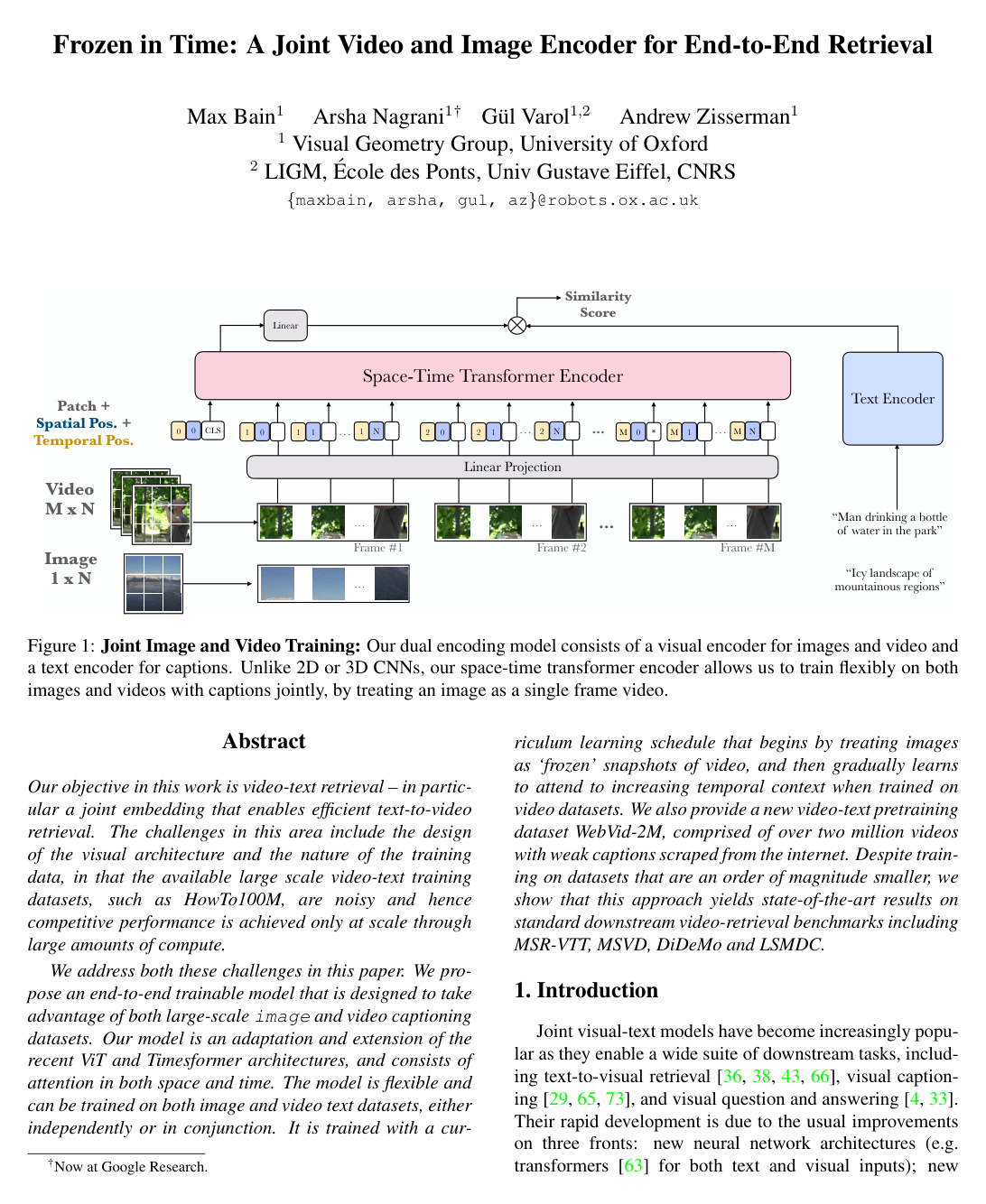
Frozen in Time: A Joint Video and Image Encoder for End-to-End Retrieval
Max Bain, Arsha Nagrani, Gül Varol, Andrew Zisserman
Why you should read this
Proposes an end-to-end spatiotemporal visual architecture trained jointly on static images and video captions alongside the WebVid-2M dataset, achieving state-of-the-art text-to-video retrieval performance with an order of magnitude less training data.
Our objective in this work is video-text retrieval - in particular a joint embedding that enables efficient text-to-video retrieval. The challenges in this area include the design of the visual architecture and the nature of the training data, in that the available large scale video-text training datasets, such as HowTo100M, are noisy and hence competitive performance is achieved only at scale through large amounts of compute. We address both these challenges in this paper. We propose an end-to-end trainable model that is designed to take advantage of both large-scale image and video captioning datasets. Our model is an adaptation and extension of the recent ViT and Timesformer architectures, and consists of attention in both space and time. The model is flexible and can be trained on both image and video text datasets, either independently or in conjunction. It is trained with a curriculum learning schedule that begins by treating images as 'frozen' snapshots of video, and then gradually learns to attend to increasing temporal context when trained on video datasets. We also provide a new video-text pretraining dataset WebVid-2M, comprised of over two million videos with weak captions scraped from the internet. Despite training on datasets that are an order of magnitude smaller, we show that this approach yields state-of-the-art results on standard downstream video-retrieval benchmarks including MSR-VTT, MSVD, DiDeMo and LSMDC.
Added
2026-09-24
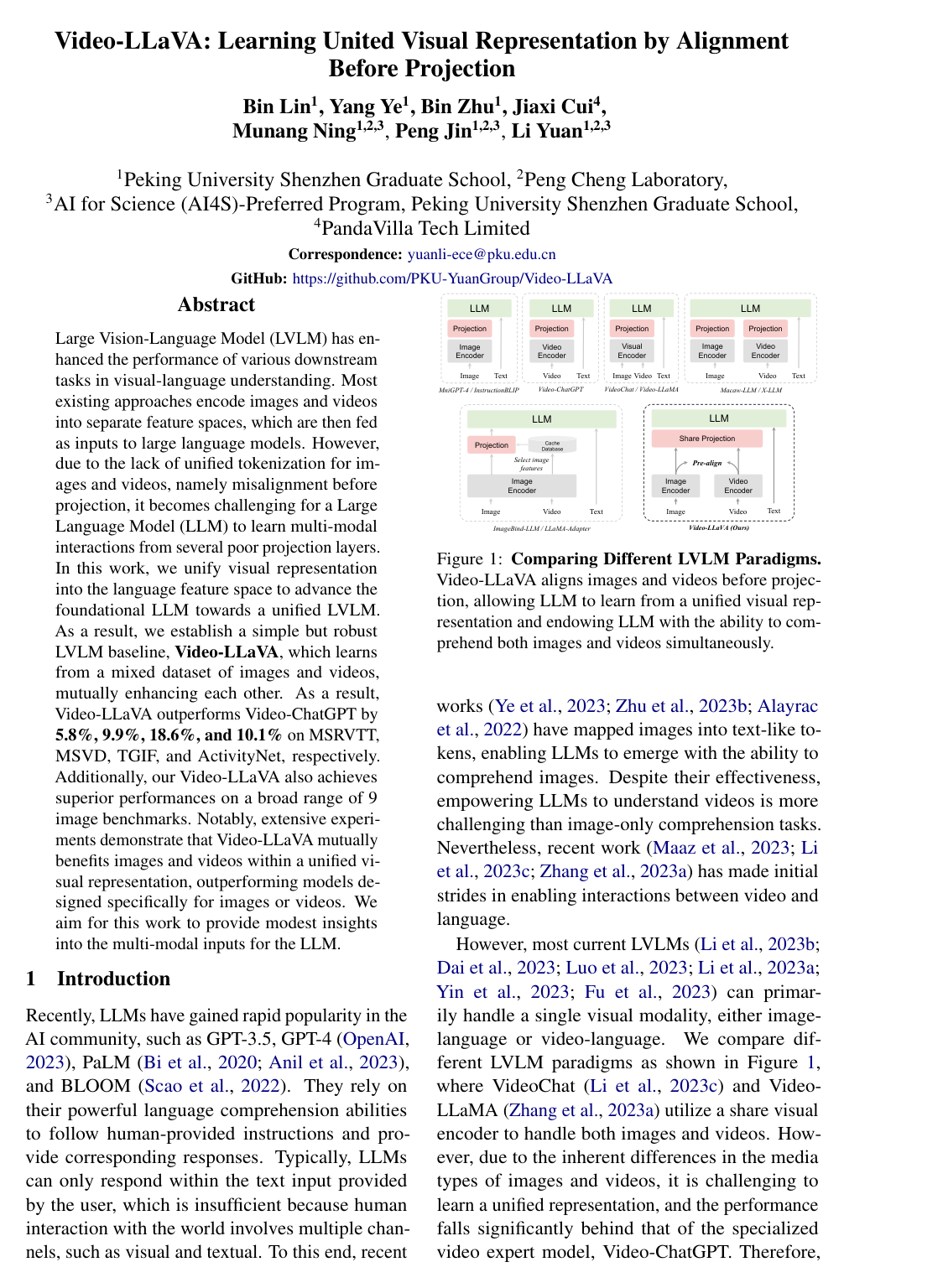
Video-LLaVA: Learning United Visual Representation by Alignment Before Projection
Bin Lin, Yang Ye, Bin Zhu, Jiaxi Cui, Munan Ning, Peng Jin, Li Yuan
Why you should read this
Introduces Video-LLaVA, a vision-language model that aligns image and video features into a single representation before projecting them to a large language model, demonstrating that joint multimodal training outperforms specialized single-modality systems across major image and video benchmarks.
The Large Vision-Language Model (LVLM) has enhanced the performance of various downstream tasks in visual-language understanding. Most existing approaches encode images and videos into separate feature spaces, which are then fed as inputs to large language models. However, due to the lack of unified tokenization for images and videos, namely misalignment before projection, it becomes challenging for a Large Language Model (LLM) to learn multi-modal interactions from several poor projection layers. In this work, we unify visual representation into the language feature space to advance the foundational LLM towards a unified LVLM. As a result, we establish a simple but robust LVLM baseline, Video-LLaVA, which learns from a mixed dataset of images and videos, mutually enhancing each other. Video-LLaVA achieves superior performances on a broad range of 9 image benchmarks across 5 image question-answering datasets and 4 image benchmark toolkits. Additionally, our Video-LLaVA also outperforms Video-ChatGPT by 5.8%, 9.9%, 18.6%, and 10.1% on MSRVTT, MSVD, TGIF, and ActivityNet, respectively. Notably, extensive experiments demonstrate that Video-LLaVA mutually benefits images and videos within a unified visual representation, outperforming models designed specifically for images or videos. We aim for this work to provide modest insights into the multi-modal inputs for the LLM. Code address: \href{this https URL}
Added
2026-09-24
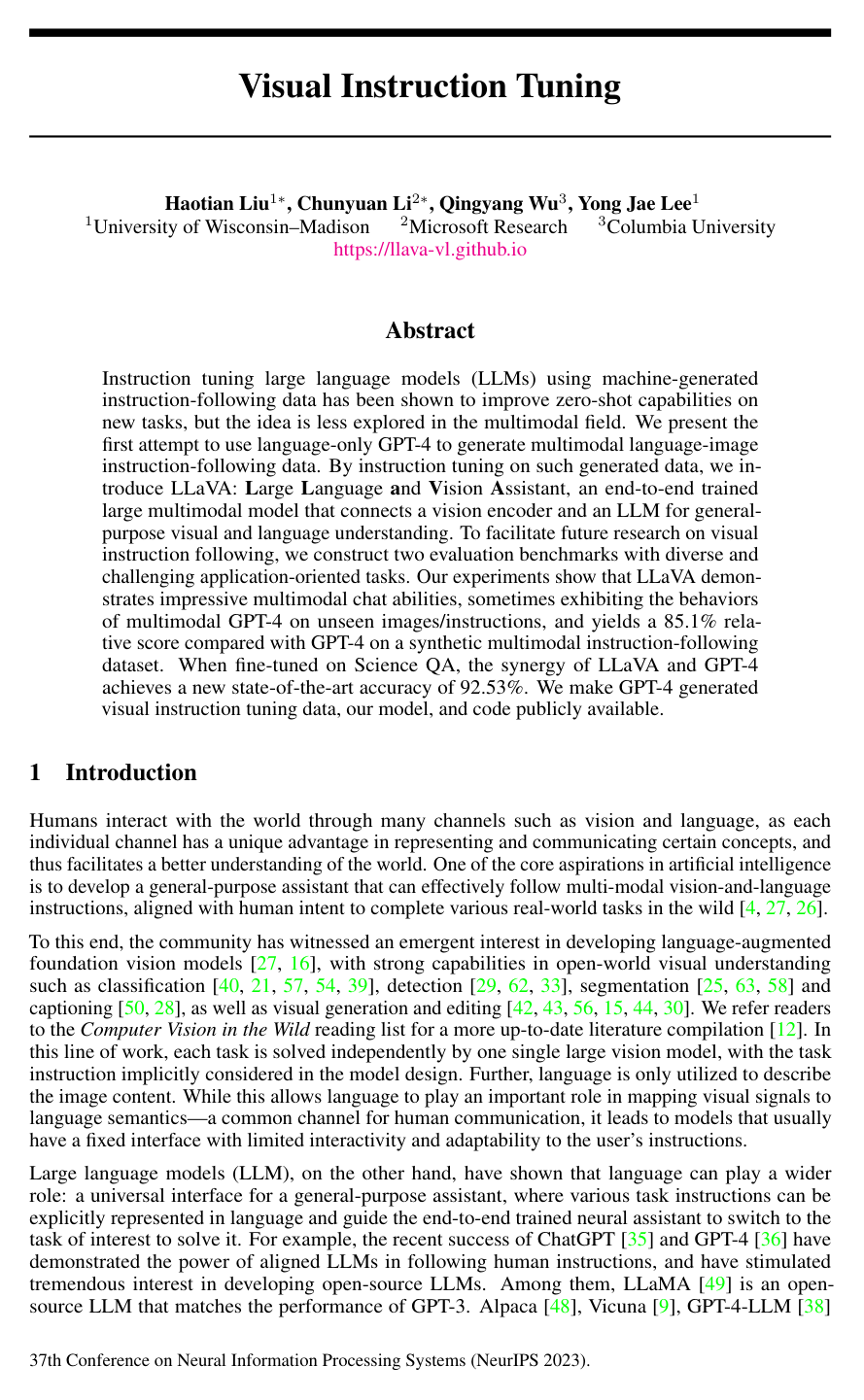
Visual Instruction Tuning
Haotian Liu, Chunyuan Li, Qingyang Wu, Yong Jae Lee
Why you should read this
Develops LLaVA, a pioneering large multimodal model, which achieves impressive visual-language chat capabilities and state-of-the-art accuracy by leveraging a novel method of generating multimodal instruction-following data from language-only GPT-4.
Instruction tuning large language models (LLMs) using machine-generated instruction-following data has improved zero-shot capabilities on new tasks, but the idea is less explored in the multimodal field. In this paper, we present the first attempt to use language-only GPT-4 to generate multimodal language-image instruction-following data. By instruction tuning on such generated data, we introduce LLaVA: Large Language and Vision Assistant, an end-to-end trained large multimodal model that connects a vision encoder and LLM for general-purpose visual and language this http URL early experiments show that LLaVA demonstrates impressive multimodel chat abilities, sometimes exhibiting the behaviors of multimodal GPT-4 on unseen images/instructions, and yields a 85.1% relative score compared with GPT-4 on a synthetic multimodal instruction-following dataset. When fine-tuned on Science QA, the synergy of LLaVA and GPT-4 achieves a new state-of-the-art accuracy of 92.53%. We make GPT-4 generated visual instruction tuning data, our model and code base publicly available.
Added
2026-01-28
