
keyword
video-text retrieval
Video-text retrieval is a multimodal artificial intelligence task that focuses on matching and retrieving relevant video content based on a natural language text query, or conversely, finding corresponding textual descriptions given a video query. It encompasses two main subtasks: text-to-video retrieval, where written descriptions search a repository to find the most semantically aligned video clips, and video-to-text retrieval, where a video is used to retrieve matching sentences, captions, or summaries. Contemporary methods typically leverage cross-modal foundation models and neural networks to project visual, temporal, and linguistic features into a shared embedding space, enabling the system to evaluate semantic similarity and efficiently rank corresponding cross-modal pairs.
5 items
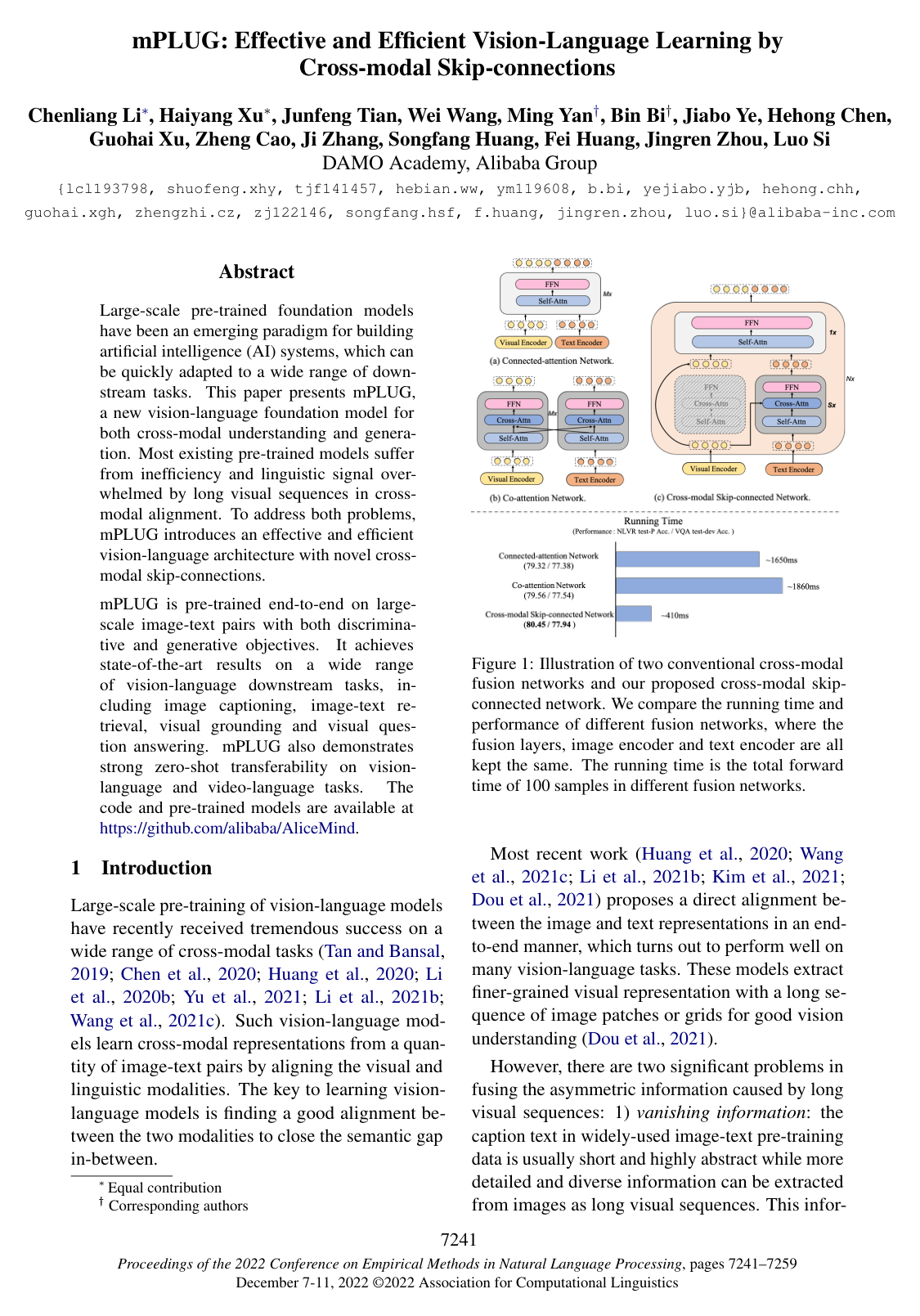
mPLUG: Effective and Efficient Vision-Language Learning by Cross-modal Skip-connections
Chenliang Li, Haiyang Xu, Junfeng Tian, Wei Wang, Ming Yan, Bin Bi, Jiabo Ye, He Chen, Guohai Xu, Zheng Cao, Ji Zhang, Songfang Huang, Fei Huang, Jingren Zhou, Luo Si
Why you should read this
Introduces a vision-language foundation model that uses cross-modal skip-connections to eliminate computational bottlenecks on long visual sequences and prevent image features from overwhelming linguistic signals during multi-modal fusion.
Large-scale pre-trained foundation models have been an emerging paradigm for building artificial intelligence (AI) systems, which can be quickly adapted to a wide range of downstream tasks. This paper presents mPLUG, a new vision-language foundation model for both cross-modal understanding and generation. Most existing pre-trained models suffer from inefficiency and linguistic signal overwhelmed by long visual sequences in cross-modal alignment. To address both problems, mPLUG introduces an effective and efficient vision-language architecture with novel cross-modal skip-connections. mPLUG is pre-trained end-to-end on large-scale image-text pairs with both discriminative and generative objectives. It achieves state-of-the-art results on a wide range of vision-language downstream tasks, including image captioning, image-text retrieval, visual grounding and visual question answering. mPLUG also demonstrates strong zero-shot transferability on vision-language and video-language tasks. The code and pre-trained models are available at https://github.com/alibaba/AliceMind.
Added
2026-09-28
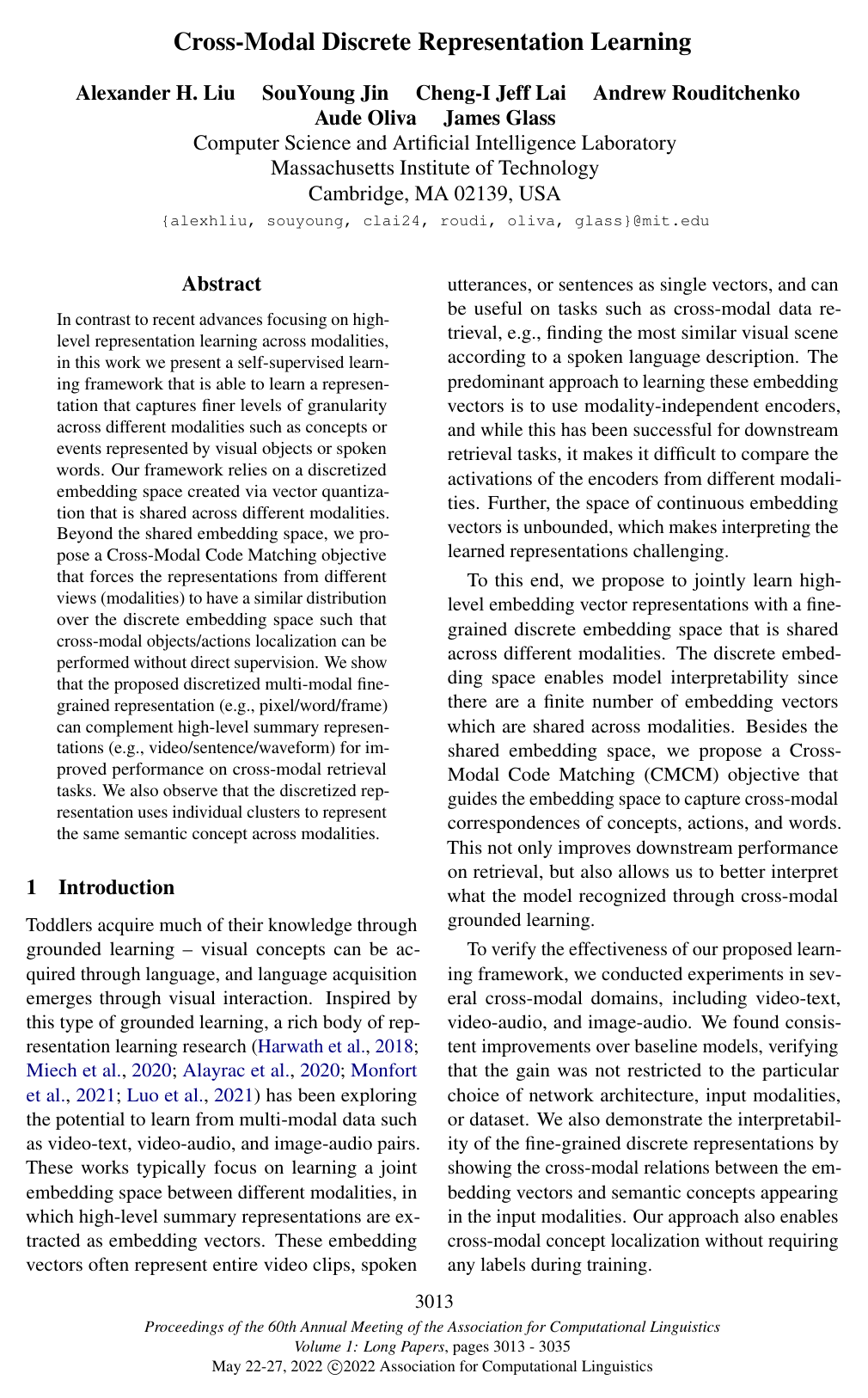
Cross-Modal Discrete Representation Learning
Alexander H. Liu, SouYoung Jin, Cheng-I Lai, Andrew Rouditchenko, Aude Oliva, James R. Glass
Why you should read this
Presents a self-supervised framework that uses vector quantization and code matching across modalities to learn fine-grained discrete representations, enabling unsupervised concept localization and boosting retrieval performance.
In contrast to recent advances focusing on high-level representation learning across modalities, in this work we present a self-supervised learning framework that is able to learn a representation that captures finer levels of granularity across different modalities such as concepts or events represented by visual objects or spoken words. Our framework relies on a discretized embedding space created via vector quantization that is shared across different modalities. Beyond the shared embedding space, we propose a Cross-Modal Code Matching objective that forces the representations from different views (modalities) to have a similar distribution over the discrete embedding space such that cross-modal objects/actions localization can be performed without direct supervision. We show that the proposed discretized multi-modal fine-grained representation (e.g., pixel/word/frame) can complement high-level summary representations (e.g., video/sentence/waveform) for improved performance on cross-modal retrieval tasks. We also observe that the discretized representation uses individual clusters to represent the same semantic concept across modalities.
Added
2026-09-26
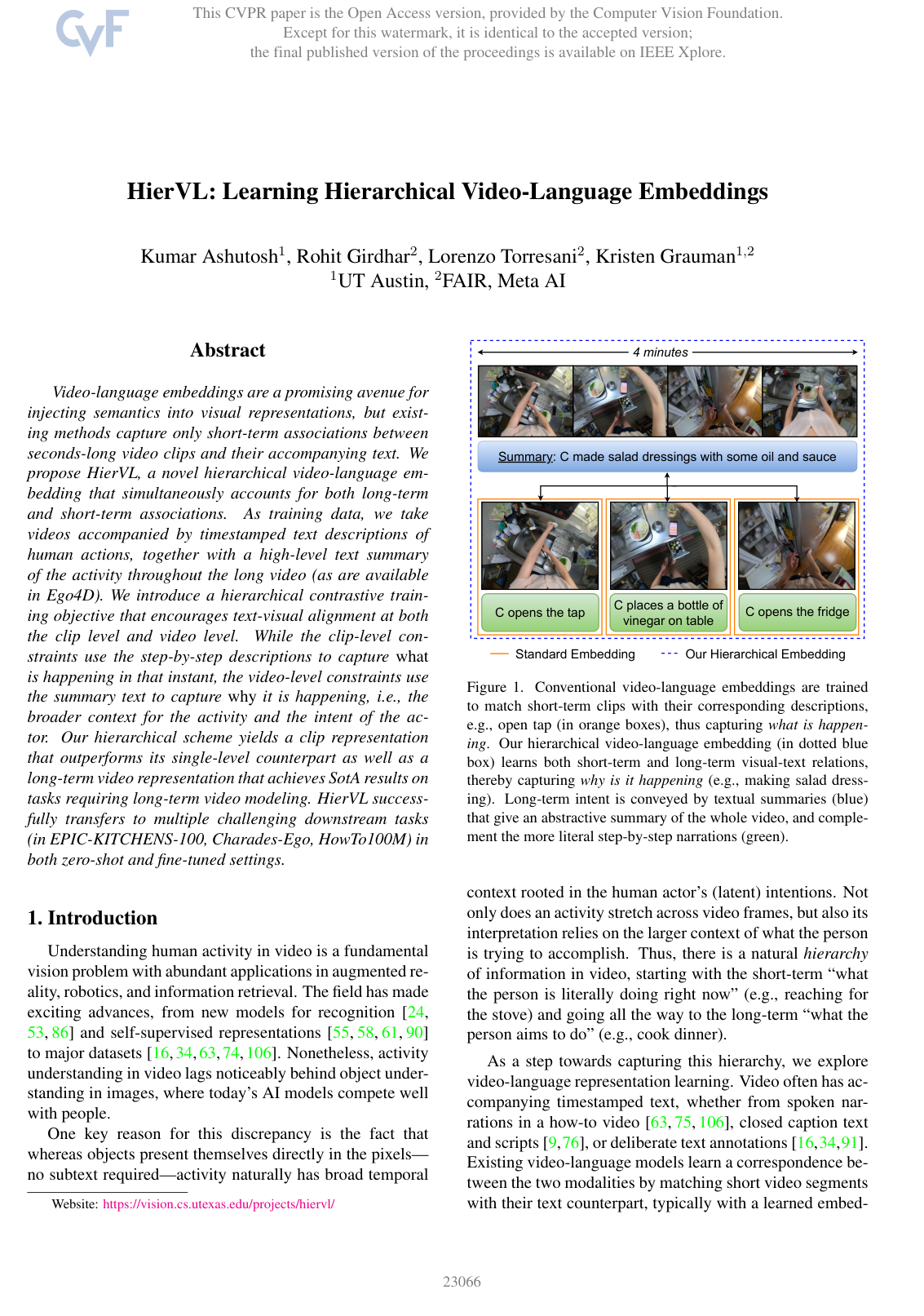
HierVL: Learning Hierarchical Video-Language Embeddings
Kumar Ashutosh, Rohit Girdhar, Lorenzo Torresani, Kristen Grauman
Why you should read this
Proposes a hierarchical video-language framework that jointly aligns short-term action clips with step-by-step descriptions and aggregated video features with abstract summaries to capture both immediate actions and long-term actor intent.
Video-language embeddings are a promising avenue for injecting semantics into visual representations, but existing methods capture only short-term associations between seconds-long video clips and their accompanying text. We propose HierVL, a novel hierarchical video-language embedding that simultaneously accounts for both long-term and short-term associations. As training data, we take videos accompanied by timestamped text descriptions of human actions, together with a high-level text summary of the activity throughout the long video (as are available in Ego4D). We introduce a hierarchical contrastive training objective that encourages text-visual alignment at both the clip level and video level. While the clip-level constraints use the step-by-step descriptions to capture what is happening in that instant, the video-level constraints use the summary text to capture why it is happening, i.e., the broader context for the activity and the intent of the actor. Our hierarchical scheme yields a clip representation that outperforms its single-level counterpart as well as a long-term video representation that achieves SotA results on tasks requiring long-term video modeling. HierVL successfully transfers to multiple challenging downstream tasks (in EPIC-KITCHENS-100, Charades-Ego, HowTo100M) in both zero-shot and fine-tuned settings.
Added
2026-09-26
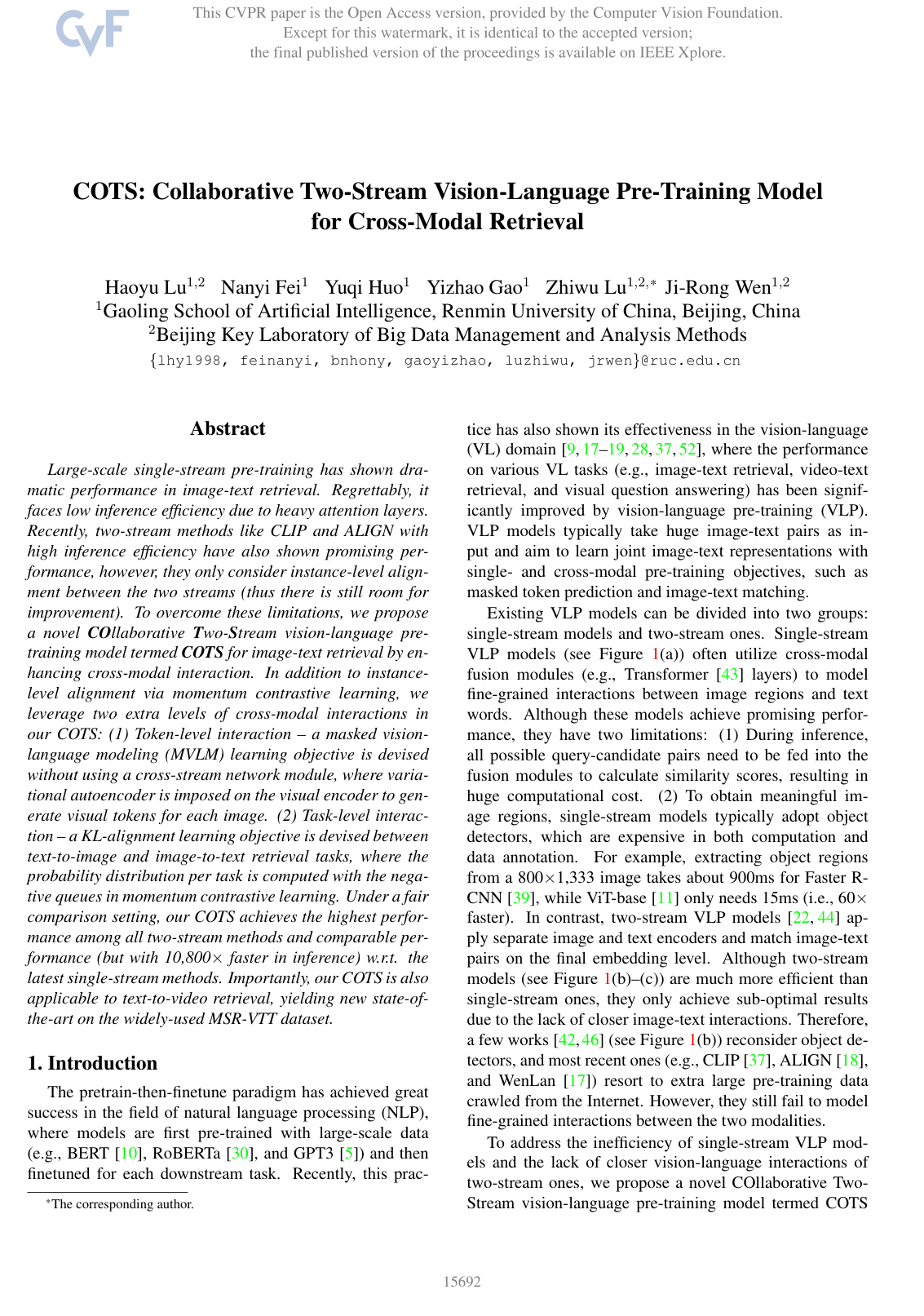
COTS: Collaborative Two-Stream Vision-Language Pre-Training Model for Cross-Modal Retrieval
Haoyu Lu, Nanyi Fei, Yuqi Huo, Yizhao Gao, Zhiwu Lu, Ji-Rong Wen
Why you should read this
Proposes a collaborative two-stream vision-language pre-training framework that integrates instance, token, and task-level interactions with an adaptive momentum filter, achieving single-stream retrieval accuracy while maintaining over 10,000 times faster inference speed.
Large-scale single-stream pre-training has shown dramatic performance in image-text retrieval. Regrettably, it faces low inference efficiency due to heavy attention layers. Recently, two-stream methods like CLIP and ALIGN with high inference efficiency have also shown promising performance, however, they only consider instance-level alignment between the two streams (thus there is still room for improvement). To overcome these limitations, we propose a novel COllaborative Two-Stream vision-language pre-training model termed COTS for image-text retrieval by enhancing cross-modal interaction. In addition to instance-level alignment via momentum contrastive learning, we leverage two extra levels of cross-modal interactions in our COTS: (1) Token-level interaction - a masked vision-language modeling (MVLM) learning objective is devised without using a cross-stream network module, where variational autoencoder is imposed on the visual encoder to generate visual tokens for each image. (2) Task-level interaction - a KL-alignment learning objective is devised between text-to-image and image-to-text retrieval tasks, where the probability distribution per task is computed with the negative queues in momentum contrastive learning. Under a fair comparison setting, our COTS achieves the highest performance among all two-stream methods and comparable performance (but with 10,800× faster in inference) w.r.t. the latest single-stream methods. Importantly, our COTS is also applicable to text-to-video retrieval, yielding new state-of-the-art on the widely-used MSR-VTT dataset.
Added
2026-09-26
CoCa: Contrastive Captioners are Image-Text Foundation Models
Jiahui Yu, Zirui Wang, Vijay K. Vasudevan, Legg Yeung, Mojtaba Seyedhosseini, Yonghui Wu
Why you should read this
Unifies the two primary training objectives—contrastive learning and generative captioning—into a single foundation model architecture.
Exploring large-scale pretrained foundation models is of significant interest in computer vision because these models can be quickly transferred to many downstream tasks. This paper presents Contrastive Captioner (CoCa), a minimalist design to pretrain an image-text encoder-decoder foundation model jointly with contrastive loss and captioning loss, thereby subsuming model capabilities from contrastive approaches like CLIP and generative methods like SimVLM. In contrast to standard encoder-decoder transformers where all decoder layers attend to encoder outputs, CoCa omits cross-attention in the first half of decoder layers to encode unimodal text representations, and cascades the remaining decoder layers which cross-attend to the image encoder for multimodal image-text representations. We apply a contrastive loss between unimodal image and text embeddings, in addition to a captioning loss on the multimodal decoder outputs which predicts text tokens autoregressively. By sharing the same computational graph, the two training objectives are computed efficiently with minimal overhead. CoCa is pretrained end-to-end and from scratch on both web-scale alt-text data and annotated images by treating all labels simply as text, seamlessly unifying natural language supervision for representation learning. Empirically, CoCa achieves state-of-the-art performance with zero-shot transfer or minimal task-specific adaptation on a broad range of downstream tasks, spanning visual recognition (ImageNet, Kinetics-400/600/700, Moments-in-Time), crossmodal retrieval (MSCOCO, Flickr30K, MSR-VTT), multimodal understanding (VQA, SNLI-VE, NLVR2), and image captioning (MSCOCO, NoCaps). Notably on ImageNet classification, CoCa obtains 86.3% zero-shot top-1 accuracy, 90.6% with a frozen encoder and learned classification head, and new state-of-the-art 91.0% top-1 accuracy on ImageNet with a finetuned encoder.
Added
2026-01-28