
keyword
video synthesis
Video synthesis is the automated generation of digital video sequences using machine learning and deep generative models. Unlike static image generation, video synthesis requires modeling both spatial features within individual frames and complex temporal dynamics across consecutive frames to ensure motion smoothness, temporal consistency, and visual fidelity over time. These generative frameworks can create entirely novel footage or transform existing visual data based on diverse conditioning inputs, including textual descriptions, reference images, audio signals, semantic layouts, and motion trajectories. Built primarily on architectures such as diffusion models, transformers, and generative adversarial networks, video synthesis enables a broad spectrum of applications, ranging from text-to-video and image-to-video generation to video editing, motion control, and interactive simulation.
20 items
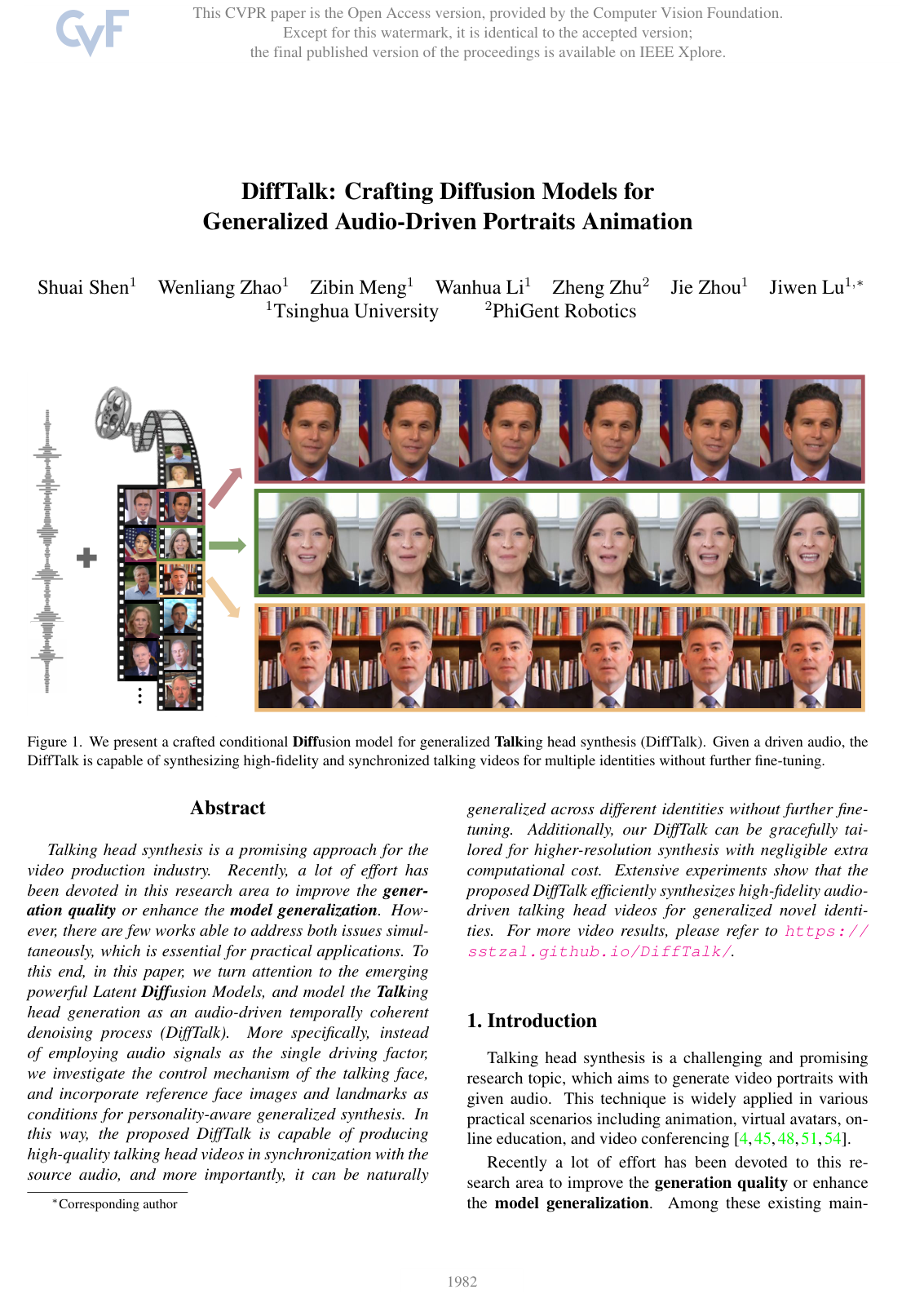
DiffTalk: Crafting Diffusion Models for Generalized Audio-Driven Portraits Animation
Shuai Shen, Wenliang Zhao, Zibin Meng, Wanhua Li, Zheng Zhu, Jie Zhou, Jiwen Lu
Why you should read this
Proposes a latent diffusion framework that combines audio signals, reference facial images, and landmarks to synthesize high-resolution talking head videos across unseen identities without fine-tuning.
Talking head synthesis is a promising approach for the video production industry. Recently, a lot of effort has been devoted in this research area to improve the generation quality or enhance the model generalization. However, there are few works able to address both issues simultaneously, which is essential for practical applications. To this end, in this paper, we turn attention to the emerging powerful Latent Diffusion Models, and model the Talking head generation as an audio-driven temporally coherent denoising process (DiffTalk). More specifically, instead of employing audio signals as the single driving factor, we investigate the control mechanism of the talking face, and incorporate reference face images and landmarks as conditions for personality-aware generalized synthesis. In this way, the proposed DiffTalk is capable of producing high-quality talking head videos in synchronization with the source audio, and more importantly, it can be naturally generalized across different identities without further fine-tuning. Additionally, our DiffTalk can be gracefully tailored for higher-resolution synthesis with negligible extra computational cost. Extensive experiments show that the proposed DiffTalk efficiently synthesizes high-fidelity audio-driven talking head videos for generalized novel identities. For more video results, please refer to https://sstzal.github.io/DiffTalk/.
Added
2026-10-05
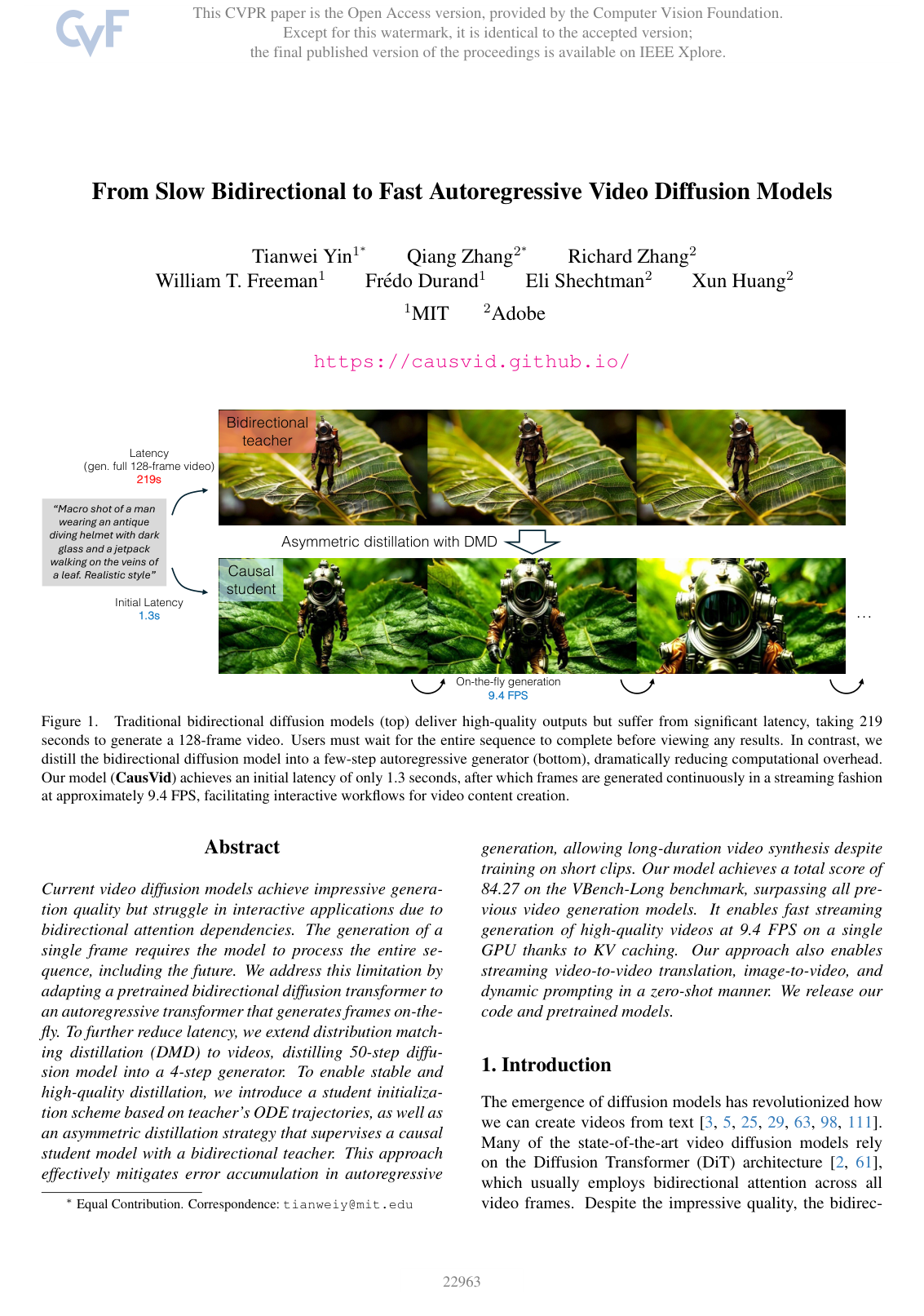
From Slow Bidirectional to Fast Autoregressive Video Diffusion Models
Tianwei Yin, Qiang Zhang, Richard Zhang, William T. Freeman, Frdo Durand, Eli Shechtman, Xun Huang
Why you should read this
Presents CausVid, a framework that distills bidirectional video diffusion transformers into a four-step causal autoregressive generator via asymmetric distribution matching distillation, enabling interactive streaming video synthesis at 9.4 frames per second on a single GPU.
Current video diffusion models achieve impressive generation quality but struggle in interactive applications due to bidirectional attention dependencies. The generation of a single frame requires the model to process the entire sequence, including the future. We address this limitation by adapting a pretrained bidirectional diffusion transformer to an autoregressive transformer that generates frames on-the-fly. To further reduce latency, we extend distribution matching distillation (DMD) to videos, distilling 50-step diffusion model into a 4-step generator. To enable stable and high-quality distillation, we introduce a student initialization scheme based on teacher's ODE trajectories, as well as an asymmetric distillation strategy that supervises a causal student model with a bidirectional teacher. This approach effectively mitigates error accumulation in autoregressive generation, allowing long-duration video synthesis despite training on short clips. Our model achieves a total score of 84.27 on the VBench-Long benchmark, surpassing all previous video generation models. It enables fast streaming generation of high-quality videos at 9.4 FPS on a single GPU thanks to KV caching. Our approach also enables streaming video-to-video translation, image-to-video, and dynamic prompting in a zero-shot manner. We release our code and pretrained models.
Added
2026-10-05
Video Probabilistic Diffusion Models in Projected Latent Space
Sihyun Yu, Kihyuk Sohn, Subin Kim, Jinwoo Shin
Why you should read this
Proposes a projected latent video diffusion model that factorizes 3D video data into efficient 2D latent representations, enabling resource-friendly training and generation of high-resolution, arbitrary-length videos while substantially improving state-of-the-art synthesis quality on UCF-101.
Despite the remarkable progress in deep generative models, synthesizing high-resolution and temporally coherent videos still remains a challenge due to their high-dimensionality and complex temporal dynamics along with large spatial variations. Recent works on diffusion models have shown their potential to solve this challenge, yet they suffer from severe computation- and memory-inefficiency that limit the scalability. To handle this issue, we propose a novel generative model for videos, coined projected latent video diffusion model (PVDM), a probabilistic diffusion model which learns a video distribution in a low-dimensional latent space and thus can be efficiently trained with high-resolution videos under limited resources. Specifically, PVDM is composed of two components: (a) an autoencoder that projects a given video as 2D-shaped latent vectors that factorize the complex cubic structure of video pixels and (b) a diffusion model architecture specialized for our new factorized latent space and the training/sampling procedure to synthesize videos of arbitrary length with a single model. Experiments on popular video generation datasets demonstrate the superiority of PVDM compared with previous video synthesis methods; e.g., PVDM obtains the FVD score of 639.7 on the UCF-101 long video (128 frames) generation benchmark, which improves 1773.4 of the prior state-of-the-art.
Added
2026-10-05
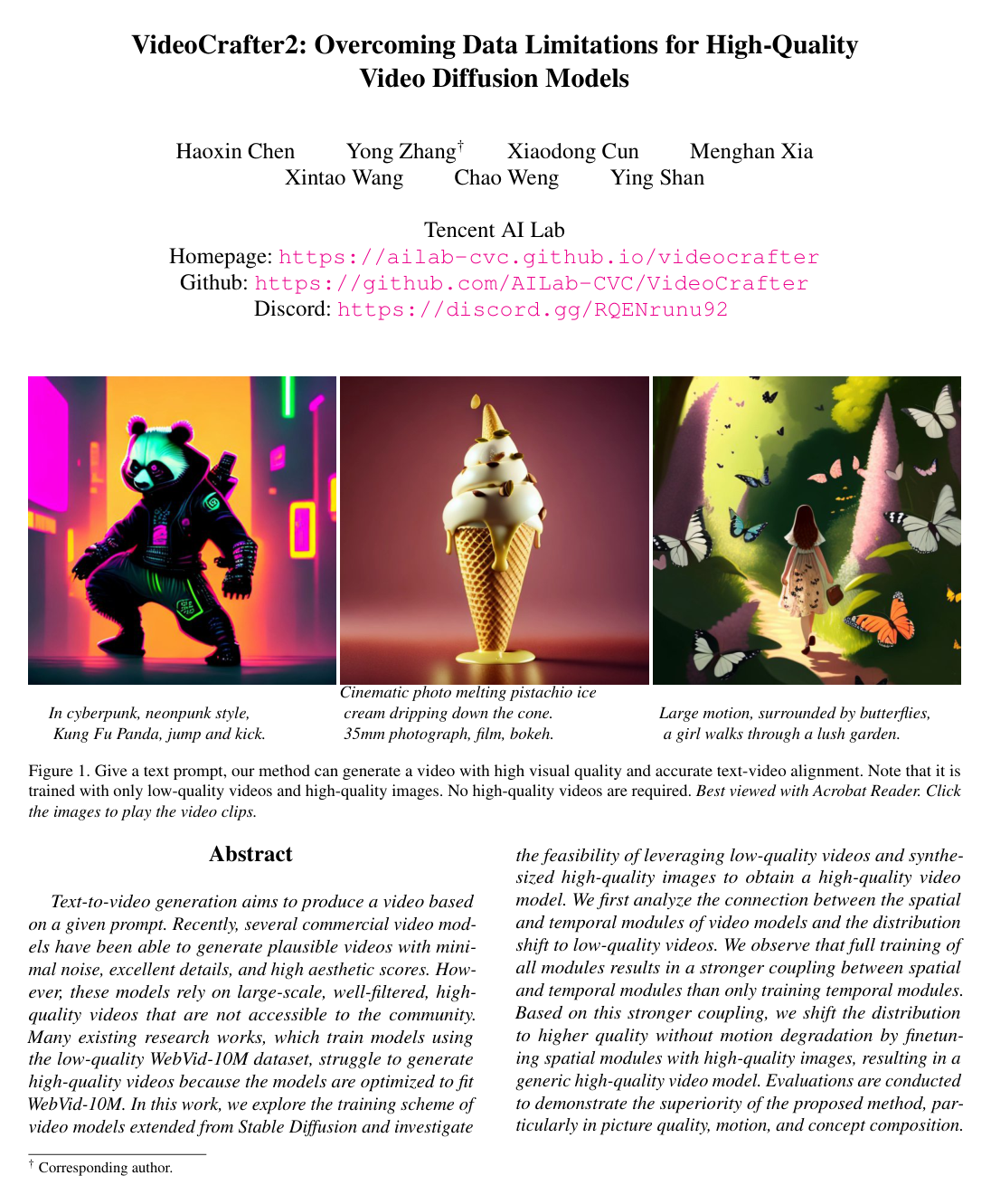
VideoCrafter2: Overcoming Data Limitations for High-Quality Video Diffusion Models
Haoxin Chen, Yong Zhang, Xiaodong Cun, Menghan Xia, Xintao Wang, Chao Weng, Ying Shan
Why you should read this
Presents a training strategy that enables text-to-video diffusion models to overcome low-quality video datasets by finetuning spatial modules with high-quality images without sacrificing motion dynamics.
Text-to-video generation aims to produce a video based on a given prompt. Recently, several commercial video models have been able to generate plausible videos with minimal noise, excellent details, and high aesthetic scores. However, these models rely on large-scale, well-filtered, high-quality videos that are not accessible to the community. Many existing research works, which train models using the low-quality WebVid-10M dataset, struggle to generate high-quality videos because the models are optimized to fit WebVid-10M. In this work, we explore the training scheme of video models extended from Stable Diffusion and investigate the feasibility of leveraging low-quality videos and synthesized high-quality images to obtain a high-quality video model. We first analyze the connection between the spatial and temporal modules of video models and the distribution shift to low-quality videos. We observe that full training of all modules results in a stronger coupling between spatial and temporal modules than only training temporal modules. Based on this stronger coupling, we shift the distribution to higher quality without motion degradation by finetuning spatial modules with high-quality images, resulting in a generic high-quality video model. Evaluations are conducted to demonstrate the superiority of the proposed method, particularly in picture quality, motion, and concept composition.
Added
2026-10-05
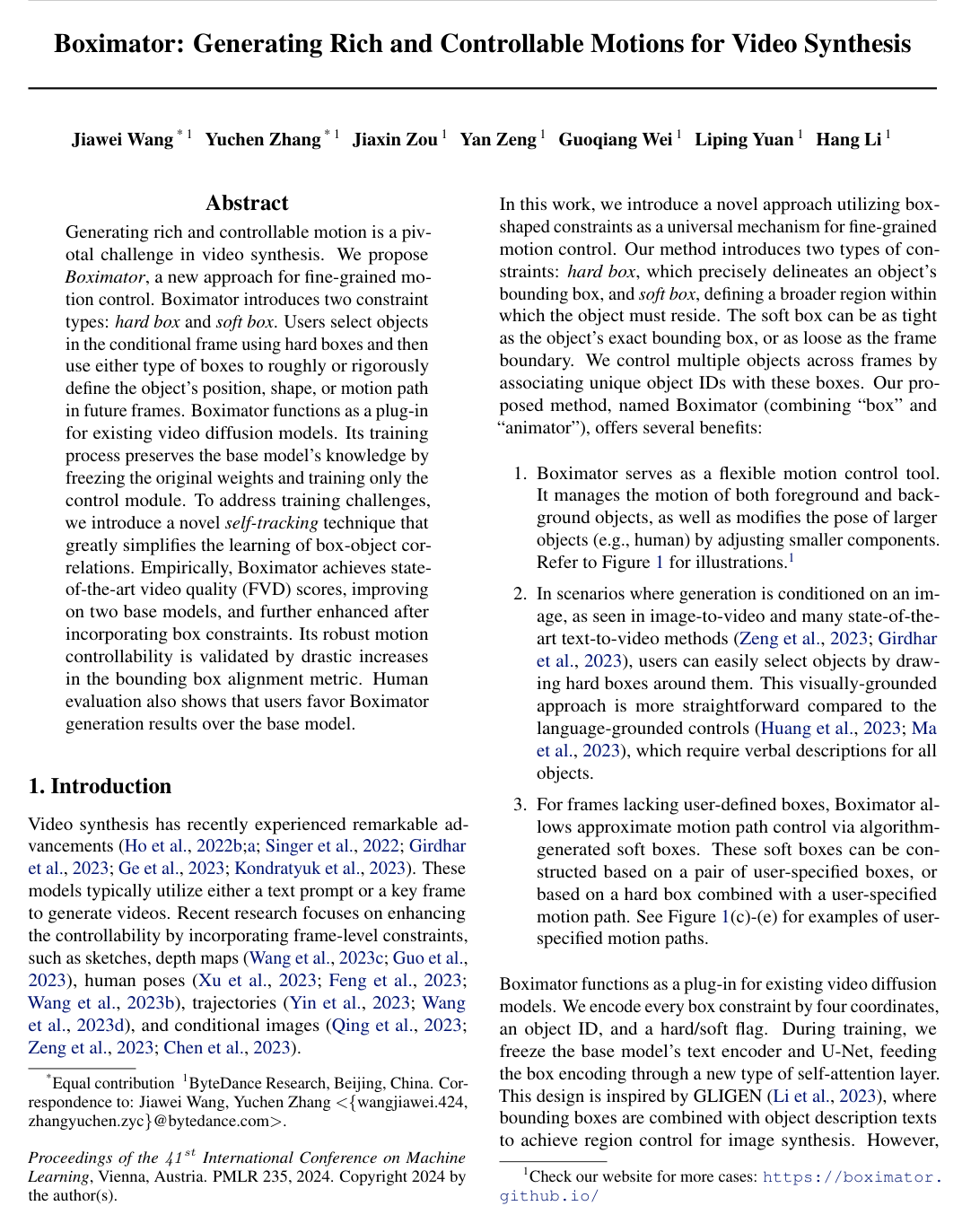
Boximator: Generating Rich and Controllable Motions for Video Synthesis
Jiawei Wang, Yuchen Zhang, Jiaxin Zou, Yan Zeng, Guoqiang Wei, Liping Yuan, Hang Li
Why you should read this
Proposes Boximator, a plug-in for video diffusion models that enables precise, visual motion control across frames using flexible bounding-box constraints and a novel self-tracking training technique.
Generating rich and controllable motion is a pivotal challenge in video synthesis. We propose Boximator, a new approach for fine-grained motion control. Boximator introduces two constraint types: hard box and soft box. Users select objects in the conditional frame using hard boxes and then use either type of boxes to roughly or rigorously define the object’s position, shape, or motion path in future frames. Boximator functions as a plug-in for existing video diffusion models. Its training process preserves the base model’s knowledge by freezing the original weights and training only the control module. To address training challenges, we introduce a novel self-tracking technique that greatly simplifies the learning of box-object correlations. Empirically, Boximator achieves state-of-the-art video quality (FVD) scores, improving on two base models, and further enhanced after incorporating box constraints. Its robust motion controllability is validated by drastic increases in the bounding box alignment metric. Human evaluation also shows that users favor Boximator generation results over the base model.
Added
2026-10-02
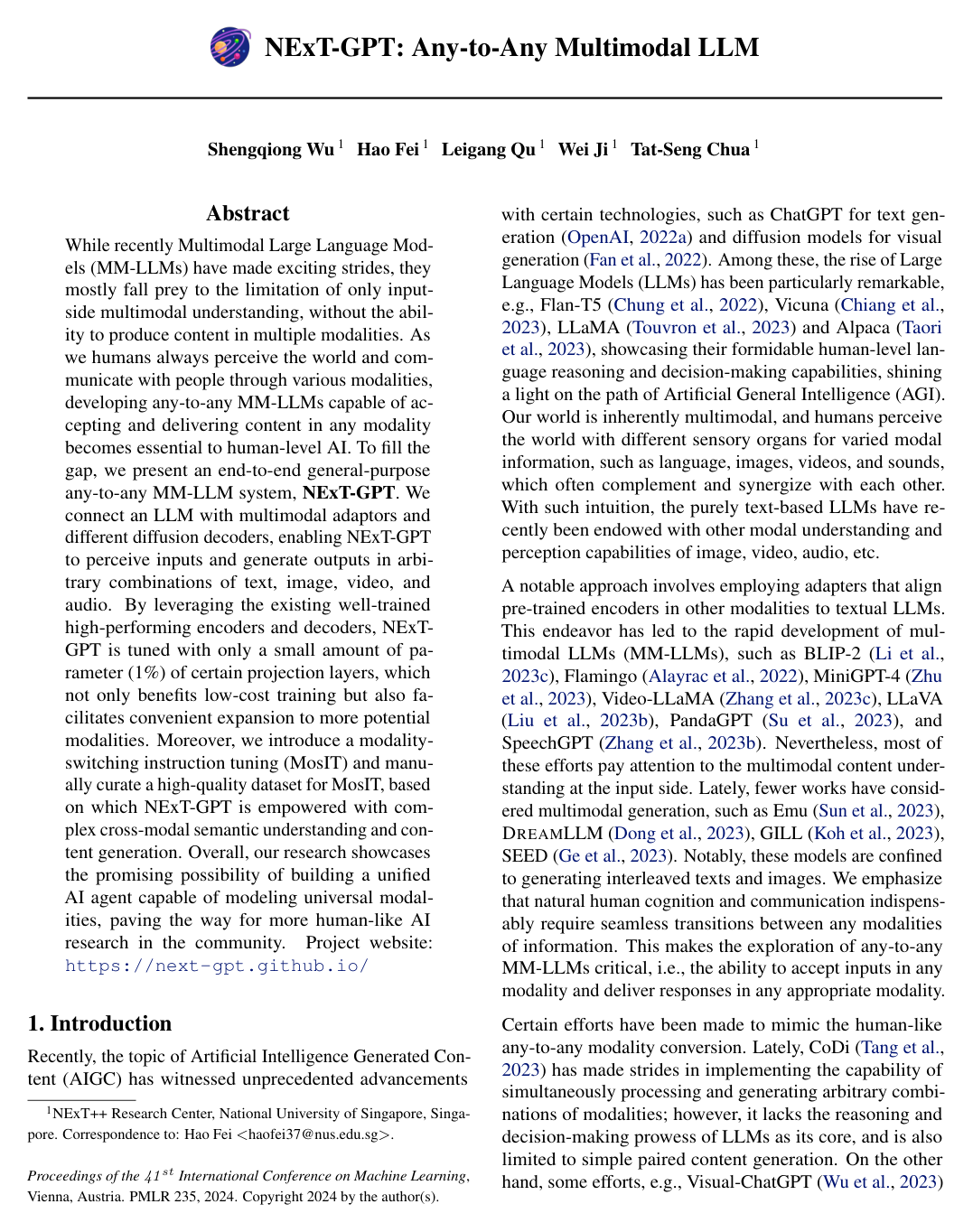
NExT-GPT: Any-to-Any Multimodal LLM
Shengqiong Wu, Hao Fei, Leigang Qu, Wei Ji, Tat-Seng Chua
Why you should read this
Presents an end-to-end multimodal language model that accepts and generates arbitrary combinations of text, image, video, and audio by tuning just one percent of projection parameters between an existing core model and specialized diffusion decoders.
While recently Multimodal Large Language Models (MM-LLMs) have made exciting strides, they mostly fall prey to the limitation of only input-side multimodal understanding, without the ability to produce content in multiple modalities. As we humans always perceive the world and communicate with people through various modalities, developing any-to-any MM-LLMs capable of accepting and delivering content in any modality becomes essential to human-level AI. To fill the gap, we present an end-to-end general-purpose any-to-any MM-LLM system, NExT-GPT. We connect an LLM with multimodal adaptors and different diffusion decoders, enabling NExT-GPT to perceive inputs and generate outputs in arbitrary combinations of text, image, video, and audio. By leveraging the existing well-trained high-performing encoders and decoders, NExT-GPT is tuned with only a small amount of parameter (1%) of certain projection layers, which not only benefits low-cost training but also facilitates convenient expansion to more potential modalities. Moreover, we introduce a modality-switching instruction tuning (MosIT) and manually curate a high-quality dataset for MosIT, based on which NExT-GPT is empowered with complex cross-modal semantic understanding and content generation. Overall, our research showcases the promising possibilities of building a unified AI agent capable of modeling universal modalities, paving the way for more human-like AI research in the community. Project website: https://next-gpt.github.io/
Added
2026-09-28
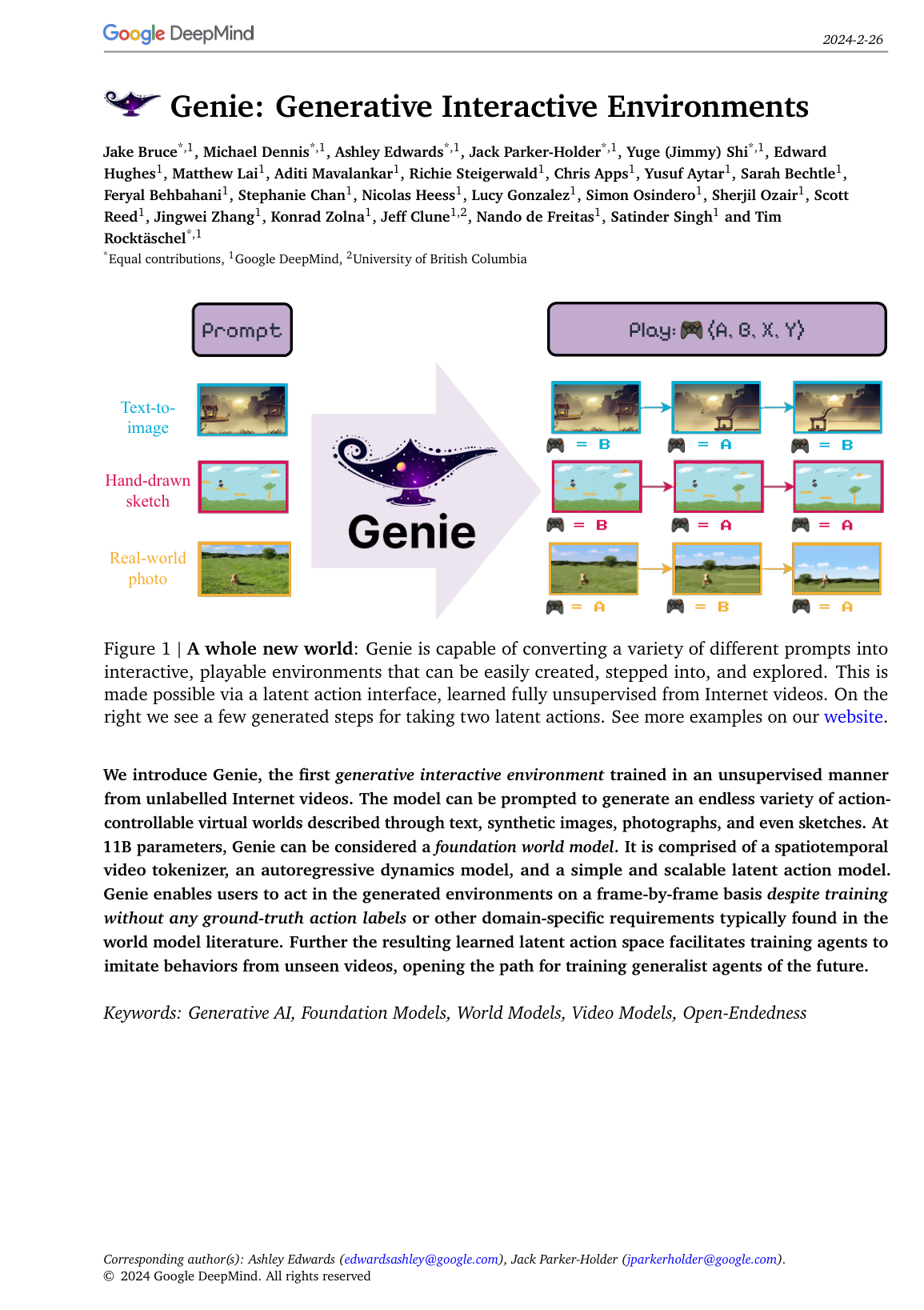
Genie: Generative Interactive Environments
Jake Bruce, Michael D. Dennis, Ashley Edwards, Jack Parker-Holder, Yuge Shi, Edward Hughes, Matthew Lai, Aditi Mavalankar, Richie Steigerwald, Chris Apps, Yusuf Aytar, Sarah Bechtle, Feryal M. P. Behbahani, Stephanie C. Y. Chan, Nicolas Heess, Lucy Gonzalez, Simon Osindero, Sherjil Ozair, Scott E. Reed, Jingwei Zhang, Konrad Zolna, Jeff Clune, Nando de Freitas, Satinder Singh, Tim Rocktäschel
Why you should read this
Presents Genie, an 11-billion-parameter foundation world model that learns controllable interactive environments and latent actions directly from unlabeled internet video, enabling users to generate and play virtual worlds from prompts as simple as a single image or sketch.
We introduce Genie, the first generative interactive environment trained in an unsupervised manner from unlabelled Internet videos. The model can be prompted to generate an endless variety of action-controllable virtual worlds described through text, synthetic images, photographs, and even sketches. At 11B parameters, Genie can be considered a foundation world model. It is comprised of a spatiotemporal video tokenizer, an autoregressive dynamics model, and a simple and scalable latent action model. Genie enables users to act in the generated environments on a frame-by-frame basis despite training without any ground-truth action labels or other domain-specific requirements typically found in the world model literature. Further the resulting learned latent action space facilitates training agents to imitate behaviors from unseen videos, opening the path for training generalist agents of the future.
Added
2026-09-28
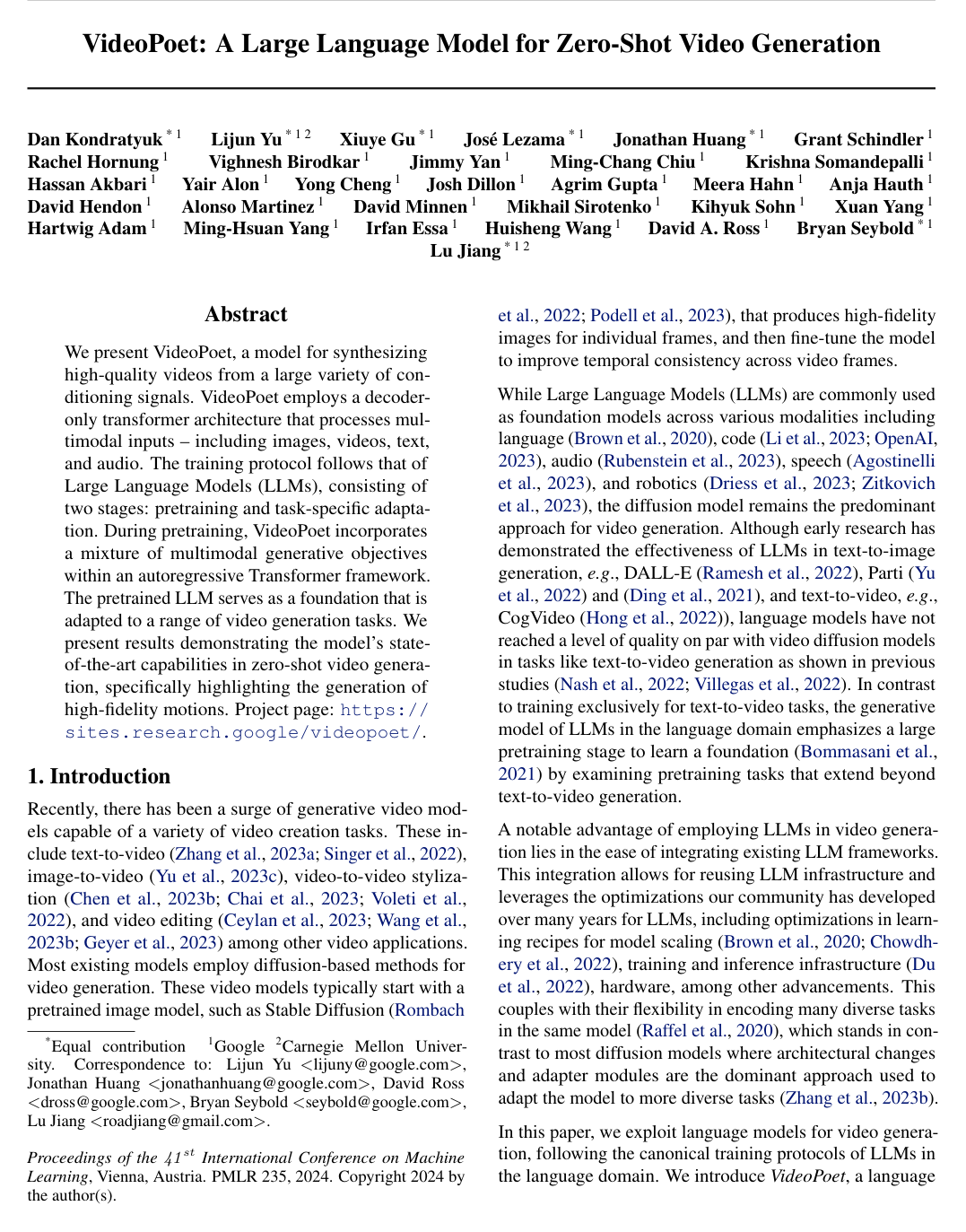
VideoPoet: A Large Language Model for Zero-Shot Video Generation
Dan Kondratyuk, Lijun Yu, Xiuye Gu, José Lezama, Jonathan Huang, Grant Schindler, Rachel Hornung, Vighnesh Birodkar, Jimmy Yan, Ming-Chang Chiu, Krishna Somandepalli, Hassan Akbari, Yair Alon, Yong Cheng, Joshua V. Dillon, Agrim Gupta, Meera Hahn, Anja Hauth, David Hendon, Alonso Martinez, David Minnen, Mikhail Sirotenko, Kihyuk Sohn, Xuan Yang, Hartwig Adam, Ming-Hsuan Yang, Irfan Essa, Huisheng Wang, David A. Ross, Bryan Seybold, Lu Jiang
Why you should read this
Demonstrates that a unified decoder-only language model trained on discrete multimodal tokens can match or outperform diffusion approaches across diverse video generation and editing tasks without task-specific architectural changes.
We present VideoPoet, a model for synthesizing high-quality videos from a large variety of conditioning signals. VideoPoet employs a decoder-only transformer architecture that processes multimodal inputs – including images, videos, text, and audio. The training protocol follows that of Large Language Models (LLMs), consisting of two stages: pretraining and task-specific adaptation. During pretraining, VideoPoet incorporates a mixture of multimodal generative objectives within an autoregressive Transformer framework. The pretrained LLM serves as a foundation that is adapted to a range of video generation tasks. We present results demonstrating the model’s state-of-the-art capabilities in zero-shot video generation, specifically highlighting the generation of high-fidelity motions. Project page: https://sites.research.google/videopoet/.
Added
2026-09-28
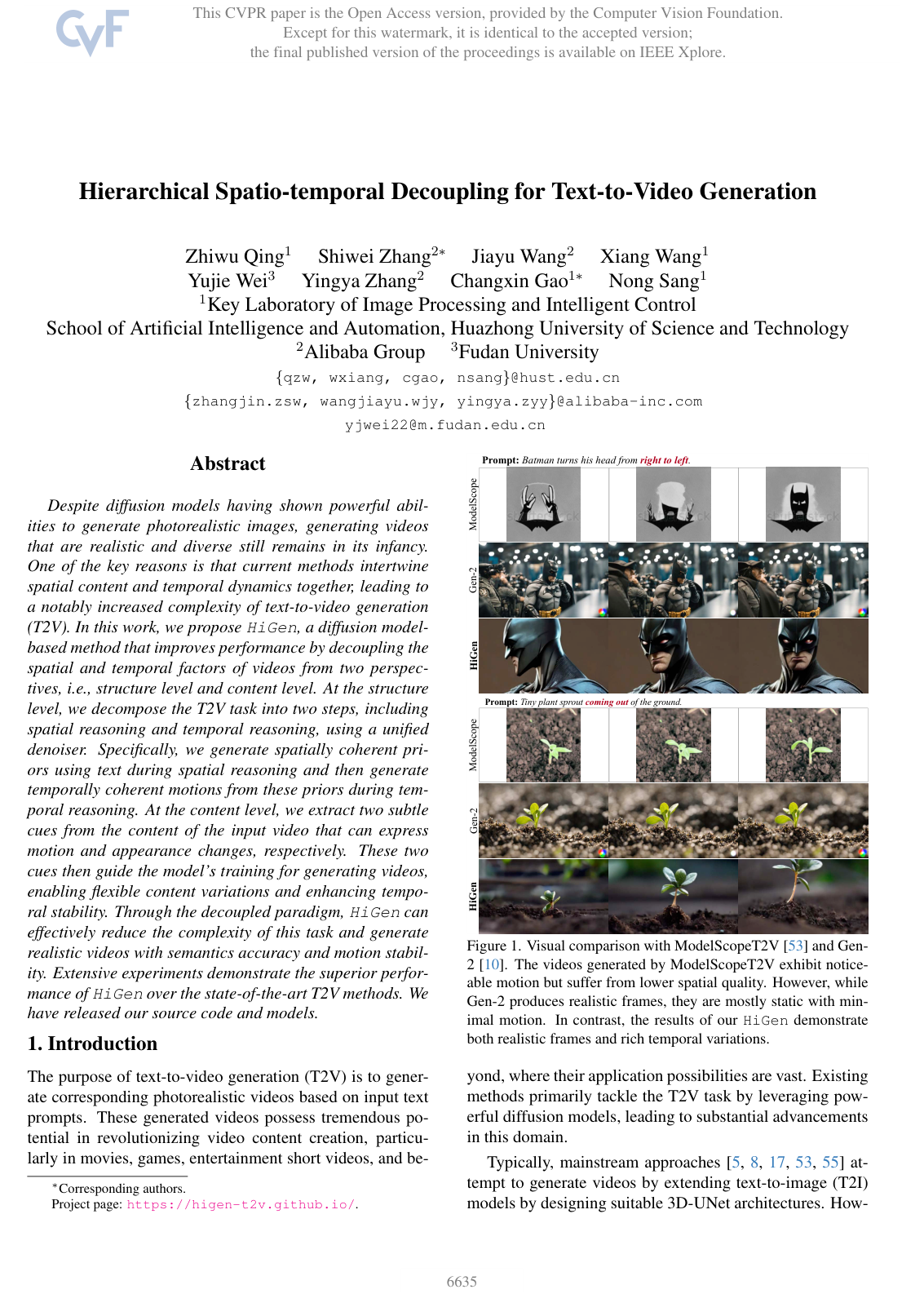
Hierarchical Spatio-temporal Decoupling for Text-to- Video Generation
Zhiwu Qing, Shiwei Zhang, Jiayu Wang, Xiang Wang, Yujie Wei, Yingya Zhang, Changxin Gao, Nong Sang
Why you should read this
Proposes HiGen, a diffusion-based framework that decouples spatial reasoning from temporal dynamics at both the structural and content levels to generate realistic, temporally stable videos from text prompts.
Despite diffusion models having shown powerful abilities to generate photorealistic images, generating videos that are realistic and diverse still remains in its infancy. One of the key reasons is that current methods intertwine spatial content and temporal dynamics together, leading to a notably increased complexity of text-to-video generation (T2V). In this work, we propose HiGen, a diffusion model-based method that improves performance by decoupling the spatial and temporal factors of videos from two perspectives, i.e., structure level and content level. At the structure level, we decompose the T2V task into two steps, including spatial reasoning and temporal reasoning, using a unified denoiser. Specifically, we generate spatially coherent priors using text during spatial reasoning and then generate temporally coherent motions from these priors during temporal reasoning. At the content level, we extract two subtle cues from the content of the input video that can express motion and appearance changes, respectively. These two cues then guide the model's training for generating videos, enabling flexible content variations and enhancing temporal stability. Through the decoupled paradigm, HiGen can effectively reduce the complexity of this task and generate realistic videos with semantics accuracy and motion stability. Extensive experiments demonstrate the superior performance of HiGen over the state-of-the-art T2V methods. We have released our source code and models.
Added
2026-09-26
MotionClone: Training-Free Motion Cloning for Controllable Video Generation
Pengyang Ling, Jiazi Bu, Pan Zhang, Xiaoyi Dong, Yuhang Zang, Tong Wu, Huaian Chen, Jiaqi Wang, Yi Jin
Why you should read this
Proposes MotionClone, a training-free framework that transfers camera and object motions from reference videos to text-to-video and image-to-video generation by extracting motion guidance from sparse temporal attention maps in a single denoising step.
Motion-based controllable video generation offers the potential for creating captivating visual content. Existing methods typically necessitate model training to encode particular motion cues or incorporate fine-tuning to inject certain motion patterns, resulting in limited flexibility and generalization. In this work, we propose MotionClone, a training-free framework that enables motion cloning from reference videos to versatile motion-controlled video generation, including text-to-video and image-to-video. Based on the observation that the dominant components in temporal-attention maps drive motion synthesis, while the rest mainly capture noisy or very subtle motions, MotionClone utilizes sparse temporal attention weights as motion representations for motion guidance, facilitating diverse motion transfer across varying scenarios. Meanwhile, MotionClone allows for the direct extraction of motion representation through a single denoising step, bypassing the cumbersome inversion processes and thus promoting both efficiency and flexibility. Extensive experiments demonstrate that MotionClone exhibits proficiency in both global camera motion and local object motion, with notable superiority in terms of motion fidelity, textual alignment, and temporal consistency.
Added
2026-09-26
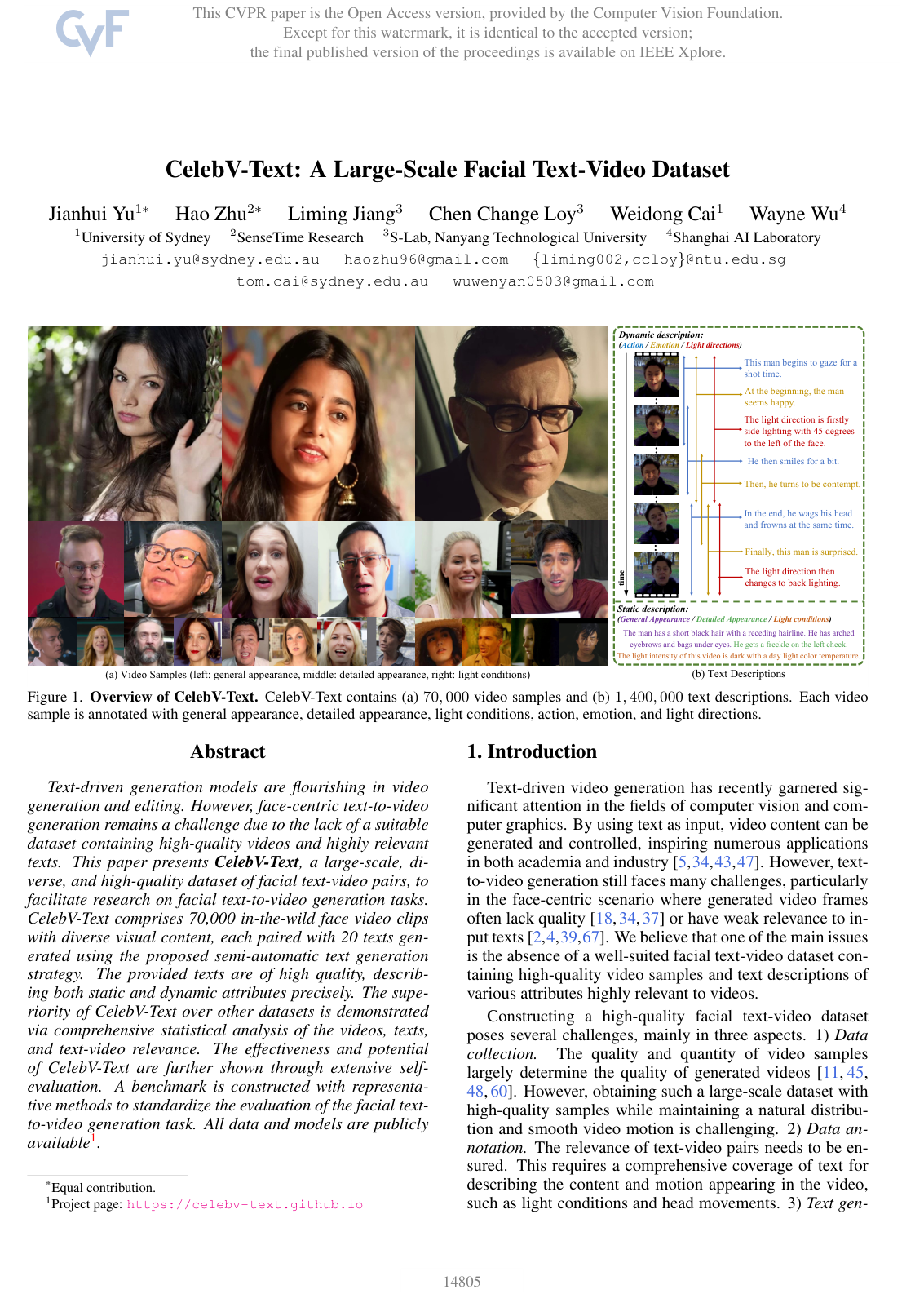
CelebV-Text: A Large-Scale Facial Text-Video Dataset
Jianhui Yu, Hao Zhu, Liming Jiang, Chen Change Loy, Weidong Cai, Wayne Wu
Why you should read this
Presents a large-scale dataset of 70,000 in-the-wild facial video clips paired with 1.4 million detailed static and dynamic text descriptions to advance and standardize face-centric text-to-video generation.
Text-driven generation models are flourishing in video generation and editing. However, face-centric text-to-video generation remains a challenge due to the lack of a suitable dataset containing high-quality videos and highly relevant texts. This paper presents CelebV-Text, a large-scale, diverse, and high-quality dataset of facial text-video pairs, to facilitate research on facial text-to-video generation tasks. CelebV-Text comprises 70,000 in-the-wild face video clips with diverse visual content, each paired with 20 texts generated using the proposed semi-automatic text generation strategy. The provided texts are of high quality, describing both static and dynamic attributes precisely. The superiority of CelebV-Text over other datasets is demonstrated via comprehensive statistical analysis of the videos, texts, and text-video relevance. The effectiveness and potential of CelebV-Text are further shown through extensive self-evaluation. A benchmark is constructed with representative methods to standardize the evaluation of the facial text-to-video generation task. All data and models are publicly available^1.
Added
2026-09-26
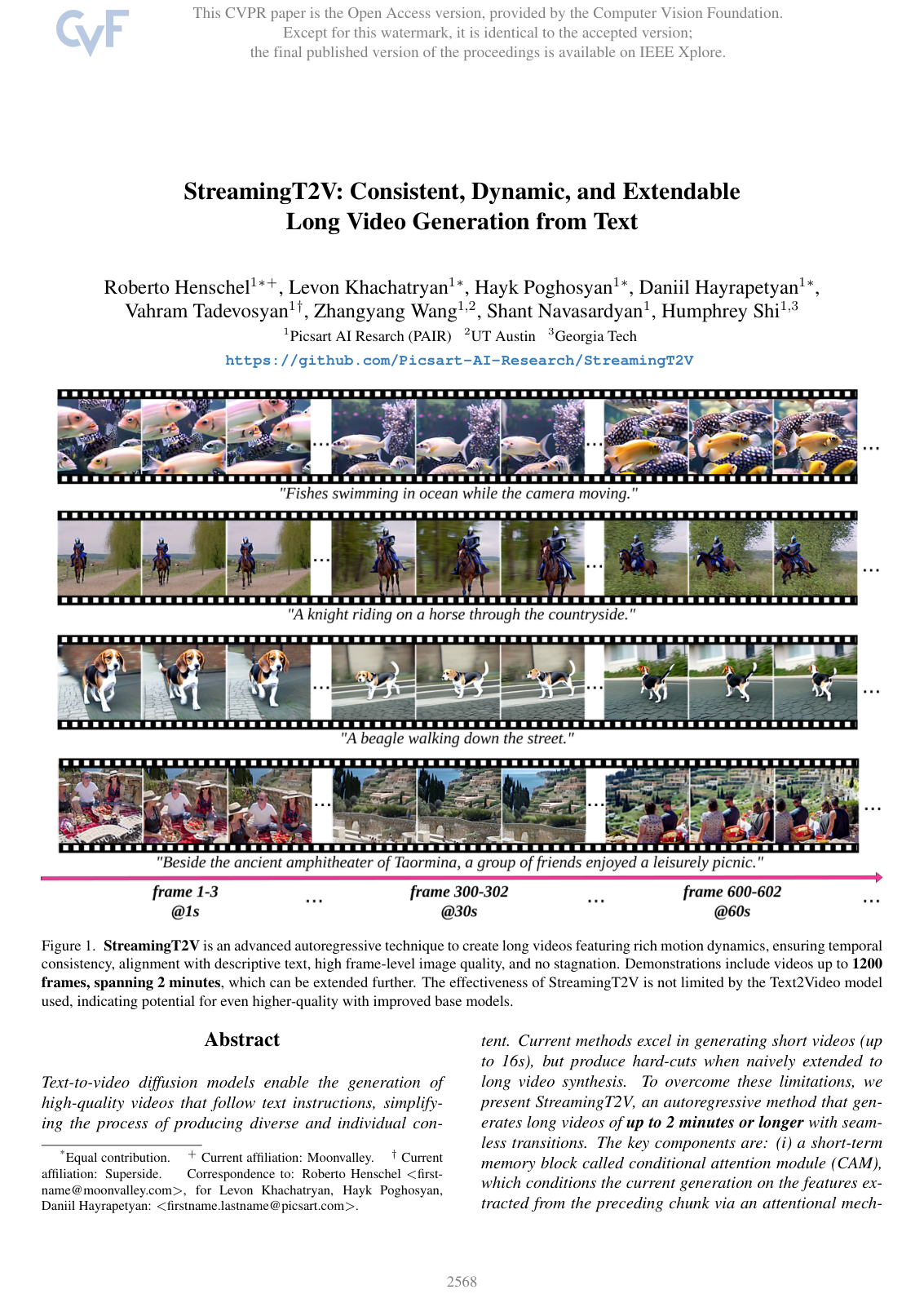
StreamingT2V: Consistent, Dynamic, and Extendable Long Video Generation from Text
Roberto Henschel, Levon Khachatryan, Hayk Poghosyan, Daniil Hayrapetyan, Vahram Tadevosyan, Zhangyang Wang, Shant Navasardyan, Humphrey Shi
Why you should read this
Proposes an autoregressive text-to-video framework that combines short- and long-term memory modules with randomized blending to generate temporally consistent, high-motion videos of extended length without visual stagnation or frame degradation.
Text-to-video diffusion models enable the generation of high-quality videos that follow text instructions, simplifying the process of producing diverse and individual content. Current methods excel in generating short videos (up to 16s), but produce hard-cuts when naively extended to long video synthesis. To overcome these limitations, we present StreamingT2V, an autoregressive method that generates long videos of up to 2 minutes or longer with seamless transitions. The key components are: (i) a short-term memory block called conditional attention module (CAM), which conditions the current generation on the features extracted from the preceding chunk via an attentional mech-
Added
2026-09-26
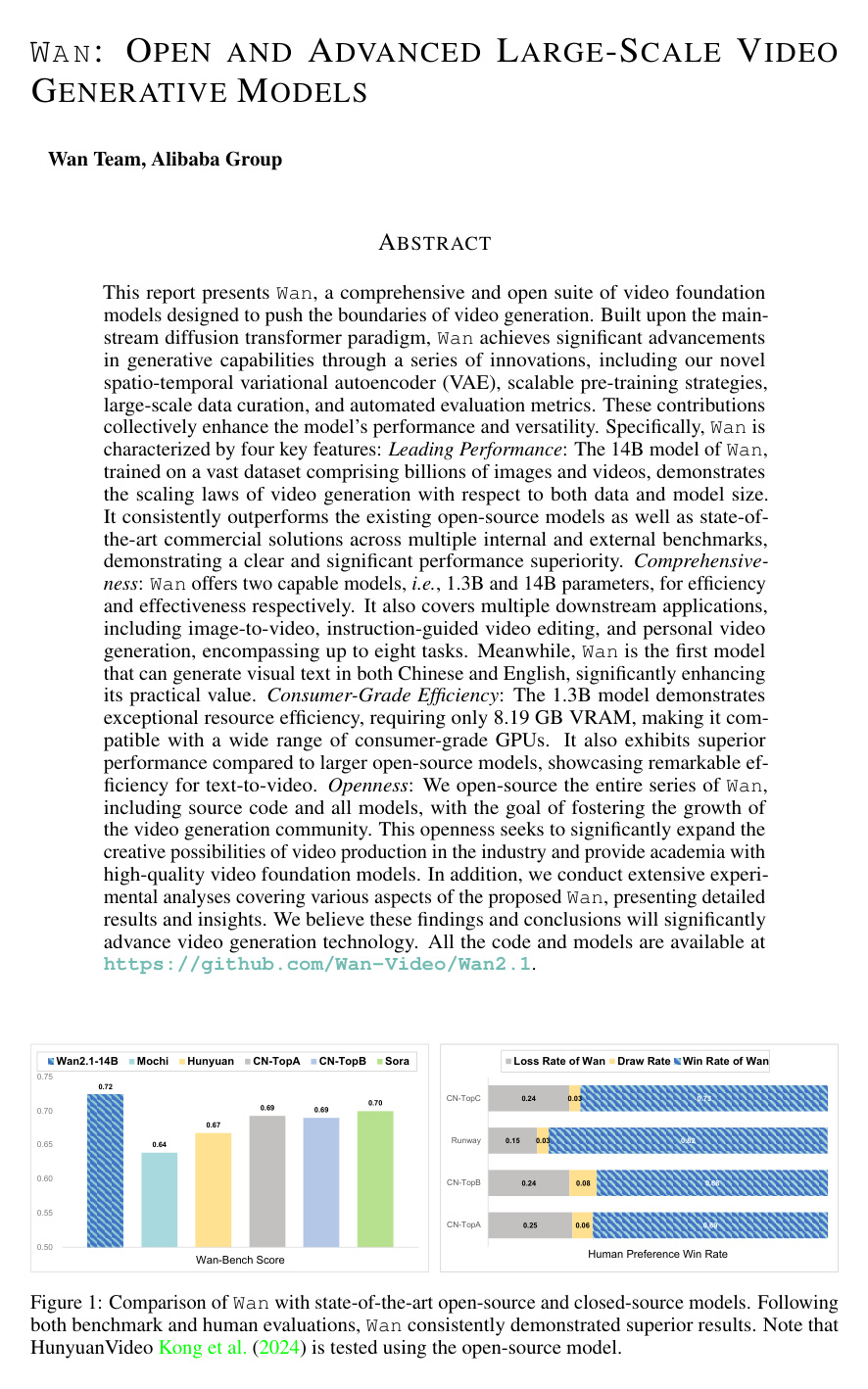
Wan: Open and Advanced Large-Scale Video Generative Models
Ang Wang, Baole Ai, Bin Wen, Chaojie Mao, Chen-Wei Xie, Di Chen, Feiwu Yu, Haiming Zhao, Jianxiao Yang, Jianyuan Zeng, Jiayu Wang, Jingfeng Zhang, Jingren Zhou, Jinkai Wang, Jixuan Chen, Kai Zhu, Kang Zhao, Keyu Yan, Lianghua Huang, Xiaofeng Meng, Ningying Zhang, Pandeng Li, Ping Wu, Ruihang Chu, Rui Feng, Shiwei Zhang, Siyang Sun, Tao Fang, Tianxing Wang, T. Gui, Tingyu Weng, Tong Shen, Wei Lin, Wei Wang, Wen-Chao Zhou, Wente Wang, Wen Shen, Wenyuan Yu, Xianzhong Shi, Xiaomin Huang, Xin Xu, Yan Kou, Yan-Mei Lv, Yifei Li, Yi-Jing Liu, Yiming Wang, Yingya Zhang, Yitong Huang, Yong Li, You Wu, Yu Liu, Yulin Pan, Yun Zheng, Yuntao Hong, Yupeng Shi, Yutong Feng, Zeyinzi Jiang, Zhen Han, Zhi-Fan Wu, Ziyu Liu
Why you should read this
Presents an open-source suite of diffusion transformer video foundation models scaling up to 14 billion parameters that outperforms leading commercial systems while providing a lightweight variant that runs on consumer GPUs with under 8.2 GB of VRAM.
This report presents Wan, a comprehensive and open suite of video foundation models designed to push the boundaries of video generation. Built upon the mainstream diffusion transformer paradigm, Wan achieves significant advancements in generative capabilities through a series of innovations, including our novel VAE, scalable pre-training strategies, large-scale data curation, and automated evaluation metrics. These contributions collectively enhance the model's performance and versatility. Specifically, Wan is characterized by four key features: Leading Performance: The 14B model of Wan, trained on a vast dataset comprising billions of images and videos, demonstrates the scaling laws of video generation with respect to both data and model size. It consistently outperforms the existing open-source models as well as state-of-the-art commercial solutions across multiple internal and external benchmarks, demonstrating a clear and significant performance superiority. Comprehensiveness: Wan offers two capable models, i.e., 1.3B and 14B parameters, for efficiency and effectiveness respectively. It also covers multiple downstream applications, including image-to-video, instruction-guided video editing, and personal video generation, encompassing up to eight tasks. Consumer-Grade Efficiency: The 1.3B model demonstrates exceptional resource efficiency, requiring only 8.19 GB VRAM, making it compatible with a wide range of consumer-grade GPUs. Openness: We open-source the entire series of Wan, including source code and all models, with the goal of fostering the growth of the video generation community. This openness seeks to significantly expand the creative possibilities of video production in the industry and provide academia with high-quality video foundation models. All the code and models are available at this https URL.
Added
2026-09-24
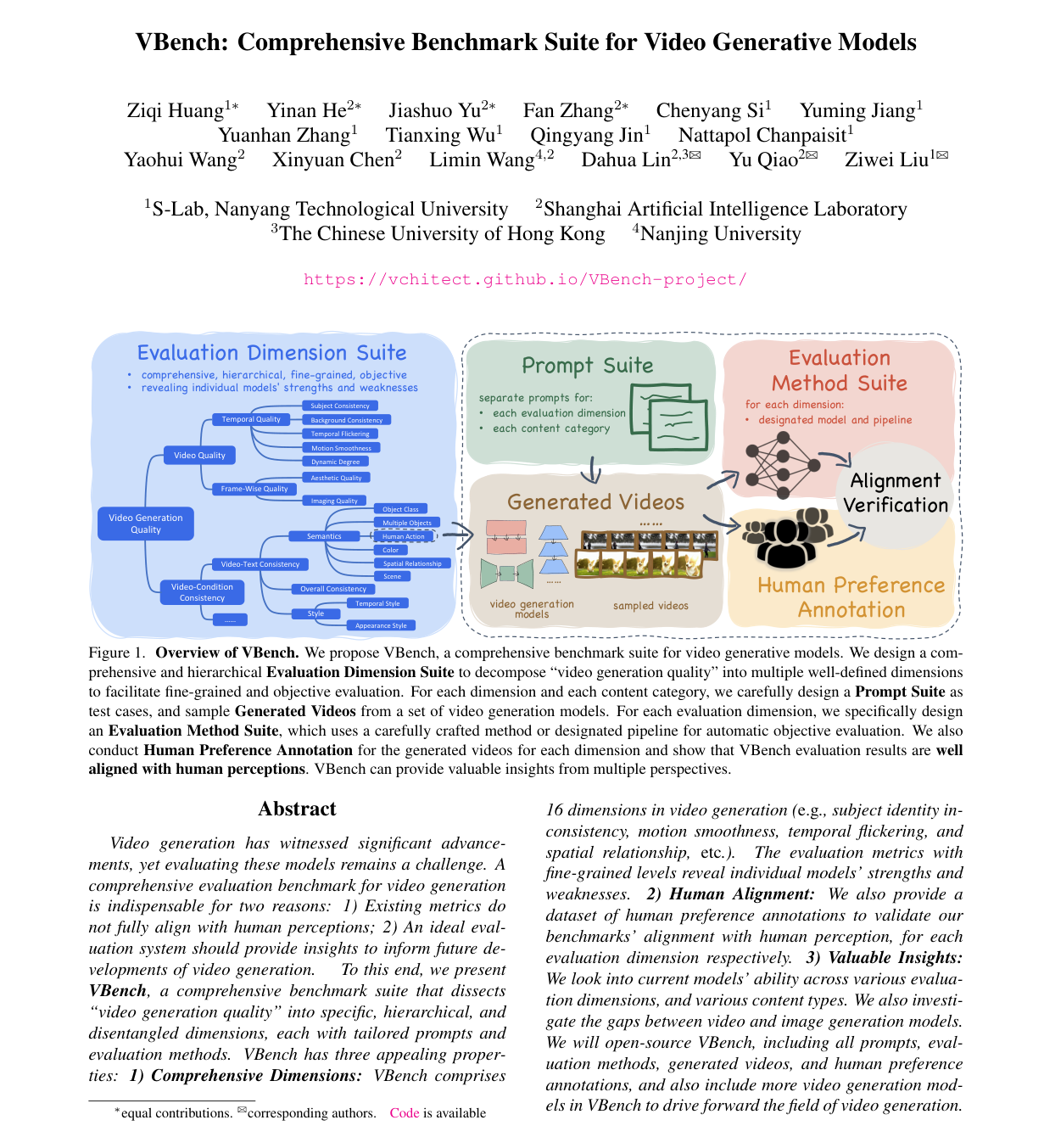
VBench: Comprehensive Benchmark Suite for Video Generative Models
Ziqi Huang, Yinan He, Jiashuo Yu, Fan Zhang, Chenyang Si, Yuming Jiang, Yuanhan Zhang, Tianxing Wu, Qin Jin, Nattapol Chanpaisit, Yaohui Wang, Xinyuan Chen, Limin Wang, Dahua Lin, Yu Qiao, Ziwei Liu
Why you should read this
Presents VBench, an evaluation suite that measures video generation quality across 16 human-aligned dimensions—including temporal consistency, motion smoothness, and subject identity—to provide precise diagnostic benchmarks for video synthesis models.
Video generation has witnessed significant advancements, yet evaluating these models remains a challenge. A comprehensive evaluation benchmark for video generation is indispensable for two reasons: 1) Existing metrics do not fully align with human perceptions; 2) An ideal evaluation system should provide insights to inform future developments of video generation. To this end, we present VBench, a comprehensive benchmark suite that dissects "video generation quality" into specific, hierarchical, and disentangled dimensions, each with tailored prompts and evaluation methods. VBench has three appealing properties: 1) Comprehensive Dimensions: VBench comprises 16 dimensions in video generation (e.g., subject identity inconsistency, motion smoothness, temporal flickering, and spatial relationship, etc). The evaluation metrics with fine-grained levels reveal individual models' strengths and weaknesses. 2) Human Alignment: We also provide a dataset of human preference annotations to validate our benchmarks' alignment with human perception, for each evaluation dimension respectively. 3) Valuable Insights: We look into current models' ability across various evaluation dimensions, and various content types. We also investigate the gaps between video and image generation models. We will open-source VBench, including all prompts, evaluation methods, generated videos, and human preference annotations, and also include more video generation models in VBench to drive forward the field of video generation.
Added
2026-09-18
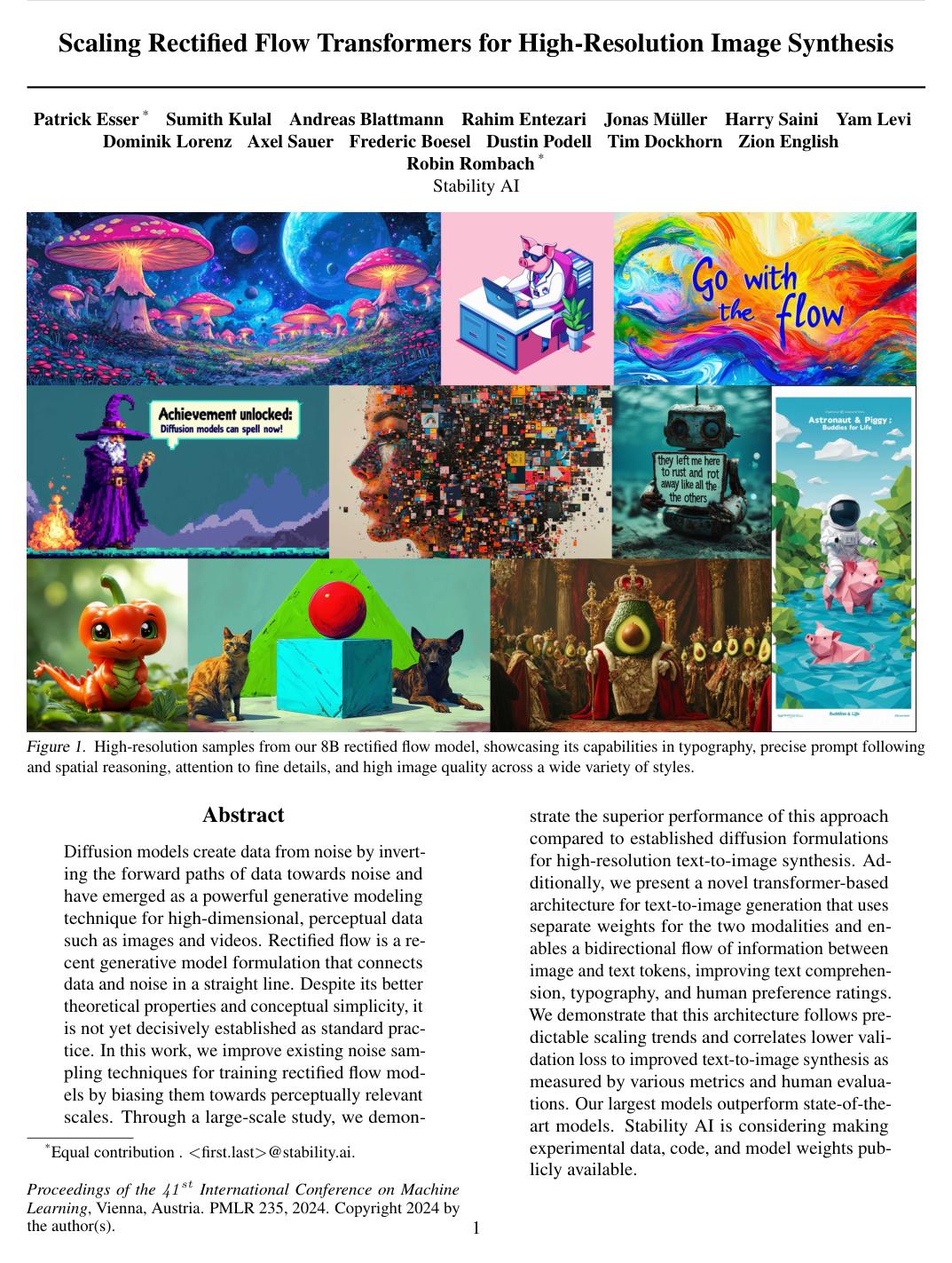
Scaling Rectified Flow Transformers for High-Resolution Image Synthesis
Patrick Esser, Sumith Kulal, Andreas Blattmann, Rahim Entezari, Jonas Müller, Harry Saini, Yam Levi, Dominik Lorenz, Axel Sauer, Frederic Boesel, Dustin Podell, Tim Dockhorn, Zion English, Robin Rombach
Why you should read this
Proposes a multimodal transformer architecture and tailored noise sampling strategy that enables rectified flow models to scale efficiently, outperforming existing state-of-the-art systems in high-resolution image synthesis and typographic accuracy.
Diffusion models create data from noise by inverting the forward paths of data towards noise and have emerged as a powerful generative modeling technique for high-dimensional, perceptual data such as images and videos. Rectified flow is a recent generative model formulation that connects data and noise in a straight line. Despite its better theoretical properties and conceptual simplicity, it is not yet decisively established as standard practice. In this work, we improve existing noise sampling techniques for training rectified flow models by biasing them towards perceptually relevant scales. Through a large-scale study, we demonstrate the superior performance of this approach compared to established diffusion formulations for high-resolution text-to-image synthesis. Additionally, we present a novel transformer-based architecture for text-to-image generation that uses separate weights for the two modalities and enables a bidirectional flow of information between image and text tokens, improving text comprehension, typography, and human preference ratings. We demonstrate that this architecture follows predictable scaling trends and correlates lower validation loss to improved text-to-image synthesis as measured by various metrics and human evaluations. Our largest models outperform state-of-the-art models, and we will make our experimental data, code, and model weights publicly available.
Added
2026-05-13
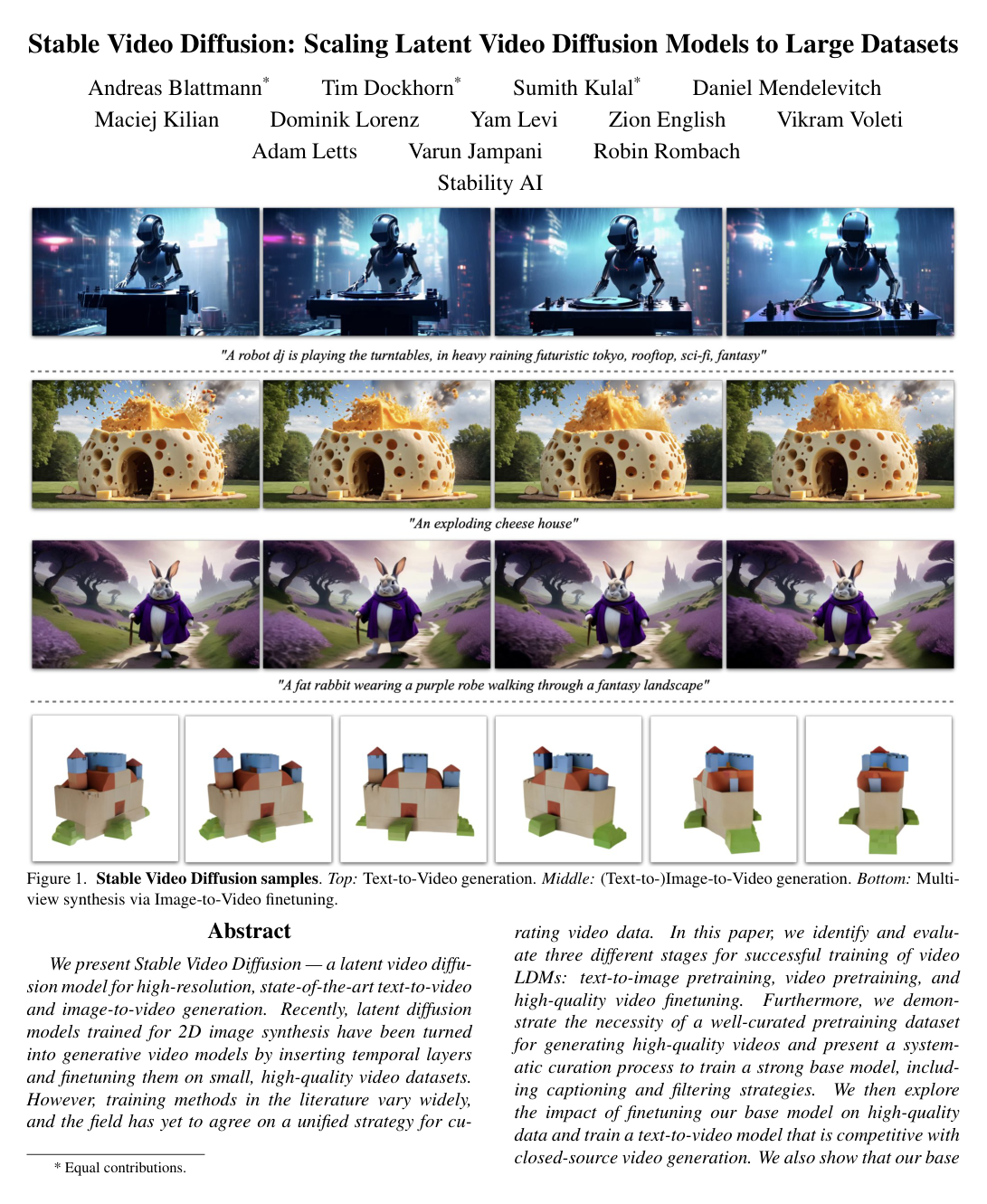
Stable Video Diffusion: Scaling Latent Video Diffusion Models to Large Datasets
Andreas Blattmann, Tim Dockhorn, Sumith Kulal, Daniel Mendelevitch, Maciej Kilian, Dominik Lorenz, Yam Levi, Zion English, Vikram Voleti, Adam Letts, Varun Jampani, Robin Rombach
Why you should read this
Presents a systematic and highly effective strategy for training latent video diffusion models, including data curation and multi-stage finetuning, to achieve state-of-the-art text-to-video and image-to-video generation with released code and weights.
We present Stable Video Diffusion - a latent video diffusion model for high-resolution, state-of-the-art text-to-video and image-to-video generation. Recently, latent diffusion models trained for 2D image synthesis have been turned into generative video models by inserting temporal layers and finetuning them on small, high-quality video datasets. However, training methods in the literature vary widely, and the field has yet to agree on a unified strategy for curating video data. In this paper, we identify and evaluate three different stages for successful training of video LDMs: text-to-image pretraining, video pretraining, and high-quality video finetuning. Furthermore, we demonstrate the necessity of a well-curated pretraining dataset for generating high-quality videos and present a systematic curation process to train a strong base model, including captioning and filtering strategies. We then explore the impact of finetuning our base model on high-quality data and train a text-to-video model that is competitive with closed-source video generation. We also show that our base model provides a powerful motion representation for downstream tasks such as image-to-video generation and adaptability to camera motion-specific LoRA modules. Finally, we demonstrate that our model provides a strong multi-view 3D-prior and can serve as a base to finetune a multi-view diffusion model that jointly generates multiple views of objects in a feedforward fashion, outperforming image-based methods at a fraction of their compute budget. We release code and model weights at this https URL .
Added
2026-03-11

Lumiere: A Space-Time Diffusion Model for Video Generation
Omer Bar-Tal, Hila Chefer, Omer Tov, Charles Herrmann, Roni Paiss, Shiran Zada, Ariel Ephrat, Junhwa Hur, Guanghui Liu, Amit Raj, Yuanzhen Li, Michael Rubinstein, Tomer Michaeli, Oliver Wang, Deqing Sun, Tali Dekel, Inbar Mosseri
Why you should read this
Introduces a Space-Time U-Net architecture that generates the entire temporal duration of a video in a single forward pass, eliminating the global inconsistency issues of previous cascaded models.
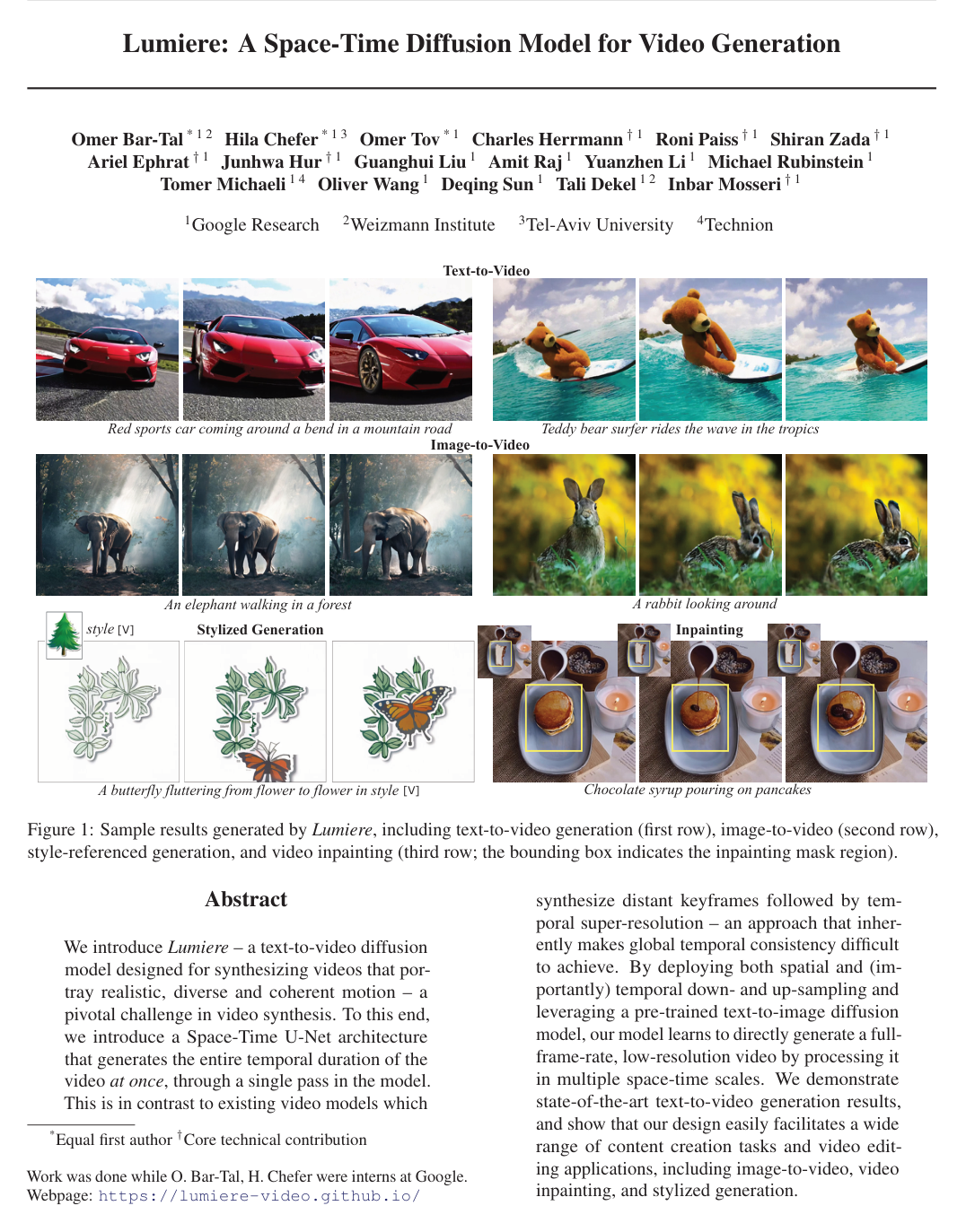
We introduce Lumiere – a text-to-video diffusion model designed for synthesizing videos that portray realistic, diverse and coherent motion – a pivotal challenge in video synthesis. To this end, we introduce a Space-Time U-Net architecture that generates the entire temporal duration of the video at once, through a single pass in the model. This is in contrast to existing video models which synthesize distant keyframes followed by temporal super-resolution – an approach that inherently makes global temporal consistency difficult to achieve. By deploying both spatial and (importantly) temporal down- and up-sampling and leveraging a pre-trained text-to-image diffusion model, our model learns to directly generate a full-frame-rate, low-resolution video by processing it in multiple space-time scales. We demonstrate state-of-the-art text-to-video generation results, and show that our design easily facilitates a wide range of content creation tasks and video editing applications, including image-to-video, video inpainting, and stylized generation.
Added
2026-03-11
Align Your Latents: High-Resolution Video Synthesis with Latent Diffusion Models
Andreas Blattmann, Robin Rombach, Huan Ling, Tim Dockhorn, Seung Wook Kim, Sanja Fidler, Karsten Kreis
Why you should read this
Provides the definitive blueprint for converting static image latent diffusion models into video generators by inserting and aligning temporal attention layers.
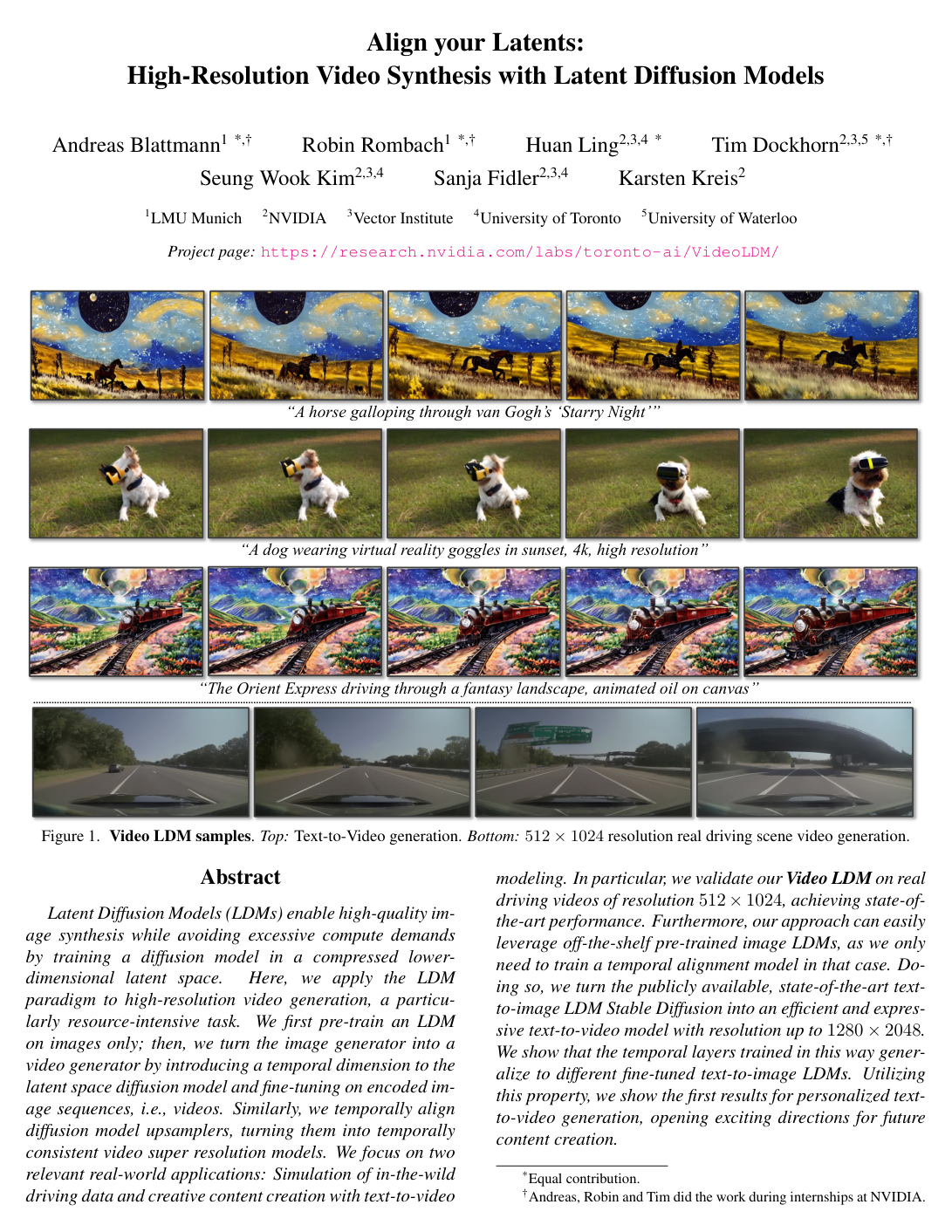
Latent Diffusion Models (LDMs) enable high-quality image synthesis while avoiding excessive compute demands by training a diffusion model in a compressed lower-dimensional latent space. Here, we apply the LDM paradigm to high-resolution video generation, a particularly resource-intensive task. We first pre-train an LDM on images only; then, we turn the image generator into a video generator by introducing a temporal dimension to the latent space diffusion model and finetuning on encoded image sequences, i.e., videos. Similarly, we temporally align diffusion model upsamplers, turning them into temporally consistent video super resolution models. We focus on two relevant real-world applications: Simulation of in-the-wild driving data and creative content creation with text-to-video modeling. In particular, we validate our Video LDM on real driving videos of resolution <tex xmlns:mml="http://www.w3.org/1998/Math/MathML" xmlns:xlink="http://www.w3.org/1999/xlink"></tex> , achieving state-of-the-art performance. Furthermore, our approach can easily leverage off-the-shelf pretrained image LDMs, as we only need to train a temporal alignment model in that case. Doing so, we turn the publicly available, state-of-the-art text-to-image LDM Stable Diffusion into an efficient and expressive text-to-video model with resolution up to <tex xmlns:mml="http://www.w3.org/1998/Math/MathML" xmlns:xlink="http://www.w3.org/1999/xlink"></tex> . We show that the temporal layers trained in this way generalize to different finetuned text-to-image LDMs. Utilizing this property, we show the first results for personalized text-to-video generation, opening exciting directions for future content creation. Project page: https://nv-tlabs.github.io/VideoLDM/
Added
2026-03-11
Phenaki: Variable Length Video Generation From Open Domain Textual Description
Ruben Villegas, Mohammad Babaeizadeh, Pieter-Jan Kindermans, Hernan Moraldo, Han Zhang, Mohammad Taghi Saffar, Santiago Castro, Julius Kunze, Dumitru Erhan
Why you should read this
Develops a causal transformer architecture that synthesizes arbitrarily long videos from dynamic text prompts using bidirectional training on discrete temporal tokens.
We present Phenaki, a model capable of realistic video synthesis, given a sequence of textual prompts. Generating videos from text is particularly challenging due to the computational cost, limited quantities of high quality text-video data and variable length of videos. To address these issues, we introduce a new model for learning video representation which compresses the video to a small representation of discrete tokens. This tokenizer uses causal attention in time, which allows it to work with variable-length videos. To generate video tokens from text we are using a bidirectional masked transformer conditioned on pre-computed text tokens. The generated video tokens are subsequently de-tokenized to create the actual video. To address data issues, we demonstrate how joint training on a large corpus of image-text pairs as well as a smaller number of video-text examples can result in generalization beyond what is available in the video datasets. Compared to the previous video generation methods, Phenaki can generate arbitrary long videos conditioned on a sequence of prompts (i.e. time variable text or a story) in open domain. To the best of our knowledge, this is the first time a paper studies generating videos from time variable prompts. In addition, compared to the per-frame baselines, the proposed video encoder-decoder computes fewer tokens per video but results in better spatio-temporal consistency.
Added
2026-03-11
Video-to-Video Synthesis
Ting-Chun Wang, Ming-Yu Liu, Jun-Yan Zhu, Guilin Liu, Andrew Tao, Jan Kautz, Bryan Catanzaro
Why you should read this
Develops a progressive generator and a multi-scale temporal discriminator to enable high-resolution, photorealistic translation of semantic layouts into temporally coherent video.
We study the problem of video-to-video synthesis, whose goal is to learn a mapping function from an input source video (e.g., a sequence of semantic segmentation masks) to an output photorealistic video that precisely depicts the content of the source video. While its image counterpart, the image-to-image synthesis problem, is a popular topic, the video-to-video synthesis problem is less explored in the literature. Without understanding temporal dynamics, directly applying existing image synthesis approaches to an input video often results in temporally incoherent videos of low visual quality. In this paper, we propose a novel video-to-video synthesis approach under the generative adversarial learning framework. Through carefully-designed generator and discriminator architectures, coupled with a spatio-temporal adversarial objective, we achieve high-resolution, photorealistic, temporally coherent video results on a diverse set of input formats including segmentation masks, sketches, and poses. Experiments on multiple benchmarks show the advantage of our method compared to strong baselines. In particular, our model is capable of synthesizing 2K resolution videos of street scenes up to 30 seconds long, which significantly advances the state-of-the-art of video synthesis. Finally, we apply our approach to future video prediction, outperforming several state-of-the-art competing systems.
Added
2026-03-11