
keyword
video reasoning
Video reasoning is an artificial intelligence capability that involves analyzing visual and temporal information across video sequences to understand events, infer causal relationships, and draw logical conclusions. Beyond basic video recognition tasks that merely identify isolated objects or actions, video reasoning requires computational models to comprehend spatio-temporal dynamics, track object interactions over time, and correlate visual content with linguistic queries or external knowledge. This capability enables systems to perform advanced tasks such as video question answering, temporal event grounding, intent prediction, and narrative comprehension across both short clips and extended long-form video content.
4 items
Video Question Answering: Datasets, Algorithms and Challenges
Yaoyao Zhong, Wei Ji, Junbin Xiao, Yicong Li, Weihong Deng, Tat-Seng Chua
Why you should read this
Presents a comprehensive taxonomy of video question answering that classifies benchmarks by modality and reasoning difficulty while systematically evaluating architectural techniques from spatio-temporal attention to neuro-symbolic reasoning.
This survey aims to organize the recent advances in video question answering (VideoQA) and point towards future directions. We firstly categorize the datasets into: 1) normal VideoQA, multi-modal VideoQA and knowledge-based VideoQA, according to the modalities invoked in the question-answer pairs, and 2) factoid VideoQA and inference VideoQA, according to the technical challenges in comprehending the questions and deriving the correct answers. We then summarize the VideoQA techniques, including those mainly designed for Factoid QA (such as the early spatio-temporal attention-based methods and the recent Transformer-based ones) and those targeted at explicit relation and logic inference (such as neural modular networks, neural symbolic methods, and graph-structured methods). Aside from the backbone techniques, we also delve into specific models and derive some common and useful insights either for video modeling, question answering, or for cross-modal correspondence learning. Finally, we present the research trends of studying beyond factoid VideoQA to inference VideoQA, as well as towards the robustness and interpretability. Additionally, we maintain a repository, https://github.com/VRU-NExT/VideoQA, to keep trace of the latest VideoQA papers, datasets, and their open-source implementations if available. With these efforts, we strongly hope this survey could shed light on the follow-up VideoQA research.
Added
2026-10-01
TimeSuite: Improving MLLMs for Long Video Understanding via Grounded Tuning
Xiangyu Zeng, Kunchang Li, Chenting Wang, Xinhao Li, Tianxiang Jiang, Ziang Yan, Songze Li, Yansong Shi, Zhengrong Yue, Yi Wang, Yali Wang, Yu Qiao, Limin Wang
Why you should read this
Presents TimeSuite, a grounded instruction-tuning framework that adapts multimodal language models for long-form video comprehension by pairing efficient token compression with explicit timestamp generation to curb hallucinations.
Multimodal Large Language Models (MLLMs) have demonstrated impressive performance in short video understanding. However, understanding long-form videos still remains challenging for MLLMs. This paper proposes TimeSuite, a collection of new designs to adapt the existing short-form video MLLMs for long video understanding, including a simple yet efficient framework to process long video sequence, a high-quality video dataset for grounded tuning of MLLMs, and a carefully-designed instruction tuning task to explicitly incorporate the grounding supervision in the traditional QA format. Specifically, based on VideoChat, we propose our long-video MLLM, coined as VideoChat-T, by implementing a token shuffling to compress long video tokens and introducing Temporal Adaptive Position Encoding (TAPE) to enhance the temporal awareness of visual representation. Meanwhile, we introduce the TimePro, a comprehensive grounding-centric instruction tuning dataset composed of 9 tasks and 349k high-quality grounded annotations. Notably, we design a new instruction tuning task type, called Temporal Grounded Caption, to peform detailed video descriptions with the corresponding time stamps prediction. This explicit temporal location prediction will guide MLLM to correctly attend on the visual content when generating description, and thus reduce the hallucination risk caused by the LLMs. Experimental results demonstrate that our TimeSuite provides a successful solution to enhance the long video understanding capability of short-form MLLM, achieving improvement of 5.6% and 6.8% on the benchmarks of Egoschema and VideoMME, respectively. In addition, VideoChat-T exhibits robust zero-shot temporal grounding capabilities, significantly outperforming the existing state-of-the-art MLLMs. After fine-tuning, it performs on par with the traditional supervised expert models.
Added
2026-09-26
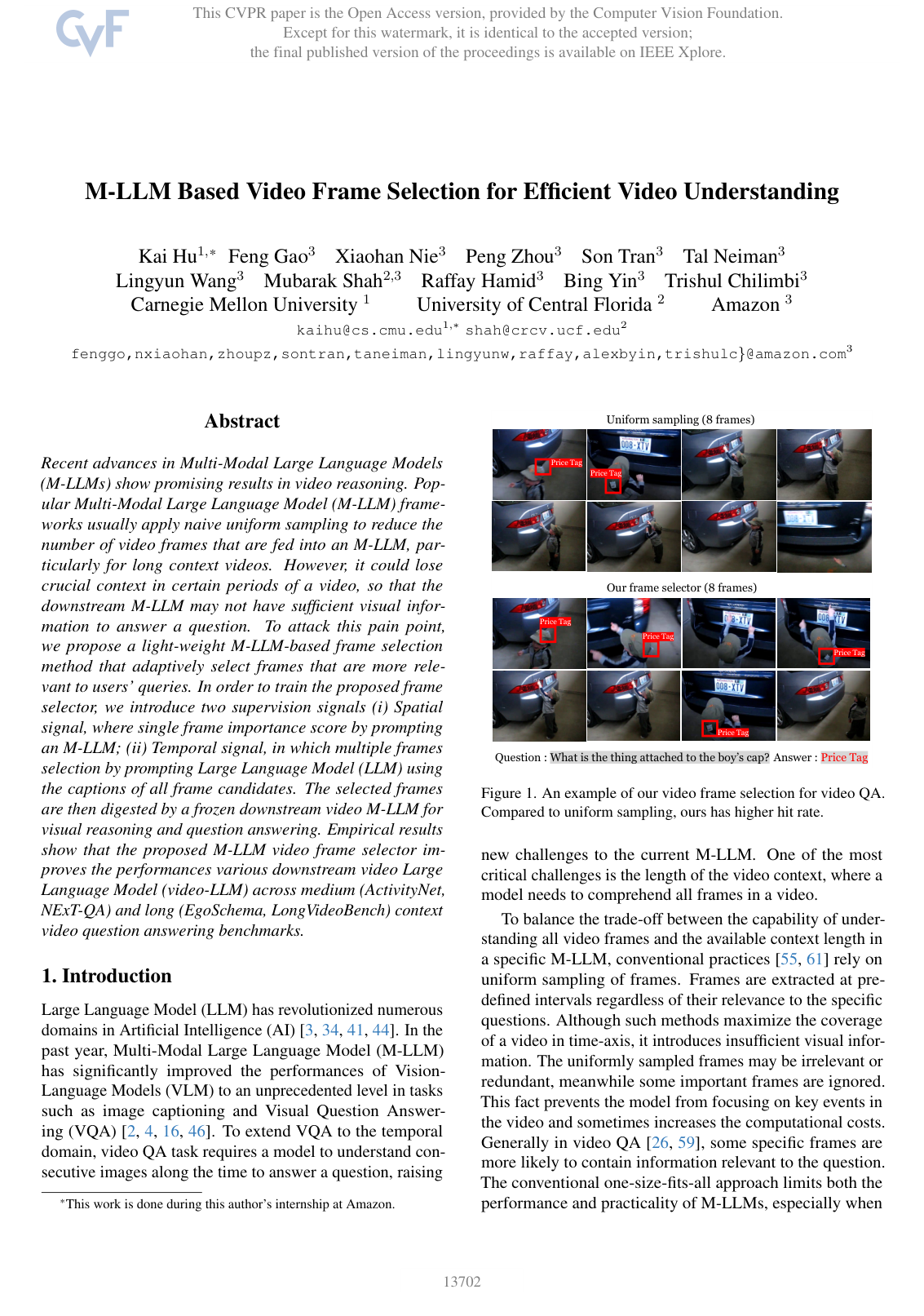
M-LLM Based Video Frame Selection for Efficient Video Understanding
Kai Hu, Feng Gao, Xiaohan Nie, Peng Zhou, Son Tran, Tal Neiman, Lingyun Wang, Mubarak Shah, Raffay Hamid, Bing Yin, Trishul Chilimbi
Why you should read this
Develops a lightweight, plug-and-play video frame selector trained with spatial and temporal pseudo-labels to replace uniform sampling, boosting question-answering accuracy and efficiency for frozen multimodal LLMs on long- and medium-context video benchmarks.
Recent advances in Multi-Modal Large Language Models (M-LLMs) show promising results in video reasoning. Popular Multi-Modal Large Language Model (M-LLM) frameworks usually apply naive uniform sampling to reduce the number of video frames that are fed into an M-LLM, particularly for long context videos. However, it could lose crucial context in certain periods of a video, so that the downstream M-LLM may not have sufficient visual information to answer a question. To attack this pain point, we propose a light-weight M-LLM-based frame selection method that adaptively select frames that are more relevant to users' queries. In order to train the proposed frame selector, we introduce two supervision signals (i) Spatial signal, where single frame importance score by prompting an M-LLM; (ii) Temporal signal, in which multiple frames selection by prompting Large Language Model (LLM) using the captions of all frame candidates. The selected frames are then digested by a frozen downstream video M-LLM for visual reasoning and question answering. Empirical results show that the proposed M-LLM video frame selector improves the performances various downstream video Large Language Model (video-LLM) across medium (ActivityNet, NExT-QA) and long (EgoSchema, LongVideoBench) context video question answering benchmarks.
Added
2026-09-26
Video-ChatGPT: Towards Detailed Video Understanding via Large Vision and Language Models
Muhammad Maaz, Hanoona Abdul Rasheed, Salman Khan, Fahad Khan
Why you should read this
Presents Video-ChatGPT to enable detailed conversational video understanding by combining a video-adapted visual encoder with a large language model, alongside a 100,000-sample instruction dataset and a standardized quantitative evaluation benchmark.
Conversation agents fueled by Large Language Models (LLMs) are providing a new way to interact with visual data. While there have been initial attempts for image-based conversation models, this work addresses the under-explored field of \emph{video-based conversation} by introducing Video-ChatGPT. It is a multimodal model that merges a video-adapted visual encoder with an LLM. The resulting model is capable of understanding and generating detailed conversations about videos. We introduce a new dataset of 100,000 video-instruction pairs used to train Video-ChatGPT acquired via manual and semi-automated pipeline that is easily scalable and robust to label noise. We also develop a quantitative evaluation framework for video-based dialogue models to objectively analyze the strengths and weaknesses of video-based dialogue models. Code: this https URL.
Added
2026-09-25