
keyword
video object segmentation
Video object segmentation is a computer vision task that involves identifying and separating one or more target objects from the background by generating pixel-accurate masks across all frames of a video sequence. The primary goal is to track and delineate the exact spatial boundaries of objects over time while maintaining temporal consistency despite real-world challenges such as occlusions, appearance variations, motion blur, and visual distractors. Depending on the level of guidance provided, the task is typically framed as semi-supervised, where an initial annotation such as a mask or bounding box is supplied in the starting frame to guide subsequent propagation, or as unsupervised and weakly supervised, where algorithms automatically discover and segment salient or moving objects throughout the video without prior frame-level target annotations.
11 items
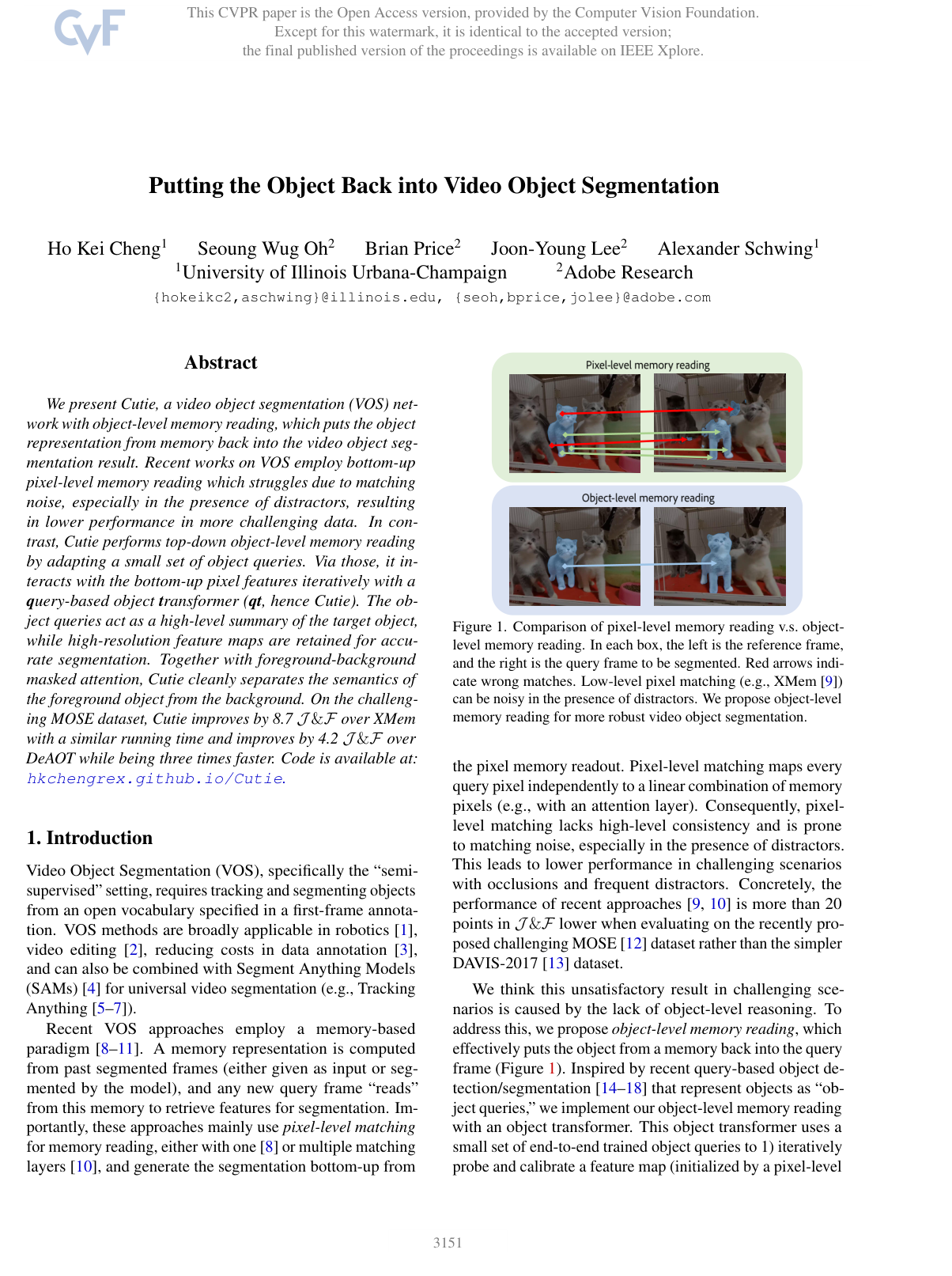
Putting the Object Back into Video Object Segmentation
Ho Kei Cheng, Seoung Wug Oh, Brian L. Price, Joon-Young Lee, Alexander G. Schwing
Why you should read this
Proposes Cutie, a video object segmentation framework that pairs bottom-up pixel features with top-down query-based object memory reading to overcome matching noise from distractors and substantially boost segmentation accuracy on challenging benchmarks.
We present Cutie, a video object segmentation (VOS) network with object-level memory reading, which puts the object representation from memory back into the video object segmentation result. Recent works on VOS employ bottom-up pixel-level memory reading which struggles due to matching noise, especially in the presence of distractors, resulting in lower performance in more challenging data. In contrast, Cutie performs top-down object-level memory reading by adapting a small set of object queries. Via those, it interacts with the bottom-up pixel features iteratively with a query-based object transformer (qt, hence Cutie). The object queries act as a high-level summary of the target object, while high-resolution feature maps are retained for accurate segmentation. Together with foreground-background masked attention, Cutie cleanly separates the semantics of the foreground object from the background. On the challenging MOSE dataset, Cutie improves by 8.7 J&F over XMem with a similar running time and improves by 4.2 J&F over DeAOT while being three times faster. Code is available at: hkchengrex.github.io/Cutie.
Added
2026-10-05
Conditional Object-Centric Learning from Video
Thomas Kipf, Gamaleldin Fathy Elsayed, Aravindh Mahendran, Austin Stone, Sara Sabour, Georg Heigold, Rico Jonschkowski, Alexey Dosovitskiy, Klaus Greff
Why you should read this
Proposes a sequential extension to Slot Attention that combines optical flow prediction with sparse initial location cues, enabling object-centric models to segment, track, and generalize across complex video scenes with minimal supervision.
Object-centric representations are a promising path toward more systematic generalization by providing flexible abstractions upon which compositional world models can be built. Recent work on simple 2D and 3D datasets has shown that models with object-centric inductive biases can learn to segment and represent meaningful objects from the statistical structure of the data alone without the need for any supervision. However, such fully-unsupervised methods still fail to scale to diverse realistic data, despite the use of increasingly complex inductive biases such as priors for the size of objects or the 3D geometry of the scene. In this paper, we instead take a weakly-supervised approach and focus on how 1) using the temporal dynamics of video data in the form of optical flow and 2) conditioning the model on simple object location cues can be used to enable segmenting and tracking objects in significantly more realistic synthetic data. We introduce a sequential extension to Slot Attention which we train to predict optical flow for realistic looking synthetic scenes and show that conditioning the initial state of this model on a small set of hints, such as center of mass of objects in the first frame, is sufficient to significantly improve instance segmentation. These benefits generalize beyond the training distribution to novel objects, novel backgrounds, and to longer video sequences. We also find that such initial-state-conditioning can be used during inference as a flexible interface to query the model for specific objects or parts of objects, which could pave the way for a range of weakly-supervised approaches and allow more effective interaction with trained models.
Added
2026-09-29
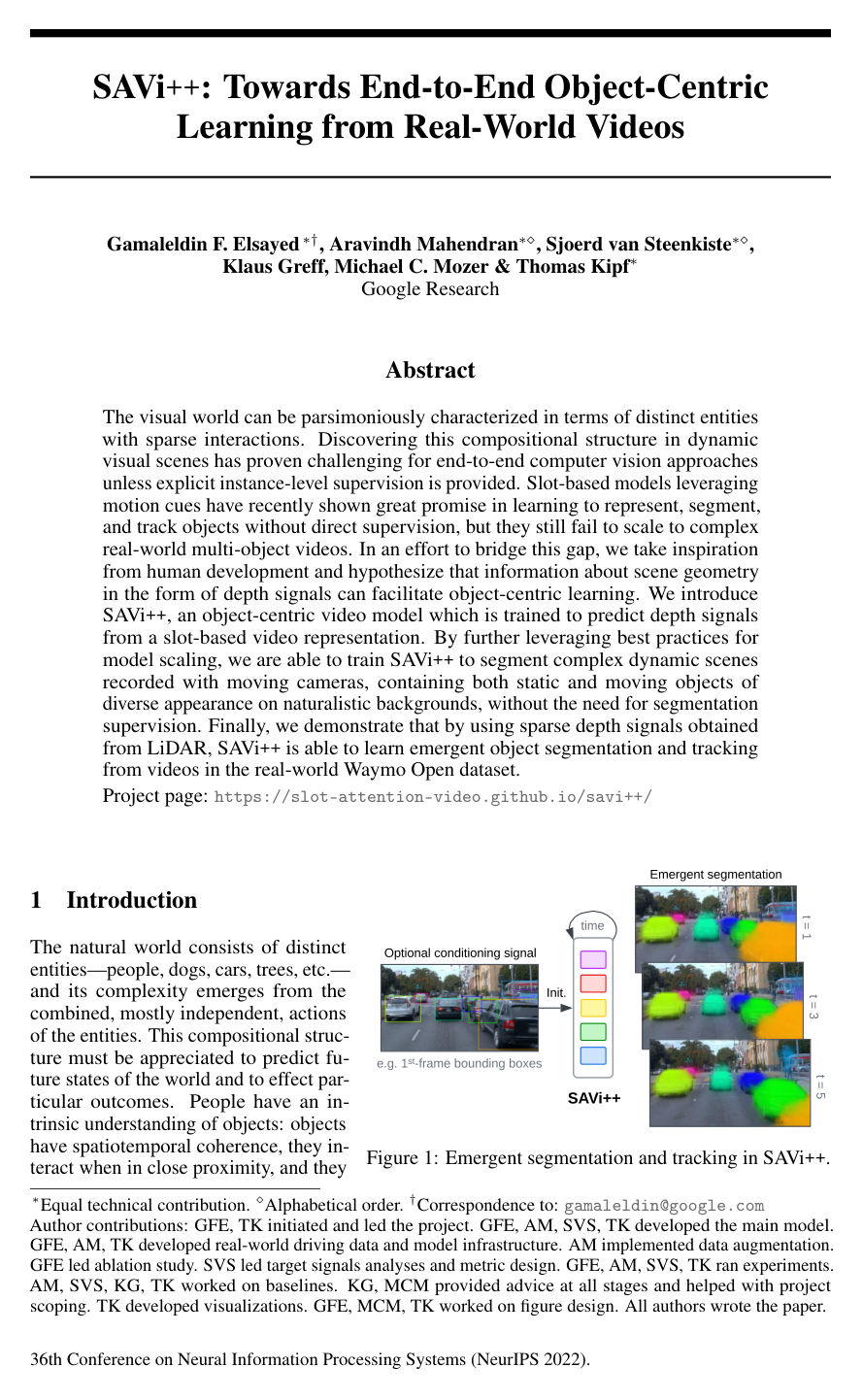
SAVi++: Towards End-to-End Object-Centric Learning from Real-World Videos
Gamaleldin F. Elsayed, Aravindh Mahendran, Sjoerd van Steenkiste, Klaus Greff, Michael C. Mozer, Thomas Kipf
Why you should read this
Presents an end-to-end slot-based video model that leverages depth prediction and architectural scaling to achieve unsupervised object segmentation and tracking in complex real-world driving scenes.
The visual world can be parsimoniously characterized in terms of distinct entities with sparse interactions. Discovering this compositional structure in dynamic visual scenes has proven challenging for end-to-end computer vision approaches unless explicit instance-level supervision is provided. Slot-based models leveraging motion cues have recently shown great promise in learning to represent, segment, and track objects without direct supervision, but they still fail to scale to complex real-world multi-object videos. In an effort to bridge this gap, we take inspiration from human development and hypothesize that information about scene geometry in the form of depth signals can facilitate object-centric learning. We introduce SAVi++, an object-centric video model which is trained to predict depth signals from a slot-based video representation. By further leveraging best practices for model scaling, we are able to train SAVi++ to segment complex dynamic scenes recorded with moving cameras, containing both static and moving objects of diverse appearance on naturalistic backgrounds, without the need for segmentation supervision. Finally, we demonstrate that by using sparse depth signals obtained from LiDAR, SAVi++ is able to learn emergent object segmentation and tracking from videos in the real-world Waymo Open dataset.
Added
2026-09-28
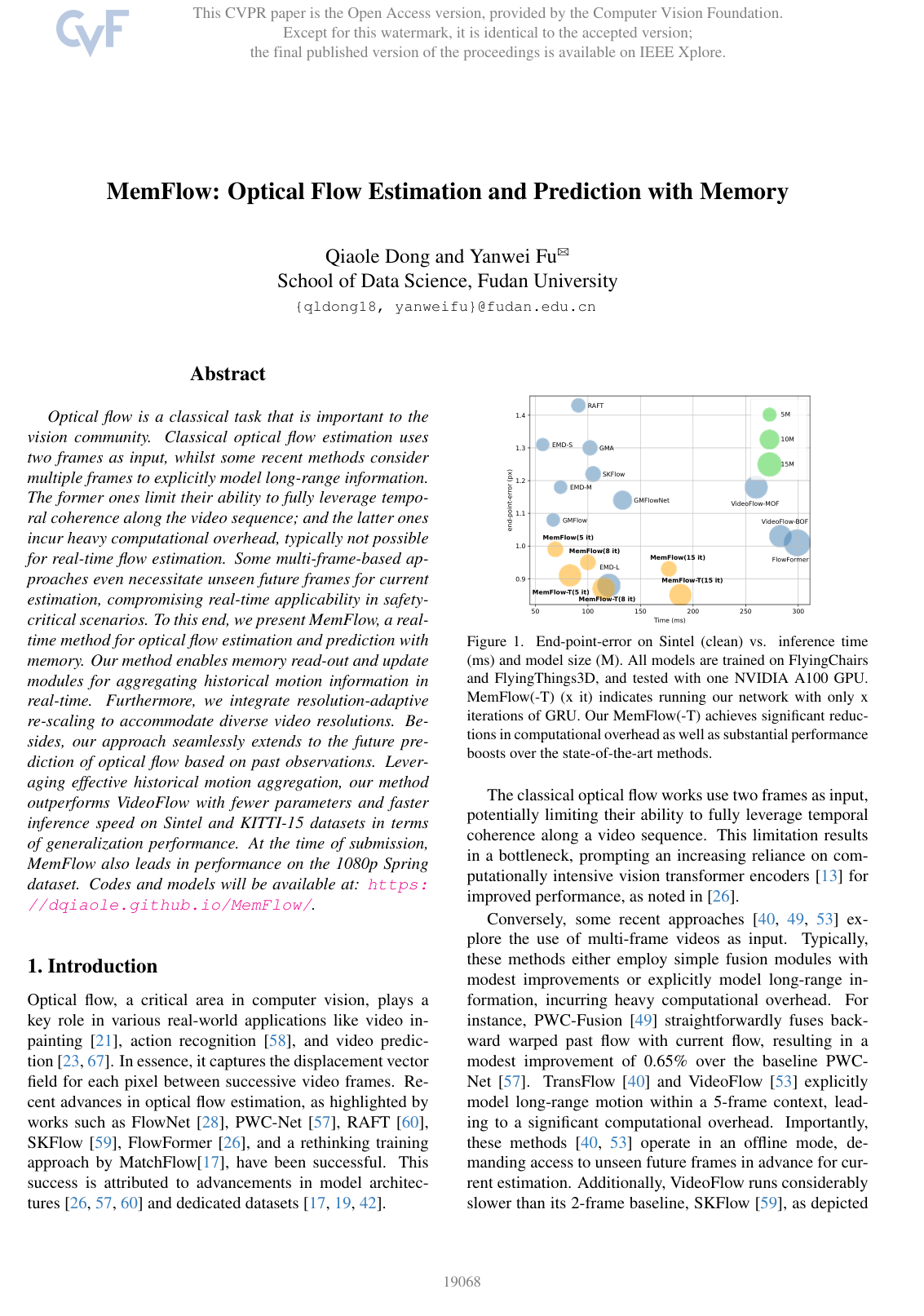
MemFlow: Optical Flow Estimation and Prediction with Memory
Qiaole Dong, Yanwei Fu
Why you should read this
Proposes a real-time multi-frame optical flow architecture that maintains a dynamic memory buffer to aggregate past motion, achieving state-of-the-art cross-dataset generalization on Sintel and KITTI-15 while directly supporting future flow prediction.
Optical flow is a classical task that is important to the vision community. Classical optical flow estimation uses two frames as input, whilst some recent methods consider multiple frames to explicitly model long-range information. The former ones limit their ability to fully leverage temporal coherence along the video sequence; and the latter ones incur heavy computational overhead, typically not possible for real-time flow estimation. Some multi-frame-based approaches even necessitate unseen future frames for current estimation, compromising real-time applicability in safety-critical scenarios. To this end, we present MemFlow, a real-time method for optical flow estimation and prediction with memory. Our method enables memory read-out and update modules for aggregating historical motion information in real-time. Furthermore, we integrate resolution-adaptive re-scaling to accommodate diverse video resolutions. Besides, our approach seamlessly extends to the future prediction of optical flow based on past observations. Leveraging effective historical motion aggregation, our method outperforms VideoFlow with fewer parameters and faster inference speed on Sintel and KITTI-15 datasets in terms of generalization performance. At the time of submission, MemFlow also leads in performance on the 1080p Spring dataset. Codes and models will be available at: https://dqiaole.github.io/MemFlow/.
Added
2026-09-26
Decoupling Features in Hierarchical Propagation for Video Object Segmentation
Zongxin Yang, Yi Yang
Why you should read this
Proposes a dual-branch hierarchical propagation framework and an efficient gated module that decouple visual from object-specific embeddings, setting new state-of-the-art benchmarks in video object segmentation while maintaining real-time processing speeds.
This paper focuses on developing a more effective method of hierarchical propagation for semi-supervised Video Object Segmentation (VOS). Based on vision transformers, the recently-developed Associating Objects with Transformers (AOT) approach introduces hierarchical propagation into VOS and has shown promising results. The hierarchical propagation can gradually propagate information from past frames to the current frame and transfer the current frame feature from object-agnostic to object-specific. However, the increase of object-specific information will inevitably lead to the loss of object-agnostic visual information in deep propagation layers. To solve such a problem and further facilitate the learning of visual embeddings, this paper proposes a Decoupling Features in Hierarchical Propagation (DeAOT) approach. Firstly, DeAOT decouples the hierarchical propagation of object-agnostic and object-specific embeddings by handling them in two independent branches. Secondly, to compensate for the additional computation from dual-branch propagation, we propose an efficient module for constructing hierarchical propagation, i.e., Gated Propagation Module, which is carefully designed with single-head attention. Extensive experiments show that DeAOT significantly outperforms AOT in both accuracy and efficiency. On YouTube-VOS, DeAOT can achieve 86.0% at 22.4fps and 82.0% at 53.4fps. Without test-time augmentations, we achieve new state-of-the-art performance on four benchmarks, i.e., YouTube-VOS (86.2%), DAVIS 2017 (86.2%), DAVIS 2016 (92.9%), and VOT 2020 (0.622). Project page: https://github.com/z-x-yang/AOT.
Added
2026-09-26
D2NeRF: Self-Supervised Decoupling of Dynamic and Static Objects from a Monocular Video
Tianhao Wu, Fangcheng Zhong, Andrea Tagliasacchi, Forrester Cole, Cengiz Öztireli
Why you should read this
Presents a self-supervised neural radiance field framework that reconstructs static 3D scenes from monocular video by decoupling moving objects and dynamic shadows using separate field networks and a skewed-entropy loss.
Given a monocular video, segmenting and decoupling dynamic objects while recovering the static environment is a widely studied problem in machine intelligence. Existing solutions usually approach this problem in the image domain, limiting their performance and understanding of the environment. We introduce Decoupled Dynamic Neural Radiance Field (D²NeRF), a self-supervised approach that takes a monocular video and learns a 3D scene representation which decouples moving objects, including their shadows, from the static background. Our method represents the moving objects and the static background by two separate neural radiance fields with only one allowing for temporal changes. A naive implementation of this approach leads to the dynamic component taking over the static one as the representation of the former is inherently more general and prone to overfitting. To this end, we propose a novel loss to promote correct separation of phenomena. We further propose a shadow field network to detect and decouple dynamically moving shadows. We introduce a new dataset containing various dynamic objects and shadows and demonstrate that our method can achieve better performance than state-of-the-art approaches in decoupling dynamic and static 3D objects, occlusion and shadow removal, and image segmentation for moving objects. Project page: d2nerf.github.io
Added
2026-09-26
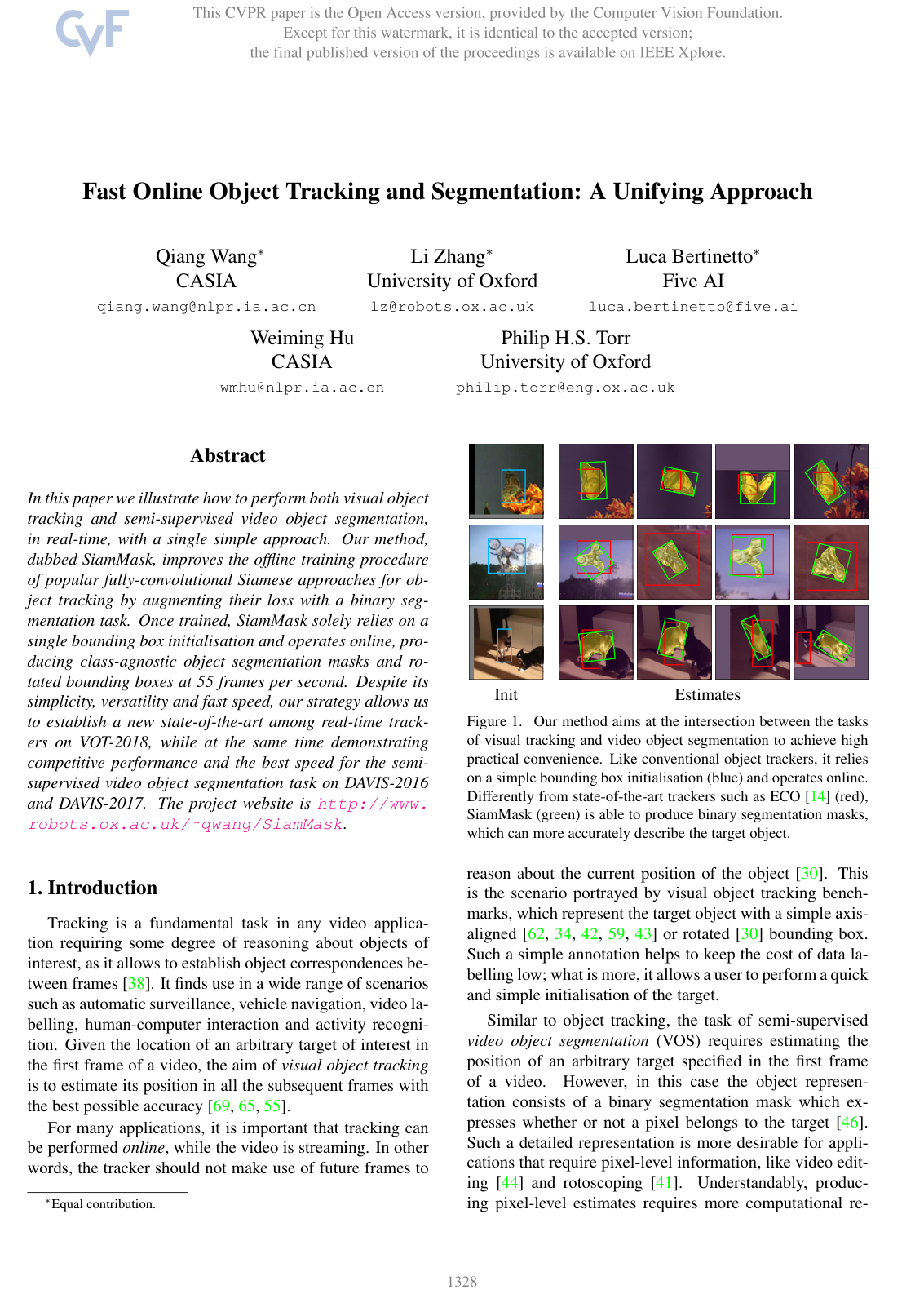
Fast Online Object Tracking and Segmentation: A Unifying Approach
Qiang Wang, Li Zhang, Luca Bertinetto, Weiming Hu, Philip H. S. Torr
Why you should read this
Proposes SiamMask, a unified framework that extends fully-convolutional Siamese trackers with a binary segmentation branch to achieve state-of-the-art real-time object tracking and video mask generation at 55 frames per second from a single bounding box initialization.
In this paper we illustrate how to perform both visual object tracking and semi-supervised video object segmentation, in real-time, with a single simple approach. Our method, dubbed SiamMask, improves the offline training procedure of popular fully-convolutional Siamese approaches for object tracking by augmenting their loss with a binary segmentation task. Once trained, SiamMask solely relies on a single bounding box initialisation and operates online, producing class-agnostic object segmentation masks and rotated bounding boxes at 55 frames per second. Despite its simplicity, versatility and fast speed, our strategy allows us to establish a new state of the art among real-time trackers on VOT-2018, while at the same time demonstrating competitive performance and the best speed for the semi-supervised video object segmentation task on DAVIS-2016 and DAVIS-2017. The project website is this http URL.
Added
2026-09-25
DINOv3
Oriane Siméoni, Huy V. Vo, Maximilian Seitzer, Federico Baldassarre, Maxime Oquab, Cijo Jose, Vasil Khalidov, Marc Szafraniec, Seungeun Yi, Michaël Ramamonjisoa, Francisco Massa, Daniel Haziza, Luca Wehrstedt, Jianyuan Wang, Timothée Darcet, Théo Moutakanni, Leonel Sentana, Claire Roberts, Andrea Vedaldi, Jamie Tolan, John Brandt, Camille Couprie, Julien Mairal, Hervé Jégou, Patrick Labatut, Piotr Bojanowski
Why you should read this
Introduces DINOv3, a self-supervised vision foundation model that incorporates Gram anchoring to prevent feature degradation during extended training and achieves state-of-the-art dense representation performance across diverse visual tasks without fine-tuning.
Self-supervised learning holds the promise of eliminating the need for manual data annotation, enabling models to scale effortlessly to massive datasets and larger architectures. By not being tailored to specific tasks or domains, this training paradigm has the potential to learn visual representations from diverse sources, ranging from natural to aerial images -- using a single algorithm. This technical report introduces DINOv3, a major milestone toward realizing this vision by leveraging simple yet effective strategies. First, we leverage the benefit of scaling both dataset and model size by careful data preparation, design, and optimization. Second, we introduce a new method called Gram anchoring, which effectively addresses the known yet unsolved issue of dense feature maps degrading during long training schedules. Finally, we apply post-hoc strategies that further enhance our models' flexibility with respect to resolution, model size, and alignment with text. As a result, we present a versatile vision foundation model that outperforms the specialized state of the art across a broad range of settings, without fine-tuning. DINOv3 produces high-quality dense features that achieve outstanding performance on various vision tasks, significantly surpassing previous self- and weakly-supervised foundation models. We also share the DINOv3 suite of vision models, designed to advance the state of the art on a wide spectrum of tasks and data by providing scalable solutions for diverse resource constraints and deployment scenarios.
Added
2026-09-25
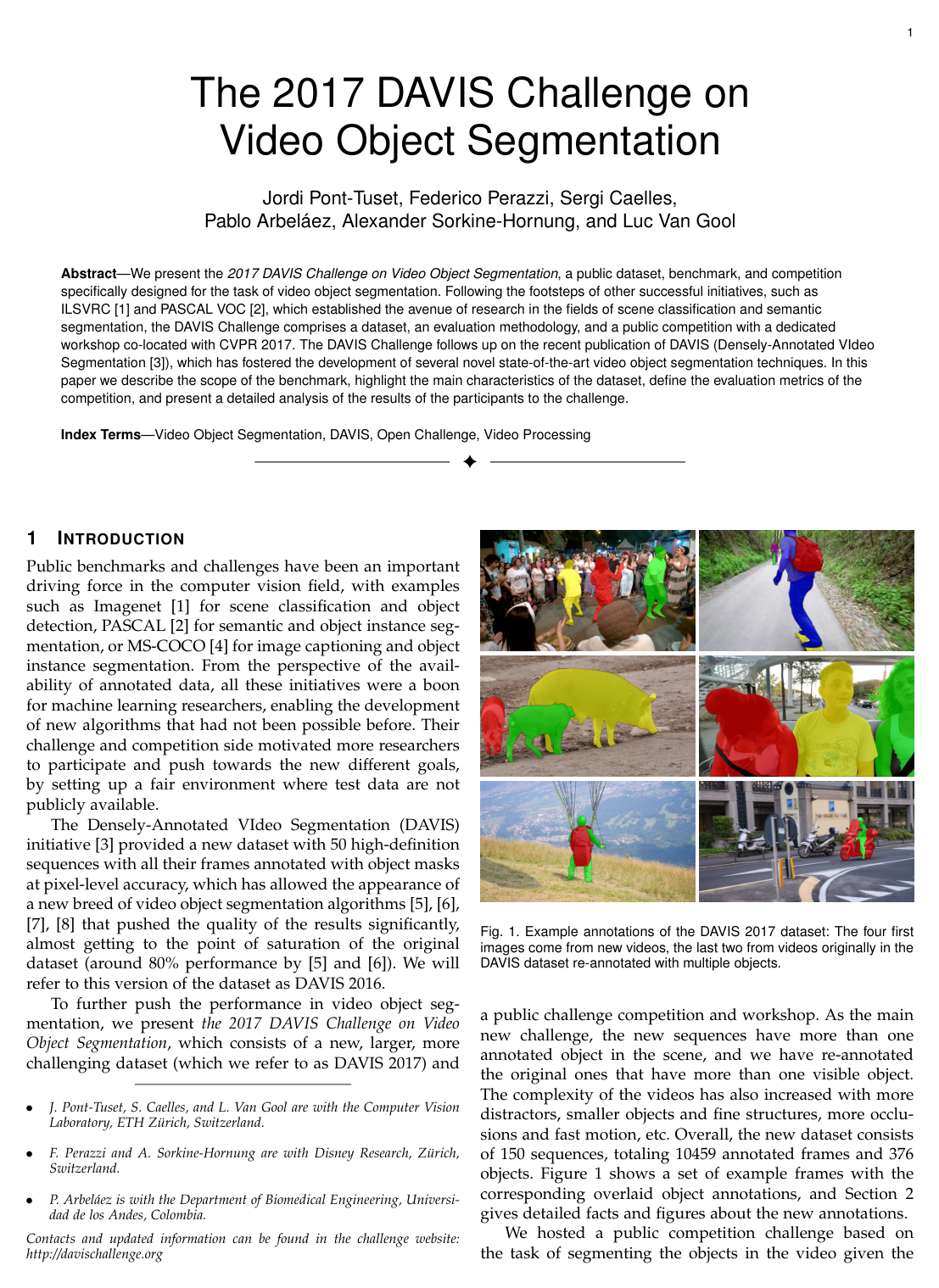
The 2017 DAVIS Challenge on Video Object Segmentation
Jordi Pont-Tuset, Federico Perazzi, Sergi Caelles, Pablo Arbeláez, Alex Sorkine-Hornung, Luc Van Gool
Why you should read this
Establishes a standardized benchmark for video object segmentation by introducing an expanded multi-object dataset, formal evaluation metrics, and a comparative performance analysis of top-performing methods.
We present the 2017 DAVIS Challenge on Video Object Segmentation, a public dataset, benchmark, and competition specifically designed for the task of video object segmentation. Following the footsteps of other successful initiatives, such as ILSVRC and PASCAL VOC, which established the avenue of research in the fields of scene classification and semantic segmentation, the DAVIS Challenge comprises a dataset, an evaluation methodology, and a public competition with a dedicated workshop co-located with CVPR 2017. The DAVIS Challenge follows up on the recent publication of DAVIS (Densely-Annotated VIdeo Segmentation), which has fostered the development of several novel state-of-the-art video object segmentation techniques. In this paper we describe the scope of the benchmark, highlight the main characteristics of the dataset, define the evaluation metrics of the competition, and present a detailed analysis of the results of the participants to the challenge.
Added
2026-09-24
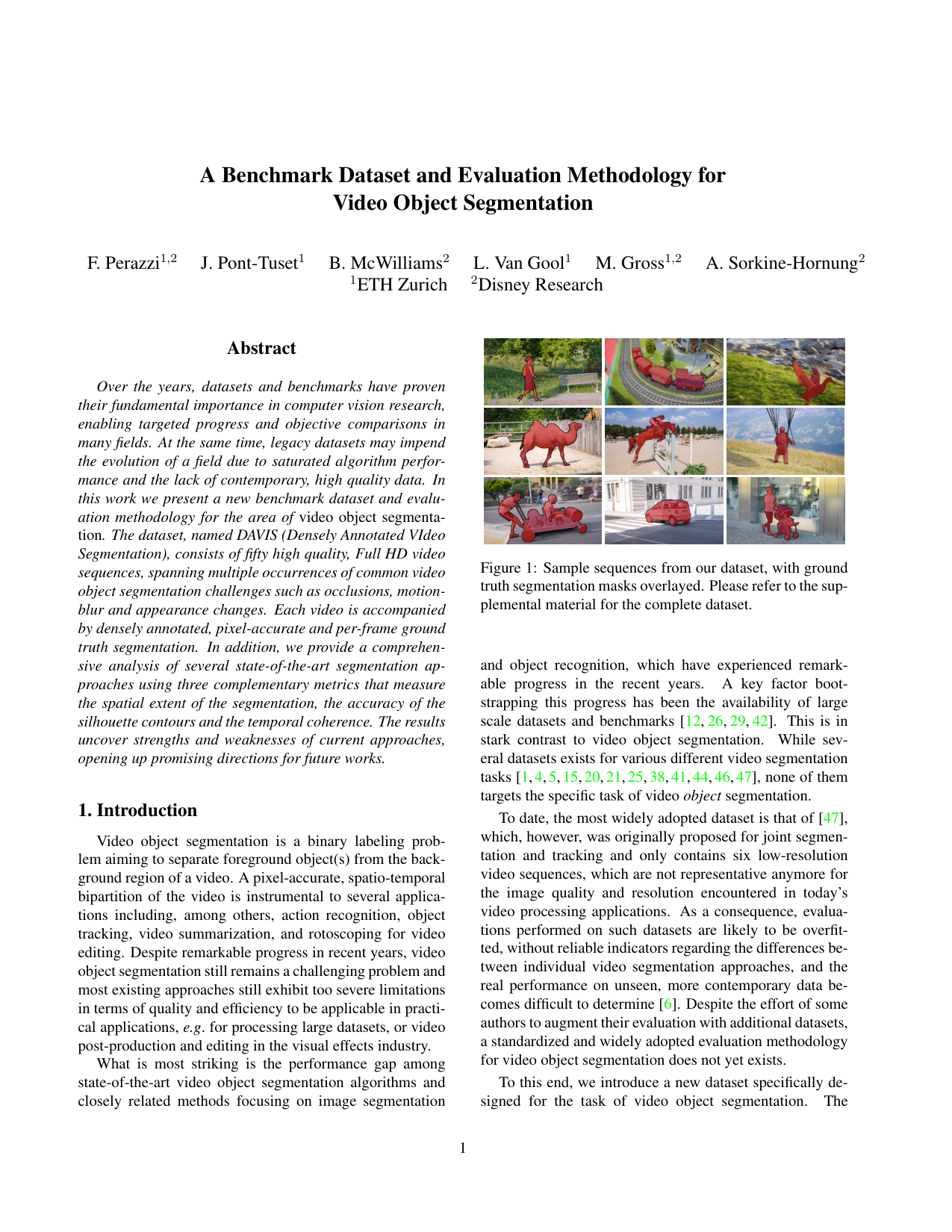
A Benchmark Dataset and Evaluation Methodology for Video Object Segmentation
Federico Perazzi, J. Pont-Tuset, B. McWilliams, L. Gool, M. Gross, A. Sorkine-Hornung
Why you should read this
Introduces the densely annotated DAVIS video-segmentation benchmark and complementary spatial, contour, and temporal metrics that expose the strengths and weaknesses of current methods.
Over the years, datasets and benchmarks have proven their fundamental importance in computer vision research, enabling targeted progress and objective comparisons in many fields. At the same time, legacy datasets may impend the evolution of a field due to saturated algorithm performance and the lack of contemporary, high quality data. In this work we present a new benchmark dataset and evaluation methodology for the area of video object segmentation. The dataset, named DAVIS (Densely Annotated VIdeo Segmentation), consists of fifty high quality, Full HD video sequences, spanning multiple occurrences of common video object segmentation challenges such as occlusions, motion-blur and appearance changes. Each video is accompanied by densely annotated, pixel-accurate and per-frame ground truth segmentation. In addition, we provide a comprehensive analysis of several state-of-the-art segmentation approaches using three complementary metrics that measure the spatial extent of the segmentation, the accuracy of the silhouette contours and the temporal coherence. The results uncover strengths and weaknesses of current approaches, opening up promising directions for future works.
Added
2026-09-14
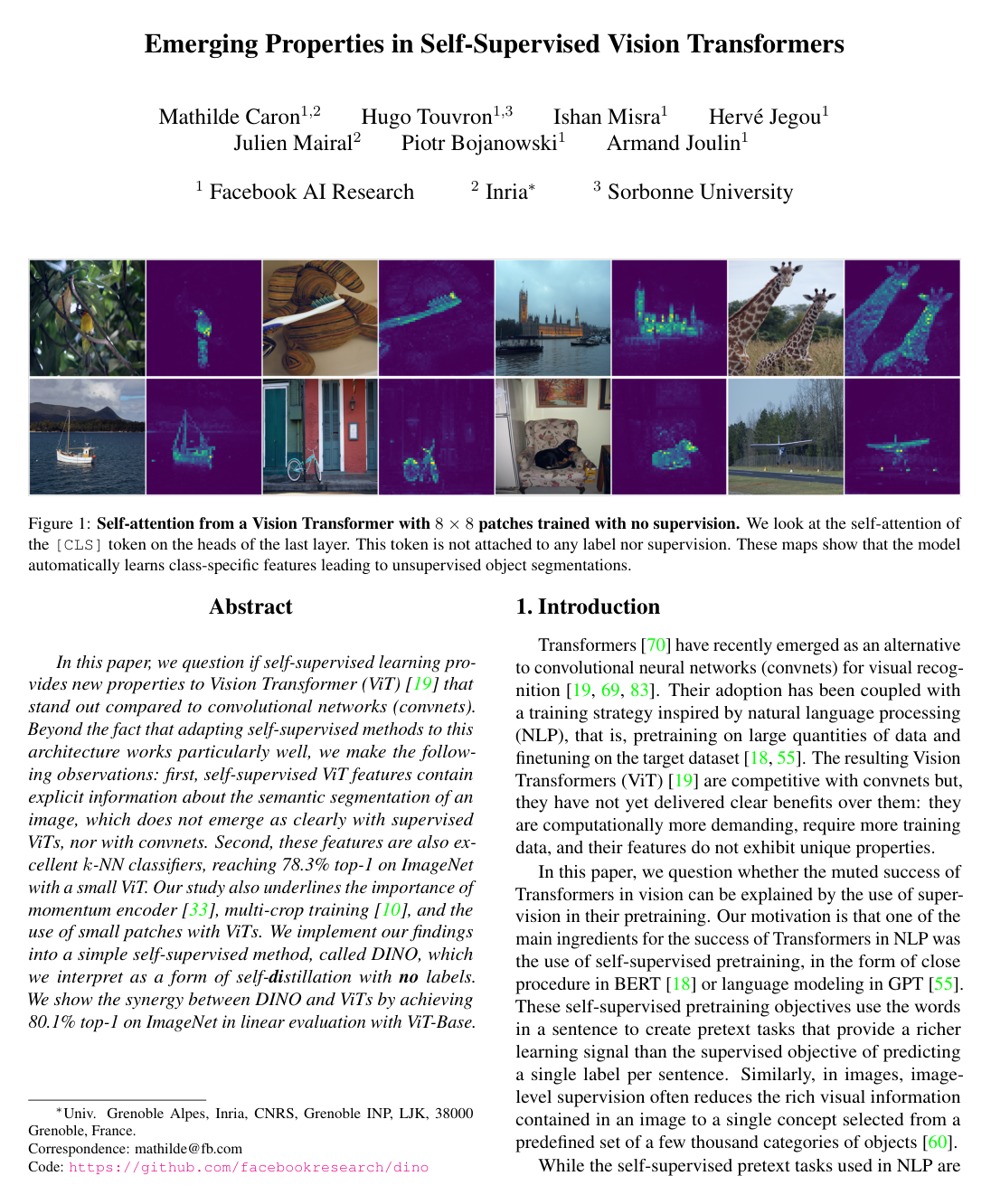
Emerging Properties in Self-Supervised Vision Transformers
Mathilde Caron, Hugo Touvron, Ishan Misra, Hervé Jégou, Julien Mairal, Piotr Bojanowski, Armand Joulin
Why you should read this
Demonstrates how self-supervised learning with Vision Transformers automatically discovers object boundaries and segmentation without any labels, a capability that doesn't emerge in supervised Vision Transformers or standard convolutional networks, and introduces DINO, a simpler self-supervised method that achieves state-of-the-art results by treating the learning process as self-distillation.
In this paper, we question if self-supervised learning provides new properties to Vision Transformer (ViT) that stand out compared to convolutional networks (convnets). Beyond the fact that adapting self-supervised methods to this architecture works particularly well, we make the following observations: first, self-supervised ViT features contain explicit information about the semantic segmentation of an image, which does not emerge as clearly with supervised ViTs, nor with convnets. Second, these features are also excellent k-NN classifiers, reaching 78.3% top-1 on ImageNet with a small ViT. Our study also underlines the importance of momentum encoder, multi-crop training, and the use of small patches with ViTs. We implement our findings into a simple self-supervised method, called DINO, which we interpret as a form of self-distillation with no labels. We show the synergy between DINO and ViTs by achieving 80.1% top-1 on ImageNet in linear evaluation with ViT-Base.
Added
2026-02-21