
keyword
video enhancement
Video enhancement is the process of improving the visual quality, clarity, and resolution of digital video sequences. It encompasses a range of computational techniques designed to restore degraded footage or augment lower-quality recordings, including video super-resolution, noise reduction, compression artifact removal, and frame rate interpolation. Unlike single-image processing, video enhancement relies heavily on temporal information, utilizing motion estimation and alignment across consecutive frames to reconstruct fine spatial details while maintaining temporal consistency to prevent visual flickering, jitter, and artifacts across the sequence.
2 items
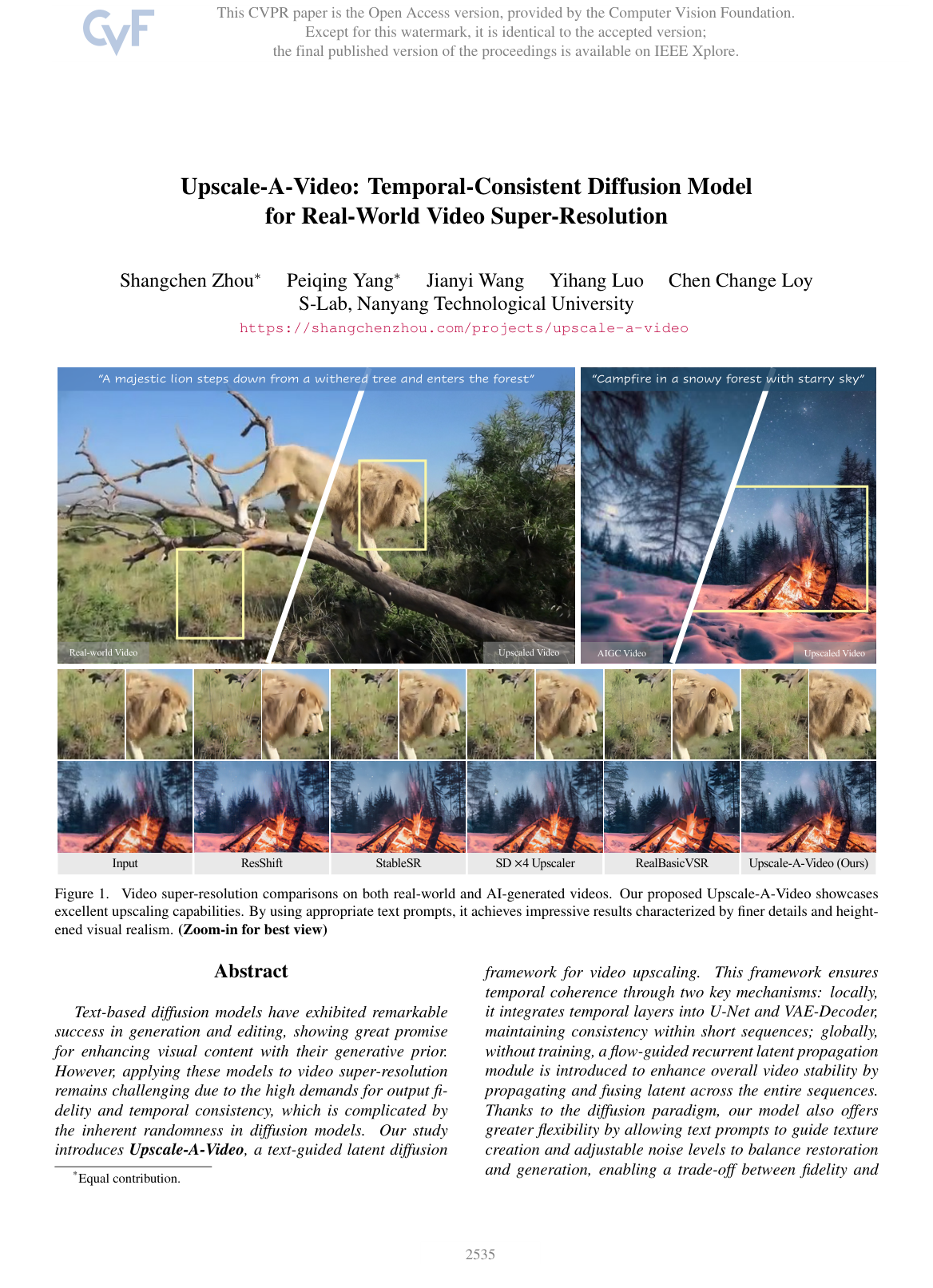
Upscale-A-Video: Temporal-Consistent Diffusion Model for Real-World Video Super-Resolution
Shangchen Zhou, Peiqing Yang, Jianyi Wang, Yihang Luo, Chen Change Loy
Why you should read this
Proposes a text-guided latent diffusion framework for real-world video super-resolution that integrates local temporal layers into the U-Net and VAE decoder alongside training-free recurrent latent propagation to produce temporally consistent, high-quality video sequences.
Text-based diffusion models have exhibited remarkable success in generation and editing, showing great promise for enhancing visual content with their generative prior. However, applying these models to video super-resolution remains challenging due to the high demands for output fidelity and temporal consistency, which is complicated by the inherent randomness in diffusion models. Our study introduces Upscale-A-Video, a text-guided latent diffusion framework for video upscaling. This framework ensures temporal coherence through two key mechanisms: locally, it integrates temporal layers into U-Net and VAE-Decoder, maintaining consistency within short sequences; globally, without training, a flow-guided recurrent latent propagation module is introduced to enhance overall video stability by propagating and fusing latent across the entire sequences. Thanks to the diffusion paradigm, our model also offers greater flexibility by allowing text prompts to guide texture creation and adjustable noise levels to balance restoration and generation, enabling a trade-off between fidelity and
Added
2026-09-26
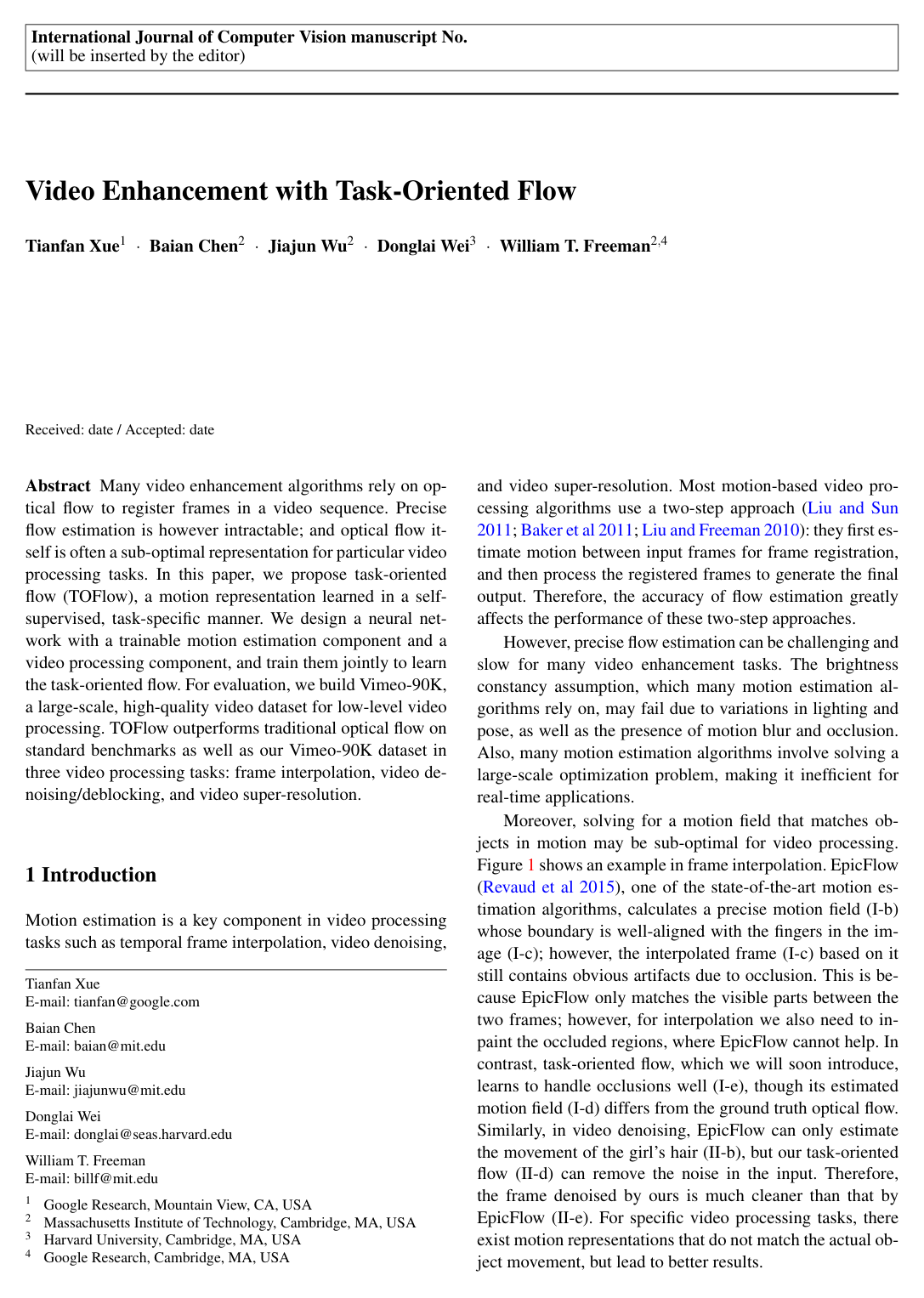
Video Enhancement with Task-Oriented Flow
Tianfan Xue, Baian Chen, Jiajun Wu, Donglai Wei, William T. Freeman
Why you should read this
Proposes task-oriented flow (TOFlow) and the Vimeo-90K benchmark, demonstrating that learning task-specific motion representations end-to-end outperforms standard optical flow for video frame interpolation, denoising, and super-resolution.
Many video enhancement algorithms rely on optical flow to register frames in a video sequence. Precise flow estimation is however intractable; and optical flow itself is often a sub-optimal representation for particular video processing tasks. In this paper, we propose task-oriented flow (TOFlow), a motion representation learned in a self-supervised, task-specific manner. We design a neural network with a trainable motion estimation component and a video processing component, and train them jointly to learn the task-oriented flow. For evaluation, we build Vimeo-90K, a large-scale, high-quality video dataset for low-level video processing. TOFlow outperforms traditional optical flow on standard benchmarks as well as our Vimeo-90K dataset in three video processing tasks: frame interpolation, video denoising/deblocking, and video super-resolution.
Added
2026-09-24