
keyword
UI understanding
UI understanding is a multimodal artificial intelligence capability that enables computer systems to perceive, parse, and semantically interpret graphical user interfaces displayed on digital screens. It involves analyzing visual elements such as text, buttons, icons, forms, and layout structures directly from screenshots or underlying structural code to comprehend their visual hierarchy and functional relationships. By bridging computer vision and language comprehension, UI understanding allows models to perform tasks such as screen reading comprehension, visual question answering, element localization, and autonomous task navigation across web and mobile applications.
3 items
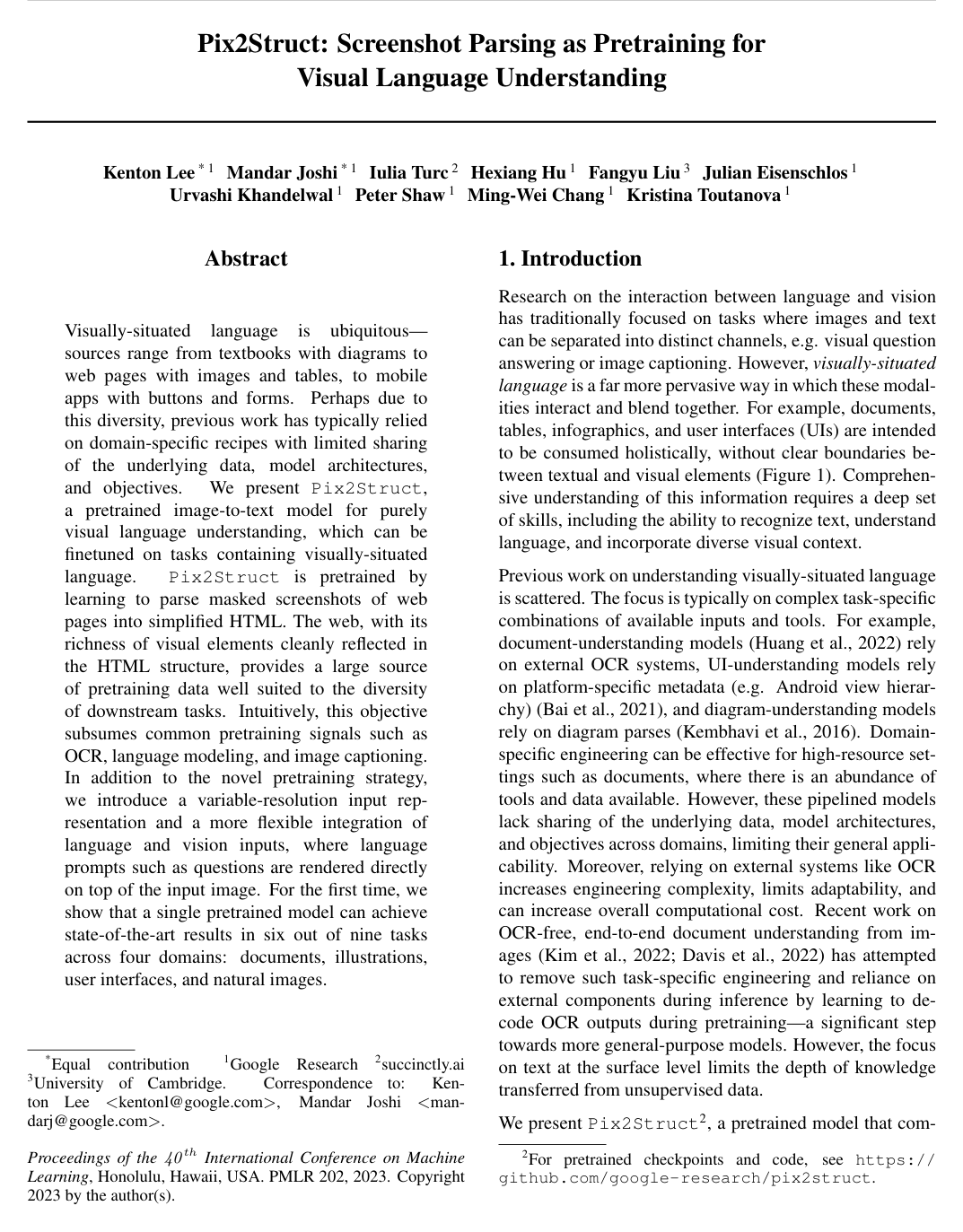
Pix2Struct: Screenshot Parsing as Pretraining for Visual Language Understanding
Kenton Lee, Mandar Joshi, Iulia Raluca Turc, Hexiang Hu, Fangyu Liu, Julian Martin Eisenschlos, Urvashi Khandelwal, Peter Shaw, Ming-Wei Chang, Kristina Toutanova
Why you should read this
Presents Pix2Struct, an image-to-text model pretrained by parsing masked web screenshots into simplified HTML, enabling a single OCR-free architecture to handle diverse visual language tasks across documents, diagrams, and user interfaces.
Visually-situated language is ubiquitous—sources range from textbooks with diagrams to web pages with images and tables, to mobile apps with buttons and forms. Perhaps due to this diversity, previous work has typically relied on domain-specific recipes with limited sharing of the underlying data, model architectures, and objectives. We present Pix2Struct, a pretrained image-to-text model for purely visual language understanding, which can be finetuned on tasks containing visually-situated language. Pix2Struct is pretrained by learning to parse masked screenshots of web pages into simplified HTML. The web, with its richness of visual elements cleanly reflected in the HTML structure, provides a large source of pretraining data well suited to the diversity of downstream tasks. Intuitively, this objective subsumes common pretraining signals such as OCR, language modeling, and image captioning. In addition to the novel pretraining strategy, we introduce a variable-resolution input representation and a more flexible integration of language and vision inputs, where language prompts such as questions are rendered directly on top of the input image. For the first time, we show that a single pretrained model can achieve state-of-the-art results in six out of nine tasks across four domains: documents, illustrations, user interfaces, and natural images.
Added
2026-09-28
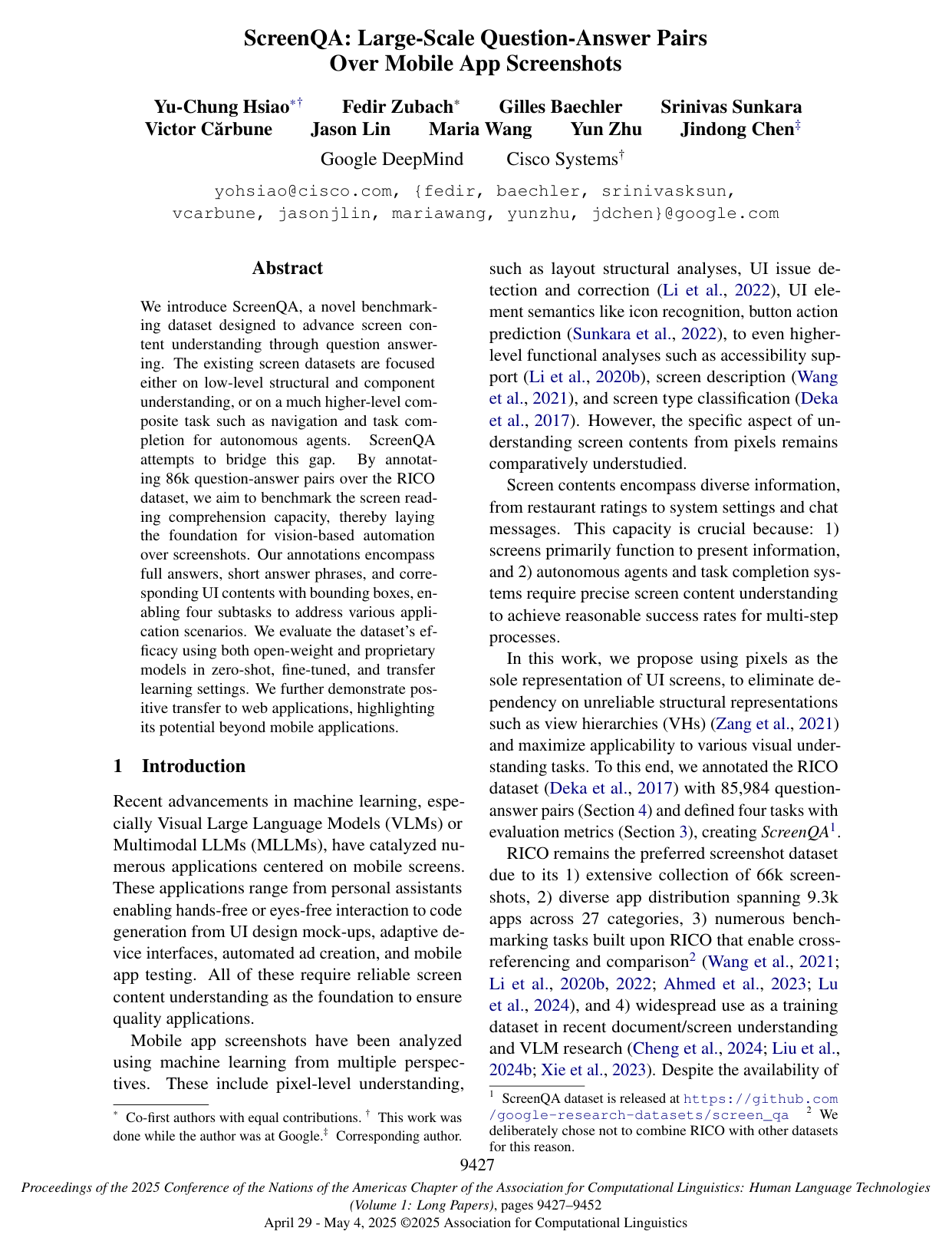
ScreenQA: Large-Scale Question-Answer Pairs Over Mobile App Screenshots
Yu-Chung Hsiao, Fedir Zubach, Gilles Baechler, Srinivas Sunkara, Victor Carbune, Jason Lin, Maria Wang, Yun Zhu, Jindong Chen
Why you should read this
Presents ScreenQA, a large-scale benchmark of 86,000 question-answer pairs with bounding-box groundings over mobile screenshots to evaluate multimodal models on visual screen reading comprehension and interface-based automation.
We introduce ScreenQA, a novel benchmarking dataset designed to advance screen content understanding through question answering. The existing screen datasets are focused either on low-level structural and component understanding, or on a much higher-level composite task such as navigation and task completion for autonomous agents. ScreenQA attempts to bridge this gap. By annotating 86k question-answer pairs over the RICO dataset, we aim to benchmark the screen reading comprehension capacity, thereby laying the foundation for vision-based automation over screenshots. Our annotations encompass full answers, short answer phrases, and corresponding UI contents with bounding boxes, enabling four subtasks to address various application scenarios. We evaluate the dataset's efficacy using both open-weight and proprietary models in zero-shot, fine-tuned, and transfer learning settings. We further demonstrate positive transfer to web applications, highlighting its potential beyond mobile applications.
Added
2026-09-26
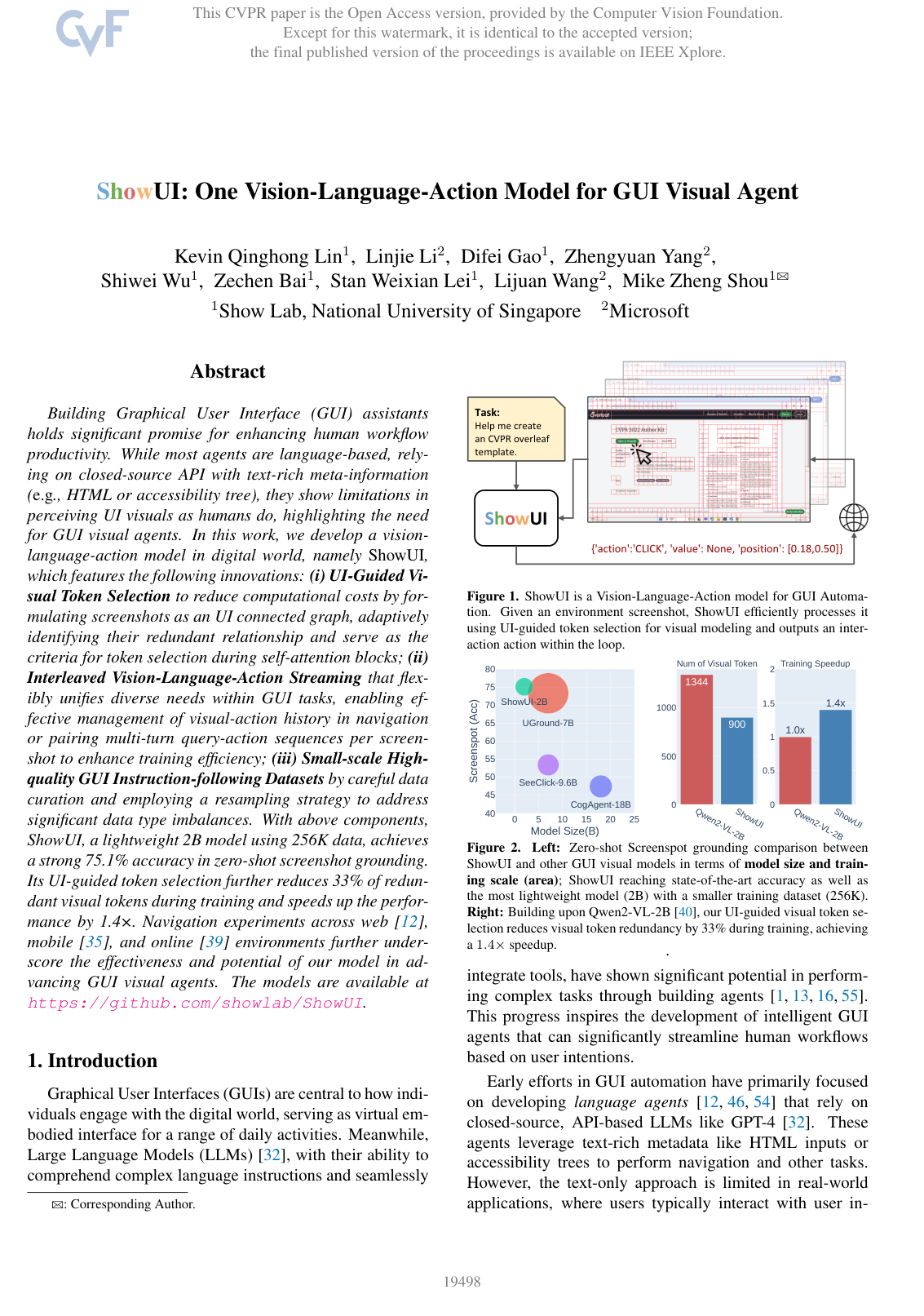
ShowUI: One Vision-Language-Action Model for GUI Visual Agent
Kevin Qinghong Lin, Linjie Li, Difei Gao, Zhengyuan Yang, Shiwei Wu, Zechen Bai, Stan Weixian Lei, Lijuan Wang, Mike Zheng Shou
Why you should read this
Presents a lightweight 2B vision-language-action model that achieves state-of-the-art zero-shot GUI grounding by pruning redundant visual tokens through connected UI graphs and unifying multi-turn navigation into an interleaved streaming framework.
Building Graphical User Interface (GUI) assistants holds significant promise for enhancing human workflow productivity. While most agents are language-based, relying on closed-source API with text-rich meta-information (e.g., HTML or accessibility tree), they show limitations in perceiving UI visuals as humans do, highlighting the need for GUI visual agents. In this work, we develop a vision-language-action model in digital world, namely ShowUI, which features the following innovations: (i) UI-Guided Visual Token Selection to reduce computational costs by formulating screenshots as an UI connected graph, adaptively identifying their redundant relationship and serve as the criteria for token selection during self-attention blocks; (ii) Interleaved Vision-Language-Action Streaming that flexibly unifies diverse needs within GUI tasks, enabling effective management of visual-action history in navigation or pairing multi-turn query-action sequences per screenshot to enhance training efficiency; (iii) Small-scale High-quality GUI Instruction-following Datasets by careful data curation and employing a resampling strategy to address significant data type imbalances. With above components, ShowUI, a lightweight 2B model using 256K data, achieves a strong 75.1% accuracy in zero-shot screenshot grounding. Its UI-guided token selection further reduces 33% of redundant visual tokens during training and speeds up the performance by 1.4x. Navigation experiments across web [12], mobile [35], and online [39] environments further underscore the effectiveness and potential of our model in advancing GUI visual agents. The models are available at https://github.com/showlab/ShowUI.
Added
2026-09-26