
keyword
transformer feed-forward layers
Transformer feed-forward layers are neural network sub-layers within each block of a transformer architecture that process and transform individual token representations independently across sequence positions. Typically situated after the multi-head attention mechanism, each feed-forward layer consists of two linear transformations separated by a non-linear activation function, expanding the representation into a higher-dimensional intermediate space before projecting it back to the original model dimension. These components comprise a substantial portion of a transformer model parameters and computational cost, functioning largely as associative or key-value memory structures that store linguistic and factual knowledge to iteratively update token representations and refine predictions over the vocabulary.
4 items
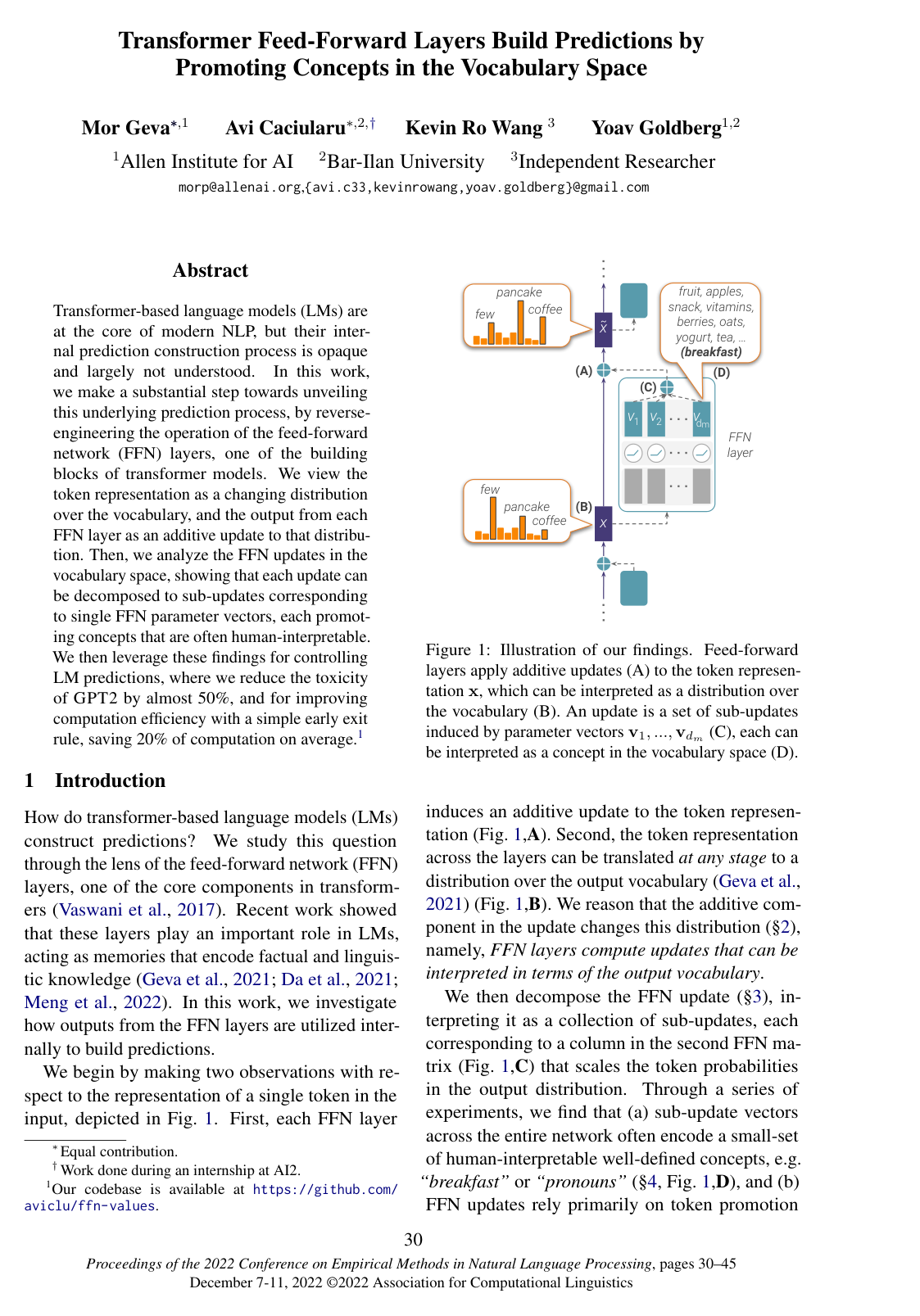
Transformer Feed-Forward Layers Build Predictions by Promoting Concepts in the Vocabulary Space
Mor Geva, Avi Caciularu, Kevin Ro Wang, Yoav Goldberg
Why you should read this
Reveals how transformer feed-forward layers construct predictions by promoting human-interpretable concepts directly in the vocabulary space, enabling practical techniques to cut GPT-2 toxicity by half and save twenty percent of inference computation through early exiting.
Transformer-based language models (LMs) are at the core of modern NLP, but their internal prediction construction process is opaque and largely not understood. In this work, we make a substantial step towards unveiling this underlying prediction process, by reverse-engineering the operation of the feed-forward network (FFN) layers, one of the building blocks of transformer models. We view the token representation as a changing distribution over the vocabulary, and the output from each FFN layer as an additive update to that distribution. Then, we analyze the FFN updates in the vocabulary space, showing that each update can be decomposed to sub-updates corresponding to single FFN parameter vectors, each promoting concepts that are often human-interpretable. We then leverage these findings for controlling LM predictions, where we reduce the toxicity of GPT2 by almost 50%, and for improving computation efficiency with a simple early exit rule, saving 20% of computation on average.
Added
2026-09-29
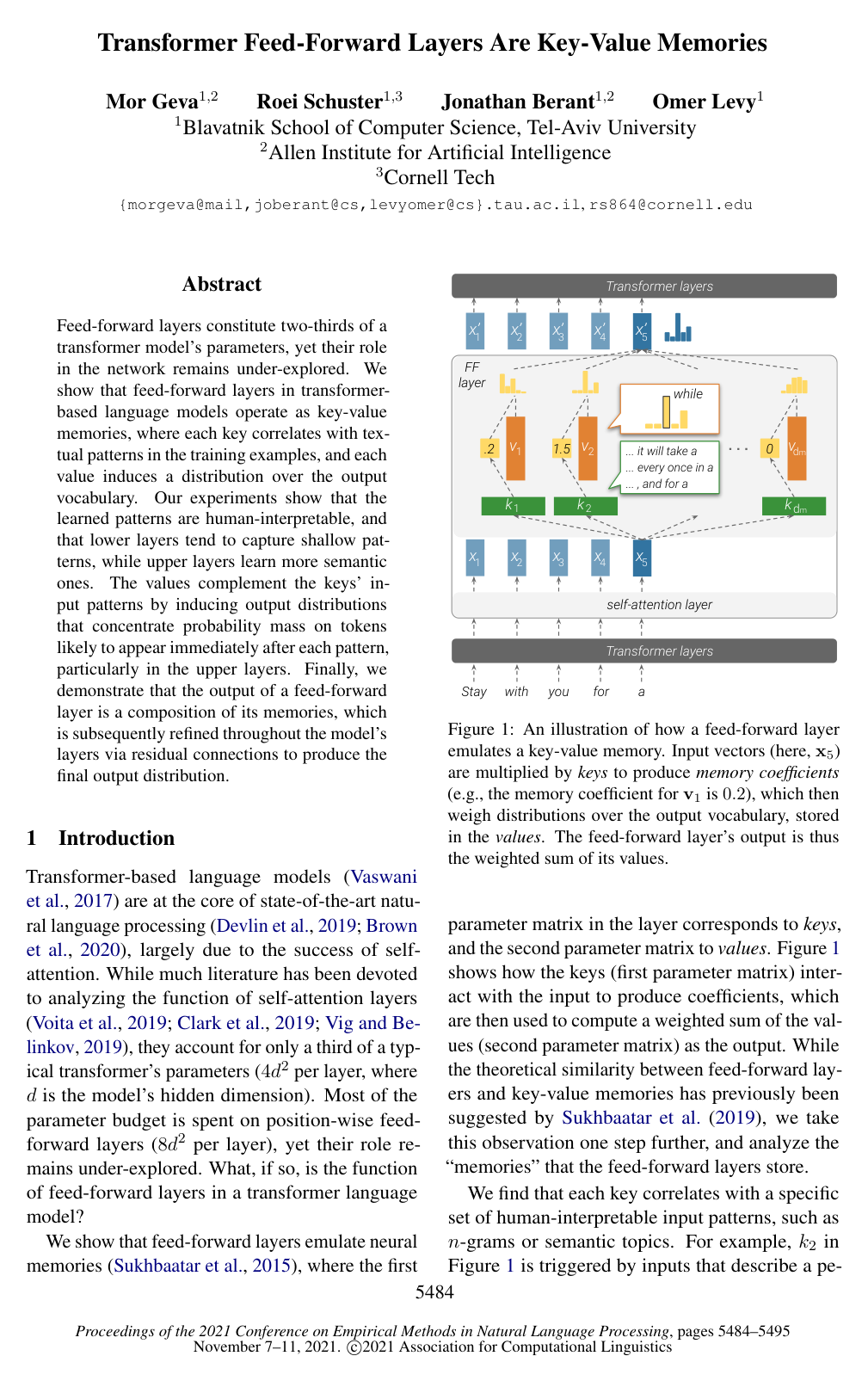
Transformer Feed-Forward Layers Are Key-Value Memories
Mor Geva, Roei Schuster, Jonathan Berant, Omer Levy
Why you should read this
Shows that transformer feed-forward layers function as key-value memories, revealing how the majority of network parameters store human-interpretable textual patterns and directly predict next-token distributions.
Feed-forward layers constitute two-thirds of a transformer model's parameters, yet their role in the network remains under-explored. We show that feed-forward layers in transformer-based language models operate as key-value memories, where each key correlates with textual patterns in the training examples, and each value induces a distribution over the output vocabulary. Our experiments show that the learned patterns are human-interpretable, and that lower layers tend to capture shallow patterns, while upper layers learn more semantic ones. The values complement the keys' input patterns by inducing output distributions that concentrate probability mass on tokens likely to appear immediately after each pattern, particularly in the upper layers. Finally, we demonstrate that the output of a feed-forward layer is a composition of its memories, which is subsequently refined throughout the model's layers via residual connections to produce the final output distribution.
Added
2026-09-24
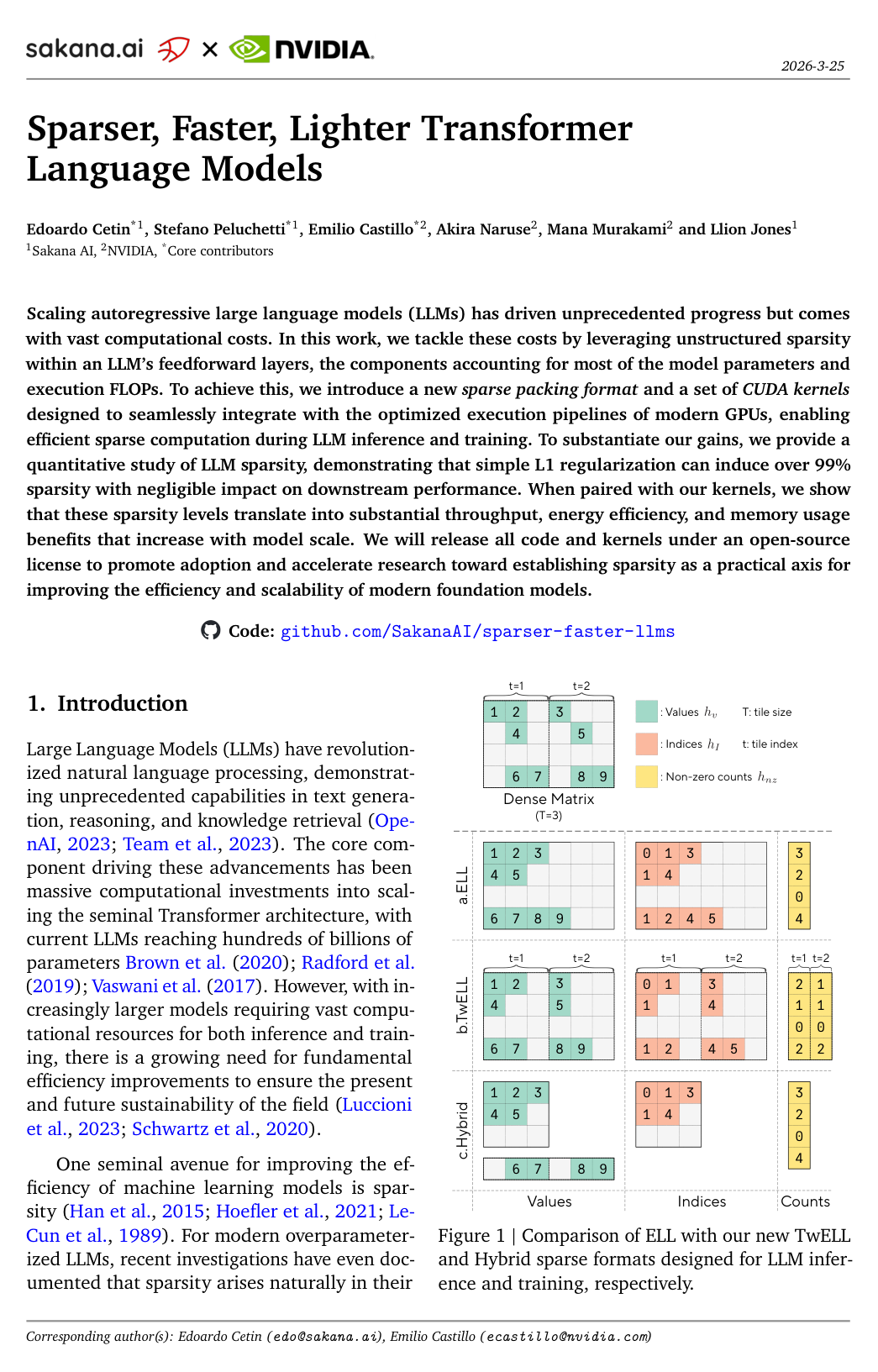
Sparser, Faster, Lighter Transformer Language Models
Edoardo Cetin, Stefano Peluchetti, Emilio Castillo, Akira Naruse, Mana Murakami, Llion Jones
Why you should read this
Introduces a novel sparse packing format and CUDA kernels that overcome the historical inefficiency of sparse computations on GPUs, enabling over 99% unstructured sparsity in LLM feedforward layers with substantial gains in throughput, energy efficiency, and memory usage.
Scaling autoregressive large language models (LLMs) has driven unprecedented progress but comes with vast computational costs. In this work, we tackle these costs by leveraging unstructured sparsity within an LLM's feedforward layers, the components accounting for most of the model parameters and execution FLOPs. To achieve this, we introduce a new sparse packing format and a set of CUDA kernels designed to seamlessly integrate with the optimized execution pipelines of modern GPUs, enabling efficient sparse computation during LLM inference and training. To substantiate our gains, we provide a quantitative study of LLM sparsity, demonstrating that simple L1 regularization can induce over 99% sparsity with negligible impact on downstream performance. When paired with our kernels, we show that these sparsity levels translate into substantial throughput, energy efficiency, and memory usage benefits that increase with model scale. We will release all code and kernels under an open-source license to promote adoption and accelerate research toward establishing sparsity as a practical axis for improving the efficiency and scalability of modern foundation models.
Added
2026-05-08

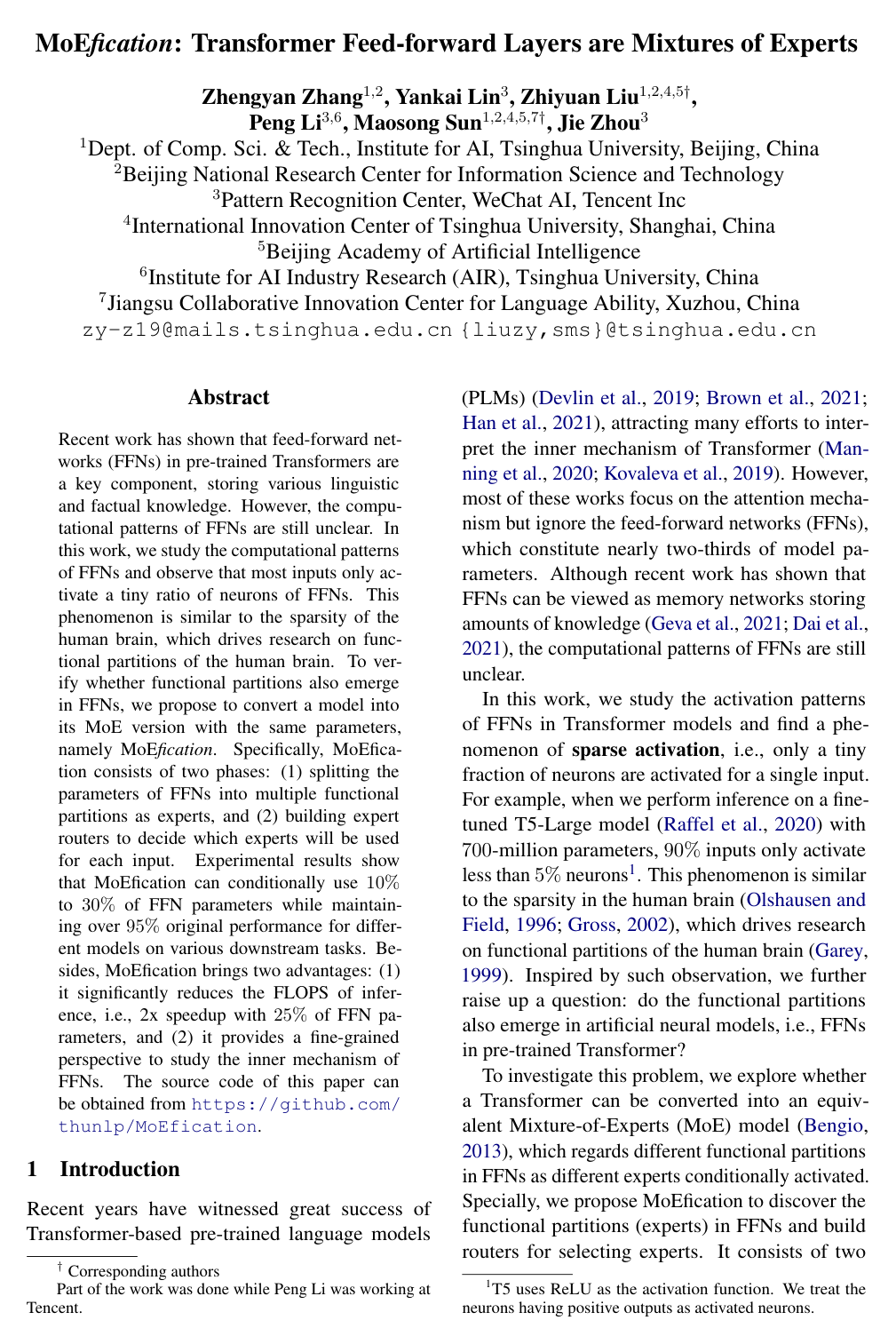
MoEfication: Transformer Feed-forward Layers are Mixtures of Experts
Zhengyan Zhang, Yankai Lin, Zhiyuan Liu, Peng Li, Maosong Sun, Jie Zhou
Why you should read this
Proposes MoEfication, a novel method for converting existing Transformer models into efficient Mixtures-of-Experts (MoE) architectures, significantly reducing inference FLOPS by using only a fraction of FFN parameters while retaining over 95% of original performance.
Recent work has shown that feed-forward networks (FFNs) in pre-trained Transformers are a key component, storing various linguistic and factual knowledge. However, the computational patterns of FFNs are still unclear. In this work, we study the computational patterns of FFNs and observe that most inputs only activate a tiny ratio of neurons of FFNs. This phenomenon is similar to the sparsity of the human brain, which drives research on functional partitions of the human brain. To verify whether functional partitions also emerge in FFNs, we propose to convert a model into its MoE version with the same parameters, namely MoEfication. Specifically, MoEfication consists of two phases: (1) splitting the parameters of FFNs into multiple functional partitions as experts, and (2) building expert routers to decide which experts will be used for each input. Experimental results show that MoEfication can conditionally use 10% to 30% of FFN parameters while maintaining over 95% original performance for different models on various downstream tasks. Besides, MoEfication brings two advantages: (1) it significantly reduces the FLOPS of inference, i.e., 2x speedup with 25% of FFN parameters, and (2) it provides a fine-grained perspective to study the inner mechanism of FFNs. The source code of this paper can be obtained from this https URL.
Added
2026-02-25
