
keyword
topic classification
Topic classification is a natural language processing and machine learning task that involves automatically assigning one or more predefined thematic categories or subject labels to a given text based on its content. Unlike sentiment analysis, which determines emotional tone or opinion polarity, topic classification focuses strictly on identifying what a text is about, such as politics, sports, healthcare, or technology. The process typically involves analyzing linguistic patterns and semantic context within sentences or full documents using methods ranging from statistical classifiers and support vector machines to deep neural networks and large language models. It is widely applied in organizing unstructured text, filtering news feeds, routing customer support tickets, and enhancing information retrieval systems.
3 items
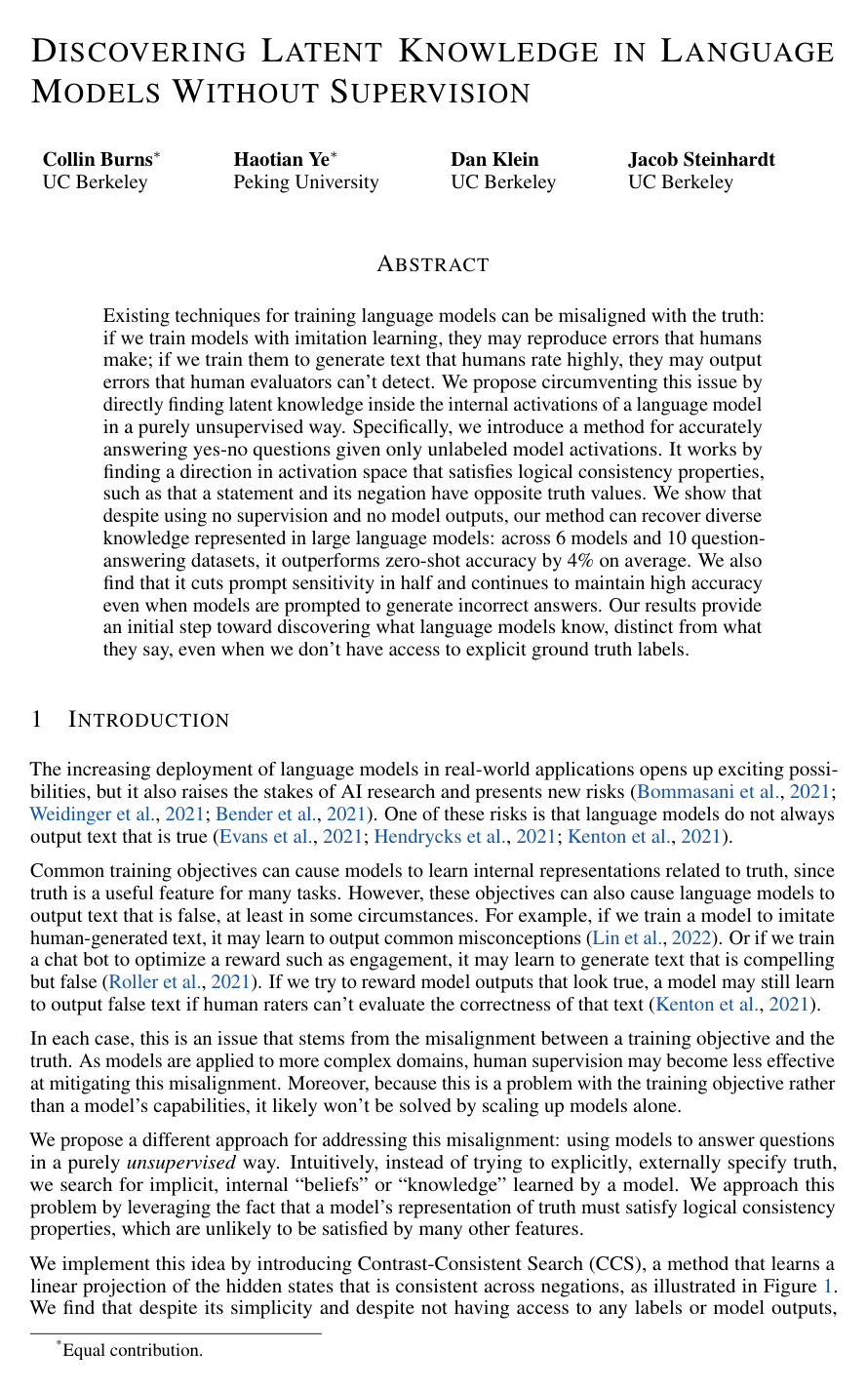
Discovering Latent Knowledge in Language Models Without Supervision
Collin Burns, Haotian Ye, Dan Klein, Jacob Steinhardt
Why you should read this
Introduces an unsupervised technique for extracting truthful latent knowledge directly from language model activations by enforcing logical consistency, enabling accurate question answering even when models are prompted to generate false outputs.
Existing techniques for training language models can be misaligned with the truth: if we train models with imitation learning, they may reproduce errors that humans make; if we train them to generate text that humans rate highly, they may output errors that human evaluators can't detect. We propose circumventing this issue by directly finding latent knowledge inside the internal activations of a language model in a purely unsupervised way. Specifically, we introduce a method for accurately answering yes-no questions given only unlabeled model activations. It works by finding a direction in activation space that satisfies logical consistency properties, such as that a statement and its negation have opposite truth values. We show that despite using no supervision and no model outputs, our method can recover diverse knowledge represented in large language models: across 6 models and 10 question-answering datasets, it outperforms zero-shot accuracy by 4\% on average. We also find that it cuts prompt sensitivity in half and continues to maintain high accuracy even when models are prompted to generate incorrect answers. Our results provide an initial step toward discovering what language models know, distinct from what they say, even when we don't have access to explicit ground truth labels.
Added
2026-09-26
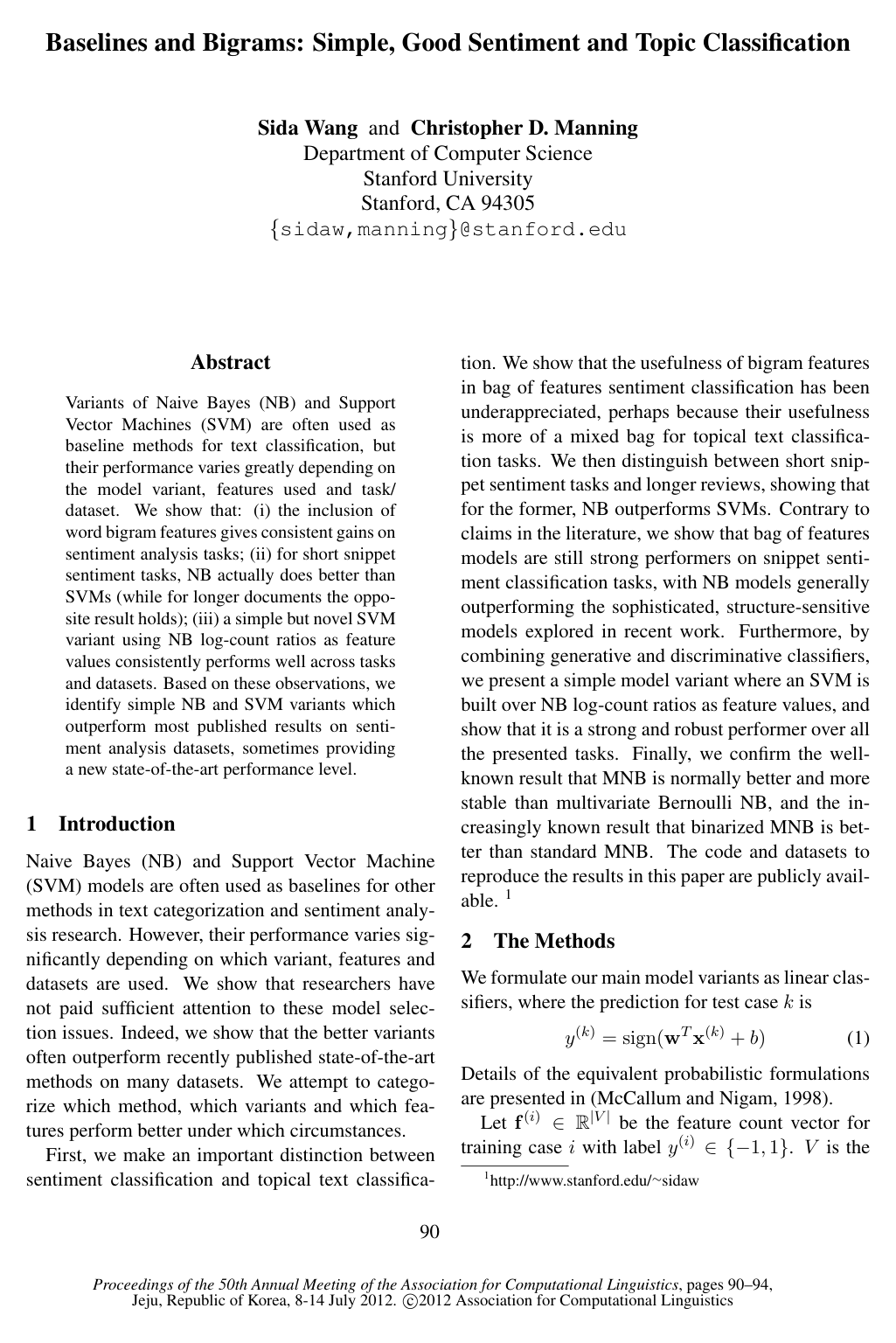
Baselines and Bigrams: Simple, Good Sentiment and Topic Classification
Sida I. Wang, Christopher D. Manning
Why you should read this
Demonstrates that simple Naive Bayes and Support Vector Machine baselines with word bigrams—particularly the hybrid NBSVM model—can outperform complex, structure-sensitive methods across standard sentiment and topic classification benchmarks.
Variants of Naive Bayes (NB) and Support Vector Machines (SVM) are often used as baseline methods for text classification, but their performance varies greatly depending on the model variant, features used and task/dataset. We show that: (i) the inclusion of word bigram features gives consistent gains on sentiment analysis tasks; (ii) for short snippet sentiment tasks, NB actually does better than SVMs (while for longer documents the opposite result holds); (iii) a simple but novel SVM variant using NB log-count ratios as feature values consistently performs well across tasks and datasets. Based on these observations, we identify simple NB and SVM variants which outperform most published results on sentiment analysis datasets, sometimes providing a new state-of-the-art performance level.
Added
2026-09-25
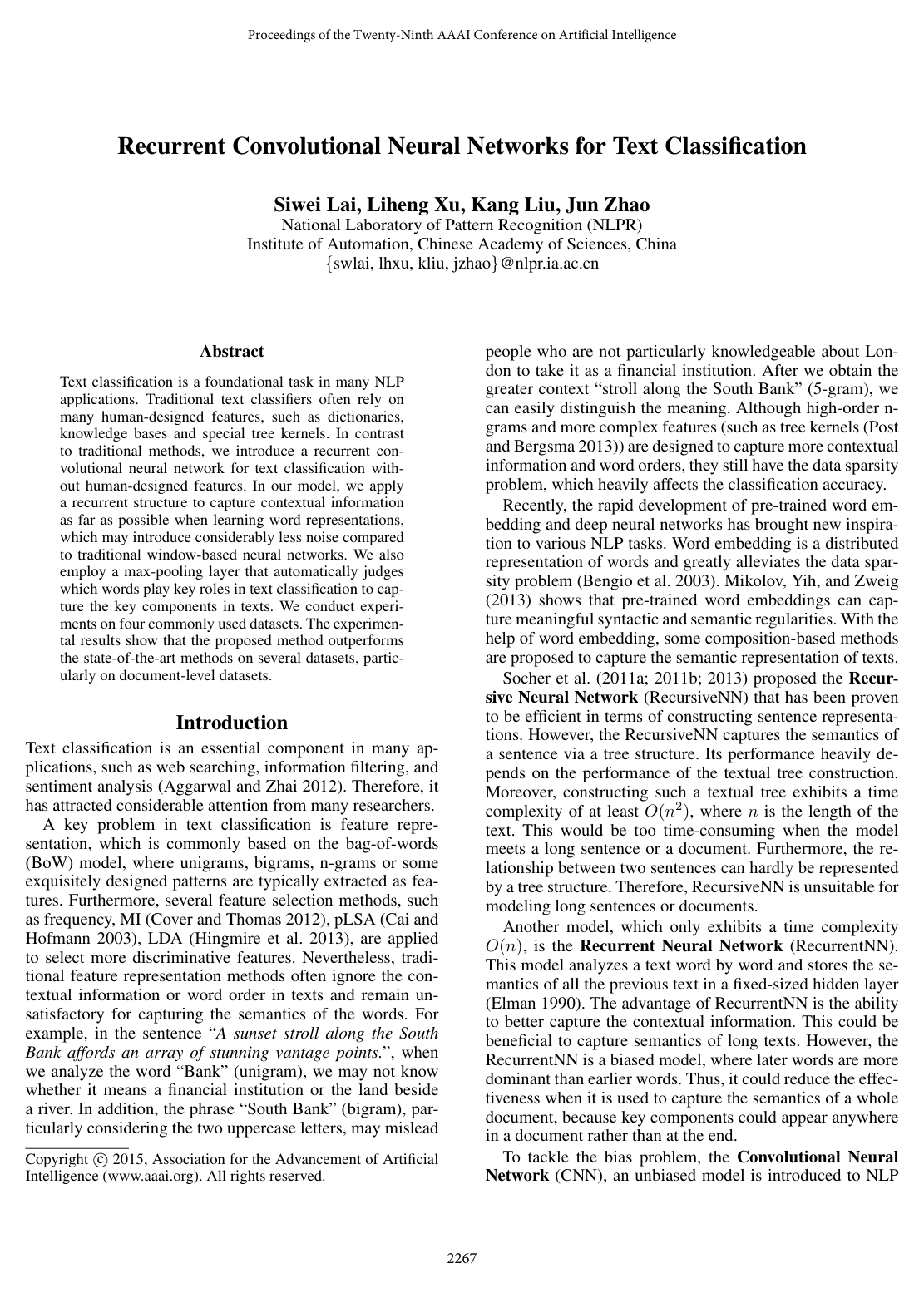
Recurrent Convolutional Neural Networks for Text Classification
Siwei Lai, Liheng Xu, Kang Liu, Jun Zhao
Why you should read this
Proposes a recurrent convolutional neural network that integrates bidirectional recurrent structures with max-pooling to capture global contextual information with linear computational complexity, outperforming traditional window-based CNNs and tree-based recursive models across text classification tasks.
Text classification is a foundational task in many NLP applications. Traditional text classifiers often rely on many human-designed features, such as dictionaries, knowledge bases and special tree kernels. In contrast to traditional methods, we introduce a recurrent convolutional neural network for text classification without human-designed features. In our model, we apply a recurrent structure to capture contextual information as far as possible when learning word representations, which may introduce considerably less noise compared to traditional window-based neural networks. We also employ a max-pooling layer that automatically judges which words play key roles in text classification to capture the key components in texts. We conduct experiments on four commonly used datasets. The experimental results show that the proposed method outperforms the state-of-the-art methods on several datasets, particularly on document-level datasets.
Added
2026-09-14