
keyword
time series prediction
Time series prediction is the task of estimating future values of a variable based on historical data collected sequentially over time. Unlike standard predictive modeling approaches that assume data points are independent and exchangeable, time series prediction explicitly accounts for chronological ordering and internal temporal dependencies, such as autocorrelation, trends, and seasonal patterns. By analyzing historical observations and optionally incorporating relevant external or driving variables, models project future trajectories or uncertainty intervals across subsequent time steps in domains such as economics, weather forecasting, signal processing, and operational planning.
4 items
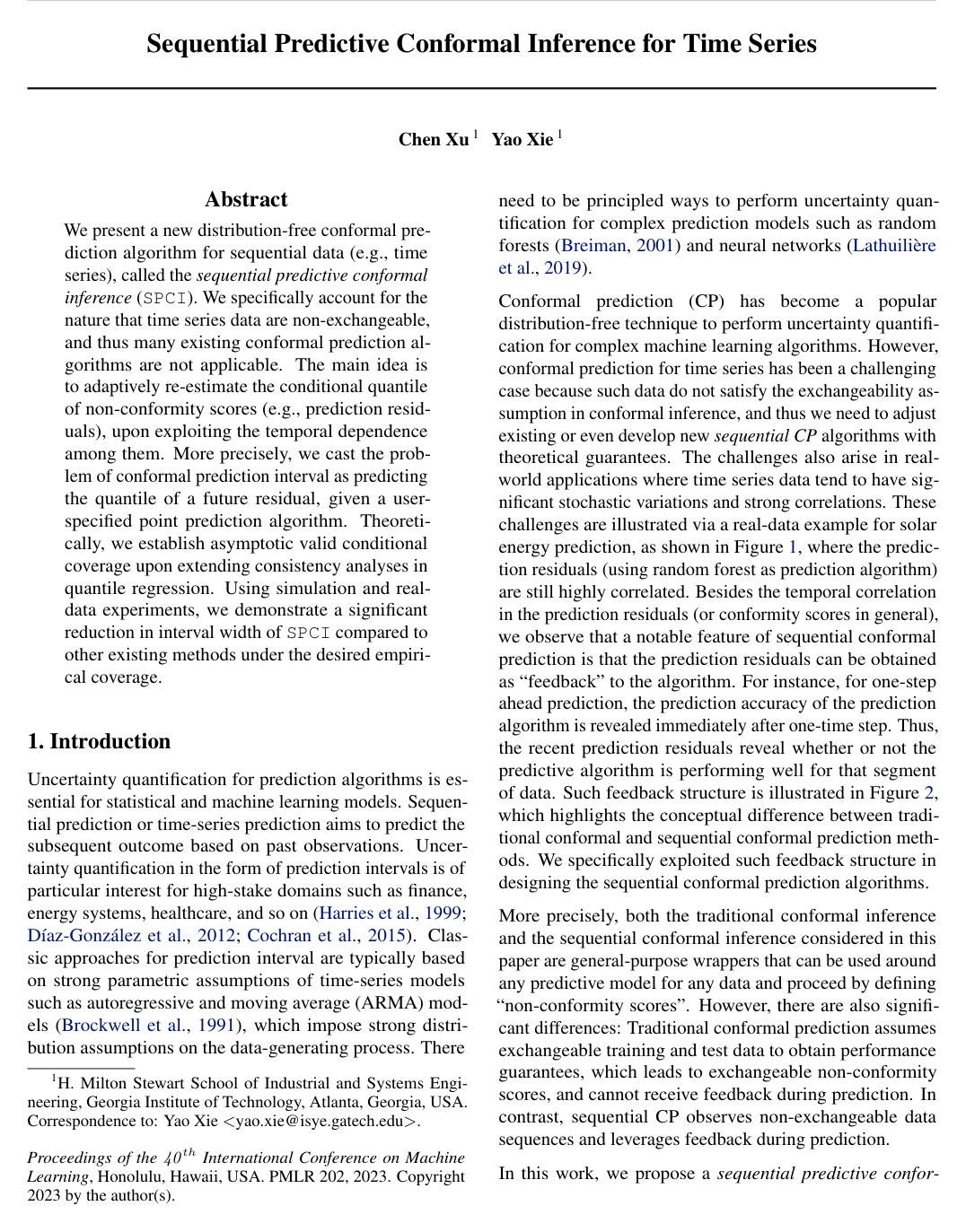
Sequential Predictive Conformal Inference for Time Series
Chen Xu, Yao Xie
Why you should read this
Develops a distribution-free conformal prediction framework for time series that adaptively estimates conditional quantiles of correlated residuals to construct significantly narrower prediction intervals with asymptotic valid conditional coverage.
We present a new distribution-free conformal prediction algorithm for sequential data (e.g., time series), called the sequential predictive conformal inference (SPCI). We specifically account for the nature that time series data are non-exchangeable, and thus many existing conformal prediction algorithms are not applicable. The main idea is to adaptively re-estimate the conditional quantile of non-conformity scores (e.g., prediction residuals), upon exploiting the temporal dependence among them. More precisely, we cast the problem of conformal prediction interval as predicting the quantile of a future residual, given a user-specified point prediction algorithm. Theoretically, we establish asymptotic valid conditional coverage upon extending consistency analyses in quantile regression. Using simulation and real-data experiments, we demonstrate a significant reduction in interval width of SPCI compared to other existing methods under the desired empirical coverage.
Added
2026-10-02
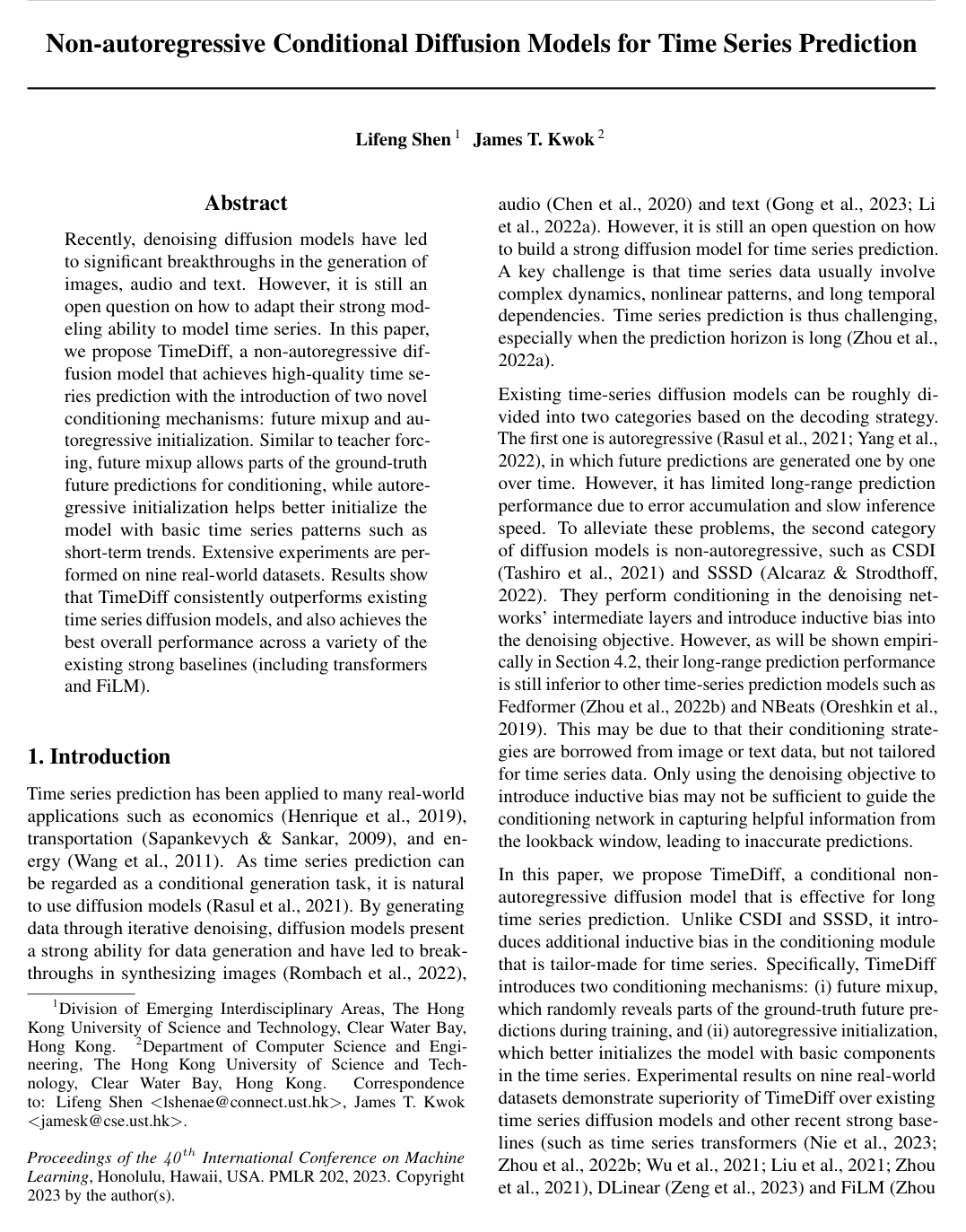
Non-autoregressive Conditional Diffusion Models for Time Series Prediction
Lifeng Shen, James T. Kwok
Why you should read this
Proposes TimeDiff, a non-autoregressive diffusion framework featuring future mixup and autoregressive initialization to overcome error accumulation and outperform existing transformers and diffusion baselines in long-range time series forecasting.
Recently, denoising diffusion models have led to significant breakthroughs in the generation of images, audio and text. However, it is still an open question on how to adapt their strong modeling ability to model time series. In this paper, we propose TimeDiff, a non-autoregressive diffusion model that achieves high-quality time series prediction with the introduction of two novel conditioning mechanisms: future mixup and autoregressive initialization. Similar to teacher forcing, future mixup allows parts of the ground-truth future predictions for conditioning, while autoregressive initialization helps better initialize the model with basic time series patterns such as short-term trends. Extensive experiments are performed on nine real-world datasets. Results show that TimeDiff consistently outperforms existing time series diffusion models, and also achieves the best overall performance across a variety of the existing strong baselines (including transformers and FiLM).
Added
2026-09-26
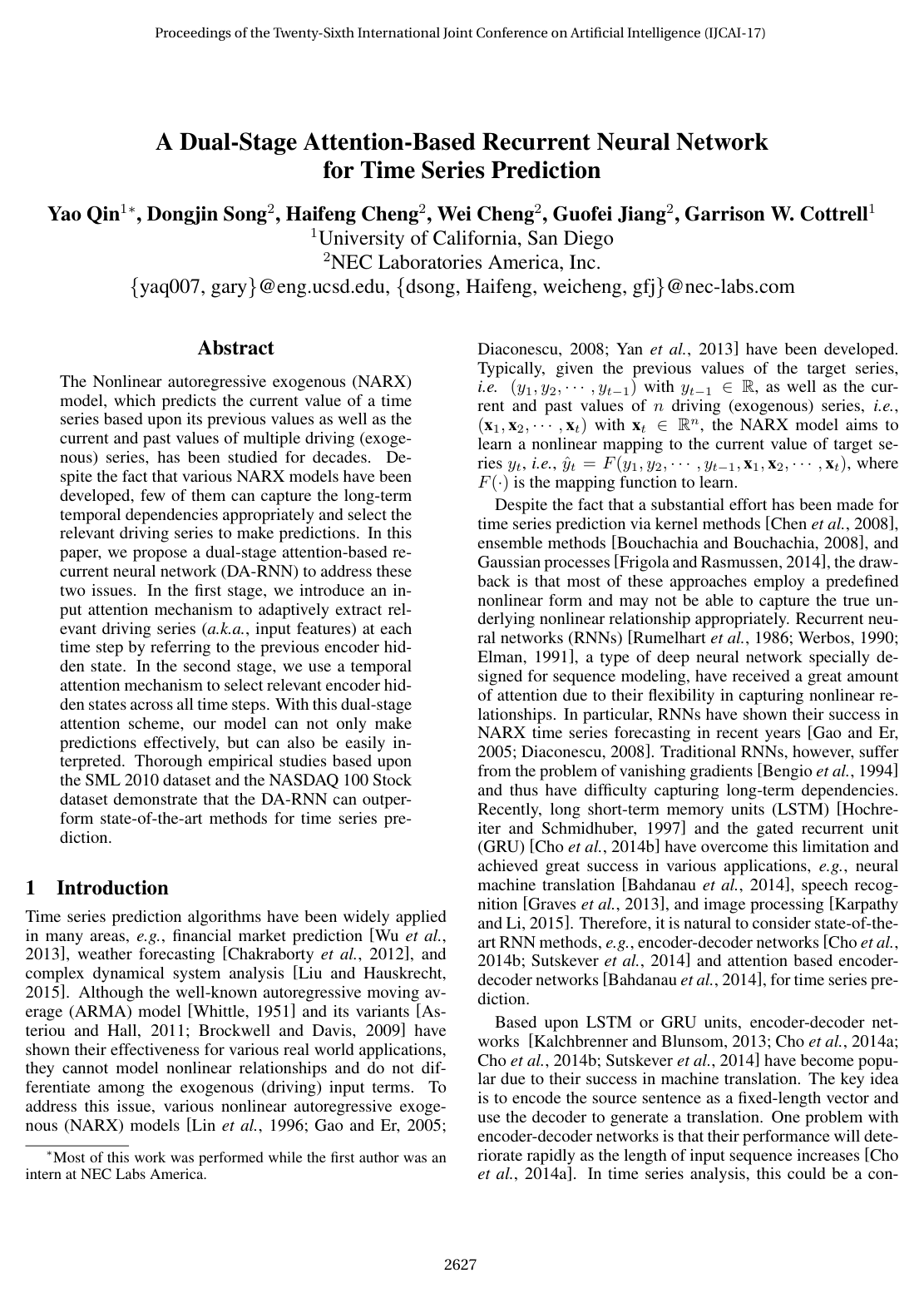
A Dual-Stage Attention-Based Recurrent Neural Network for Time Series Prediction
Yao Qin, Dongjin Song, Haifeng Chen, Wei Cheng, Guofei Jiang, G. Cottrell
Why you should read this
Proposes a dual-stage attention-based recurrent neural network (DA-RNN) that adaptively selects relevant exogenous driving series and long-term temporal dependencies to improve both prediction accuracy and model interpretability in time series forecasting.
The Nonlinear autoregressive exogenous (NARX) model, which predicts the current value of a time series based on its previous values as well as the current and past values of multiple driving (exogenous) series, has been studied for decades. Despite the fact that various NARX models have been developed, few of them can capture the long-term temporal dependencies appropriately and select the relevant driving series to make predictions. In this paper, we propose a dual-stage attention-based recurrent neural network (DA-RNN) to address these two issues. In the first stage, we introduce an input attention mechanism to adaptively extract relevant driving series (a.k.a., input features) at each time step by referring to the previous encoder hidden state. In the second stage, we use a temporal attention mechanism to select relevant encoder hidden states across all time steps. With this dual-stage attention scheme, our model can not only make predictions effectively, but can also be easily interpreted. Thorough empirical studies based upon the SML 2010 dataset and the NASDAQ 100 Stock dataset demonstrate that the DA-RNN can outperform state-of-the-art methods for time series prediction.
Added
2026-09-24
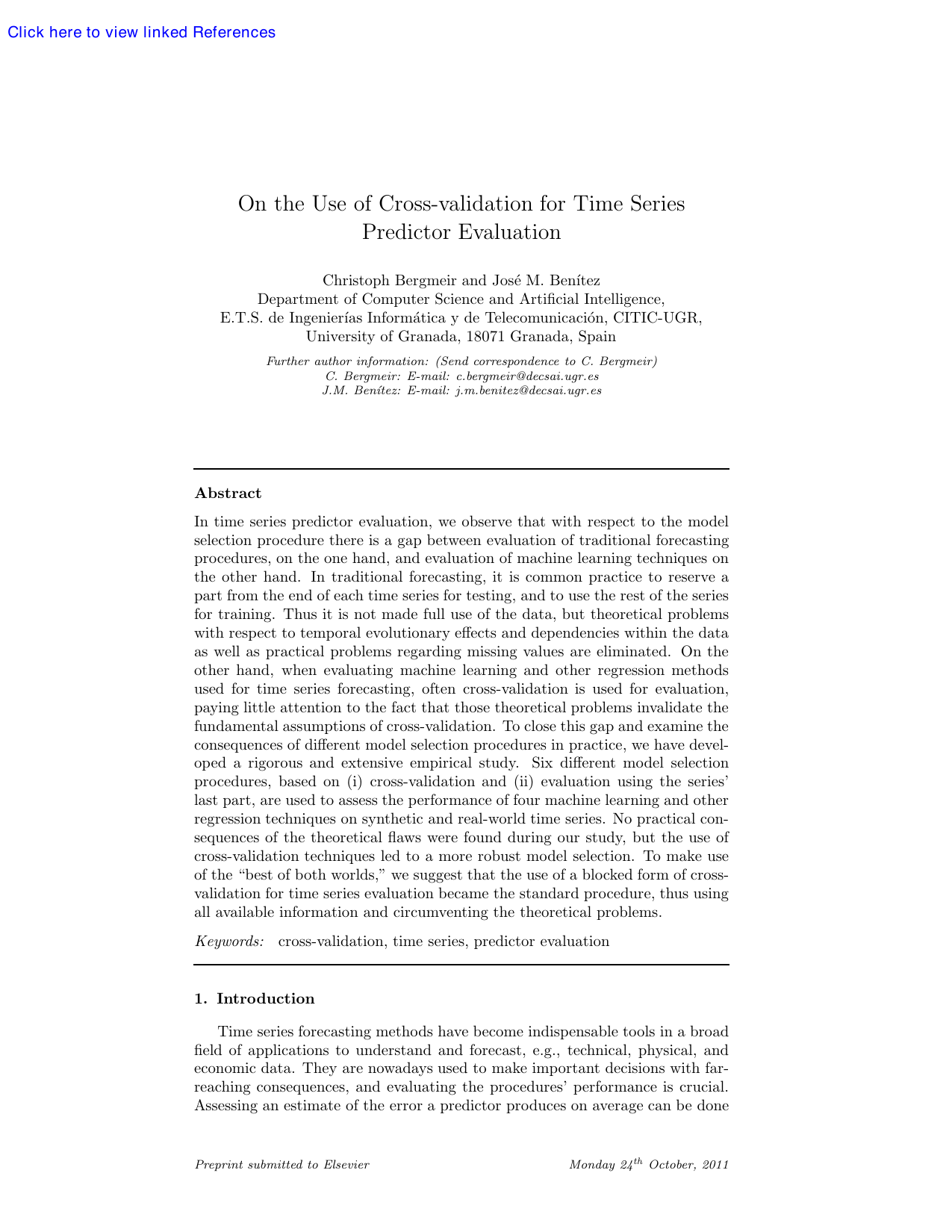
On the use of cross-validation for time series predictor evaluation
Christoph Bergmeir, José M. Benítez
Why you should read this
This paper tackles a practical question that remains central to forecasting: when time-ordered observations violate ordinary cross-validation assumptions, which evaluation procedure still selects reliable models? Its controlled comparison of six validation schemes across synthetic and real series shows why blocked cross-validation is a strong default when stationarity is checked.
In time series predictor evaluation, we observe that with respect to the model selection procedure there is a gap between evaluation of traditional forecasting procedures, on the one hand, and evaluation of machine learning techniques on the other hand. In traditional forecasting, it is common practice to reserve a part from the end of each time series for testing, and to use the rest of the series for training. Thus it is not made full use of the data, but theoretical problems with respect to temporal evolutionary effects and dependencies within the data as well as practical problems regarding missing values are eliminated. On the other hand, when evaluating machine learning and other regression methods used for time series forecasting, often cross-validation is used for evaluation, paying little attention to the fact that those theoretical problems invalidate the fundamental assumptions of cross-validation. To close this gap and examine the consequences of different model selection procedures in practice, we have developed a rigorous and extensive empirical study. Six different model selection procedures, based on (i) cross-validation and (ii) evaluation using the series’ last part, are used to assess the performance of four machine learning and other regression techniques on synthetic and real-world time series. No practical consequences of the theoretical flaws were found during our study, but the use of cross-validation techniques led to a more robust model selection. To make use of the “best of both worlds,” we suggest that the use of a blocked form of cross-validation for time series evaluation became the standard procedure, thus using all available information and circumventing the theoretical problems.
Added
2026-06-27