
keyword
textual similarity tasks
Textual similarity tasks are natural language processing problem formulations and evaluation benchmarks designed to quantify the degree of semantic equivalence or relatedness between pairs of texts, such as sentences or phrases. In these tasks, computational models or sentence embedding algorithms generate a numerical score reflecting how closely two texts match in underlying meaning, rather than merely measuring surface-level lexical overlap. Performance is standardly evaluated by computing correlation metrics, such as Spearman or Pearson correlation coefficients, between the similarity scores predicted by the model and ground-truth human annotations. These benchmarks serve as foundational tools for evaluating the representational quality of sentence embeddings and supporting downstream language applications such as information retrieval, duplicate detection, question answering, and text summarization.
4 items
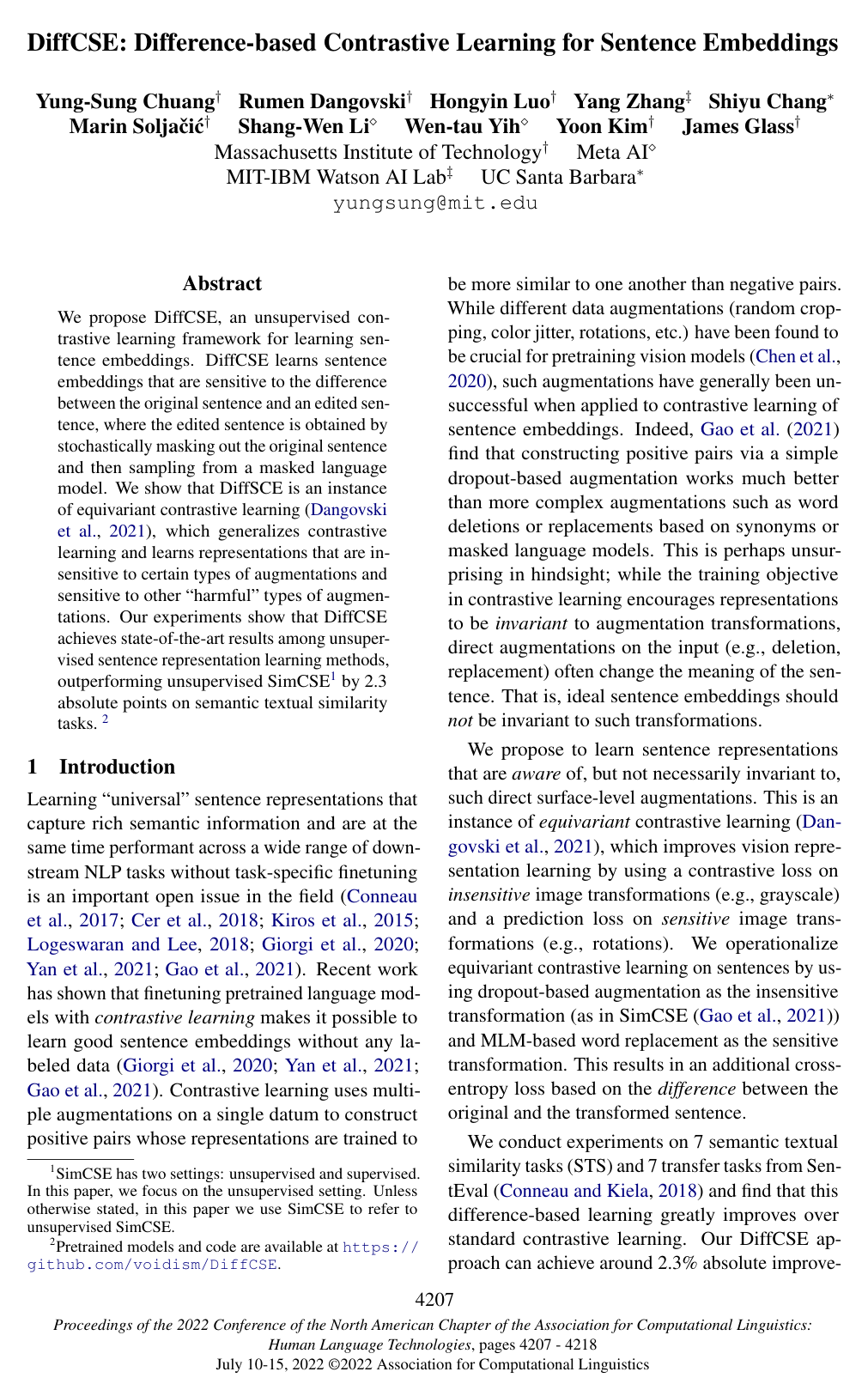
DiffCSE: Difference-based Contrastive Learning for Sentence Embeddings
Yung-Sung Chuang, Rumen Dangovski, Hongyin Luo, Yang Zhang, Shiyu Chang, Marin Soljacic, Shang-Wen Li, Scott Yih, Yoon Kim, James R. Glass
Why you should read this
Proposes DiffCSE, an unsupervised sentence embedding framework that improves semantic similarity performance by pairing standard contrastive learning with an auxiliary difference prediction task to make representations sensitive to meaning-altering word edits.
We propose DiffCSE, an unsupervised contrastive learning framework for learning sentence embeddings. DiffCSE learns sentence embeddings that are sensitive to the difference between the original sentence and an edited sentence, where the edited sentence is obtained by stochastically masking out the original sentence and then sampling from a masked language model. We show that DiffCSE is an instance of equivariant contrastive learning (Dangovski et al., 2021), which generalizes contrastive learning and learns representations that are insensitive to certain types of augmentations and sensitive to other “harmful” types of augmentations. Our experiments show that DiffCSE achieves state-of-the-art results among unsupervised sentence representation learning methods, outperforming unsupervised SimCSE1 by 2.3 absolute points on semantic textual similarity tasks. 2
Added
2026-09-26
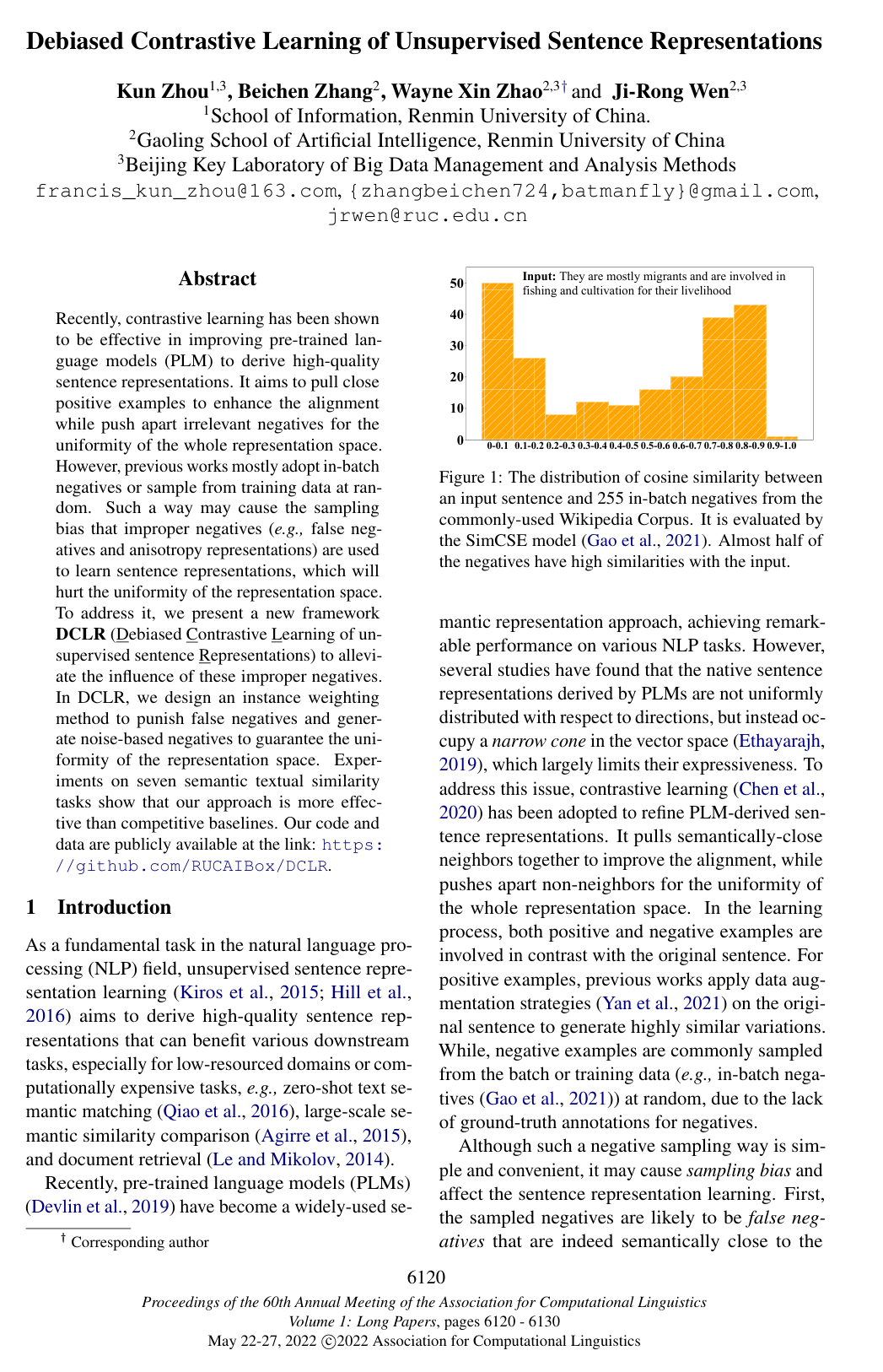
Debiased Contrastive Learning of Unsupervised Sentence Representations
Kun Zhou, Beichen Zhang, Wayne Xin Zhao, Ji-Rong Wen
Why you should read this
Proposes a debiased contrastive learning framework that improves unsupervised sentence embeddings by downweighting false negatives and generating optimized noise-based negative samples to overcome representation anisotropy.
Recently, contrastive learning has been shown to be effective in improving pre-trained language models (PLM) to derive high-quality sentence representations. It aims to pull close positive examples to enhance the alignment while push apart irrelevant negatives for the uniformity of the whole representation space. However, previous works mostly adopt in-batch negatives or sample from training data at random. Such a way may cause the sampling bias that improper negatives (e.g., false negatives and anisotropy representations) are used to learn sentence representations, which will hurt the uniformity of the representation space. To address it, we present a new framework DCLR (Debiased Contrastive Learning of unsupervised sentence Representations) to alleviate the influence of these improper negatives. In DCLR, we design an instance weighting method to punish false negatives and generate noise-based negatives to guarantee the uniformity of the representation space. Experiments on seven semantic textual similarity tasks show that our approach is more effective than competitive baselines. Our code and data are publicly available at the link: https://github.com/RUCAIBox/DCLR.
Added
2026-09-26
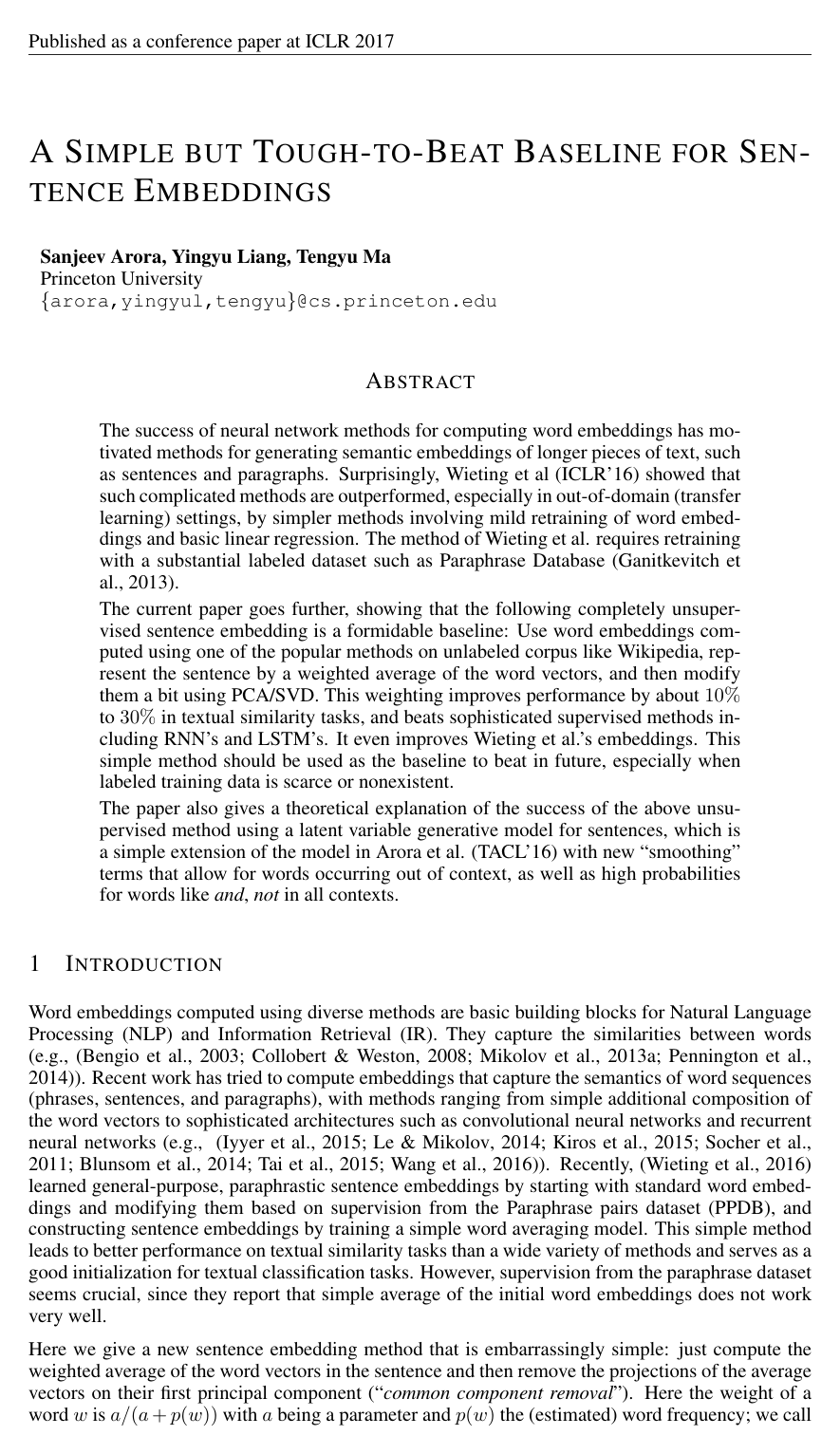
A Simple but Tough-to-Beat Baseline for Sentence Embeddings
Sanjeev Arora, Yingyu Liang, Tengyu Ma
Why you should read this
Proposes an unsupervised sentence embedding baseline combining smooth inverse frequency weighting with principal component removal that consistently outperforms complex neural network models on semantic similarity benchmarks.
The success of neural network methods for computing word embeddings has motivated methods for generating semantic embeddings of longer pieces of text, such as sentences and paragraphs. Surprisingly, Wieting et al (ICLR'16) showed that such complicated methods are outperformed, especially in out-of-domain (transfer learning) settings, by simpler methods involving mild retraining of word embeddings and basic linear regression. The method of Wieting et al. requires retraining with a substantial labeled dataset such as Paraphrase Database (Ganitkevitch et al., 2013). The current paper goes further, showing that the following completely unsupervised sentence embedding is a formidable baseline: Use word embeddings computed using one of the popular methods on unlabeled corpus like Wikipedia, represent the sentence by a weighted average of the word vectors, and then modify them a bit using PCA/SVD. This weighting improves performance by about 10% to 30% in textual similarity tasks, and beats sophisticated supervised methods including RNN's and LSTM's. It even improves Wieting et al.'s embeddings. This simple method should be used as the baseline to beat in future, especially when labeled training data is scarce or nonexistent. The paper also gives a theoretical explanation of the success of the above unsupervised method using a latent variable generative model for sentences, which is a simple extension of the model in Arora et al. (TACL'16) with new "smoothing" terms that allow for words occuring out of context, as well as high probabilities for words like and, not in all contexts.
Added
2026-09-25
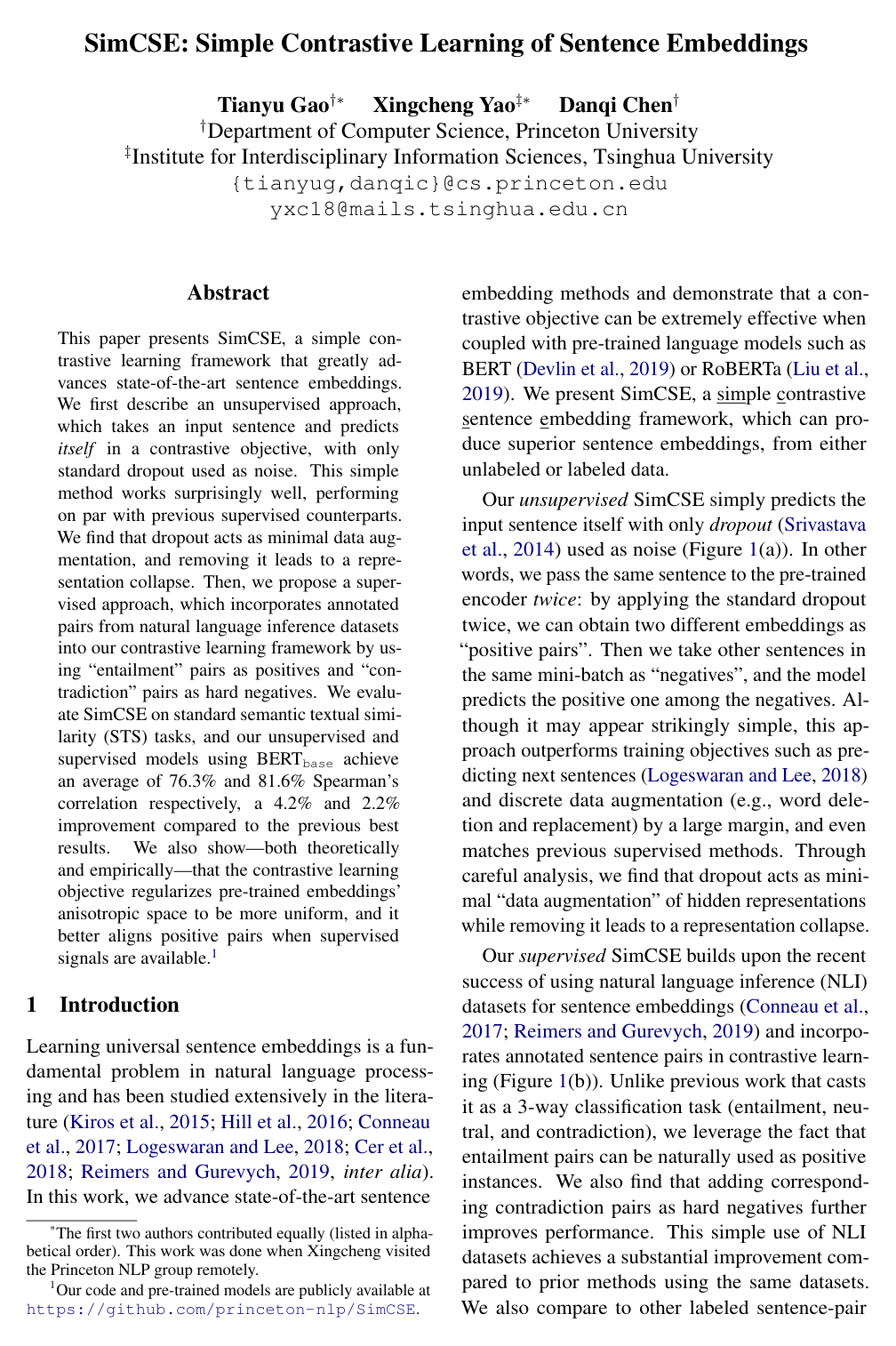
SimCSE: Simple Contrastive Learning of Sentence Embeddings
Tianyu Gao, Xingcheng Yao, Danqi Chen
Why you should read this
Presents SimCSE, a novel contrastive learning framework that utilizes dropout as minimal data augmentation for unsupervised learning and incorporates NLI pairs for supervised learning, thereby establishing new state-of-the-art results for sentence embeddings and improving representation uniformity.
This paper presents SimCSE, a simple contrastive learning framework that greatly advances state-of-the-art sentence embeddings. We first describe an unsupervised approach, which takes an input sentence and predicts itself in a contrastive objective, with only standard dropout used as noise. This simple method works surprisingly well, performing on par with previous supervised counterparts. We find that dropout acts as minimal data augmentation, and removing it leads to a representation collapse. Then, we propose a supervised approach, which incorporates annotated pairs from natural language inference datasets into our contrastive learning framework by using "entailment" pairs as positives and "contradiction" pairs as hard negatives. We evaluate SimCSE on standard semantic textual similarity (STS) tasks, and our unsupervised and supervised models using BERT base achieve an average of 76.3% and 81.6% Spearman's correlation respectively, a 4.2% and 2.2% improvement compared to the previous best results. We also show -- both theoretically and empirically -- that the contrastive learning objective regularizes pre-trained embeddings' anisotropic space to be more uniform, and it better aligns positive pairs when supervised signals are available.
Added
2026-05-04
