
keyword
temporal attention layer
A temporal attention layer is a neural network component that calculates dynamic importance weights across different time steps in sequential data to selectively prioritize relevant temporal information. By evaluating relationships between time points rather than treating all sequence positions uniformly, this layer allows models to effectively capture both short-term dependencies and long-range patterns over time. The mechanism produces a weighted aggregation of feature representations across the temporal dimension, enabling deep learning architectures to focus on critical time steps, transitions, or trends in tasks such as multivariate time-series forecasting, video modeling, and sequence prediction.
3 items
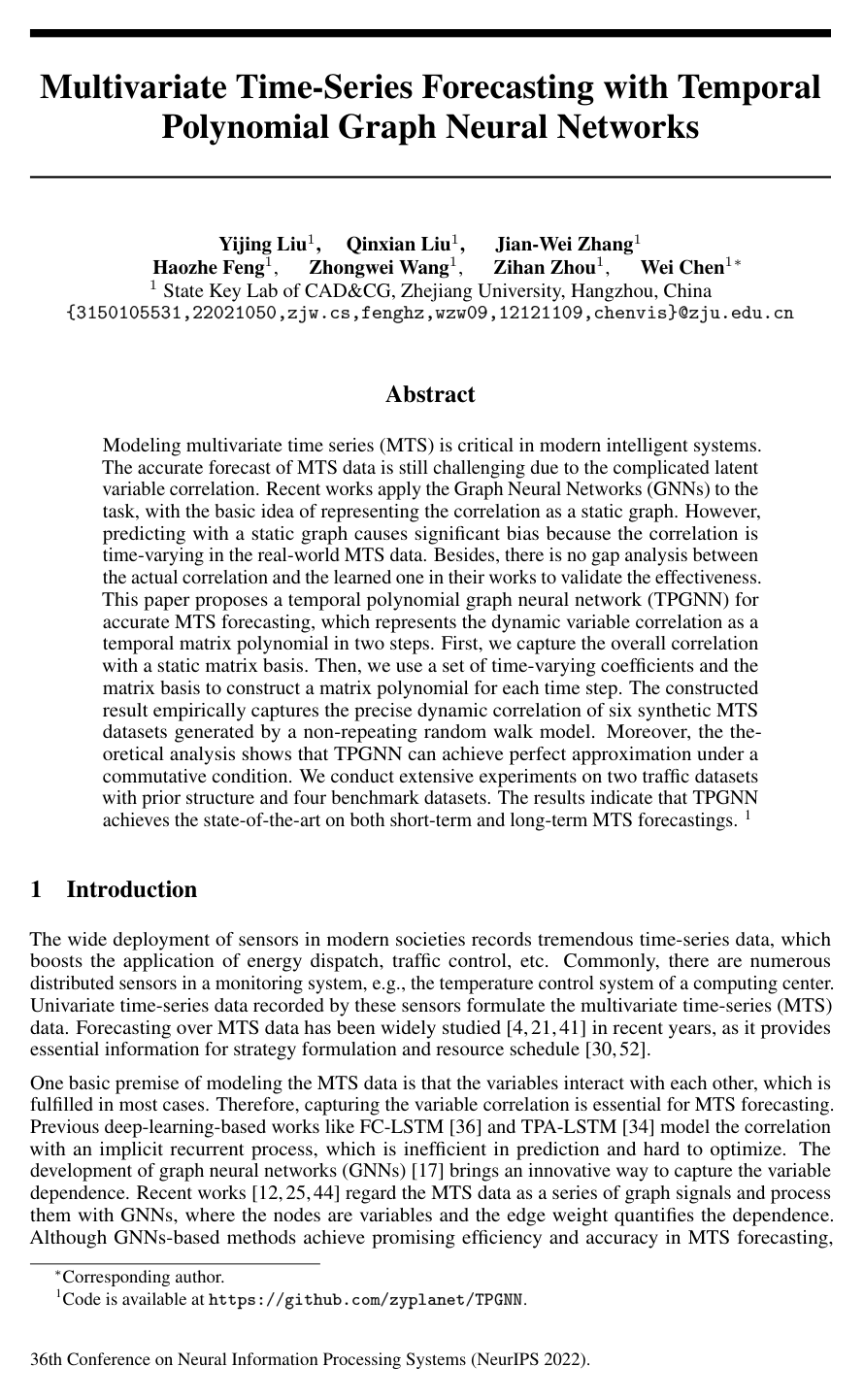
Multivariate Time-Series Forecasting with Temporal Polynomial Graph Neural Networks
Yijing Liu, Qinxian Liu, Jian-Wei Zhang, Haozhe Feng, Zhongwei Wang, Zihan Zhou, Wei Chen
Why you should read this
Proposes a temporal polynomial graph neural network that dynamically models time-varying variable correlations using matrix polynomials and cyclic timestamp embeddings, significantly reducing approximation errors in multivariate time-series forecasting.
Modeling multivariate time series (MTS) is critical in modern intelligent systems. The accurate forecast of MTS data is still challenging due to the complicated latent variable correlation. Recent works apply the Graph Neural Networks (GNNs) to the task, with the basic idea of representing the correlation as a static graph. However, predicting with a static graph causes significant bias because the correlation is time-varying in the real-world MTS data. Besides, there is no gap analysis between the actual correlation and the learned one in their works to validate the effectiveness. This paper proposes a temporal polynomial graph neural network (TPGNN) for accurate MTS forecasting, which represents the dynamic variable correlation as a temporal matrix polynomial in two steps. First, we capture the overall correlation with a static matrix basis. Then, we use a set of time-varying coefficients and the matrix basis to construct a matrix polynomial for each time step. The constructed result empirically captures the precise dynamic correlation of six synthetic MTS datasets generated by a non-repeating random walk model. Moreover, the theoretical analysis shows that TPGNN can achieve perfect approximation under a commutative condition. We conduct extensive experiments on two traffic datasets with prior structure and four benchmark datasets. The results indicate that TPGNN achieves the state-of-the-art on both short-term and long-term MTS forecastings. 1
Added
2026-09-26
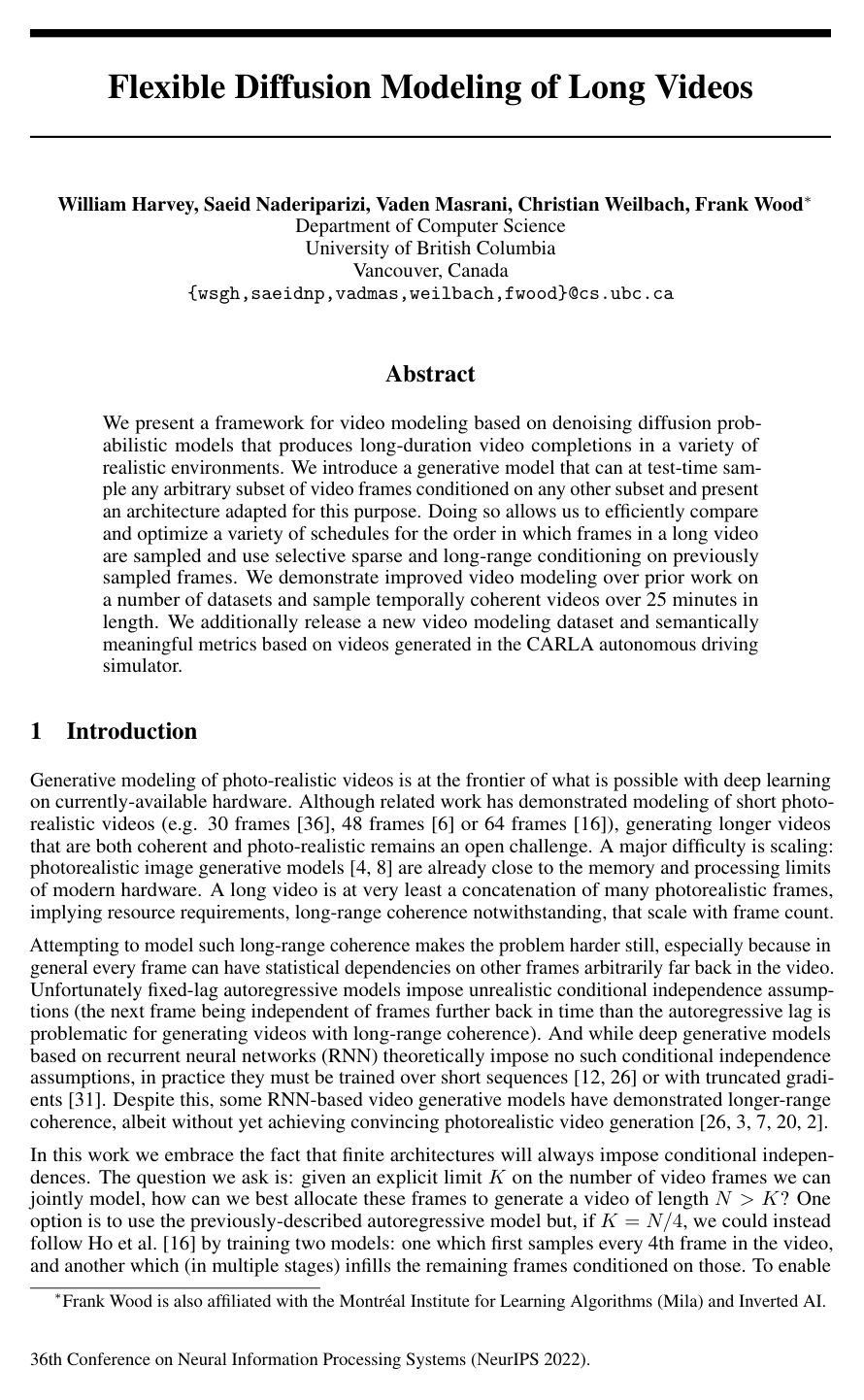
Flexible Diffusion Modeling of Long Videos
William Harvey, Saeid Naderiparizi, Vaden Masrani, Christian Weilbach, Frank Wood
Why you should read this
Introduces a flexible video diffusion model capable of sampling arbitrary subsets of frames conditioned on any other frames, enabling customizable sampling schedules that generate temporally coherent videos over 25 minutes long.
We present a framework for video modeling based on denoising diffusion probabilistic models that produces long-duration video completions in a variety of realistic environments. We introduce a generative model that can at test-time sample any arbitrary subset of video frames conditioned on any other subset and present an architecture adapted for this purpose. Doing so allows us to efficiently compare and optimize a variety of schedules for the order in which frames in a long video are sampled and use selective sparse and long-range conditioning on previously sampled frames. We demonstrate improved video modeling over prior work on a number of datasets and sample temporally coherent videos over 25 minutes in length. We additionally release a new video modeling dataset and semantically meaningful metrics based on videos generated in the CARLA autonomous driving simulator.
Added
2026-09-26
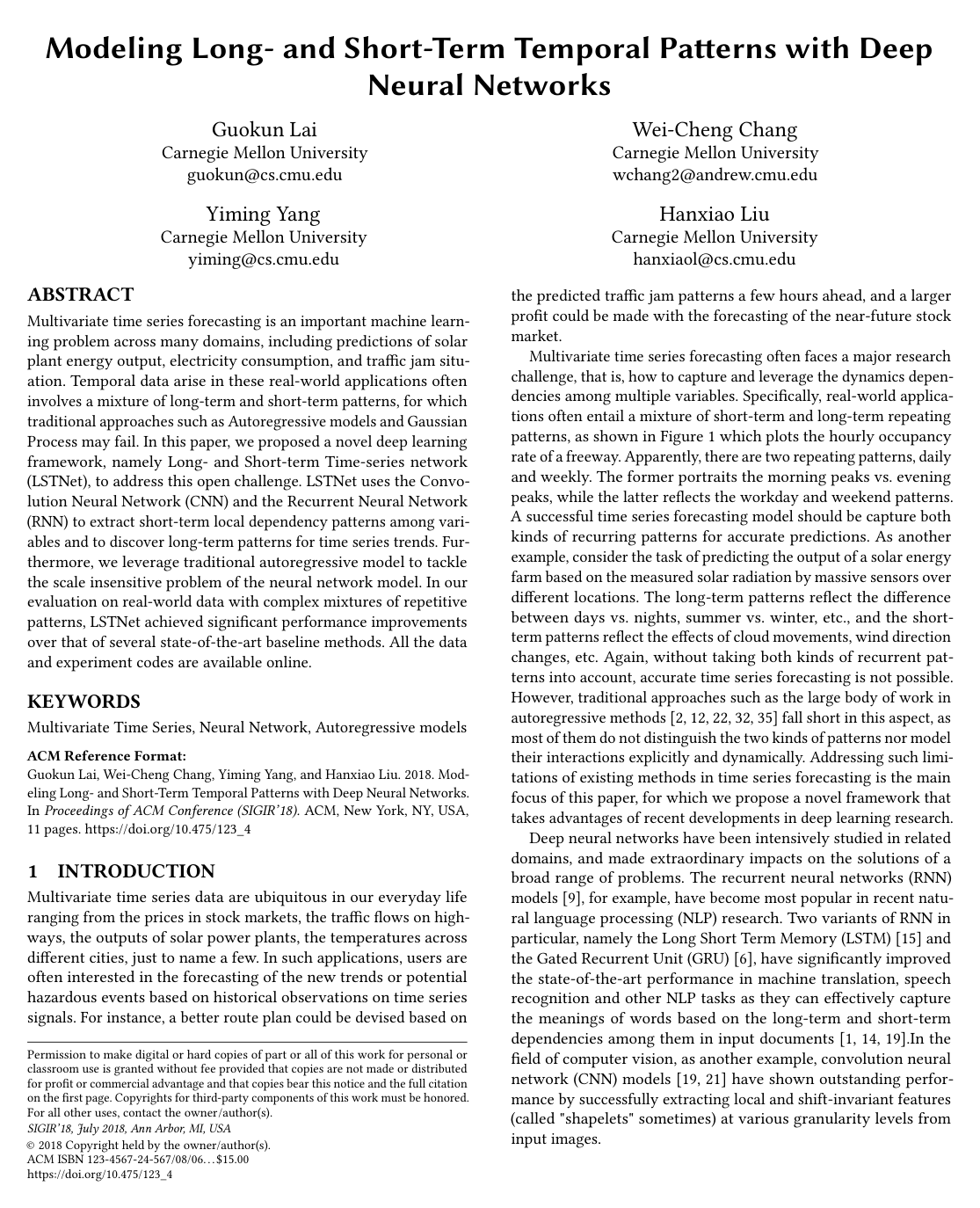
Modeling Long- and Short-Term Temporal Patterns with Deep Neural Networks
Guokun Lai, Wei-Cheng Chang, Yiming Yang, Hanxiao Liu
Why you should read this
Introduces LSTNet, a deep learning architecture that integrates convolutional and recurrent neural networks with an autoregressive model to capture both short-term local dependencies and long-term trends while addressing scale insensitivity in multivariate time series forecasting.
Multivariate time series forecasting is an important machine learning problem across many domains, including predictions of solar plant energy output, electricity consumption, and traffic jam situation. Temporal data arise in these real-world applications often involves a mixture of long-term and short-term patterns, for which traditional approaches such as Autoregressive models and Gaussian Process may fail. In this paper, we proposed a novel deep learning framework, namely Long- and Short-term Time-series network (LSTNet), to address this open challenge. LSTNet uses the Convolution Neural Network (CNN) and the Recurrent Neural Network (RNN) to extract short-term local dependency patterns among variables and to discover long-term patterns for time series trends. Furthermore, we leverage traditional autoregressive model to tackle the scale insensitive problem of the neural network model. In our evaluation on real-world data with complex mixtures of repetitive patterns, LSTNet achieved significant performance improvements over that of several state-of-the-art baseline methods. All the data and experiment codes are available online.
Added
2026-09-14