
keyword
style transfer
Style transfer is an image processing and computer vision technique that renders the semantic content of one image in the visual or artistic style of another. By utilizing deep neural networks, the process computationally separates the underlying structure and subject matter of a source image from the aesthetic characteristics, such as color palettes, brushstrokes, and textures, of a reference image or domain. Generative architectures, including convolutional neural networks, generative adversarial networks, and diffusion models, recombine these distinct representations to synthesize a new image that preserves the recognizable layout and objects of the source while adopting the artistic appearance of the target style. The technique is widely used in digital art creation, photo and video stylization, and cross-domain image synthesis.
19 items
A Neural Algorithm of Artistic Style
Leon A. Gatys, Alexander S. Ecker, Matthias Bethge
Why you should read this
Demonstrates how deep convolutional neural networks can separate and recombine the semantic content of one image and the artistic style of another, establishing the foundational algorithm for neural style transfer.
In fine art, especially painting, humans have mastered the skill to create unique visual experiences through composing a complex interplay between the content and style of an image. Thus far the algorithmic basis of this process is unknown and there exists no artificial system with similar capabilities. However, in other key areas of visual perception such as object and face recognition near-human performance was recently demonstrated by a class of biologically inspired vision models called Deep Neural Networks. Here we introduce an artificial system based on a Deep Neural Network that creates artistic images of high perceptual quality. The system uses neural representations to separate and recombine content and style of arbitrary images, providing a neural algorithm for the creation of artistic images. Moreover, in light of the striking similarities between performance-optimised artificial neural networks and biological vision, our work offers a path forward to an algorithmic understanding of how humans create and perceive artistic imagery.
Added
2026-10-04
License
Published with permission
Composer: Creative and Controllable Image Synthesis with Composable Conditions
Lianghua Huang, Di Chen, Yu Liu, Yujun Shen, Deli Zhao, Jingren Zhou
Why you should read this
Develops Composer, a controllable diffusion framework that conditions image synthesis on decomposed representations like text descriptions, spatial layouts, and color histograms to enable flexible visual creation and multi-task image editing without retraining.
Recent large-scale generative models learned on big data are capable of synthesizing incredible images yet suffer from limited controllability. This work offers a new generation paradigm that allows flexible control of the output image, such as spatial layout and palette, while maintaining the synthesis quality and model creativity. With compositionality as the core idea, we first decompose an image into representative factors, and then train a diffusion model with all these factors as the conditions to recompose the input. At the inference stage, the rich intermediate representations work as composable elements, leading to a huge design space (i.e., exponentially proportional to the number of decomposed factors) for customizable content creation. It is noteworthy that our approach, which we call Composer, supports various levels of conditions, such as text description as the global information, depth map and sketch as the local guidance, color histogram for low-level details, etc. Besides improving controllability, we confirm that Composer serves as a general framework and facilitates a wide range of classical generative tasks without retraining. Code and models will be made available.
Added
2026-09-28
CLIPDraw: Exploring Text-to-Drawing Synthesis through Language-Image Encoders
Kevin Frans, Lisa B. Soros, Olaf Witkowski
Why you should read this
Introduces a training-free text-to-drawing method that uses a pre-trained CLIP model and differentiable rendering to synthesize recognizable, stylistically diverse vector art directly from natural language prompts.
CLIPDraw is an algorithm that synthesizes novel drawings from natural language input. It does not require any additional training; rather, a pre-trained CLIP language-image encoder is used as a metric for maximizing similarity between the given description and a generated drawing. Crucially, CLIPDraw operates over vector strokes rather than pixel images, which biases drawings towards simpler human-recognizable shapes. Results compare CLIPDraw with other synthesis-through-optimization methods, as well as highlight various interesting behaviors of CLIPDraw, such as satisfying ambiguous text in multiple ways, reliably producing drawings in diverse styles, and scaling from simple to complex visual representations as stroke count increases.
Added
2026-09-26
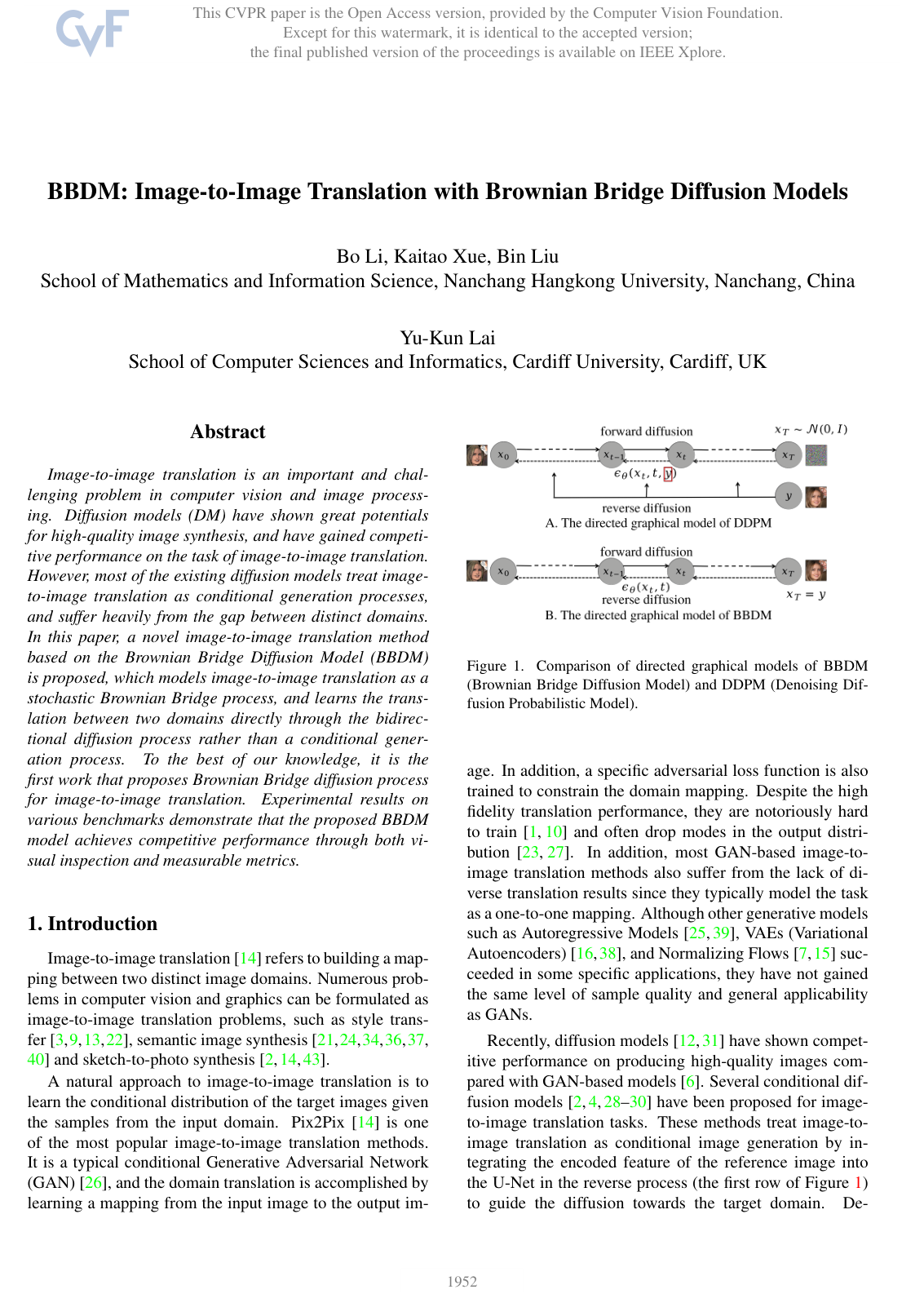
BBDM: Image-to-Image Translation with Brownian Bridge Diffusion Models
Bo Li, Kaitao Xue, Bin Liu, Yu-Kun Lai
Why you should read this
Proposes a novel Brownian Bridge diffusion model that formulates image-to-image translation as a direct bidirectional stochastic process between domains rather than conditional generation, yielding superior cross-domain mapping and synthesis quality.
Image-to-image translation is an important and challenging problem in computer vision and image processing. Diffusion models (DM) have shown great potentials for high-quality image synthesis, and have gained competitive performance on the task of image-to-image translation. However, most of the existing diffusion models treat image-to-image translation as conditional generation processes, and suffer heavily from the gap between distinct domains. In this paper, a novel image-to-image translation method based on the Brownian Bridge Diffusion Model (BBDM) is proposed, which models image-to-image translation as a stochastic Brownian Bridge process, and learns the translation between two domains directly through the bidirectional diffusion process rather than a conditional generation process. To the best of our knowledge, it is the first work that proposes Brownian Bridge diffusion process for image-to-image translation. Experimental results on various benchmarks demonstrate that the proposed BBDM model achieves competitive performance through both visual inspection and measurable metrics.
Added
2026-09-26
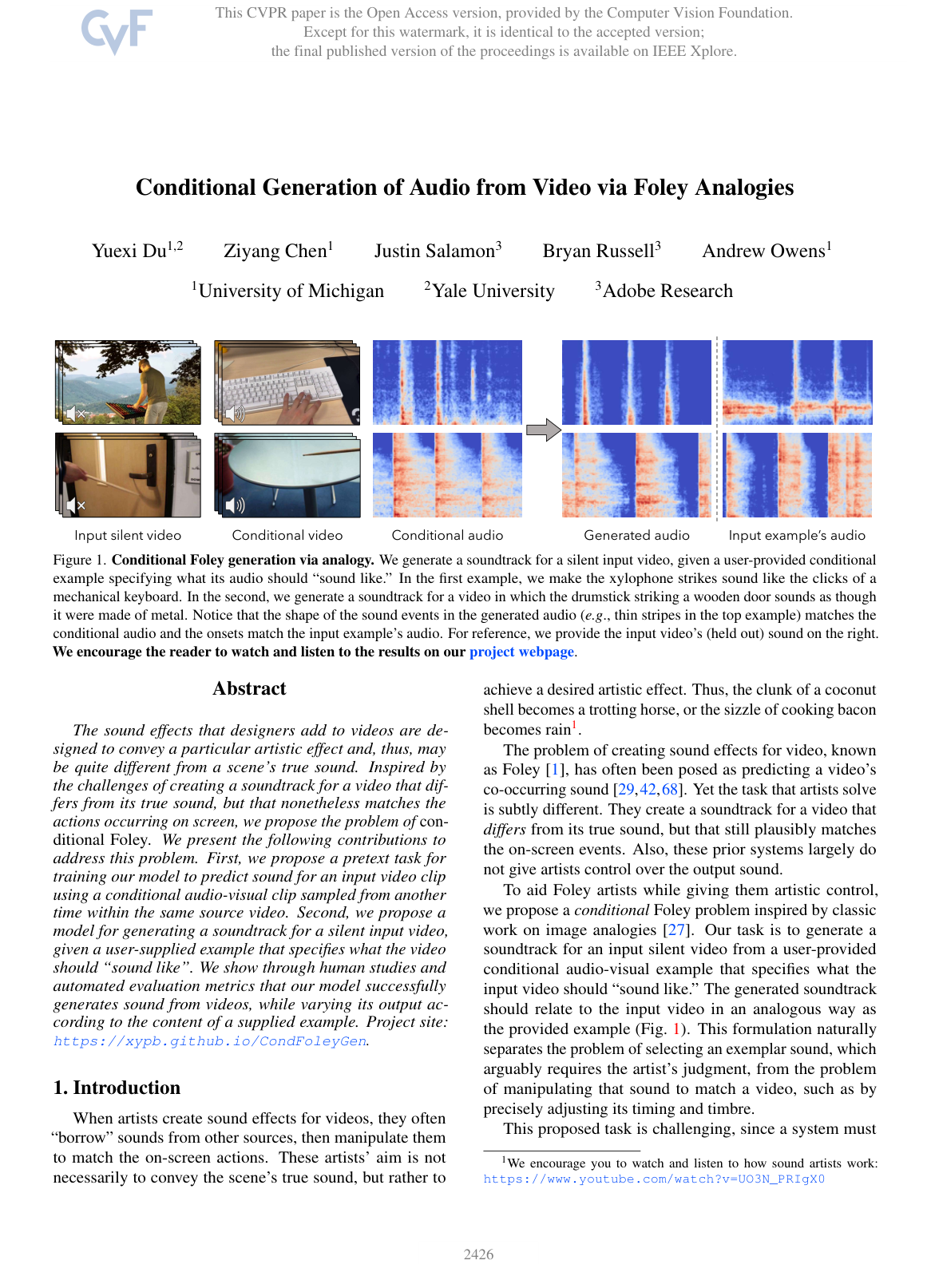
Conditional Generation of Audio from Video via Foley Analogies
Yuexi Du, Ziyang Chen, Justin Salamon, Bryan C. Russell, Andrew Owens
Why you should read this
Proposes a self-supervised video-to-audio framework that synthesizes synchronized soundtracks for silent videos by transferring the acoustic timbre of user-provided reference clips to match on-screen actions.
The sound effects that designers add to videos are designed to convey a particular artistic effect and, thus, may be quite different from a scene’s true sound. Inspired by the challenges of creating a soundtrack for a video that differs from its true sound, but that nonetheless matches the actions occurring on screen, we propose the problem of conditional Foley. We present the following contributions to address this problem. First, we propose a pretext task for training our model to predict sound for an input video clip using a conditional audio-visual clip sampled from another time within the same source video. Second, we propose a model for generating a soundtrack for a silent input video, given a user-supplied example that specifies what the video should “sound like”. We show through human studies and automated evaluation metrics that our model successfully generates sound from videos, while varying its output according to the content of a supplied example. Project site: https://xypb.github.io/CondFoleyGen.
Added
2026-09-26
Toward Multimodal Image-to-Image Translation
Jun-Yan Zhu, Richard Zhang, Deepak Pathak, Trevor Darrell, Alexei A. Efros, Oliver Wang, Eli Shechtman
Why you should read this
Proposes a conditional generative framework that enforces bijective consistency between latent codes and generated images, effectively overcoming mode collapse to produce diverse, realistic outputs for ambiguous image-to-image translation tasks.
Many image-to-image translation problems are ambiguous, as a single input image may correspond to multiple possible outputs. In this work, we aim to model a \emph{distribution} of possible outputs in a conditional generative modeling setting. The ambiguity of the mapping is distilled in a low-dimensional latent vector, which can be randomly sampled at test time. A generator learns to map the given input, combined with this latent code, to the output. We explicitly encourage the connection between output and the latent code to be invertible. This helps prevent a many-to-one mapping from the latent code to the output during training, also known as the problem of mode collapse, and produces more diverse results. We explore several variants of this approach by employing different training objectives, network architectures, and methods of injecting the latent code. Our proposed method encourages bijective consistency between the latent encoding and output modes. We present a systematic comparison of our method and other variants on both perceptual realism and diversity.
Added
2026-09-25
Precomputed Real-Time Texture Synthesis with Markovian Generative Adversarial Networks
Chuan Li, Michael Wand
Why you should read this
Introduces Markovian Generative Adversarial Networks, a feed-forward approach that eliminates test-time optimization to synthesize textures and stylize videos in real time at speeds hundreds of times faster than previous neural methods.
This paper proposes Markovian Generative Adversarial Networks (MGANs), a method for training generative neural networks for efficient texture synthesis. While deep neural network approaches have recently demonstrated remarkable results in terms of synthesis quality, they still come at considerable computational costs (minutes of run-time for low-res images). Our paper addresses this efficiency issue. Instead of a numerical deconvolution in previous work, we precompute a feed-forward, strided convolutional network that captures the feature statistics of Markovian patches and is able to directly generate outputs of arbitrary dimensions. Such network can directly decode brown noise to realistic texture, or photos to artistic paintings. With adversarial training, we obtain quality comparable to recent neural texture synthesis methods. As no optimization is required any longer at generation time, our run-time performance (0.25M pixel images at 25Hz) surpasses previous neural texture synthesizers by a significant margin (at least 500 times faster). We apply this idea to texture synthesis, style transfer, and video stylization.
Added
2026-09-25
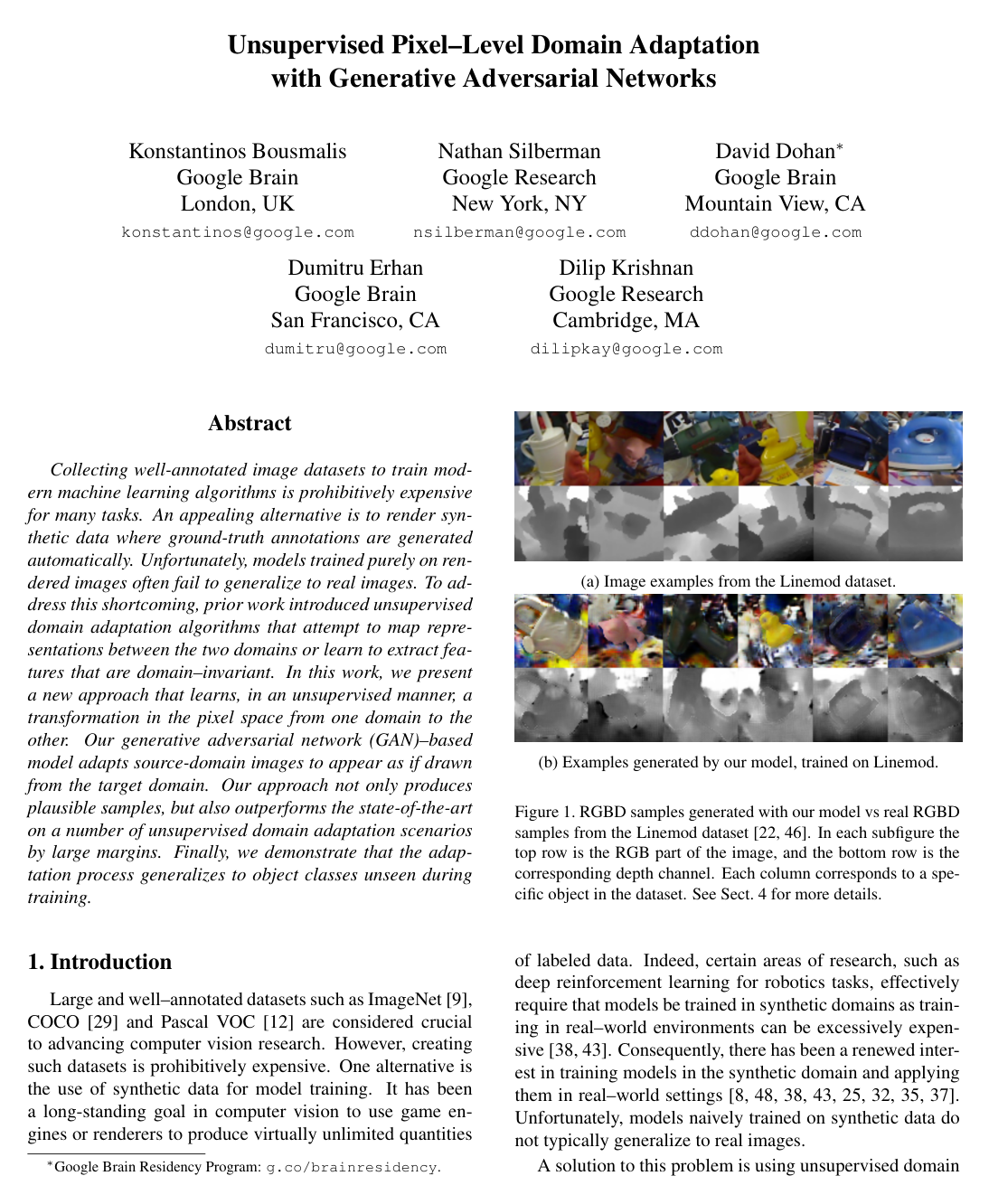
Unsupervised Pixel-Level Domain Adaptation with Generative Adversarial Networks
Konstantinos Bousmalis, Nathan Silberman, David Dohan, Dumitru Erhan, Dilip Krishnan
Why you should read this
Proposes an unsupervised generative adversarial framework that translates synthetic images into realistic target-domain imagery at the pixel level, significantly improving classifier generalization across domains and to unseen object classes without requiring target annotations.
Collecting well-annotated image datasets to train modern machine learning algorithms is prohibitively expensive for many tasks. One appealing alternative is rendering synthetic data where ground-truth annotations are generated automatically. Unfortunately, models trained purely on rendered images often fail to generalize to real images. To address this shortcoming, prior work introduced unsupervised domain adaptation algorithms that attempt to map representations between the two domains or learn to extract features that are domain-invariant. In this work, we present a new approach that learns, in an unsupervised manner, a transformation in the pixel space from one domain to the other. Our generative adversarial network (GAN)-based method adapts source-domain images to appear as if drawn from the target domain. Our approach not only produces plausible samples, but also outperforms the state-of-the-art on a number of unsupervised domain adaptation scenarios by large margins. Finally, we demonstrate that the adaptation process generalizes to object classes unseen during training.
Added
2026-09-24
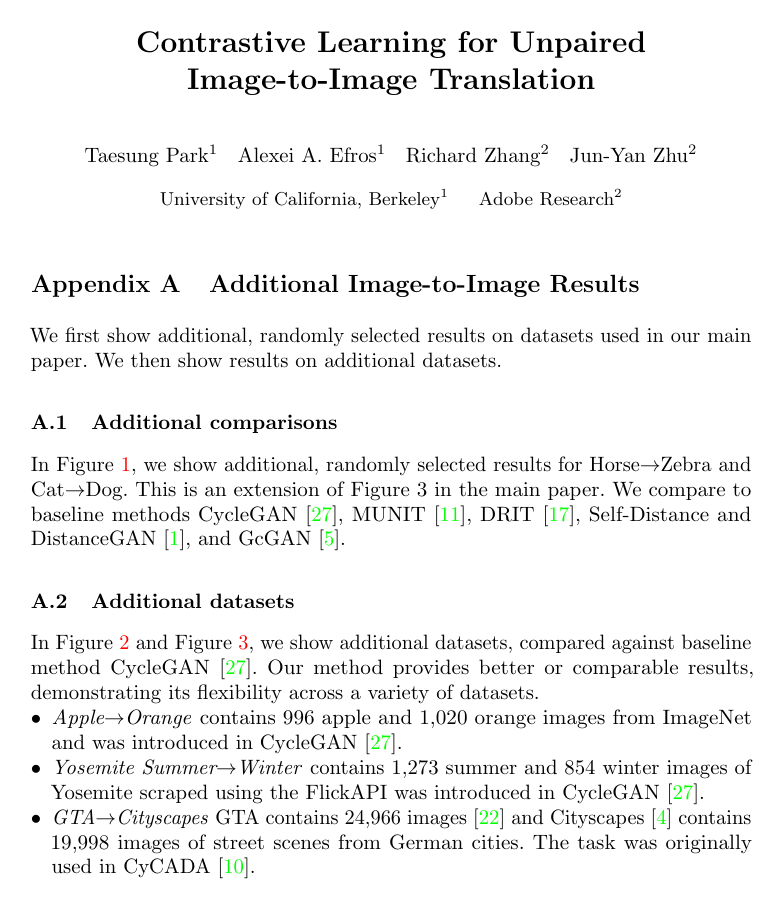
Contrastive Learning for Unpaired Image-to-Image Translation
Taesung Park, Alexei A. Efros, Richard Zhang, Jun-Yan Zhu
Why you should read this
Presents a patch-based contrastive learning framework that replaces standard cycle-consistency constraints to generate higher-quality unpaired image-to-image translations with significantly faster training times.
In image-to-image translation, each patch in the output should reflect the content of the corresponding patch in the input, independent of domain. We propose a straightforward method for doing so -- maximizing mutual information between the two, using a framework based on contrastive learning. The method encourages two elements (corresponding patches) to map to a similar point in a learned feature space, relative to other elements (other patches) in the dataset, referred to as negatives. We explore several critical design choices for making contrastive learning effective in the image synthesis setting. Notably, we use a multilayer, patch-based approach, rather than operate on entire images. Furthermore, we draw negatives from within the input image itself, rather than from the rest of the dataset. We demonstrate that our framework enables one-sided translation in the unpaired image-to-image translation setting, while improving quality and reducing training time. In addition, our method can even be extended to the training setting where each "domain" is only a single image.
Added
2026-09-24
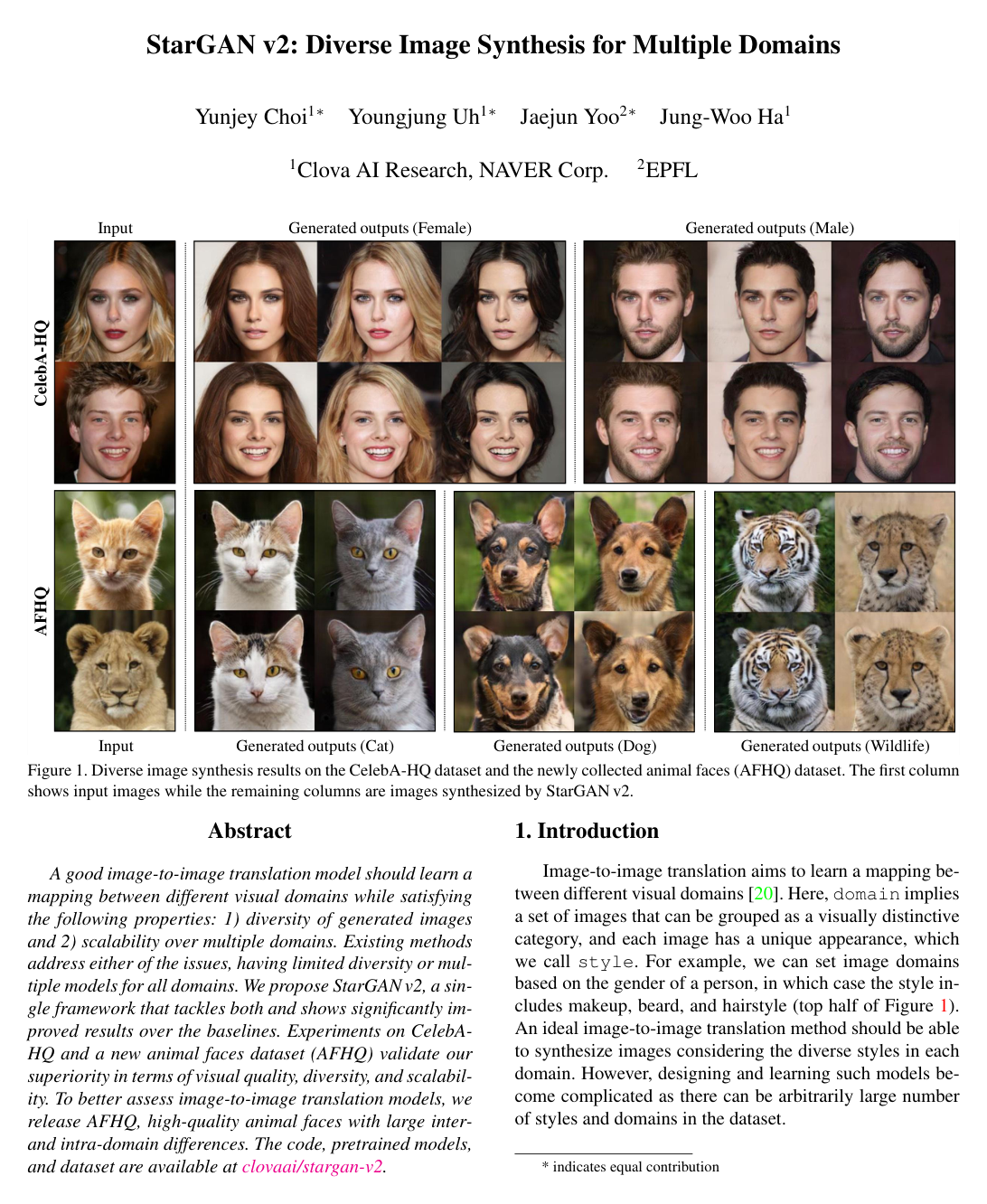
StarGAN v2: Diverse Image Synthesis for Multiple Domains
Yunjey Choi, Youngjung Uh, Jaejun Yoo, Jung-Woo Ha
Why you should read this
Proposes a scalable image-to-image translation framework that generates diverse images across multiple visual domains within a single model and introduces the AFHQ benchmark dataset for evaluating cross-domain synthesis.
A good image-to-image translation model should learn a mapping between different visual domains while satisfying the following properties: 1) diversity of generated images and 2) scalability over multiple domains. Existing methods address either of the issues, having limited diversity or multiple models for all domains. We propose StarGAN v2, a single framework that tackles both and shows significantly improved results over the baselines. Experiments on CelebA-HQ and a new animal faces dataset (AFHQ) validate our superiority in terms of visual quality, diversity, and scalability. To better assess image-to-image translation models, we release AFHQ, high-quality animal faces with large inter- and intra-domain differences. The code, pretrained models, and dataset can be found at this https URL.
Added
2026-09-18
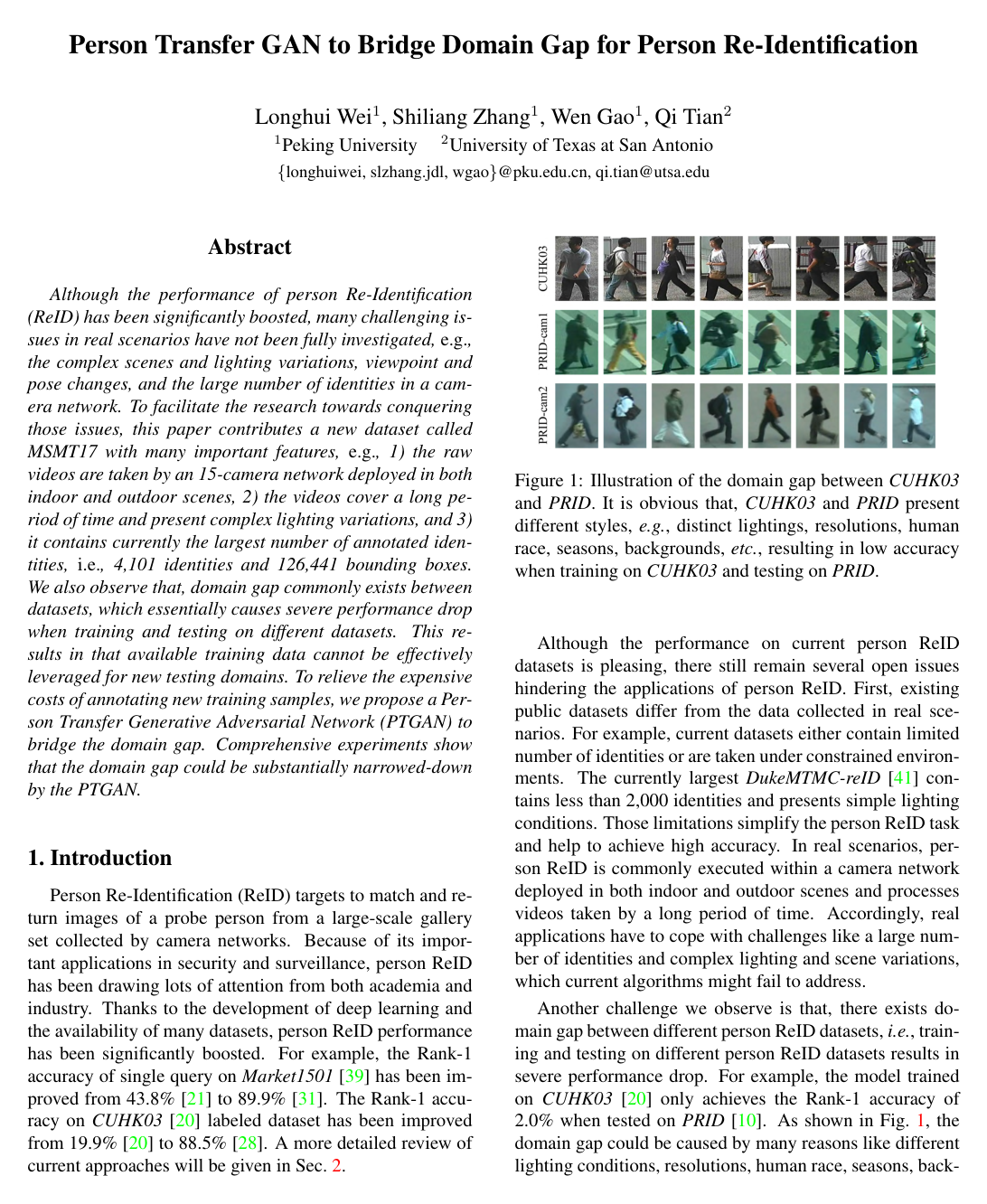
Person Transfer GAN to Bridge Domain Gap for Person Re-identification
Longhui Wei, Shiliang Zhang, Wen Gao, Qi Tian
Why you should read this
Introduces the large-scale MSMT17 benchmark and a Person Transfer GAN that bridges cross-dataset domain gaps by translating labeled person images into new camera environments without requiring target-domain annotations.
Although the performance of person Re-Identification (ReID) has been significantly boosted, many challenging issues in real scenarios have not been fully investigated, e.g., the complex scenes and lighting variations, viewpoint and pose changes, and the large number of identities in a camera network. To facilitate the research towards conquering those issues, this paper contributes a new dataset called MSMT17 with many important features, e.g., 1) the raw videos are taken by an 15-camera network deployed in both indoor and outdoor scenes, 2) the videos cover a long period of time and present complex lighting variations, and 3) it contains currently the largest number of annotated identities, i.e., 4,101 identities and 126,441 bounding boxes. We also observe that, domain gap commonly exists between datasets, which essentially causes severe performance drop when training and testing on different datasets. This results in that available training data cannot be effectively leveraged for new testing domains. To relieve the expensive costs of annotating new training samples, we propose a Person Transfer Generative Adversarial Network (PTGAN) to bridge the domain gap. Comprehensive experiments show that the domain gap could be substantially narrowed-down by the PTGAN.
Added
2026-09-17
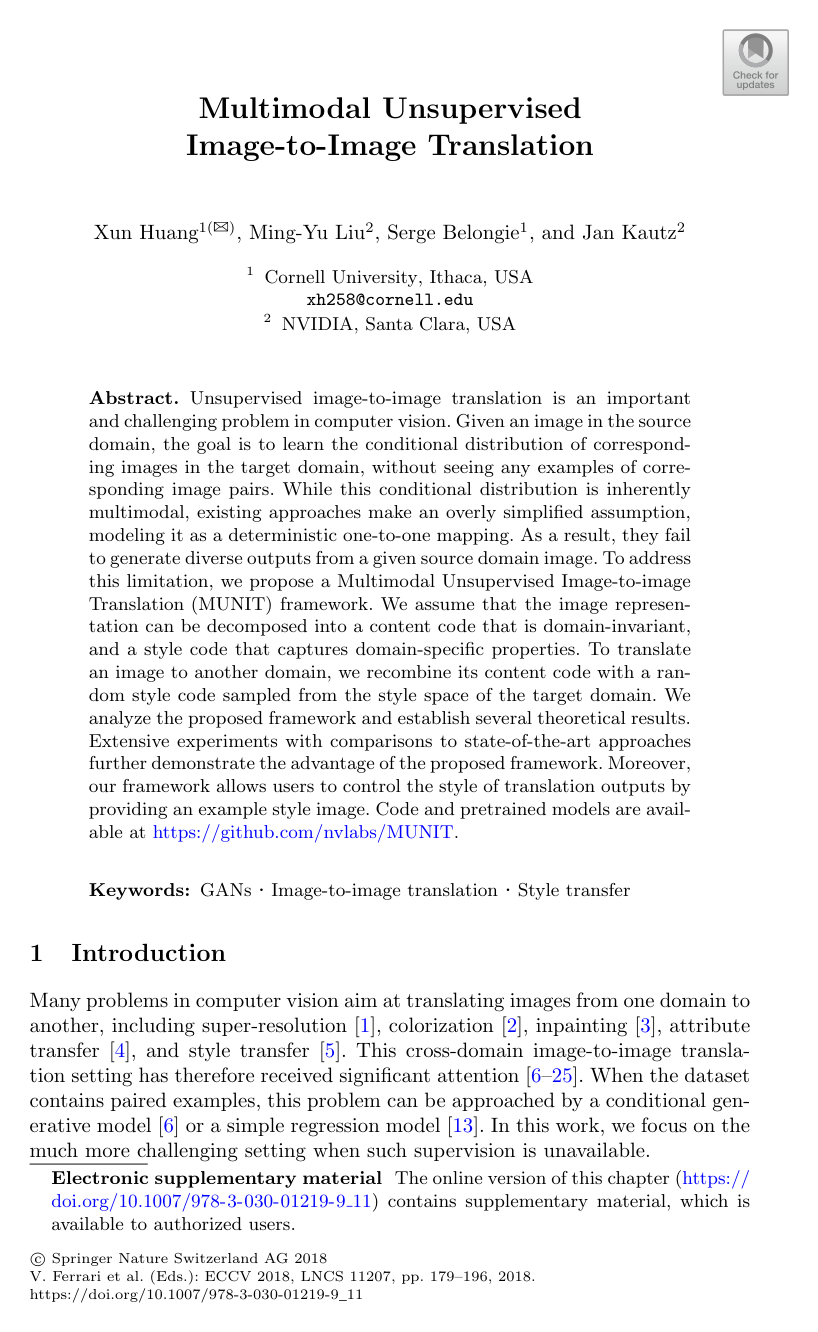
Multimodal Unsupervised Image-to-Image Translation
Xun Huang, Ming-Yu Liu, Serge J. Belongie, Jan Kautz
Why you should read this
Presents the MUNIT framework, which overcomes the one-to-one mapping limitation of unsupervised image translation by disentangling domain-invariant content from domain-specific style to generate diverse, user-controllable outputs.
Unsupervised image-to-image translation is an important and challenging problem in computer vision. Given an image in the source domain, the goal is to learn the conditional distribution of corresponding images in the target domain, without seeing any pairs of corresponding images. While this conditional distribution is inherently multimodal, existing approaches make an overly simplified assumption, modeling it as a deterministic one-to-one mapping. As a result, they fail to generate diverse outputs from a given source domain image. To address this limitation, we propose a Multimodal Unsupervised Image-to-image Translation (MUNIT) framework. We assume that the image representation can be decomposed into a content code that is domain-invariant, and a style code that captures domain-specific properties. To translate an image to another domain, we recombine its content code with a random style code sampled from the style space of the target domain. We analyze the proposed framework and establish several theoretical results. Extensive experiments with comparisons to the state-of-the-art approaches further demonstrates the advantage of the proposed framework. Moreover, our framework allows users to control the style of translation outputs by providing an example style image. Code and pretrained models are available at this https URL
Added
2026-09-14
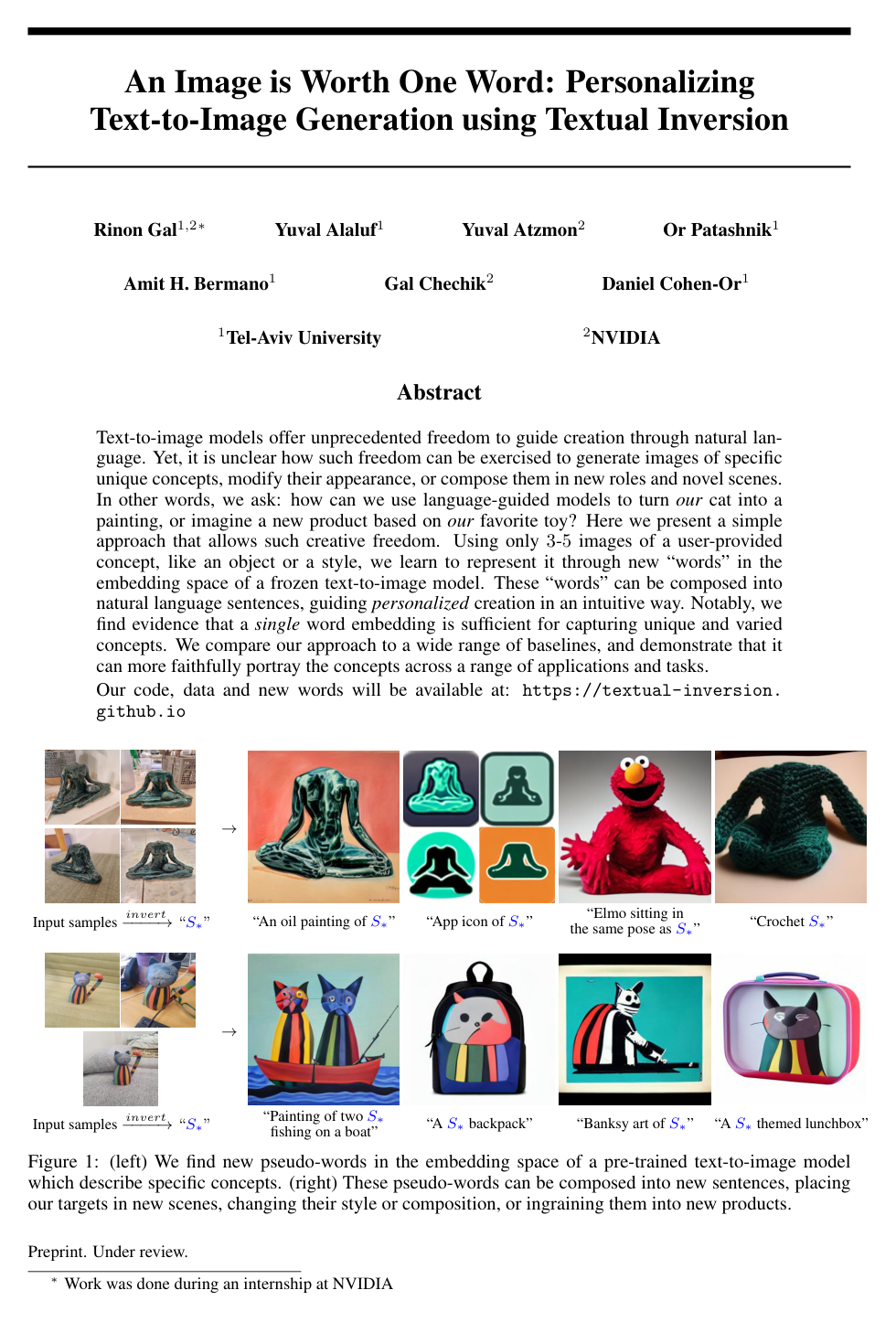
An Image is Worth One Word: Personalizing Text-to-Image Generation using Textual Inversion
Rinon Gal, Yuval Alaluf, Yuval Atzmon, Or Patashnik, Amit H. Bermano, Gal Chechik, Daniel Cohen-Or
Why you should read this
Introduces Textual Inversion, a technique that captures user-provided visual concepts into single word embeddings within a frozen text-to-image model, enabling precise personalized generation from natural language prompts using only a handful of reference images.
Text-to-image models offer unprecedented freedom to guide creation through natural language. Yet, it is unclear how such freedom can be exercised to generate images of specific unique concepts, modify their appearance, or compose them in new roles and novel scenes. In other words, we ask: how can we use language-guided models to turn our cat into a painting, or imagine a new product based on our favorite toy? Here we present a simple approach that allows such creative freedom. Using only 3-5 images of a user-provided concept, like an object or a style, we learn to represent it through new "words" in the embedding space of a frozen text-to-image model. These "words" can be composed into natural language sentences, guiding personalized creation in an intuitive way. Notably, we find evidence that a single word embedding is sufficient for capturing unique and varied concepts. We compare our approach to a wide range of baselines, and demonstrate that it can more faithfully portray the concepts across a range of applications and tasks. Our code, data and new words will be available at: this https URL
Added
2026-09-14
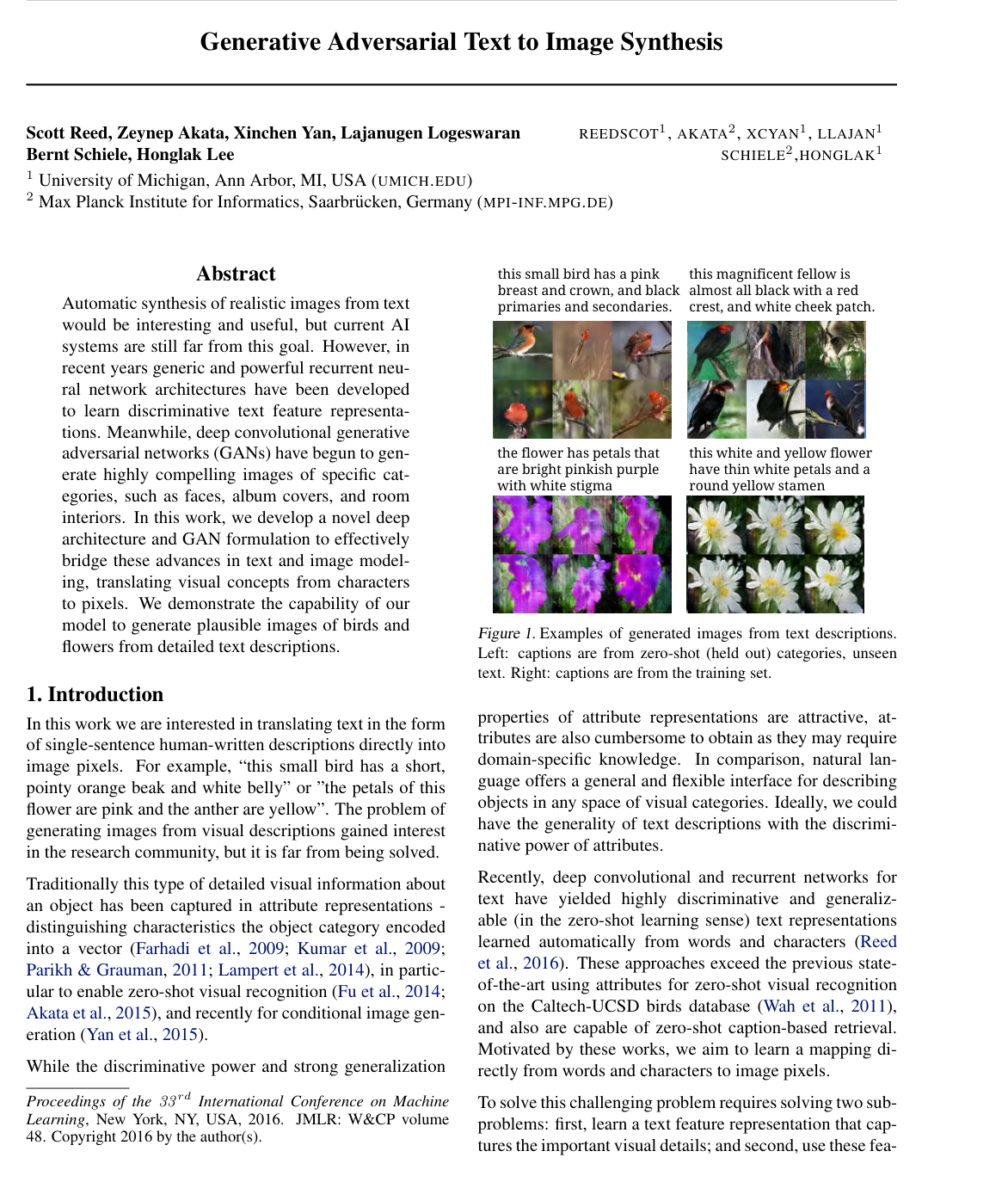
Generative Adversarial Text to Image Synthesis
Scott Reed, Zeynep Akata, Xinchen Yan, Lajanugen Logeswaran, Bernt Schiele, Honglak Lee
Why you should read this
Introduces a conditional generative adversarial network architecture that bridges text representations and convolutional generators to synthesize realistic images directly from natural language descriptions.
Automatic synthesis of realistic images from text would be interesting and useful, but current AI systems are still far from this goal. However, in recent years generic and powerful recurrent neural network architectures have been developed to learn discriminative text feature representations. Meanwhile, deep convolutional generative adversarial networks (GANs) have begun to generate highly compelling images of specific categories, such as faces, album covers, and room interiors. In this work, we develop a novel deep architecture and GAN formulation to effectively bridge these advances in text and image model- ing, translating visual concepts from characters to pixels. We demonstrate the capability of our model to generate plausible images of birds and flowers from detailed text descriptions.
Added
2026-09-11
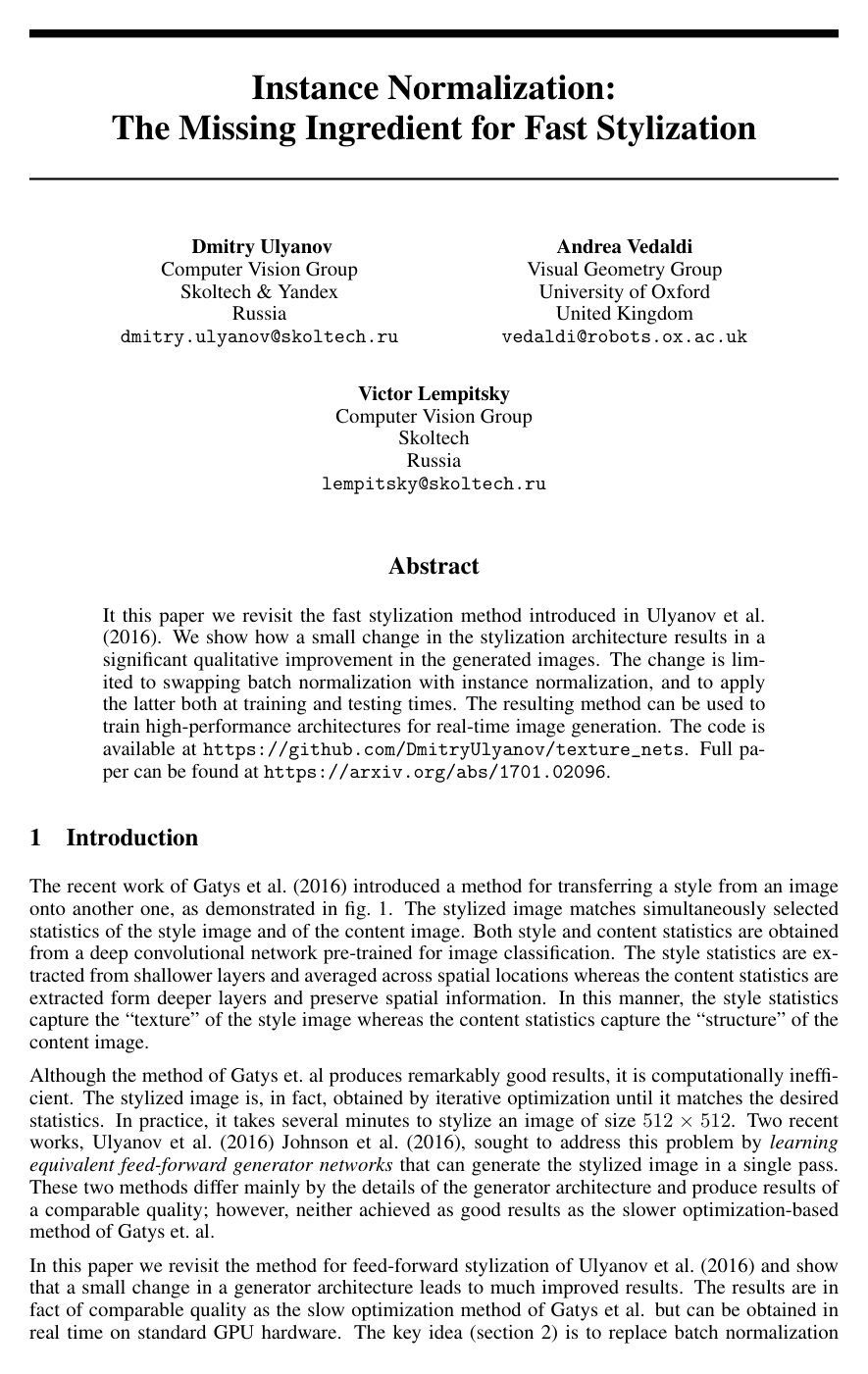
Instance Normalization: The Missing Ingredient for Fast Stylization
Dmitry Ulyanov, Andrea Vedaldi, Victor Lempitsky
Why you should read this
Introduces instance normalization as an effective replacement for batch normalization in feed-forward neural style transfer networks, substantially improving the visual quality of real-time stylized images.
It this paper we revisit the fast stylization method introduced in Ulyanov et. al. (2016). We show how a small change in the stylization architecture results in a significant qualitative improvement in the generated images. The change is limited to swapping batch normalization with instance normalization, and to apply the latter both at training and testing times. The resulting method can be used to train high-performance architectures for real-time image generation. The code will is made available on github at this https URL. Full paper can be found at arXiv:1701.02096.
Added
2026-09-11
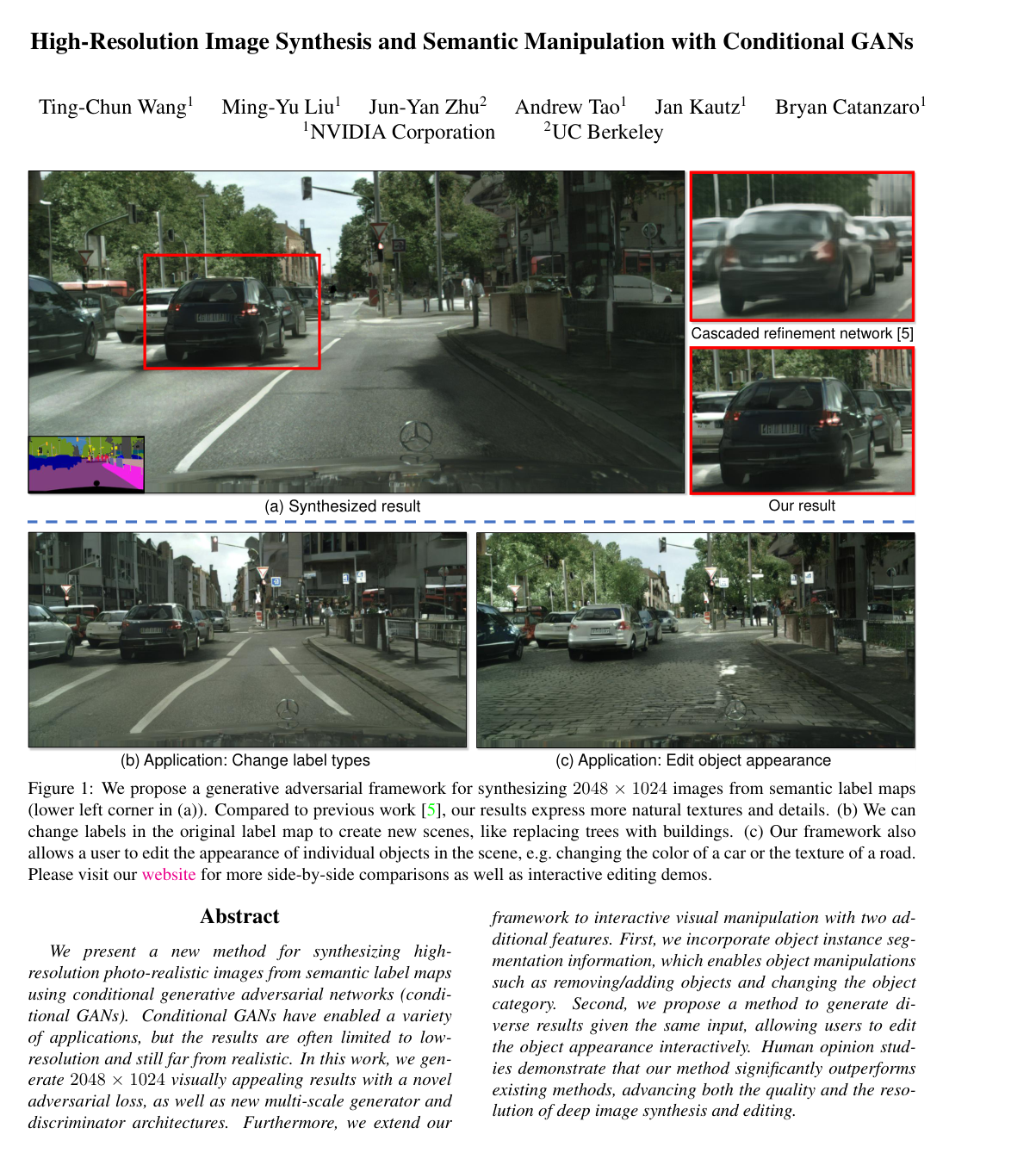
High-Resolution Image Synthesis and Semantic Manipulation with Conditional GANs
Ting-Chun Wang, Ming-Yu Liu, Jun-Yan Zhu, Andrew Tao, Jan Kautz, Bryan Catanzaro
Why you should read this
Presents a multi-scale conditional generative adversarial framework that achieves photorealistic 2048x1024 image synthesis from semantic label maps while supporting interactive, instance-level visual manipulation.
We present a new method for synthesizing high-resolution photo-realistic images from semantic label maps using conditional generative adversarial networks (conditional GANs). Conditional GANs have enabled a variety of applications, but the results are often limited to low-resolution and still far from realistic. In this work, we generate 2048x1024 visually appealing results with a novel adversarial loss, as well as new multi-scale generator and discriminator architectures. Furthermore, we extend our framework to interactive visual manipulation with two additional features. First, we incorporate object instance segmentation information, which enables object manipulations such as removing/adding objects and changing the object category. Second, we propose a method to generate diverse results given the same input, allowing users to edit the object appearance interactively. Human opinion studies demonstrate that our method significantly outperforms existing methods, advancing both the quality and the resolution of deep image synthesis and editing.
Added
2026-09-10
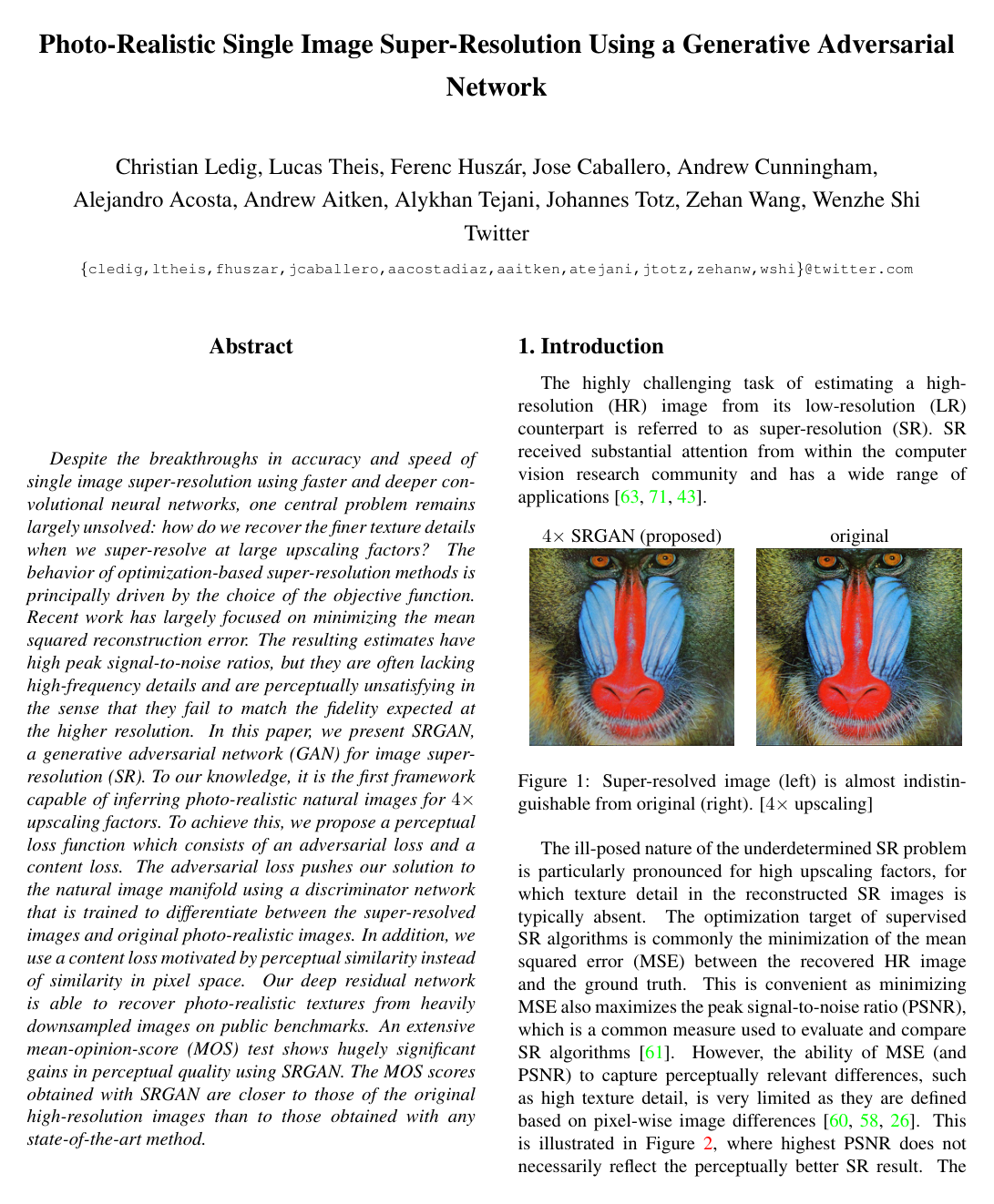
Photo-Realistic Single Image Super-Resolution Using a Generative Adversarial Network
Christian Ledig, Lucas Theis, Ferenc Huszar, Jose Caballero, Andrew Cunningham, Alejandro Acosta, Andrew Aitken, Alykhan Tejani, Johannes Totz, Zehan Wang, Wenzhe Shi
Why you should read this
Introduces SRGAN, a framework combining generative adversarial training and a perceptual loss to produce photo-realistic textures in 4x image super-resolution, overcoming the blurriness typical of standard pixel-space optimization.
Despite the breakthroughs in accuracy and speed of single image super-resolution using faster and deeper convolutional neural networks, one central problem remains largely unsolved: how do we recover the finer texture details when we super-resolve at large upscaling factors? The behavior of optimization-based super-resolution methods is principally driven by the choice of the objective function. Recent work has largely focused on minimizing the mean squared reconstruction error. The resulting estimates have high peak signal-to-noise ratios, but they are often lacking high-frequency details and are perceptually unsatisfying in the sense that they fail to match the fidelity expected at the higher resolution. In this paper, we present SRGAN, a generative adversarial network (GAN) for image super-resolution (SR). To our knowledge, it is the first framework capable of inferring photo-realistic natural images for 4x upscaling factors. To achieve this, we propose a perceptual loss function which consists of an adversarial loss and a content loss. The adversarial loss pushes our solution to the natural image manifold using a discriminator network that is trained to differentiate between the super-resolved images and original photo-realistic images. In addition, we use a content loss motivated by perceptual similarity instead of similarity in pixel space. Our deep residual network is able to recover photo-realistic textures from heavily downsampled images on public benchmarks. An extensive mean-opinion-score (MOS) test shows hugely significant gains in perceptual quality using SRGAN. The MOS scores obtained with SRGAN are closer to those of the original high-resolution images than to those obtained with any state-of-the-art method.
Added
2026-09-06
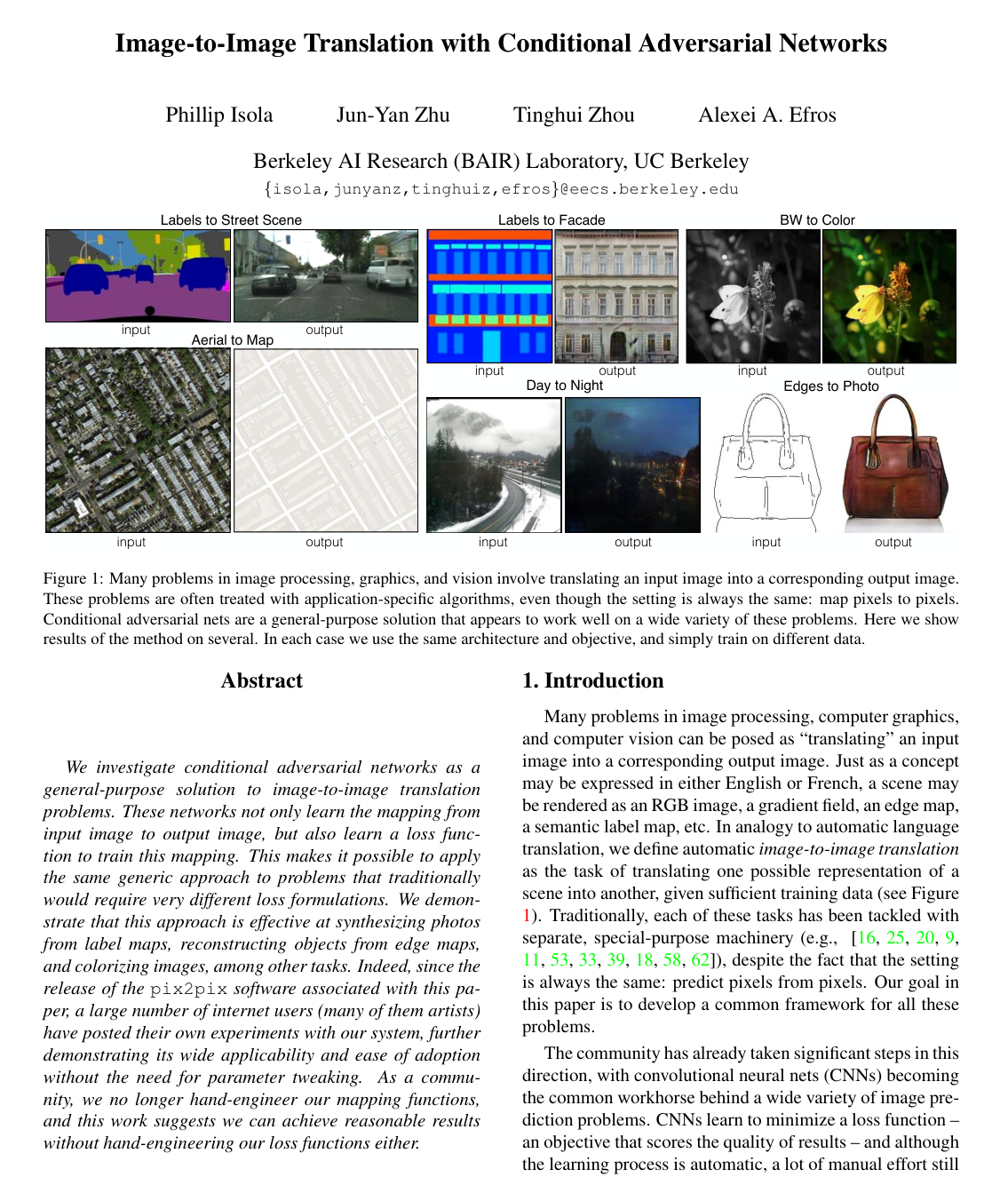
Image-to-Image Translation with Conditional Adversarial Networks
Phillip Isola, Jun-Yan Zhu, Tinghui Zhou, Alexei A. Efros
Why you should read this
Develops the "Pix2Pix" framework to perform paired image translation using a U-Net generator and PatchGAN discriminator.
We investigate conditional adversarial networks as a general-purpose solution to image-to-image translation problems. These networks not only learn the mapping from input image to output image, but also learn a loss function to train this mapping. This makes it possible to apply the same generic approach to problems that traditionally would require very different loss formulations. We demonstrate that this approach is effective at synthesizing photos from label maps, reconstructing objects from edge maps, and colorizing images, among other tasks. Indeed, since the release of the pix2pix software associated with this paper, a large number of internet users (many of them artists) have posted their own experiments with our system, further demonstrating its wide applicability and ease of adoption without the need for parameter tweaking. As a community, we no longer hand-engineer our mapping functions, and this work suggests we can achieve reasonable results without hand-engineering our loss functions either.
Added
2026-03-07
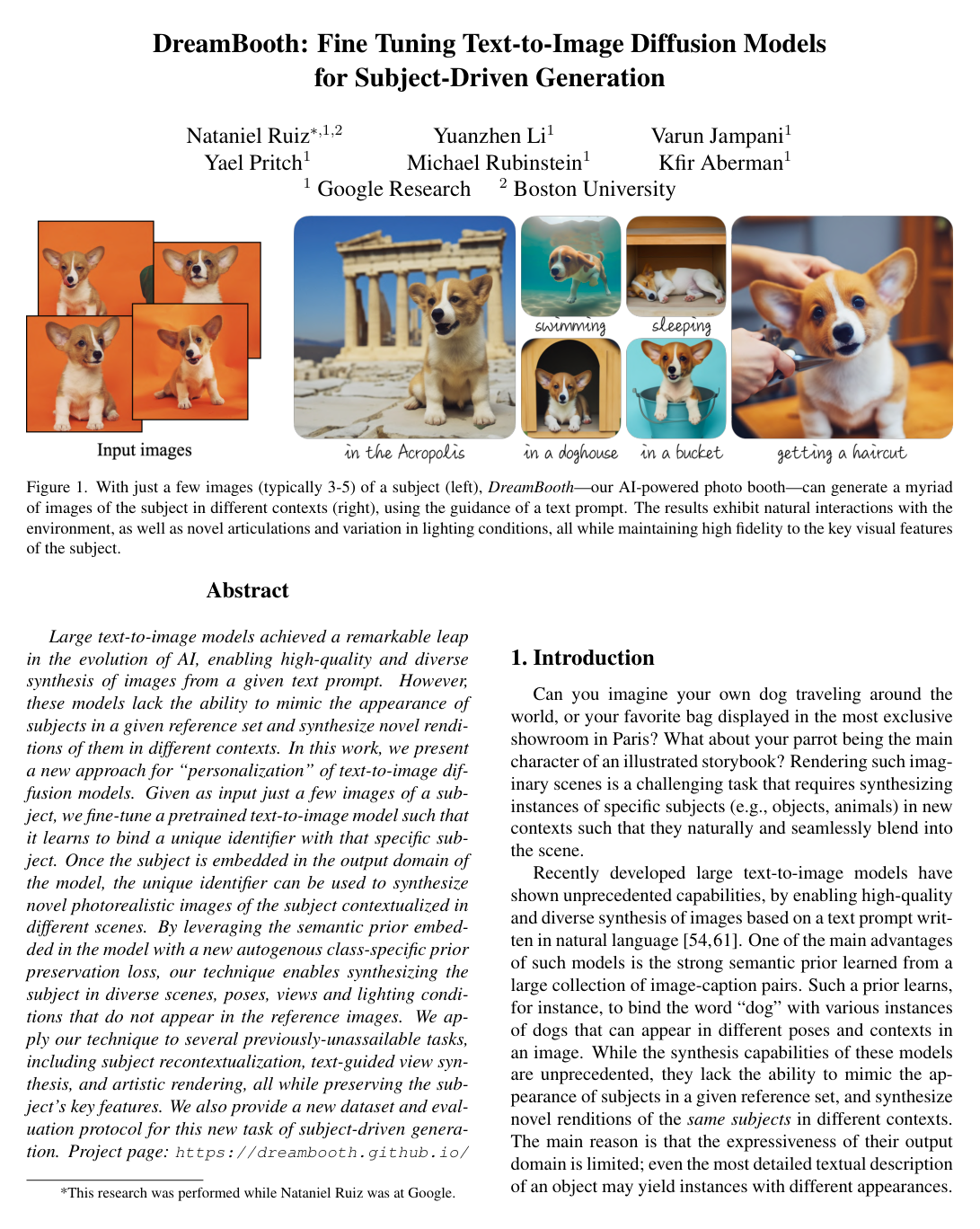
DreamBooth: Fine Tuning Text-to-Image Diffusion Models for Subject-Driven Generation
Nataniel Ruiz, Yuanzhen Li, Varun Jampani, Yael Pritch, Michael Rubinstein, Kfir Aberman
Why you should read this
Presents a groundbreaking method to personalize text-to-image AI, allowing users to generate specific subjects in diverse scenes with photorealistic accuracy from just a few reference images.
Large text-to-image models achieved a remarkable leap in the evolution of AI, enabling high-quality and diverse synthesis of images from a given text prompt. However, these models lack the ability to mimic the appearance of subjects in a given reference set and synthesize novel renditions of them in different contexts. In this work, we present a new approach for "personalization" of text-to-image diffusion models. Given as input just a few images of a subject, we fine-tune a pretrained text-to-image model such that it learns to bind a unique identifier with that specific subject. Once the subject is embedded in the output domain of the model, the unique identifier can be used to synthesize novel photorealistic images of the subject contextualized in different scenes. By leveraging the semantic prior embedded in the model with a new autogenous class-specific prior preservation loss, our technique enables synthesizing the subject in diverse scenes, poses, views and lighting conditions that do not appear in the reference images. We apply our technique to several previously-unassailable tasks, including subject recontextualization, text-guided view synthesis, and artistic rendering, all while preserving the subject's key features. We also provide a new dataset and evaluation protocol for this new task of subject-driven generation. Project page: this https URL
Added
2026-02-25
