
keyword
stochastic games
A stochastic game, also known as a Markov game, is a dynamic framework in game theory where multiple players interact over a sequence of discrete time steps across various environmental states. At each step, the game occupies a particular state, and every player simultaneously selects an action. The combination of all players actions and the current state probabilistically determines the next state of the system as well as the immediate payoff or reward received by each participant. First introduced by Lloyd Shapley, stochastic games generalize both single-agent Markov decision processes to multi-agent settings and static repeated games to multi-state environments, serving as a foundational mathematical model for multi-agent reinforcement learning in cooperative, competitive, and mixed-motive scenarios.
5 items
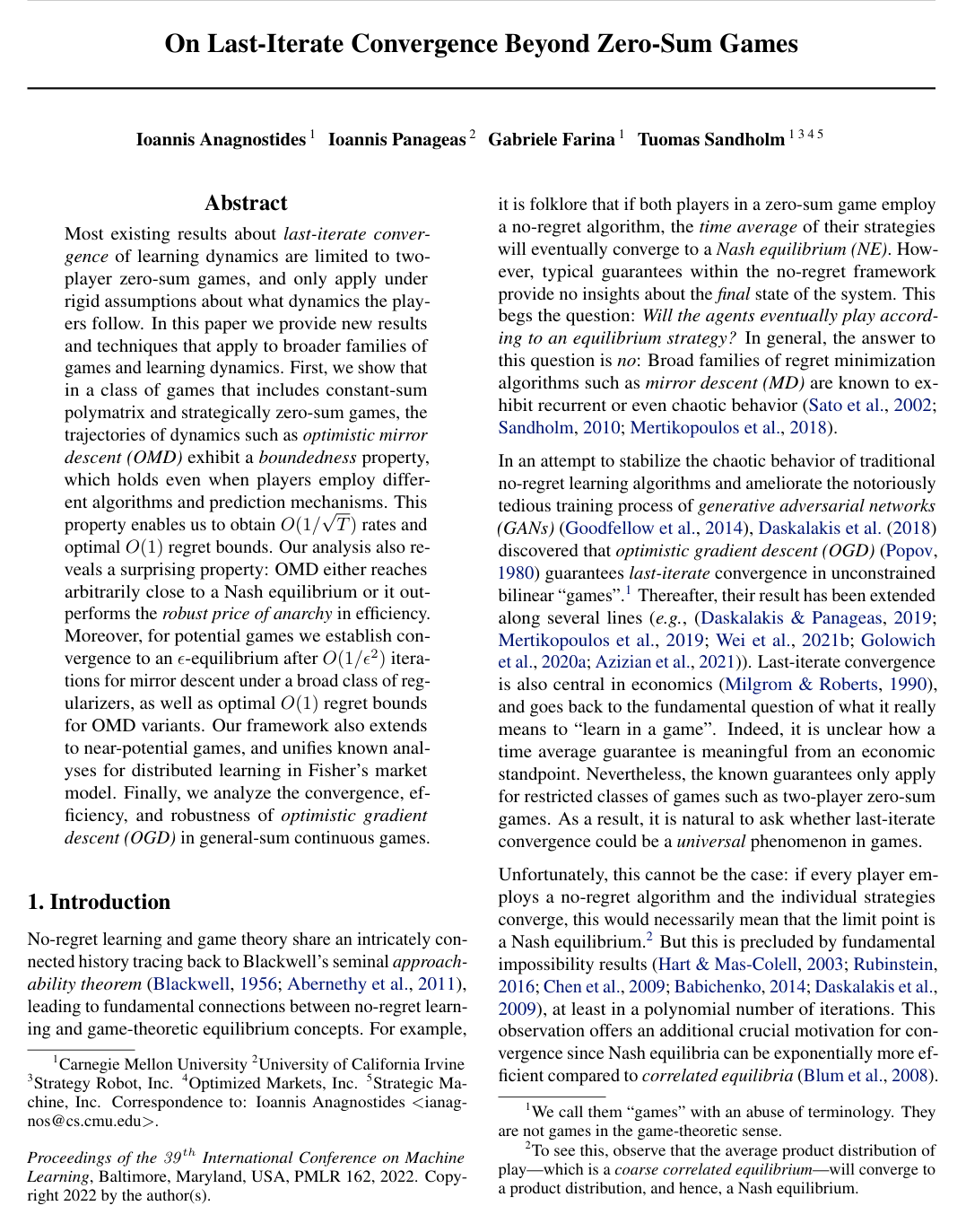
On Last-Iterate Convergence Beyond Zero-Sum Games
Ioannis Anagnostides, Ioannis Panageas, Gabriele Farina, Tuomas Sandholm
Why you should read this
Establishes last-iterate convergence rates and optimal regret bounds for optimistic mirror descent across broader game classes beyond zero-sum settings, including polymatrix, strategically zero-sum, and potential games where players can use heterogeneous algorithms.
Most existing results about last-iterate convergence of learning dynamics are limited to two-player zero-sum games, and only apply under rigid assumptions about what dynamics the players follow. In this paper we provide new results and techniques that apply to broader families of games and learning dynamics. First, we show that in a class of games that includes constant-sum polymatrix and strategically zero-sum games, the trajectories of dynamics such as optimistic mirror descent (OMD) exhibit a boundedness property, which holds even when players employ different algorithms and prediction mechanisms. This property enables us to obtain O(1/√T) rates and optimal O(1) regret bounds. Our analysis also reveals a surprising property: OMD either reaches arbitrarily close to a Nash equilibrium or it outperforms the robust price of anarchy in efficiency. Moreover, for potential games we establish convergence to an ε-equilibrium after O(1/ε^2) iterations for mirror descent under a broad class of regularizers, as well as optimal O(1) regret bounds for OMD variants. Our framework also extends to near-potential games, and unifies known analyses for distributed learning in Fisher’s market model. Finally, we analyze the convergence, efficiency, and robustness of optimistic gradient descent (OGD) in general-sum continuous games.
Added
2026-10-03
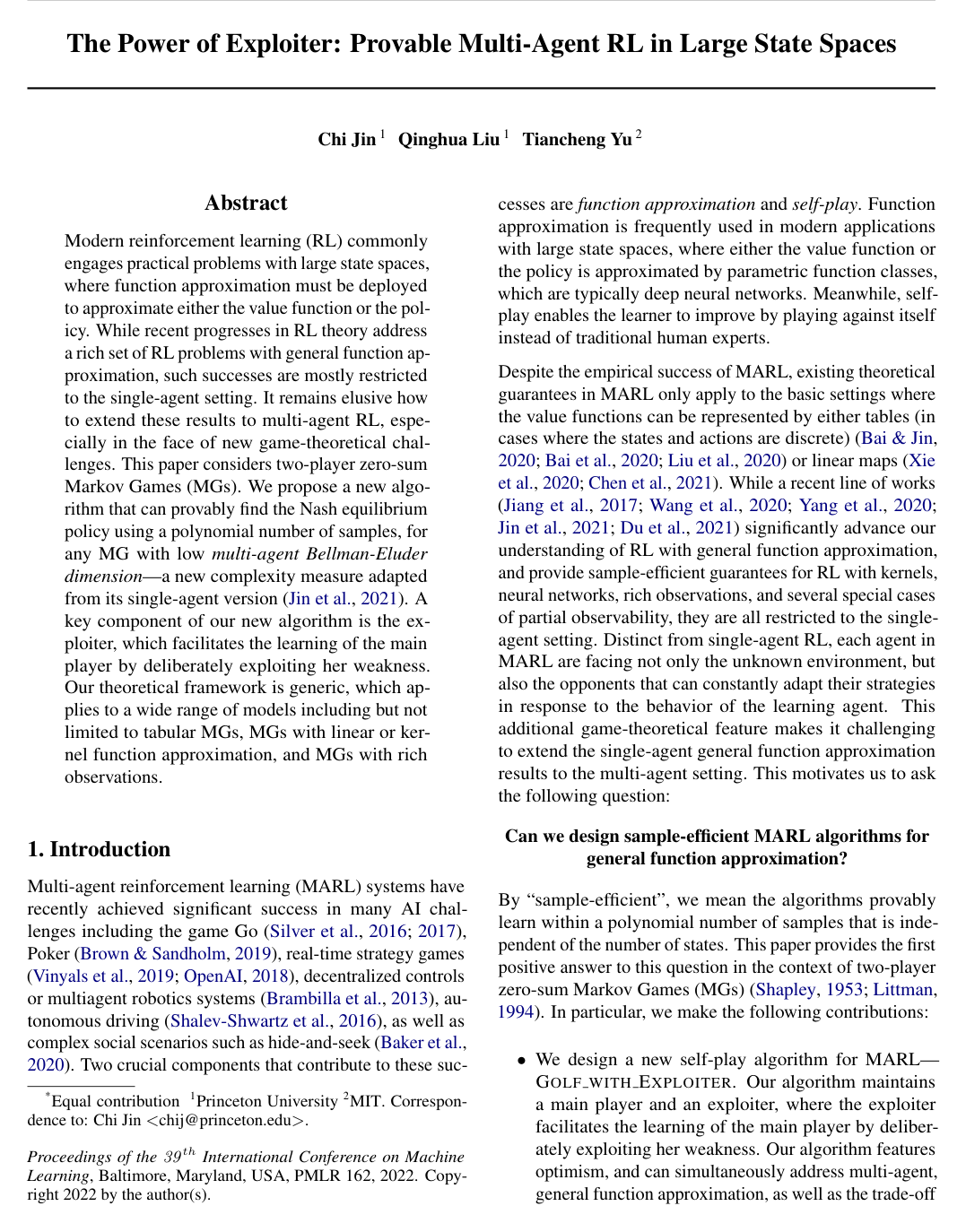
The Power of Exploiter: Provable Multi-Agent RL in Large State Spaces
Chi Jin, Qinghua Liu, Tiancheng Yu
Why you should read this
Develops an exploiter-driven self-play algorithm alongside a multi-agent Bellman-Eluder dimension to provide provable sample-efficiency guarantees for learning Nash equilibria in two-player zero-sum Markov games with general function approximation.
Modern reinforcement learning (RL) commonly engages practical problems with large state spaces, where function approximation must be deployed to approximate either the value function or the policy. While recent progresses in RL theory address a rich set of RL problems with general function approximation, such successes are mostly restricted to the single-agent setting. It remains elusive how to extend these results to multi-agent RL, especially in the face of new game-theoretical challenges. This paper considers two-player zero-sum Markov Games (MGs). We propose a new algorithm that can provably find the Nash equilibrium policy using a polynomial number of samples, for any MG with low multi-agent Bellman-Eluder dimension—a new complexity measure adapted from its single-agent version (Jin et al., 2021). A key component of our new algorithm is the exploiter, which facilitates the learning of the main player by deliberately exploiting her weakness. Our theoretical framework is generic, which applies to a wide range of models including but not limited to tabular MGs, MGs with linear or kernel function approximation, and MGs with rich observations.
Added
2026-10-03
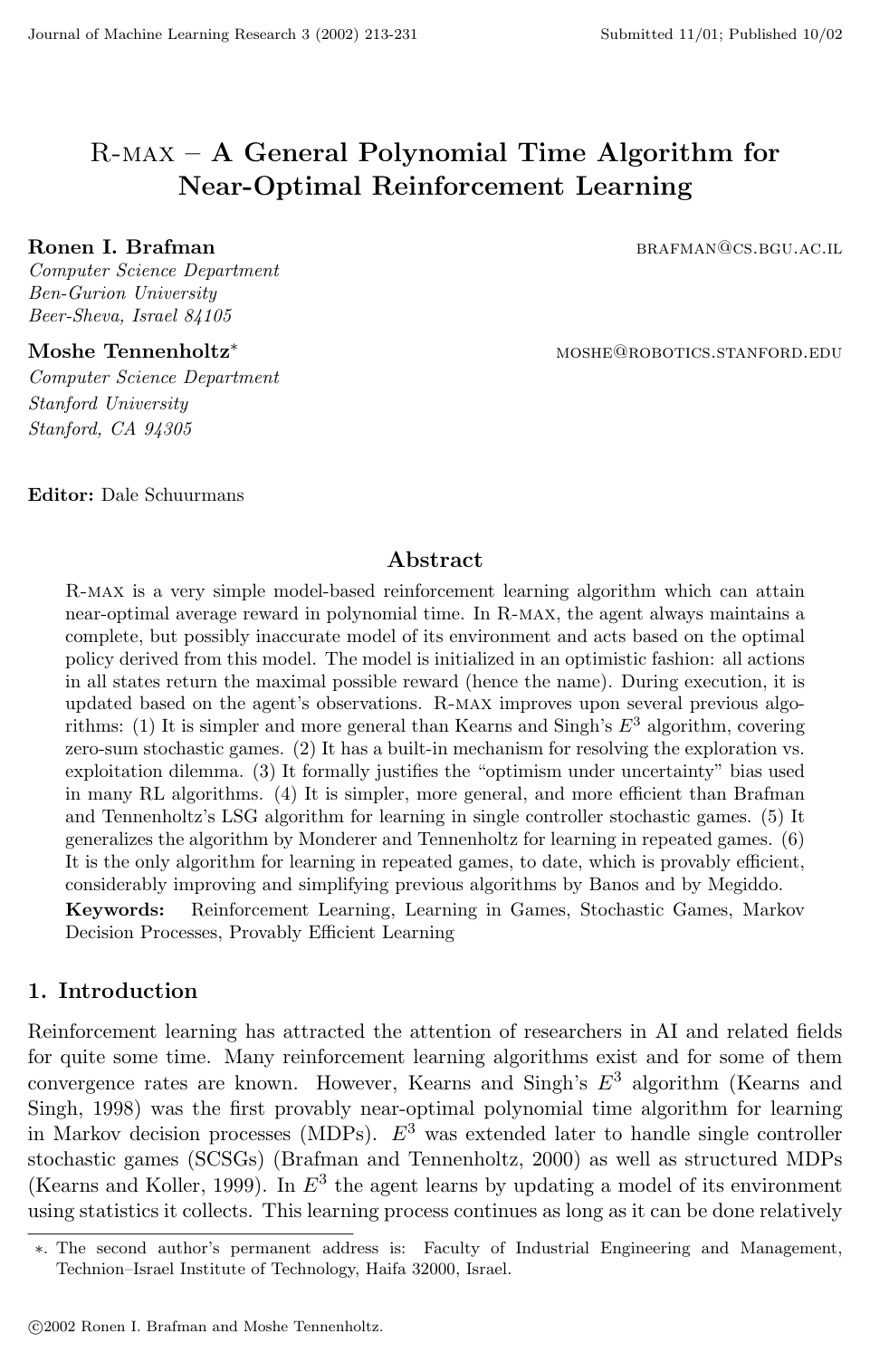
R-MAX - A General Polynomial Time Algorithm for Near-Optimal Reinforcement Learning
R. Brafman, Moshe Tennenholtz
Why you should read this
Introduces the R-MAX algorithm, providing a simple model-based approach that formally justifies optimism under uncertainty to achieve provably near-optimal reinforcement learning in polynomial time across Markov decision processes and zero-sum stochastic games.
R-MAX is a very simple model-based reinforcement learning algorithm which can attain near-optimal average reward in polynomial time. In R-MAX, the agent always maintains a complete, but possibly inaccurate model of its environment and acts based on the optimal policy derived from this model. The model is initialized in an optimistic fashion: all actions in all states return the maximal possible reward (hence the name). During execution, it is updated based on the agent’s observations. R-MAX improves upon several previous algorithms: (1) It is simpler and more general than Kearns and Singh’s E3 algorithm, covering zero-sum stochastic games. (2) It has a built-in mechanism for resolving the exploration vs. exploitation dilemma. (3) It formally justifies the “optimism under uncertainty” bias used in many RL algorithms. (4) It is simpler, more general, and more efficient than Brafman and Tennenholtz’s LSG algorithm for learning in single controller stochastic games. (5) It generalizes the algorithm by Monderer and Tennenholtz for learning in repeated games. (6) It is the only algorithm for learning in repeated games, to date, which is provably efficient, considerably improving and simplifying previous algorithms by Banos and by Megiddo.
Added
2026-09-25
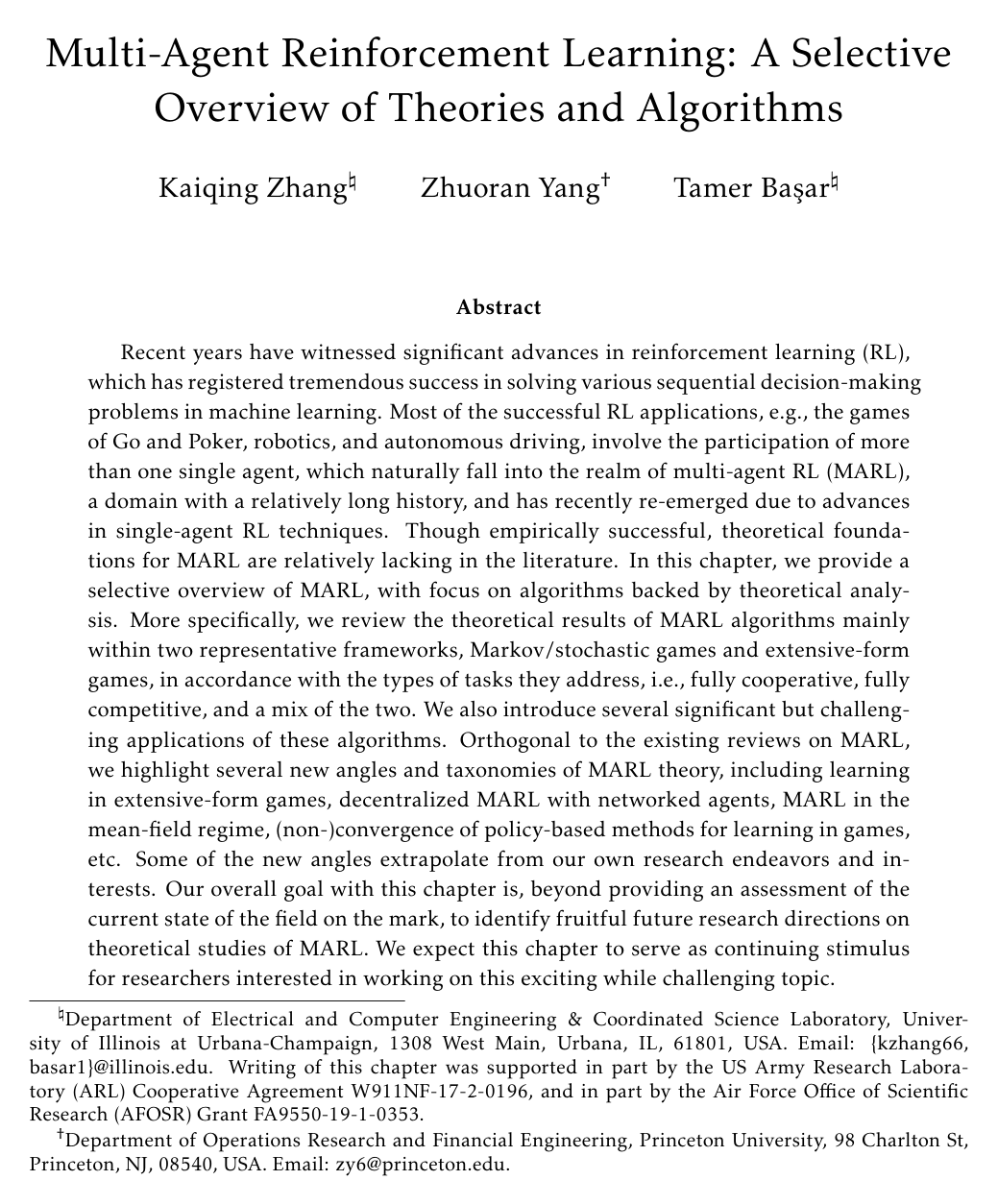
Multi-Agent Reinforcement Learning: A Selective Overview of Theories and Algorithms
Kaiqing Zhang, Zhuoran Yang, Tamer Başar
Why you should read this
Synthesizes the theoretical foundations of multi-agent reinforcement learning across stochastic and extensive-form games, categorizing algorithmic guarantees for cooperative, competitive, decentralized, and mean-field settings.
Recent years have witnessed significant advances in reinforcement learning (RL), which has registered great success in solving various sequential decision-making problems in machine learning. Most of the successful RL applications, e.g., the games of Go and Poker, robotics, and autonomous driving, involve the participation of more than one single agent, which naturally fall into the realm of multi-agent RL (MARL), a domain with a relatively long history, and has recently re-emerged due to advances in single-agent RL techniques. Though empirically successful, theoretical foundations for MARL are relatively lacking in the literature. In this chapter, we provide a selective overview of MARL, with focus on algorithms backed by theoretical analysis. More specifically, we review the theoretical results of MARL algorithms mainly within two representative frameworks, Markov/stochastic games and extensive-form games, in accordance with the types of tasks they address, i.e., fully cooperative, fully competitive, and a mix of the two. We also introduce several significant but challenging applications of these algorithms. Orthogonal to the existing reviews on MARL, we highlight several new angles and taxonomies of MARL theory, including learning in extensive-form games, decentralized MARL with networked agents, MARL in the mean-field regime, (non-)convergence of policy-based methods for learning in games, etc. Some of the new angles extrapolate from our own research endeavors and interests. Our overall goal with this chapter is, beyond providing an assessment of the current state of the field on the mark, to identify fruitful future research directions on theoretical studies of MARL. We expect this chapter to serve as continuing stimulus for researchers interested in working on this exciting while challenging topic.
Added
2026-09-24
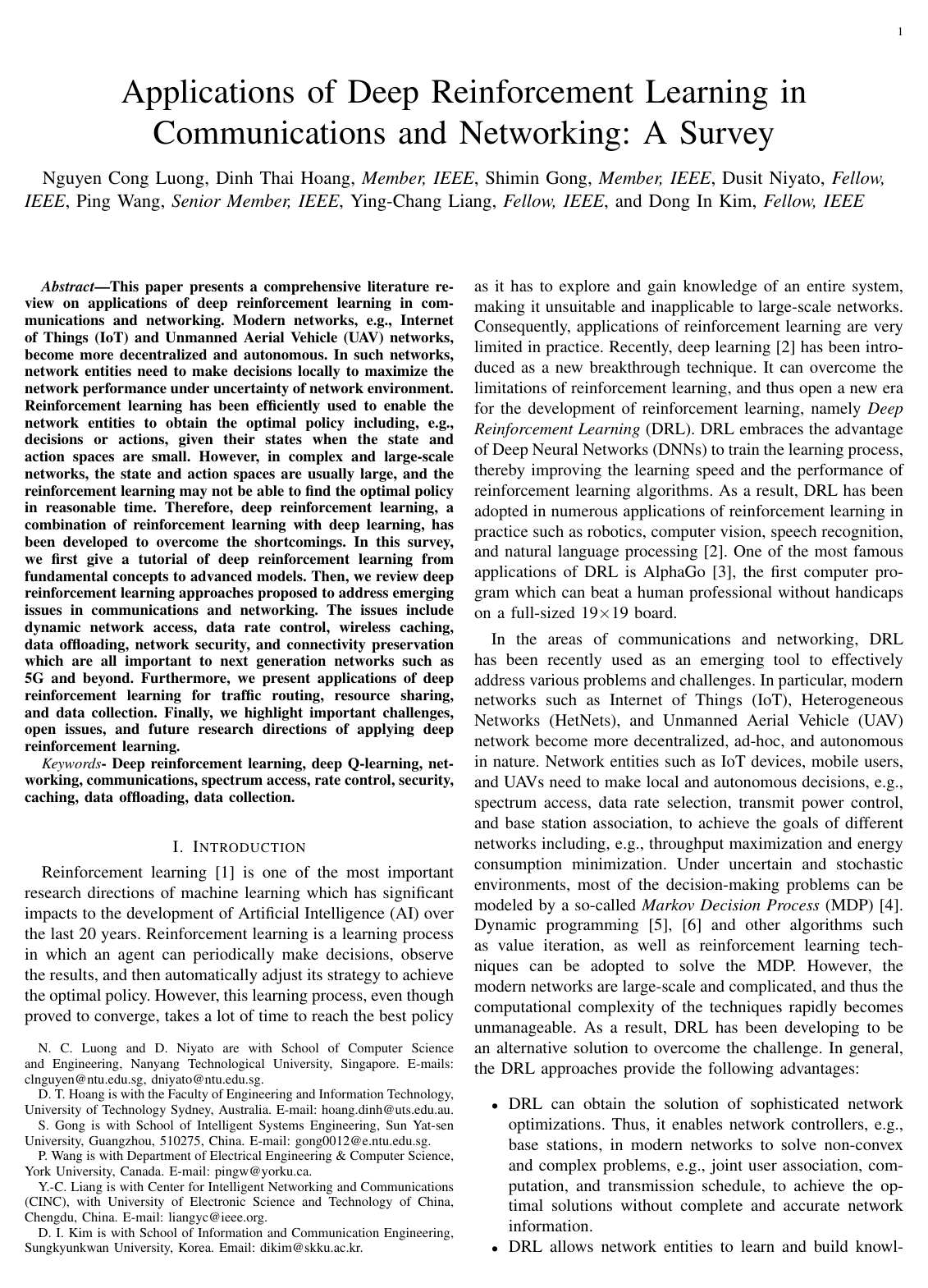
Applications of Deep Reinforcement Learning in Communications and Networking: A Survey
Nguyen Cong Luong, Dinh Thai Hoang, Shimin Gong, Dusit Niyato, Ping Wang, Ying-Chang Liang, Dong In Kim
Why you should read this
Surveys the application of deep reinforcement learning across modern communication networks, providing a structured analysis of how advanced models solve complex decision-making problems in dynamic spectrum access, wireless caching, traffic routing, and network security.
This paper presents a comprehensive literature review on applications of deep reinforcement learning in communications and networking. Modern networks, e.g., Internet of Things (IoT) and Unmanned Aerial Vehicle (UAV) networks, become more decentralized and autonomous. In such networks, network entities need to make decisions locally to maximize the network performance under uncertainty of network environment. Reinforcement learning has been efficiently used to enable the network entities to obtain the optimal policy including, e.g., decisions or actions, given their states when the state and action spaces are small. However, in complex and large-scale networks, the state and action spaces are usually large, and the reinforcement learning may not be able to find the optimal policy in reasonable time. Therefore, deep reinforcement learning, a combination of reinforcement learning with deep learning, has been developed to overcome the shortcomings. In this survey, we first give a tutorial of deep reinforcement learning from fundamental concepts to advanced models. Then, we review deep reinforcement learning approaches proposed to address emerging issues in communications and networking. The issues include dynamic network access, data rate control, wireless caching, data offloading, network security, and connectivity preservation which are all important to next generation networks such as 5G and beyond. Furthermore, we present applications of deep reinforcement learning for traffic routing, resource sharing, and data collection. Finally, we highlight important challenges, open issues, and future research directions of applying deep reinforcement learning.
Added
2026-09-18