
keyword
spectral clustering
Spectral clustering is an unsupervised machine learning technique that groups data points by analyzing the spectrum, or eigenvalues and eigenvectors, of a graph-based similarity matrix derived from pairwise relationships in the data. Unlike traditional methods like standard k-means that assume convex or spherically shaped clusters in Euclidean space, spectral clustering models the dataset as a weighted affinity graph, constructs a graph Laplacian matrix, and uses its eigenvectors to project the data into a lower-dimensional embedding space. A standard partitioning algorithm, such as k-means, is then applied to the embedded coordinates to assign final cluster labels. This graph-theoretic formulation allows spectral clustering to effectively uncover complex, non-linearly separable cluster geometries and manifold structures that conventional distance-based clustering algorithms fail to capture.
30 items
Contrastive and Non-Contrastive Self-Supervised Learning Recover Global and Local Spectral Embedding Methods
Randall Balestriero, Yann LeCun
Why you should read this
Unifies contrastive and non-contrastive self-supervised learning under classical spectral embedding theory, deriving closed-form optimal representations and practical rules for selecting algorithms based on task alignment and dataset size.
Self-Supervised Learning (SSL) surmises that inputs and pairwise positive relations- ships are enough to learn meaningful representations. Although SSL has recently reached a milestone: outperforming supervised methods in many modalities. . . the theoretical foundations are limited, method-specific, and fail to provide principled design guidelines to practitioners. In this paper, we propose a unifying framework under the helm of spectral manifold learning to address those limitations. Through the course of this study, we will rigorously demonstrate that VICReg, SimCLR, BarlowTwins et al. correspond to eponymous spectral methods such as Laplacian Eigenmaps, Multidimensional Scaling et al. This unification will then allow us to obtain (i) the closed-form optimal representation for each method, (ii) the closed- form optimal network parameters in the linear regime for each method, (iii) the impact of the pairwise relations used during training on each of those quantities and on downstream classification task performances, and most importantly, (iv) the first theoretical bridge between contrastive and non-contrastive methods towards global and local spectral embedding methods respectively, hinting at the benefits and limitations of each. For example, (i) if the pairwise relation is aligned with the downstream task, any SSL method can be employed successfully and will recover the supervised method, but in the low data regime, SimCLR or VICReg with high invariance hyper-parameter should be preferred; (ii) if the pairwise relation is mis- aligned with the downstream task, BarlowTwins or VICReg with small invariance hyper-parameter should be preferred.
Added
2026-10-05
Theoretical Foundations of t-SNE for Visualizing High-Dimensional Clustered Data
T. Tony Cai, Rong Ma
Why you should read this
Establishes a rigorous theoretical foundation for t-SNE by linking its early exaggeration phase to Laplacian spectral clustering and analyzing its map kinematics to provide principled guidelines for hyperparameter selection.
This paper investigates the theoretical foundations of the t-distributed stochastic neighbor embedding (t-SNE) algorithm, a popular nonlinear dimension reduction and data visualization method. A novel theoretical framework for the analysis of t-SNE based on the gradient descent approach is presented. For the early exaggeration stage of t-SNE, we show its asymptotic equivalence to power iterations based on the underlying graph Laplacian, characterize its limiting behavior, and uncover its deep connection to Laplacian spectral clustering, and fundamental principles including early stopping as implicit regularization. The results explain the intrinsic mechanism and the empirical benefits of such a computational strategy. For the embedding stage of t-SNE, we characterize the kinematics of the low-dimensional map throughout the iterations, and identify an amplification phase, featuring the intercluster repulsion and the expansive behavior of the low-dimensional map, and a stabilization phase. The general theory explains the fast convergence rate and the exceptional empirical performance of t-SNE for visualizing clustered data, brings forth the interpretations of the t-SNE visualizations, and provides theoretical guidance for applying t-SNE and selecting its tuning parameters in various applications.
Added
2026-09-26
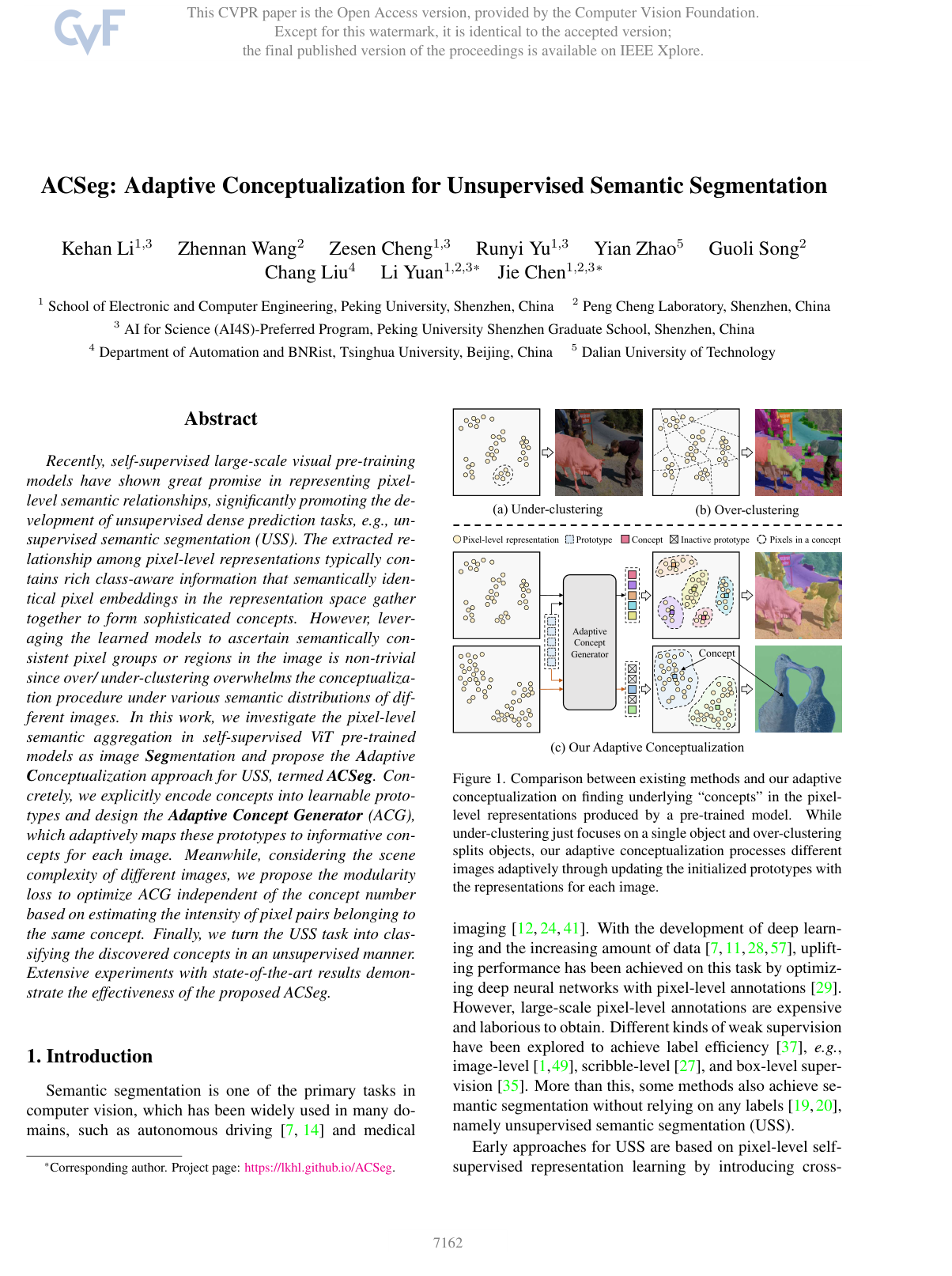
ACSeg: Adaptive Conceptualization for Unsupervised Semantic Segmentation
Kehan Li, Zhennan Wang, Zesen Cheng, Runyi Yu, Yian Zhao, Guoli Song, Chang Liu, Li Yuan, Jie Chen
Why you should read this
Proposes an unsupervised semantic segmentation framework that dynamically maps learnable prototypes into image-specific semantic concepts using attention mechanisms and a modularity loss, overcoming over- and under-clustering issues without requiring manual annotations.
Recently, self-supervised large-scale visual pre-training models have shown great promise in representing pixel-level semantic relationships, significantly promoting the development of unsupervised dense prediction tasks, e.g., unsupervised semantic segmentation (USS). The extracted relationship among pixel-level representations typically contains rich class-aware information that semantically identical pixel embeddings in the representation space gather together to form sophisticated concepts. However, leveraging the learned models to ascertain semantically consistent pixel groups or regions in the image is non-trivial since over/ under-clustering overwhelms the conceptualization procedure under various semantic distributions of different images. In this work, we investigate the pixel-level semantic aggregation in self-supervised ViT pre-trained models as image Segmentation and propose the Adaptive Conceptualization approach for USS, termed ACSeg. Concretely, we explicitly encode concepts into learnable prototypes and design the Adaptive Concept Generator (ACG), which adaptively maps these prototypes to informative concepts for each image. Meanwhile, considering the scene complexity of different images, we propose the modularity loss to optimize ACG independent of the concept number based on estimating the intensity of pixel pairs belonging to the same concept. Finally, we turn the USS task into classifying the discovered concepts in an unsupervised manner. Extensive experiments with state-of-the-art results demonstrate the effectiveness of the proposed ACSeg.
Added
2026-09-26
Efficient One-Pass Multi-View Subspace Clustering with Consensus Anchors
Suyuan Liu, Siwei Wang, Pei Zhang, Kai Xu, Xinwang Liu, Changwang Zhang, Feng Gao
Why you should read this
Proposes a scalable multi-view subspace clustering method that jointly learns consensus anchors and a fused graph with exact connected components, achieving linear time complexity and directly generating cluster labels without heuristic anchor sampling or post-processing steps.
Multi-view subspace clustering (MVSC) optimally integrates multiple graph structure information to improve clustering performance. Recently, many anchor-based variants are proposed to reduce the computational complexity of MVSC. Though achieving considerable acceleration, we observe that most of them adopt fixed anchor points separating from the sub-sequential anchor graph construction, which may adversely affect the clustering performance. In addition, post-processing is required to generate discrete clustering labels with additional time consumption. To address these issues, we propose a scalable and parameter-free MVSC method to directly output the clustering labels with optimal anchor graph, termed as Efficient One-pass Multi-view Subspace Clustering with Consensus Anchors (EOMSC-CA). Specially, we combine anchor learning and graph construction into a uniform framework to boost clustering performance. Meanwhile, by imposing a graph connectivity constraint, our algorithm directly outputs the clustering labels without any post-processing procedures as previous methods do. Our proposed EOMSC-CA is proven to be linear complexity respecting to the data size. The superiority of our EOMSC-CA over the effectiveness and efficiency is demonstrated by extensive experiments. Our code is publicly available at https://github.com/Tracesource/EOMSC-CA.
Added
2026-09-26
Semantic-Enhanced Image Clustering
Shaotian Cai, Liping Qiu, Xiaojun Chen, Qin Zhang, Longteng Chen
Why you should read this
Proposes a CLIP-guided image clustering framework that extracts semantic WordNet spaces and enforces dual-space consistency to accurately separate visually similar yet semantically distinct images without predefined class names.
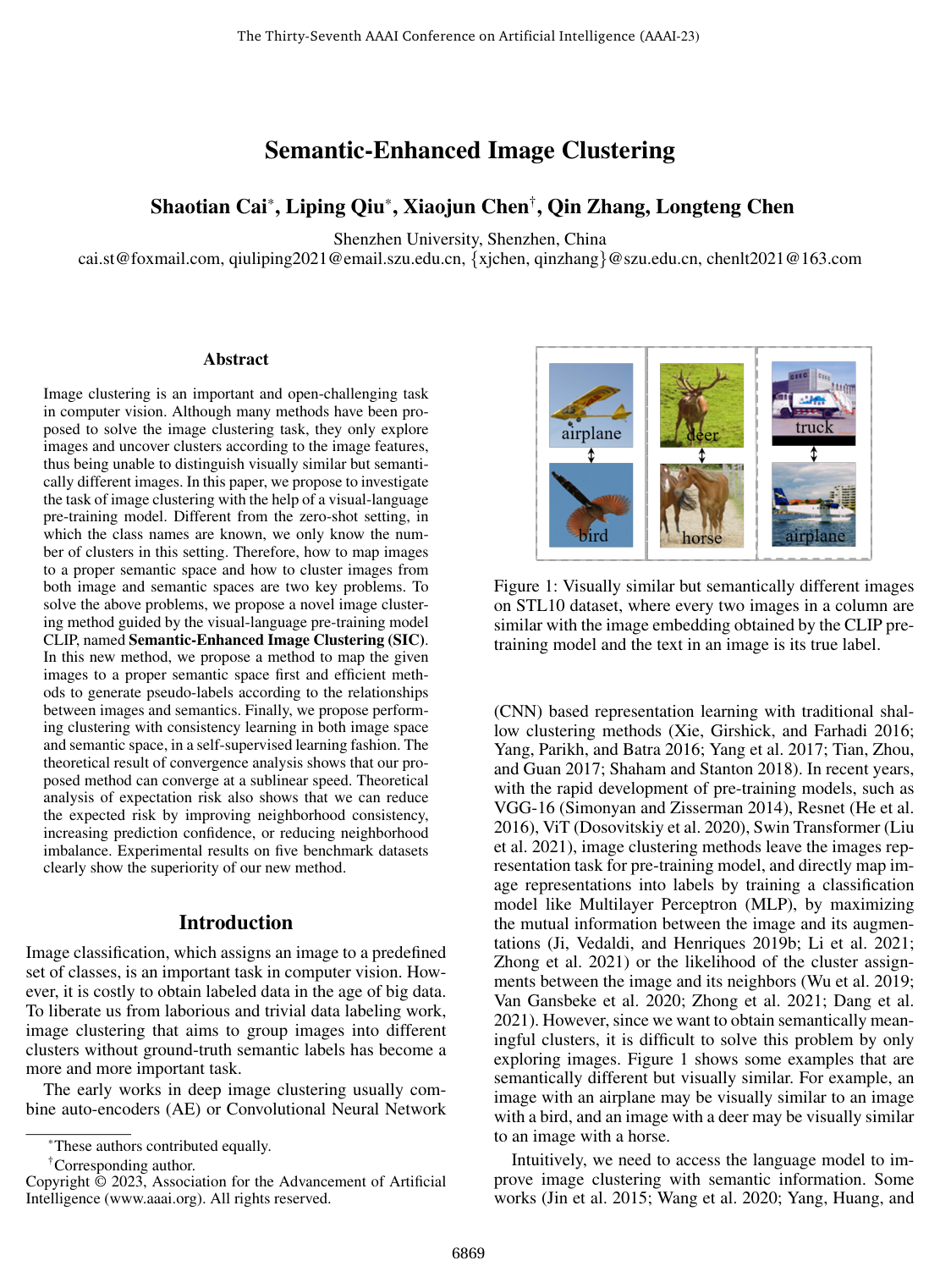
Image clustering is an important and open-challenging task in computer vision. Although many methods have been proposed to solve the image clustering task, they only explore images and uncover clusters according to the image features, thus being unable to distinguish visually similar but semantically different images. In this paper, we propose to investigate the task of image clustering with the help of a visual-language pre-training model. Different from the zero-shot setting, in which the class names are known, we only know the number of clusters in this setting. Therefore, how to map images to a proper semantic space and how to cluster images from both image and semantic spaces are two key problems. To solve the above problems, we propose a novel image clustering method guided by the visual-language pre-training model CLIP, named Semantic-Enhanced Image Clustering (SIC). In this new method, we propose a method to map the given images to a proper semantic space first and efficient methods to generate pseudo-labels according to the relationships between images and semantics. Finally, we propose performing clustering with consistency learning in both image space and semantic space, in a self-supervised learning fashion. The theoretical result of convergence analysis shows that our proposed method can converge at a sublinear speed. Theoretical analysis of expectation risk also shows that we can reduce the expected risk by improving neighborhood consistency, increasing prediction confidence, or reducing neighborhood imbalance. Experimental results on five benchmark datasets clearly show the superiority of our new method.
Added
2026-09-26
Let the Data Choose: Flexible and Diverse Anchor Graph Fusion for Scalable Multi-View Clustering
Pei Zhang, Siwei Wang, Liang Li, Changwang Zhang, Xinwang Liu, En Zhu, Zhe Liu, Lu Zhou, Lei Luo
Why you should read this
Proposes a scalable multi-view clustering framework that automatically weights varied anchor graph sizes across different views to avoid costly hyperparameter tuning while achieving linear computational complexity.
In the past few years, numerous multi-view graph clustering algorithms have been proposed to enhance the clustering performance by exploring information from multiple views. Despite the superior performance, the high time and space expenditures limit their scalability. Accordingly, anchor graph learning has been introduced to alleviate the computational complexity. However, existing approaches can be further improved by the following considerations: (i) Existing anchor-based methods share the same number of anchors across views. This strategy violates the diversity and flexibility of multi-view data distribution. (ii) Searching for the optimal anchor number within hyper-parameters takes much extra tuning time, which makes existing methods impractical. (iii) How to flexibly fuse multi-view anchor graphs of diverse sizes has not been well explored in existing literature. To address the above issues, we propose a novel anchor-based method termed Flexible and Diverse Anchor Graph Fusion for Scalable Multi-View Clustering (FDAGF) in this paper. Instead of manually tuning optimal anchor with massive hyper-parameters, we propose to optimize the contribution weights of a group of pre-defined anchor numbers to avoid extra time expenditure among views. Most importantly, we propose a novel hybrid fusion strategy for multi-size anchor graphs with theoretical proof, which allows flexible and diverse anchor graph fusion. Then, an efficient linear optimization algorithm is proposed to solve the resultant problem. Comprehensive experimental results demonstrate the effectiveness and efficiency of our proposed framework. The source code is available at https://github.com/Jeaninezpp/FDAGF.
Added
2026-09-26
XAI Beyond Classification: Interpretable Neural Clustering
Xi Peng, Yunfan Li, Ivor W. Tsang, Hongyuan Zhu, Jiancheng Lv, Joey Tianyi Zhou
Why you should read this
Proposes an intrinsically explainable neural network that reformulates discrete k-means into a differentiable layer, enabling end-to-end parallel optimization, online clustering on data streams, and provable convergence without relying on post-hoc interpretations.
In this paper, we study two challenging problems in explainable AI (XAI) and data clustering. The first is how to directly design a neural network with inherent interpretability, rather than giving post-hoc explanations of a black-box model. The second is implementing discrete k-means with a differentiable neural network that embraces the advantages of parallel computing, online clustering, and clustering-favorable representation learning. To address these two challenges, we design a novel neural network, which is a differentiable reformulation of the vanilla k-means, called inTerpretable nEuraL cLustering (TELL). Our contributions are threefold. First, to the best of our knowledge, most existing XAI works focus on supervised learning paradigms. This work is one of the few XAI studies on unsupervised learning, in particular, data clustering. Second, TELL is an interpretable, or the so-called intrinsically explainable and transparent model. In contrast, most existing XAI studies resort to various means for understanding a black-box model with post-hoc explanations. Third, from the view of data clustering, TELL possesses many properties highly desired by k-means, including but not limited to online clustering, plug-and-play module, parallel computing, and provable convergence. Extensive experiments show that our method achieves superior performance comparing with 14 clustering approaches on three challenging data sets. The source code could be accessed at www.pengxi.me.
Added
2026-09-26
Decoupled Contrastive Multi-View Clustering with High-Order Random Walks
Yiding Lu, Yijie Lin, Mouxing Yang, Dezhong Peng, Peng Hu, Xi Peng
Why you should read this
Proposes a decoupled multi-view clustering framework that uses high-order random walks to rectify false positive and false negative pairs globally while preserving view-specific information through cross-view reconstruction.
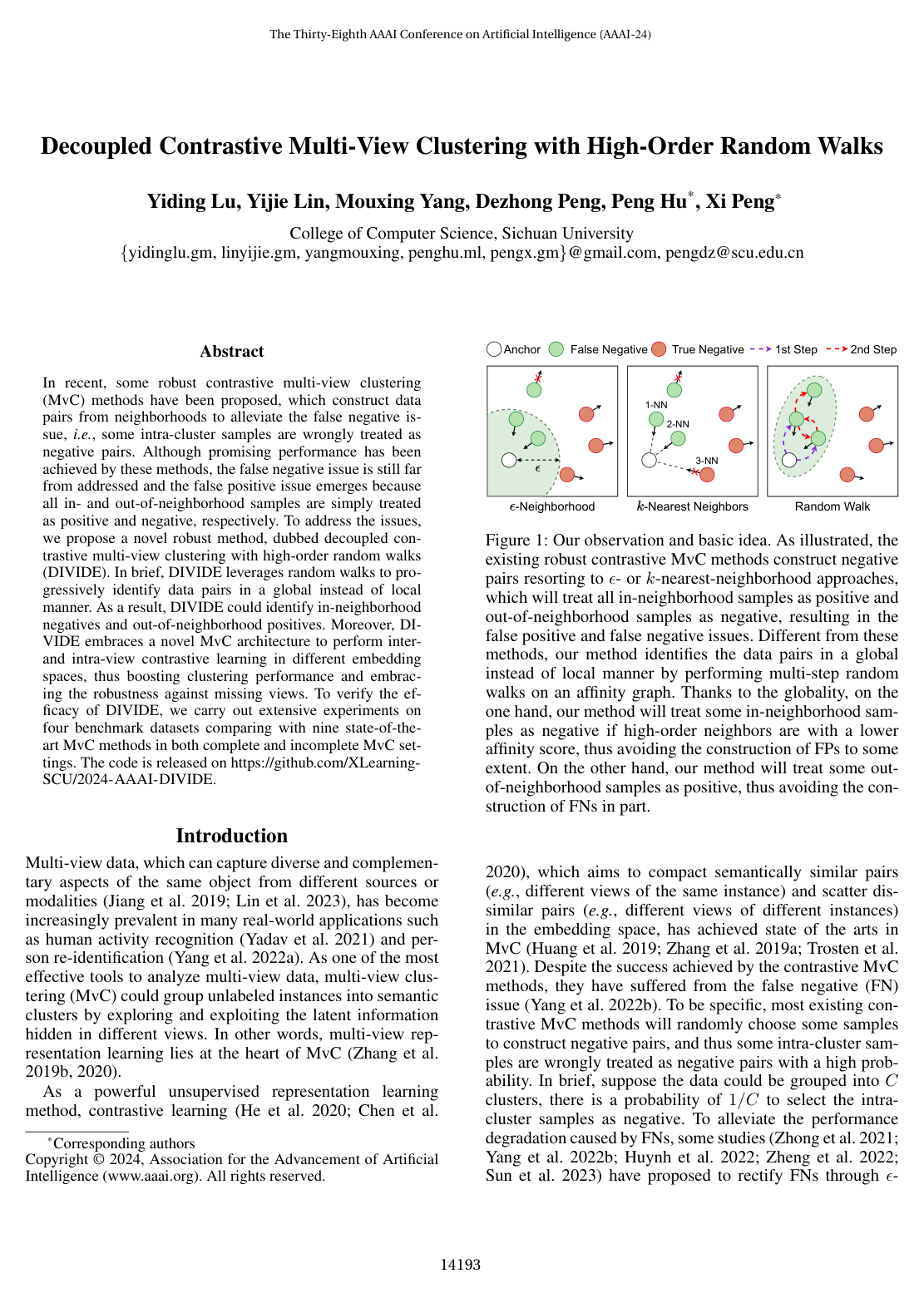
In recent, some robust contrastive multi-view clustering (MvC) methods have been proposed, which construct data pairs from neighborhoods to alleviate the false negative issue, i.e., some intra-cluster samples are wrongly treated as negative pairs. Although promising performance has been achieved by these methods, the false negative issue is still far from addressed and the false positive issue emerges because all in- and out-of-neighborhood samples are simply treated as positive and negative, respectively. To address the issues, we propose a novel robust method, dubbed decoupled contrastive multi-view clustering with high-order random walks (DIVIDE). In brief, DIVIDE leverages random walks to progressively identify data pairs in a global instead of local manner. As a result, DIVIDE could identify in-neighborhood negatives and out-of-neighborhood positives. Moreover, DIVIDE embraces a novel MvC architecture to perform inter- and intra-view contrastive learning in different embedding spaces, thus boosting clustering performance and embracing the robustness against missing views. To verify the efficacy of DIVIDE, we carry out extensive experiments on four benchmark datasets comparing with nine state-of-the-art MvC methods in both complete and incomplete MvC settings. The code is released on https://github.com/XLearning-SCU/2024-AAAI-DIVIDE.
Added
2026-09-26
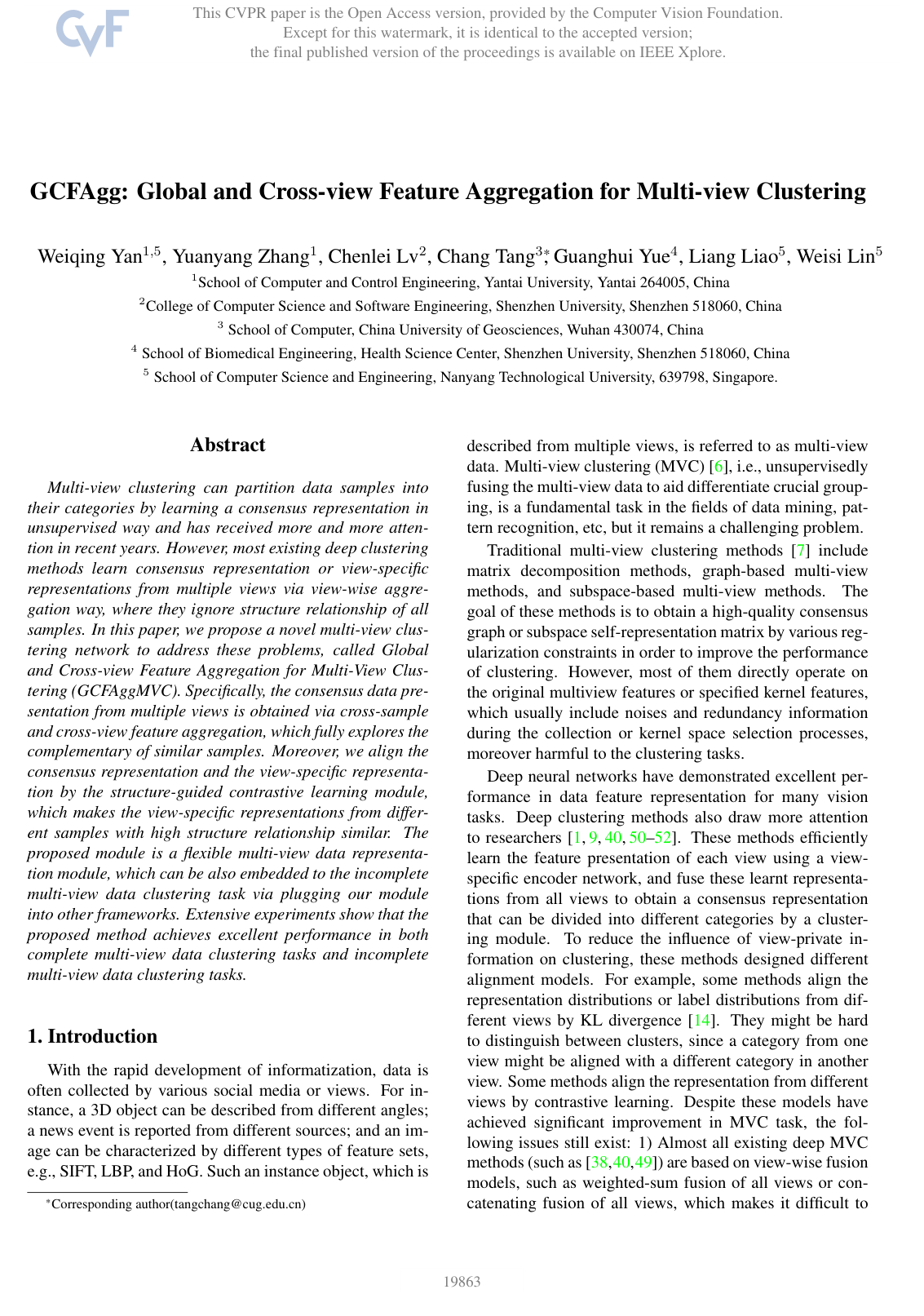
GCFAgg: Global and Cross-View Feature Aggregation for Multi-View Clustering
Weiqing Yan, Yuanyang Zhang, Chenlei Lv, Chang Tang, Guanghui Yue, Liang Liao, Weisi Lin
Why you should read this
Proposes a global and cross-view feature aggregation framework that integrates transformer-based sample relationships with structure-guided contrastive learning to boost multi-view clustering performance on both complete and incomplete datasets.
Multi-view clustering can partition data samples into their categories by learning a consensus representation in unsupervised way and has received more and more attention in recent years. However, most existing deep clustering methods learn consensus representation or view-specific representations from multiple views via view-wise aggregation way, where they ignore structure relationship of all samples. In this paper, we propose a novel multi-view clustering network to address these problems, called Global and Cross-view Feature Aggregation for Multi-View Clustering (GCFAggMVC). Specifically, the consensus data presentation from multiple views is obtained via cross-sample and cross-view feature aggregation, which fully explores the complementary of similar samples. Moreover, we align the consensus representation and the view-specific representation by the structure-guided contrastive learning module, which makes the view-specific representations from different samples with high structure relationship similar. The proposed module is a flexible multi-view data representation module, which can be also embedded to the incomplete multi-view data clustering task via plugging our module into other frameworks. Extensive experiments show that the proposed method achieves excellent performance in both complete multi-view data clustering tasks and incomplete multi-view data clustering tasks.
Added
2026-09-26
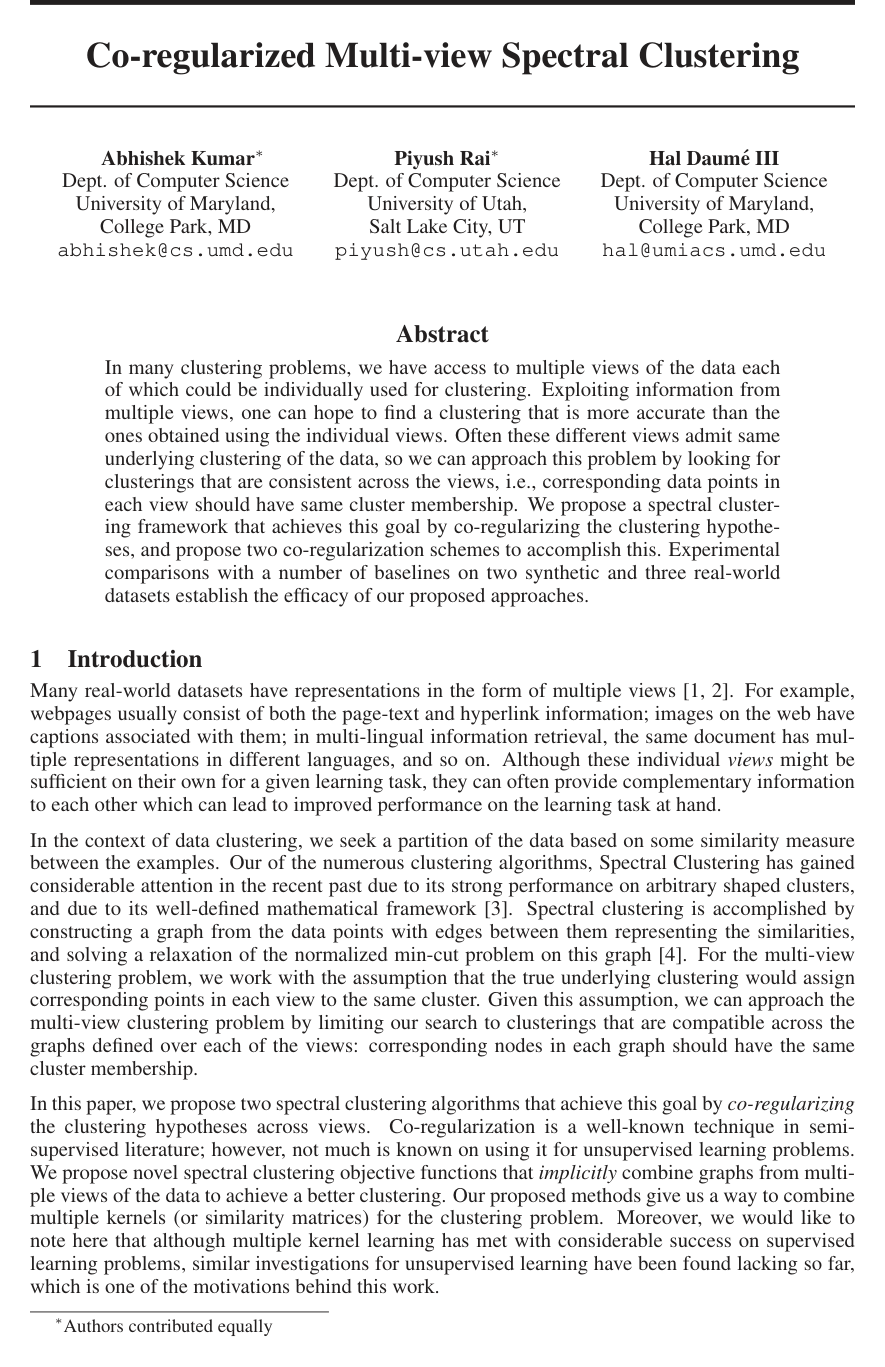
Co-regularized Multi-view Spectral Clustering
Abhishek Kumar, Piyush Rai, Hal Daumé
Why you should read this
Proposes a multi-view spectral clustering framework that co-regularizes graph Laplacians across different data representations to find consistent cluster assignments across diverse views.
In many clustering problems, we have access to multiple views of the data each of which could be individually used for clustering. Exploiting information from multiple views, one can hope to find a clustering that is more accurate than the ones obtained using the individual views. Often these different views admit same underlying clustering of the data, so we can approach this problem by looking for clusterings that are consistent across the views, i.e., corresponding data points in each view should have same cluster membership. We propose a spectral clustering framework that achieves this goal by co-regularizing the clustering hypotheses, and propose two co-regularization schemes to accomplish this. Experimental comparisons with a number of baselines on two synthetic and three real-world datasets establish the efficacy of our proposed approaches.
Added
2026-09-25
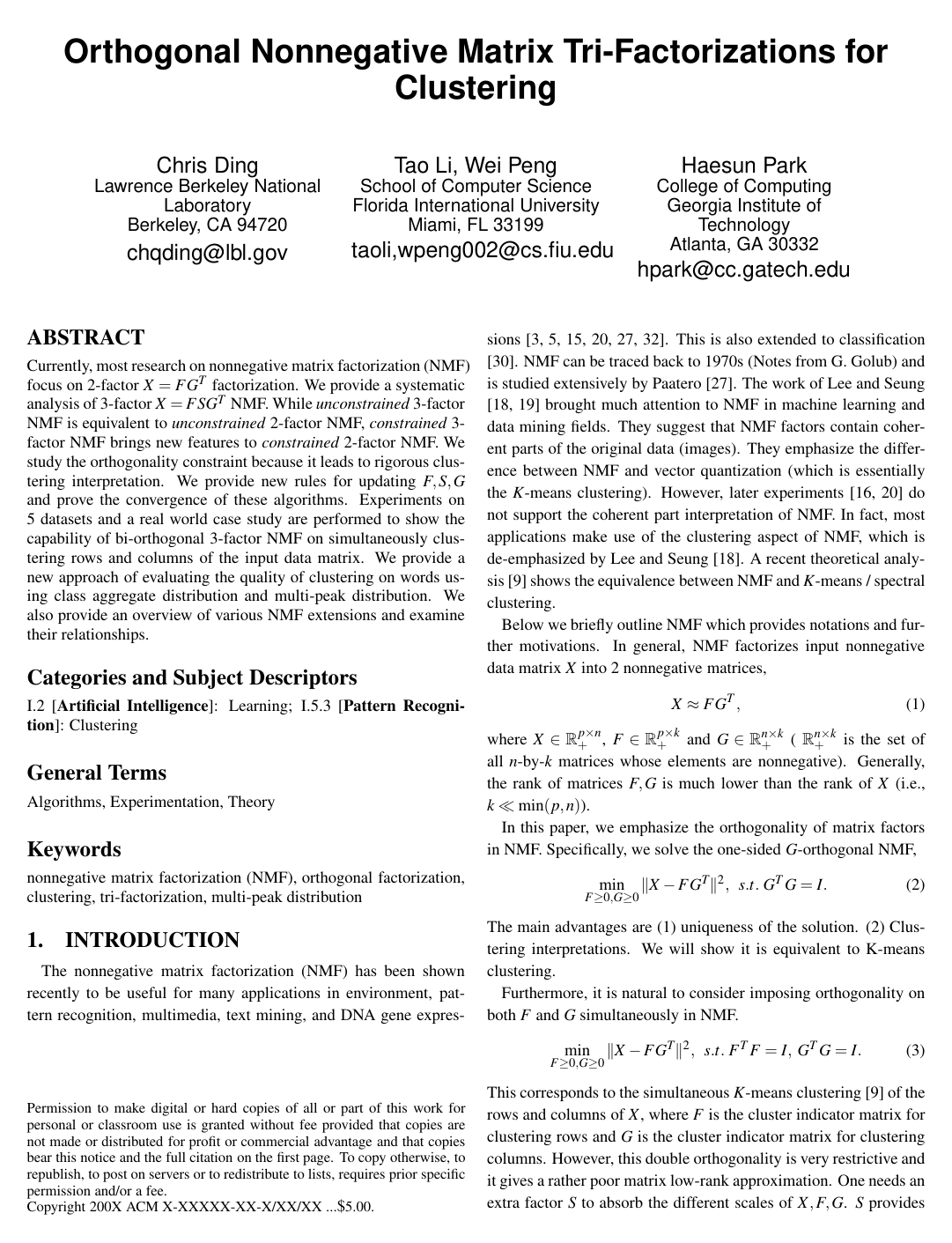
Orthogonal nonnegative matrix t-factorizations for clustering
C. Ding, Tao Li, Wei Peng, Haesun Park
Why you should read this
Establishes a rigorous mathematical foundation and convergent update algorithms for orthogonal three-factor nonnegative matrix factorization, enabling simultaneous, interpretable co-clustering of rows and columns in complex data matrices.
Currently, most research on nonnegative matrix factorization (NMF) focus on 2-factor X = FG^T factorization. We provide a systematic analysis of 3-factor X = FSG^T NMF. While unconstrained 3-factor NMF is equivalent to unconstrained 2-factor NMF, constrained 3-factor NMF brings new features to constrained 2-factor NMF. We study the orthogonality constraint because it leads to rigorous clustering interpretation. We provide new rules for updating F,S,G and prove the convergence of these algorithms. Experiments on 5 datasets and a real world case study are performed to show the capability of bi-orthogonal 3-factor NMF on simultaneously clustering rows and columns of the input data matrix. We provide a new approach of evaluating the quality of clustering on words using class aggregate distribution and multi-peak distribution. We also provide an overview of various NMF extensions and examine their relationships.
Added
2026-09-25
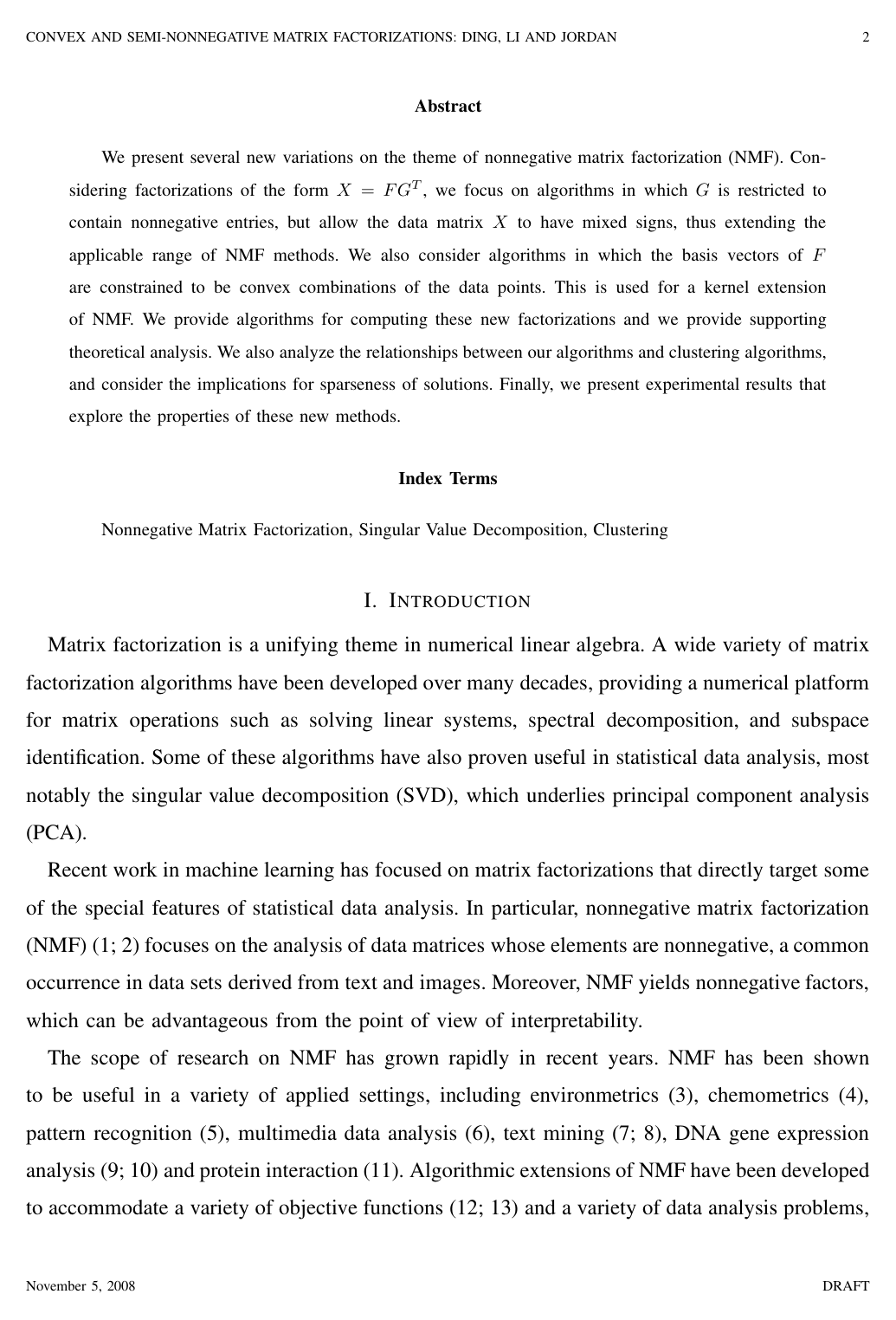
Convex and Semi-Nonnegative Matrix Factorizations
C. Ding, Tao Li, Michael I. Jordan
Why you should read this
Introduces Semi-NMF and Convex-NMF to enable nonnegative matrix factorization on mixed-sign data and kernel spaces while establishing theoretical and practical connections to K-means clustering.
We present several new variations on the theme of nonnegative matrix factorization (NMF). Considering factorizations of the form X = FG^T, we focus on algorithms in which G is restricted to contain nonnegative entries, but allow the data matrix X to have mixed signs, thus extending the applicable range of NMF methods. We also consider algorithms in which the basis vectors of F are constrained to be convex combinations of the data points. This is used for a kernel extension of NMF. We provide algorithms for computing these new factorizations and we provide supporting theoretical analysis. We also analyze the relationships between our algorithms and clustering algorithms, and consider the implications for sparseness of solutions. Finally, we present experimental results that explore the properties of these new methods.
Added
2026-09-25
Deep clustering: Discriminative embeddings for segmentation and separation
John R. Hershey, Zhuo Chen, Jonathan Le Roux, Shinji Watanabe
Why you should read this
Proposes deep clustering, a framework that trains neural networks to map spectrogram time-frequency bins into discriminative embeddings, enabling speaker-independent audio separation that successfully generalizes to unseen mixtures.
We address the problem of acoustic source separation in a deep learning framework we call "deep clustering." Rather than directly estimating signals or masking functions, we train a deep network to produce spectrogram embeddings that are discriminative for partition labels given in training data. Previous deep network approaches provide great advantages in terms of learning power and speed, but previously it has been unclear how to use them to separate signals in a class-independent way. In contrast, spectral clustering approaches are flexible with respect to the classes and number of items to be segmented, but it has been unclear how to leverage the learning power and speed of deep networks. To obtain the best of both worlds, we use an objective function that to train embeddings that yield a low-rank approximation to an ideal pairwise affinity matrix, in a class-independent way. This avoids the high cost of spectral factorization and instead produces compact clusters that are amenable to simple clustering methods. The segmentations are therefore implicitly encoded in the embeddings, and can be "decoded" by clustering. Preliminary experiments show that the proposed method can separate speech: when trained on spectrogram features containing mixtures of two speakers, and tested on mixtures of a held-out set of speakers, it can infer masking functions that improve signal quality by around 6dB. We show that the model can generalize to three-speaker mixtures despite training only on two-speaker mixtures. The framework can be used without class labels, and therefore has the potential to be trained on a diverse set of sound types, and to generalize to novel sources. We hope that future work will lead to segmentation of arbitrary sounds, with extensions to microphone array methods as well as image segmentation and other domains.
Added
2026-09-25
Kernel k-means: spectral clustering and normalized cuts
Inderjit S. Dhillon, Yuqiang Guan, Brian Kulis
Why you should read this
Proves a theoretical equivalence between weighted kernel k-means and spectral clustering objectives, enabling graph-based normalized cuts to be minimized through efficient iterative algorithms without relying on computationally expensive eigenvector calculations.
Kernel k-means and spectral clustering have both been used to identify clusters that are non-linearly separable in input space. Despite significant research, these methods have remained only loosely related. In this paper, we give an explicit theoretical connection between them. We show the generality of the weighted kernel k-means objective function, and derive the spectral clustering objective of normalized cut as a special case. Given a positive definite similarity matrix, our results lead to a novel weighted kernel k-means algorithm that monotonically decreases the normalized cut. This has important implications: a) eigenvector-based algorithms, which can be computationally prohibitive, are not essential for minimizing normalized cuts, b) various techniques, such as local search and acceleration schemes, may be used to improve the quality as well as speed of kernel k-means. Finally, we present results on several interesting data sets, including diametrical clustering of large gene-expression matrices and a handwriting recognition data set.
Added
2026-09-25
Think Globally, Fit Locally: Unsupervised Learning of Low Dimensional Manifold
L. Saul, S. Roweis
Why you should read this
Introduces Locally Linear Embedding (LLE), an unsupervised algorithm that recovers the underlying global geometry of high-dimensional data without local minima by solving an efficient sparse eigenvalue problem that preserves local linear relationships.
The problem of dimensionality reduction arises in many fields of information processing, including machine learning, data compression, scientific visualization, pattern recognition, and neural computation. Here we describe locally linear embedding (LLE), an unsupervised learning algorithm that computes low dimensional, neighborhood preserving embeddings of high dimensional data. The data, assumed to be sampled from an underlying manifold, are mapped into a single global coordinate system of lower dimensionality. The mapping is derived from the symmetries of locally linear reconstructions, and the actual computation of the embedding reduces to a sparse eigenvalue problem. Notably, the optimizations in LLE—though capable of generating highly nonlinear embeddings—are simple to implement, and they do not involve local minima. In this paper, we describe the implementation of the algorithm in detail and discuss several extensions that enhance its performance. We present results of the algorithm applied to data sampled from known manifolds, as well as to collections of images of faces, lips, and handwritten digits. These examples are used to provide extensive illustrations of the algorithm's performance—both successes and failures—and to relate the algorithm to previous and ongoing work in nonlinear dimensionality reduction.
Added
2026-09-24
Learning with Hypergraphs: Clustering, Classification, and Embedding
Dengyong Zhou, Jiayuan Huang, B. Schölkopf
Why you should read this
Generalizes spectral graph theory to hypergraphs by formulating normalized hypergraph cuts, Laplacians, and random walks to enable higher-order relational clustering, embedding, and transductive classification without losing multi-object structural information.
We usually endow the investigated objects with pairwise relationships, which can be illustrated as graphs. In many real-world problems, however, relationships among the objects of our interest are more complex than pairwise. Naively squeezing the complex relationships into pairwise ones will inevitably lead to loss of information which can be expected valuable for our learning tasks however. There we consider using hypergraphs instead to completely represent complex relationships among the objects of our interest, and thus the problem of learning with hypergraphs arises. Our main contribution in this paper is to generalize the powerful methodology of spectral clustering which originally operates on undirected graphs to hypergraphs, and further develop algorithms for hypergraph embedding and transductive classification on the basis of the spectral hypergraph clustering approach. Our experiments on a number of benchmarks showed the advantages of hypergraphs over usual graphs.
Added
2026-09-24
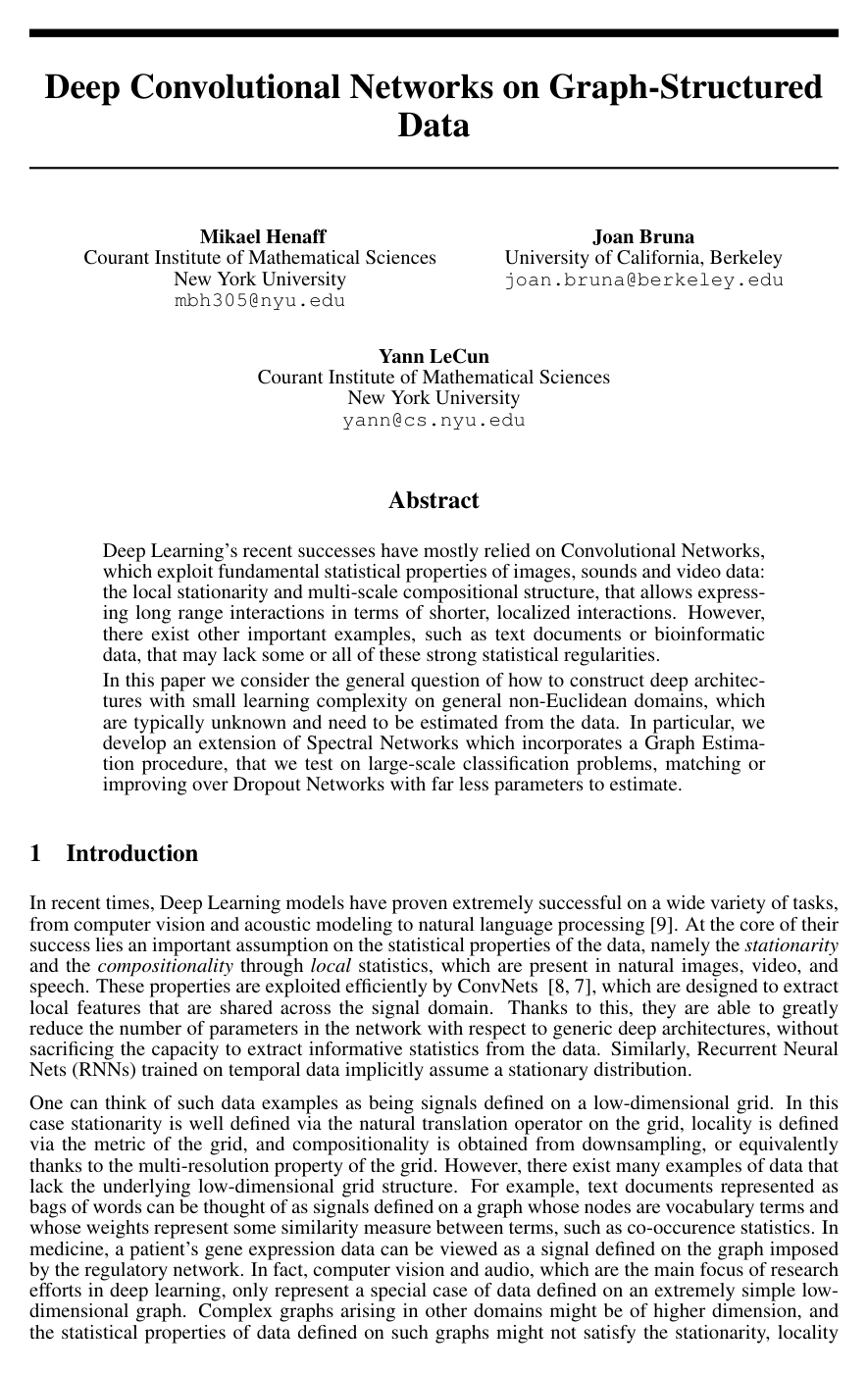
Deep Convolutional Networks on Graph-Structured Data
Mikael Henaff, Joan Bruna, Yann LeCun
Why you should read this
Develops an extension of spectral convolutional networks that estimates underlying graph structures directly from unstructured data, drastically reducing parameter complexity while matching or exceeding the classification performance of standard deep architectures.
Deep Learning's recent successes have mostly relied on Convolutional Networks, which exploit fundamental statistical properties of images, sounds and video data: the local stationarity and multi-scale compositional structure, that allows expressing long range interactions in terms of shorter, localized interactions. However, there exist other important examples, such as text documents or bioinformatic data, that may lack some or all of these strong statistical regularities. In this paper we consider the general question of how to construct deep architectures with small learning complexity on general non-Euclidean domains, which are typically unknown and need to be estimated from the data. In particular, we develop an extension of Spectral Networks which incorporates a Graph Estimation procedure, that we test on large-scale classification problems, matching or improving over Dropout Networks with far less parameters to estimate.
Added
2026-09-24
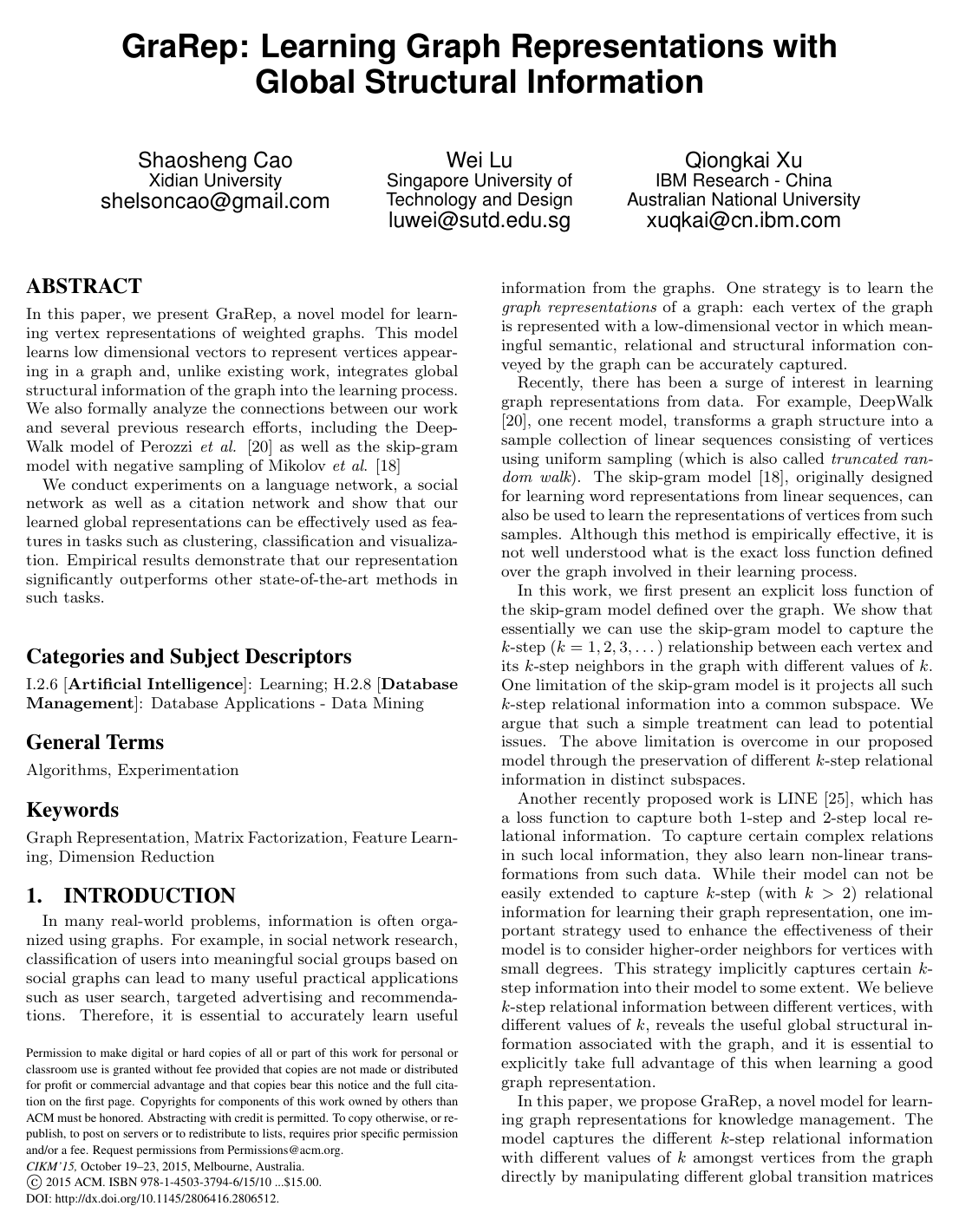
GraRep: Learning Graph Representations with Global Structural Information
Shaosheng Cao, Wei Lu, Qiongkai Xu
Why you should read this
Proposes GraRep, a graph representation learning model that captures high-order relational information by directly factorizing distinct k-step probability transition matrices to preserve global graph structure across separate subspaces without sampling.
In this paper, we present GraRep, a novel model for learning vertex representations of weighted graphs. This model learns low dimensional vectors to represent vertices appearing in a graph and, unlike existing work, integrates global structural information of the graph into the learning process. We also formally analyze the connections between our work and several previous research efforts, including the DeepWalk model of Perozzi et al. [20] as well as the skip-gram model with negative sampling of Mikolov et al. [18] We conduct experiments on a language network, a social network as well as a citation network and show that our learned global representations can be effectively used as features in tasks such as clustering, classification and visualization. Empirical results demonstrate that our representation significantly outperforms other state-of-the-art methods in such tasks.
Added
2026-09-24
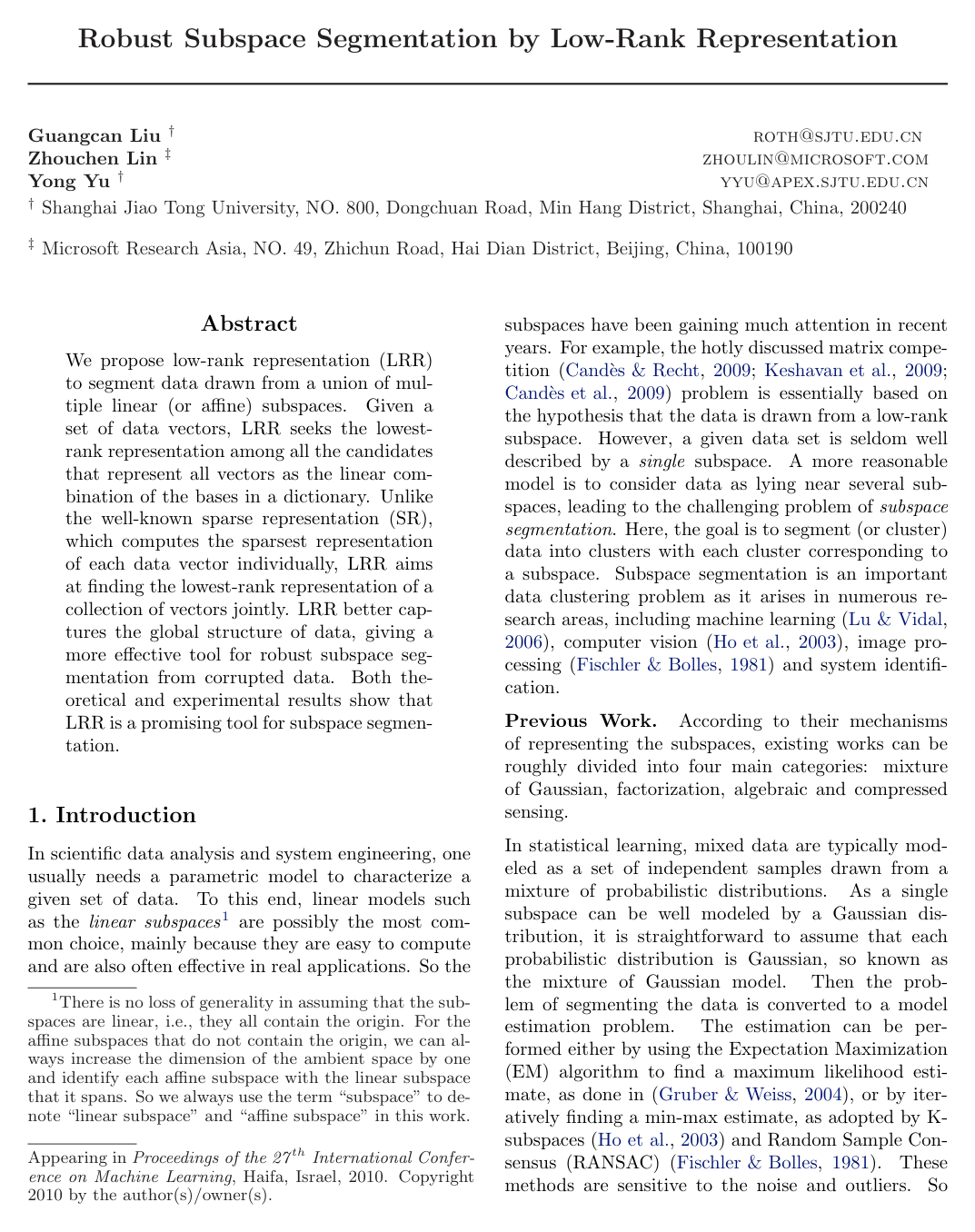
Robust Subspace Segmentation by Low-Rank Representation
Guangcan Liu, Zhouchen Lin, Yong Yu
Why you should read this
Proposes a low-rank representation framework that jointly captures global data structures via nuclear norm minimization to accurately segment data lying across multiple subspaces even when severely corrupted by noise and outliers.
We propose low-rank representation (LRR) to segment data drawn from a union of multiple linear (or affine) subspaces. Given a set of data vectors, LRR seeks the lowest-rank representation among all the candidates that represent all vectors as the linear combination of the bases in a dictionary. Unlike the well-known sparse representation (SR), which computes the sparsest representation of each data vector individually, LRR aims at finding the lowest-rank representation of a collection of vectors jointly. LRR better captures the global structure of data, giving a more effective tool for robust subspace segmentation from corrupted data. Both theoretical and experimental results show that LRR is a promising tool for subspace segmentation.
Added
2026-09-24
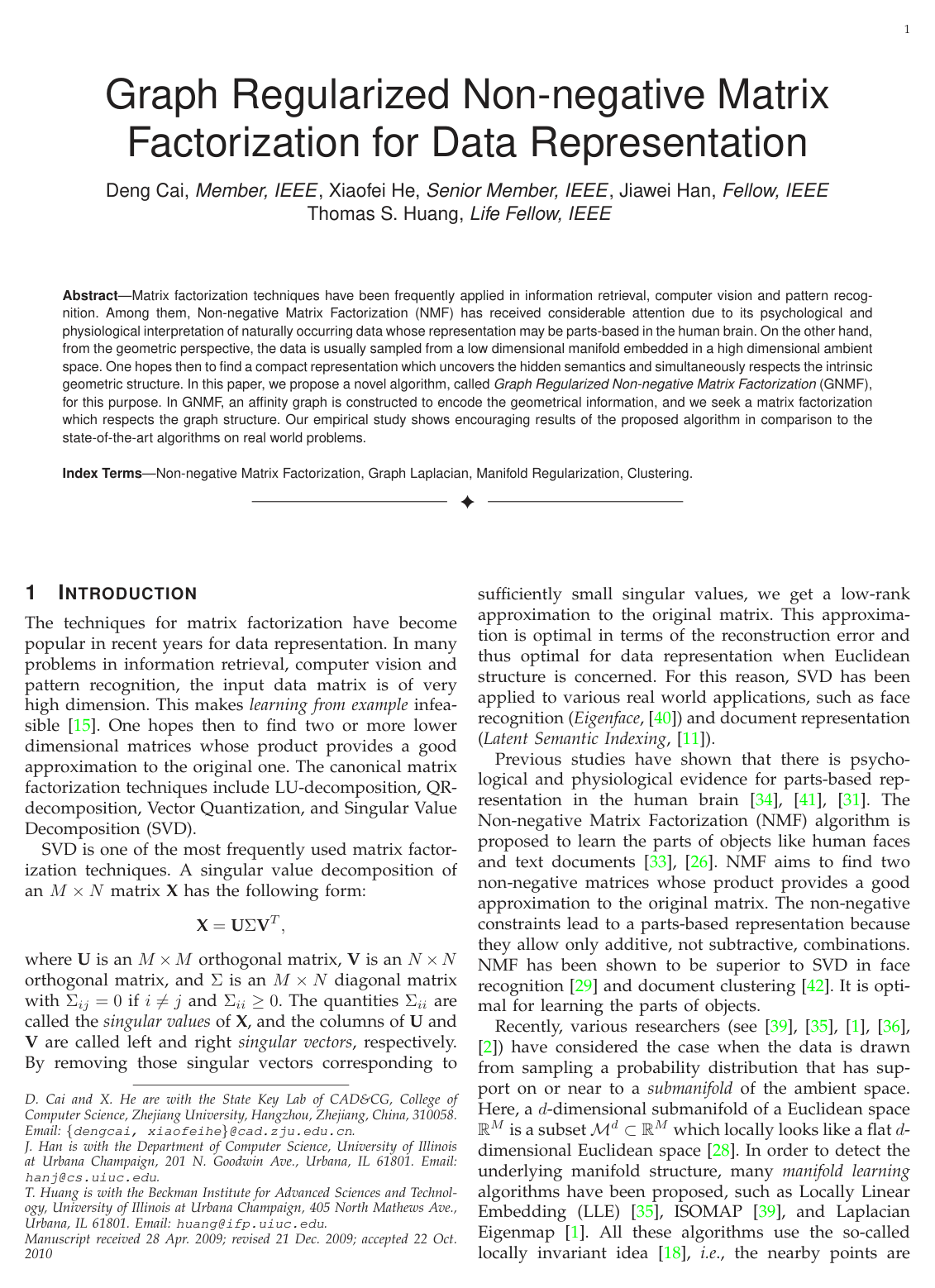
Graph Regularized Nonnegative Matrix Factorization for Data Representation
Deng Cai, Xiaofei He, Jiawei Han, Thomas S. Huang
Why you should read this
Proposes a graph-regularized nonnegative matrix factorization algorithm that preserves the intrinsic geometric structure of high-dimensional data by incorporating a nearest-neighbor graph into parts-based representation learning.
Matrix factorization techniques have been frequently applied in information retrieval, computer vision and pattern recognition. Among them, Non-negative Matrix Factorization (NMF) has received considerable attention due to its psychological and physiological interpretation of naturally occurring data whose representation may be parts-based in the human brain. On the other hand, from the geometric perspective, the data is usually sampled from a low dimensional manifold embedded in a high dimensional ambient space. One hopes then to find a compact representation which uncovers the hidden semantics and simultaneously respects the intrinsic geometric structure. In this paper, we propose a novel algorithm, called Graph Regularized Non-negative Matrix Factorization (GNMF), for this purpose. In GNMF, an affinity graph is constructed to encode the geometrical information, and we seek a matrix factorization which respects the graph structure. Our empirical study shows encouraging results of the proposed algorithm in comparison to the state-of-the-art algorithms on real world problems.
Added
2026-09-18