
keyword
spatio-temporal forecasting
Spatio-temporal forecasting is the process of predicting future states, values, or events across multiple geographic or networked locations over time by simultaneously modeling spatial interactions and temporal dynamics. Unlike purely temporal time-series forecasting, which evaluates sequential changes at isolated points, or purely spatial analysis, which examines static distributions across space, spatio-temporal forecasting captures how conditions at one location propagate to and interact with interconnected areas across successive time intervals. In computational modeling and machine learning, this task typically integrates spatial feature extractors, such as graph neural networks or convolutional operators, with sequential architectures like recurrent networks, transformers, or continuous-time differential equations. The approach is critical in domains governed by complex, interconnected spatial and temporal dependencies, including traffic flow prediction, meteorology, air quality monitoring, logistics, and disease transmission tracking.
2 items
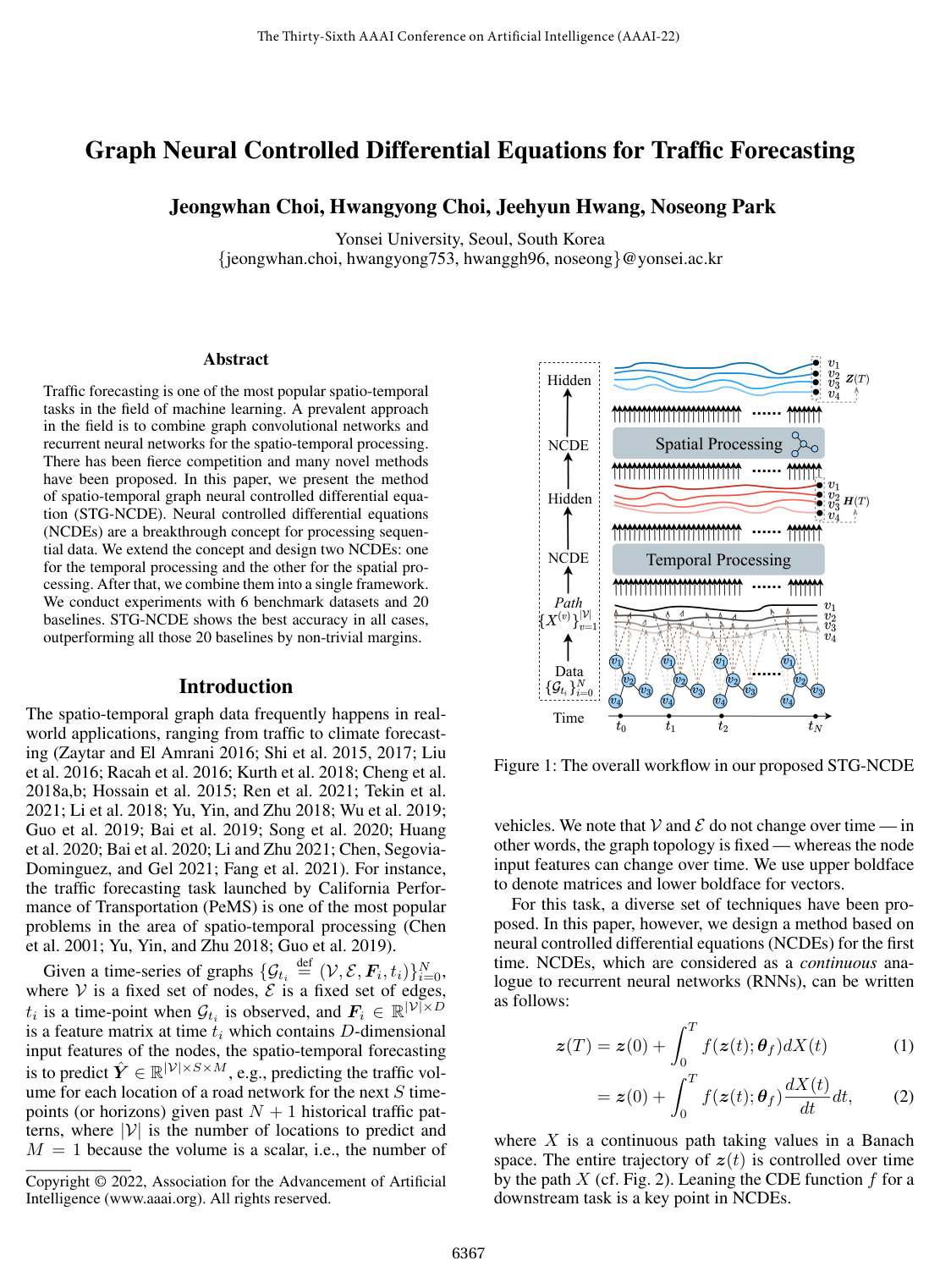
Graph Neural Controlled Differential Equations for Traffic Forecasting
Jeongwhan Choi, Hwangyong Choi, Jeehyun Hwang, Noseong Park
Why you should read this
Develops a unified spatio-temporal neural controlled differential equation framework that continuously models both spatial graph dynamics and temporal traffic patterns, significantly outperforming existing baselines across benchmark forecasting datasets.
Traffic forecasting is one of the most popular spatio-temporal tasks in the field of machine learning. A prevalent approach in the field is to combine graph convolutional networks and recurrent neural networks for the spatio-temporal processing. There has been fierce competition and many novel methods have been proposed. In this paper, we present the method of spatio-temporal graph neural controlled differential equation (STG-NCDE). Neural controlled differential equations (NCDEs) are a breakthrough concept for processing sequential data. We extend the concept and design two NCDEs: one for the temporal processing and the other for the spatial processing. After that, we combine them into a single framework. We conduct experiments with 6 benchmark datasets and 20 baselines. STG-NCDE shows the best accuracy in all cases, outperforming all those 20 baselines by non-trivial margins.
Added
2026-09-26
Transformers in Time Series: A Survey
Qingsong Wen, Tian Zhou, Chao Zhang, Weiqiu Chen, Ziqing Ma, Junchi Yan, Liang Sun
Why you should read this
Presents a systematic taxonomy of Transformer adaptations for time series forecasting, anomaly detection, and classification alongside empirical analyses of model size and seasonal decomposition to guide future architectural designs.
Transformers have achieved superior performances in many tasks in natural language processing and computer vision, which also triggered great interest in the time series community. Among multiple advantages of Transformers, the ability to capture long-range dependencies and interactions is especially attractive for time series modeling, leading to exciting progress in various time series applications. In this paper, we systematically review Transformer schemes for time series modeling by highlighting their strengths as well as limitations. In particular, we examine the development of time series Transformers in two perspectives. From the perspective of network structure, we summarize the adaptations and modifications that have been made to Transformers in order to accommodate the challenges in time series analysis. From the perspective of applications, we categorize time series Transformers based on common tasks including forecasting, anomaly detection, and classification. Empirically, we perform robust analysis, model size analysis, and seasonal-trend decomposition analysis to study how Transformers perform in time series. Finally, we discuss and suggest future directions to provide useful research guidance. To the best of our knowledge, this paper is the first work to comprehensively and systematically summarize the recent advances of Transformers for modeling time series data. We hope this survey will ignite further research interests in time series Transformers.
Added
2026-09-24