
keyword
spatial pyramid pooling
Spatial pyramid pooling is a neural network pooling technique in computer vision that divides feature maps into spatial grids at multiple resolutions and pools features within each bin to produce a fixed-length output vector. Unlike standard pooling layers that produce variable-sized outputs when presented with variable-sized inputs, spatial pyramid pooling allows deep learning architectures to process images of arbitrary dimensions and aspect ratios without requiring prior cropping or warping. By aggregating local and global contextual information across a pyramid of spatial scales, this mechanism preserves spatial layout information and improves the robustness of models to scale variations and geometric deformations in tasks such as visual recognition, object detection, and semantic segmentation.
7 items
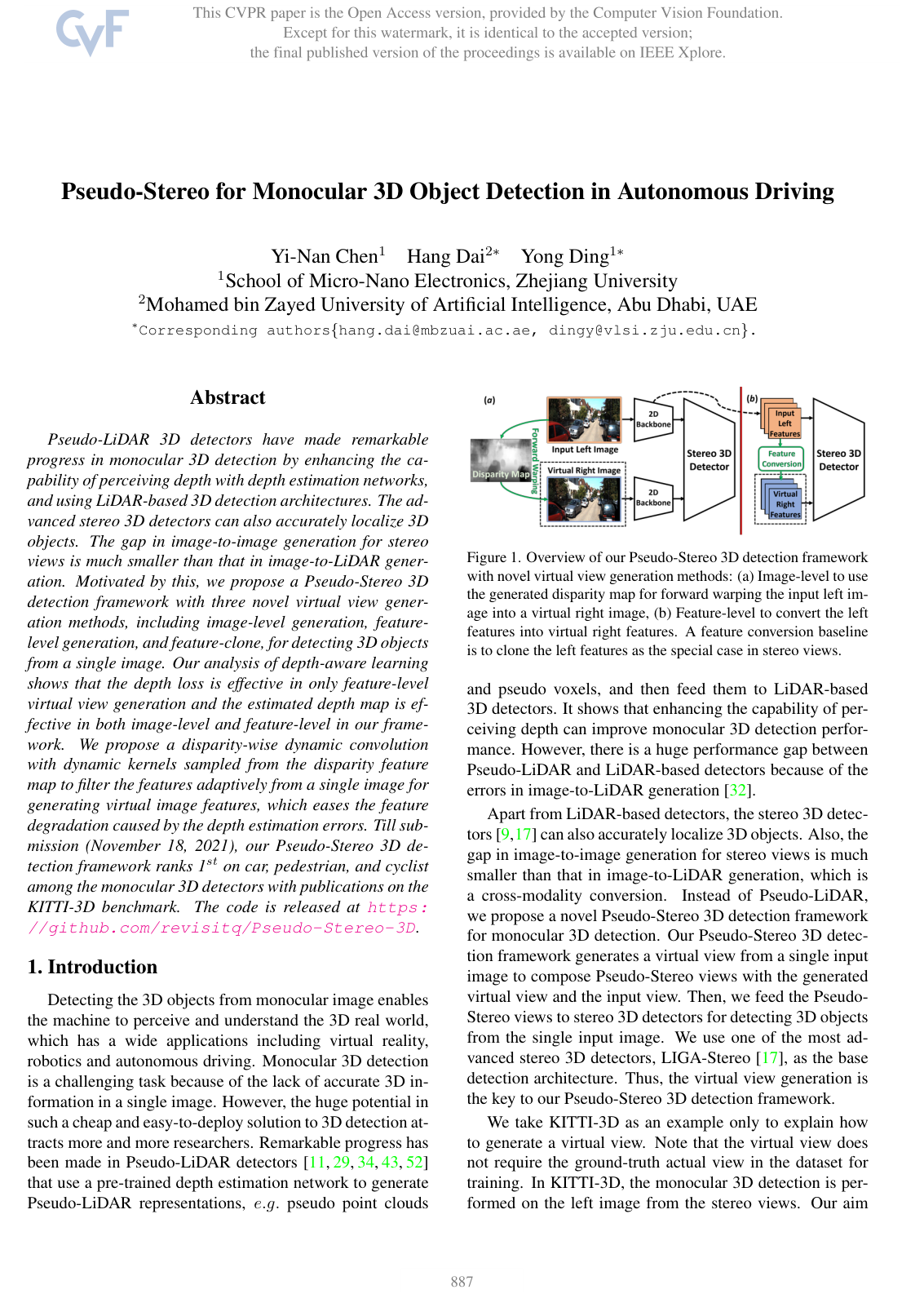
Pseudo-Stereo for Monocular 3D Object Detection in Autonomous Driving
Yi-Nan Chen, Hang Dai, Yong Ding
Why you should read this
Proposes a monocular 3D object detection framework that generates virtual right-view features using disparity-wise dynamic convolutions, enabling stereo-based detection architectures to achieve state-of-the-art accuracy on the KITTI-3D benchmark from a single input image.
Pseudo-LiDAR 3D detectors have made remarkable progress in monocular 3D detection by enhancing the capability of perceiving depth with depth estimation networks, and using LiDAR-based 3D detection architectures. The advanced stereo 3D detectors can also accurately localize 3D objects. The gap in image-to-image generation for stereo views is much smaller than that in image-to-LiDAR generation. Motivated by this, we propose a Pseudo-Stereo 3D detection framework with three novel virtual view generation methods, including image-level generation, feature-level generation, and feature-clone, for detecting 3D objects from a single image. Our analysis of depth-aware learning shows that the depth loss is effective in only feature-level virtual view generation and the estimated depth map is effective in both image-level and feature-level in our framework. We propose a disparity-wise dynamic convolution with dynamic kernels sampled from the disparity feature map to filter the features adaptively from a single image for generating virtual image features, which eases the feature degradation caused by the depth estimation errors. Till submission (November 18, 2021), our Pseudo-Stereo 3D detection framework ranks 1st on car, pedestrian, and cyclist among the monocular 3D detectors with publications on the KITTI-3D benchmark. The code is released at https://github.com/revisitq/Pseudo-Stereo-3D.
Added
2026-09-26
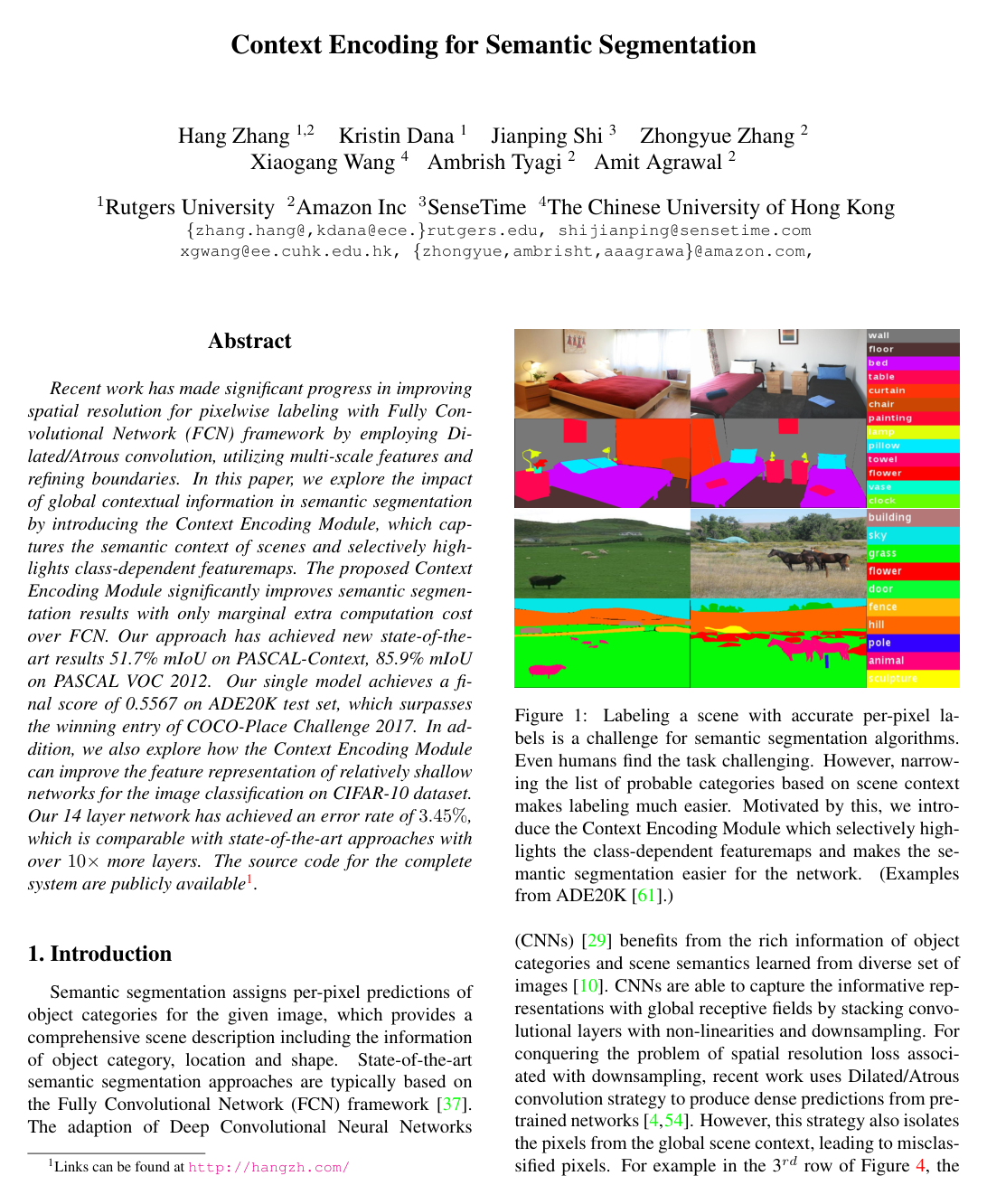
Context Encoding for Semantic Segmentation
Hang Zhang, Kristin Dana, Jianping Shi, Zhongyue Zhang, Xiaogang Wang, Ambrish Tyagi, Amit Agrawal
Why you should read this
Introduces a Context Encoding Module that captures global scene context to selectively emphasize relevant class feature maps, setting state-of-the-art semantic segmentation performance on standard benchmarks while adding minimal computational overhead.
Recent work has made significant progress in improving spatial resolution for pixelwise labeling with Fully Convolutional Network (FCN) framework by employing Dilated/Atrous convolution, utilizing multi-scale features and refining boundaries. In this paper, we explore the impact of global contextual information in semantic segmentation by introducing the Context Encoding Module, which captures the semantic context of scenes and selectively highlights class-dependent featuremaps. The proposed Context Encoding Module significantly improves semantic segmentation results with only marginal extra computation cost over FCN. Our approach has achieved new state-of-the-art results 51.7% mIoU on PASCAL-Context, 85.9% mIoU on PASCAL VOC 2012. Our single model achieves a final score of 0.5567 on ADE20K test set, which surpass the winning entry of COCO-Place Challenge in 2017. In addition, we also explore how the Context Encoding Module can improve the feature representation of relatively shallow networks for the image classification on CIFAR-10 dataset. Our 14 layer network has achieved an error rate of 3.45%, which is comparable with state-of-the-art approaches with over 10 times more layers. The source code for the complete system are publicly available.
Added
2026-09-25
Convolutional neural networks at constrained time cost
Kaiming He, Jian Sun
Why you should read this
Demonstrates how to optimize convolutional neural network design trade-offs across depth, filter count, and filter size to significantly improve ImageNet accuracy while running 20% faster than AlexNet under a strict computation budget.
Though recent advanced convolutional neural networks (CNNs) have been improving the image recognition accuracy, the models are getting more complex and time-consuming. For real-world applications in industrial and commercial scenarios, engineers and developers are often faced with the requirement of constrained time budget. In this paper, we investigate the accuracy of CNNs under constrained time cost. Under this constraint, the designs of the network architectures should exhibit as trade-offs among the factors like depth, numbers of filters, filter sizes, etc. With a series of controlled comparisons, we progressively modify a baseline model while preserving its time complexity. This is also helpful for understanding the importance of the factors in network designs. We present an architecture that achieves very competitive accuracy in the ImageNet dataset (11.8% top-5 error, 10-view test), yet is 20% faster than "AlexNet" (16.0% top-5 error, 10-view test).
Added
2026-09-25
A Theoretical Analysis of Feature Pooling in Visual Recognition
Y-Lan Boureau, Jean Ponce, Yann LeCun
Why you should read this
Establishes a rigorous theoretical framework explaining why max pooling outperforms average pooling for sparse visual features and demonstrates how pooling cardinality and dictionary size directly govern recognition accuracy.
Many modern visual recognition algorithms incorporate a step of spatial 'pooling', where the outputs of several nearby feature detectors are combined into a local or global 'bag of features', in a way that preserves task-related information while removing irrelevant details. Pooling is used to achieve invariance to image transformations, more compact representations, and better robustness to noise and clutter. Several papers have shown that the details of the pooling operation can greatly influence the performance, but studies have so far been purely empirical. In this paper, we show that the reasons underlying the performance of various pooling methods are obscured by several confounding factors, such as the link between the sample cardinality in a spatial pool and the resolution at which low-level features have been extracted. We provide a detailed theoretical analysis of max pooling and average pooling, and give extensive empirical comparisons for object recognition tasks.
Added
2026-09-25
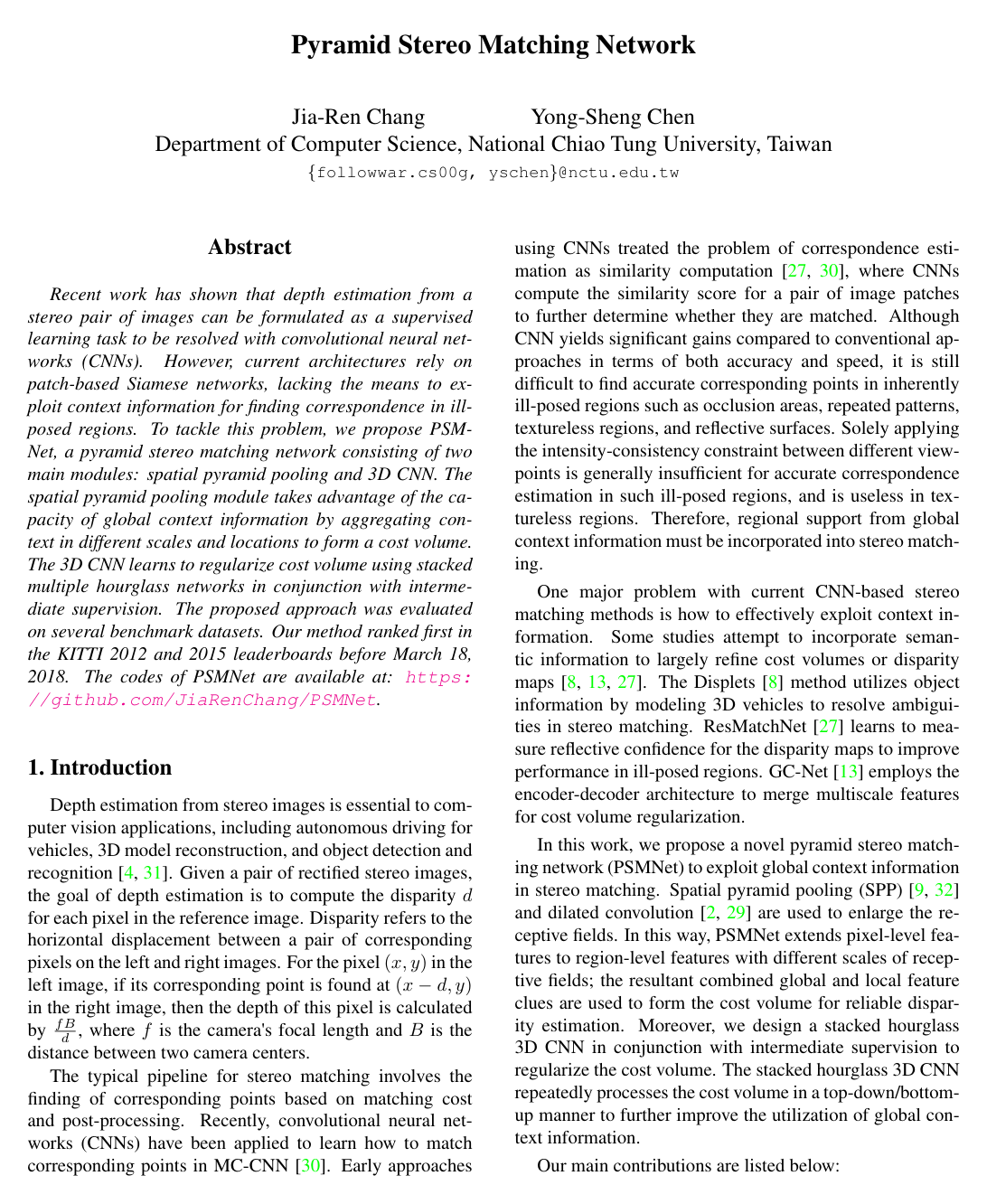
Pyramid Stereo Matching Network
Jia-Ren Chang, Yong-Sheng Chen
Why you should read this
Introduces PSMNet, a stereo matching network that integrates spatial pyramid pooling and stacked 3D convolutional hourglass modules to exploit multi-scale global context and accurately estimate depth in challenging image regions.
Recent work has shown that depth estimation from a stereo pair of images can be formulated as a supervised learning task to be resolved with convolutional neural networks (CNNs). However, current architectures rely on patch-based Siamese networks, lacking the means to exploit context information for finding correspondence in illposed regions. To tackle this problem, we propose PSMNet, a pyramid stereo matching network consisting of two main modules: spatial pyramid pooling and 3D CNN. The spatial pyramid pooling module takes advantage of the capacity of global context information by aggregating context in different scales and locations to form a cost volume. The 3D CNN learns to regularize cost volume using stacked multiple hourglass networks in conjunction with intermediate supervision. The proposed approach was evaluated on several benchmark datasets. Our method ranked first in the KITTI 2012 and 2015 leaderboards before March 18, 2018. The codes of PSMNet are available at: this https URL.
Added
2026-09-18
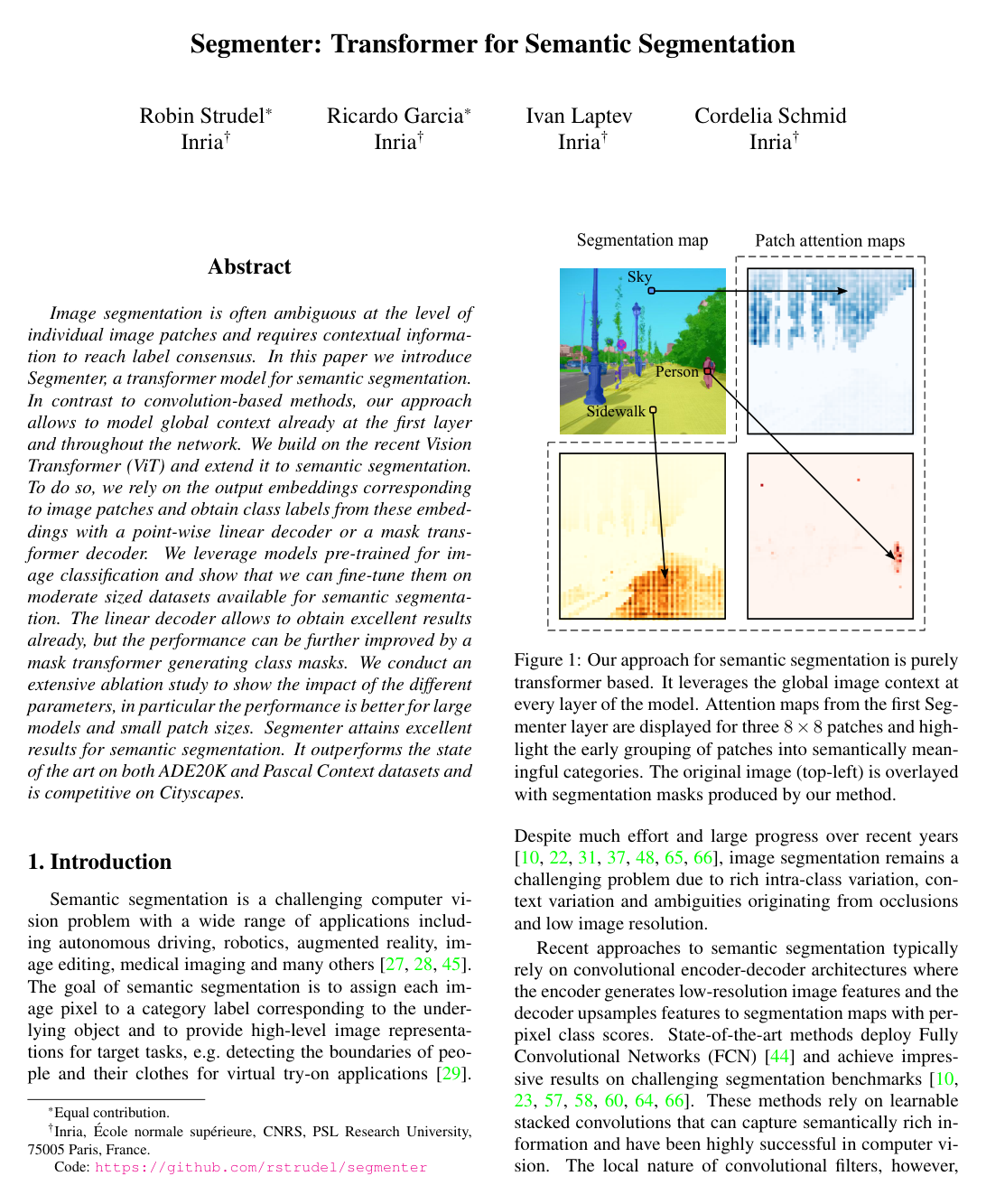
Segmenter: Transformer for Semantic Segmentation
Robin Strudel, Ricardo Garcia, Ivan Laptev, Cordelia Schmid
Why you should read this
Introduces Segmenter, an end-to-end Vision Transformer architecture for semantic segmentation that captures global context throughout the network using a mask transformer decoder, surpassing convolutional baselines on the ADE20K and Pascal Context benchmarks.
Image segmentation is often ambiguous at the level of individual image patches and requires contextual information to reach label consensus. In this paper we introduce Segmenter, a transformer model for semantic segmentation. In contrast to convolution-based methods, our approach allows to model global context already at the first layer and throughout the network. We build on the recent Vision Transformer (ViT) and extend it to semantic segmentation. To do so, we rely on the output embeddings corresponding to image patches and obtain class labels from these embeddings with a point-wise linear decoder or a mask transformer decoder. We leverage models pre-trained for image classification and show that we can fine-tune them on moderate sized datasets available for semantic segmentation. The linear decoder allows to obtain excellent results already, but the performance can be further improved by a mask transformer generating class masks. We conduct an extensive ablation study to show the impact of the different parameters, in particular the performance is better for large models and small patch sizes. Segmenter attains excellent results for semantic segmentation. It outperforms the state of the art on both ADE20K and Pascal Context datasets and is competitive on Cityscapes.
Added
2026-09-17
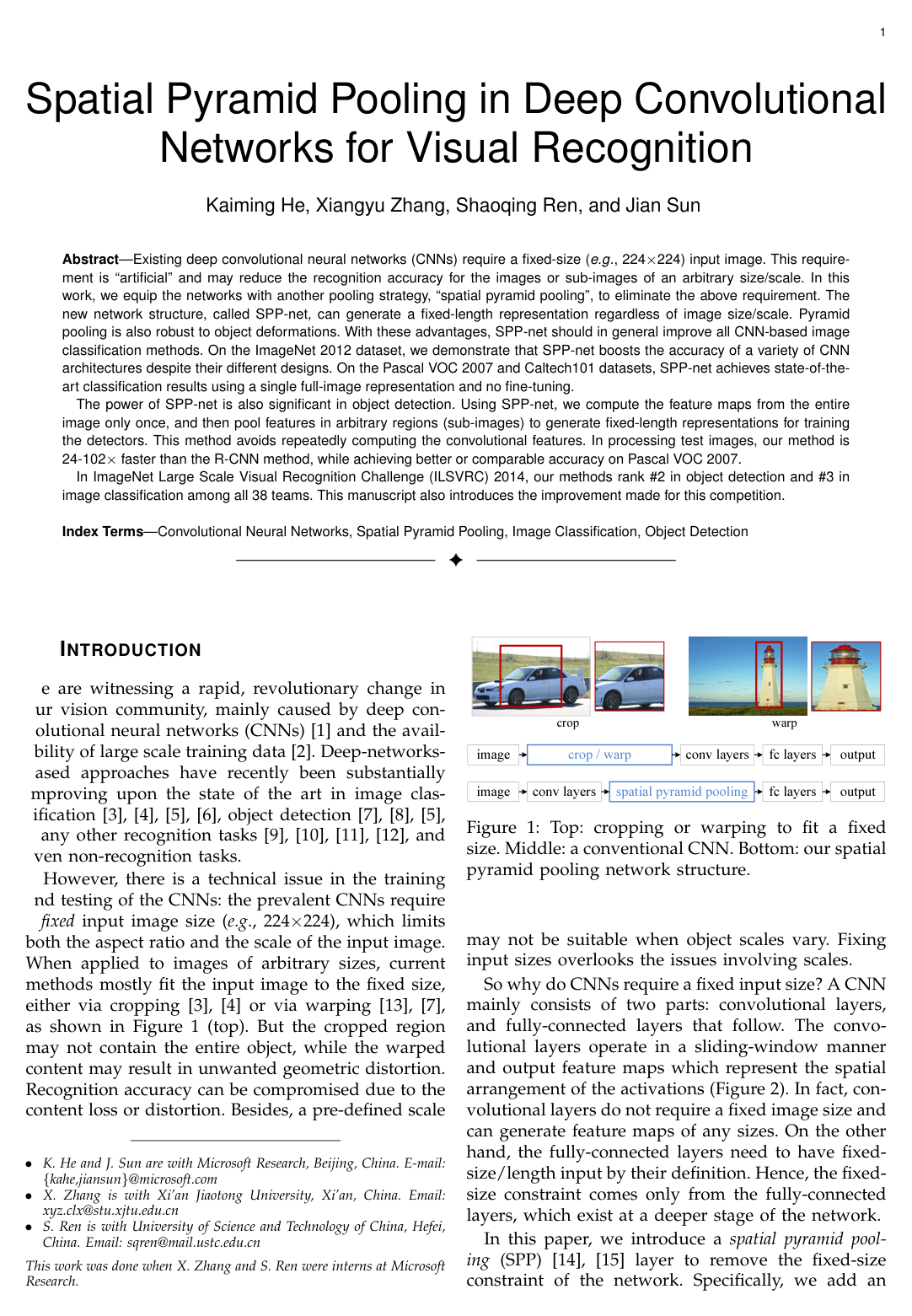
Spatial Pyramid Pooling in Deep Convolutional Networks for Visual Recognition
Kaiming He, Xiangyu Zhang, Shaoqing Ren, Jian Sun
Why you should read this
Introduces spatial pyramid pooling to eliminate fixed-size input constraints in convolutional neural networks, enabling arbitrary-scale image classification and speeding up object detection by up to a hundredfold over R-CNN.
Existing deep convolutional neural networks (CNNs) require a fixed-size (e.g., 224x224) input image. This requirement is "artificial" and may reduce the recognition accuracy for the images or sub-images of an arbitrary size/scale. In this work, we equip the networks with another pooling strategy, "spatial pyramid pooling", to eliminate the above requirement. The new network structure, called SPP-net, can generate a fixed-length representation regardless of image size/scale. Pyramid pooling is also robust to object deformations. With these advantages, SPP-net should in general improve all CNN-based image classification methods. On the ImageNet 2012 dataset, we demonstrate that SPP-net boosts the accuracy of a variety of CNN architectures despite their different designs. On the Pascal VOC 2007 and Caltech101 datasets, SPP-net achieves state-of-the-art classification results using a single full-image representation and no fine-tuning. The power of SPP-net is also significant in object detection. Using SPP-net, we compute the feature maps from the entire image only once, and then pool features in arbitrary regions (sub-images) to generate fixed-length representations for training the detectors. This method avoids repeatedly computing the convolutional features. In processing test images, our method is 24-102x faster than the R-CNN method, while achieving better or comparable accuracy on Pascal VOC 2007. In ImageNet Large Scale Visual Recognition Challenge (ILSVRC) 2014, our methods rank #2 in object detection and #3 in image classification among all 38 teams. This manuscript also introduces the improvement made for this competition.
Added
2026-09-06