Built independently by an author, for readers. Read the story and support ChapterPal

keyword

slide-level diagnosis

A slide-level diagnosis is an overarching clinical assessment or diagnostic classification assigned to an entire digital whole-slide pathology image as a single entity, rather than to localized pixel-level regions or individual cells within the tissue specimen. In computational pathology and clinical diagnostics, this approach associates the entire gigapixel image with an overall categorical label, such as the presence of malignancy, specific cancer subtype, genetic mutation status, or disease grade, derived from routine pathology reports. Because it evaluates the whole tissue section without requiring labor-intensive manual pixel-level or region-of-interest annotations, slide-level diagnosis serves as a fundamental target in weakly supervised deep learning frameworks and automated decision-support systems.

1 item

Data-efficient and weakly supervised computational pathology on whole-slide images

Data-efficient and weakly supervised computational pathology on whole-slide images

Ming Y. Lu, Drew F. K. Williamson, Tiffany Y. Chen, Richard J. Chen, Matteo Barbieri, Faisal Mahmood

Why you should read this

Presents CLAM, a data-efficient deep learning framework that uses clustering-constrained attention to classify gigapixel whole slide images and identify clinically relevant morphological patterns using only slide-level labels.

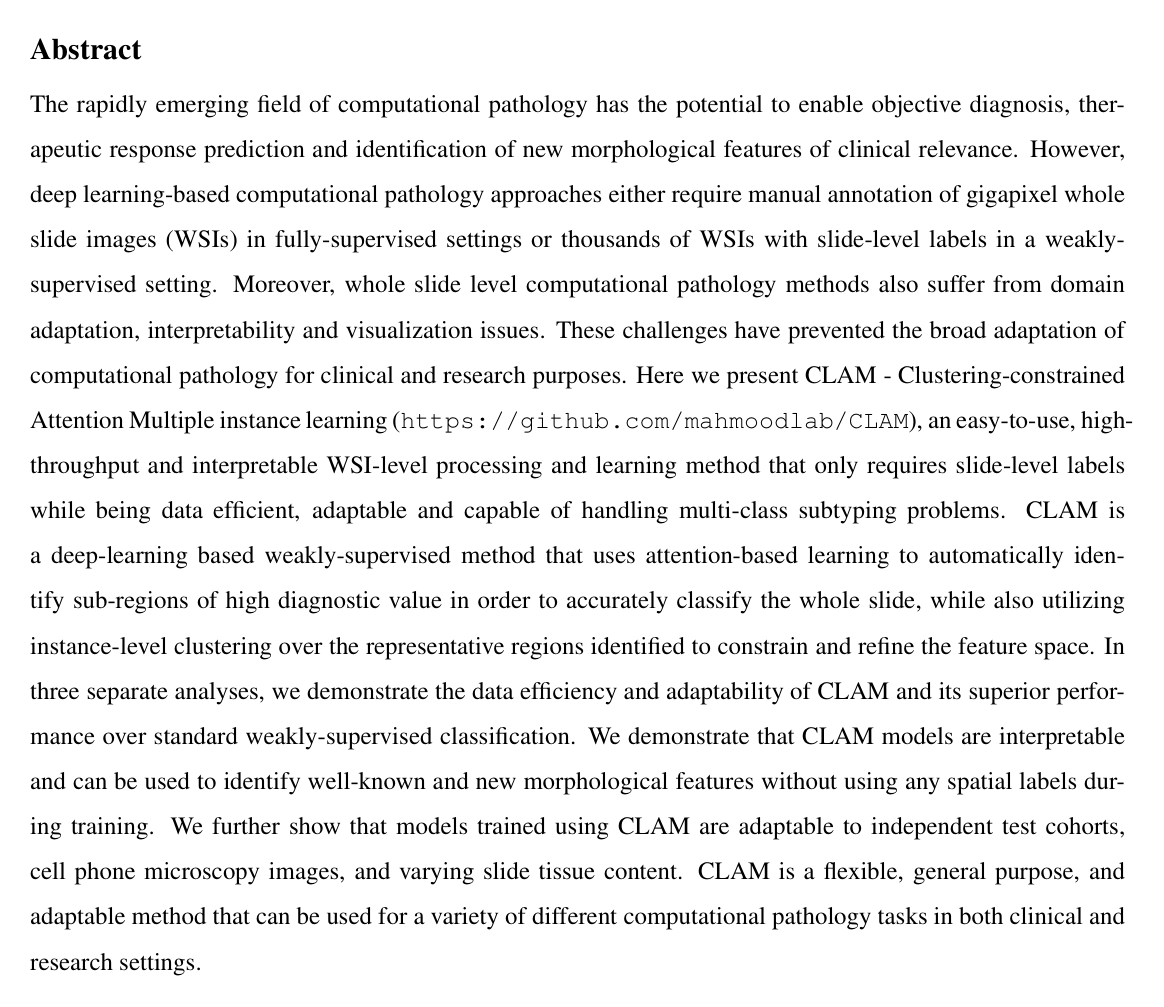
The rapidly emerging field of computational pathology has the potential to enable objective diagnosis, therapeutic response prediction and identification of new morphological features of clinical relevance. However, deep learning-based computational pathology approaches either require manual annotation of gigapixel whole slide images (WSIs) in fully-supervised settings or thousands of WSIs with slide-level labels in a weakly-supervised setting. Moreover, whole slide level computational pathology methods also suffer from domain adaptation and interpretability issues. These challenges have prevented the broad adaptation of computational pathology for clinical and research purposes. Here we present CLAM - Clustering-constrained attention multiple instance learning, an easy-to-use, high-throughput, and interpretable WSI-level processing and learning method that only requires slide-level labels while being data efficient, adaptable and capable of handling multi-class subtyping problems. CLAM is a deep-learning-based weakly-supervised method that uses attention-based learning to automatically identify sub-regions of high diagnostic value in order to accurately classify the whole slide, while also utilizing instance-level clustering over the representative regions identified to constrain and refine the feature space. In three separate analyses, we demonstrate the data efficiency and adaptability of CLAM and its superior performance over standard weakly-supervised classification. We demonstrate that CLAM models are interpretable and can be used to identify well-known and new morphological features. We further show that models trained using CLAM are adaptable to independent test cohorts, cell phone microscopy images, and biopsies. CLAM is a general-purpose and adaptable method that can be used for a variety of different computational pathology tasks in both clinical and research settings.

Added

2026-09-15