
keyword
Sentiment Treebank
A Sentiment Treebank is a natural language processing corpus in which sentences are parsed into syntactic tree structures with sentiment labels annotated at every node, spanning individual words, nested phrases, and whole sentences. Designed to advance the study of semantic compositionality, this structured dataset enables computational models to learn and evaluate how grammatical combinations, negation, and modifiers alter sentiment polarity and intensity from the phrase level up to the sentence level. By providing granular annotations across complete syntactic trees—frequently evaluated in both binary and fine-grained classification settings—a Sentiment Treebank serves as a standard benchmark for developing and testing compositional semantic and sentence-level text classification models.
11 items
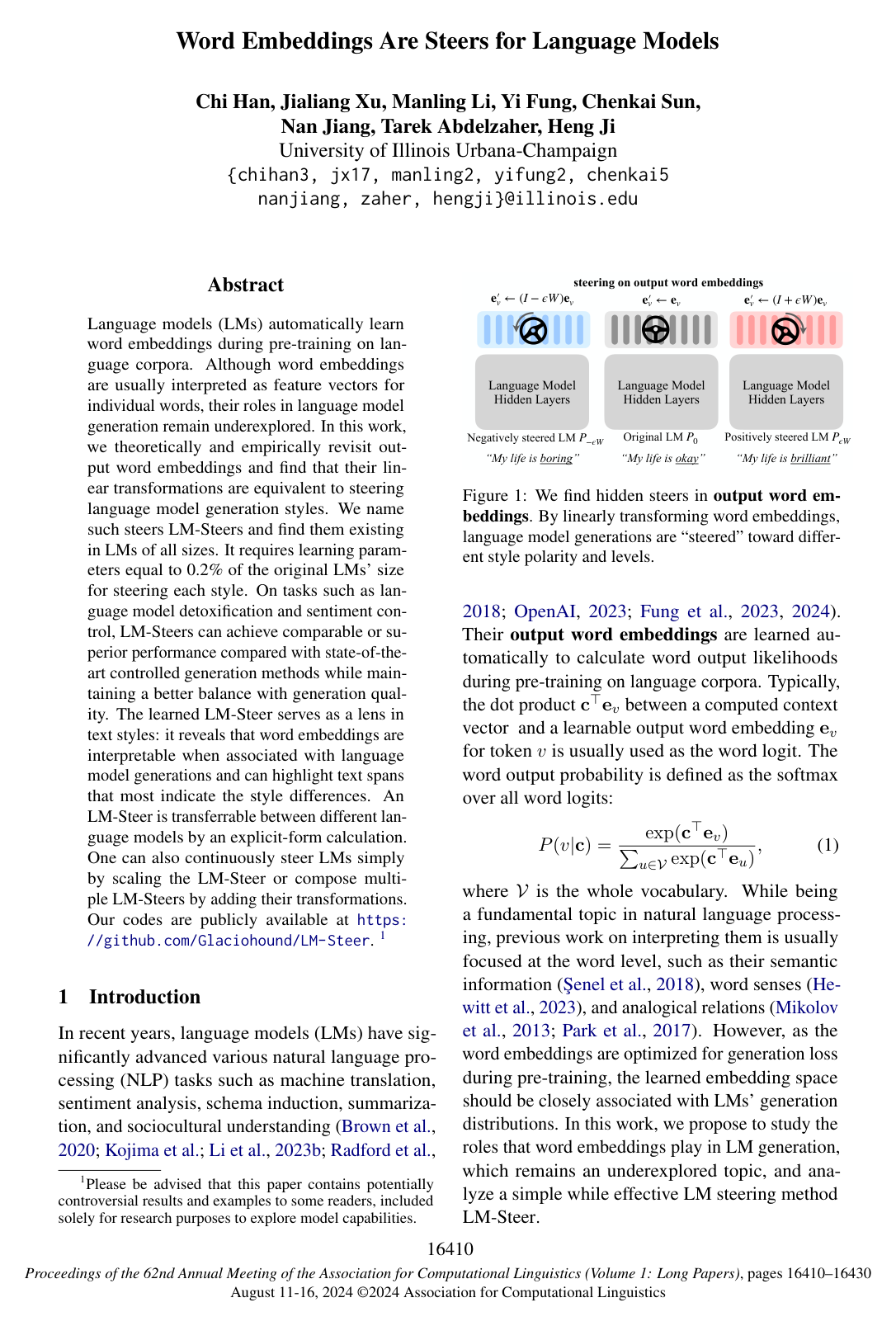
Word Embeddings Are Steers for Language Models
Chi Han, Jialiang Xu, Manling Li, Yi Fung, Chenkai Sun, Nan Jiang, Tarek F. Abdelzaher, Heng Ji
Why you should read this
Proposes LM-Steer, a lightweight approach that applies linear transformations to output word embeddings to achieve parameter-efficient, transferable, and continuous style control across language models without retraining internal weights.
Recent studies have shown that large language models (LLMs), when augmented with additional weights through adapters—for instance, LoRA—can learn specialized tasks without updating model parameters—a paradigm known as either Instruction Tuning (IT) for individual instructions or Task Arithmetic (TA) for task-specific adaptation. In such scenarios, different instruction/task datasets induce distinct steering vectors within LLMs' embedding space, shaping behavior according to downstream objectives. Inspired by recent advances in model merging or parameter composition, we investigate whether multiple steering directions (each optimized toward generating responses on one dataset while discouraging outputs outside its distribution via unlearning-like objectives) can be combined into a single vector enabling zero-shot generalization across diverse tasks.
Added
2026-10-02
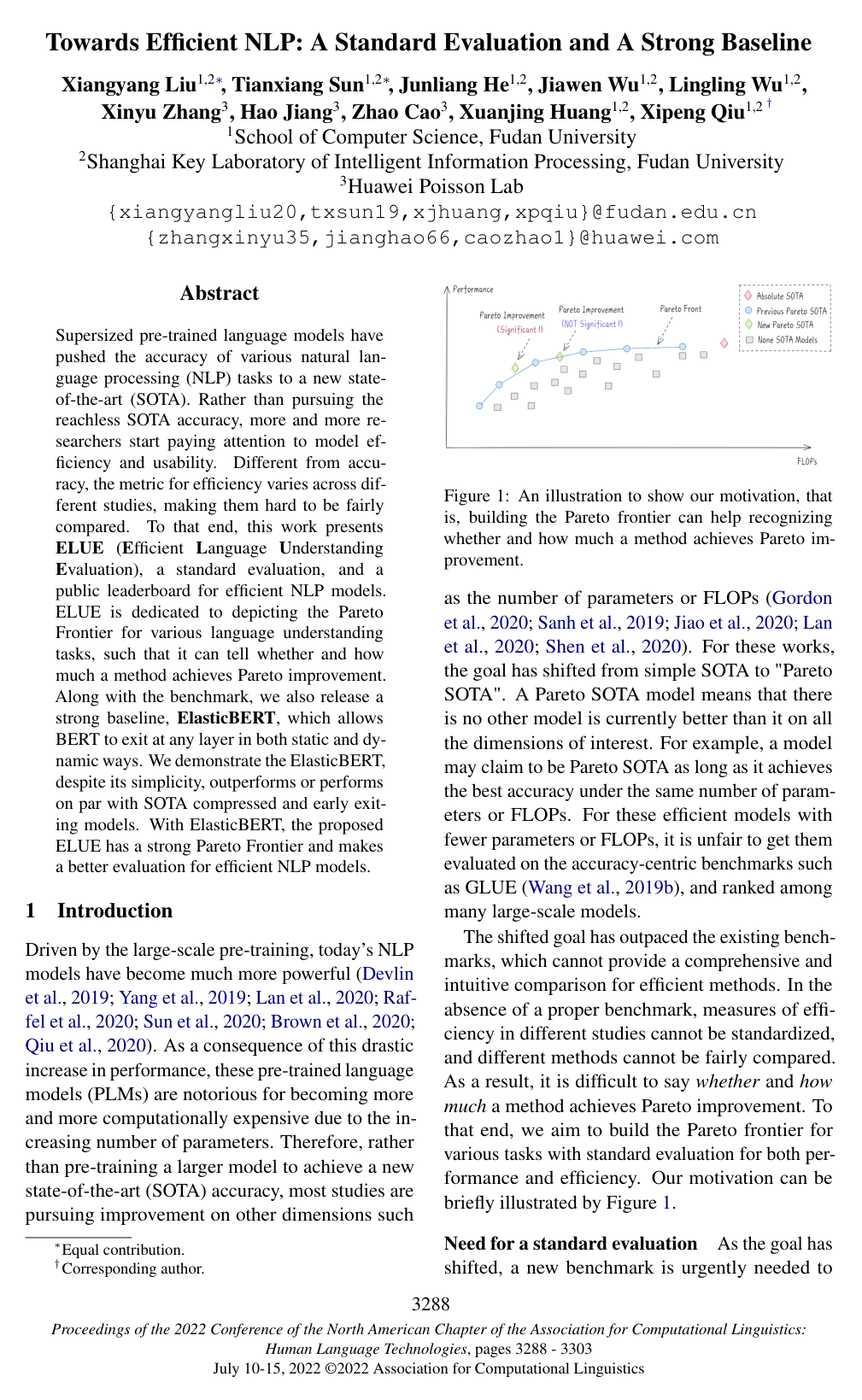
Towards Efficient NLP: A Standard Evaluation and A Strong Baseline
Xiangyang Liu, Tianxiang Sun, Junliang He, Jiawen Wu, Lingling Wu, Xinyu Zhang, Hao Jiang, Zhao Cao, Xuanjing Huang, Xipeng Qiu
Why you should read this
Establishes ELUE, a standardized evaluation benchmark with a public leaderboard to measure Pareto improvements across accuracy and computational cost, while introducing ElasticBERT as a strong baseline capable of both static and dynamic early exiting across any layer.
Supersized pre-trained language models have pushed the accuracy of various natural language processing (NLP) tasks to a new state-of-the-art (SOTA). Rather than pursuing the reachless SOTA accuracy, more and more researchers start paying attention to model efficiency and usability. Different from accuracy, the metric for efficiency varies across different studies, making them hard to be fairly compared. To that end, this work presents ELUE (Efficient Language Understanding Evaluation), a standard evaluation, and a public leaderboard for efficient NLP models. ELUE is dedicated to depicting the Pareto Frontier for various language understanding tasks, such that it can tell whether and how much a method achieves Pareto improvement. Along with the benchmark, we also release a strong baseline, ElasticBERT, which allows BERT to exit at any layer in both static and dynamic ways. We demonstrate the ElasticBERT, despite its simplicity, outperforms or performs on par with SOTA compressed and early exiting models. With ElasticBERT, the proposed ELUE has a strong Pareto Frontier and makes a better evaluation for efficient NLP models.
Added
2026-09-26
A Sensitivity Analysis of (and Practitioners’ Guide to) Convolutional Neural Networks for Sentence Classification
Ye Zhang, Byron C. Wallace
Why you should read this
Establishes practical guidelines for configuring convolutional neural networks in sentence classification by isolating which hyperparameter choices critically influence model accuracy and which can be safely neglected.
Convolutional Neural Networks (CNNs) have recently achieved remarkably strong performance on the practically important task of sentence classification (kim 2014, kalchbrenner 2014, johnson 2014). However, these models require practitioners to specify an exact model architecture and set accompanying hyperparameters, including the filter region size, regularization parameters, and so on. It is currently unknown how sensitive model performance is to changes in these configurations for the task of sentence classification. We thus conduct a sensitivity analysis of one-layer CNNs to explore the effect of architecture components on model performance; our aim is to distinguish between important and comparatively inconsequential design decisions for sentence classification. We focus on one-layer CNNs (to the exclusion of more complex models) due to their comparative simplicity and strong empirical performance, which makes it a modern standard baseline method akin to Support Vector Machine (SVMs) and logistic regression. We derive practical advice from our extensive empirical results for those interested in getting the most out of CNNs for sentence classification in real world settings.
Added
2026-09-25
Deep Convolutional Neural Networks for Sentiment Analysis of Short Texts
Cícero Nogueira dos Santos, Maíra Gatti
Why you should read this
Proposes CharSCNN, a deep convolutional neural network that jointly extracts character- and sentence-level representations to improve sentiment classification performance on short texts across movie review and Twitter benchmarks.
Sentiment analysis of short texts such as single sentences and Twitter messages is challenging because of the limited contextual information that they normally contain. Effectively solving this task requires strategies that combine the small text content with prior knowledge and use more than just bag-of-words. In this work we propose a new deep convolutional neural network that exploits from character- to sentence-level information to perform sentiment analysis of short texts. We apply our approach for two corpora of two different domains: the Stanford Sentiment Treebank (SSTb), which contains sentences from movie reviews; and the Stanford Twitter Sentiment corpus (STS), which contains Twitter messages. For the SSTb corpus, our approach achieves state-of-the-art results for single sentence sentiment prediction in both binary positive/negative classification, with 85.7% accuracy, and fine-grained classification, with 48.3% accuracy. For the STS corpus, our approach achieves a sentiment prediction accuracy of 86.4%.
Added
2026-09-25
Recurrent Neural Network for Text Classification with Multi-Task Learning
Pengfei Liu, Xipeng Qiu, Xuanjing Huang
Why you should read this
Proposes three multi-task recurrent neural network architectures that share text representations across related tasks to improve classification accuracy when training data is limited.
Neural network based methods have obtained great progress on a variety of natural language processing tasks. However, in most previous works, the models are learned based on single-task supervised objectives, which often suffer from insufficient training data. In this paper, we use the multi-task learning framework to jointly learn across multiple related tasks. Based on recurrent neural network, we propose three different mechanisms of sharing information to model text with task-specific and shared layers. The entire network is trained jointly on all these tasks. Experiments on four benchmark text classification tasks show that our proposed models can improve the performance of a task with the help of other related tasks.
Added
2026-09-25
A Simple but Tough-to-Beat Baseline for Sentence Embeddings
Sanjeev Arora, Yingyu Liang, Tengyu Ma
Why you should read this
Proposes an unsupervised sentence embedding baseline combining smooth inverse frequency weighting with principal component removal that consistently outperforms complex neural network models on semantic similarity benchmarks.
The success of neural network methods for computing word embeddings has motivated methods for generating semantic embeddings of longer pieces of text, such as sentences and paragraphs. Surprisingly, Wieting et al (ICLR'16) showed that such complicated methods are outperformed, especially in out-of-domain (transfer learning) settings, by simpler methods involving mild retraining of word embeddings and basic linear regression. The method of Wieting et al. requires retraining with a substantial labeled dataset such as Paraphrase Database (Ganitkevitch et al., 2013). The current paper goes further, showing that the following completely unsupervised sentence embedding is a formidable baseline: Use word embeddings computed using one of the popular methods on unlabeled corpus like Wikipedia, represent the sentence by a weighted average of the word vectors, and then modify them a bit using PCA/SVD. This weighting improves performance by about 10% to 30% in textual similarity tasks, and beats sophisticated supervised methods including RNN's and LSTM's. It even improves Wieting et al.'s embeddings. This simple method should be used as the baseline to beat in future, especially when labeled training data is scarce or nonexistent. The paper also gives a theoretical explanation of the success of the above unsupervised method using a latent variable generative model for sentences, which is a simple extension of the model in Arora et al. (TACL'16) with new "smoothing" terms that allow for words occuring out of context, as well as high probabilities for words like and, not in all contexts.
Added
2026-09-25
Recurrent Convolutional Neural Networks for Text Classification
Siwei Lai, Liheng Xu, Kang Liu, Jun Zhao
Why you should read this
Proposes a recurrent convolutional neural network that integrates bidirectional recurrent structures with max-pooling to capture global contextual information with linear computational complexity, outperforming traditional window-based CNNs and tree-based recursive models across text classification tasks.
Text classification is a foundational task in many NLP applications. Traditional text classifiers often rely on many human-designed features, such as dictionaries, knowledge bases and special tree kernels. In contrast to traditional methods, we introduce a recurrent convolutional neural network for text classification without human-designed features. In our model, we apply a recurrent structure to capture contextual information as far as possible when learning word representations, which may introduce considerably less noise compared to traditional window-based neural networks. We also employ a max-pooling layer that automatically judges which words play key roles in text classification to capture the key components in texts. We conduct experiments on four commonly used datasets. The experimental results show that the proposed method outperforms the state-of-the-art methods on several datasets, particularly on document-level datasets.
Added
2026-09-14
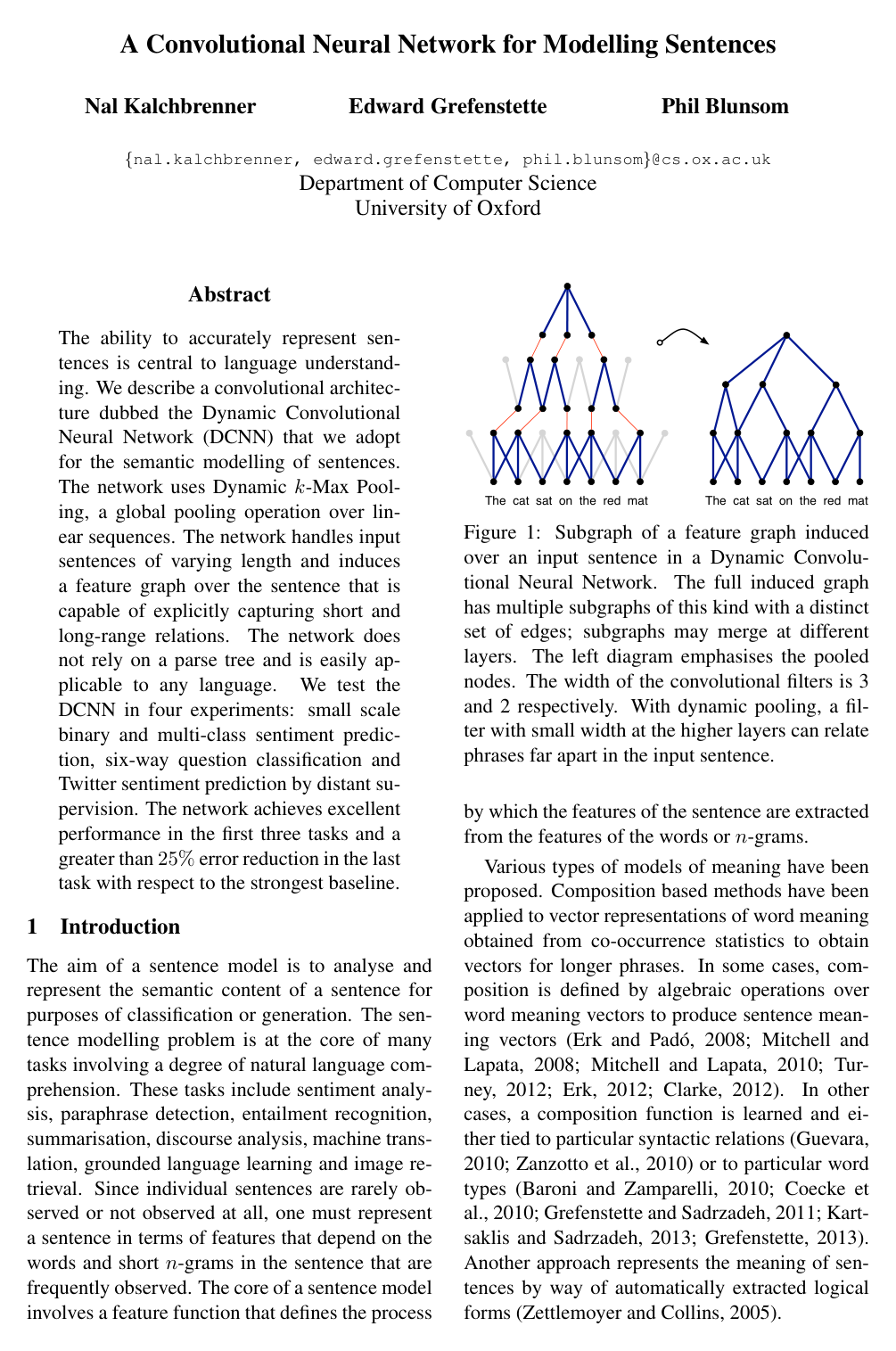
A Convolutional Neural Network for Modelling Sentences
Nal Kalchbrenner, Edward Grefenstette, Phil Blunsom
Why you should read this
Introduces the Dynamic Convolutional Neural Network and dynamic k-max pooling, establishing a parser-free framework that captures both local and long-range semantic relationships across variable-length sentences in any language.
The ability to accurately represent sentences is central to language understanding. We describe a convolutional architecture dubbed the Dynamic Convolutional Neural Network (DCNN) that we adopt for the semantic modelling of sentences. The network uses Dynamic k-Max Pooling, a global pooling operation over linear sequences. The network handles input sentences of varying length and induces a feature graph over the sentence that is capable of explicitly capturing short and long-range relations. The network does not rely on a parse tree and is easily applicable to any language. We test the DCNN in four experiments: small scale binary and multi-class sentiment prediction, six-way question classification and Twitter sentiment prediction by distant supervision. The network achieves excellent performance in the first three tasks and a greater than 25% error reduction in the last task with respect to the strongest baseline.
Added
2026-09-11
ALBERT: A Lite BERT for Self-supervised Learning of Language Representations
Zhenzhong Lan, Mingda Chen, Sebastian Goodman, Kevin Gimpel, Piyush Sharma, Radu Soricut
Why you should read this
Proposes ALBERT, a lightweight BERT architecture that uses parameter-sharing techniques and a sentence-order prediction objective to surpass BERT-large on GLUE, SQuAD, and RACE while drastically reducing memory footprint and training costs.
Increasing model size when pretraining natural language representations often results in improved performance on downstream tasks. However, at some point further model increases become harder due to GPU/TPU memory limitations and longer training times. To address these problems, we present two parameter-reduction techniques to lower memory consumption and increase the training speed of BERT. Comprehensive empirical evidence shows that our proposed methods lead to models that scale much better compared to the original BERT. We also use a self-supervised loss that focuses on modeling inter-sentence coherence, and show it consistently helps downstream tasks with multi-sentence inputs. As a result, our best model establishes new state-of-the-art results on the GLUE, RACE, and \squad benchmarks while having fewer parameters compared to BERT-large. The code and the pretrained models are available at this https URL.
Added
2026-09-08
License
Published with permission
Recursive Deep Models for Semantic Compositionality Over a Sentiment Treebank
Richard Socher, Alex Perelygin, Jean Wu, Jason Chuang, Christopher D. Manning, Andrew Y. Ng, Christopher Potts
Why you should read this
Introduces the Stanford Sentiment Treebank and Recursive Neural Tensor Networks, establishing a framework to accurately model phrase-level semantic compositionality and negation scope across parse trees.
Semantic word spaces have been very useful but cannot express the meaning of longer phrases in a principled way. Further progress towards understanding compositionality in tasks such as sentiment detection requires richer supervised training and evaluation resources and more powerful models of composition. To remedy this, we introduce a Sentiment Treebank. It includes fine grained sentiment labels for 215,154 phrases in the parse trees of 11,855 sentences and presents new challenges for sentiment compositionality. To address them, we introduce the Recursive Neural Tensor Network. When trained on the new treebank, this model outperforms all previous methods on several metrics. It pushes the state of the art in single sentence positive/negative classification from 80% up to 85.4%. The accuracy of predicting fine-grained sentiment labels for all phrases reaches 80.7%, an improvement of 9.7% over bag of features baselines. Lastly, it is the only model that can accurately capture the effects of negation and its scope at various tree levels for both positive and negative phrases.
Added
2026-09-07
Convolutional Neural Networks for Sentence Classification
Yoon Kim
Why you should read this
Demonstrates that simple convolutional neural networks trained on pre-trained word vectors achieve state-of-the-art accuracy across multiple standard sentence classification benchmarks with minimal hyperparameter tuning.
We report on a series of experiments with convolutional neural networks (CNN) trained on top of pre-trained word vectors for sentence-level classification tasks. We show that a simple CNN with little hyperparameter tuning and static vectors achieves excellent results on multiple benchmarks. Learning task-specific vectors through fine-tuning offers further gains in performance. We additionally propose a simple modification to the architecture to allow for the use of both task-specific and static vectors. The CNN models discussed herein improve upon the state of the art on 4 out of 7 tasks, which include sentiment analysis and question classification.
Added
2026-09-06