A Convolutional Neural Network for Modelling Sentences

Nal KalchbrennerEdward GrefenstettePhil Blunsom

article2014ACL3,657 citations

Introduces the Dynamic Convolutional Neural Network and dynamic k-max pooling, establishing a parser-free framework that captures both local and long-range semantic relationships across variable-length sentences in any language.

Listen

This paper introduces a dynamic convolutional neural network, called the DCNN, that learns fixed-length semantic representations of sentences for classification tasks. The work addresses the challenge of modeling sentence meaning accurately when sentences vary in length and when relevant relations between words may be either adjacent or far apart. Such modeling supports core applications including sentiment analysis, question answering, and other tasks that require natural language comprehension.

The authors set out to build and test a neural architecture that extracts ordered features from word sequences without depending on external parse trees or language-specific resources. The DCNN alternates wide one-dimensional convolutional layers with dynamic k-max pooling layers. The pooling operation selects the k strongest activations while preserving their relative order, and the value of k adjusts automatically according to sentence length and network depth. Word embeddings are learned jointly with the rest of the network, and the model is trained end-to-end with back-propagation.

Experiments were conducted on four benchmarks. On the Stanford Sentiment Treebank the DCNN reached 48.5 percent accuracy for five-class sentiment and 86.8 percent for binary sentiment, exceeding both n-gram baselines and prior neural models. On the TREC question classification task it attained 93.0 percent accuracy, matching the performance of systems that rely on dozens of hand-engineered features and parsers. On a large Twitter sentiment dataset collected by distant supervision the network reduced prediction error by more than 25 percent relative to the strongest unigram-bigram baseline.

These results indicate that a convolutional architecture with dynamic pooling can capture both local and long-range semantic patterns directly from raw text. The approach therefore removes the need for costly syntactic preprocessing and extends readily to any language or to informal text such as tweets. The performance gains are largest when substantial training data are available, yet the model still competes with heavily engineered systems on smaller labeled sets once word vectors are initialized from unsupervised corpora.

The main limitations are that the network was evaluated only on classification tasks and that its internal feature graphs, while effective, remain difficult to interpret beyond the first layer. Further gains would likely come from testing the same architecture on generation, entailment, or machine-translation objectives and from scaling the model to larger unlabeled corpora.

arXiv: 1404.2188
Cover for A Convolutional Neural Network for Modelling Sentences

Abstract

The ability to accurately represent sentences is central to language understanding. We describe a convolutional architecture dubbed the Dynamic Convolutional Neural Network (DCNN) that we adopt for the semantic modelling of sentences. The network uses Dynamic k-Max Pooling, a global pooling operation over linear sequences. The network handles input sentences of varying length and induces a feature graph over the sentence that is capable of explicitly capturing short and long-range relations. The network does not rely on a parse tree and is easily applicable to any language. We test the DCNN in four experiments: small scale binary and multi-class sentiment prediction, six-way question classification and Twitter sentiment prediction by distant supervision. The network achieves excellent performance in the first three tasks and a greater than 25% error reduction in the last task with respect to the strongest baseline.

Table of Contents

  • A Convolutional Neural Network for Modelling Sentences
  • 1 Introduction
  • 2 Background
  • 2.1 Related Neural Sentence Models
  • 2.2 Convolution
  • 2.3 Time-Delay Neural Networks
  • 3 Convolutional Neural Networks with Dynamic kk-Max Pooling
  • 3.1 Wide Convolution
  • 3.2 kk-Max Pooling
  • 3.3 Dynamic kk-Max Pooling
  • 3.4 Non-linear Feature Function
  • 3.5 Multiple Feature Maps
  • 3.6 Folding
  • 4 Properties of the Sentence Model
  • 4.1 Word and nn-Gram Order
  • 4.2 Induced Feature Graph
  • 5 Experiments
  • 5.1 Training
  • 5.2 Sentiment Prediction in Movie Reviews
  • 5.3 Question Type Classification
  • 5.4 Twitter Sentiment Prediction with Distant Supervision
  • 5.5 Visualising Feature Detectors
  • 6 Conclusion
  • Acknowledgements
  • References

Knowls

  1. Knowl 1 — Dynamic Convolutional Neural Network Architecture

    model/method

    The Dynamic Convolutional Neural Network (DCNN) is a deep convolutional architecture designed to map variable-length sentences into fixed-size semantic representations without requiring syntactic parse trees.

    Given an input sentence of ss words, each word is mapped to an embedding vector wiRd\mathbf{w}_i \in \mathbb{R}^d, forming a sentence matrix s=[w1,,ws]Rd×s\mathbf{s} = [\mathbf{w}_1, \dots, \mathbf{w}_s] \in \mathbb{R}^{d \times s}. The network alternates one-dimensional wide convolutional layers and dynamic kk-max pooling layers, optionally interleaving folding layers and element-wise non-linearities (such as tanh\tanh). At the first convolutional layer, multiple feature maps are generated by convolving different filter matrices with the sentence matrix s\mathbf{s}. Subsequent layers stack multiple feature maps computed by convolving order-4 filter tensors across all maps of the preceding layer.

    The intermediate layers utilize dynamic kk-max pooling to subsample sequences smoothly as a function of depth and sentence length. The topmost convolutional layer is followed by a fixed ktopk_{\text{top}}-max pooling operation, yielding a representation whose dimensionality is independent of the input sentence length ss. The pooled features are flattened and passed to one or more fully connected layers topped by a softmax classification layer.

  2. Knowl 2 — Wide One-Dimensional Convolution for Sequence Modeling

    definition

    A one-dimensional convolution between a filter vector mRm\mathbf{m} \in \mathbb{R}^m of width mm and an input sequence sRs\mathbf{s} \in \mathbb{R}^s computes an output sequence c\mathbf{c} via dot products with sliding mm-grams:

    cj=msjm+1:jc_j = \mathbf{m}^\top \mathbf{s}_{j-m+1:j}

    In a narrow convolution, the index jj ranges from mm to ss, which requires sms \ge m and yields an output sequence of length sm+1s - m + 1.

    In a wide convolution, the index jj ranges from 11 to s+m1s + m - 1, producing an output sequence cRs+m1\mathbf{c} \in \mathbb{R}^{s+m-1}. Out-of-range input values si\mathbf{s}_i where i<1i < 1 or i>si > s are defined to be zero (zero-padding). Wide convolution provides two structural properties:

    1. Every weight in the filter m\mathbf{m} reaches all words in the sequence, including margin tokens, avoiding edge neglect.
    2. It guarantees a valid, non-empty output sequence c\mathbf{c} for any sequence length s1s \ge 1 and filter width mm, regardless of whether s<ms < m.
  3. Knowl 3 — k-Max Pooling Operator

    definition

    The kk-max pooling operator is a global non-linear subsampling function applied over a linear sequence. Given a sequence pRp\mathbf{p} \in \mathbb{R}^p of length pp and a pooling parameter kk such that pkp \ge k, kk-max pooling extracts the subsequence pmaxkRk\mathbf{p}^k_{\max} \in \mathbb{R}^k consisting of the kk largest values in p\mathbf{p}.

    The values in pmaxk\mathbf{p}^k_{\max} preserve their original relative temporal order in p\mathbf{p}. Unlike local pooling or standard 1-max pooling (which returns only the single maximum value), kk-max pooling:

    1. Retains the relative order of active features across the sequence while achieving invariance to their absolute positions.
    2. Preserves feature frequency by distinguishing whether a feature occurs once or multiple times.
    3. Captures the smooth progression of feature activations across the sequence.
  4. Knowl 4 — Dynamic k-Max Pooling Schedule

    equation

    In a Dynamic Convolutional Neural Network with LL convolutional layers, dynamic kk-max pooling dynamically calculates the pooling parameter klk_l for the ll-th convolutional layer (1lL1 \le l \le L) as a function of the layer depth ll and the input sentence length ss:

    kl=max(ktop,LlLs)k_l = \max\left(k_{\text{top}}, \left\lceil \frac{L - l}{L} s \right\rceil\right)

    where ktopk_{\text{top}} is a predefined fixed pooling parameter applied at the topmost layer (l=Ll = L), and \lceil \cdot \rceil is the ceiling function.

    This parameter schedule gradually compresses the sequence length across successive layers proportionally to the sentence length ss, ensuring that lower layers retain a higher number of activations to capture local and intermediate-range combinations, while the topmost layer produces a fixed-size sequence of length ktopk_{\text{top}} irrespective of ss.

  5. Knowl 5 — Folding Layer for Feature Map Channel Mixing

    model/method

    A folding layer is a parameter-free operation applied after a convolutional layer and before pooling to induce dependencies across different rows of a feature map.

    For a feature map matrix of dimension d×rd \times r (where dd is the feature dimension and rr is the sequence length), folding computes an output matrix of dimension (d/2)×r(d/2) \times r by summing every two adjacent rows component-wise:

    Ai,jfolded=A2i1,j+A2i,j,1id/2,1jr\mathbf{A}_{i, j}^{\text{folded}} = \mathbf{A}_{2i-1, j} + \mathbf{A}_{2i, j}, \quad 1 \le i \le d/2, \quad 1 \le j \le r

    Folding halves the representation size along the embedding dimension and allows higher-order feature detectors to combine information from multiple rows of lower-order feature maps without introducing dense channel-mixing parameter matrices.

  6. Knowl 6 — Multi-Channel Feature Map Computation in Convolutional Layers

    equation

    In a DCNN with multiple feature maps per layer, the jj-th feature map Fji\mathbf{F}_j^i at layer ii is obtained by convolving order-4 filter weight tensors across all nn feature maps {Fki1}k=1n\{\mathbf{F}_k^{i-1}\}_{k=1}^n of layer i1i-1 and summing the results:

    Fji=k=1nmj,kiFki1\mathbf{F}_j^i = \sum_{k=1}^n \mathbf{m}_{j,k}^i * \mathbf{F}_k^{i-1}

    where * denotes the wide one-dimensional convolution and mj,ki\mathbf{m}_{j,k}^i is the filter matrix linking map kk at layer i1i-1 to map jj at layer ii.

    Following convolution, folding (optional), dynamic kk-max pooling, a row-wise bias vector bRd\mathbf{b} \in \mathbb{R}^d, and an element-wise non-linear activation function gg (such as tanh\tanh) are applied to each resulting map.

  7. Knowl 7 — Induced Feature Graph in Dynamic Convolutional Neural Networks

    theoretical result

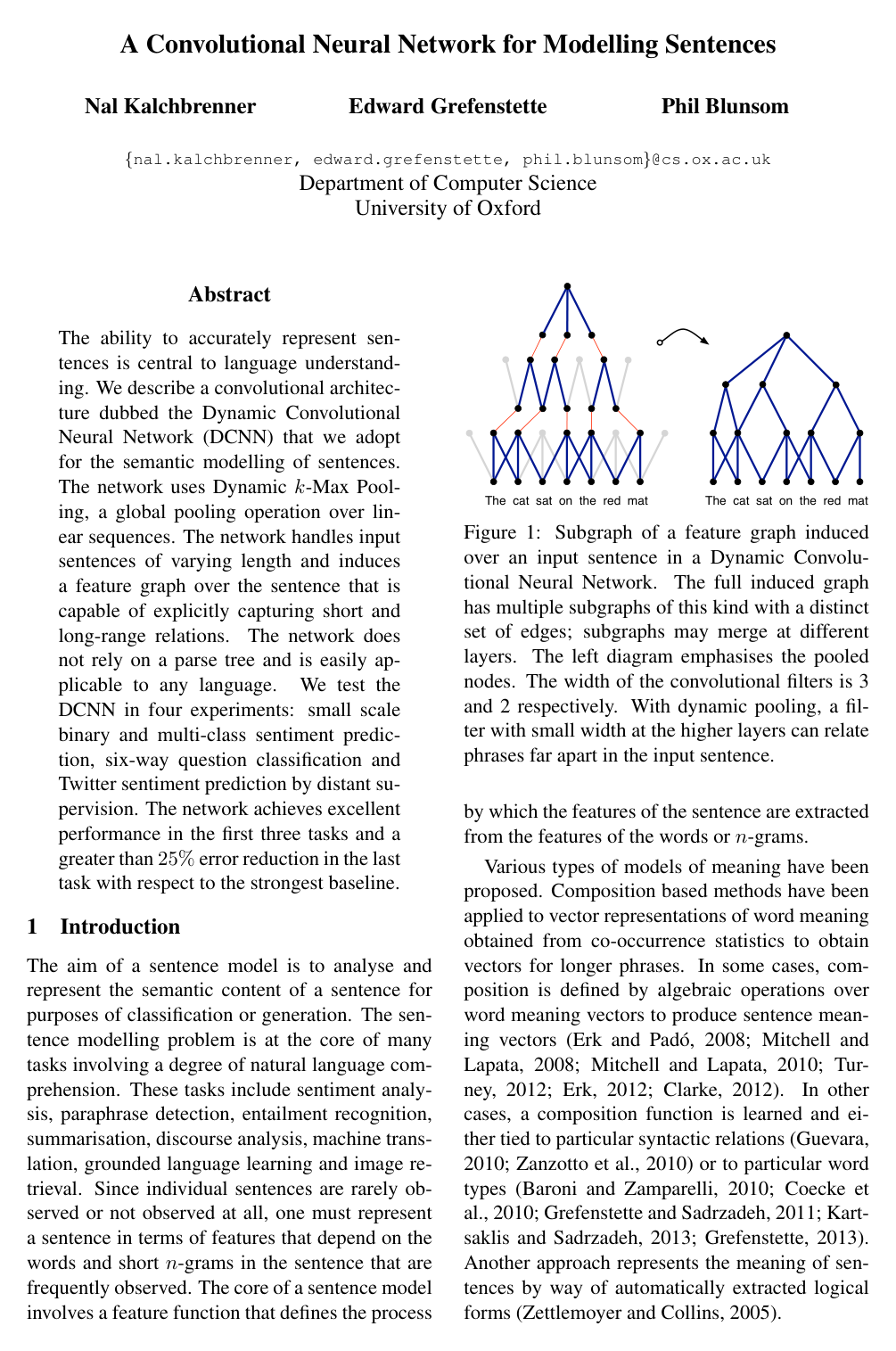
    The hierarchy of wide convolutional and dynamic kk-max pooling layers in a DCNN induces an internal directed acyclic graph (DAG) with weighted edges rooted at the classification layer.

    Nodes at layer l1l-1 connect to nodes at layer ll if they participate in the convolution computing the higher node's activation; nodes not retained by the kk-max pooling operation are pruned from the graph. Because dynamic kk-max pooling operates globally across the entire sequence rather than in small local windows, higher-layer filters with small widths can combine activations originating from non-contiguous phrases located far apart in the input sentence.

    This graph structure provides a hierarchical sentence representation analogous to a parse tree, but it is learned end-to-end, data-driven, internal to the network, and applicable to unstructured or unparseable text (such as social media posts) across any language without external syntactic parsers.

  8. Knowl 8 — Sentiment Classification on the Stanford Sentiment Treebank

    empirical result

    The DCNN was evaluated on the Stanford Sentiment Treebank (SST) for both 5-class fine-grained classification (negative, somewhat negative, neutral, somewhat positive, positive) and binary classification.

    For binary classification, the dataset contains 6,920 training, 872 development, and 1,821 test sentences. For fine-grained classification, it contains 8,544 training, 1,101 development, and 2,210 test sentences. The DCNN used word embedding dimension d=48d=48, filter widths 7 and 5 with 6 and 14 feature maps for binary classification (ktop=4k_{\text{top}}=4), and filter widths 10 and 7 with 6 and 12 maps for fine-grained classification (ktop=5k_{\text{top}}=5), trained with Adagrad and dropout on the penultimate layer.

    Classifier Fine-grained (%) Binary (%)
    NB 41.0 81.8
    BiNB 41.9 83.1
    SVM 40.7 79.4
    Recursive Neural Tensor Network (RecNTN) 45.7 85.4
    Max-TDNN 37.4 77.1
    Neural Bag-of-Words (NBoW) 42.4 80.5
    DCNN 48.5 86.8

    The DCNN outperforms all baselines, including tree-structured recursive networks (RecNTN) that rely on explicit syntactic parse trees.

  9. Knowl 9 — Question Type Classification Performance on the TREC Dataset

    empirical result

    The DCNN was tested on the 6-class TREC question classification task consisting of 5,452 training questions and 500 test questions. The model used unsupervised word vectors (d=32d=32), a single convolutional layer with filter size 8, and 5 feature maps.

    Classifier Features Used Accuracy (%)
    Hierarchical MaxEnt POS, chunks, NE, semantic relations 91.0
    MaxEnt POS, chunks, NE, supertags, CCG parser, WordNet 92.6
    MaxEnt POS, wh-word, head word, hypernyms, WordNet 93.6
    SVM POS, wh-word, head word, hypernyms, WordNet, 60 rules 95.0
    Max-TDNN Unsupervised vectors 84.4
    NBoW Unsupervised vectors 88.2
    DCNN Unsupervised vectors 93.0

    The DCNN achieves 93.0% accuracy, matching the performance of state-of-the-art models reliant on hand-crafted rules, named-entity taggers, CCG parsers, and WordNet lexical hierarchies (p<0.09p < 0.09), without requiring any external linguistic resources.

  10. Knowl 10 — Twitter Sentiment Classification via Distant Supervision

    empirical result

    The DCNN was evaluated on a distant supervision Twitter sentiment classification task. The training set consists of 1.6 million tweets automatically labeled as positive or negative based on emoticons, and the test set comprises 400 hand-annotated tweets. Word embeddings were initialized randomly with dimension d=60d = 60.

    Classifier Accuracy (%)
    SVM 81.6
    BiNB 82.7
    MaxEnt 83.0
    Max-TDNN 78.8
    NBoW 80.9
    DCNN 87.4

    The DCNN achieves 87.4% accuracy, yielding a greater than 25% error reduction relative to the strongest non-neural nn-gram baseline (MaxEnt at 83.0%), demonstrating that the network scales effectively to large-scale distantly supervised corpora.

  11. Knowl 11 — Syntactic and Semantic Patterns Learned by First-Layer Convolutional Filters

    empirical result

    Inspection and ranking of validation and test 7-grams by activation values in the first layer of a DCNN (filter width m=7m=7) trained on binary sentiment classification show that individual filters learn specialized linguistic feature detectors beyond mere keyword matching.

    The learned detectors identify:

    1. Direct positive sentiment (e.g., "lovely comedic moments and several fine", "good script, good dialogue, funny").
    2. Direct negative sentiment (e.g., "nonexistent plot and pretentious visual style", "fails the most basic test as").
    3. Negation patterns that invert sentiment (e.g., "n't have any huge laughs in its", "not that kung pow is n't funny").
    4. Sentiment potentiators and intensifiers (e.g., "too dull and pretentious to be", "either too serious or too lighthearted").
    5. Structural and discourse constructions, including "all", "or", "with...that", and "as...as".

Coverage note — Deliberately omitted general background discussions of baseline neural models (Recursive Neural Networks, basic RNNs, generic NBoW) and the Fast Fourier Transform acceleration details, as these represent standard background techniques rather than novel contributions of this paper.

References

  1. 1.Marco Baroni and Roberto Zamparelli. 2010. Nouns are vectors, adjectives are matrices: Representing adjective-noun constructions in semantic space. In EMNLP, pages 1183–1193. ACL.
  2. 2.Phil Blunsom, Krystle Kocik, and James R. Curran. 2006. Question classification with log-linear models. In SIGIR '06: Proceedings of the 29th annual international ACM SIGIR conference on Research and development in information retrieval, pages 615–616, New York, NY, USA. ACM.
  3. 3.Daoud Clarke. 2012. A context-theoretic framework for compositionality in distributional semantics. Computational Linguistics, 38(1):41–71.
  4. 4.Bob Coecke, Mehrnoosh Sadrzadeh, and Stephen Clark. 2010. Mathematical Foundations for a Compositional Distributional Model of Meaning. March.
  5. 5.Ronan Collobert and Jason Weston. 2008. A unified architecture for natural language processing: Deep neural networks with multitask learning. In International Conference on Machine Learning, ICML.
  6. 6.John Duchi, Elad Hazan, and Yoram Singer. 2011. Adaptive subgradient methods for online learning and stochastic optimization. J. Mach. Learn. Res., 12:2121–2159, July.
  7. 7.Katrin Erk and Sebastian Padó. 2008. A structured vector space model for word meaning in context. Proceedings of the Conference on Empirical Methods in Natural Language Processing - EMNLP '08, (October):897.
  8. 8.Katrin Erk. 2012. Vector space models of word meaning and phrase meaning: A survey. Language and Linguistics Compass, 6(10):635–653.
  9. 9.Felix A. Gers and Jrgen Schmidhuber. 2001. Lstm recurrent networks learn simple context-free and context-sensitive languages. IEEE Transactions on Neural Networks, 12(6):1333–1340.
  10. 10.Alec Go, Richa Bhayani, and Lei Huang. 2009. Twitter sentiment classification using distant supervision. Processing, pages 1–6.
  11. 11.Edward Grefenstette and Mehrnoosh Sadrzadeh. 2011. Experimental support for a categorical compositional distributional model of meaning. In Proceedings of the Conference on Empirical Methods in Natural Language Processing, pages 1394–1404. Association for Computational Linguistics.
  12. 12.Edward Grefenstette. 2013. Category-theoretic quantitative compositional distributional models of natural language semantics. arXiv preprint arXiv:1311.1539.
  13. 13.Emiliano Guevara. 2010. Modelling Adjective-Noun Compositionality by Regression. ESSLLI'10 Workshop on Compositionality and Distributional Semantic Models.
  14. 14.Karl Moritz Hermann and Phil Blunsom. 2013. The Role of Syntax in Vector Space Models of Compositional Semantics. In Proceedings of the 51st Annual Meeting of the Association for Computational Linguistics (Volume 1: Long Papers), Sofia, Bulgaria, August. Association for Computational Linguistics. Forthcoming.
  15. 15.Geoffrey E. Hinton, Nitish Srivastava, Alex Krizhevsky, Ilya Sutskever, and Ruslan Salakhutdinov. 2012. Improving neural networks by preventing co-adaptation of feature detectors. CoRR, abs/1207.0580.
  16. 16.Geoffrey E. Hinton. 1989. Connectionist learning procedures. Artif. Intell., 40(1-3):185–234.
  17. 17.Zhiheng Huang, Marcus Thint, and Zengchang Qin. 2008. Question classification using head words and their hypernyms. In Proceedings of the Conference on Empirical Methods in Natural Language Processing, EMNLP '08, pages 927–936, Stroudsburg, PA, USA. Association for Computational Linguistics.
  18. 18.Nal Kalchbrenner and Phil Blunsom. 2013a. Recurrent continuous translation models. In Proceedings of the 2013 Conference on Empirical Methods in Natural Language Processing, Seattle, October. Association for Computational Linguistics.
  19. 19.Nal Kalchbrenner and Phil Blunsom. 2013b. Recurrent Convolutional Neural Networks for Discourse Compositionality. In Proceedings of the Workshop on Continuous Vector Space Models and their Compositionality, Sofia, Bulgaria, August. Association for Computational Linguistics.
  20. 20.Dimitri Kartsaklis and Mehrnoosh Sadrzadeh. 2013. Prior disambiguation of word tensors for constructing sentence vectors. In Proceedings of the 2013 Conference on Empirical Methods in Natural Language Processing (EMNLP), Seattle, USA, October.
  21. 21.Andreas Küchler and Christoph Goller. 1996. Inductive learning in symbolic domains using structure-driven recurrent neural networks. In Günther Görz and Steffen Hölldobler, editors, KI, volume 1137 of Lecture Notes in Computer Science, pages 183–197. Springer.
  22. 22.Yann LeCun, Léon Bottou, Yoshua Bengio, and Patrick Haffner. 1998. Gradient-based learning applied to document recognition. Proceedings of the IEEE, 86(11):2278–2324, November.
  23. 23.Xin Li and Dan Roth. 2002. Learning question classifiers. In Proceedings of the 19th international conference on Computational linguistics-Volume 1, pages 1–7. Association for Computational Linguistics.
  24. 24.Tomas Mikolov and Geoffrey Zweig. 2012. Context dependent recurrent neural network language model. In SLT, pages 234–239.
  25. 25.Tomas Mikolov, Stefan Kombrink, Lukas Burget, Jan Cernocký, and Sanjeev Khudanpur. 2011. Extensions of recurrent neural network language model. In ICASSP, pages 5528–5531. IEEE.
  26. 26.Jeff Mitchell and Mirella Lapata. 2008. Vector-based models of semantic composition. In Proceedings of ACL, volume 8.
  27. 27.Jeff Mitchell and Mirella Lapata. 2010. Composition in distributional models of semantics. Cognitive Science, 34(8):1388–1429.
  28. 28.Jordan B. Pollack. 1990. Recursive distributed representations. Artificial Intelligence, 46:77–105.
  29. 29.Holger Schwenk. 2012. Continuous space translation models for phrase-based statistical machine translation. In COLING (Posters), pages 1071–1080.
  30. 30.Joo Silva, Lusa Coheur, AnaCristina Mendes, and Andreas Wichert. 2011. From symbolic to subsymbolic information in question classification. Artificial Intelligence Review, 35(2):137–154.
  31. 31.Richard Socher, Jeffrey Pennington, Eric H. Huang, Andrew Y. Ng, and Christopher D. Manning. 2011. Semi-Supervised Recursive Autoencoders for Predicting Sentiment Distributions. In Proceedings of the 2011 Conference on Empirical Methods in Natural Language Processing (EMNLP).
  32. 32.Richard Socher, Quoc V. Le, Christopher D. Manning, and Andrew Y. Ng. 2013a. Grounded Compositional Semantics for Finding and Describing Images with Sentences. In Transactions of the Association for Computational Linguistics (TACL).
  33. 33.Richard Socher, Alex Perelygin, Jean Wu, Jason Chuang, Christopher D. Manning, Andrew Y. Ng, and Christopher Potts. 2013b. Recursive deep models for semantic compositionality over a sentiment treebank. In Proceedings of the 2013 Conference on Empirical Methods in Natural Language Processing, pages 1631–1642, Stroudsburg, PA, October. Association for Computational Linguistics.
  34. 34.Joseph Turian, Lev Ratinov, and Yoshua Bengio. 2010. Word representations: a simple and general method for semi-supervised learning. In Proceedings of the 48th Annual Meeting of the Association for Computational Linguistics, pages 384–394. Association for Computational Linguistics.
  35. 35.Peter Turney. 2012. Domain and function: A dual-space model of semantic relations and compositions. J. Artif. Intell. Res.(JAIR), 44:533–585.
  36. 36.Alexander Waibel, Toshiyuki Hanazawa, Geofrey Hinton, Kiyohiro Shikano, and Kevin J. Lang. 1990. Readings in speech recognition. chapter Phoneme Recognition Using Time-delay Neural Networks, pages 393–404. Morgan Kaufmann Publishers Inc., San Francisco, CA, USA.
  37. 37.Fabio Massimo Zanzotto, Ioannis Korkontzelos, Francesca Fallucchi, and Suresh Manandhar. 2010. Estimating linear models for compositional distributional semantics. In Proceedings of the 23rd International Conference on Computational Linguistics, pages 1263–1271. Association for Computational Linguistics.
  38. 38.Luke S. Zettlemoyer and Michael Collins. 2005. Learning to map sentences to logical form: Structured classification with probabilistic categorial grammars. In UAI, pages 658–666. AUAI Press.

Citation

MLA
Kalchbrenner, N., et al. “A Convolutional Neural Network for Modelling Sentences”. Proceedings of the 52nd Annual Meeting of the Association for Computational Linguistics (Volume 1: Long Papers), 2014, pp. 655–65, https://doi.org/10.3115/v1/P14-1062.
APA
Kalchbrenner, N., Grefenstette, E., & Blunsom, P. (2014). A Convolutional Neural Network for Modelling Sentences. Proceedings of the 52nd Annual Meeting of the Association for Computational Linguistics (Volume 1: Long Papers), 655–665. https://doi.org/10.3115/v1/P14-1062
Chicago
Kalchbrenner, N., E. Grefenstette, and P. Blunsom. 2014. “A Convolutional Neural Network for Modelling Sentences”. Proceedings of the 52nd Annual Meeting of the Association for Computational Linguistics (Volume 1: Long Papers), 655–65. https://doi.org/10.3115/v1/P14-1062.
Harvard
Kalchbrenner, N., Grefenstette, E. and Blunsom, P. (2014) “A Convolutional Neural Network for Modelling Sentences”, Proceedings of the 52nd Annual Meeting of the Association for Computational Linguistics (Volume 1: Long Papers). Association for Computational Linguistics, pp. 655–665. Available at: https://doi.org/10.3115/v1/P14-1062.
Vancouver
1. Kalchbrenner N, Grefenstette E, Blunsom P (2014) A Convolutional Neural Network for Modelling Sentences. In: Proceedings of the 52nd Annual Meeting of the Association for Computational Linguistics (Volume 1: Long Papers). Association for Computational Linguistics, pp 655–665

BibTeX

@inproceedings{kalchbrenner-etal-2014-convolutional,
    title = "A Convolutional Neural Network for Modelling Sentences",
    author = "Kalchbrenner, Nal  and
      Grefenstette, Edward  and
      Blunsom, Phil",
    editor = "Toutanova, Kristina  and
      Wu, Hua",
    booktitle = "Proceedings of the 52nd Annual Meeting of the Association for Computational Linguistics (Volume 1: Long Papers)",
    month = jun,
    year = "2014",
    address = "Baltimore, Maryland",
    publisher = "Association for Computational Linguistics",
    url = "https://aclanthology.org/P14-1062/",
    doi = "10.3115/v1/P14-1062",
    pages = "655--665"
}
Metadata:ACL Anthology

Access the Paper

This paper is available from its original source. Click below to access the PDF.

Open PDF

License: https://creativecommons.org/licenses/by-nc-sa/4.0/