
keyword
scene labeling
Scene labeling is a computer vision task that involves assigning a predefined categorical label to every individual pixel in an image based on the object, surface, or region class it represents. Often used interchangeably with semantic segmentation, this dense prediction process partitions an entire visual scene into coherent, meaningful areas by identifying elements such as roads, buildings, vegetation, vehicles, and pedestrians. Unlike image-level classification, which determines only the overall content of an image, scene labeling captures precise spatial boundaries, fine-grained visual details, and surrounding contextual relationships throughout the composition. As a foundational component of automated visual scene understanding, it is widely utilized in technologies such as autonomous driving, robotic navigation, medical imaging, and augmented reality.
5 items
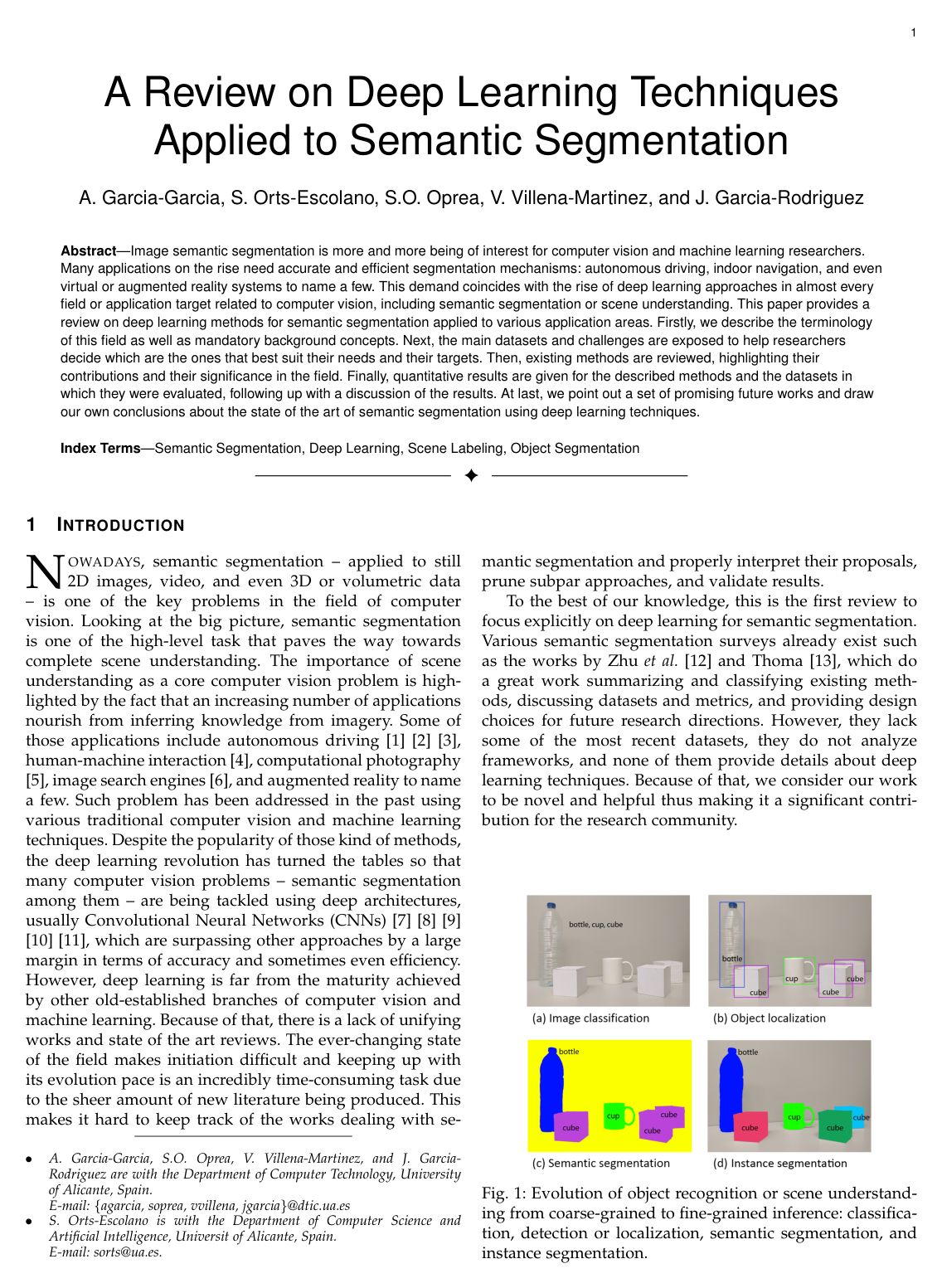
A Review on Deep Learning Techniques Applied to Semantic Segmentation
Alberto Garcia-Garcia, Sergio Orts-Escolano, Sergiu Oprea, Victor Villena-Martinez, Jose Garcia-Rodriguez
Why you should read this
Surveys deep learning methods for semantic segmentation by systematically categorizing leading architectures, comparing quantitative benchmark performance across standard datasets, and identifying key future research directions for computer vision applications.
Image semantic segmentation is more and more being of interest for computer vision and machine learning researchers. Many applications on the rise need accurate and efficient segmentation mechanisms: autonomous driving, indoor navigation, and even virtual or augmented reality systems to name a few. This demand coincides with the rise of deep learning approaches in almost every field or application target related to computer vision, including semantic segmentation or scene understanding. This paper provides a review on deep learning methods for semantic segmentation applied to various application areas. Firstly, we describe the terminology of this field as well as mandatory background concepts. Next, the main datasets and challenges are exposed to help researchers decide which are the ones that best suit their needs and their targets. Then, existing methods are reviewed, highlighting their contributions and their significance in the field. Finally, quantitative results are given for the described methods and the datasets in which they were evaluated, following up with a discussion of the results. At last, we point out a set of promising future works and draw our own conclusions about the state of the art of semantic segmentation using deep learning techniques.
Added
2026-09-25
Conditional Random Fields as Recurrent Neural Networks
Shuai Zheng, Sadeep Jayasumana, Bernardino Romera-Paredes, Vibhav Vineet, Zhizhong Su, Dalong Du, Chang Huang, Philip H. S. Torr
Why you should read this
Integrates Conditional Random Fields into convolutional neural networks by formulating mean-field inference as recurrent layers, enabling end-to-end training for accurate semantic segmentation without disconnected post-processing.
Pixel-level labelling tasks, such as semantic segmentation, play a central role in image understanding. Recent approaches have attempted to harness the capabilities of deep learning techniques for image recognition to tackle pixel-level labelling tasks. One central issue in this methodology is the limited capacity of deep learning techniques to delineate visual objects. To solve this problem, we introduce a new form of convolutional neural network that combines the strengths of Convolutional Neural Networks (CNNs) and Conditional Random Fields (CRFs)-based probabilistic graphical modelling. To this end, we formulate mean-field approximate inference for the Conditional Random Fields with Gaussian pairwise potentials as Recurrent Neural Networks. This network, called CRF-RNN, is then plugged in as a part of a CNN to obtain a deep network that has desirable properties of both CNNs and CRFs. Importantly, our system fully integrates CRF modelling with CNNs, making it possible to train the whole deep network end-to-end with the usual back-propagation algorithm, avoiding offline post-processing methods for object delineation. We apply the proposed method to the problem of semantic image segmentation, obtaining top results on the challenging Pascal VOC 2012 segmentation benchmark.
Added
2026-09-14
Learning Hierarchical Features for Scene Labeling
C. Farabet, C. Couprie, Laurent Najman, Yann LeCun
Why you should read this
Proposes a multiscale convolutional network that learns hierarchical features directly from raw pixels across image pyramids, enabling near-real-time scene parsing while eliminating the need for hand-engineered features and complex graphical model post-processing.
Scene labeling consists in labeling each pixel in an image with the category of the object it belongs to. We propose a method that uses a multiscale convolutional network trained from raw pixels to extract dense feature vectors that encode regions of multiple sizes centered on each pixel. The method alleviates the need for engineered features, and produces a powerful representation that captures texture, shape and contextual information. We report results using multiple post-processing methods to produce the final labeling. Among those, we propose a technique to automatically retrieve, from a pool of segmentation components, an optimal set of components that best explain the scene; these components are arbitrary, e.g. they can be taken from a segmentation tree, or from any family of over-segmentations. The system yields record accuracies on the Sift Flow Dataset (33 classes) and the Barcelona Dataset (170 classes) and near-record accuracy on Stanford Background Dataset (8 classes), while being an order of magnitude faster than competing approaches, producing a 320 × 240 image labeling in less than a second, including feature extraction.
Added
2026-09-14
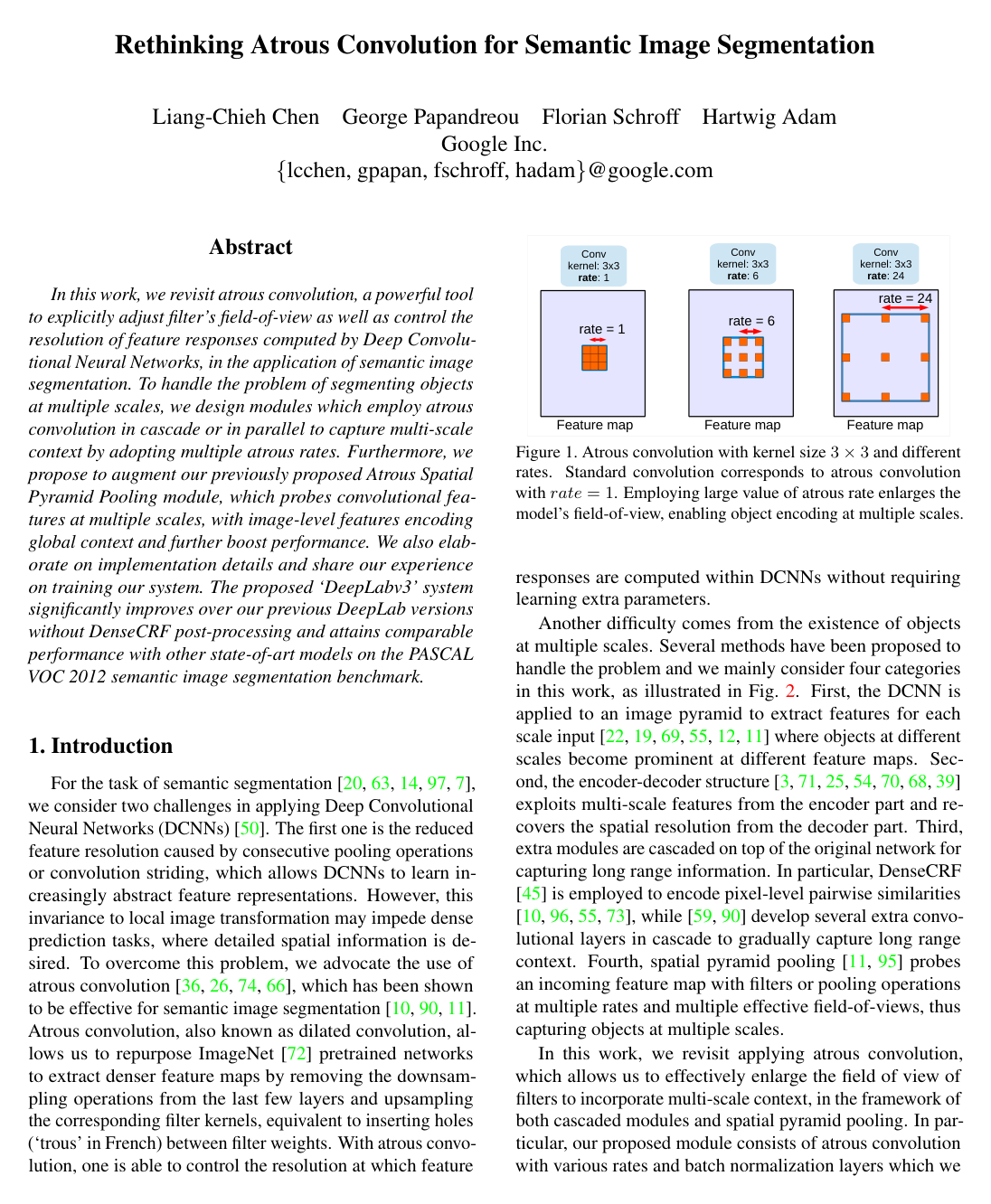
Rethinking Atrous Convolution for Semantic Image Segmentation
Liang-Chieh Chen, George Papandreou, Florian Schroff, Hartwig Adam
Why you should read this
Proposes DeepLabv3, an effective semantic segmentation framework that combines cascading atrous convolutions with an upgraded Atrous Spatial Pyramid Pooling module to capture multi-scale context without relying on conditional random field post-processing.
In this work, we revisit atrous convolution, a powerful tool to explicitly adjust filter's field-of-view as well as control the resolution of feature responses computed by Deep Convolutional Neural Networks, in the application of semantic image segmentation. To handle the problem of segmenting objects at multiple scales, we design modules which employ atrous convolution in cascade or in parallel to capture multi-scale context by adopting multiple atrous rates. Furthermore, we propose to augment our previously proposed Atrous Spatial Pyramid Pooling module, which probes convolutional features at multiple scales, with image-level features encoding global context and further boost performance. We also elaborate on implementation details and share our experience on training our system. The proposed `DeepLabv3' system significantly improves over our previous DeepLab versions without DenseCRF post-processing and attains comparable performance with other state-of-art models on the PASCAL VOC 2012 semantic image segmentation benchmark.
Added
2026-09-11
License
Published with permission
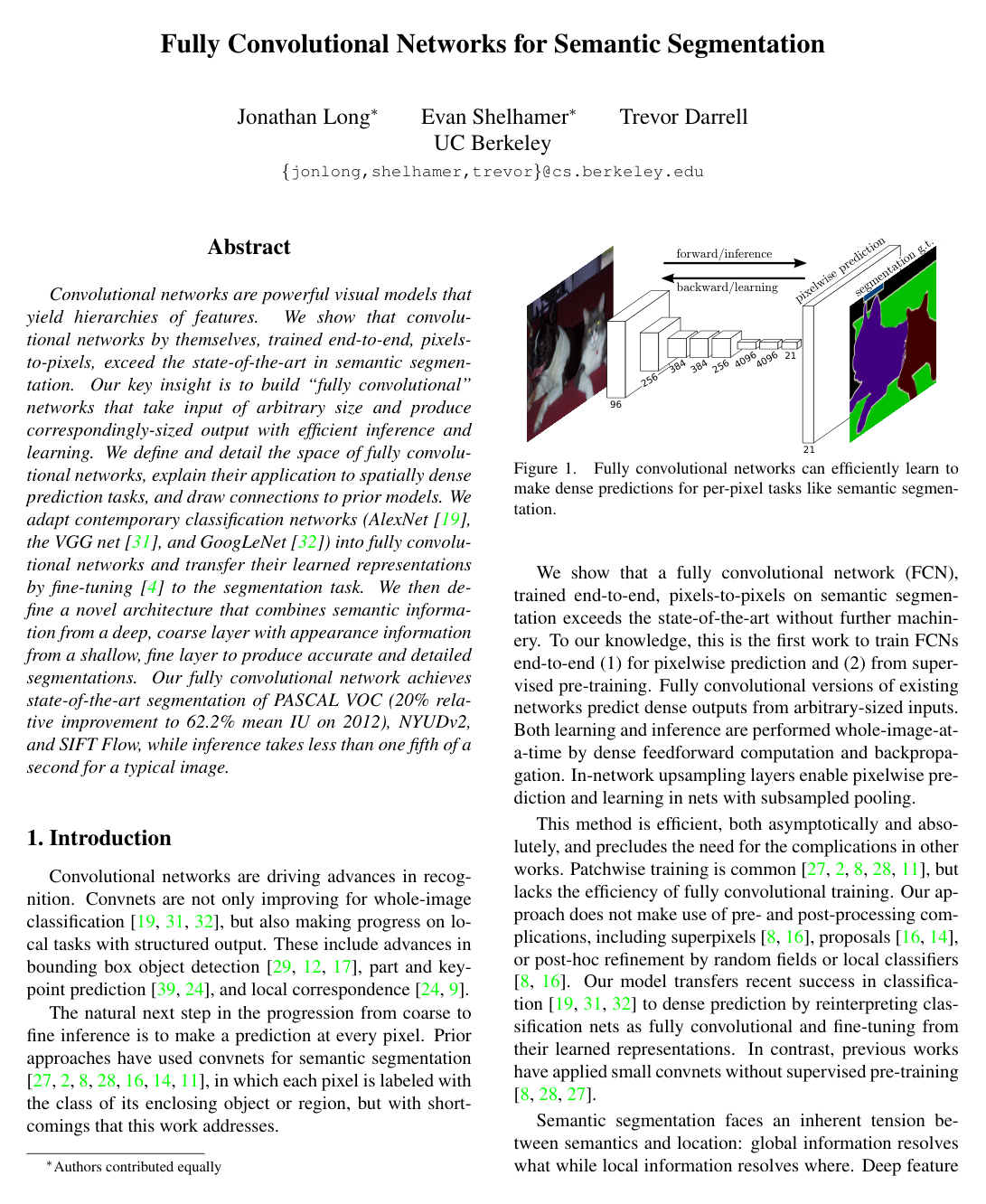
Fully convolutional networks for semantic segmentation
Jonathan Long, Evan Shelhamer, Trevor Darrell
Why you should read this
Transforms classification networks into fully convolutional architectures capable of processing arbitrary input sizes to produce dense, pixel-wise prediction maps.
Convolutional networks are powerful visual models that yield hierarchies of features. We show that convolutional networks by themselves, trained end-to-end, pixels-to-pixels, exceed the state-of-the-art in semantic segmentation. Our key insight is to build "fully convolutional" networks that take input of arbitrary size and produce correspondingly-sized output with efficient inference and learning. We define and detail the space of fully convolutional networks, explain their application to spatially dense prediction tasks, and draw connections to prior models. We adapt contemporary classification networks (AlexNet [20], the VGG net [31], and GoogLeNet [32]) into fully convolutional networks and transfer their learned representations by fine-tuning [3] to the segmentation task. We then define a skip architecture that combines semantic information from a deep, coarse layer with appearance information from a shallow, fine layer to produce accurate and detailed segmentations. Our fully convolutional network achieves state-of-the-art segmentation of PASCAL VOC (20% relative improvement to 62.2% mean IU on 2012), NYUDv2, and SIFT Flow, while inference takes less than one fifth of a second for a typical image.
Added
2026-02-18