
keyword
sample complexity
Sample complexity is the number of training samples, observations, or environment interactions that a machine learning algorithm requires to learn a target concept, function, or policy with high accuracy and high probability. In computational and statistical learning theory, it serves as a standard metric for evaluating the data efficiency of an algorithm, typically expressed as a mathematical function of the desired error tolerance, the allowed failure probability, and the intrinsic complexity or dimension of the hypothesis class. Lower sample complexity indicates that an algorithm can generalize effectively or achieve near-optimal decision-making using less data, contrasting with computational complexity, which measures the processing time or memory required during the learning process.
11 items
Pessimistic Model-based Offline Reinforcement Learning under Partial Coverage
Masatoshi Uehara, Wen Sun
Why you should read this
Develops Constrained Pessimistic Policy Optimization (CPPO) to prove that model-based offline reinforcement learning with general function approximation can succeed under partial data coverage, extending PAC guarantees to low-rank and factored MDPs.
We study model-based offline Reinforcement Learning with general function approximation without a full coverage assumption on the offline data distribution. We present an algorithm named Constrained Pessimistic Policy Optimization (CPPO)which leverages a general function class and uses a constraint over the model class to encode pessimism. Under the assumption that the ground truth model belongs to our function class (i.e., realizability in the function class), CPPO has a PAC guarantee with offline data only providing partial coverage, i.e., it can learn a policy that competes against any policy that is covered by the offline data. We then demonstrate that this algorithmic framework can be applied to many specialized Markov Decision Processes where additional structural assumptions can further refine the concept of partial coverage. Two notable examples are: (1) low-rank MDP with representation learning where the partial coverage condition is defined using a relative condition number measured by the unknown ground truth feature representation; (2) factored MDP where the partial coverage condition is defined using density ratio based concentrability coefficients associated with individual factors.
Added
2026-10-05
Stochastic Policy Gradient Methods: Improved Sample Complexity for Fisher-non-degenerate Policies
Ilyas Fatkhullin, Anas Barakat, Anastasia Kireeva, Niao He
Why you should read this
Establishes improved global sample complexities of and for Fisher-non-degenerate parameterized policies through computationally efficient, single-loop stochastic policy gradient algorithms that bypass the need for importance sampling weights.
Added
2026-10-03
Linear-Time User-Level DP SCO via Robust Statistics
Pasin Manurangsi, Badih Ghazi, Daogao Liu, Ravi Kumar
Why you should read this
Introduces a linear-time algorithm for user-level differentially private stochastic convex optimization that employs median and trimmed-mean gradient estimators to eliminate per-step noise accumulation and achieve near-optimal privacy-utility trade-offs.
User-level differentially private stochastic convex optimization (DP-SCO) has garnered significant attention due to the paramount importance of safeguarding user privacy in modern large-scale machine learning applications. Current methods, such as those based on differentially private stochastic gradient descent (DP-SGD), often struggle with high noise accumulation and suboptimal utility due to the need to privatize every intermediate iterate. In this work, we introduce a novel linear-time algorithm that leverages robust statistics, specifically the median and trimmed mean, to overcome these challenges. Our approach uniquely bounds the sensitivity of all intermediate iterates of SGD with gradient estimation based on robust statistics, thereby significantly reducing the gradient estimation noise for privacy purposes and enhancing the privacy-utility trade-off. By sidestepping the repeated privatization required by previous methods, our algorithm not only achieves an improved theoretical privacy-utility trade-off but also maintains computational efficiency. We complement our algorithm with an information-theoretic lower bound, showing that our upper bound is optimal up to logarithmic factors and the dependence on . This work sets the stage for more robust and efficient privacy-preserving techniques in machine learning, with implications for future research and application in the field.
Added
2026-10-01
On the Hardness of Bandit Learning
Nataly Brukhim, Aldo Pacchiano, Miro Dudík, Robert E. Schapire
Why you should read this
Establishes fundamental theoretical limits of structured bandit learning by proving that no combinatorial dimension can characterize learnability and demonstrating that finding optimal actions can be computationally intractable even when sample complexity is minimal and standard empirical risk minimization is efficient.
We study the task of bandit learning, also known as best-arm identification, under the assumption that the true reward function f belongs to a known, but arbitrary, function class F. We seek a general theory of bandit learnability, akin to the PAC framework for classification. Our investigation is guided by the following two questions: (1) which classes F are learnable, and (2) how they are learnable. For example, in the case of binary PAC classification, learnability is fully determined by a combinatorial dimension - the VC dimension- and can be attained via a simple algorithmic principle, namely, empirical risk minimization (ERM). In contrast to classical learning-theoretic results, our findings reveal limitations of learning in structured bandits, offering insights into the boundaries of bandit learnability. First, for the question of "which", we show that the paradigm of identifying the learnable classes via a dimension-like quantity fails for bandit learning. We give a simple proof demonstrating that no combinatorial dimension can characterize bandit learnability, even in finite classes, following a standard definition of dimension introduced by Ben-David et al. (2019). For the question of "how", we prove a computational hardness result: we construct a reward function class for which at most two queries are needed to find the optimal action, yet no algorithm can do so in polynomial time unless RP=NP. We also prove that this class admits efficient algorithms for standard algorithmic operations often considered in learning theory, such as an ERM. This implies that computational hardness is in this case inherent to the task of bandit learning. Beyond these results, we investigate additional themes such as learning under noise, trade-offs between noise models, and the relationship between query complexity and regret minimization.
Added
2026-09-29
In-context Convergence of Transformers
Yu Huang, Yuan Cheng, Yingbin Liang
Why you should read this
Establishes the first finite-time convergence guarantees and characterizes the stage-wise gradient descent dynamics of single-layer softmax transformers performing in-context learning on linear tasks across balanced and imbalanced feature distributions.
Transformers have recently revolutionized many domains in modern machine learning and one salient discovery is their remarkable in-context learning capability, where models can solve an unseen task by utilizing task-specific prompts without further parameters fine-tuning. This also inspired recent theoretical studies aiming to understand the in-context learning mechanism of transformers, which however focused only on linear transformers. In this work, we take the first step toward studying the learning dynamics of a one-layer transformer with softmax attention trained via gradient descent in order to in-context learn linear function classes. We consider a structured data model, where each token is randomly sampled from a set of feature vectors in either balanced or imbalanced fashion. For data with balanced features, we establish the finite-time convergence guarantee with near-zero prediction error by navigating our analysis over two phases of the training dynamics of the attention map. More notably, for data with imbalanced features, we show that the learning dynamics take a stage-wise convergence process, where the transformer first converges to a near-zero prediction error for the query tokens of dominant features, and then converges later to a near-zero error for query tokens of under-represented features, via one and four training phases. Our proof features new techniques for analyzing the competing strengths of two types of attention weights, the change of which determines different training phases.
Added
2026-09-26
Unpacking Reward Shaping: Understanding the Benefits of Reward Engineering on Sample Complexity
Abhishek Gupta, Aldo Pacchiano, Yuexiang Zhai, Sham M. Kakade, Sergey Levine
Why you should read this
Establishes theoretical guarantees and algorithmic methods showing how reward shaping provably improves reinforcement learning sample complexity by reducing the effective state space and horizon dependence during exploration.
Reinforcement learning provides an automated framework for learning behaviors from high-level reward specifications, but in practice the choice of reward function can be crucial for good results – while in principle the reward only needs to specify what the task is, in reality practitioners often need to design more detailed rewards that provide the agent with some hints about how the task should be completed. The idea of this type of “reward-shaping” has been often discussed in the literature, and is often a critical part of practical applications, but there is relatively little formal characterization of how the choice of reward shaping can yield benefits in sample complexity. In this work, we build on the framework of novelty-based exploration to provide a simple scheme for incorporating shaped rewards into RL along with an analysis tool to show that particular choices of reward shaping provably improve sample efficiency. We characterize the class of problems where these gains are expected to be significant and show how this can be connected to practical algorithms in the literature. We confirm that these results hold in practice in an experimental evaluation, providing an insight into the mechanisms through which reward shaping can significantly improve the complexity of reinforcement learning while retaining asymptotic performance.
Added
2026-09-26
Near-optimal Regret Bounds for Reinforcement Learning
Thomas Jaksch, R. Ortner, P. Auer
Why you should read this
Establishes near-optimal regret bounds for undiscounted reinforcement learning by introducing the diameter parameter to characterize MDP transition structures and developing the UCRL2 algorithm with high-probability performance guarantees matching theoretical lower bounds.
For undiscounted reinforcement learning in Markov decision processes (MDPs) we consider the total regret of a learning algorithm with respect to an optimal policy. In order to describe the transition structure of an MDP we propose a new parameter: An MDP has diameter D if for any pair of states s, s' there is a policy which moves from s to s' in at most D steps (on average). We present a reinforcement learning algorithm with total regret Ő(DS√AT) after T steps for any unknown MDP with S states, A actions per state, and diameter D. This bound holds with high probability. We also present a corresponding lower bound of Ω(√DSAT) on the total regret of any learning algorithm.
Source
https://proceedings.neurips.cc/paper/3401-near-optimal-regret-bounds-for-reinforcement-learning.pdfAdded
2026-09-25

A Convergence Theory for Deep Learning via Over-Parameterization
Zeyuan Allen-Zhu, Yuanzhi Li, Zhao Song
Why you should read this
Proves that standard stochastic gradient descent finds global minima in polynomial time for deep, over-parameterized neural networks with ReLU activations across fully-connected, convolutional, and residual architectures.
Deep neural networks (DNNs) have demonstrated dominating performance in many fields; since AlexNet, networks used in practice are going wider and deeper. On the theoretical side, a long line of works has been focusing on training neural networks with one hidden layer. The theory of multi-layer networks remains largely unsettled. In this work, we prove why stochastic gradient descent (SGD) can find on the training objective of DNNs in . We only make two assumptions: the inputs are non-degenerate and the network is over-parameterized. The latter means the network width is sufficiently large: in , the number of layers and in , the number of samples. Our key technique is to derive that, in a sufficiently large neighborhood of the random initialization, the optimization landscape is almost-convex and semi-smooth even with ReLU activations. This implies an equivalence between over-parameterized neural networks and neural tangent kernel (NTK) in the finite (and polynomial) width setting. As concrete examples, starting from randomly initialized weights, we prove that SGD can attain 100% training accuracy in classification tasks, or minimize regression loss in linear convergence speed, with running time polynomial in . Our theory applies to the widely-used but non-smooth ReLU activation, and to any smooth and possibly non-convex loss functions. In terms of network architectures, our theory at least applies to fully-connected neural networks, convolutional neural networks (CNN), and residual neural networks (ResNet).
Added
2026-09-24
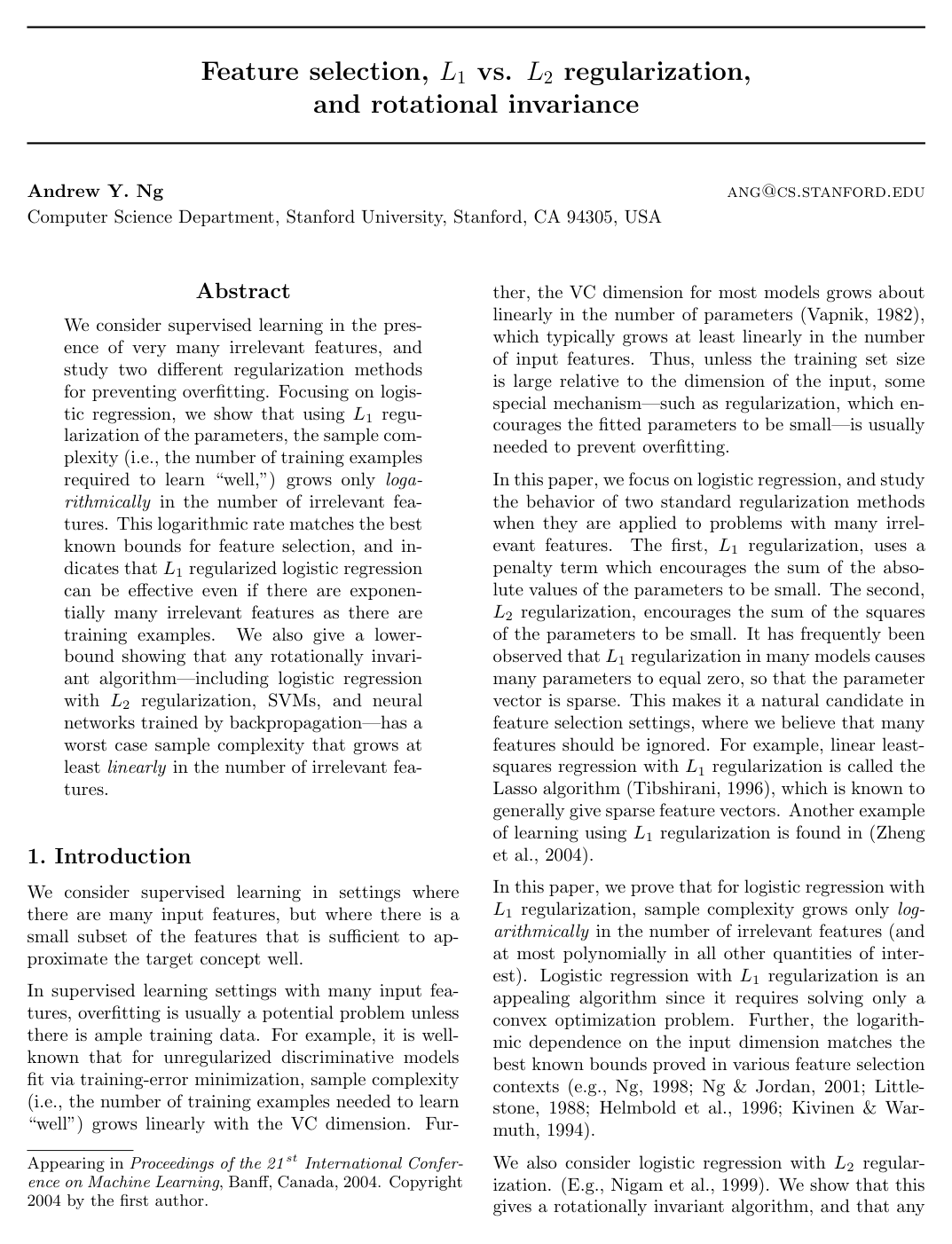
Feature selection, L1 vs. L2 regularization, and rotational invariance
Andrew Y. Ng
Why you should read this
Proves that L1-regularized logistic regression requires only logarithmically many training examples in the number of irrelevant features, whereas rotationally invariant methods like L2 regularization and SVMs suffer from sample complexity that scales at least linearly.
This document is a presentation slide deck and does not contain an abstract.
Added
2026-09-16
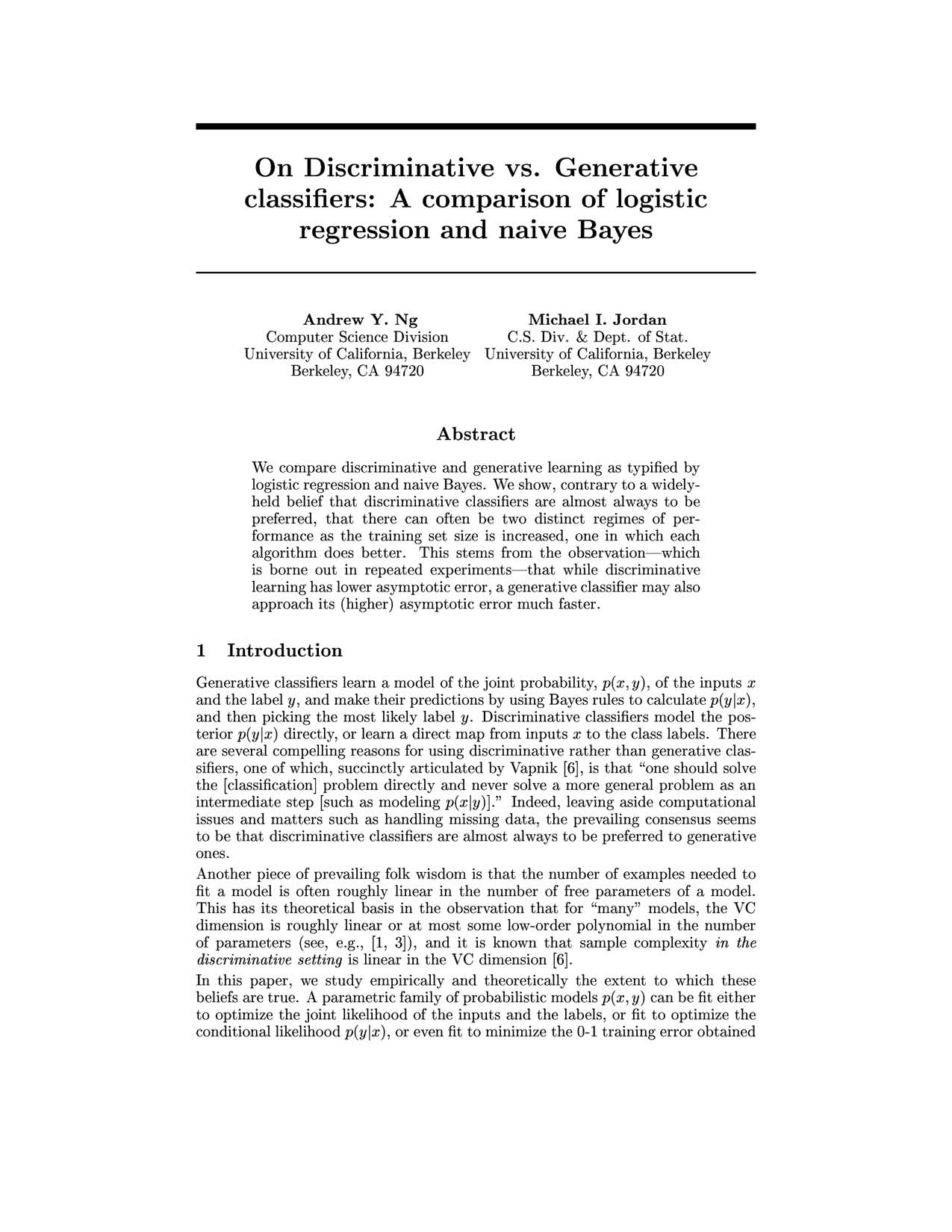
On Discriminative vs. Generative Classifiers: A comparison of logistic regression and naive Bayes
A. Ng, Michael I. Jordan
Why you should read this
Demonstrates that while discriminative classifiers achieve lower asymptotic error, generative models require only logarithmic sample complexity to approach their asymptotic performance, explaining why naive Bayes frequently outperforms logistic regression on smaller training sets.
We compare discriminative and generative learning as typified by logistic regression and naive Bayes. We show, contrary to a widely-held belief that discriminative classifiers are almost always to be preferred, that there can often be two distinct regimes of performance as the training set size is increased, one in which each algorithm does better. This stems from the observation—which is borne out in repeated experiments—that while discriminative learning has lower asymptotic error, a generative classifier may also approach its (higher) asymptotic error much faster.
Added
2026-09-14
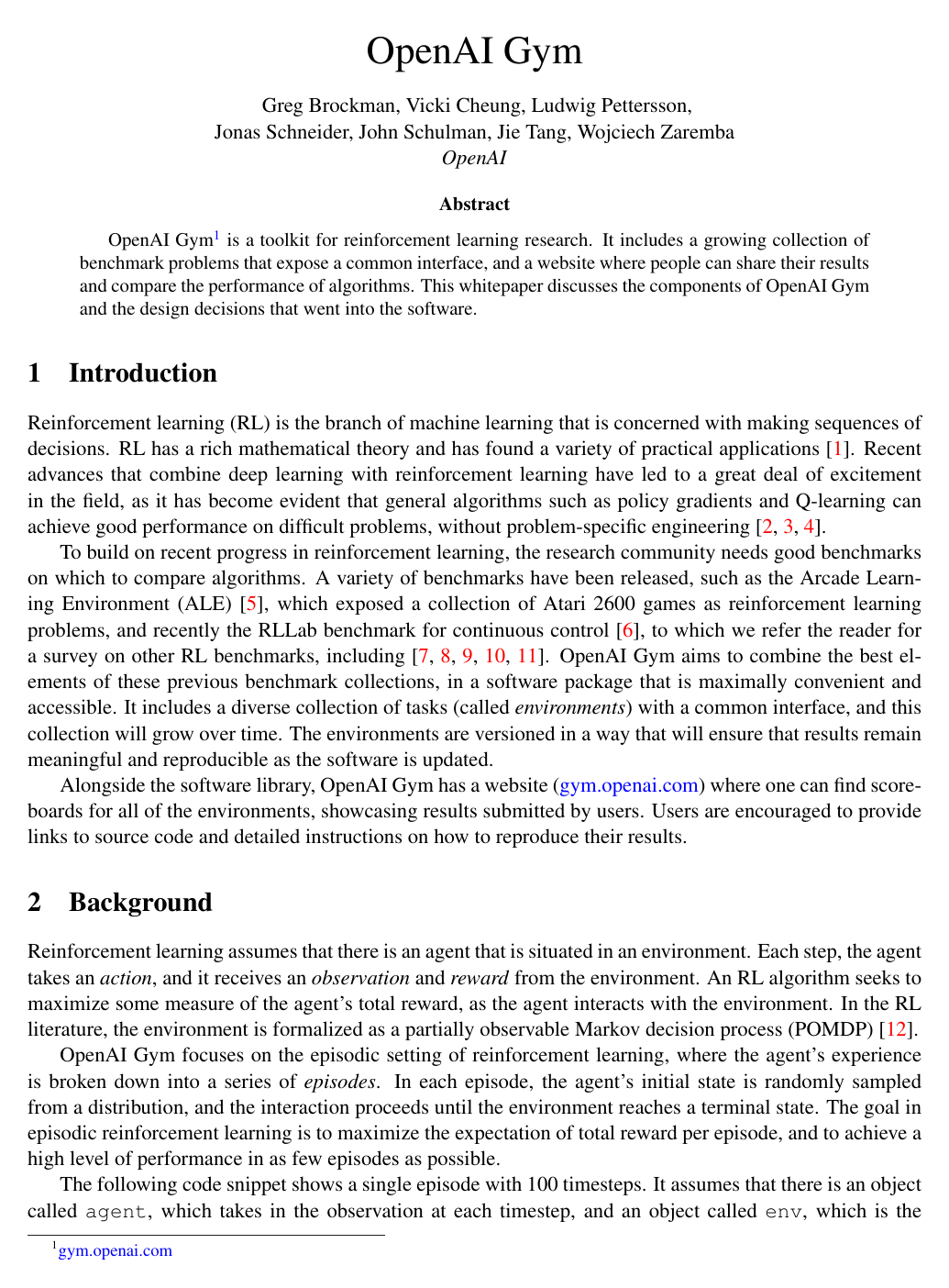
OpenAI Gym
Greg Brockman, Vicki Cheung, Ludwig Pettersson, Jonas Schneider, John Schulman, Jie Tang, Wojciech Zaremba
Why you should read this
Establishes a standardized interface across a diverse suite of simulation environments to enable reproducible benchmarking and direct performance comparisons for reinforcement learning algorithms.
OpenAI Gym is a toolkit for reinforcement learning research. It includes a growing collection of benchmark problems that expose a common interface, and a website where people can share their results and compare the performance of algorithms. This whitepaper discusses the components of OpenAI Gym and the design decisions that went into the software.
Added
2026-09-09
License
Published with permission