
keyword
risk minimization
Risk minimization is a fundamental principle in machine learning and statistical decision theory that aims to find a model or decision rule that minimizes expected loss, or statistical risk, across all potential data. In this framework, a loss function quantifies the error or penalty incurred when a model prediction deviates from the true outcome. Because the true underlying probability distribution of the data is typically unknown, learning algorithms frequently rely on empirical risk minimization, which approximates the expected risk by minimizing the average loss over an observed training dataset. To address computational challenges and prevent overfitting, practical approaches often optimize continuous surrogate loss functions and integrate regularization techniques, thereby ensuring that the resulting model generalizes effectively to unseen instances.
7 items
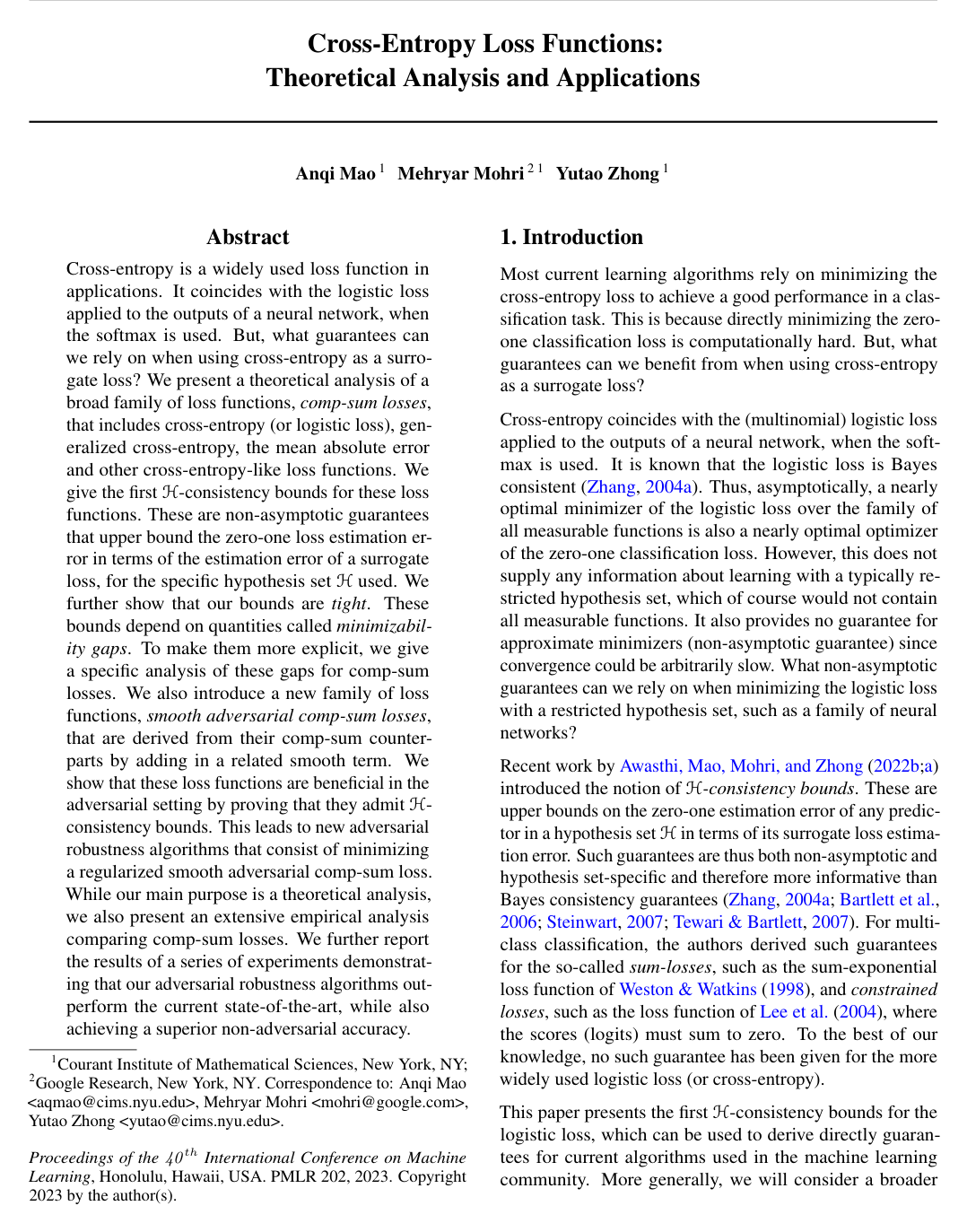
Cross-Entropy Loss Functions: Theoretical Analysis and Applications
Anqi Mao, Mehryar Mohri, Yutao Zhong
Why you should read this
Establishes the first tight non-asymptotic -consistency bounds for cross-entropy and general comp-sum loss functions, using these theoretical guarantees to develop new adversarial training objectives that improve defense against attacks without sacrificing standard accuracy.
Cross-entropy is a widely used loss function in applications. It coincides with the logistic loss applied to the outputs of a neural network, when the softmax is used. But, what guarantees can we rely on when using cross-entropy as a surrogate loss? We present a theoretical analysis of a broad family of loss functions, comp-sum losses, that includes cross-entropy (or logistic loss), generalized cross-entropy, the mean absolute error and other cross-entropy-like loss functions. We give the first -consistency bounds for these loss functions. These are non-asymptotic guarantees that upper bound the zero-one loss estimation error in terms of the estimation error of a surrogate loss, for the specific hypothesis set used. We further show that our bounds are tight. These bounds depend on quantities called minimizability gaps. To make them more explicit, we give a specific analysis of these gaps for comp-sum losses. We also introduce a new family of loss functions, smooth adversarial comp-sum losses, that are derived from their comp-sum counterparts by adding in a related smooth term. We show that these loss functions are beneficial in the adversarial setting by proving that they admit -consistency bounds. This leads to new adversarial robustness algorithms that consist of minimizing a regularized smooth adversarial comp-sum loss. While our main purpose is a theoretical analysis, we also present an extensive empirical analysis comparing comp-sum losses. We further report the results of a series of experiments demonstrating that our adversarial robustness algorithms outperform the current state-of-the-art, while also achieving a superior non-adversarial accuracy.
Added
2026-10-05
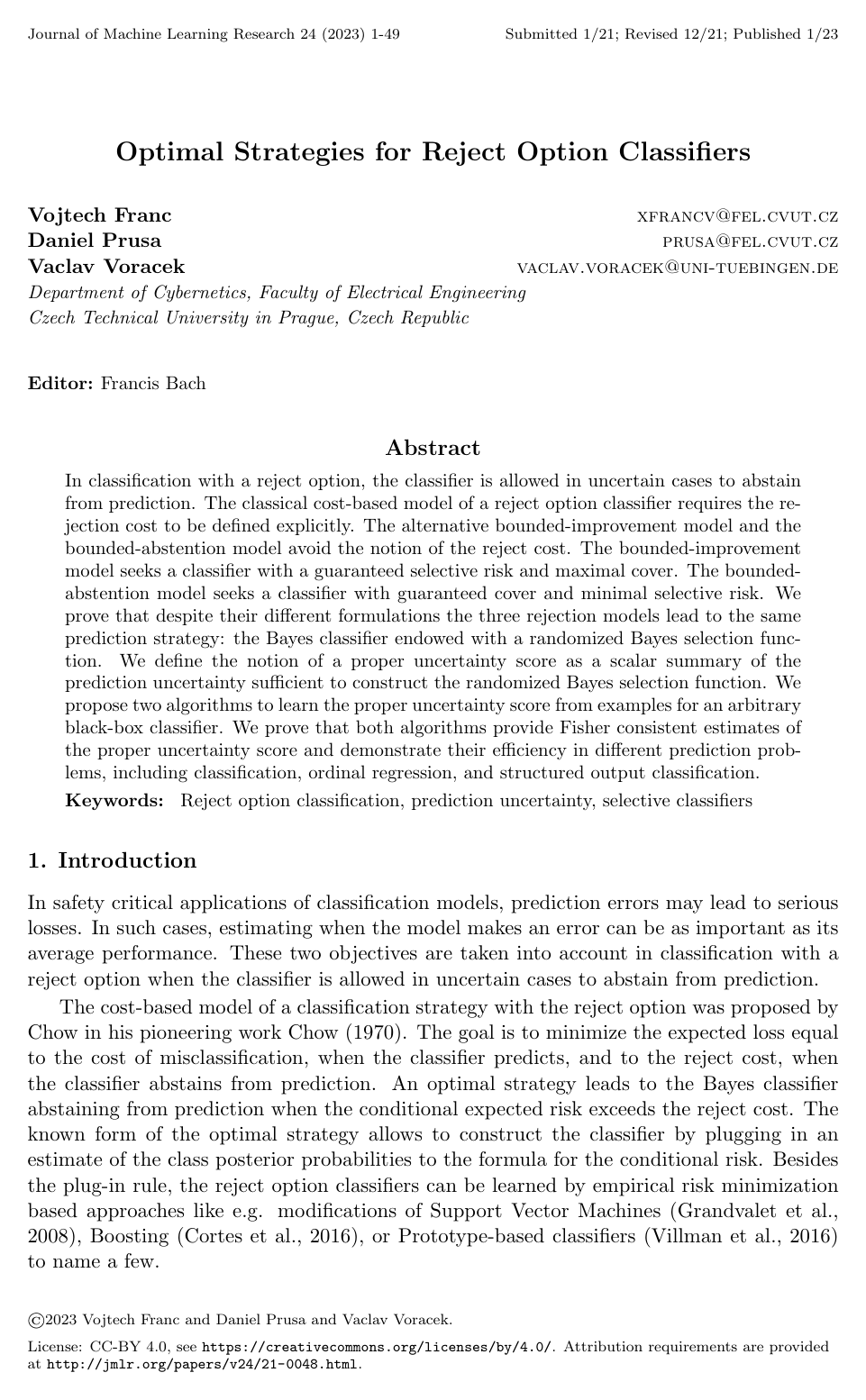
Optimal Strategies for Reject Option Classifiers
Vojtech Franc, Daniel Prusa, Václav Vorácek
Why you should read this
Unifies cost-based, bounded-improvement, and bounded-abstention selective classification models by proving they share the same optimal strategy, while developing two Fisher consistent algorithms to learn optimal rejection functions for arbitrary black-box classifiers across diverse prediction tasks.
In classification with a reject option, the classifier is allowed in uncertain cases to abstain from prediction. The classical cost-based model of a reject option classifier requires the rejection cost to be defined explicitly. The alternative bounded-improvement model and the bounded-abstention model avoid the notion of the reject cost. The bounded-improvement model seeks a classifier with a guaranteed selective risk and maximal cover. The bounded-abstention model seeks a classifier with guaranteed cover and minimal selective risk. We prove that despite their different formulations the three rejection models lead to the same prediction strategy: the Bayes classifier endowed with a randomized Bayes selection function. We define the notion of a proper uncertainty score as a scalar summary of the prediction uncertainty sufficient to construct the randomized Bayes selection function. We propose two algorithms to learn the proper uncertainty score from examples for an arbitrary black-box classifier. We prove that both algorithms provide Fisher consistent estimates of the proper uncertainty score and demonstrate their efficiency in different prediction problems, including classification, ordinal regression, and structured output classification.
Added
2026-09-26
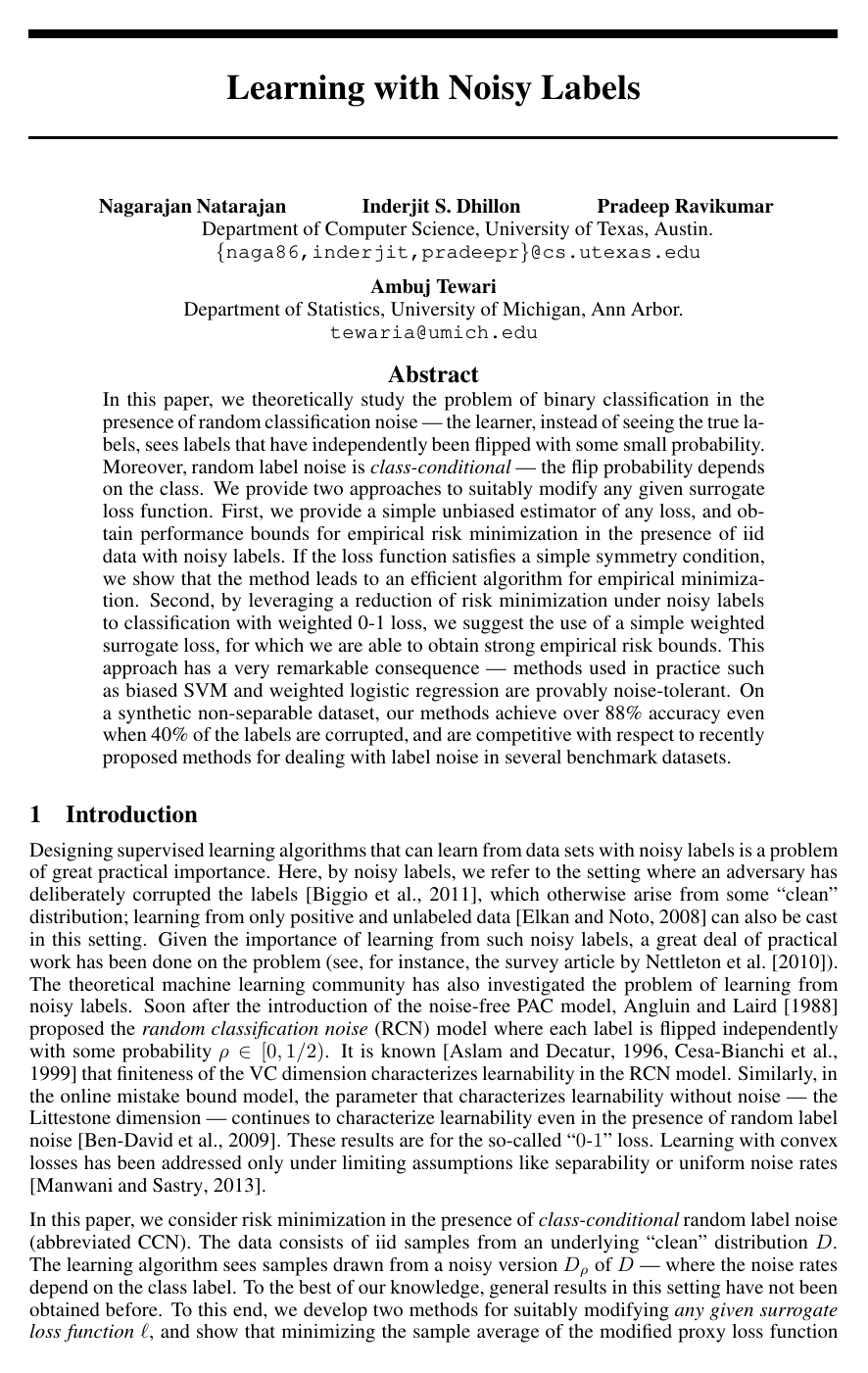
Learning with Noisy Labels
Nagarajan Natarajan, I. Dhillon, Pradeep Ravikumar, Ambuj Tewari
Why you should read this
Establishes theoretical guarantees and practical surrogate loss modifications that enable standard classifiers like biased support vector machines and weighted logistic regression to learn effectively from class-conditional noisy labels.
In this paper, we theoretically study the problem of binary classification in the presence of random classification noise — the learner, instead of seeing the true labels, sees labels that have independently been flipped with some small probability. Moreover, random label noise is class-conditional — the flip probability depends on the class. We provide two approaches to suitably modify any given surrogate loss function. First, we provide a simple unbiased estimator of any loss, and obtain performance bounds for empirical risk minimization in the presence of iid data with noisy labels. If the loss function satisfies a simple symmetry condition, we show that the method leads to an efficient algorithm for empirical minimization. Second, by leveraging a reduction of risk minimization under noisy labels to classification with weighted 0-1 loss, we suggest the use of a simple weighted surrogate loss, for which we are able to obtain strong empirical risk bounds. This approach has a very remarkable consequence — methods used in practice such as biased SVM and weighted logistic regression are provably noise-tolerant. On a synthetic non-separable dataset, our methods achieve over 88% accuracy even when 40% of the labels are corrupted, and are competitive with respect to recently proposed methods for dealing with label noise in several benchmark datasets.
Added
2026-09-25
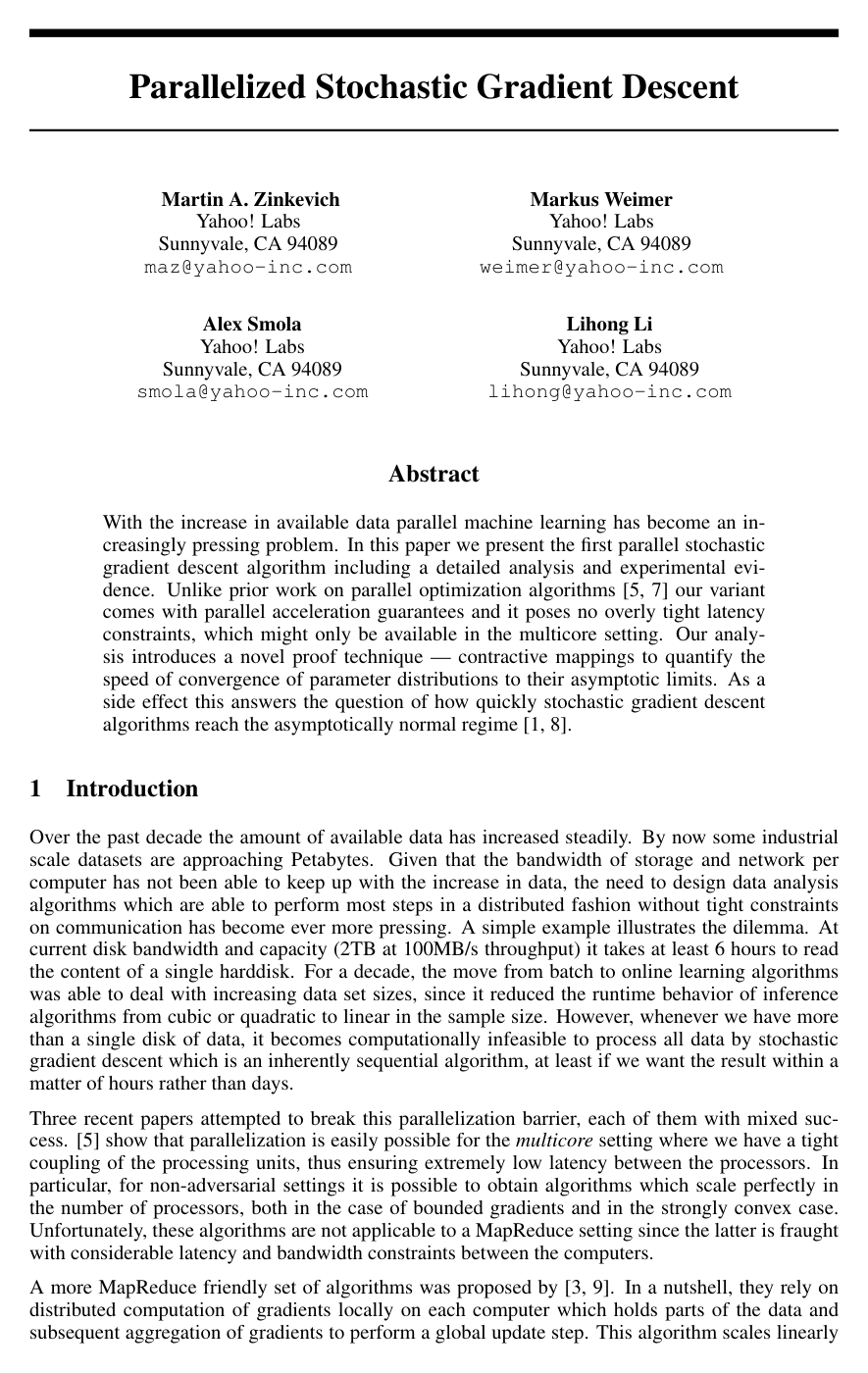
Parallelized Stochastic Gradient Descent
Martin A. Zinkevich, Markus Weimer, Alex Smola, Lihong Li
Why you should read this
Presents a parallel stochastic gradient descent algorithm with theoretical acceleration guarantees and minimal communication overhead, proving via contractive mappings how parameter averaging across distributed machines achieves fast convergence for large-scale learning.
With the increase in available data parallel machine learning has become an increasingly pressing problem. In this paper we present the first parallel stochastic gradient descent algorithm including a detailed analysis and experimental evidence. Unlike prior work on parallel optimization algorithms [5, 7] our variant comes with parallel acceleration guarantees and it poses no overly tight latency constraints, which might only be available in the multicore setting. Our analysis introduces a novel proof technique — contractive mappings to quantify the speed of convergence of parameter distributions to their asymptotic limits. As a side effect this answers the question of how quickly stochastic gradient descent algorithms reach the asymptotically normal regime [1, 8].
Added
2026-09-25
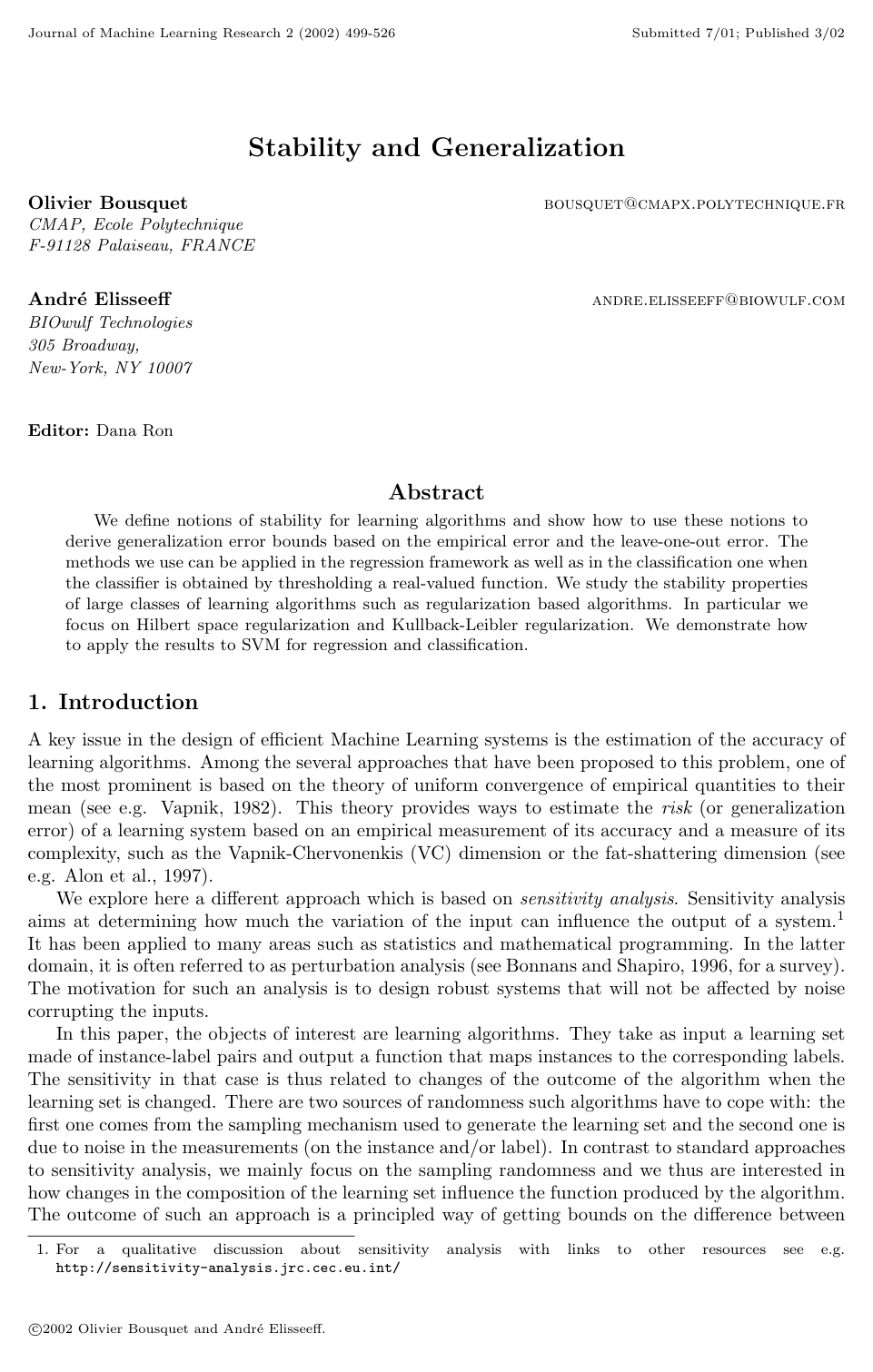
Stability and Generalization
Olivier Bousquet, André Elisseeff
Why you should read this
Establishes an algorithmic stability framework that uses concentration inequalities to derive tight generalization error bounds for regularized learning methods like support vector machines without relying on standard uniform convergence or VC-dimension arguments.
We define notions of stability for learning algorithms and show how to use these notions to derive generalization error bounds based on the empirical error and the leave-one-out error. The methods we use can be applied in the regression framework as well as in the classification one when the classifier is obtained by thresholding a real-valued function. We study the stability properties of large classes of learning algorithms such as regularization based algorithms. In particular we focus on Hilbert space regularization and Kullback-Leibler regularization. We demonstrate how to apply the results to SVM for regression and classification.
Added
2026-09-16
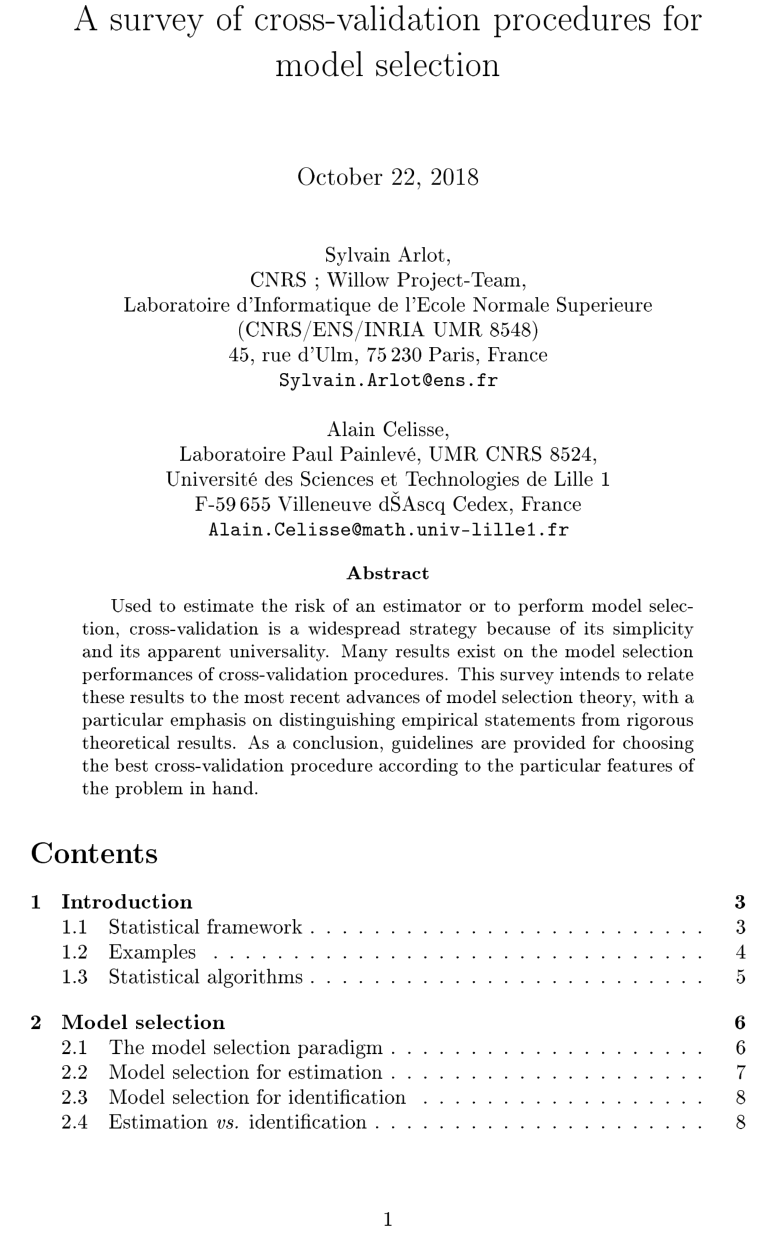
A survey of cross-validation procedures for model selection
Sylvain Arlot, Alain Celisse
Why you should read this
Synthesizes theoretical guarantees and empirical properties of cross-validation methods, providing practical guidelines for selecting the best validation strategy based on specific data and modeling constraints.
Used to estimate the risk of an estimator or to perform model selection, cross-validation is a widespread strategy because of its simplicity and its apparent universality. Many results exist on the model selection performances of cross-validation procedures. This survey intends to relate these results to the most recent advances of model selection theory, with a particular emphasis on distinguishing empirical statements from rigorous theoretical results. As a conclusion, guidelines are provided for choosing the best cross-validation procedure according to the particular features of the problem in hand.
Added
2026-09-11
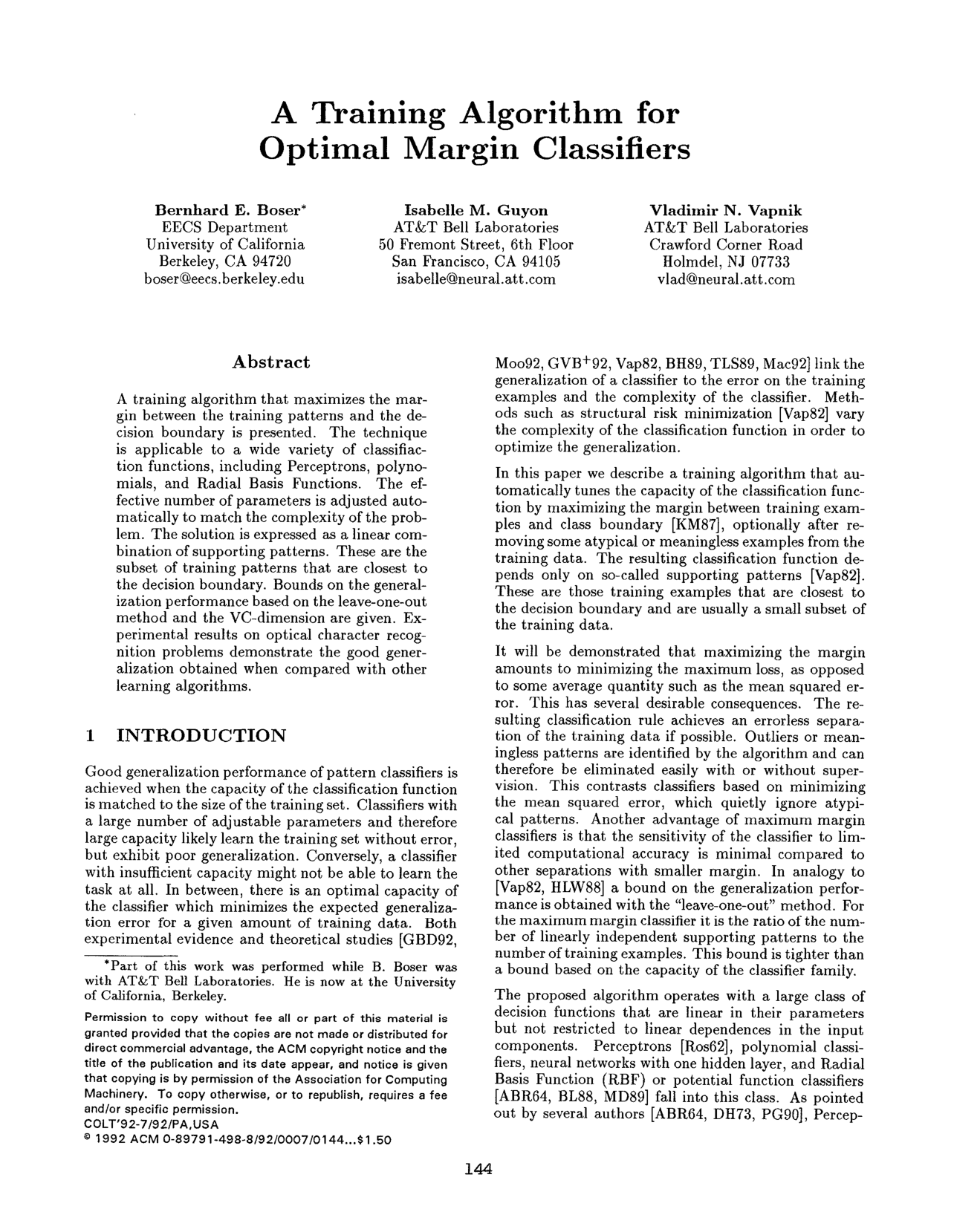
A training algorithm for optimal margin classifiers
Bernhard E. Boser, Isabelle M. Guyon, Vladimir N. Vapnik
Why you should read this
Introduces the foundation of Support Vector Machines by integrating non-linear kernel functions with maximum-margin hyperplanes, enabling efficient classification with strong theoretical generalization bounds.
A training algorithm that maximizes the margin between the training patterns and the decision boundary is presented. The technique is applicable to a wide variety of classification functions, including Perceptrons, polynomials, and Radial Basis Functions. The effective number of parameters is adjusted automatically to match the complexity of the problem. The solution is expressed as a linear combination of supporting patterns. These are the subset of training patterns that are closest to the decision boundary. Bounds on the generalization performance based on the leave-one-out method and the VC-dimension are given. Experimental results on optical character recognition problems demonstrate the good generalization obtained when compared with other learning algorithms.
Added
2026-09-06