
keyword
reward model
A reward model is a machine learning model that evaluates generated outputs and assigns a numerical score reflecting their quality, correctness, or alignment with specific goals and human preferences. Typically trained on comparison data where human annotators or automated systems rank alternative responses, the model learns to capture complex, nuanced criteria such as helpfulness, safety, and logical coherence that are difficult to specify using explicit mathematical rules. In reinforcement learning workflows, particularly for language and generative models, the reward model acts as an objective function, providing the scalar or step-by-step feedback necessary for policy optimization algorithms and test-time ranking methods to guide an agent toward producing more desirable behavior.
17 items
The RL/LLM Taxonomy Tree: Reviewing Synergies Between Reinforcement Learning and Large Language Models
Moschoula Pternea, Prerna Singh, Abir Chakraborty, Yagna D. Oruganti, Mirco Milletarí, Sayli Bapat, Kebei Jiang
Why you should read this
Establishes a three-part taxonomy classifying how reinforcement learning and large language models combine across model tuning, agent training, and joint planning systems while identifying current technical limitations and future research directions.
In this work, we review research studies that combine Reinforcement Learning (RL) and Large Language Models (LLMs), two areas that owe their momentum to the development of deep neural networks. We propose a novel taxonomy of three main classes based on the way that the two model types interact with each other. The first class, RL4LLM, includes studies where RL is leveraged to improve the performance of LLMs on tasks related to Natural Language Processing. L4LLM is divided into two sub-categories depending on whether RL is used to directly fine-tune an existing LLM or to improve the prompt of the LLM. In the second class, LLM4RL, an LLM assists the training of an RL model that performs a task that is not inherently related to natural language. We further break down LLM4RL based on the component of the RL training framework that the LLM assists or replaces, namely reward shaping, goal generation, and policy function. Finally, in the third class, RL+LLM, an LLM and an RL agent are embedded in a common planning framework without either of them contributing to training or fine-tuning of the other. We further branch this class to distinguish between studies with and without natural language feedback. We use this taxonomy to explore the motivations behind the synergy of LLMs and RL and explain the reasons for its success, while pinpointing potential shortcomings and areas where further research is needed, as well as alternative methodologies that serve the same goal.
Added
2026-10-05
AlpacaFarm: A Simulation Framework for Methods that Learn from Human Feedback
Yann Dubois, Chen Xuechen Li, Rohan Taori, Tianyi Zhang, Ishaan Gulrajani, Jimmy Ba, Carlos Guestrin, Percy Liang, Tatsunori B. Hashimoto
Why you should read this
Introduces a simulation framework that reduces the cost of feedback-based language model training by fifty times using validated model-generated feedback, offering reliable automated evaluation and benchmark reference implementations for methods like PPO and DPO.
Large language models (LLMs) such as ChatGPT have seen widespread adoption due to their strong instruction-following abilities. Developing these LLMs involves a complex yet poorly understood workflow requiring training with human feedback. Replicating and understanding this instruction-following requires tackling three major challenges: the high cost of data collection, the lack of trustworthy evaluation, and the absence of reference method implementations. We address these challenges with AlpacaFarm, a simulator that enables research and development for learning from feedback at a low cost. First, we design LLM prompts to simulate human feedback that are 50x cheaper than crowdworkers and display high agreement with humans. Second, we propose an automatic evaluation and validate it against human instructions obtained on real-world interactions. Third, we contribute reference implementations for several methods (PPO, DPO, best-of-n, expert iteration, and more) that learn from pairwise feedback. Finally, as an end-to-end validation of AlpacaFarm, we train and evaluate eleven models on 10k pairs of real human feedback and show that rankings of models trained in AlpacaFarm match rankings of models trained on human data. As a demonstration of the research possible in AlpacaFarm, we find that methods that use a reward model can substantially improve over supervised fine-tuning and that our reference PPO implementation leads to a +10% improvement in win-rate against Davinci003. We release all components of AlpacaFarm at this https URL.
Added
2026-10-05
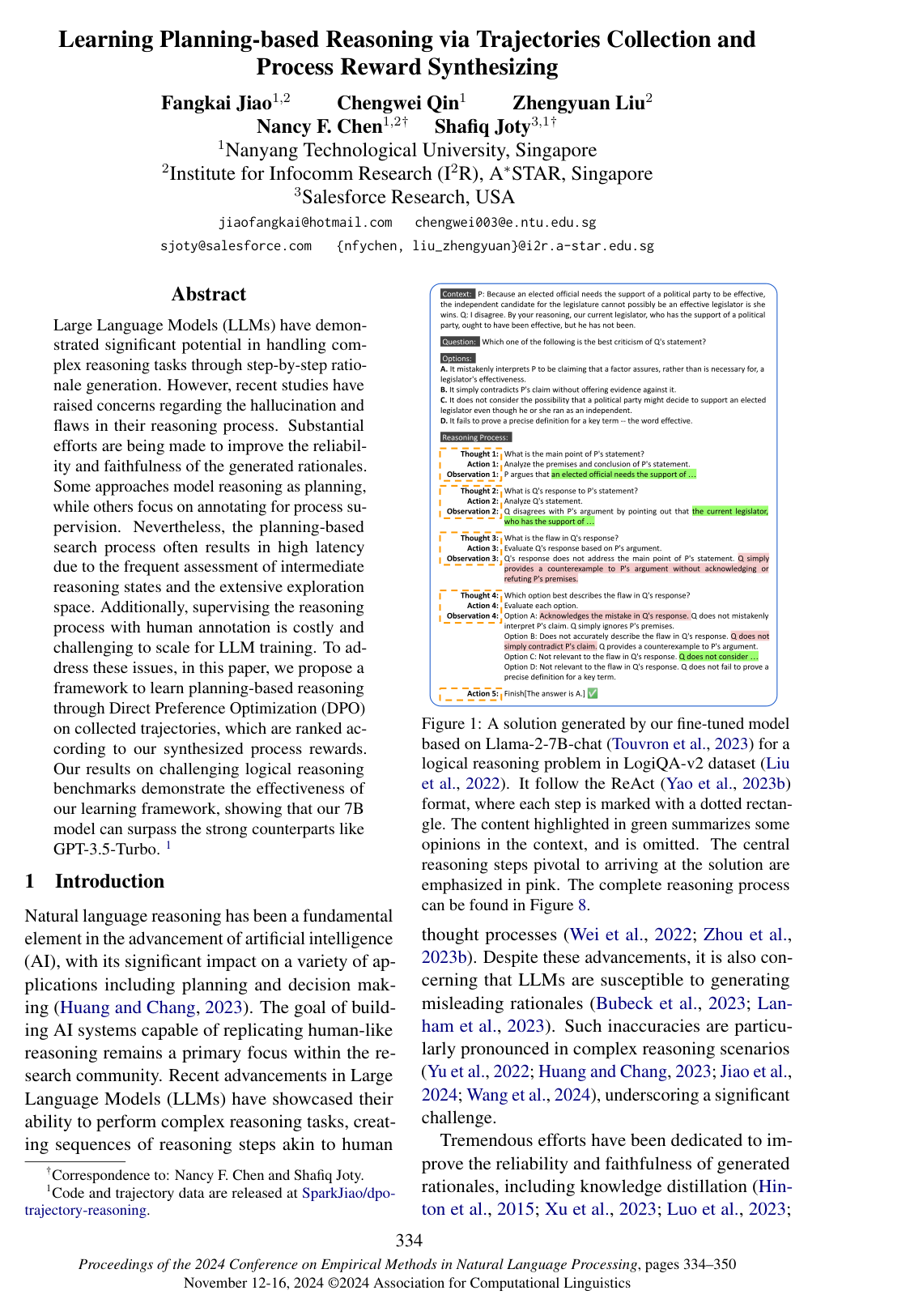
Learning Planning-based Reasoning by Trajectories Collection and Process Reward Synthesizing
Fangkai Jiao, Chengwei Qin, Zhengyuan Liu, Nancy F. Chen, Shafiq Joty
Why you should read this
Develops a framework that synthesizes step-level process rewards from offline outcome simulations and trains 7B models via Direct Preference Optimization, enabling them to outperform GPT-3.5-Turbo on complex logical reasoning without expensive human supervision or high-latency search algorithms.
Large Language Models (LLMs) have demonstrated significant potential in handling complex reasoning tasks through step-by-step rationale generation. However, recent studies have raised concerns regarding the hallucination and flaws in their reasoning process. Substantial efforts are being made to improve the reliability and faithfulness of the generated rationales. Some approaches model reasoning as planning, while others focus on annotating for process supervision. Nevertheless, the planning-based search process often results in high latency due to the frequent assessment of intermediate reasoning states and the extensive exploration space. Additionally, supervising the reasoning process with human annotation is costly and challenging to scale for LLM training. To address these issues, in this paper, we propose a framework to learn planning-based reasoning through Direct Preference Optimization (DPO) on collected trajectories, which are ranked according to our synthesized process rewards. Our results on challenging logical reasoning benchmarks demonstrate the effectiveness of our learning framework, showing that our 7B model can surpass the strong counterparts like GPT-3.5-Turbo.
Added
2026-10-03
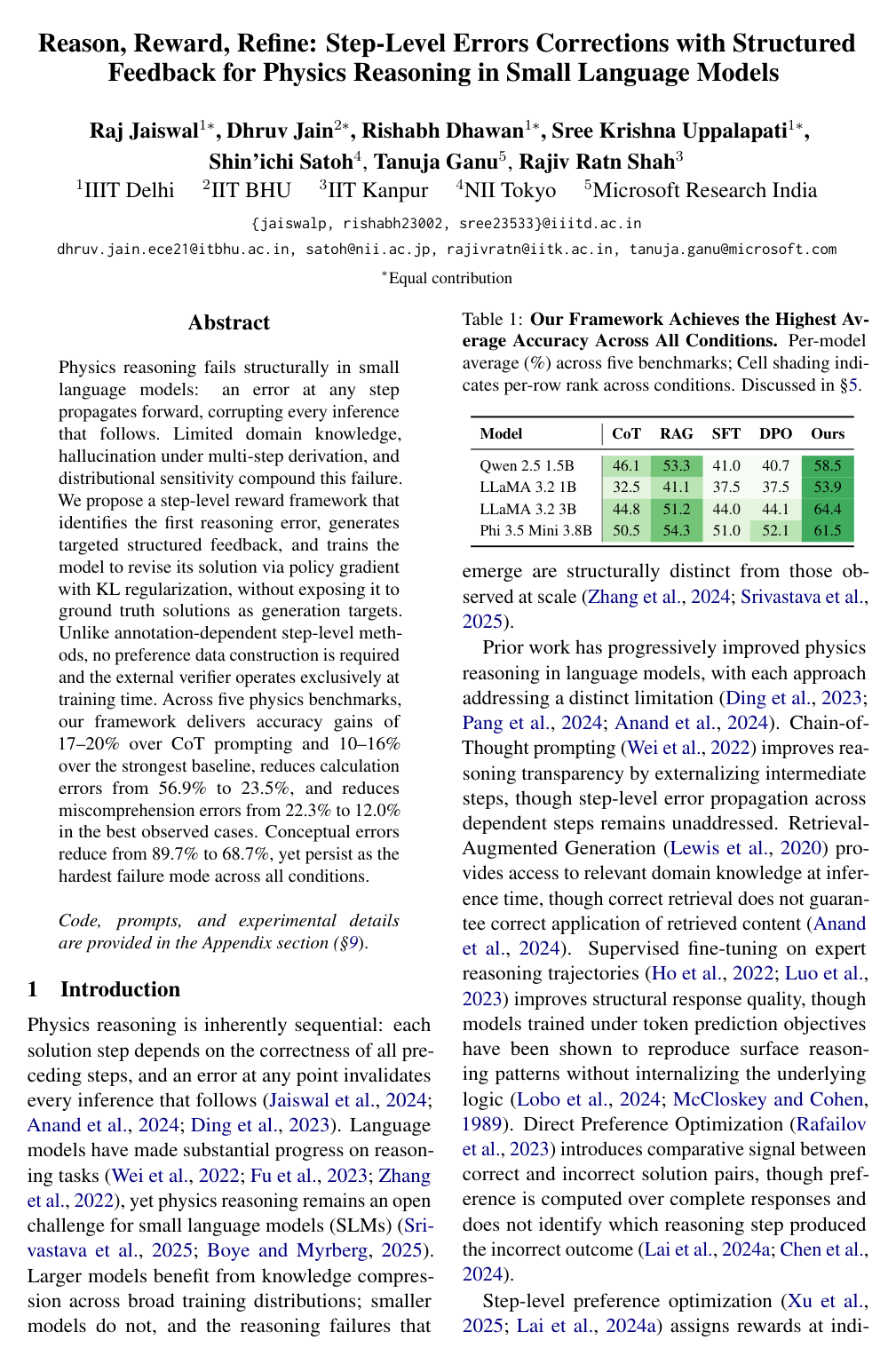
Reason, Reward, Refine: Step-Level Errors Corrections with Structured Feedback for Physics Reasoning in Small Language Models
Raj Jaiswal, Dhruv Jain, Rishabh Dhawan, Sree Krishna Uppalapati, Shin'ichi Satoh, Tanuja Ganu, Rajiv Ratn Shah
Why you should read this
Proposes a step-level reinforcement learning framework that trains small language models to correct multi-step physics derivation errors using structured feedback, achieving up to 20% accuracy gains across five benchmarks without requiring human preference data or test-time verifiers.
Physics reasoning fails structurally in small language models: an error at any step propagates forward, corrupting every inference that follows. Limited domain knowledge, hallucination under multi-step derivation, and distributional sensitivity compound this failure. We propose a step-level reward framework that identifies the first reasoning error, generates targeted structured feedback, and trains the model to revise its solution via policy gradient with KL regularization, without exposing it to ground truth solutions as generation targets. Unlike annotation-dependent step-level methods, no preference data construction is required and the external verifier operates exclusively at training time. Across five physics benchmarks, our framework delivers accuracy gains of 17-20% over CoT prompting and 10-16% over the strongest baseline, reduces calculation errors from 56.9% to 23.5%, and reduces miscomprehension errors from 22.3% to 12.0% in the best observed cases. Conceptual errors reduce from 89.7% to 68.7%, yet persist as the hardest failure mode across all conditions.
Added
2026-09-29
STRIVE: Structured Spatiotemporal Exploration for Reinforcement Learning in Video Question Answering
Emad Bahrami, Olga Zatsarynna, Parth Pathak, Sunando Sengupta, Juergen Gall, Mohsen Fayyaz
Why you should read this
Introduces STRIVE, a reinforcement learning framework that resolves weak policy optimization in video question answering by jointly evaluating generated text alongside importance-sampled visual variants to enrich reward signals across multimodal reasoning benchmarks.
We introduce STRIVE (SpatioTemporal Reinforcement with Importance-aware Variant Exploration), a structured reinforcement learning framework for video question answering. While group-based policy optimization methods have shown promise in large multimodal models, they often suffer from low reward variance when responses exhibit similar correctness, leading to weak or unstable advantage estimates. STRIVE addresses this limitation by constructing multiple spatiotemporal variants of each input video and performing joint normalization across both textual generations and visual variants. By expanding group comparisons beyond linguistic diversity to structured visual perturbations, STRIVE enriches reward signals and promotes more stable and informative policy updates. To ensure exploration remains semantically grounded, we introduce an importance-aware sampling mechanism that prioritizes frames most relevant to the input question while preserving temporal coverage. This design encourages robust reasoning across complementary visual perspectives rather than overfitting to a single spatiotemporal configuration. Experiments on six challenging video reasoning benchmarks including VideoMME, TempCompass, VideoMMMU, MMVU, VSI-Bench, and PerceptionTest demonstrate consistent improvements over strong reinforcement learning baselines across multiple large multimodal models. Our results highlight the role of structured spatiotemporal exploration as a principled mechanism for stabilizing multimodal reinforcement learning and improving video reasoning performance.
Added
2026-09-29
Training Emergent Joint Associations: A Reinforcement Learning Approach to Creative Thinking in Language Models
Mukul Singh, Ananya Singha, Aishni Parab, Pronita Mehrotra, Sumit Gulwani
Why you should read this
Demonstrates that training language models with reinforcement learning guided by cognitive associative thinking metrics improves their capacity for novel connections, abstraction, and problem-solving across creative writing, programming, and data visualization.
Associative thinking--the ability to connect seemingly unrelated ideas--is a foundational element of human creativity and problem-solving. This paper explores whether reinforcement learning (RL) guided by associative thinking principles can enhance a model's performance across diverse generative tasks, including story writing, code generation, and chart creation. We introduce a reinforcement learning framework that uses a prompt-based evaluation mechanism, incorporating established divergent thinking metrics from creativity research. A base language model is fine-tuned using this framework to reward outputs demonstrating higher novelty through higher degrees of conceptual connectivity. Interestingly, the experimental results suggest that RL-based associative thinking-trained models not only generate more original and coherent stories but also exhibit improved abstraction and flexibility in tasks such as programming and data visualization. Our findings provide initial evidence that modeling cognitive creativity principles through reinforcement learning can yield more adaptive and generative AI.
Added
2026-09-29
Principled Reinforcement Learning with Human Feedback from Pairwise or K-wise Comparisons
Banghua Zhu, Michael I. Jordan, Jiantao Jiao
Why you should read this
Establishes a theoretical foundation for reinforcement learning with human feedback, proving why standard maximum likelihood reward estimation fails during policy optimization, how pessimistic estimation fixes this failure, and deriving the first sample complexity bound for maximum-entropy inverse reinforcement learning.
We provide a theoretical framework for Reinforcement Learning with Human Feedback (RLHF). Our analysis shows that when the true reward function is linear, the widely used maximum likelihood estimator (MLE) converges under both the Bradley-Terry-Luce (BTL) model and the Plackett-Luce (PL) model. However, we show that when training a policy based on the learned reward model, MLE fails while a pessimistic MLE provides policies with improved performance under certain coverage assumptions. Additionally, we demonstrate that under the PL model, the true MLE and an alternative MLE that splits the -wise comparison into pairwise comparisons both converge. Moreover, the true MLE is asymptotically more efficient. Our results validate the empirical success of existing RLHF algorithms in InstructGPT and provide new insights for algorithm design. Furthermore, our results unify the problem of RLHF and max-entropy Inverse Reinforcement Learning (IRL), and provide the first sample complexity bound for max-entropy IRL.
Added
2026-09-28
Safe RLHF: Safe Reinforcement Learning from Human Feedback
Josef Dai, Xuehai Pan, Ruiyang Sun, Jiaming Ji, Xinbo Xu, Mickel Liu, Yizhou Wang, Yaodong Yang
Why you should read this
Introduces a constrained reinforcement learning framework that separates human feedback on helpfulness and safety into distinct reward and cost models, enabling language models to satisfy strict safety limits without degrading response quality.
With the development of large language models (LLMs), striking a balance between the performance and safety of AI systems has never been more critical. However, the inherent tension between the objectives of helpfulness and harmlessness presents a significant challenge during LLM training. To address this issue, we propose Safe Reinforcement Learning from Human Feedback (Safe RLHF), a novel algorithm for human value alignment. Safe RLHF explicitly decouples human preferences regarding helpfulness and harmlessness, effectively avoiding the crowdworkers' confusion about the tension and allowing us to train separate reward and cost models. We formalize the safety concern of LLMs as an optimization task of maximizing the reward function while satisfying specified cost constraints. Leveraging the Lagrangian method to solve this constrained problem, Safe RLHF dynamically adjusts the balance between the two objectives during fine-tuning. Through a three-round fine-tuning using Safe RLHF, we demonstrate a superior ability to mitigate harmful responses while enhancing model performance compared to existing value-aligned algorithms. Experimentally, we fine-tuned the Alpaca-7B using Safe RLHF and aligned it with collected human preferences, significantly improving its helpfulness and harmlessness according to human evaluations.
Added
2026-09-26
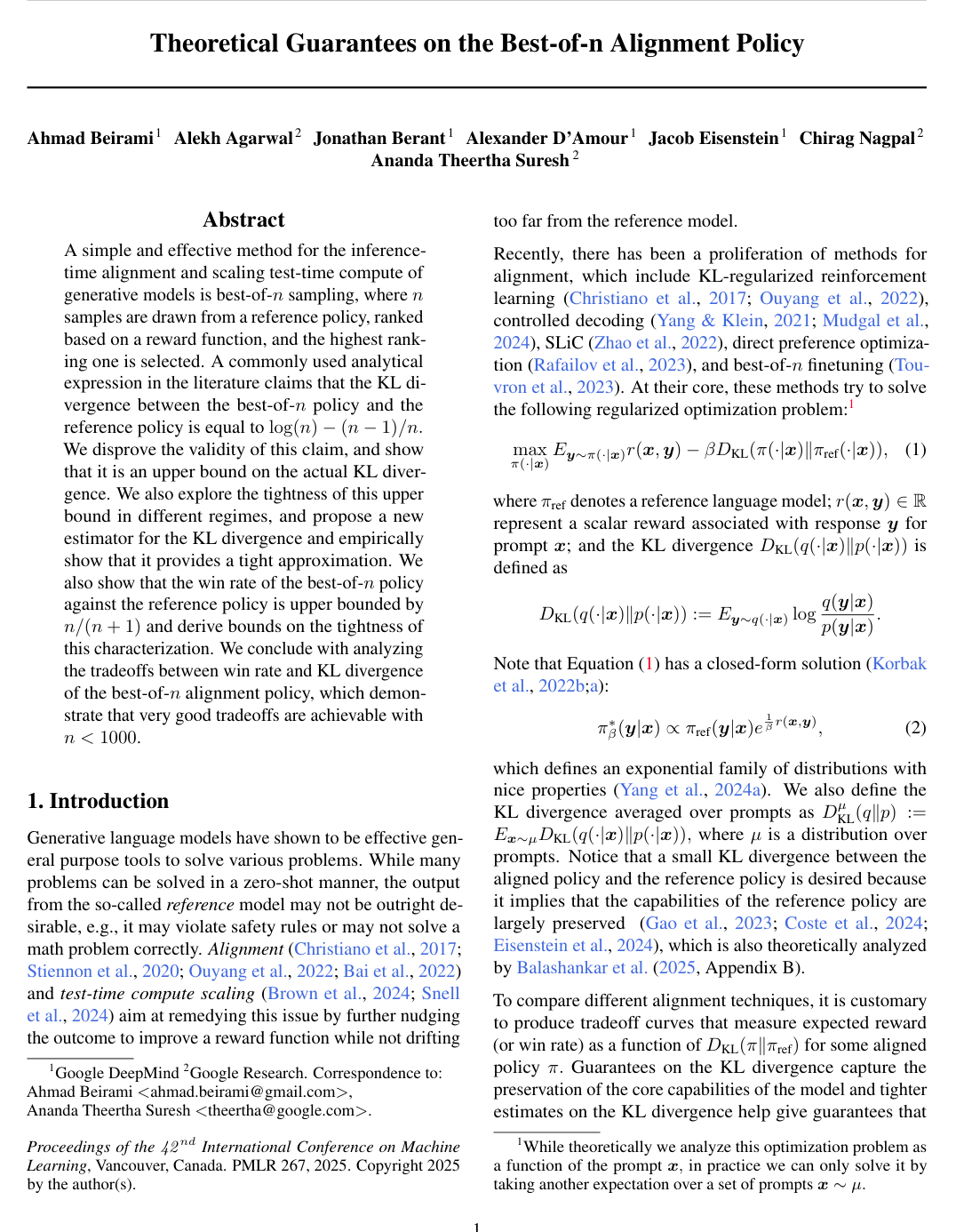
Theoretical guarantees on the best-of-n alignment policy
Ahmad Beirami, Alekh Agarwal, Jonathan Berant, Alexander Nicholas D'Amour, Jacob Eisenstein, Chirag Nagpal, Ananda Theertha Suresh
Why you should read this
Establishes rigorous theoretical guarantees for best-of-n alignment sampling by disproving a widely used closed-form KL divergence formula, bounding policy drift and win rates, and introducing a tighter KL estimator to guide test-time compute scaling.
A simple and effective method for the inference-time alignment and scaling test-time compute of generative models is best-of-n sampling, where n samples are drawn from a reference policy, ranked based on a reward function, and the highest ranking one is selected. A commonly used analytical expression in the literature claims that the KL divergence between the best-of-n policy and the reference policy is equal to log(n) − (n − 1)/n. We disprove the validity of this claim, and show that it is an upper bound on the actual KL divergence. We also explore the tightness of this upper bound in different regimes, and propose a new estimator for the KL divergence and empirically show that it provides a tight approximation. We also show that the win rate of the best-of-n policy against the reference policy is upper bounded by n/(n + 1) and derive bounds on the tightness of this characterization. We conclude with analyzing the tradeoffs between win rate and KL divergence of the best-of-n alignment policy, which demonstrate that very good tradeoffs are achievable with n < 1000.
Added
2026-09-26
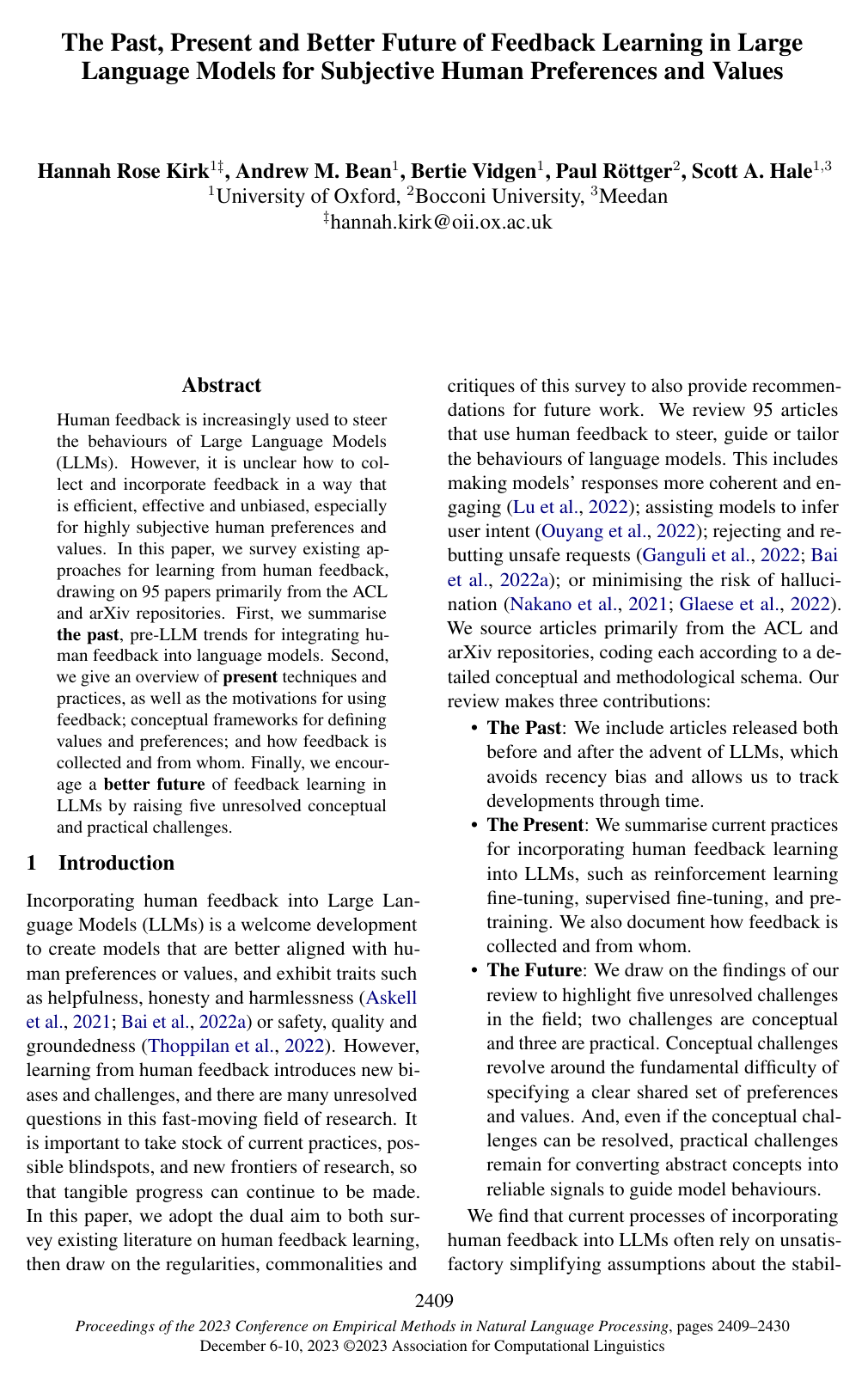
The Past, Present and Better Future of Feedback Learning in Large Language Models for Subjective Human Preferences and Values
Hannah Kirk, Andrew M. Bean, Bertie Vidgen, Paul Röttger, Scott Hale
Why you should read this
Systematizes the evolution of human feedback learning across 95 studies to identify critical conceptual and practical challenges in aligning language models with subjective preferences and values.
Human feedback is increasingly used to steer the behaviours of Large Language Models (LLMs). However, it is unclear how to collect and incorporate feedback in a way that is efficient, effective and unbiased, especially for highly subjective human preferences and values. In this paper, we survey existing approaches for learning from human feedback, drawing on 95 papers primarily from the ACL and arXiv repositories. First, we summarise the past, pre-LLM trends for integrating human feedback into language models. Second, we give an overview of present techniques and practices, as well as the motivations for using feedback; conceptual frameworks for defining values and preferences; and how feedback is collected and from whom. Finally, we encourage a better future of feedback learning in LLMs by raising five unresolved conceptual and practical challenges.
Added
2026-09-26
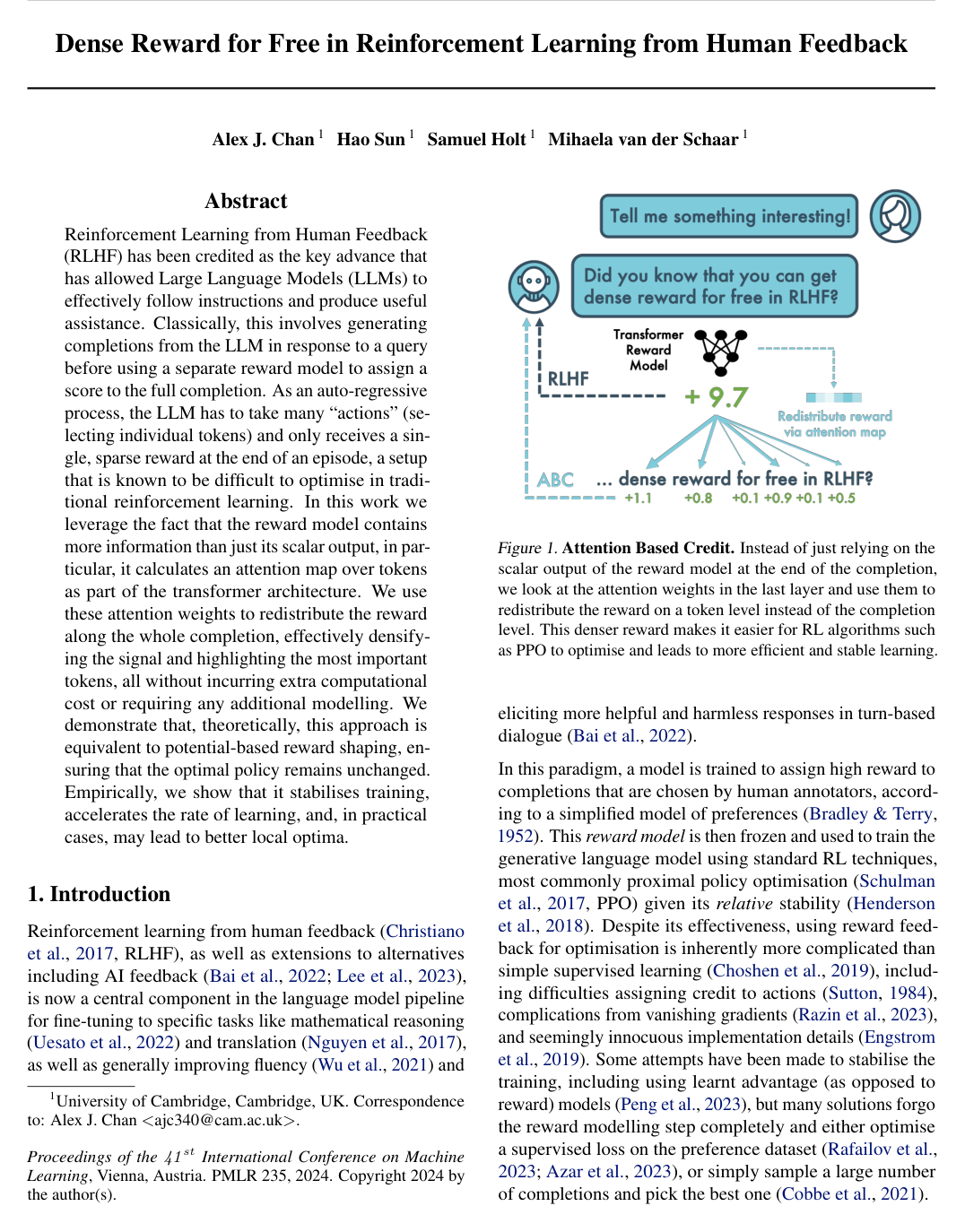
Dense Reward for Free in Reinforcement Learning from Human Feedback
Alex James Chan, Hao Sun, Samuel Holt, Mihaela van der Schaar
Why you should read this
Introduces Attention Based Credit, a method that uses the reward model's internal attention weights to convert sparse sequence-level feedback into dense, token-level rewards without additional training, accelerating RLHF convergence while theoretically preserving the optimal policy.
Reinforcement Learning from Human Feedback (RLHF) has been credited as the key advance that has allowed Large Language Models (LLMs) to effectively follow instructions and produce useful assistance. Classically, this involves generating completions from the LLM in response to a query before using a separate reward model to assign a score to the full completion. As an auto-regressive process, the LLM has to take many “actions” (selecting individual tokens) and only receives a single, sparse reward at the end of an episode, a setup that is known to be difficult to optimise in traditional reinforcement learning. In this work we leverage the fact that the reward model contains more information than just its scalar output, in particular, it calculates an attention map over tokens as part of the transformer architecture. We use these attention weights to redistribute the reward along the whole completion, effectively densifying the signal and highlighting the most important tokens, all without incurring extra computational cost or requiring any additional modelling. We demonstrate that, theoretically, this approach is equivalent to potential-based reward shaping, ensuring that the optimal policy remains unchanged. Empirically, we show that it stabilises training, accelerates the rate of learning, and, in practical cases, may lead to better local optima.
Added
2026-09-26
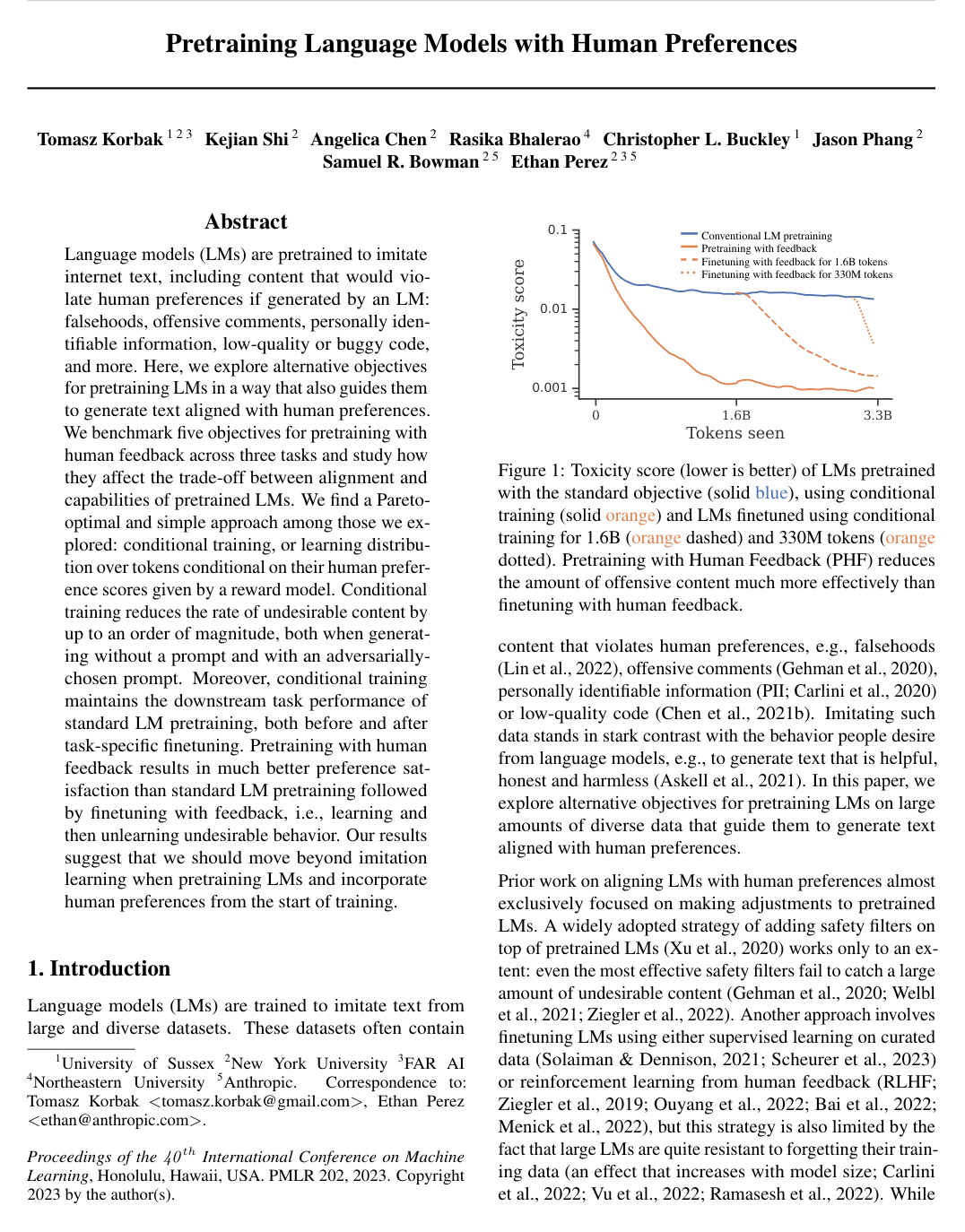
Pretraining Language Models with Human Preferences
Tomasz Korbak, Kejian Shi, Angelica Chen, Rasika Vinayak Bhalerao, Christopher L. Buckley, Jason Phang, Samuel R. Bowman, Ethan Perez
Why you should read this
Demonstrates that integrating human preferences directly into language model pretraining via conditional training reduces undesirable outputs by up to an order of magnitude while preserving downstream capabilities, outperforming the standard pipeline of pretraining followed by post-hoc alignment fine-tuning.
Language models (LMs) are pretrained to imitate internet text, including content that would violate human preferences if generated by an LM: falsehoods, offensive comments, personally identifiable information, low-quality or buggy code, and more. Here, we explore alternative objectives for pretraining LMs in a way that also guides them to generate text aligned with human preferences. We benchmark five objectives for pretraining with human feedback across three tasks and study how they affect the trade-off between alignment and capabilities of pretrained LMs. We find a Pareto-optimal and simple approach among those we explored: conditional training, or learning distribution over tokens conditional on their human preference scores given by a reward model. Conditional training reduces the rate of undesirable content by up to an order of magnitude, both when generating without a prompt and with an adversarially-chosen prompt. Moreover, conditional training maintains the downstream task performance of standard LM pretraining, both before and after task-specific finetuning. Pretraining with human feedback results in much better preference satisfaction than standard LM pretraining followed by finetuning with feedback, i.e., learning and then unlearning undesirable behavior. Our results suggest that we should move beyond imitation learning when pretraining LMs and incorporate human preferences from the start of training.
Added
2026-09-26
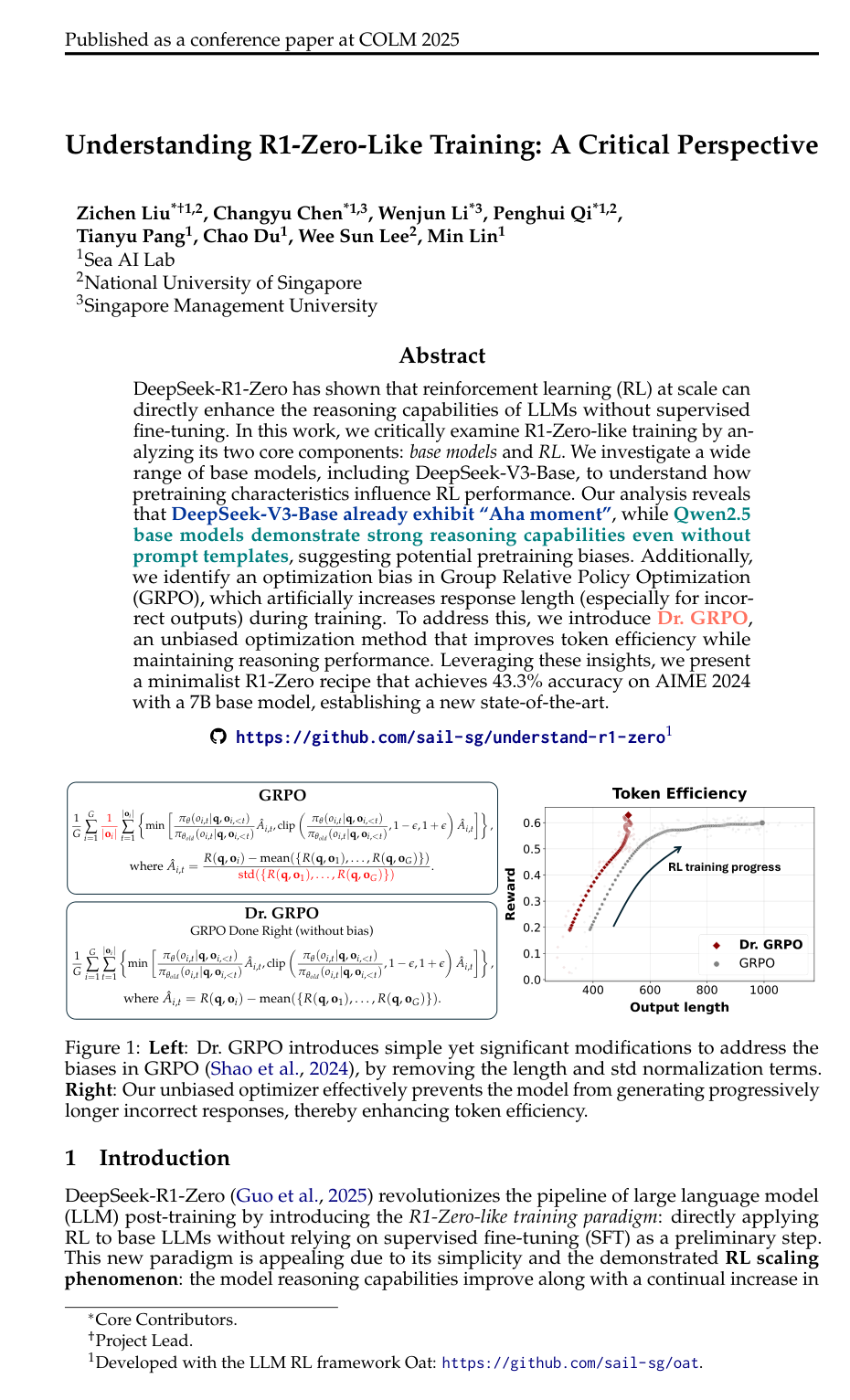
Understanding R1-Zero-Like Training: A Critical Perspective
Zichen Liu, Changyu Chen, Wenjun Li, Penghui Qi, Tianyu Pang, Chao Du, Wee Sun Lee, Min Lin
Why you should read this
Reveals critical pretraining and optimization biases in R1-Zero-like reasoning models, introducing an unbiased algorithm called Dr. GRPO that prevents response length inflation and sets a 7B state-of-the-art benchmark of 43.3% on AIME 2024.
DeepSeek-R1-Zero has shown that reinforcement learning (RL) at scale can directly enhance the reasoning capabilities of LLMs without supervised fine-tuning. In this work, we critically examine R1-Zero-like training by analyzing its two core components: base models and RL. We investigate a wide range of base models, including DeepSeek-V3-Base, to understand how pretraining characteristics influence RL performance. Our analysis reveals that DeepSeek-V3-Base already exhibit ''Aha moment'', while Qwen2.5 base models demonstrate strong reasoning capabilities even without prompt templates, suggesting potential pretraining biases. Additionally, we identify an optimization bias in Group Relative Policy Optimization (GRPO), which artificially increases response length (especially for incorrect outputs) during training. To address this, we introduce Dr. GRPO, an unbiased optimization method that improves token efficiency while maintaining reasoning performance. Leveraging these insights, we present a minimalist R1-Zero recipe that achieves 43.3% accuracy on AIME 2024 with a 7B base model, establishing a new state-of-the-art. Our code is available at this https URL.
Added
2026-09-25
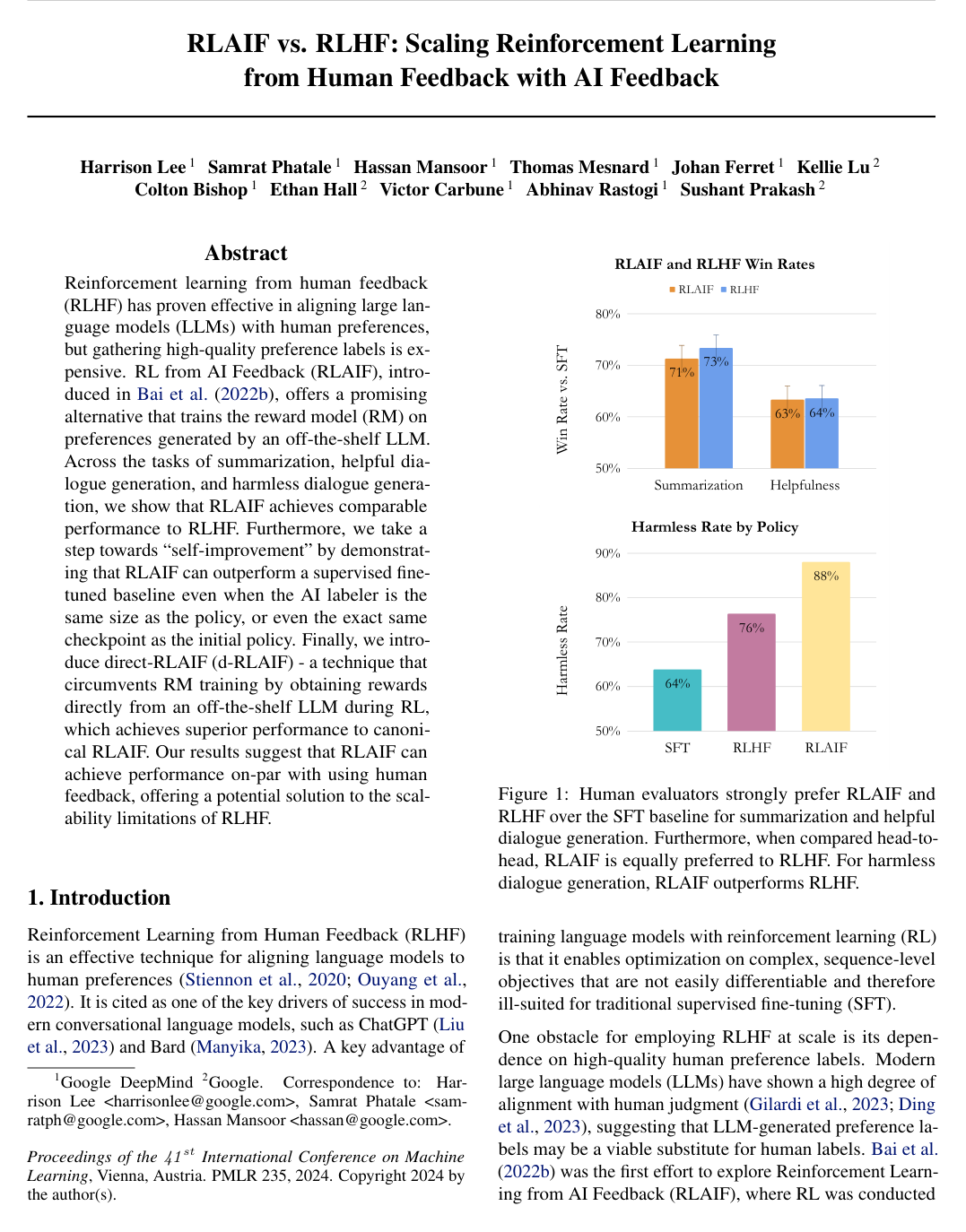
RLAIF vs. RLHF: Scaling Reinforcement Learning from Human Feedback with AI Feedback
Harrison Lee, Samrat Phatale, Hassan Mansoor, Thomas Mesnard, Johan Ferret, Kellie Lu, Colton Bishop, Ethan Hall, Victor Carbune, Abhinav Rastogi, Sushant Prakash
Why you should read this
Demonstrates that reinforcement learning from AI feedback achieves alignment performance comparable to human feedback across dialogue and summarization tasks, showing that language models can self-improve without costly human annotations and introducing direct-RLAIF to bypass reward model training.
Reinforcement learning from human feedback (RLHF) has proven effective in aligning large language models (LLMs) with human preferences, but gathering high-quality preference labels is expensive. RL from AI Feedback (RLAIF), introduced in Bai et al., offers a promising alternative that trains the reward model (RM) on preferences generated by an off-the-shelf LLM. Across the tasks of summarization, helpful dialogue generation, and harmless dialogue generation, we show that RLAIF achieves comparable performance to RLHF. Furthermore, we take a step towards "self-improvement" by demonstrating that RLAIF can outperform a supervised fine-tuned baseline even when the AI labeler is the same size as the policy, or even the exact same checkpoint as the initial policy. Finally, we introduce direct-RLAIF (d-RLAIF) - a technique that circumvents RM training by obtaining rewards directly from an off-the-shelf LLM during RL, which achieves superior performance to canonical RLAIF. Our results suggest that RLAIF can achieve performance on-par with using human feedback, offering a potential solution to the scalability limitations of RLHF.
Added
2026-09-22

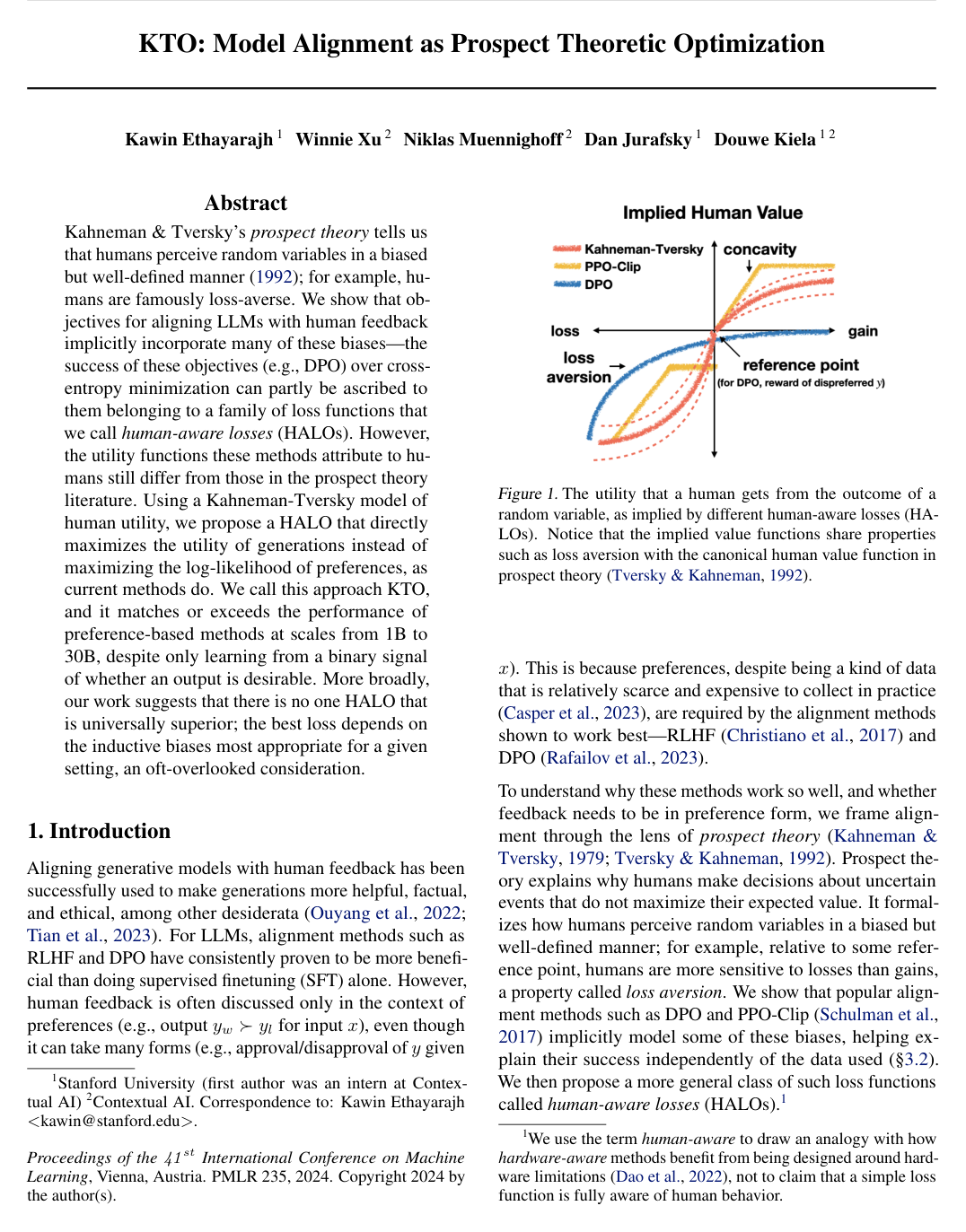
KTO: Model Alignment as Prospect Theoretic Optimization
Kawin Ethayarajh, Winnie Xu, Niklas Muennighoff, Dan Jurafsky, Douwe Kiela
Why you should read this
Introduces KTO, a novel human-aware loss function based on Kahneman-Tversky's prospect theory, which effectively aligns LLMs using only binary feedback and matches or exceeds preference-based methods across various scales, suggesting the critical role of inductive biases in selecting optimal alignment losses.
Kahneman & Tversky's tells us that humans perceive random variables in a biased but well-defined manner (1992); for example, humans are famously loss-averse. We show that objectives for aligning LLMs with human feedback implicitly incorporate many of these biases -- the success of these objectives (e.g., DPO) over cross-entropy minimization can partly be ascribed to them belonging to a family of loss functions that we call (HALOs). However, the utility functions these methods attribute to humans still differ from those in the prospect theory literature. Using a Kahneman-Tversky model of human utility, we propose a HALO that directly maximizes the utility of generations instead of maximizing the log-likelihood of preferences, as current methods do. We call this approach KTO, and it matches or exceeds the performance of preference-based methods at scales from 1B to 30B, despite only learning from a binary signal of whether an output is desirable. More broadly, our work suggests that there is no one HALO that is universally superior; the best loss depends on the inductive biases most appropriate for a given setting, an oft-overlooked consideration.
Added
2026-05-07

Direct Preference Optimization: Your Language Model is Secretly a Reward Model
Rafael Rafailov, Archit Sharma, Eric Mitchell, Stefano Ermon, Christopher D. Manning, Chelsea Finn
Why you should read this
Develops a stable, performant, and computationally lightweight algorithm called Direct Preference Optimization (DPO) that simplifies fine-tuning large language models to align with human preferences more effectively and efficiently than current complex reinforcement learning methods.
While large-scale unsupervised language models (LMs) learn broad world knowledge and some reasoning skills, achieving precise control of their behavior is difficult due to the completely unsupervised nature of their training. Existing methods for gaining such steerability collect human labels of the relative quality of model generations and fine-tune the unsupervised LM to align with these preferences, often with reinforcement learning from human feedback (RLHF). However, RLHF is a complex and often unstable procedure, first fitting a reward model that reflects the human preferences, and then fine-tuning the large unsupervised LM using reinforcement learning to maximize this estimated reward without drifting too far from the original model. In this paper we introduce a new parameterization of the reward model in RLHF that enables extraction of the corresponding optimal policy in closed form, allowing us to solve the standard RLHF problem with only a simple classification loss. The resulting algorithm, which we call Direct Preference Optimization (DPO), is stable, performant, and computationally lightweight, eliminating the need for sampling from the LM during fine-tuning or performing significant hyperparameter tuning. Our experiments show that DPO can fine-tune LMs to align with human preferences as well as or better than existing methods. Notably, fine-tuning with DPO exceeds PPO-based RLHF in ability to control sentiment of generations, and matches or improves response quality in summarization and single-turn dialogue while being substantially simpler to implement and train.
Added
2026-04-23
Training-Free Group Relative Policy Optimization
Yuzheng Cai, Siqi Cai, Yuchen Shi, Zihan Xu, Yulei Qin, Gang Li, Zongyi Li, Xiaoyu Tan, Haojia Lin, Yong Mao, Lichao Chen, Ke Li, Xing Sun
Why you should read this
Introduces Training-Free GRPO, a cost-effective method to significantly enhance LLM agent performance in specialized domains without any parameter updates or extensive data, outperforming fine-tuned models with marginal cost.
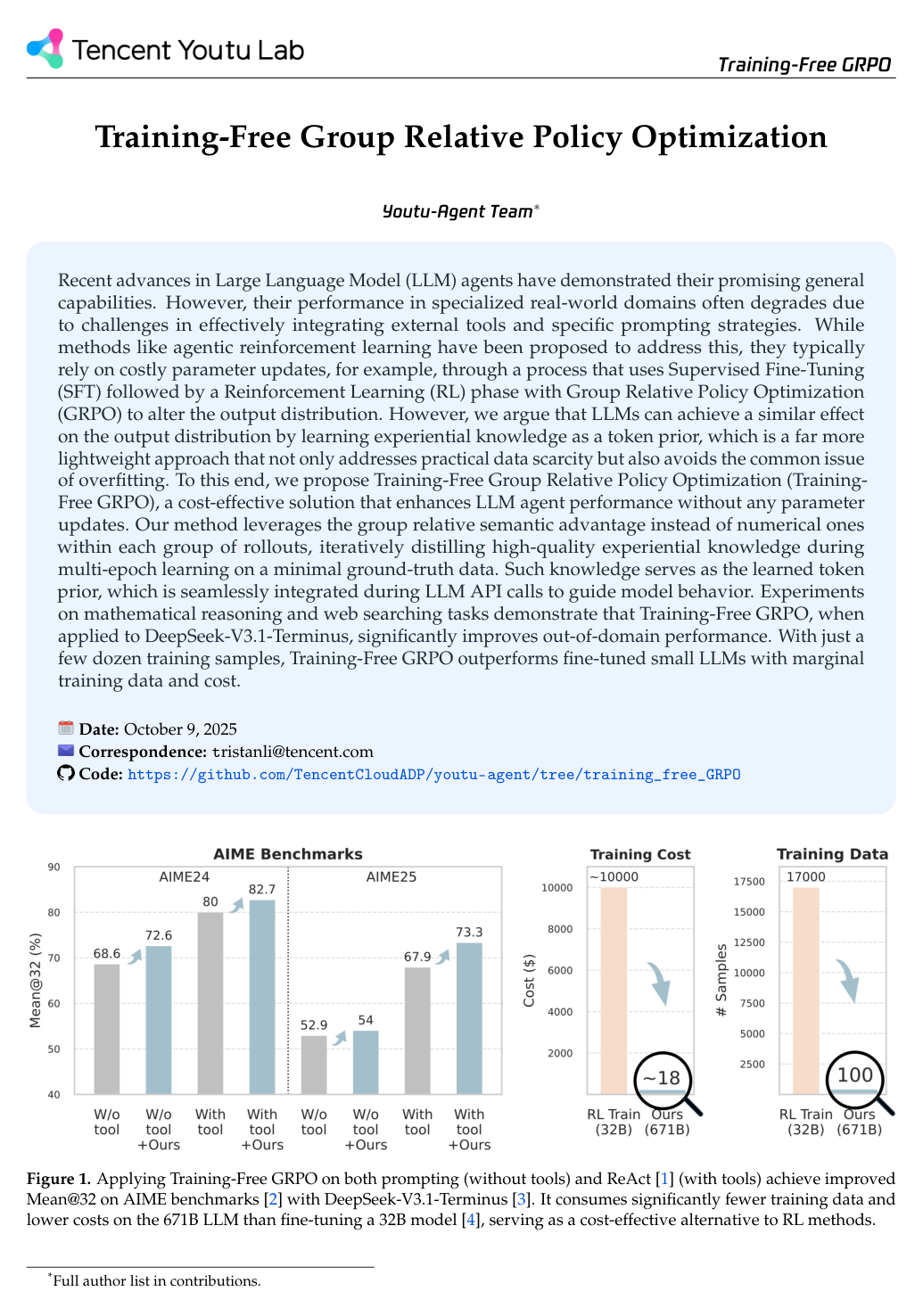
Recent advances in Large Language Model (LLM) agents have demonstrated their promising general capabilities. However, their performance in specialized real-world domains often degrades due to challenges in effectively integrating external tools and specific prompting strategies. While methods like agentic reinforcement learning have been proposed to address this, they typically rely on costly parameter updates, for example, through a process that uses Supervised Fine-Tuning (SFT) followed by a Reinforcement Learning (RL) phase with Group Relative Policy Optimization (GRPO) to alter the output distribution. However, we argue that LLMs can achieve a similar effect on the output distribution by learning experiential knowledge as a token prior, which is a far more lightweight approach that not only addresses practical data scarcity but also avoids the common issue of overfitting. To this end, we propose Training-Free Group Relative Policy Optimization (Training-Free GRPO), a cost-effective solution that enhances LLM agent performance without any parameter updates. Our method leverages the group relative semantic advantage instead of numerical ones within each group of rollouts, iteratively distilling high-quality experiential knowledge during multi-epoch learning on a minimal ground-truth data. Such knowledge serves as the learned token prior, which is seamlessly integrated during LLM API calls to guide model behavior. Experiments on mathematical reasoning and web searching tasks demonstrate that Training-Free GRPO, when applied to DeepSeek-V3.1-Terminus, significantly improves out-of-domain performance. With just a few dozen training samples, Training-Free GRPO outperforms fine-tuned small LLMs with marginal training data and cost.
Added
2026-03-26