
keyword
rehearsal-based methods
Rehearsal-based methods are machine learning approaches used in continual or incremental learning to prevent catastrophic forgetting by storing a representative subset of past data, or generating synthetic approximations of past experiences, and replaying them alongside new data during training. By maintaining an episodic memory buffer, these techniques periodically reintroduce historical examples into the optimization process, reinforcing previously learned representations and decision boundaries as the model adapts to new tasks or classes. While highly effective at maintaining performance across sequentially learned distributions, these methods typically require additional memory management and can introduce storage, computational, and data-privacy trade-offs due to the retention of past samples.
2 items
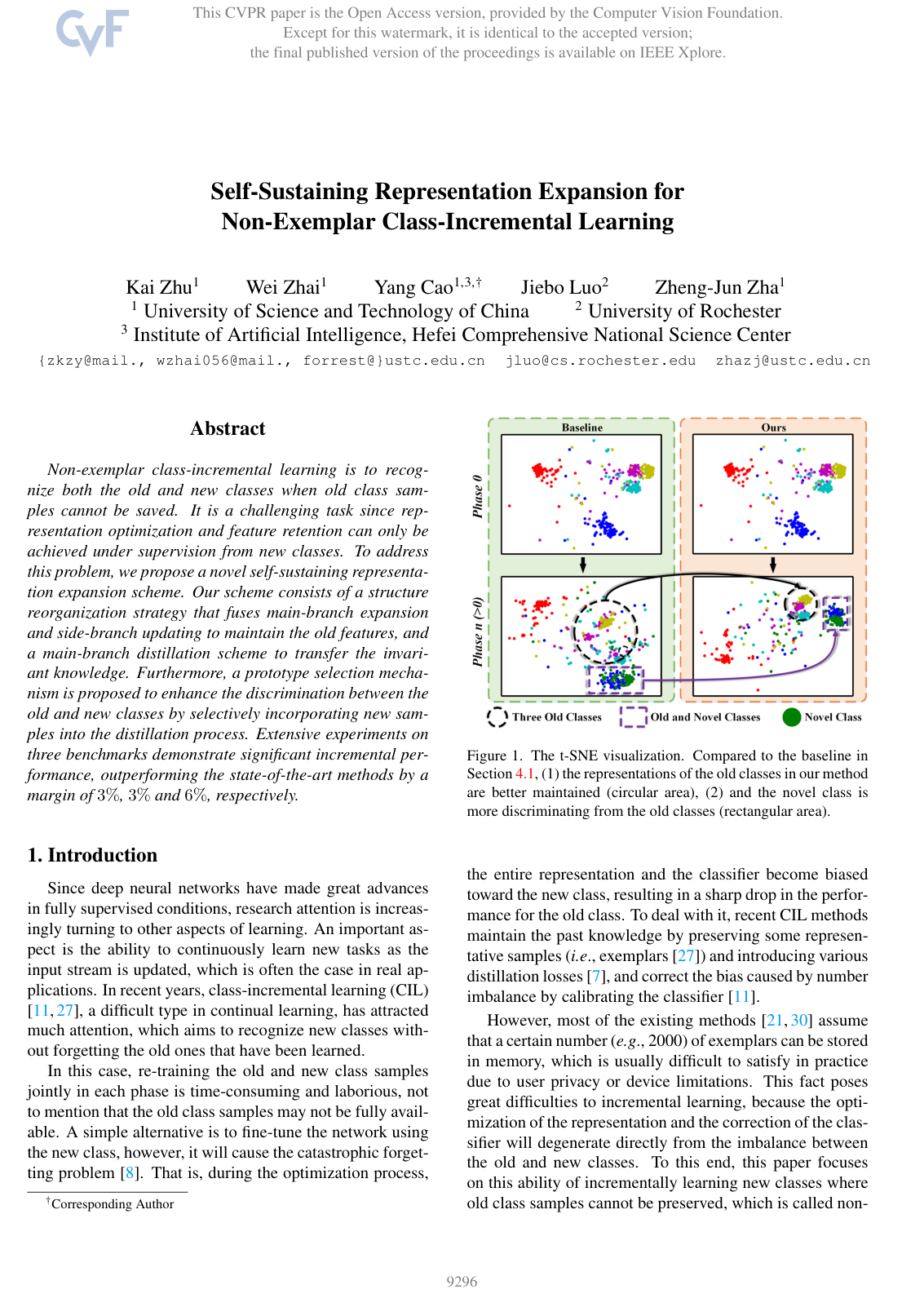
Self-Sustaining Representation Expansion for Non-Exemplar Class-Incremental Learning
Kai Zhu, Wei Zhai, Yang Cao, Jiebo Luo, Zhengjun Zha
Why you should read this
Develops a self-sustaining representation expansion framework for non-exemplar class-incremental learning that prevents catastrophic forgetting and parameter explosion by dynamically reorganizing network structures and selectively distilling knowledge using new class prototypes.
Non-exemplar class-incremental learning is to recognize both the old and new classes when old class samples cannot be saved. It is a challenging task since representation optimization and feature retention can only be achieved under supervision from new classes. To address this problem, we propose a novel self-sustaining representation expansion scheme. Our scheme consists of a structure reorganization strategy that fuses main-branch expansion and side-branch updating to maintain the old features, and a main-branch distillation scheme to transfer the invariant knowledge. Furthermore, a prototype selection mechanism is proposed to enhance the discrimination between the old and new classes by selectively incorporating new samples into the distillation process. Extensive experiments on three benchmarks demonstrate significant incremental performance, outperforming the state-of-the-art methods by a margin of 3%, 3% and 6%, respectively.
Added
2026-09-26
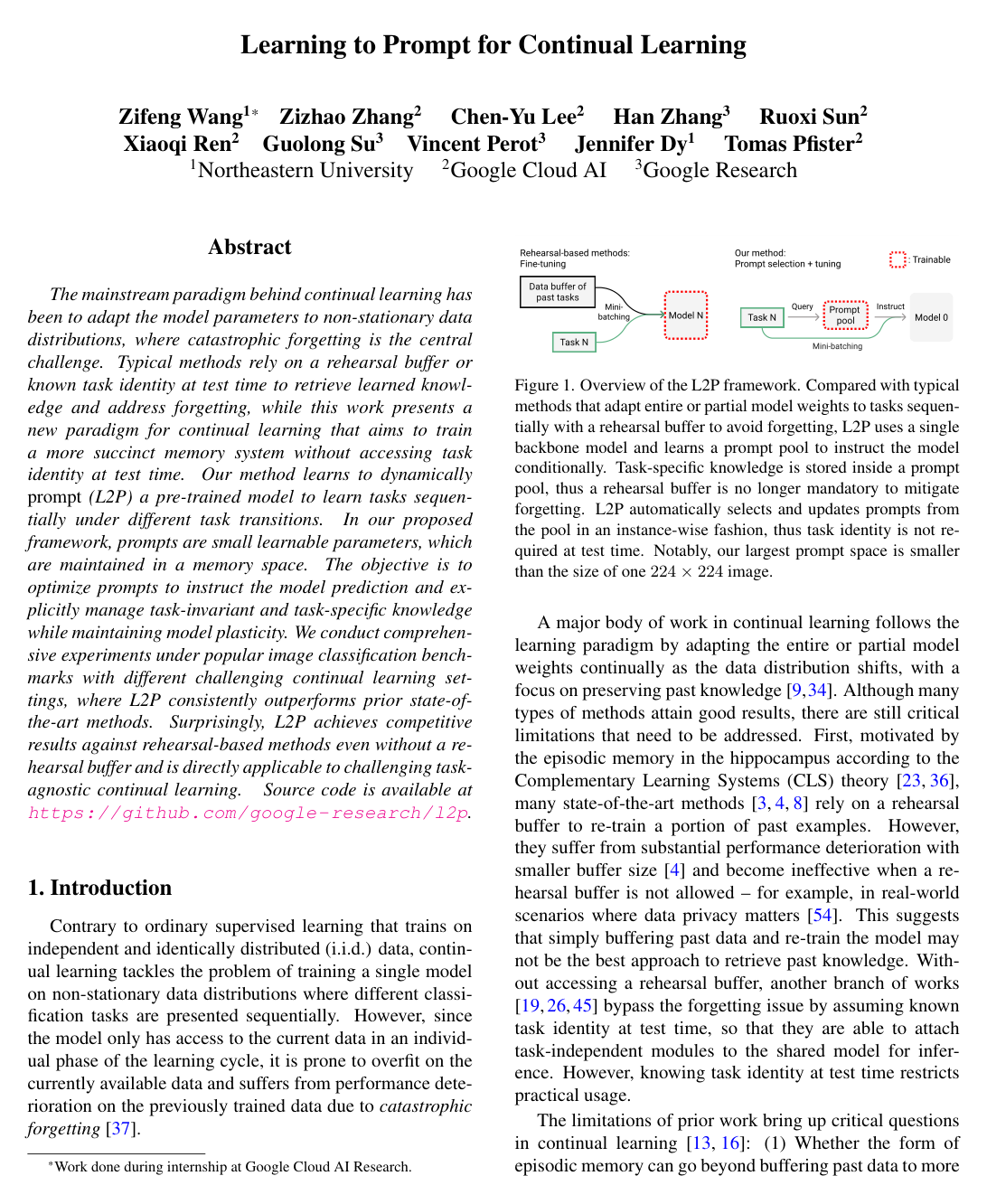
Learning to Prompt for Continual Learning
Zifeng Wang, Zizhao Zhang, Chen-Yu Lee, Han Zhang, Ruoxi Sun, Xiaoqi Ren, Guolong Su, Vincent Perot, Jennifer Dy, Tomas Pfister
Why you should read this
Introduces a prompt-based continual learning framework that dynamically selects learnable prompts to guide pre-trained models across sequential tasks, matching rehearsal-based performance without storing past data or requiring task identities at test time.
The mainstream paradigm behind continual learning has been to adapt the model parameters to non-stationary data distributions, where catastrophic forgetting is the central challenge. Typical methods rely on a rehearsal buffer or known task identity at test time to retrieve learned knowledge and address forgetting, while this work presents a new paradigm for continual learning that aims to train a more succinct memory system without accessing task identity at test time. Our method learns to dynamically prompt (L2P) a pre-trained model to learn tasks sequentially under different task transitions. In our proposed framework, prompts are small learnable parameters, which are maintained in a memory space. The objective is to optimize prompts to instruct the model prediction and explicitly manage task-invariant and task-specific knowledge while maintaining model plasticity. We conduct comprehensive experiments under popular image classification benchmarks with different challenging continual learning settings, where L2P consistently outperforms prior state-of-the-art methods. Surprisingly, L2P achieves competitive results against rehearsal-based methods even without a rehearsal buffer and is directly applicable to challenging task-agnostic continual learning. Source code is available at this https URL.
Added
2026-09-25