
keyword
recommender systems
Recommender systems are algorithms and information filtering tools designed to predict user preferences and suggest relevant items, such as products, media, or online content. These systems typically analyze past user behavior, user-item interactions, and item attributes using approaches such as collaborative filtering, content-based filtering, or hybrid methods. To overcome challenges like data sparsity and the cold-start problem for new users or items, modern implementations often incorporate auxiliary side information, knowledge graphs, and predictive machine learning models, including matrix factorization and deep neural networks, to accurately model complex patterns and deliver personalized recommendations.
11 items
Neural Factorization Machines for Sparse Predictive Analytics
Xiangnan He, Tat-Seng Chua
Why you should read this
Proposes Neural Factorization Machines, a model that unifies linear factorization machines with non-linear neural networks to capture higher-order feature interactions in sparse data, delivering superior predictive accuracy with simpler training than deeper alternatives.
Many predictive tasks of web applications need to model categorical variables, such as user IDs and demographics like genders and occupations. To apply standard machine learning techniques, these categorical predictors are always converted to a set of binary features via one-hot encoding, making the resultant feature vector highly sparse. To learn from such sparse data effectively, it is crucial to account for the interactions between features. Factorization Machines (FMs) are a popular solution for efficiently using the second-order feature interactions. However, FM models feature interactions in a linear way, which can be insufficient for capturing the non-linear and complex inherent structure of real-world data. While deep neural networks have recently been applied to learn non-linear feature interactions in industry, such as the Wide&Deep by Google and DeepCross by Microsoft, the deep structure meanwhile makes them difficult to train. In this paper, we propose a novel model Neural Factorization Machine (NFM) for prediction under sparse settings. NFM seamlessly combines the linearity of FM in modelling second-order feature interactions and the non-linearity of neural network in modelling higher-order feature interactions. Conceptually, NFM is more expressive than FM since FM can be seen as a special case of NFM without hidden layers. Empirical results on two regression tasks show that with one hidden layer only, NFM significantly outperforms FM with a 7.3% relative improvement. Compared to the recent deep learning methods Wide&Deep and DeepCross, our NFM uses a shallower structure but offers better performance, being much easier to train and tune in practice.
Added
2026-09-25
Collaborative Deep Learning for Recommender Systems
Hao Wang, Naiyan Wang, Dit-Yan Yeung
Why you should read this
Proposes Collaborative Deep Learning (CDL), a hierarchical Bayesian framework that tightly integrates deep representation learning of auxiliary content with collaborative filtering to resolve rating sparsity issues in recommender systems.
Collaborative filtering (CF) is a successful approach commonly used by many recommender systems. Conventional CF-based methods use the ratings given to items by users as the sole source of information for learning to make recommendation. However, the ratings are often very sparse in many applications, causing CF-based methods to degrade significantly in their recommendation performance. To address this sparsity problem, auxiliary information such as item content information may be utilized. Collaborative topic regression (CTR) is an appealing recent method taking this approach which tightly couples the two components that learn from two different sources of information. Nevertheless, the latent representation learned by CTR may not be very effective when the auxiliary information is very sparse. To address this problem, we generalize recent advances in deep learning from i.i.d. input to non-i.i.d. (CF-based) input and propose in this paper a hierarchical Bayesian model called collaborative deep learning (CDL), which jointly performs deep representation learning for the content information and collaborative filtering for the ratings (feedback) matrix. Extensive experiments on three real-world datasets from different domains show that CDL can significantly advance the state of the art.
Added
2026-09-24
Collaborative Knowledge Base Embedding for Recommender Systems
Fuzheng Zhang, Nicholas Jing Yuan, Defu Lian, Xing Xie, Wei-Ying Ma
Why you should read this
Proposes the Collaborative Knowledge Base Embedding framework to tackle interaction sparsity by jointly training collaborative filtering models with structural, textual, and visual representations extracted from knowledge bases via deep learning and TransR.
Among different recommendation techniques, collaborative filtering usually suffer from limited performance due to the sparsity of user-item interactions. To address the issues, auxiliary information is usually used to boost the performance. Due to the rapid collection of information on the web, the knowledge base provides heterogeneous information including both structured and unstructured data with different semantics, which can be consumed by various applications. In this paper, we investigate how to leverage the heterogeneous information in a knowledge base to improve the quality of recommender systems. First, by exploiting the knowledge base, we design three components to extract items' semantic representations from structural content, textual content and visual content, respectively. To be specific, we adopt a heterogeneous network embedding method, termed as TransR, to extract items' structural representations by considering the heterogeneity of both nodes and relationships. We apply stacked denoising auto-encoders and stacked convolutional auto-encoders, which are two types of deep learning based embedding techniques, to extract items' textual representations and visual representations, respectively. Finally, we propose our final integrated framework, which is termed as Collaborative Knowledge Base Embedding (CKE), to jointly learn the latent representations in collaborative filtering as well as items' semantic representations from the knowledge base. To evaluate the performance of each embedding component as well as the whole system, we conduct extensive experiments with two real-world datasets from different scenarios. The results reveal that our approaches outperform several widely adopted state-of-the-art recommendation methods.
Added
2026-09-18
Toward the next generation of recommender systems: a survey of the state-of-the-art and possible extensions
Gediminas Adomavicius, Alexander Tuzhilin
Why you should read this
Establishes a foundational taxonomy of content-based, collaborative, and hybrid recommendation paradigms while identifying key future directions in context-aware filtering and multi-criteria ratings.
The paper presents an overview of the field of recommender systems and describes the current generation of recommendation methods that are usually classified into the following three main categories: content-based, collaborative, and hybrid recommendation approaches. The paper also describes various limitations of current recommendation methods and discusses possible extensions that can improve recommendation capabilities and make recommender systems applicable to an even broader range of applications. These extensions include, among others, improvement of understanding of users and items, incorporation of the contextual information into the recommendation process, support for multi-criteria ratings, and provision of more flexible and less intrusive types of recommendations.
Added
2026-09-07

Matrix Factorization Techniques for Recommender Systems
Yehuda Koren, Robert Bell, Chris Volinsky
Why you should read this
Establishes the definitive mathematical framework for collaborative filtering by demonstrating how latent matrix factorization handles data sparsity while seamlessly incorporating temporal dynamics.
As the Netflix Prize competition has demonstrated, matrix factorization models are superior to classic nearest neighbor techniques for producing product recommendations, allowing the incorporation of additional information such as implicit feedback, temporal effects, and confidence levels.
Added
2026-05-06
Wide & Deep Learning for Recommender Systems
Heng-Tze Cheng, Levent Koc, Jeremiah Harmsen, Tal Shaked, Tushar Chandra, Hrishi Aradhye, Glen Anderson, Greg Corrado, Wei Chai, Mustafa Ispir, Rohan Anil, Zakaria Haque, Lichan Hong, Vihan Jain, Xiaobing Liu, Hemal Shah
Why you should read this
Proposes a hybrid architecture that successfully balances the memorization of exact feature crosses with the continuous generalization of dense feature embeddings.
Generalized linear models with nonlinear feature transformations are widely used for large-scale regression and classification problems with sparse inputs. Memorization of feature interactions through a wide set of cross-product feature transformations are effective and interpretable, while generalization requires more feature engineering effort. With less feature engineering, deep neural networks can generalize better to unseen feature combinations through low-dimensional dense embeddings learned for the sparse features. However, deep neural networks with embeddings can over-generalize and recommend less relevant items when the user-item interactions are sparse and high-rank. In this paper, we present Wide & Deep learning---jointly trained wide linear models and deep neural networks---to combine the benefits of memorization and generalization for recommender systems. We productionized and evaluated the system on Google Play, a commercial mobile app store with over one billion active users and over one million apps. Online experiment results show that Wide & Deep significantly increased app acquisitions compared with wide-only and deep-only models. We have also open-sourced our implementation in TensorFlow.
Added
2026-04-18
License
Published with permission
RippleNet: Propagating user preferences on the knowledge graph for recommender systems
Hongwei Wang, Fuzheng Zhang, Jialin Wang, Miao Zhao, Wenjie Li, Xing Xie, Minyi Guo
Why you should read this
Introduces Ripple Network, a novel approach that propagates user preferences through knowledge graph structures like ripples on water, elegantly solving the cold start problem in recommendation systems by automatically discovering user interests along entity connections rather than relying on explicit path-based or embedding methods alone.
To address the sparsity and cold start problem of collaborative filtering, researchers usually make use of side information, such as social networks or item attributes, to improve recommendation performance. This paper considers the knowledge graph as the source of side information. To address the limitations of existing embedding-based and path-based methods for knowledge-graph-aware recommendation, we propose Ripple Network, an end-to-end framework that naturally incorporates the knowledge graph into recommender systems. Similar to actual ripples propagating on the surface of water, Ripple Network stimulates the propagation of user preferences over the set of knowledge entities by automatically and iteratively extending a user's potential interests along links in the knowledge graph. The multiple "ripples" activated by a user's historically clicked items are thus superposed to form the preference distribution of the user with respect to a candidate item, which could be used for predicting the final clicking probability. Through extensive experiments on real-world datasets, we demonstrate that Ripple Network achieves substantial gains in a variety of scenarios, including movie, book and news recommendation, over several state-of-the-art baselines.
Added
2026-01-25
Deep Interest Network for Click-Through Rate Prediction
Guorui Zhou, Chengru Song, Xiaoqiang Zhu, Ying Fan, Han Zhu, Xiao Ma, Yanghui Yan, Junqi Jin, Han Li, Kun Gai
Why you should read this
Establishes local activation units employing self-attention mechanisms to adaptively model diverse user interests based solely on relevance to candidate ads.
Click-through rate prediction is an essential task in industrial applications, such as online advertising. Recently deep learning based models have been proposed, which follow a similar Embedding&MLP paradigm. In these methods large scale sparse input features are first mapped into low dimensional embedding vectors, and then transformed into fixed-length vectors in a group-wise manner, finally concatenated together to fed into a multilayer perceptron (MLP) to learn the nonlinear relations among features. In this way, user features are compressed into a fixed-length representation vector, in regardless of what candidate ads are. The use of fixed-length vector will be a bottleneck, which brings difficulty for Embedding&MLP methods to capture user's diverse interests effectively from rich historical behaviors. In this paper, we propose a novel model: Deep Interest Network (DIN) which tackles this challenge by designing a local activation unit to adaptively learn the representation of user interests from historical behaviors with respect to a certain ad. This representation vector varies over different ads, improving the expressive ability of model greatly. Besides, we develop two techniques: mini-batch aware regularization and data adaptive activation function which can help training industrial deep networks with hundreds of millions of parameters. Experiments on two public datasets as well as an Alibaba real production dataset with over 2 billion samples demonstrate the effectiveness of proposed approaches, which achieve superior performance compared with state-of-the-art methods. DIN now has been successfully deployed in the online display advertising system in Alibaba, serving the main traffic.
Added
2026-01-25
Factorization Machines
Steffen Rendle
Why you should read this
Introduces a general predictor that models all nested feature interactions, allowing the seamless integration of side-information and context.
In this paper, we introduce Factorization Machines (FM) which are a new model class that combines the advantages of Support Vector Machines (SVM) with factorization models. Like SVMs, FMs are a general predictor working with any real valued feature vector. In contrast to SVMs, FMs model all interactions between variables using factorized parameters. Thus they are able to estimate interactions even in problems with huge sparsity (like recommender systems) where SVMs fail. We show that the model equation of FMs can be calculated in linear time and thus FMs can be optimized directly. So unlike nonlinear SVMs, a transformation in the dual form is not necessary and the model parameters can be estimated directly without the need of any support vector in the solution. We show the relationship to SVMs and the advantages of FMs for parameter estimation in sparse settings. On the other hand there are many different factorization models like matrix factorization, parallel factor analysis or specialized models like SVD++, PITF or FPMC. The drawback of these models is that they are not applicable for general prediction tasks but work only with special input data. Furthermore their model equations and optimization algorithms are derived individually for each task. We show that FMs can mimic these models just by specifying the input data (i.e. the feature vectors). This makes FMs easily applicable even for users without expert knowledge in factorization models.
Added
2026-01-25
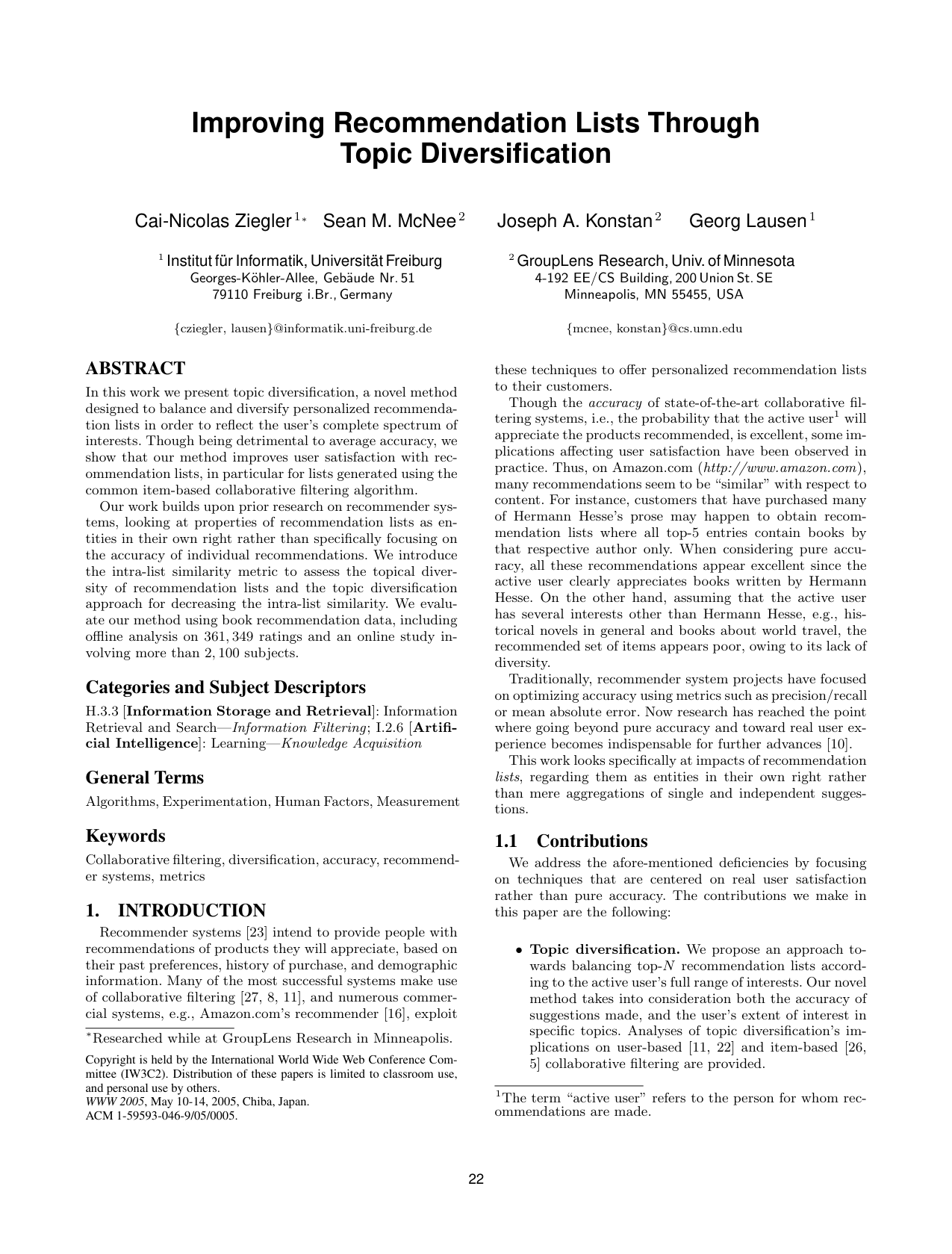
Improving recommendation lists through topic diversification
Cai-Nicolas Ziegler, Sean M. McNee, Joseph A. Konstan, Georg Lausen
Why you should read this
Proves that accuracy is insufficient for user satisfaction and introduces algorithmic methods to enforce diversity in recommendation lists.
In this work we present topic diversification, a novel method designed to balance and diversify personalized recommendation lists in order to reflect the user's complete spectrum of interests. Though being detrimental to average accuracy, we show that our method improves user satisfaction with recommendation lists, in particular for lists generated using the common item-based collaborative filtering algorithm. Our work builds upon prior research on recommender systems, looking at properties of recommendation lists as entities in their own right rather than specifically focusing on the accuracy of individual recommendations. We introduce the intra-list similarity metric to assess the topical diversity of recommendation lists and the topic diversification approach for decreasing the intra-list similarity. We evaluate our method using book recommendation data, including offline analysis on 361,349 ratings and an online study involving more than 2,100 subjects.
Added
2026-01-25
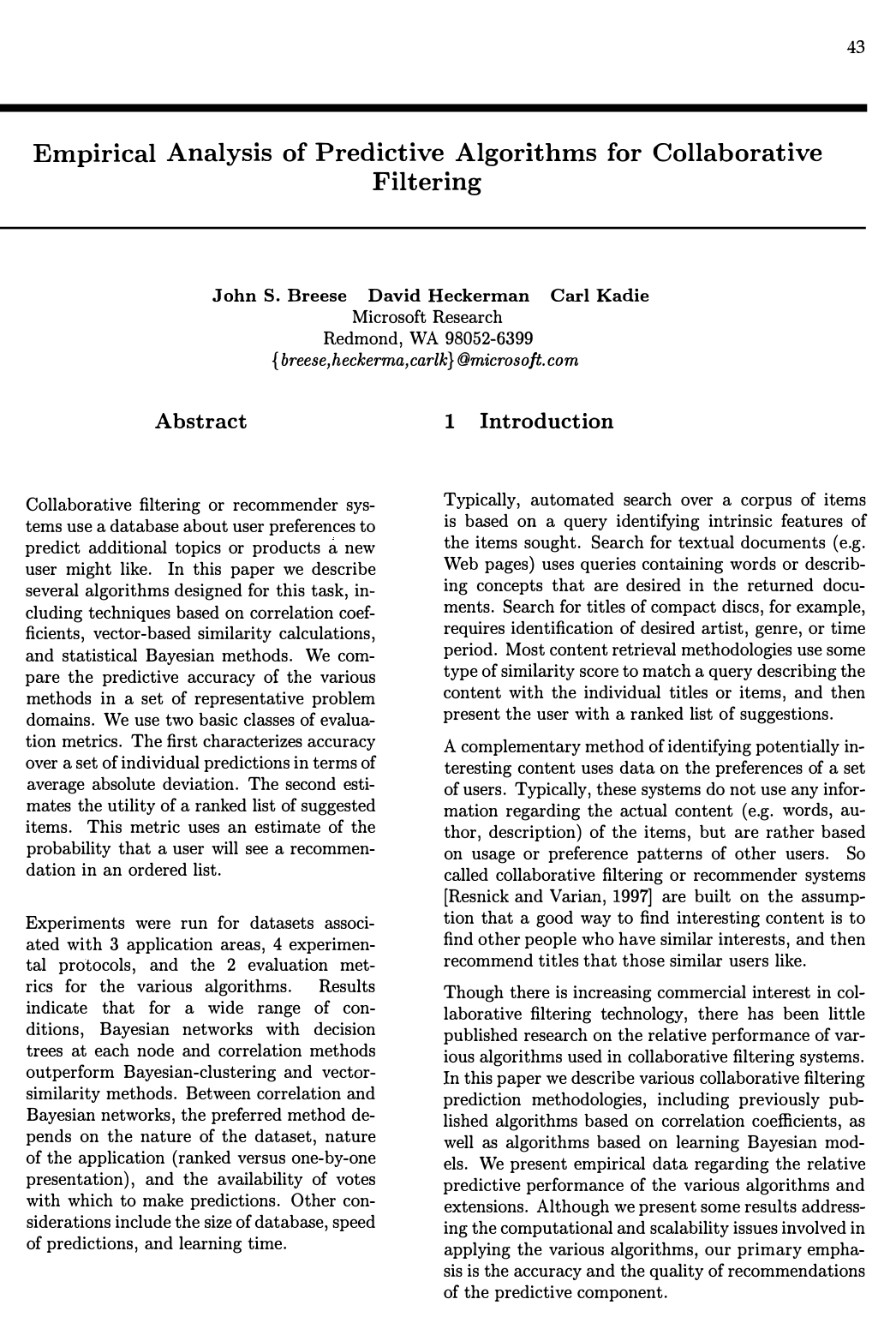
Empirical Analysis of Predictive Algorithms for Collaborative Filtering
John S. Breese, David Heckerman, Carl Kadie
Why you should read this
Demonstrates through extensive empirical analysis that Bayesian networks and correlation-based methods generally outperform other collaborative filtering techniques across various datasets and evaluation protocols.
Collaborative filtering or recommender systems use a database about user preferences to predict additional topics or products a new user might like. In this paper we describe several algorithms designed for this task, including techniques based on correlation coefficients, vector-based similarity calculations, and statistical Bayesian methods. We compare the predictive accuracy of the various methods in a set of representative problem domains. We use two basic classes of evaluation metrics. The first characterizes accuracy over a set of individual predictions in terms of average absolute deviation. The second estimates the utility of a ranked list of suggested items. This metric uses an estimate of the probability that a user will see a recommendation in an ordered list. Experiments were run for datasets associated with 3 application areas, 4 experimental protocols, and the 2 evaluation metrics for the various algorithms. Results indicate that for a wide range of conditions, Bayesian networks with decision trees at each node and correlation methods outperform Bayesian-clustering and vector-similarity methods. Between correlation and Bayesian networks, the preferred method depends on the nature of the dataset, nature of the application (ranked versus one-by-one presentation), and the availability of votes with which to make predictions. Other considerations include the size of database, speed of predictions, and learning time.
Added
2026-01-25