
keyword
question generation
Question generation is a natural language processing task that involves automatically producing fluent, syntactically valid, and contextually relevant questions from diverse input sources, such as text documents, structured knowledge bases, or visual data. In this process, computational models analyze source content to formulate inquiries that target specific concepts, underlying relations, or designated answers. The generation can be directed through rule-based templates, semantic graphs, or natural language prompts to regulate question difficulty, style, and reasoning depth. Question generation is widely applied in artificial intelligence to create synthetic training data for question answering systems, facilitate automated reading comprehension assessments in educational tools, support interactive dialog systems, and probe language models to evaluate their factual accuracy and knowledge boundaries.
8 items
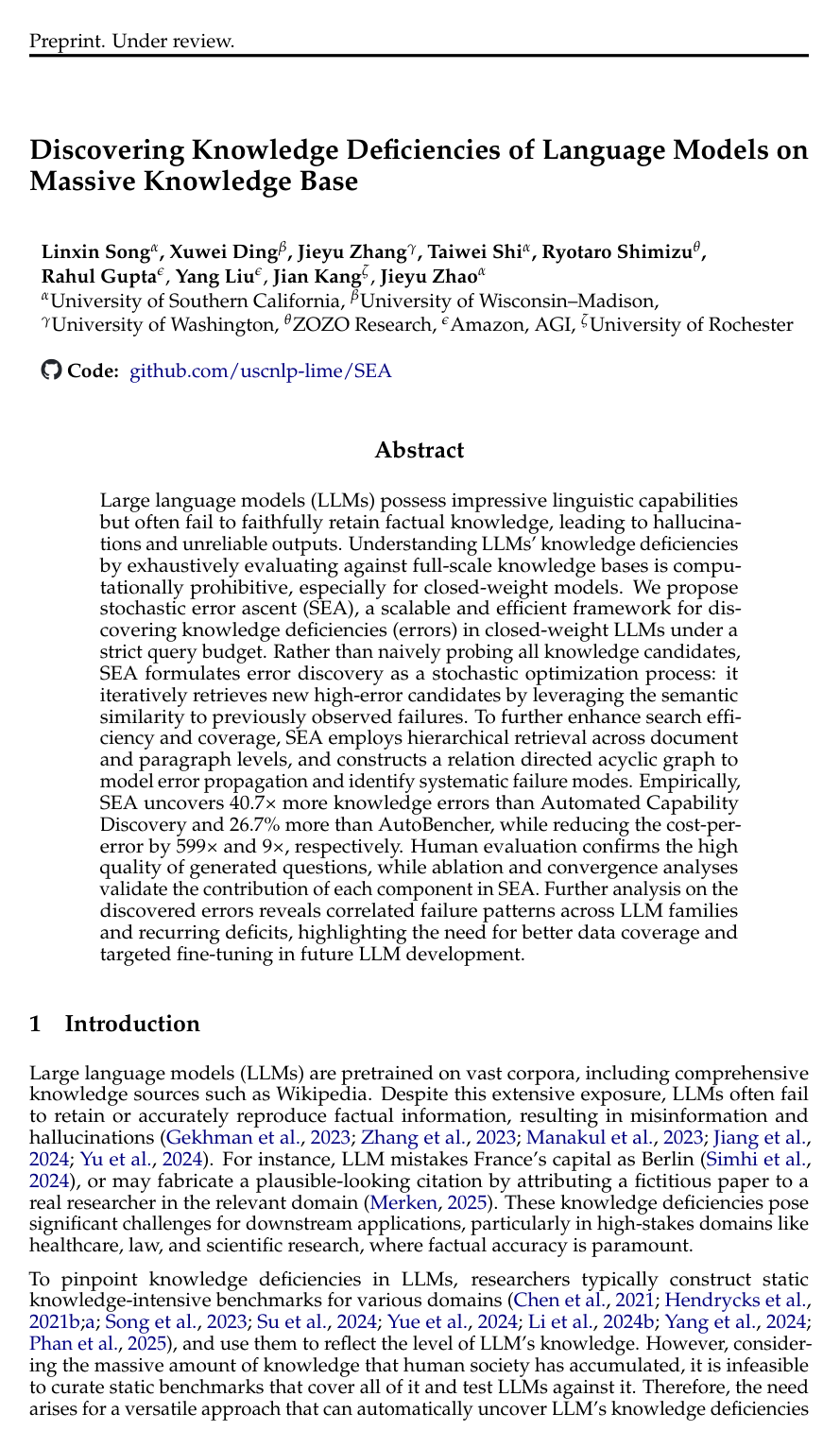
Discovering Knowledge Deficiencies of Language Models on Massive Knowledge Base
Linxin Song, Xuwei Ding, Jieyu Zhang, Taiwei Shi, Ryotaro Shimizu, Rahul Gupta, Yang Liu, Jian Kang, Jie-Yu Zhao
Why you should read this
Proposes stochastic error ascent, a scalable framework that treats knowledge failure discovery in closed-weight language models as an optimization problem, uncovering up to forty times more factual errors across massive knowledge bases while drastically reducing query costs.
Large language models (LLMs) possess impressive linguistic capabilities but often fail to faithfully retain factual knowledge, leading to hallucinations and unreliable outputs. Understanding LLMs' knowledge deficiencies by exhaustively evaluating against full-scale knowledge bases is computationally prohibitive, especially for closed-weight models. We propose stochastic error ascent (SEA), a scalable and efficient framework for discovering knowledge deficiencies (errors) in closed-weight LLMs under a strict query budget. Rather than naively probing all knowledge candidates, SEA formulates error discovery as a stochastic optimization process: it iteratively retrieves new high-error candidates by leveraging the semantic similarity to previously observed failures. To further enhance search efficiency and coverage, SEA employs hierarchical retrieval across document and paragraph levels, and constructs a relation directed acyclic graph to model error propagation and identify systematic failure modes. Empirically, SEA uncovers 40.7x more knowledge errors than Automated Capability Discovery and 26.7% more than AutoBencher, while reducing the cost-per-error by 599x and 9x, respectively. Human evaluation confirms the high quality of generated questions, while ablation and convergence analyses validate the contribution of each component in SEA. Further analysis on the discovered errors reveals correlated failure patterns across LLM families and recurring deficits, highlighting the need for better data coverage and targeted fine-tuning in future LLM development.
Added
2026-10-05
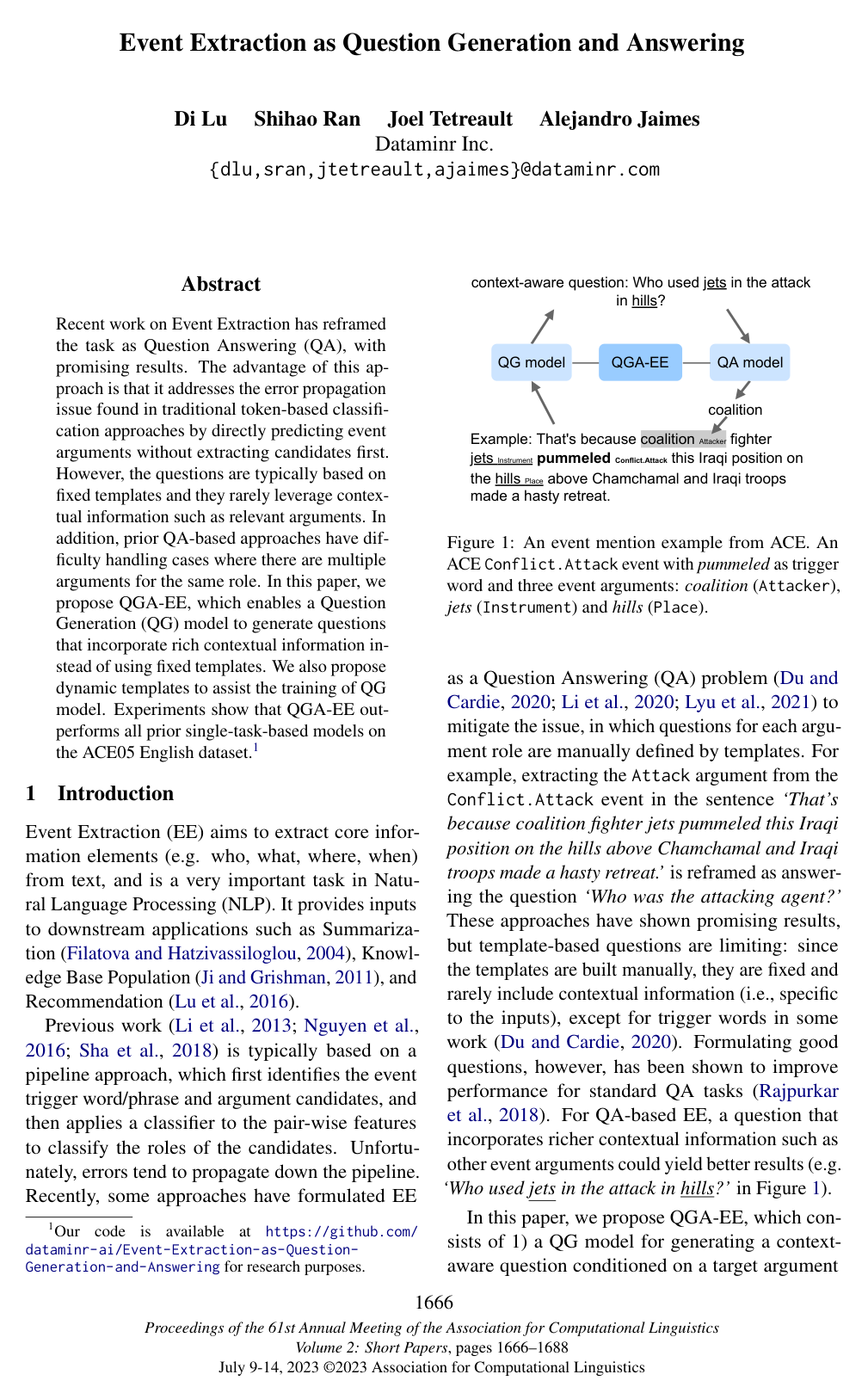
Event Extraction as Question Generation and Answering
Di Lu, Shihao Ran, Joel R. Tetreault, Alejandro Jaimes
Why you should read this
Proposes QGA-EE, a framework that trains a sequence-to-sequence question generation model with dynamic templates to produce context-rich questions, overcoming fixed-template limitations and improving event argument extraction on the ACE 2005 benchmark.
Recent work on Event Extraction has reframed the task as Question Answering (QA), with promising results. The advantage of this approach is that it addresses the error propagation issue found in traditional token-based classification approaches by directly predicting event arguments without extracting candidates first. However, the questions are typically based on fixed templates and they rarely leverage contextual information such as relevant arguments. In addition, prior QA-based approaches have difficulty handling cases where there are multiple arguments for the same role. In this paper, we propose QGA-EE, which enables a Question Generation (QG) model to generate questions that incorporate rich contextual information instead of using fixed templates. We also propose dynamic templates to assist the training of QG model. Experiments show that QGA-EE outperforms all prior single-task-based models on the ACE05 English dataset.¹
Added
2026-10-03
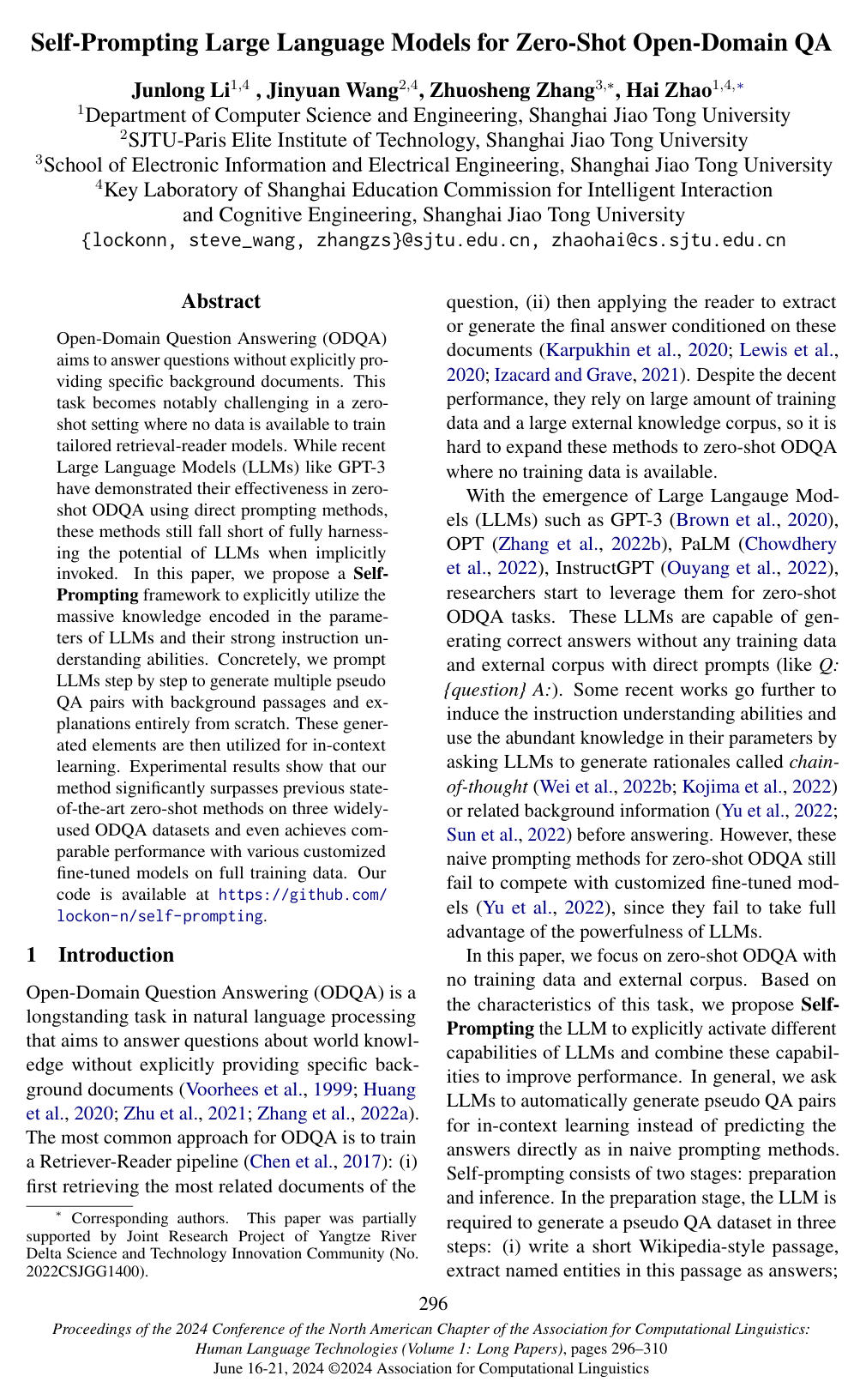
Self-Prompting Large Language Models for Zero-Shot Open-Domain QA
Junlong Li, Jinyuan Wang, Zhuosheng Zhang, Hai Zhao
Why you should read this
Proposes a zero-shot open-domain question-answering framework that prompts large language models to generate synthetic passages, QA pairs, and explanations from scratch, using clustering-based retrieval to assemble in-context demonstrations that match supervised retrieval-augmented models.
Large Language Models (LLMs) have demonstrated impressive proficiency in zero-shot open-domain question answering (ODQA), yet their performance remains limited by the knowledge-intensive nature of the task. In this paper, we propose Self-Prompting, a fully automated pipeline that leverages LLMs' inherent ability to generate data. Specifically, we prompt LLMs to imagine diverse user prompts (i.e., questions) via in-context sampling, and then use them to elicit knowledge from LLMs in order to generate synthetic passages. We demonstrate that our pipeline improves zero-shot ODQA performance by up to 9.6 F1 points across multiple base models and evaluation datasets, achieving comparable performance to supervised retrieval-augmented methods. Furthermore, we introduce self-variational prompting to mitigate hallucinations in knowledge-intensive tasks by generating multiple reasoning chains and selecting the most consistent one. Our results highlight the promise of harnessing LLMs' generative capabilities to address knowledge-intensive tasks in the absence of labeled data.
Added
2026-10-03
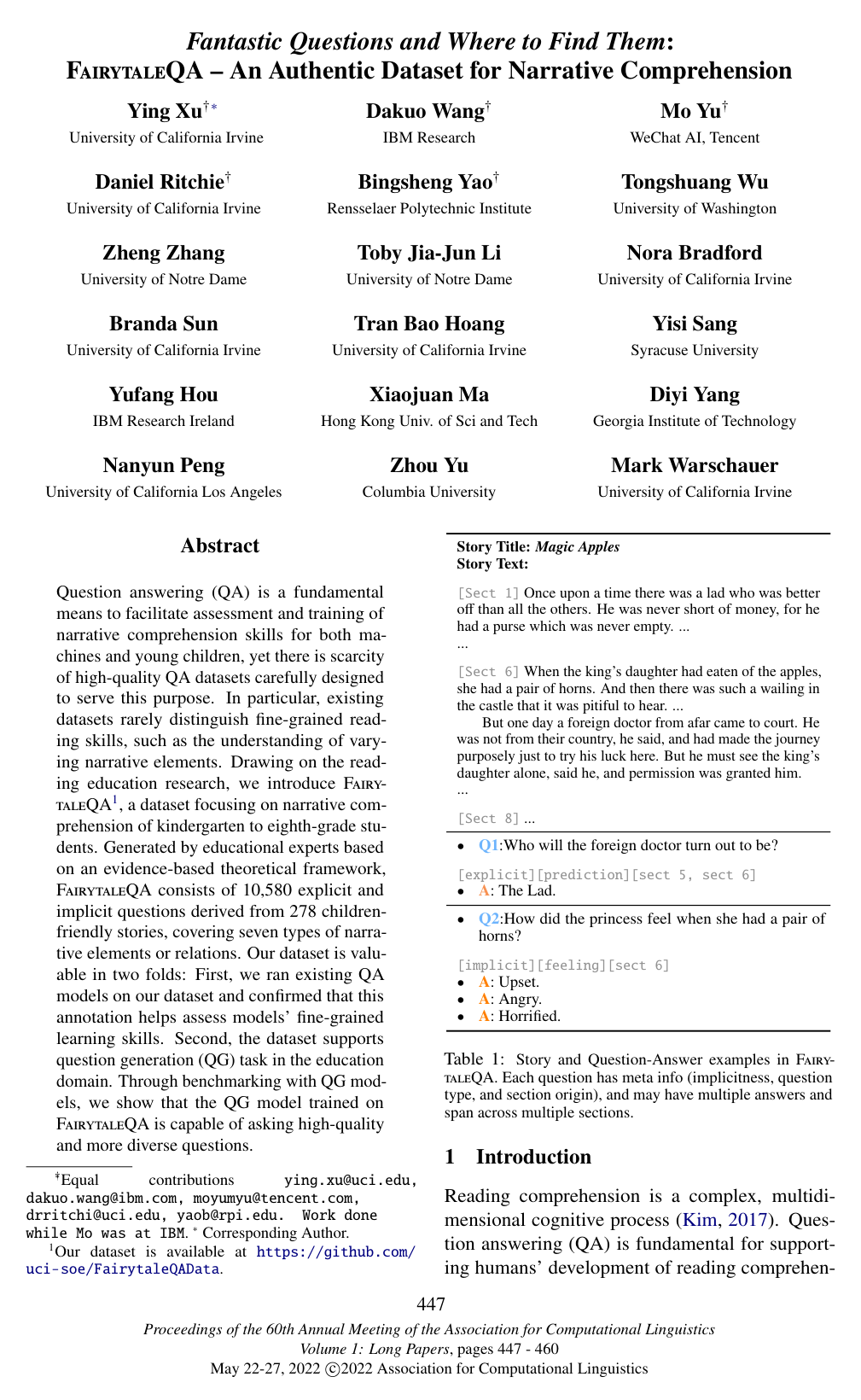
Fantastic Questions and Where to Find Them: FairytaleQA - An Authentic Dataset for Narrative Comprehension
Ying Xu, Dakuo Wang, Mo Yu, Daniel Ritchie, Bingsheng Yao, Tongshuang Wu, Zheng Zhang, Toby Jia-Jun Li, Nora Bradford, Branda Sun, Tran Bao Hoang, Yisi Sang, Yufang Hou, Xiaojuan Ma, Diyi Yang, Nanyun Peng, Zhou Yu, Mark Warschauer
Why you should read this
Introduces FairytaleQA, an expert-annotated benchmark of over 10,000 question-answer pairs mapped to narrative elements, enabling precise evaluation and generation of educational reading comprehension questions for children and language models.
Question answering (QA) is a fundamental means to facilitate assessment and training of narrative comprehension skills for both machines and young children, yet there is scarcity of high-quality QA datasets carefully designed to serve this purpose. In particular, existing datasets rarely distinguish fine-grained reading skills, such as the understanding of varying narrative elements. Drawing on the reading education research, we introduce FairytaleQA¹, a dataset focusing on narrative comprehension of kindergarten to eighth-grade students. Generated by educational experts based on an evidence-based theoretical framework, FairytaleQA consists of 10,580 explicit and implicit questions derived from 278 children-friendly stories, covering seven types of narrative elements or relations. Our dataset is valuable in two folds: First, we ran existing QA models on our dataset and confirmed that this annotation helps assess models’ fine-grained learning skills. Second, the dataset supports question generation (QG) task in the education domain. Through benchmarking with QG models, we show that the QG model trained on FairytaleQA is capable of asking high-quality and more diverse questions.
Added
2026-10-01
Controlled Text Generation with Natural Language Instructions
Wangchunshu Zhou, Yuchen Eleanor Jiang, Ethan Wilcox, Ryan Cotterell, Mrinmaya Sachan
Why you should read this
Introduces INSTRUCTCTG, a training-time framework that verbalizes diverse lexical, syntactic, semantic, style, and length constraints into natural language prompts to control text generation efficiently without modifying decoding algorithms.
Large language models can be prompted to produce fluent output for a wide range of tasks without being specifically trained to do so. Nevertheless, it is notoriously difficult to control their generation in such a way that it satisfies user-specified constraints. In this paper, we present INSTRUCTCTG, a simple controlled text generation framework that incorporates different constraints by verbalizing them as natural language instructions. We annotate natural texts through a combination of off-the-shelf NLP tools and simple heuristics with the linguistic and extra-linguistic constraints they satisfy. Then, we verbalize the constraints into natural language instructions to form weakly supervised training data, i.e., we prepend the natural language verbalizations of the constraints in front of their corresponding natural language sentences. Next, we fine-tune a pre-trained language model on the augmented corpus. Compared to existing methods, INSTRUCTCTG is more flexible in terms of the types of constraints it allows the practitioner to use. It also does not require any modification of the decoding procedure. Finally, INSTRUCTCTG allows the model to adapt to new constraints without re-training through the use of in-context learning. Our code is available at https://github.com/MichaelZhouwang/InstructCTG.
Added
2026-09-26
LM vs LM: Detecting Factual Errors via Cross Examination
Roi Cohen, May Hamri, Mor Geva, Amir Globerson
Why you should read this
Proposes a legal-inspired cross-examination framework where an examiner language model questions another model across multiple turns to uncover factual errors through generated inconsistencies without requiring external knowledge bases.
A prominent weakness of modern language models (LMs) is their tendency to generate factually incorrect text, which hinders their usability. A natural question is whether such factual errors can be detected automatically. Inspired by truth-seeking mechanisms in law, we propose a factuality evaluation framework for LMs that is based on cross-examination. Our key idea is that an incorrect claim is likely to result in inconsistency with other claims that the model generates. To discover such inconsistencies, we facilitate a multi-turn interaction between the LM that generated the claim and another LM (acting as an examiner) which introduces questions to discover inconsistencies. We empirically evaluate our method on factual claims made by multiple recent LMs on four benchmarks, finding that it outperforms existing methods and baselines, often by a large gap. Our results demonstrate the potential of using interacting LMs to capture factual errors.
Added
2026-09-26
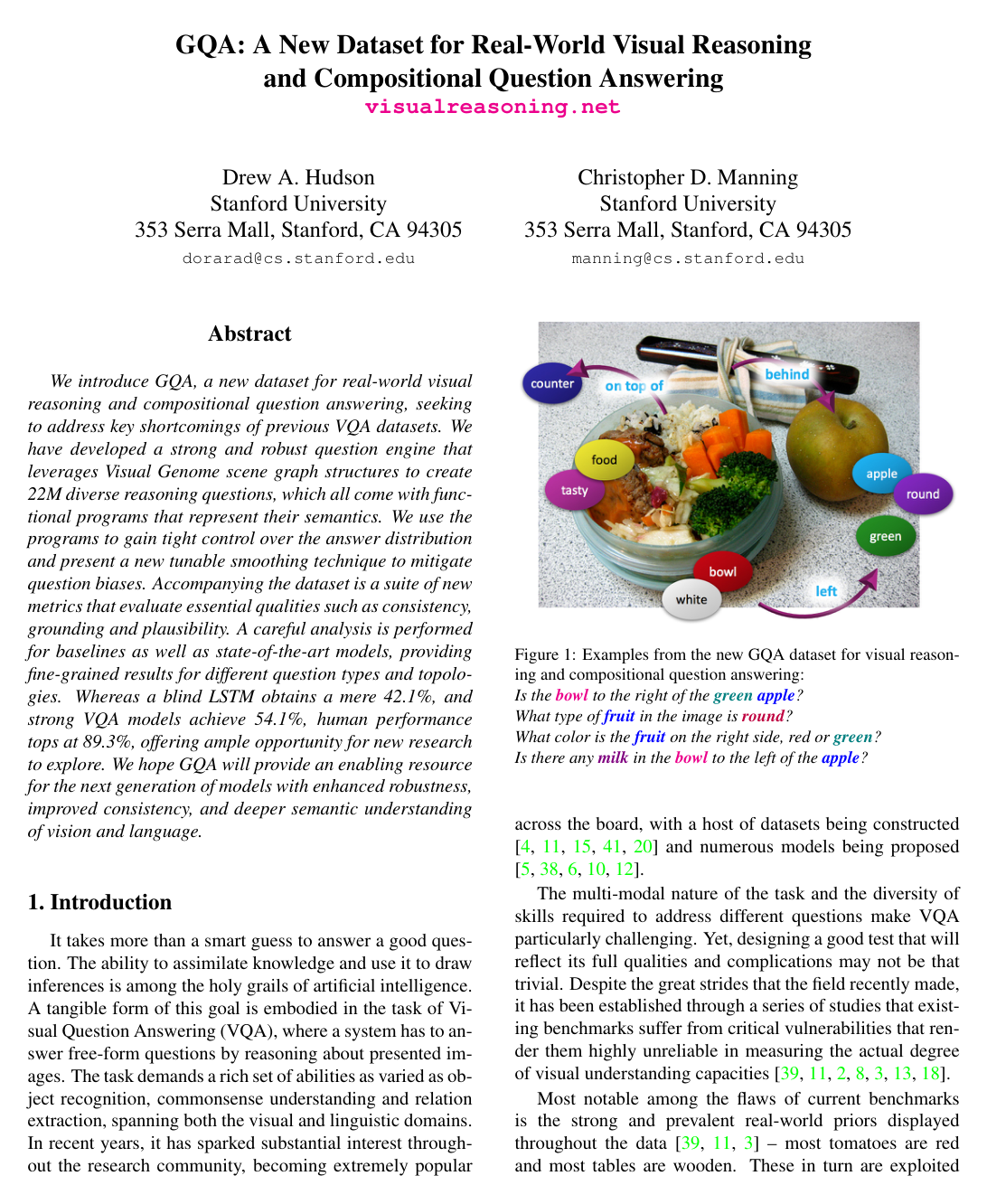
GQA: A New Dataset for Real-World Visual Reasoning and Compositional Question Answering
Drew A. Hudson, Christopher D. Manning
Why you should read this
Introduces GQA, a visual reasoning benchmark of 22 million compositional questions generated from real-world scene graphs with functional programs, enabling diagnostic evaluation of visual grounding, consistency, and multi-step reasoning while mitigating question bias.
We introduce GQA, a new dataset for real-world visual reasoning and compositional question answering, seeking to address key shortcomings of previous VQA datasets. We have developed a strong and robust question engine that leverages scene graph structures to create 22M diverse reasoning questions, all come with functional programs that represent their semantics. We use the programs to gain tight control over the answer distribution and present a new tunable smoothing technique to mitigate question biases. Accompanying the dataset is a suite of new metrics that evaluate essential qualities such as consistency, grounding and plausibility. An extensive analysis is performed for baselines as well as state-of-the-art models, providing fine-grained results for different question types and topologies. Whereas a blind LSTM obtains mere 42.1%, and strong VQA models achieve 54.1%, human performance tops at 89.3%, offering ample opportunity for new research to explore. We strongly hope GQA will provide an enabling resource for the next generation of models with enhanced robustness, improved consistency, and deeper semantic understanding for images and language.
Added
2026-09-11
Retrieval-Augmented Generation for Knowledge-Intensive NLP Tasks
Patrick Lewis, Ethan Perez, Aleksandra Piktus, Fabio Petroni, Vladimir Karpukhin, Naman Goyal, Heinrich Küttler, Mike Lewis, Wen-tau Yih, Tim Rocktäschel, Sebastian Riedel, Douwe Kiela
Why you should read this
Proposes the definitive retrieval-augmented architecture linking a pre-trained retriever with a sequence-to-sequence generator trained end-to-end to mitigate hallucinations.
Large pre-trained language models have been shown to store factual knowledge in their parameters, and achieve state-of-the-art results when fine-tuned on downstream NLP tasks. However, their ability to access and precisely manipulate knowledge is still limited, and hence on knowledge-intensive tasks, their performance lags behind task-specific architectures. Additionally, providing provenance for their decisions and updating their world knowledge remain open research problems. Pre-trained models with a differentiable access mechanism to explicit non-parametric memory can overcome this issue, but have so far been only investigated for extractive downstream tasks. We explore a general-purpose fine-tuning recipe for retrieval-augmented generation (RAG) -- models which combine pre-trained parametric and non-parametric memory for language generation. We introduce RAG models where the parametric memory is a pre-trained seq2seq model and the non-parametric memory is a dense vector index of Wikipedia, accessed with a pre-trained neural retriever. We compare two RAG formulations, one which conditions on the same retrieved passages across the whole generated sequence, the other can use different passages per token. We fine-tune and evaluate our models on a wide range of knowledge-intensive NLP tasks and set the state-of-the-art on three open domain QA tasks, outperforming parametric seq2seq models and task-specific retrieve-and-extract architectures. For language generation tasks, we find that RAG models generate more specific, diverse and factual language than a state-of-the-art parametric-only seq2seq baseline.
Added
2026-02-14