GQA: A New Dataset for Real-World Visual Reasoning and Compositional Question Answering
Drew A. HudsonChristopher D. Manning
Introduces GQA, a visual reasoning benchmark of 22 million compositional questions generated from real-world scene graphs with functional programs, enabling diagnostic evaluation of visual grounding, consistency, and multi-step reasoning while mitigating question bias.
The GQA dataset was created to overcome critical weaknesses in earlier visual question answering benchmarks, where models often relied on statistical shortcuts such as common object-color associations rather than genuine scene understanding, and where simple questions rarely demanded multi-step reasoning. The work therefore set out to produce a large-scale resource of real-world images paired with compositional questions that come with explicit semantic representations, allowing tighter control over answer distributions and finer-grained evaluation of model behavior.
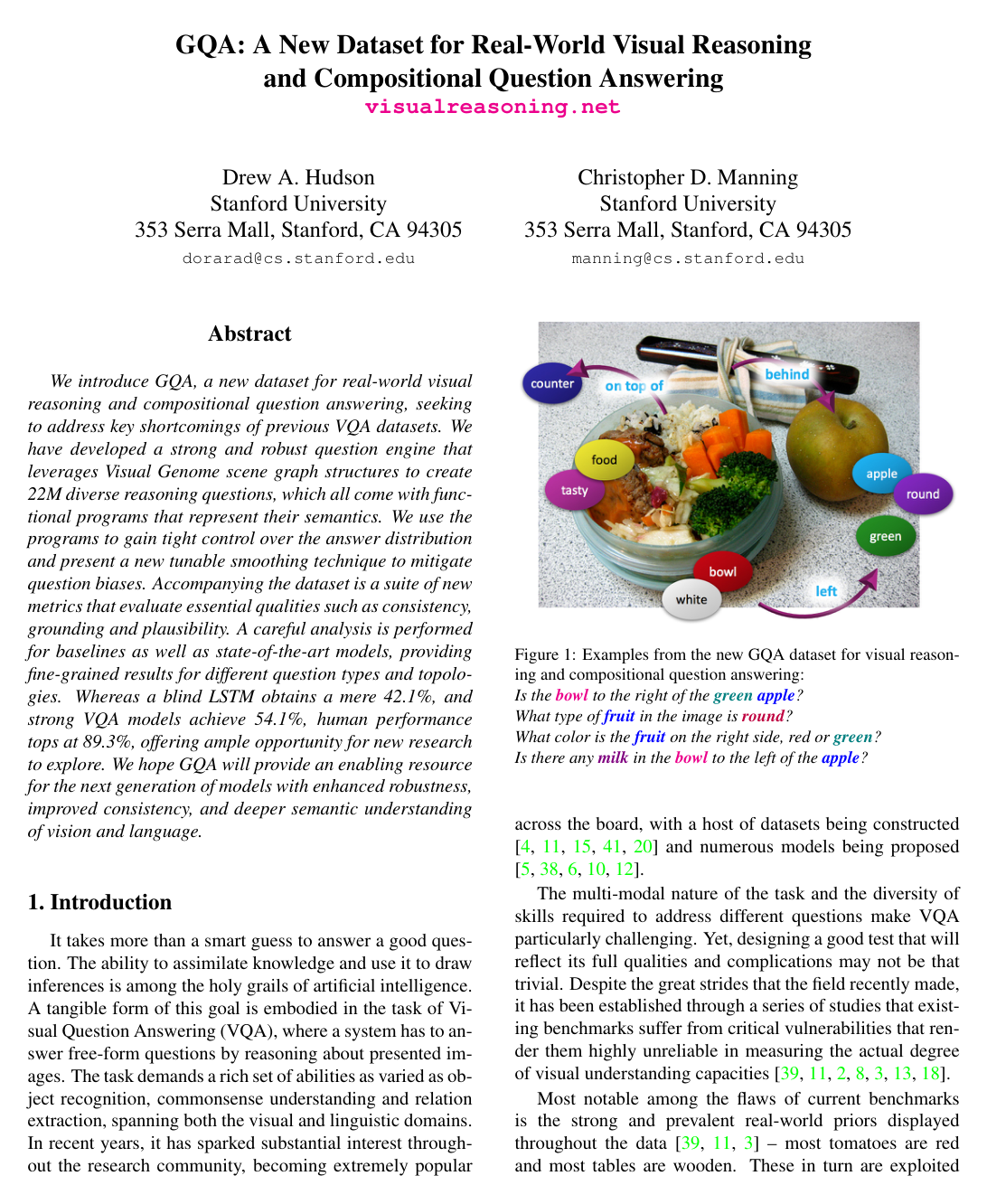
The authors built the dataset from Visual Genome scene graphs covering 113,000 images. They normalized the graphs into a clean ontology, then used an engine of 524 linguistic patterns to generate 22 million questions whose semantics are captured by functional programs. These programs enabled rejection sampling that smoothed answer distributions both globally and locally while preserving real-world tendencies, yielding a final balanced set of 1.7 million questions. The same representations supported five new evaluation metrics that measure consistency across entailed questions, answer validity and plausibility, grounding of attention, and fidelity to the overall answer distribution.
Baseline and state-of-the-art models reached 42–54 percent accuracy, while human performance reached 89 percent. Even the strongest models contradicted themselves on roughly one in five entailed questions and produced implausible answers at least 5–15 percent of the time. Accuracy rose with textual question length yet fell with semantic depth, and models benefited substantially from object-level rather than spatial visual features. Transfer experiments showed that training on GQA improved results on the VQA dataset, indicating that the new questions retain realism while posing a stricter test.
These results demonstrate that current systems still fall short of coherent, grounded reasoning and that accuracy alone masks important failure modes. The dataset therefore supplies both a more reliable benchmark and direct supervision signals—functional programs and visual pointers—that can guide development of models with greater consistency and transparency.
Further progress will require architectures that integrate visual knowledge extraction with multi-step reasoning and that explicitly enforce consistency across related questions. Larger training regimes and richer scene-graph annotations are also likely to help. The main limitations are that questions are automatically generated rather than crowdsourced in free form and that performance remains bounded by the coverage and accuracy of the underlying scene graphs; both factors should be considered when interpreting absolute scores.
- Paper: VQA: Visual Question Answering, Stanislaw Antol et al. (2015). Understanding the foundational Visual Question Answering (VQA) task and its initial dataset design is essential before exploring the GQA benchmark's efforts to address VQA's core limitations.
- Paper: Making the V in VQA Matter: Elevating the Role of Image Understanding in Visual Question Answering, Yash Goyal et al. (2016). Reviewing the critique of language biases in VQA v2.0 provides crucial context for GQA's motivation to construct balanced reasoning datasets and tunable smoothing techniques.
- Paper: Visual Genome: Connecting Language and Vision Using Crowdsourced Dense Image Annotations, Ranjay Krishna et al. (2016). Familiarity with the Visual Genome dataset's dense scene graph annotations is a prerequisite for understanding how GQA leverages scene graphs to generate its compositional questions.
- Paper: LXMERT: Learning Cross-Modality Encoder Representations from Transformers, Hao Tan et al. (2019). LXMERT extends the visual reasoning concepts introduced in GQA by pre-training cross-modality Transformer representations on massive vision-language datasets.