
keyword
quantization-aware training
Quantization-aware training is a neural network optimization and compression technique that simulates the effects of low-precision numerical representation during the training or fine-tuning process. By modeling quantization errors and clipping thresholds during the forward pass, the network learns to adjust its parameters to compensate for the precision loss that occurs when converting high-precision floating-point weights and activations into low-bit formats, such as integer representations. Because standard quantization functions are piecewise constant and non-differentiable, the optimization relies on gradient approximation methods, such as the straight-through estimator, to update the underlying parameters through backpropagation. This approach enables deep learning models to achieve significant reductions in memory footprint, computational overhead, and latency during hardware deployment while retaining higher task accuracy than methods applied solely after training.
10 items
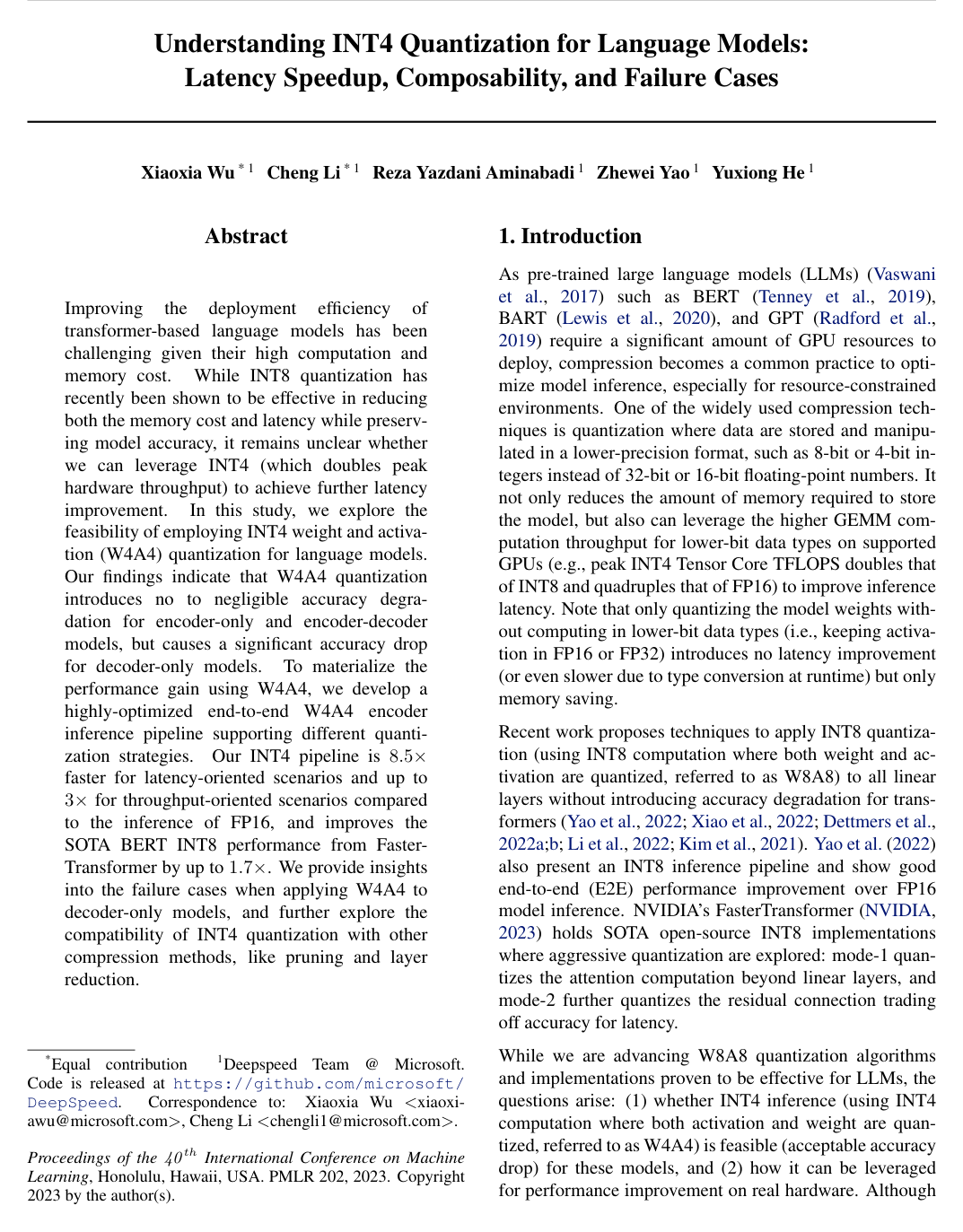
Understanding Int4 Quantization for Language Models: Latency Speedup, Composability, and Failure Cases
Xiaoxia Wu, Cheng Li, Reza Yazdani Aminabadi, Zhewei Yao, Yuxiong He
Why you should read this
Evaluates the feasibility of 4-bit weight and activation quantization across diverse transformer architectures, delivering an end-to-end inference pipeline that achieves up to an 8.5× speedup for encoder models while analyzing the root causes of accuracy degradation in decoder-only models.
Improving the deployment efficiency of transformer-based language models has been challenging given their high computation and memory cost. While INT8 quantization has recently been shown to be effective in reducing both the memory cost and latency while preserving model accuracy, it remains unclear whether we can leverage INT4 (which doubles peak hardware throughput) to achieve further latency improvement. In this study, we explore the feasibility of employing INT4 weight and activation (W4A4) quantization for language models. Our findings indicate that W4A4 quantization introduces no to negligible accuracy degradation for encoder-only and encoder-decoder models, but causes a significant accuracy drop for decoder-only models. To materialize the performance gain using W4A4, we develop a highly-optimized end-to-end W4A4 encoder inference pipeline supporting different quantization strategies. Our INT4 pipeline is 8.5× faster for latency-oriented scenarios and up to 3× for throughput-oriented scenarios compared to the inference of FP16, and improves the SOTA BERT INT8 performance from Faster-Transformer by up to 1.7×. We provide insights into the failure cases when applying W4A4 to decoder-only models, and further explore the compatibility of INT4 quantization with other compression methods, like pruning and layer reduction.
Added
2026-10-05
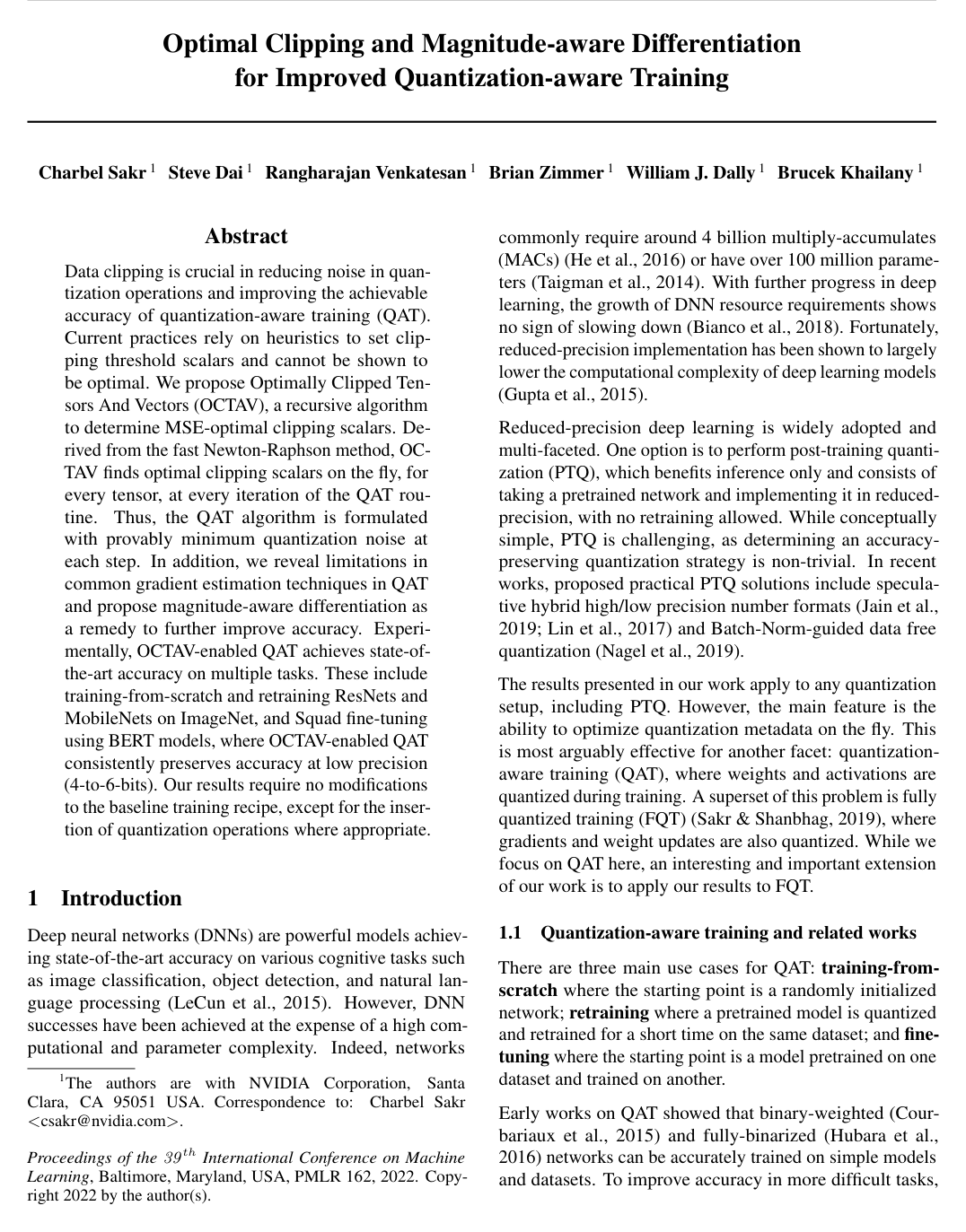
Optimal Clipping and Magnitude-aware Differentiation for Improved Quantization-aware Training
Charbel Sakr, Steve Dai, Rangharajan Venkatesan, Brian Zimmer, William J. Dally, Brucek Khailany
Why you should read this
Proposes a fast Newton-Raphson-based algorithm to dynamically compute MSE-optimal clipping scalars alongside magnitude-aware differentiation, achieving state-of-the-art accuracy in low-precision quantization-aware training without altering standard baseline hyperparameters.
Data clipping is crucial in reducing noise in quantization operations and improving the achievable accuracy of quantization-aware training (QAT). Current practices rely on heuristics to set clipping threshold scalars and cannot be shown to be optimal. We propose Optimally Clipped Tensors And Vectors (OCTAV), a recursive algorithm to determine MSE-optimal clipping scalars. Derived from the fast Newton-Raphson method, OCTAV finds optimal clipping scalars on the fly, for every tensor, at every iteration of the QAT routine. Thus, the QAT algorithm is formulated with provably minimum quantization noise at each step. In addition, we reveal limitations in common gradient estimation techniques in QAT and propose magnitude-aware differentiation as a remedy to further improve accuracy. Experimentally, OCTAV-enabled QAT achieves state-of-the-art accuracy on multiple tasks. These include training-from-scratch and retraining ResNets and MobileNets on ImageNet, and Squad fine-tuning using BERT models, where OCTAV-enabled QAT consistently preserves accuracy at low precision (4-to-6-bits). Our results require no modifications to the baseline training recipe, except for the insertion of quantization operations where appropriate.
Added
2026-10-03
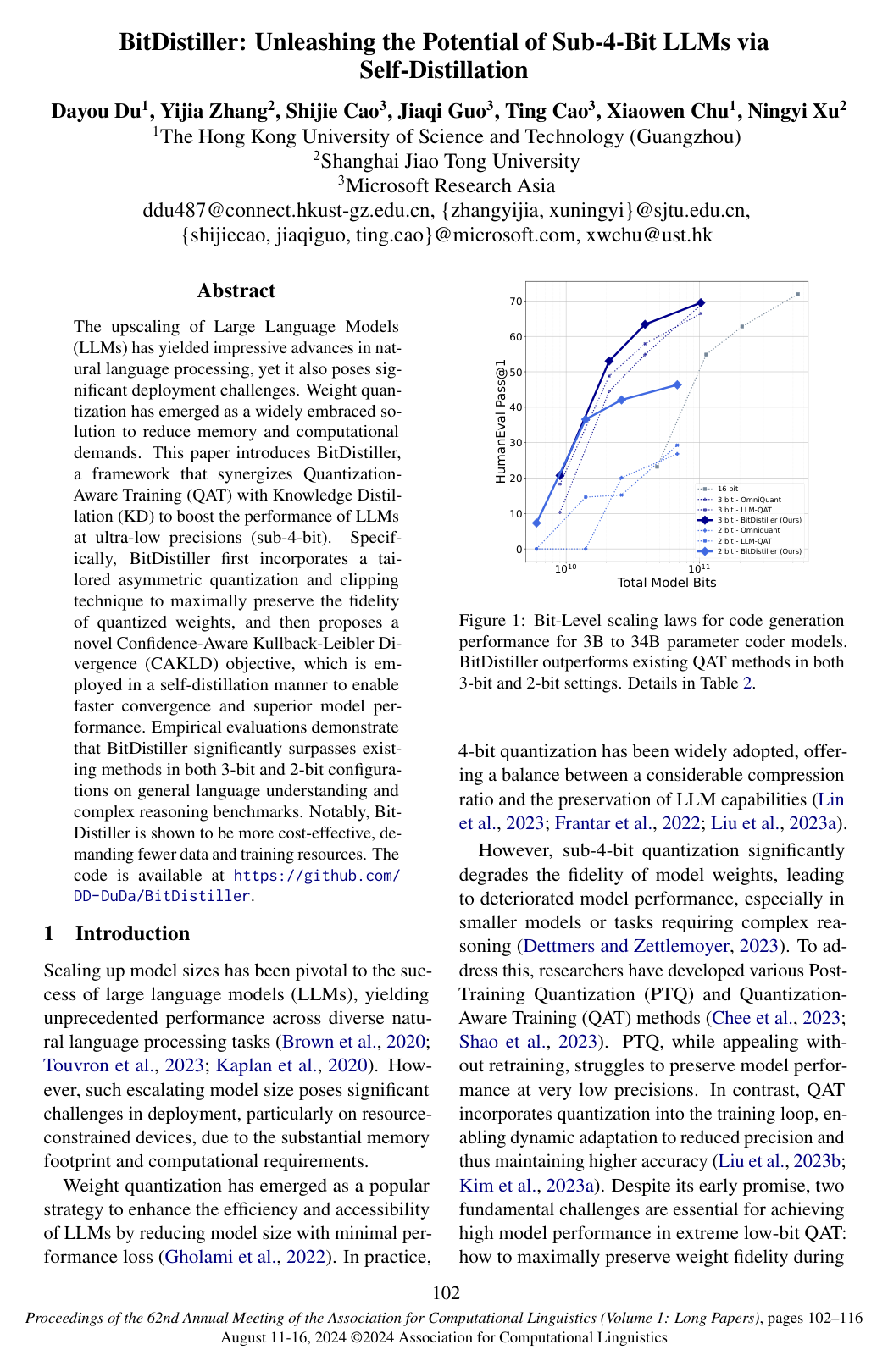
BitDistiller: Unleashing the Potential of Sub-4-Bit LLMs via Self-Distillation
Dayou Du, Yijia Zhang, Shijie Cao, Jiaqi Guo, Ting Cao, Xiaowen Chu, Ningyi Xu
Why you should read this
Proposes a self-distillation framework combining asymmetric clipping with a confidence-aware loss to train accurate 2-bit and 3-bit large language models using minimal compute and data.
The upscaling of Large Language Models (LLMs) has yielded impressive advances in natural language processing, yet it also poses significant deployment challenges. Weight quantization has emerged as a widely embraced solution to reduce memory and computational demands. This paper introduces BitDistiller, a framework that synergizes Quantization-Aware Training (QAT) with Knowledge Distillation (KD) to boost the performance of LLMs at ultra-low precisions (sub-4-bit). Specifically, BitDistiller first incorporates a tailored asymmetric quantization and clipping technique to maximally preserve the fidelity of quantized weights, and then proposes a novel Confidence-Aware Kullback-Leibler Divergence (CAKLD) objective, which is employed in a self-distillation manner to enable faster convergence and superior model performance. Empirical evaluations demonstrate that BitDistiller significantly surpasses existing methods in both 3-bit and 2-bit configurations on general language understanding and complex reasoning benchmarks. Notably, BitDistiller is shown to be more cost-effective, demanding fewer data and training resources. The code is available at https://github.com/DD-DuDa/BitDistiller.
Added
2026-09-26
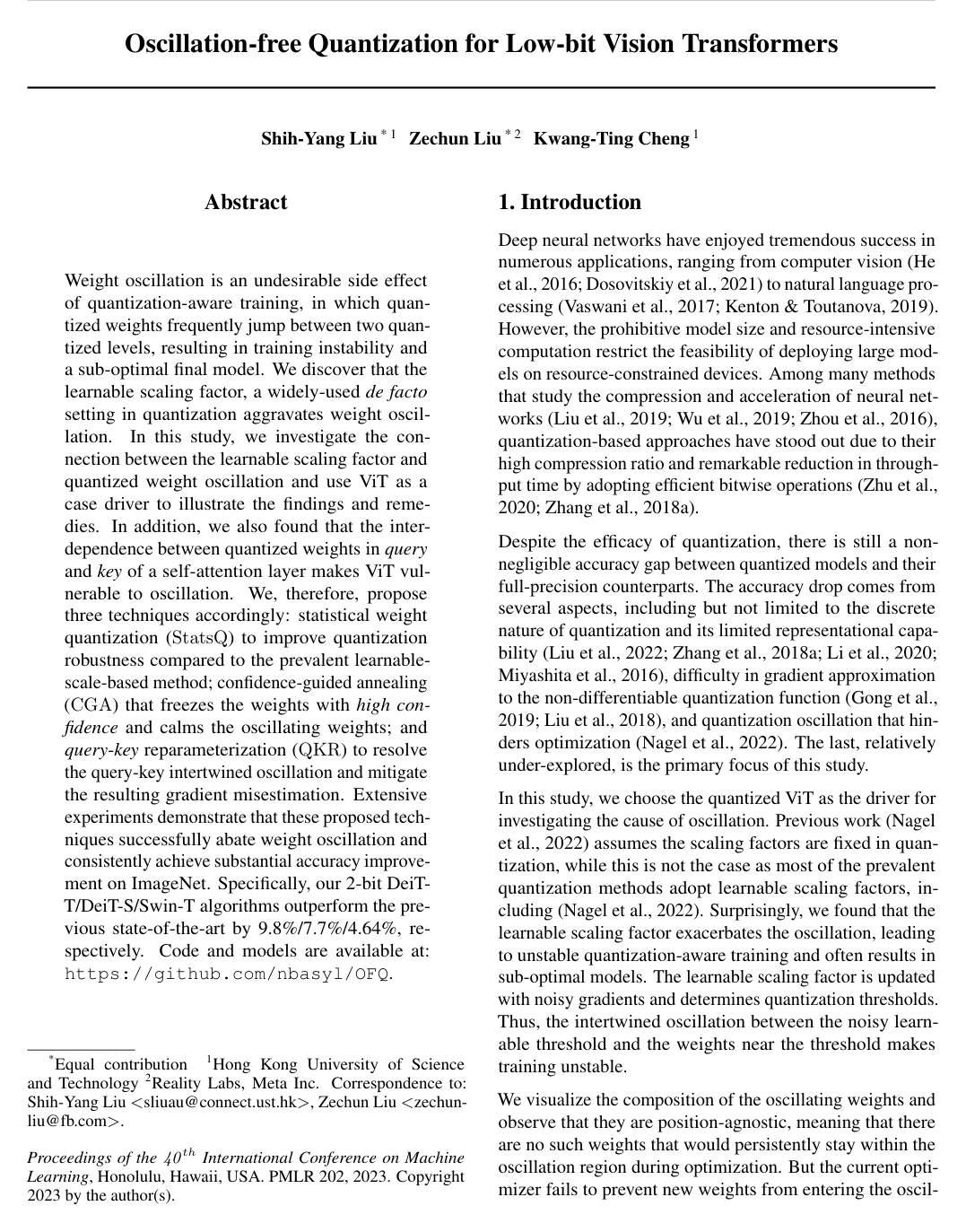
Oscillation-free Quantization for Low-bit Vision Transformers
Shih-Yang Liu, Zechun Liu, Kwang-Ting Cheng
Why you should read this
Develops statistical weight quantization, confidence-guided annealing, and query-key reparameterization to eliminate weight oscillation in quantization-aware training, significantly closing the accuracy gap between low-bit Vision Transformers and their full-precision counterparts on ImageNet.
Weight oscillation is an undesirable side effect of quantization-aware training, in which quantized weights frequently jump between two quantized levels, resulting in training instability and a sub-optimal final model. We discover that the learnable scaling factor, a widely-used de facto setting in quantization aggravates weight oscillation. In this study, we investigate the connection between the learnable scaling factor and quantized weight oscillation and use ViT as a case driver to illustrate the findings and remedies. In addition, we also found that the interdependence between quantized weights in query and key of a self-attention layer makes ViT vulnerable to oscillation. We, therefore, propose three techniques accordingly: statistical weight quantization (StatsQ) to improve quantization robustness compared to the prevalent learnable-scale-based method; confidence-guided annealing (CGA) that freezes the weights with high confidence and calms the oscillating weights; and query-key reparameterization (QKR) to resolve the query-key intertwined oscillation and mitigate the resulting gradient misestimation. Extensive experiments demonstrate that these proposed techniques successfully abate weight oscillation and consistently achieve substantial accuracy improvement on ImageNet. Specifically, our 2-bit DeiT-T/DeiT-S/Swin-T algorithms outperform the previous state-of-the-art by 9.8%/7.7%/4.64%, respectively. Code and models are available at: https://github.com/nbasyl/OFQ.
Added
2026-09-26
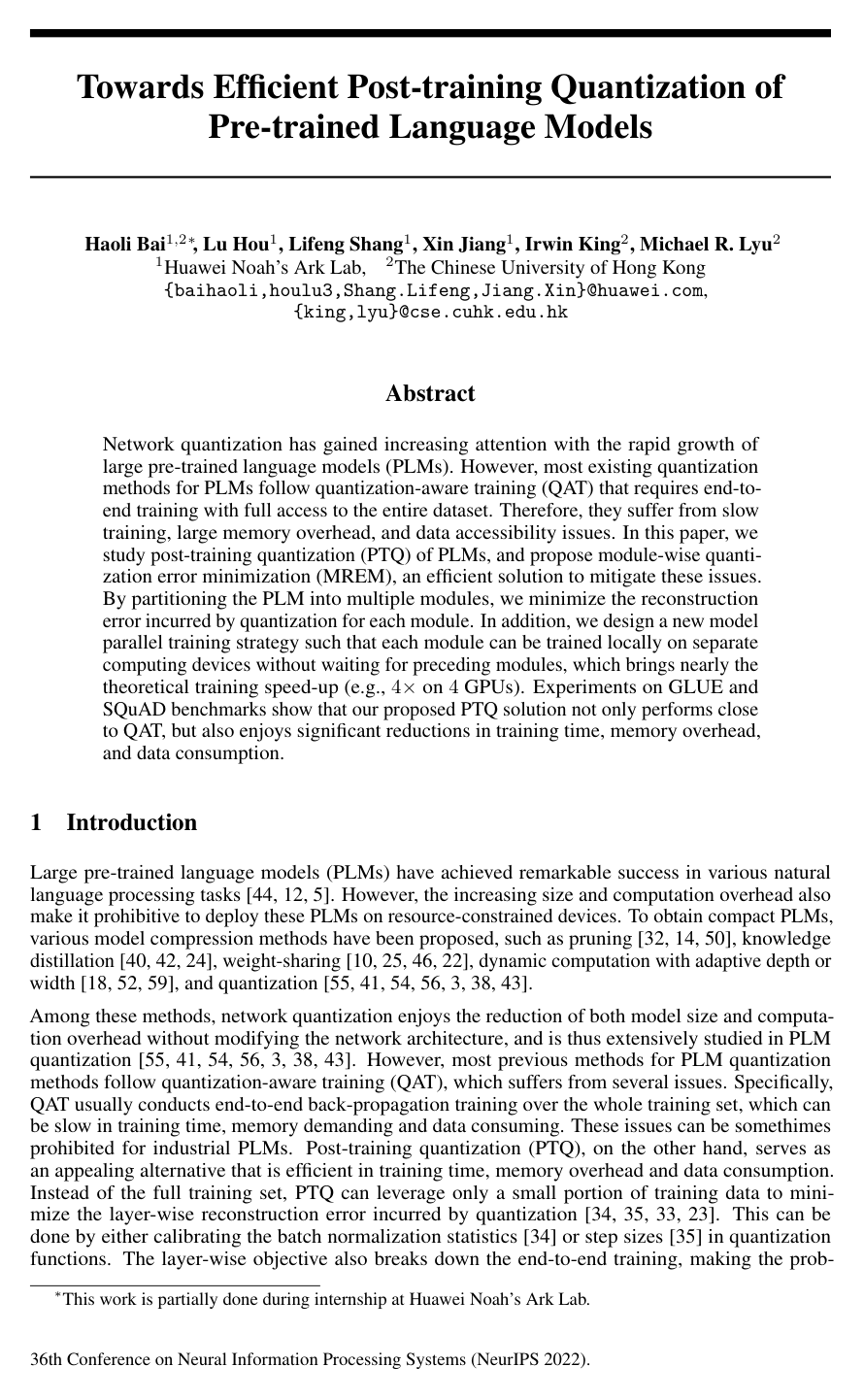
Towards Efficient Post-training Quantization of Pre-trained Language Models
Haoli Bai, Lu Hou, Lifeng Shang, Xin Jiang, Irwin King, Michael R. Lyu
Why you should read this
Proposes a parallel module-wise reconstruction error minimization framework that enables fast, memory-efficient post-training quantization for large language models while achieving accuracy competitive with full quantization-aware training.
Network quantization has gained increasing attention with the rapid growth of large pre-trained language models (PLMs). However, most existing quantization methods for PLMs follow quantization-aware training (QAT) that requires end-to-end training with full access to the entire dataset. Therefore, they suffer from slow training, large memory overhead, and data accessibility issues. In this paper, we study post-training quantization (PTQ) of PLMs, and propose module-wise quantization error minimization (MREM), an efficient solution to mitigate these issues. By partitioning the PLM into multiple modules, we minimize the reconstruction error incurred by quantization for each module. In addition, we design a new model parallel training strategy such that each module can be trained locally on separate computing devices without waiting for preceding modules, which brings nearly the theoretical training speed-up (e.g., 4× on 4 GPUs). Experiments on GLUE and SQuAD benchmarks show that our proposed PTQ solution not only performs close to QAT, but also enjoys significant reductions in training time, memory overhead, and data consumption.
Added
2026-09-26
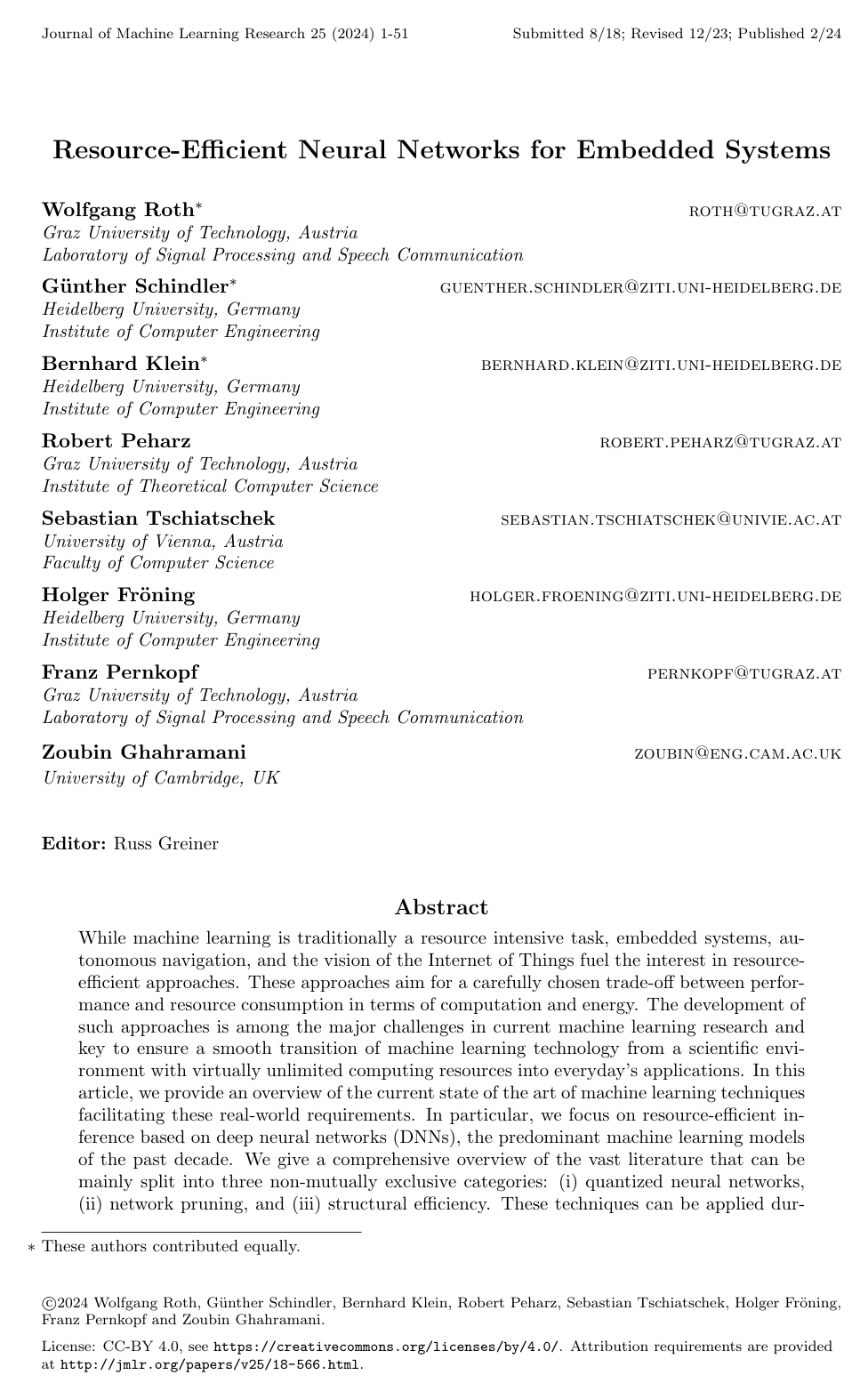
Resource-Efficient Neural Networks for Embedded Systems
Wolfgang Roth, Günther Schindler, Bernhard Klein, Robert Peharz, Sebastian Tschiatschek, Holger Fröning, Franz Pernkopf, Zoubin Ghahramani
Why you should read this
Presents a systematic review and empirical analysis of deep neural network optimization techniques, including quantization, pruning, and structural efficiency, to guide the trade-offs between prediction accuracy, latency, and energy consumption across embedded CPUs, GPUs, and FPGAs.
While machine learning is traditionally a resource intensive task, embedded systems, autonomous navigation, and the vision of the Internet of Things fuel the interest in resource-efficient approaches. These approaches aim for a carefully chosen trade-off between performance and resource consumption in terms of computation and energy. The development of such approaches is among the major challenges in current machine learning research and key to ensure a smooth transition of machine learning technology from a scientific environment with virtually unlimited computing resources into everyday’s applications. In this article, we provide an overview of the current state of the art of machine learning techniques facilitating these real-world requirements. In particular, we focus on resource-efficient inference based on deep neural networks (DNNs), the predominant machine learning models of the past decade. We give a comprehensive overview of the vast literature that can be mainly split into three non-mutually exclusive categories: (i) quantized neural networks, (ii) network pruning, and (iii) structural efficiency. These techniques can be applied dur-
Added
2026-09-26
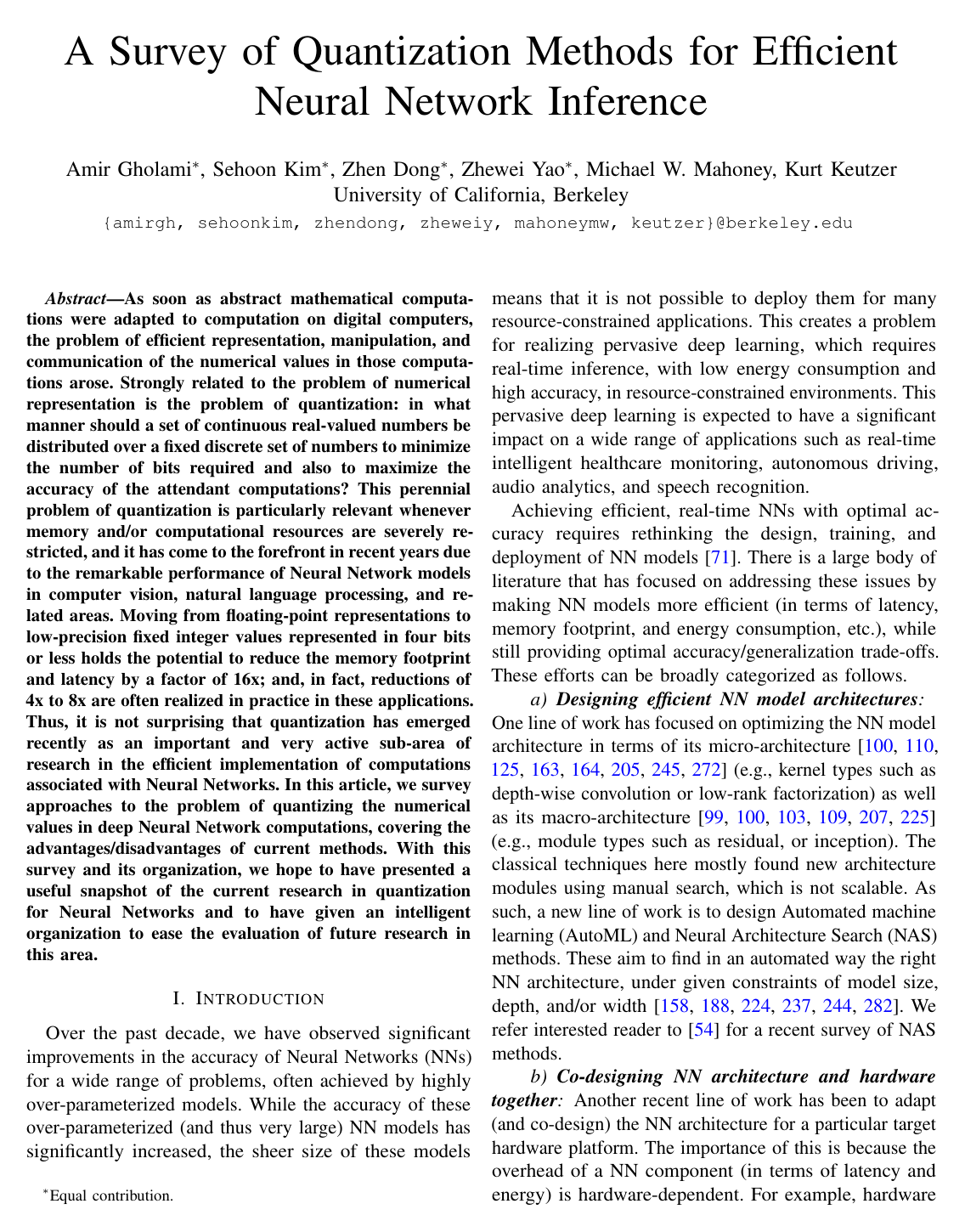
A Survey of Quantization Methods for Efficient Neural Network Inference
Amir Gholami, Sehoon Kim, Zhen Dong, Zhewei Yao, Michael W. Mahoney, Kurt Keutzer
Why you should read this
Categorizes the fundamental concepts and practical trade-offs of neural network quantization methods, providing a structured overview of how low-precision integer representations reduce memory footprint and latency during inference without sacrificing model accuracy.
As soon as abstract mathematical computations were adapted to computation on digital computers, the problem of efficient representation, manipulation, and communication of the numerical values in those computations arose. Strongly related to the problem of numerical representation is the problem of quantization: in what manner should a set of continuous real-valued numbers be distributed over a fixed discrete set of numbers to minimize the number of bits required and also to maximize the accuracy of the attendant computations? This perennial problem of quantization is particularly relevant whenever memory and/or computational resources are severely restricted, and it has come to the forefront in recent years due to the remarkable performance of Neural Network models in computer vision, natural language processing, and related areas. Moving from floating-point representations to low-precision fixed integer values represented in four bits or less holds the potential to reduce the memory footprint and latency by a factor of 16x; and, in fact, reductions of 4x to 8x are often realized in practice in these applications. Thus, it is not surprising that quantization has emerged recently as an important and very active sub-area of research in the efficient implementation of computations associated with Neural Networks. In this article, we survey approaches to the problem of quantizing the numerical values in deep Neural Network computations, covering the advantages/disadvantages of current methods. With this survey and its organization, we hope to have presented a useful snapshot of the current research in quantization for Neural Networks and to have given an intelligent organization to ease the evaluation of future research in this area.
Added
2026-09-24
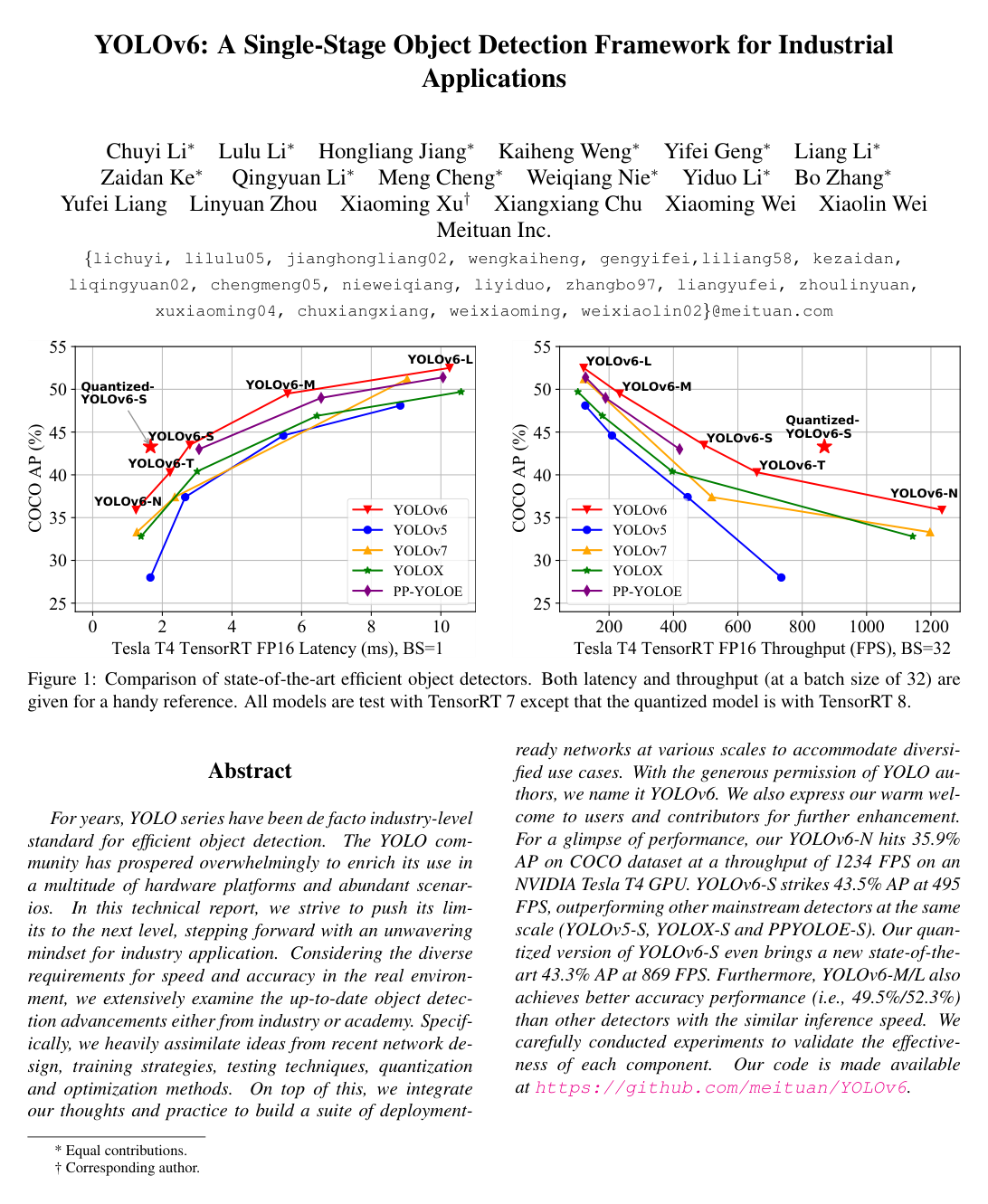
YOLOv6: A Single-Stage Object Detection Framework for Industrial Applications
Chuyi Li, Lulu Li, Hongliang Jiang, Kaiheng Weng, Yifei Geng, Liang Li, Zaidan Ke, Qingyuan Li, Meng Cheng, Weiqiang Nie, Yiduo Li, Bo Zhang, Yufei Liang, Linyuan Zhou, Xiaoming Xu, Xiangxiang Chu, Xiaoming Wei, Xiaolin Wei
Why you should read this
Introduces YOLOv6, a deployment-oriented object detection framework that integrates advanced network design, training strategies, and quantization techniques to achieve superior speed-accuracy trade-offs over existing YOLO architectures across varied hardware scales.
For years, the YOLO series has been the de facto industry-level standard for efficient object detection. The YOLO community has prospered overwhelmingly to enrich its use in a multitude of hardware platforms and abundant scenarios. In this technical report, we strive to push its limits to the next level, stepping forward with an unwavering mindset for industry application. Considering the diverse requirements for speed and accuracy in the real environment, we extensively examine the up-to-date object detection advancements either from industry or academia. Specifically, we heavily assimilate ideas from recent network design, training strategies, testing techniques, quantization, and optimization methods. On top of this, we integrate our thoughts and practice to build a suite of deployment-ready networks at various scales to accommodate diversified use cases. With the generous permission of YOLO authors, we name it YOLOv6. We also express our warm welcome to users and contributors for further enhancement. For a glimpse of performance, our YOLOv6-N hits 35.9% AP on the COCO dataset at a throughput of 1234 FPS on an NVIDIA Tesla T4 GPU. YOLOv6-S strikes 43.5% AP at 495 FPS, outperforming other mainstream detectors at the same scale~(YOLOv5-S, YOLOX-S, and PPYOLOE-S). Our quantized version of YOLOv6-S even brings a new state-of-the-art 43.3% AP at 869 FPS. Furthermore, YOLOv6-M/L also achieves better accuracy performance (i.e., 49.5%/52.3%) than other detectors with a similar inference speed. We carefully conducted experiments to validate the effectiveness of each component. Our code is made available at this https URL.
Added
2026-09-17
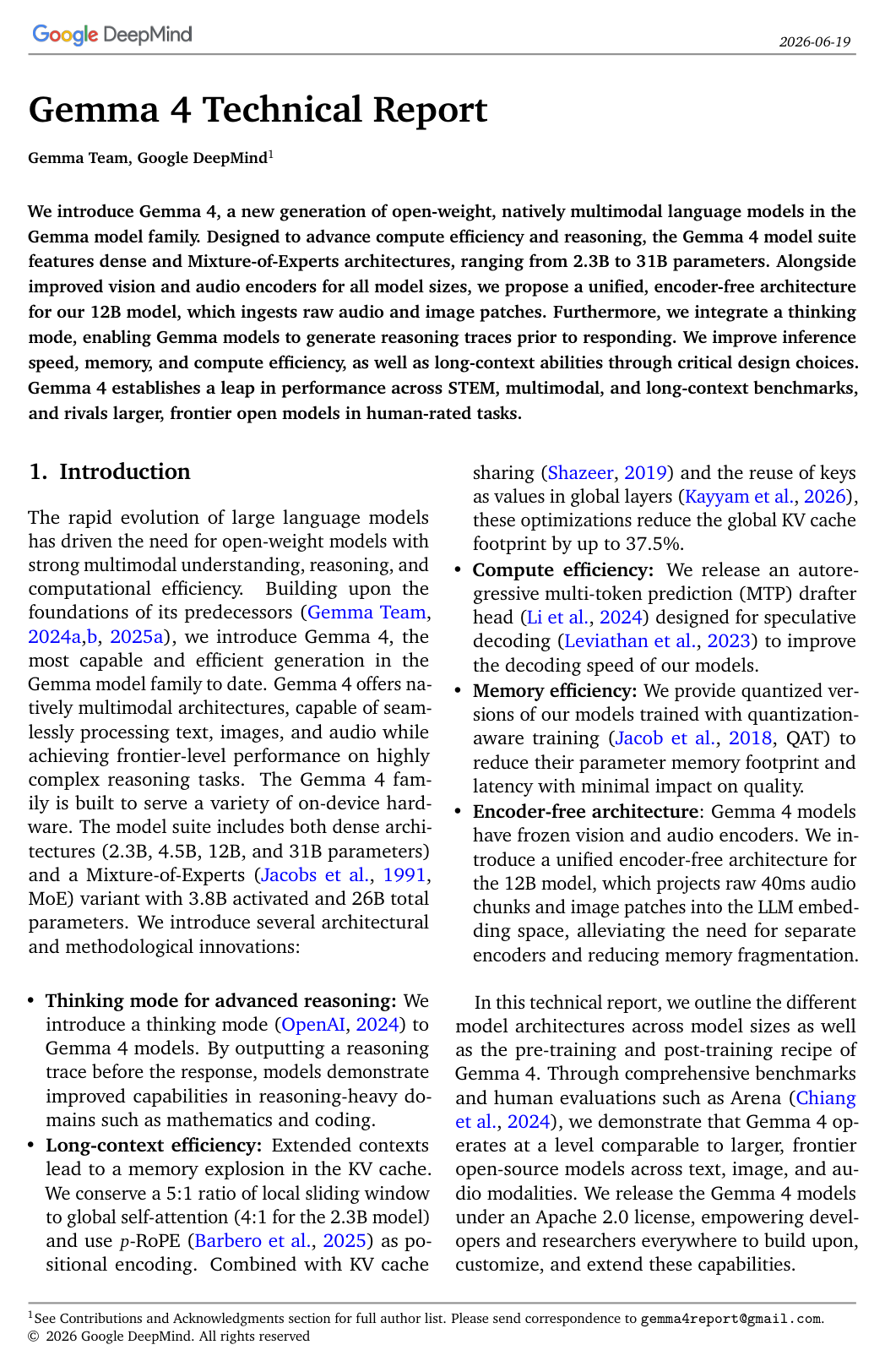
Gemma 4 Technical Report
Gemma Team, Sherif El Abd, Vaibhav Aggarwal, Robin Algayres, Alek Andreev, Olivier Bachem, Ian Ballantyne, Cormac Brick, Victor Cărbune, Michelle Casbon, Mayank Chaturvedi, Victor Cotruta, Alice Coucke, Phil Culliton, Robert Dadashi, Lucas Dixon, Mohamed Elhawaty, Utku Evci, Clément Farabet, Johan Ferret, Filippo Galgani, Sertan Girgin, Jean-Bastien Grill, Maarten Grootendorst, Jiaxian Guo, Cassidy Hardin, Yanzhang He, Steven M. Hernandez, Omri Homburger, Léonard Hussenot, Juyeong Ji, Armand Joulin, Aishwarya Kamath, Parnian Kassraie, Olivier Lacombe, Preethi Lahoti, Gaël Liu, Gus Martins, Luciano Martins, Tatiana Matejovicova, Ramona Merhej, Nikola Momchev, Sneha Mondal, Ryan Mullins, Sindhu Raghuram Panyam, Shreya Pathak, Sarah Perrin, André Susano Pinto, Etienne Pot, Angéline Pouget, Alexandre Ramé, Sabela Ramos, Douglas Reid, David Rim, Morgane Rivière, Karsten Roth, Louis Rouillard, Omar Sanseviero, Pier Giuseppe Sessa, Shane Settle, Danila Sinopalnikov, Sara Smoot, Piotr Stanczyk, Andreas Steiner, Lawrence Stewart, Ilya Tolstikhin, Michael Tschannen, Anton Tsitsulin, Nino Vieillard, Renjie Wu, Pingmei Xu, Haichuan Yang, Edouard Yvinec, Li Zhang, Joe Zou, Nicolas Aagnes, Abdelrahman Abdelhamed, Shivani Agrawal, Shubham Agrawal, Ibrahim Alabdulmohsin, Jean Baptiste Alayrac, Uri Alon, Chandramouli Amarnath, Ankesh Anand, Chrysovalantis Anastasiou, Setareh Ariafar, François-Xavier Aubet, Kyriakos Axiotis, Federico Barbero, Joelle Barral, Alexei Bendebury, Urs Bergmann, Stanley Bileschi, Kat Black, Mathieu Blondel, Sebastian Borgeaud, Arthur Bražinskas, Ryan Burnell, Robert Busa-Fekete, Mu Cai, Glenn Cameron, Charlotte Caucheteux, Garima Chadha, Jetha Chan, Aditya Chawla, Blake Jianhang Chen, Jesse Chen, Lin Chen, Xu Chen, Derek Cheng, Tzu-hsiang Chien, Nikolai Chinaev, Yi Chou, Zhaohui Chu, Benjamin Coleman, Pooja Consul, Sam Conway-Rahman, Scott Crowell, Dylan Cutler, Vivek Dani, Samira Daruki, Anil Das, Daniel Deutsch, Nishanth Dikkala, Li Ding, Qiuhan Ding, Shenil Dodhia, Konstantin Donhauser, Tulsee Doshi, Anca Dragan, Alex Druinsky, Sahil Dua, Zoltan Egyed, Danielle Eisenbud, Daniel Eppens, Cindy Fan, Bahare Fatemi, Yassir Fathullah, Vlad Feinberg, Milen Ferev, Takumi Fujimoto, Isaac Galatzer-Levy, João Gante, Simon Geisler, Soham Ghosal, Antonious M. Girgis, Alec Go, Alhaad Gokhale, Alex Grills, Yiming Gu, Pramod Gupta, Guru Guruganesh, Raia Hadsell, Hamza Harkous, Jitendra Harlalka, Demis Hassabis, Anja Hauth, Joe Heyward, Arian Hosseini, Chih-Yang Hsia, I-Hung Hsu, Xiaopeng Huang, Yangsibo Huang, Kevin Hui, Adrian Hutter, Te I, Fotis Iliopoulos, Advait Jain, Ganesh Jawahar, Ziwei Ji, Qilin Jin, Melvin Johnson, Kandarp Joshi, Arun Kandoor, Wang-Cheng Kang, Koray Kavukcuoglu, Mehran Kazemi, Kathleen Kenealy, Amr Khalifa, Phoebe Kirk, Suraj Kothawade, Vitaly Kovalev, Neel Kovelamudi, Adam Kraft, Ravin Kumar, Harish Kuppam, Justin Lannin, Chen-Yu Lee, Seungji Lee, Dmitry Lepikhin, Dongdong Li, Qiujia Li, Valentin Liévin, Ethan Lin, Ziqian Lin, Casper Liu, Tianlin Liu, Tianqi Liu, Xin Liu, Mayank Lunayach, Min Ma, Gagan Madan, Andrii Maksai, Eric Malmi, Michal Matuszak, Daniel McDuff, Gaurav Menghani, Daniil Mirylenka, Karolis Misiunas, Vedant Misra, Andreea Mitran, Kareem Mohamed, Maksim Mukha, Eric Noland, James O'Donnell, Kate Olszewska, Bernett Orlando, Wanqiong Pan, Rina Panigrahy, Unnati Parekh, Chunjong Park, Eric Paskie, Liqian Peng, Bryce Petrini, Slav Petrov, Jonas Pfeiffer, Bilal Piot, Martyna Plomecka, Siim Poder, Octavio Ponce, Arijit Pramanik, David Racz, Anish Rajan, Michelle Ramanovich, Anand Rao, Marvin Ritter, Vitor Rodrigues, Evan Rosen, Mikołaj Rybiński, Noveen Sachdeva, Michaël E. Sander, Rohit Sathyanarayana, Sagar Savla, Samuel Schmidgall, Tal Schuster, Benoit Seguin, Andrew Sellergren, Aliaksei Severyn, Izhak Shafran, Dhruv Shah, Yuan Shangguan, Ashish Shenoy, Pradeep Shenoy, Rakesh Shivanna, Pauline Sho, Lucas Spangher, Wojciech Stokowiec, Tim Strother, Yao Su, Yinghao Sun, Mukund Sundararajan, Andrea Tacchetti, Mor Hazan Taege, Pouya Tafti, Chetan Tekur, Rahul Thapa, Madeleine Traverse, Lenart Treven, Tao Tu, Chien Te Tung, Petar Veličković, Malini Pooni Venkat, Sagar Gubbi Venkatesh, Vidya Venkiteswaran, Francesco Visin, Alex Vitvitskyi, Kiran Vodrahalli, Weiyi Wang, Xin Wang, Tris Warkentin, Jan Wassenberg, John Wieting, Lechao Xiao, Hao Xu, Yuhui Xu, Fuzhao Xue, Arun Yadav, Jun Yan, Antoine Yang, Lin Yang, Ming-Hsuan Yang, Ziyu Ying, Jae Hyeon Yoo, Sajjad Zafar, Fred Zhang, Jiageng Zhang, Jianyi Zhang, Xiaofan Zhang, Chao Zhao, David Zhou, Chen Zou
Why you should read this
Introduces Gemma 4, a new generation of open-weight, natively multimodal language models that achieve state-of-the-art performance across STEM, multimodal, and long-context benchmarks while advancing compute, memory, and inference efficiency through novel architectural designs including an encoder-free architecture and a thinking mode.
We introduce Gemma 4, a new generation of open-weight, natively multimodal language models in the Gemma model family. Designed to advance compute efficiency and reasoning, the Gemma 4 model suite features dense and Mixture-of-Experts architectures, ranging from 2.3B to 31B parameters. Alongside improved vision and audio encoders for all model sizes, we propose a unified, encoder-free architecture for our 12B model, which ingests raw audio and image patches. Furthermore, we integrate a thinking mode, enabling Gemma models to generate reasoning traces prior to responding. We improve inference speed, memory, and compute efficiency, as well as long-context abilities through critical design choices. Gemma 4 establishes a leap in performance across STEM, multimodal, and long-context benchmarks, and rivals larger, frontier open models in human-rated tasks.
Added
2026-07-08

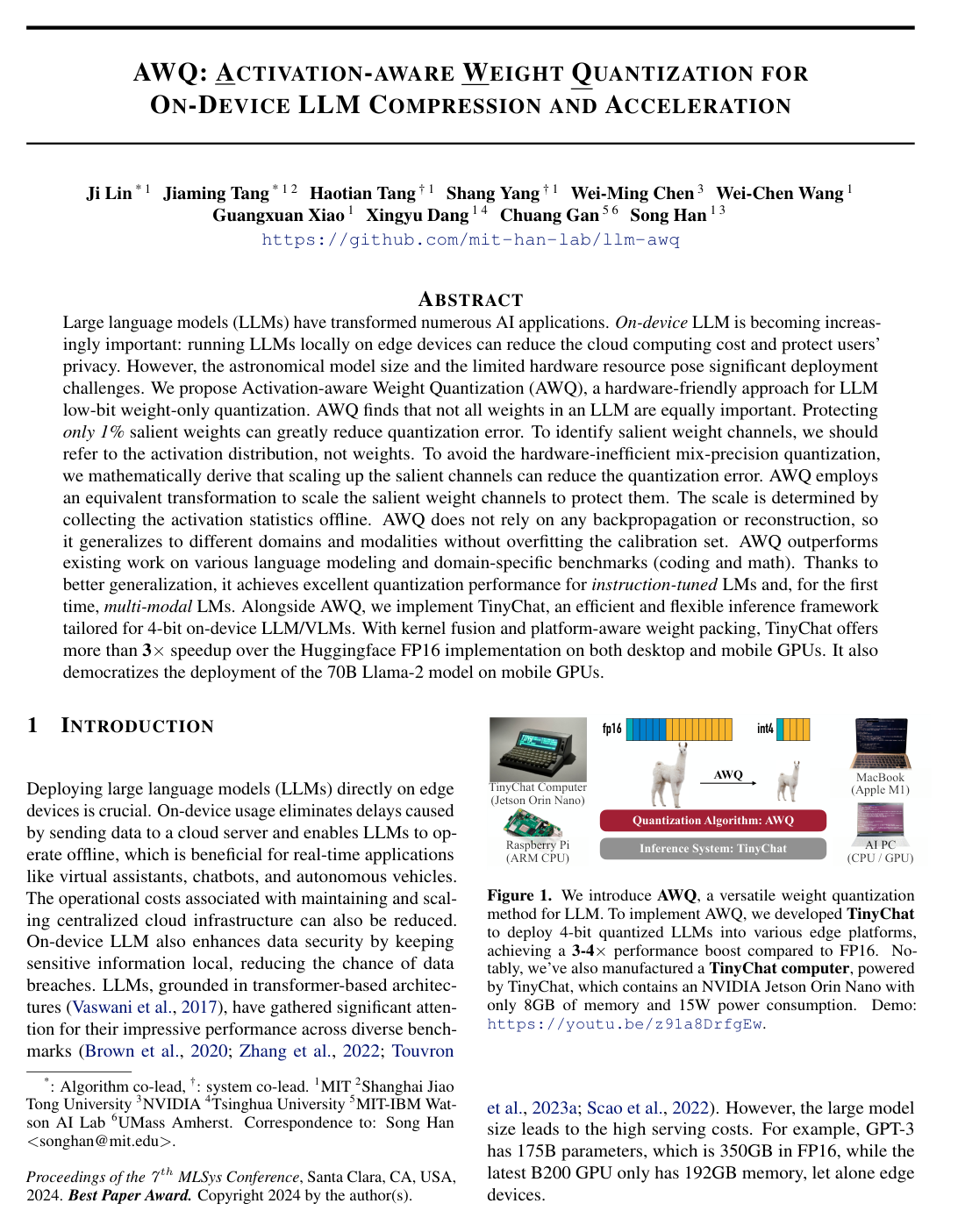
AWQ: Activation-aware Weight Quantization for On-Device LLM Compression and Acceleration
Ji Lin, Jiaming Tang, Haotian Tang, Shang Yang, Wei-Ming Chen, Wei-Chen Wang, Guangxuan Xiao, Xingyu Dang, Chuang Gan, Song Han
Why you should read this
Proves that selectively protecting the top one percent of salient weights based on activation magnitude yields superior low-bit quantization robustness compared to purely weight-based methods.
Large language models (LLMs) have transformed numerous AI applications. On-device LLM is becoming increasingly important: running LLMs locally on edge devices can reduce the cloud computing cost and protect users' privacy. However, the astronomical model size and the limited hardware resource pose significant deployment challenges. We propose Activation-aware Weight Quantization (AWQ), a hardware-friendly approach for LLM low-bit weight-only quantization. AWQ finds that not all weights in an LLM are equally important. Protecting only 1% salient weights can greatly reduce quantization error. To identify salient weight channels, we should refer to the activation distribution, not weights. To avoid the hardware-inefficient mix-precision quantization, we mathematically derive that scaling up the salient channels can reduce the quantization error. AWQ employs an equivalent transformation to scale the salient weight channels to protect them. The scale is determined by collecting the activation statistics offline. AWQ does not rely on any backpropagation or reconstruction, so it generalizes to different domains and modalities without overfitting the calibration set. AWQ outperforms existing work on various language modeling and domain-specific benchmarks (coding and math). Thanks to better generalization, it achieves excellent quantization performance for instruction-tuned LMs and, for the first time, multi-modal LMs. Alongside AWQ, we implement TinyChat, an efficient and flexible inference framework tailored for 4-bit on-device LLM/VLMs. With kernel fusion and platform-aware weight packing, TinyChat offers more than 3x speedup over the Huggingface FP16 implementation on both desktop and mobile GPUs. It also democratizes the deployment of the 70B Llama-2 model on mobile GPUs.
Added
2026-04-24