
keyword
Proximal Policy Optimization
Proximal Policy Optimization is a model-free, on-policy reinforcement learning algorithm designed to balance training stability, sample efficiency, and ease of implementation in deep actor-critic architectures. Developed as a simpler, more computationally practical alternative to trust region methods, it optimizes decision-making policies while preventing destabilizing parameter updates that can lead to severe performance collapse. The algorithm primarily achieves this through a clipped surrogate objective function that limits how much the probability ratio between the new and old policy can change in a single update step, or alternatively via an adaptive divergence penalty. By restricting policy drift, it safely allows multiple epochs of gradient-based optimization over batches of collected trajectory data, making it a widely adopted standard in robotics, continuous control benchmarks, multi-agent systems, and the reinforcement learning from human feedback processes used to align large language models.
13 items
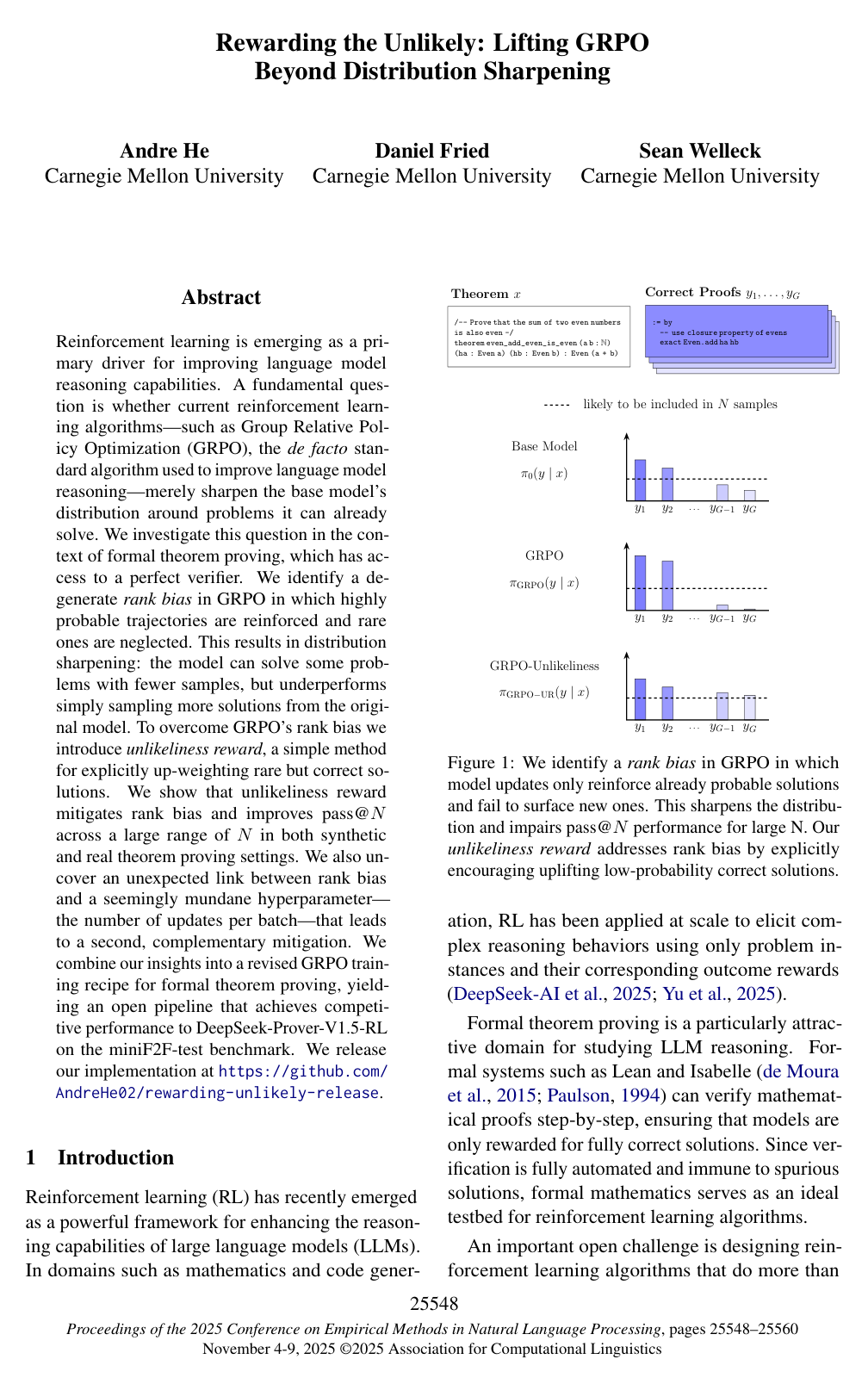
Rewarding the Unlikely: Lifting GRPO Beyond Distribution Sharpening
Andre Wang He, Daniel Fried, Sean Welleck
Why you should read this
Proposes an unlikeliness reward technique and hyperparameter adjustments to correct GRPO's bias toward high-probability solutions, preventing policy distribution collapse and significantly improving pass@N performance in formal theorem proving.
Reinforcement learning is emerging as a primary driver for improving language model reasoning capabilities. A fundamental question is whether current reinforcement learning algorithms—such as Group Relative Policy Optimization (GRPO), the de facto standard algorithm used to improve language model reasoning—merely sharpen the base model’s distribution around problems it can already solve. We investigate this question in the context of formal theorem proving, which has access to a perfect verifier. We identify a degenerate rank bias in GRPO in which highly probable trajectories are reinforced and rare ones are neglected. This results in distribution sharpening: the model can solve some problems with fewer samples, but underperforms simply sampling more solutions from the original model. To overcome GRPO’s rank bias we introduce unlikeliness reward, a simple method for explicitly up-weighting rare but correct solutions. We show that unlikeliness reward mitigates rank bias and improves pass@N across a large range of N in both synthetic and real theorem proving settings. We also uncover an unexpected link between rank bias and a seemingly mundane hyperparameter—the number of updates per batch—that leads to a second, complementary mitigation. We combine our insights into a revised GRPO training recipe for formal theorem proving, yielding an open pipeline that achieves competitive performance to DeepSeek-Prover-V1.5-RL on the miniF2F-test benchmark. We release our implementation at https://github.com/AndreHe02/rewarding-unlikely-release.
Added
2026-10-05
Learning Without Critics? Revisiting GRPO in Classical Reinforcement Learning Environments
Bryan L. M. de Oliveira, Felipe V. Frujeri, Marcos P. C. M. Queiroz, Luana G. B. Martins, Telma W. de L. Soares, Luckeciano Carvalho Melo
Why you should read this
Demonstrates the limits of critic-free Group Relative Policy Optimization across classical control tasks, showing that learned value functions remain essential for long-horizon environments while identifying the specific group-size and discounting conditions under which critic-free baselines succeed.
Group Relative Policy Optimization (GRPO) has emerged as a scalable alternative to Proximal Policy Optimization (PPO) by eliminating the learned critic and instead estimating advantages through group-relative comparisons of trajectories. This simplification raises fundamental questions about the necessity of learned baselines in policy-gradient methods. We present the first systematic study of GRPO in classical single-task reinforcement learning environments, spanning discrete and continuous control tasks. Through controlled ablations isolating baselines, discounting, and group sampling, we reveal three key findings: (1) learned critics remain essential for long-horizon tasks: all critic-free baselines underperform PPO except in short-horizon environments like CartPole where episodic returns can be effective; (2) GRPO benefits from high discount factors (gamma = 0.99) except in HalfCheetah, where lack of early termination favors moderate discounting (gamma = 0.9); (3) smaller group sizes outperform larger ones, suggesting limitations in batch-based grouping strategies that mix unrelated episodes. These results reveal both the limitations of critic-free methods in classical control and the specific conditions where they remain viable alternatives to learned value functions.
Added
2026-10-04
Topology-Aware Network Pruning using Multi-stage Graph Embedding and Reinforcement Learning
Sixing Yu, Arya Mazaheri, Ali Jannesari
Why you should read this
Proposes a multi-stage graph embedding framework that captures hierarchical neural network topologies to automatically learn optimal, FLOP-constrained pruning policies via reinforcement learning across diverse architectures.
Model compression is an essential technique for deploying deep neural networks (DNNs) on power and memory-constrained resources. However, existing model-compression methods often rely on human expertise and focus on parameters’ local importance, ignoring the rich topology information within DNNs. In this paper, we propose a novel multi-stage graph embedding technique based on graph neural networks (GNNs) to identify DNN topologies and use reinforcement learning (RL) to find a suitable compression policy. We performed resource-constrained (i.e., FLOPs) channel pruning and compared our approach with state-of-the-art model compression methods. We evaluated our method on various models from typical to mobile-friendly networks, such as ResNet family, VGG-16, MobileNet-v1/v2, and ShuffleNet. Results show that our method can achieve higher compression ratios with a minimal fine-tuning cost yet yields outstanding and competitive performance. The code is open-sourced at https://github.com/yusx-swapp/GNN-RL-Model-Compression.
Added
2026-10-03
DPO Meets PPO: Reinforced Token Optimization for RLHF
Han Zhong, Zikang Shan, Guhao Feng, Wei Xiong, Xinle Cheng, Li Zhao, Di He, Jiang Bian, Liwei Wang
Why you should read this
Proposes Reinforced Token Optimization, a framework that extracts fine-grained token-level rewards from Direct Preference Optimization to guide Proximal Policy Optimization, significantly outperforming standard RLHF methods on AlpacaEval 2 and Arena-Hard.
In the classical Reinforcement Learning from Human Feedback (RLHF) framework, Proximal Policy Optimization (PPO) is employed to learn from sparse, sentence-level rewards—a challenging scenario in traditional deep reinforcement learning. Despite the great successes of PPO in the alignment of large language models, its open-source implementation is still largely sub-optimal. To address these issues, we introduce a framework that models RLHF problems as a Markov decision process (MDP), enabling the capture of fine-grained token-wise information. Under this framework, we introduce an algorithm Reinforced Token Optimization (RTO), which learns the token-wise reward function from preference data and performs policy optimization based on this learned token-wise reward signal.Theoretically, RTO is proven to have the capability of finding the near-optimal policy sample-efficiently. For its practical implementation, RTO innovatively integrates Direct Preference Optimization (DPO) and PPO. DPO, originally derived from sparse sentence rewards, surprisingly provides us with a token-wise characterization of response quality, which is seamlessly incorporated into our subsequent PPO training stage. Extensive experiments demonstrate that RTO performs better than PPO and other direct preference learning algorithms. In particular, RTO outperforms PPO by 7.5 points on the AlpacaEval 2 benchmark and by 4.1 points on Arena-Hard. Our code and models are available at https://github.com/zkshan2002/RTO.
Added
2026-10-01
Is DPO Superior to PPO for LLM Alignment? A Comprehensive Study
Shusheng Xu, Wei Fu, Jiaxuan Gao, Wenjie Ye, Weilin Liu, Zhiyu Mei, Guangju Wang, Chao Yu, Yi Wu
Why you should read this
Demonstrates that properly configured Proximal Policy Optimization consistently surpasses Direct Preference Optimization across diverse alignment benchmarks, identifying fundamental limitations in reward-free methods and isolating the critical training factors needed to achieve superior performance in complex tasks like code generation.
Reinforcement Learning from Human Feedback (RLHF) is currently the most widely used method to align large language models (LLMs) with human preferences. Existing RLHF methods can be roughly categorized as either reward-based or reward-free. Novel applications such as ChatGPT and Claude leverage reward-based methods that first learn a reward model and apply actor-critic algorithms, such as Proximal Policy Optimization (PPO). However, in academic benchmarks, state-of-the-art results are often achieved via reward-free methods, such as Direct Preference Optimization (DPO). Is DPO truly superior to PPO? Why does PPO perform poorly on these benchmarks? In this paper, we first conduct both theoretical and empirical studies on the algorithmic properties of DPO and show that DPO may have fundamental limitations. Moreover, we also comprehensively examine PPO and reveal the key factors for the best performances of PPO in fine-tuning LLMs. Finally, we benchmark DPO and PPO across a collection of RLHF testbeds, ranging from dialogue to code generation. Experiment results demonstrate that PPO is able to surpass other alignment methods in all cases and achieve state-of-the-art results in challenging code competitions. Our code is publicly available at this https URL.
Added
2026-09-28
Local Search GFlowNets
Minsu Kim, Taeyoung Yun, Emmanuel Bengio, Dinghuai Zhang, Yoshua Bengio, Sungsoo Ahn, Jinkyoo Park
Why you should read this
Proposes a local search framework for Generative Flow Networks that integrates backward-policy backtracking and forward-policy reconstruction to focus sampling on high-reward discrete candidates across biochemical design tasks.
Generative Flow Networks (GFlowNets) are amortized sampling methods that learn a distribution over discrete objects proportional to their rewards. GFlowNets exhibit a remarkable ability to generate diverse samples, yet occasionally struggle to consistently produce samples with high rewards due to over-exploration on wide sample space. This paper proposes to train GFlowNets with local search, which focuses on exploiting high-rewarded sample space to resolve this issue. Our main idea is to explore the local neighborhood via backtracking and reconstruction guided by backward and forward policies, respectively. This allows biasing the samples toward high-reward solutions, which is not possible for a typical GFlowNet solution generation scheme, which uses the forward policy to generate the solution from scratch. Extensive experiments demonstrate a remarkable performance improvement in several biochemical tasks. Source code is available: \url{this https URL}.
Added
2026-09-26
The Policy-gradient Placement and Generative Routing Neural Networks for Chip Design
Ruoyu Cheng, Xianglong Lyu, Yang Li, Junjie Ye, Jianye Hao, Junchi Yan
Placement and routing are two critical yet time-consuming steps of chip design in modern VLSI systems. Distinct from traditional heuristic solvers, this paper on one hand proposes an RL-based model for mixed-size macro placement, which differs from existing learning-based placers that often consider the macro by coarse grid-based mask. While the standard cells are placed via gradient-based GPU acceleration. On the other hand, a one-shot conditional generative routing model, which is composed of a special-designed input-size-adapting generator and a bi-discriminator, is devised to perform one-shot routing to the pins within each net, and the order of nets to route is adaptively learned. Combining these techniques, we develop a flexible neural pipeline, which to our best knowledge, is the first joint placement and routing network without involving any traditional heuristic solver. Experimental results on chip design benchmarks showcase the effectiveness of our approach. Source code will be made publicly available at: https://github.com/Thinklab-SJTU/EDA-AI
Added
2026-09-26
Deep Reinforcement Learning in a Handful of Trials using Probabilistic Dynamics Models
Kurtland Chua, Roberto Calandra, Rowan McAllister, Sergey Levine
Why you should read this
Proposes the PETS algorithm, which combines deep neural network ensembles with trajectory sampling to close the asymptotic performance gap between model-based and model-free reinforcement learning while dramatically reducing the required training samples.
Model-based reinforcement learning (RL) algorithms can attain excellent sample efficiency, but often lag behind the best model-free algorithms in terms of asymptotic performance. This is especially true with high-capacity parametric function approximators, such as deep networks. In this paper, we study how to bridge this gap, by employing uncertainty-aware dynamics models. We propose a new algorithm called probabilistic ensembles with trajectory sampling (PETS) that combines uncertainty-aware deep network dynamics models with sampling-based uncertainty propagation. Our comparison to state-of-the-art model-based and model-free deep RL algorithms shows that our approach matches the asymptotic performance of model-free algorithms on several challenging benchmark tasks, while requiring significantly fewer samples (e.g., 8 and 125 times fewer samples than Soft Actor Critic and Proximal Policy Optimization respectively on the half-cheetah task).
Added
2026-09-24
Do We Need Adam? Surprisingly Strong and Sparse Reinforcement Learning with SGD in LLMs
Sagnik Mukherjee, Lifan Yuan, Pavan Jayasinha, Dilek Hakkani-Tür, Hao Peng
Why you should read this
Demonstrates that memory-efficient SGD matches or outperforms AdamW in reinforcement learning for large language models while naturally updating fewer than 0.02% of model parameters without explicit regularization.
Reinforcement learning (RL), particularly RL from verifiable reward (RLVR), has become a crucial phase of training large language models (LLMs) and a key focus of current scaling efforts. However, optimization practices in RL largely follow those of next-token prediction stages (e.g., pretraining and supervised fine-tuning), despite fundamental differences between RL and these stages highlighted by recent work. One such practice is the use of the AdamW optimizer, which is widely adopted for training large-scale transformers despite its high memory overhead. Our analysis shows that both momentum and adaptive learning rates in AdamW are less influential in RL than in SFT, leading us to hypothesize that RL benefits less from Adam-style per-parameter adaptive learning rates and momentum. Confirming this hypothesis, our experiments demonstrate that the substantially more memory-efficient SGD, which is known to perform poorly in supervised learning of large-scale transformers, matches or even outperforms AdamW in RL for LLMs. Remarkably, full fine-tuning with SGD updates fewer than 0.02% of model parameters without any sparsity-promoting regularization, more than 1000 times fewer than AdamW. Our analysis offers potential reasons for this update sparsity. These findings provide new insights into the optimization dynamics of RL in LLMs and show that RL can be substantially more parameter-efficient than previously recognized.
Added
2026-09-14

The Surprising Effectiveness of PPO in Cooperative Multi-Agent Games
Chao Yu, Akash Velu, Eugene Vinitsky, Yu Wang, A. Bayen, Yi Wu
Why you should read this
Demonstrates that Proximal Policy Optimization matches or outperforms specialized off-policy methods across major cooperative multi-agent benchmarks, establishing simple on-policy learning as a competitive baseline through actionable implementation and tuning guidelines.
Proximal Policy Optimization (PPO) is a ubiquitous on-policy reinforcement learning algorithm but is significantly less utilized than off-policy learning algorithms in multi-agent settings. This is often due to the belief that PPO is significantly less sample efficient than off-policy methods in multi-agent systems. In this work, we carefully study the performance of PPO in cooperative multi-agent settings. We show that PPO-based multi-agent algorithms achieve surprisingly strong performance in four popular multi-agent testbeds: the particle-world environments, the StarCraft multi-agent challenge, Google Research Football, and the Hanabi challenge, with minimal hyperparameter tuning and without any domain-specific algorithmic modifications or architectures. Importantly, compared to competitive off-policy methods, PPO often achieves competitive or superior results in both final returns and sample efficiency. Finally, through ablation studies, we analyze implementation and hyperparameter factors that are critical to PPO’s empirical performance, and give concrete practical suggestions regarding these factors. Our results show that when using these practices, simple PPO-based methods can be a strong baseline in cooperative multi-agent reinforcement learning. Source code is released at https://github.com/marlbenchmark/on-policy.
Added
2026-09-14
Do Not Let Low-Probability Tokens Over-Dominate in RL for LLMs
Zhihe Yang, Xufang Luo, Zilong Wang, Dongqi Han, Zhiyuan He, Dongsheng Li, Yunjian Xu
Why you should read this
Proposes a decentralized convex optimization framework to decompose global Signal Temporal Logic tasks into local specifications that are consistent with range-limited communication graphs, enabling scalable multi-agent coordination without requiring all-to-all connectivity.
Reinforcement learning (RL) has become a cornerstone for enhancing the reasoning capabilities of large language models (LLMs), with recent innovations such as Group Relative Policy Optimization (GRPO) demonstrating exceptional effectiveness. In this study, we identify a critical yet underexplored issue in RL training: low-probability tokens disproportionately influence model updates due to their large gradient magnitudes. This dominance hinders the effective learning of high-probability tokens, whose gradients are essential for LLMs' performance but are substantially suppressed. To mitigate this interference, we propose two novel methods: Advantage Reweighting and Low-Probability Token Isolation (Lopti), both of which effectively attenuate gradients from low-probability tokens while emphasizing parameter updates driven by high-probability tokens. Our approaches promote balanced updates across tokens with varying probabilities, thereby enhancing the efficiency of RL training. Experimental results demonstrate that they substantially improve the performance of GRPO-trained LLMs, achieving up to a 46.2% improvement in K&K Logic Puzzle reasoning tasks. Our implementation is available at https://github.com/zhyang2226/AR-Lopti.
Added
2026-05-16
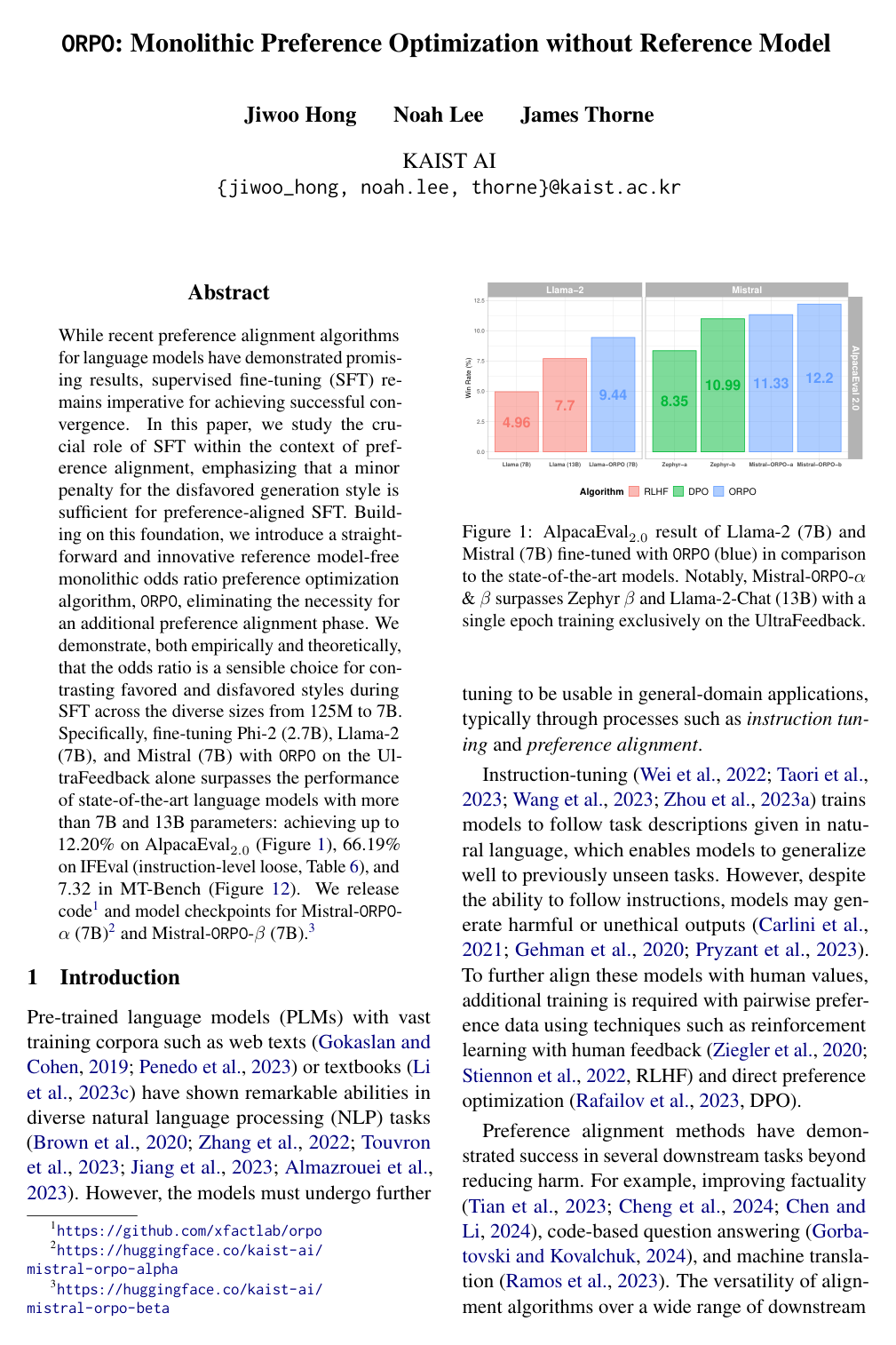
ORPO: Monolithic Preference Optimization without Reference Model
Jiwoo Hong, Noah Lee, James Thorne
Why you should read this
Introduces a streamlined single-stage training objective that penalizes rejected responses during the initial supervised fine-tuning phase, successfully eliminating the architectural overhead of maintaining a frozen reference model.
While recent preference alignment algorithms for language models have demonstrated promising results, supervised fine-tuning (SFT) remains imperative for achieving successful convergence.In this paper, we revisit SFT in the context of preference alignment, emphasizing that a minor penalty for the disfavored style is sufficient for preference alignment.Building on this foundation, we introduce a straightforward reference model-free monolithic odds ratio preference optimization algorithm, ORPO, eliminating the need for an additional preference alignment phase.We demonstrate, both empirically and theoretically, that the odds ratio is a sensible choice for contrasting favored and disfavored styles during SFT across diverse sizes from 125M to 7B.Specifically, finetuning Phi-2 (2.7B), Llama-2 (7B), and Mistral (7B) with ORPO on the UltraFeedback alone surpasses the performance of state-of-the-art language models including Llama-2 Chat and Zephyr with more than 7B and 13B parameters: achieving up to 12.20% on AlpacaEval 2.0 (Figure 1), and 7.32 in MT-Bench (Table 2).We release code 1 and model checkpoints 2 for Mistral-ORPO- and Mistral-ORPO-.
Added
2026-05-08

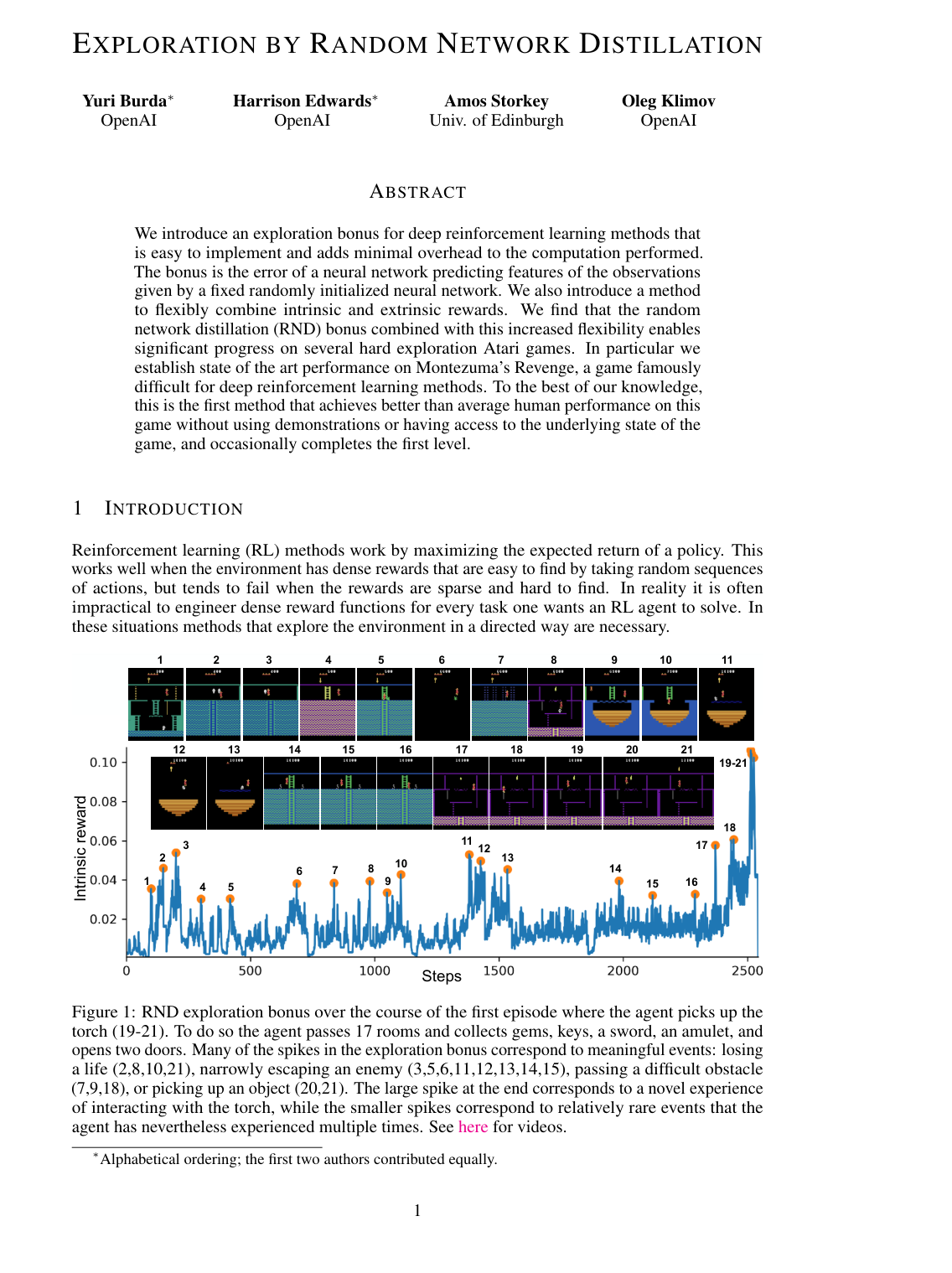
Exploration by Random Network Distillation
Yuri Burda, Harrison Edwards, Amos Storkey, Oleg Klimov
Why you should read this
Demonstrates how Random Network Distillation (RND) provides an elegant and effective solution to hard exploration problems in reinforcement learning, achieving superhuman performance on Montezuma's Revenge without demonstrations or internal game state.
We introduce an exploration bonus for deep reinforcement learning methods that is easy to implement and adds minimal overhead to the computation performed. The bonus is the error of a neural network predicting features of the observations given by a fixed randomly initialized neural network. We also introduce a method to flexibly combine intrinsic and extrinsic rewards. We find that the random network distillation (RND) bonus combined with this increased flexibility enables significant progress on several hard exploration Atari games. In particular we establish state of the art performance on Montezuma's Revenge, a game famously difficult for deep reinforcement learning methods. To the best of our knowledge, this is the first method that achieves better than average human performance on this game without using demonstrations or having access to the underlying state of the game, and occasionally completes the first level.
Added
2026-03-26
License
Published with permission