
keyword
propensity score
A propensity score is the probability that an individual receives a particular treatment or exposure, given their observed characteristics. In causal inference, it is used to account for differences in those characteristics between treated and untreated groups, helping make their outcomes more comparable.
2 items
AI Diffusion in Low Resource Language Countries
Amit Misra, Syed Waqas Zamir, Wassim Hamidouche, Inbal Becker-Reshef, Juan M. Lavista Ferres
Why you should read this
Demonstrates that low-resource language countries suffer a twenty percent reduction in artificial intelligence adoption rates, isolating linguistic accessibility as an independent barrier to global technology diffusion.
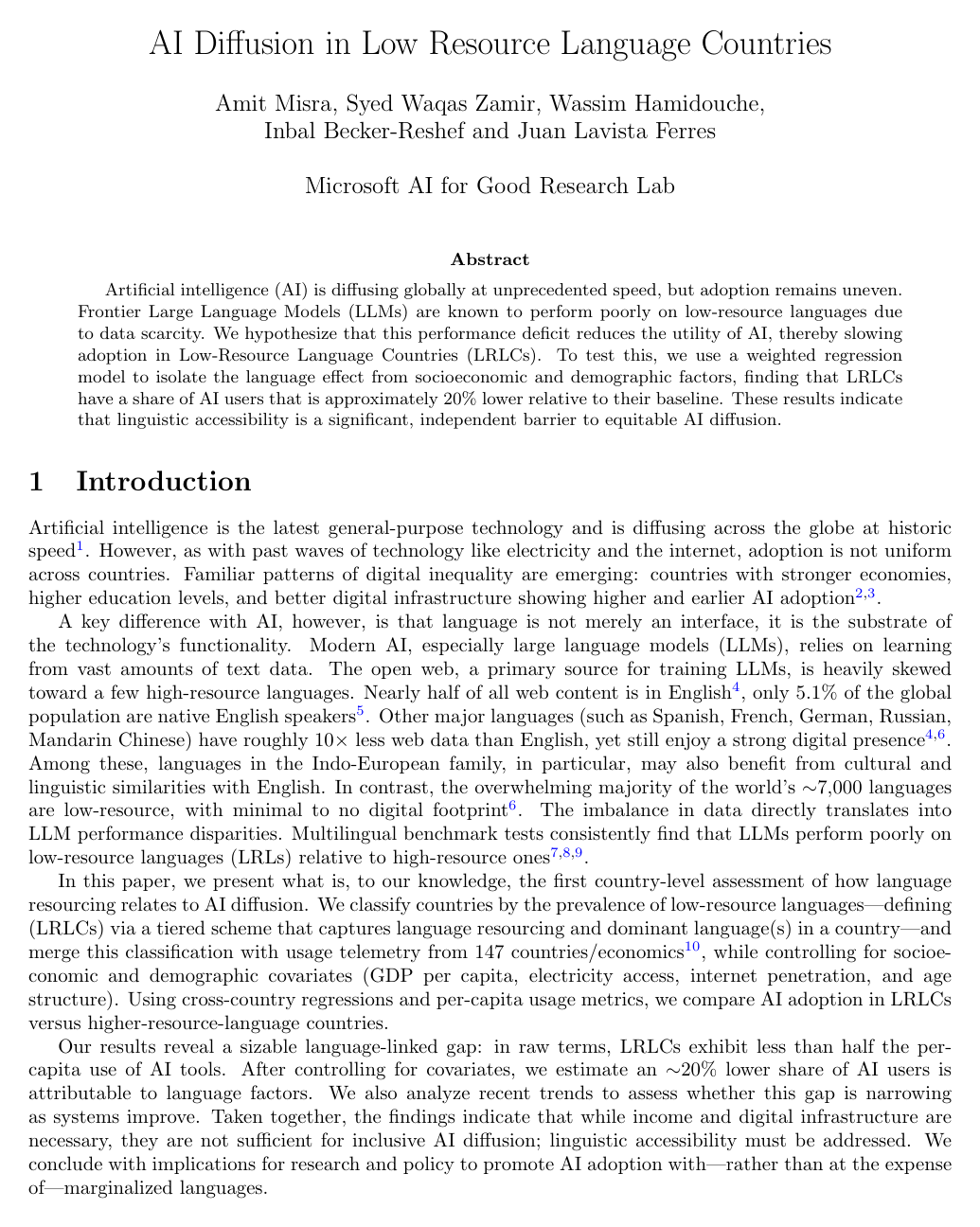
Artificial intelligence (AI) is diffusing globally at unprecedented speed, but adoption remains uneven. Frontier Large Language Models (LLMs) are known to perform poorly on low-resource languages due to data scarcity. We hypothesize that this performance deficit reduces the utility of AI, thereby slowing adoption in Low-Resource Language Countries (LRLCs). To test this, we use a weighted regression model to isolate the language effect from socioeconomic and demographic factors, finding that LRLCs have a share of AI users that is approximately 20% lower relative to their baseline. These results indicate that linguistic accessibility is a significant, independent barrier to equitable AI diffusion.
Added
2026-09-29
Estimating individual treatment effect: generalization bounds and algorithms
Uri Shalit, Fredrik D. Johansson, David Sontag
Why you should read this
Establishes generalization error bounds for individual treatment effect estimation and introduces algorithms that learn balanced representations by minimizing distribution discrepancies between treated and control groups.
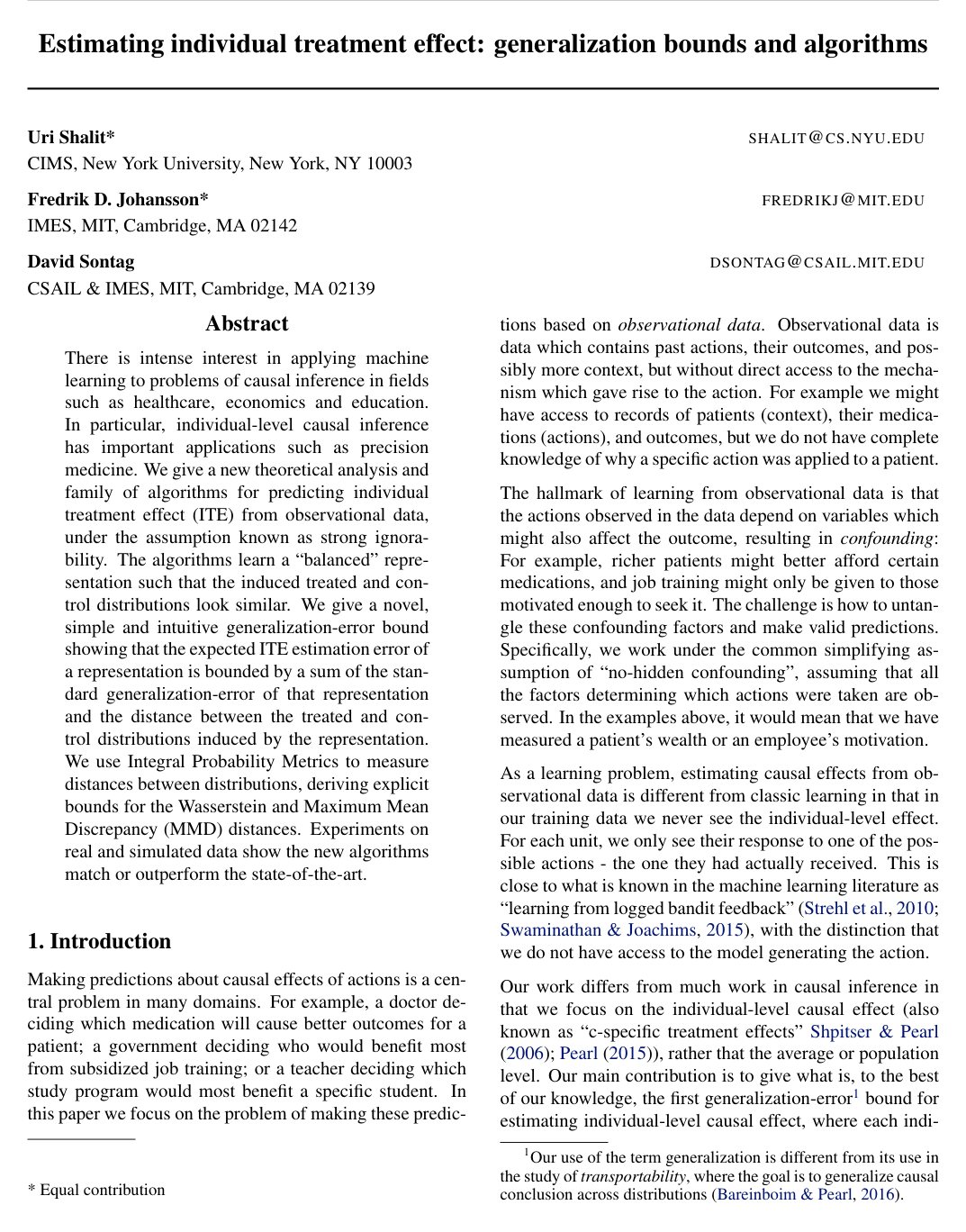
There is intense interest in applying machine learning to problems of causal inference in fields such as healthcare, economics and education. In particular, individual-level causal inference has important applications such as precision medicine. We give a new theoretical analysis and family of algorithms for predicting individual treatment effect (ITE) from observational data, under the assumption known as strong ignorability. The algorithms learn a "balanced" representation such that the induced treated and control distributions look similar. We give a novel, simple and intuitive generalization-error bound showing that the expected ITE estimation error of a representation is bounded by a sum of the standard generalization-error of that representation and the distance between the treated and control distributions induced by the representation. We use Integral Probability Metrics to measure distances between distributions, deriving explicit bounds for the Wasserstein and Maximum Mean Discrepancy (MMD) distances. Experiments on real and simulated data show the new algorithms match or outperform the state-of-the-art.
Added
2026-09-25