
keyword
pre-trained vision-language models
Pre-trained vision-language models are multimodal artificial intelligence systems trained on extensive datasets of paired images and text to learn unified representations that connect visual and linguistic information. Typically developed through large-scale training objectives, such as contrastive learning and cross-modal generative modeling on web-scale data, these models capture rich semantic alignments and contextual relationships between visual scenes and natural language descriptions. This foundational training enables them to exhibit strong zero-shot and few-shot generalization capabilities, allowing them to be adapted or directly applied to a wide range of downstream multimodal applications, including visual question answering, image classification, segmentation, video recognition, and language-guided robotic control.
8 items
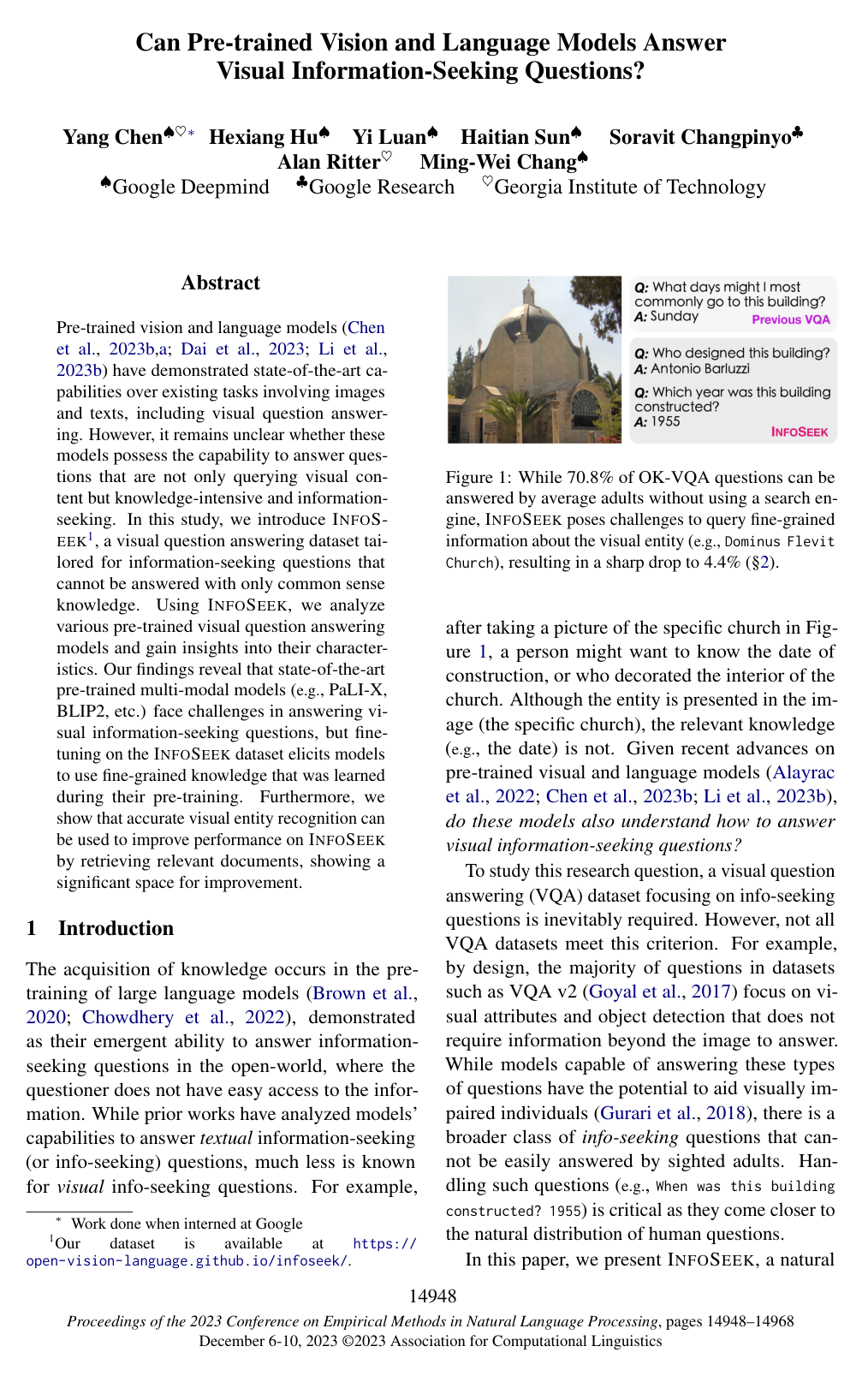
Can Pre-trained Vision and Language Models Answer Visual Information-Seeking Questions?
Yang Chen, Hexiang Hu, Yi Luan, Haitian Sun, Soravit Changpinyo, Alan Ritter, Ming-Wei Chang
Pre-trained vision and language models (Chen et al., 2023b,a; Dai et al., 2023; Li et al., 2023b) have demonstrated state-of-the-art capabilities over existing tasks involving images and texts, including visual question answering. However, it remains unclear whether these models possess the capability to answer questions that are not only querying visual content but knowledge-intensive and information-seeking. In this study, we introduce INFOSEEK^1, a visual question answering dataset tailored for information-seeking questions that cannot be answered with only common sense knowledge. Using INFOSEEK, we analyze various pre-trained visual question answering models and gain insights into their characteristics. Our findings reveal that state-of-the-art pre-trained multi-modal models (e.g., PaLI-X, BLIP2, etc.) face challenges in answering visual information-seeking questions, but fine-tuning on the INFOSEEK dataset elicits models to use fine-grained knowledge that was learned during their pre-training. Furthermore, we show that accurate visual entity recognition can be used to improve performance on INFOSEEK by retrieving relevant documents, showing a significant space for improvement.
Added
2026-09-28
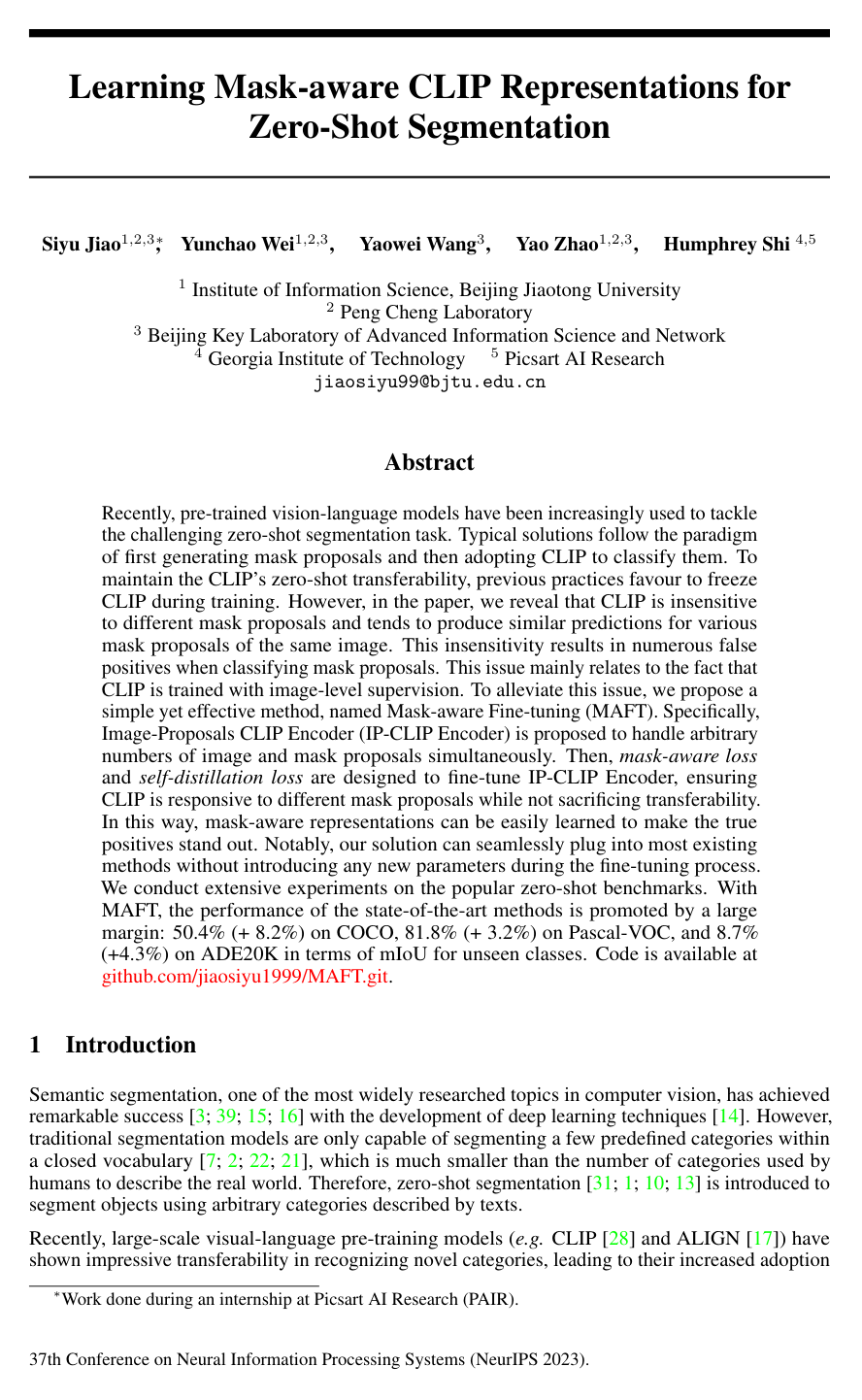
Learning Mask-aware CLIP Representations for Zero-Shot Segmentation
Siyu Jiao, Yunchao Wei, Yaowei Wang, Yao Zhao, Humphrey Shi
Why you should read this
Proposes a mask-aware fine-tuning strategy that makes pre-trained CLIP sensitive to region-level proposals without adding new parameters or sacrificing zero-shot transferability, substantially boosting unseen-class segmentation accuracy across standard benchmarks.
Recently, pre-trained vision-language models have been increasingly used to tackle the challenging zero-shot segmentation task. Typical solutions follow the paradigm of first generating mask proposals and then adopting CLIP to classify them. To maintain the CLIP's zero-shot transferability, previous practices favour to freeze CLIP during training. However, in the paper, we reveal that CLIP is insensitive to different mask proposals and tends to produce similar predictions for various mask proposals of the same image. This insensitivity results in numerous false positives when classifying mask proposals. This issue mainly relates to the fact that CLIP is trained with image-level supervision. To alleviate this issue, we propose a simple yet effective method, named Mask-aware Fine-tuning (MAFT). Specifically, Image-Proposals CLIP Encoder (IP-CLIP Encoder) is proposed to handle arbitrary numbers of image and mask proposals simultaneously. Then, mask-aware loss and self-distillation loss are designed to fine-tune IP-CLIP Encoder, ensuring CLIP is responsive to different mask proposals while not sacrificing transferability. In this way, mask-aware representations can be easily learned to make the true positives stand out. Notably, our solution can seamlessly plug into most existing methods without introducing any new parameters during the fine-tuning process. We conduct extensive experiments on the popular zero-shot benchmarks. With MAFT, the performance of the state-of-the-art methods is promoted by a large margin: 50.4% (+ 8.2%) on COCO, 81.8% (+ 3.2%) on Pascal-VOC, and 8.7% (+4.3%) on ADE20K in terms of mIoU for unseen classes. Code is available at github.com/jiaosiyu1999/MAFT.git.
Added
2026-09-26
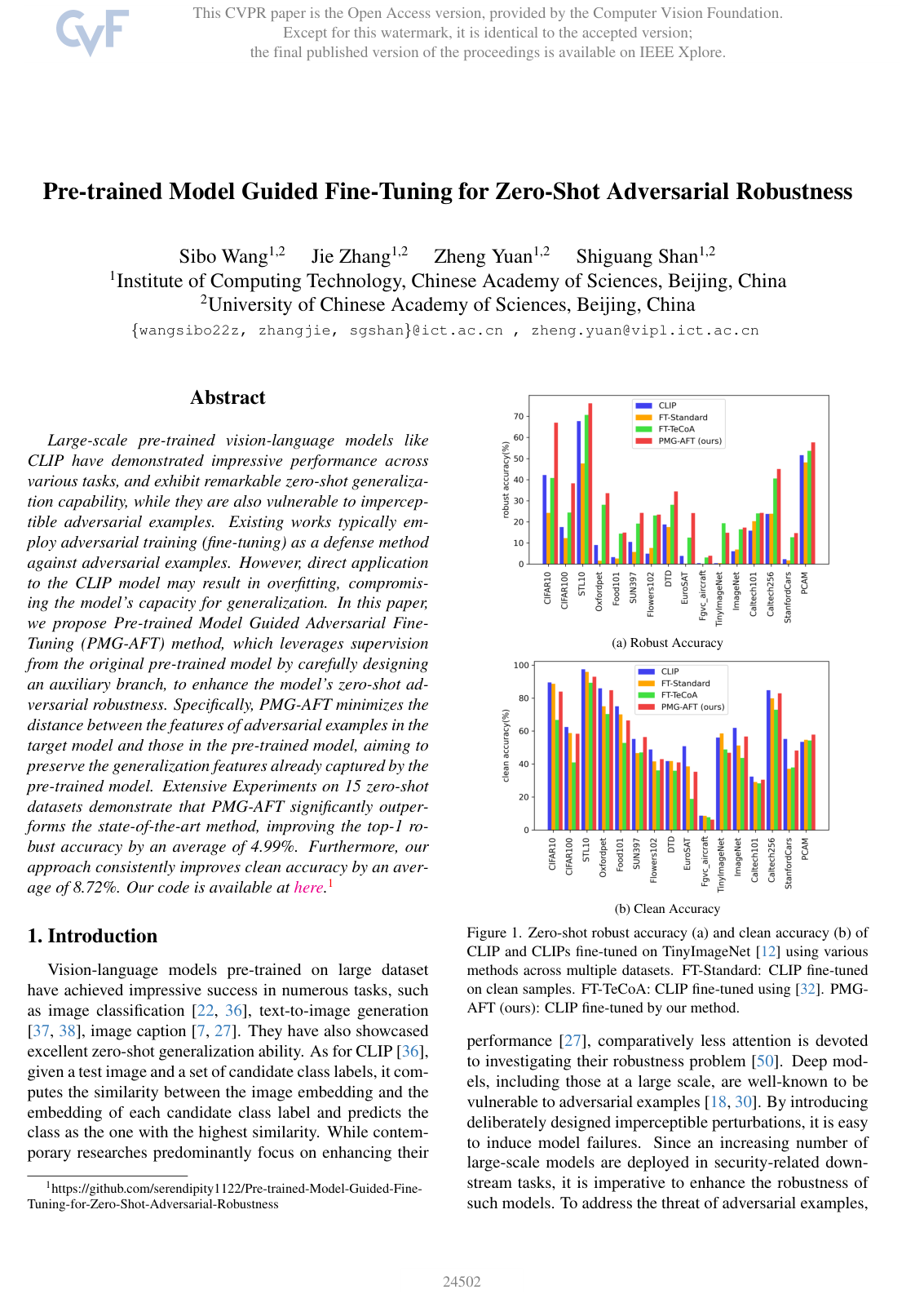
Pre-Trained Model Guided Fine-Tuning for Zero-Shot Adversarial Robustness
Sibo Wang, Jie Zhang, Zheng Yuan, Shiguang Shan
Why you should read this
Proposes a fine-tuning method that aligns adversarial features with representations from the original pre-trained model to prevent overfitting and boost CLIP's zero-shot defense performance on unseen datasets.
Large-scale pre-trained vision-language models like CLIP have demonstrated impressive performance across various tasks, and exhibit remarkable zero-shot generalization capability, while they are also vulnerable to imperceptible adversarial examples. Existing works typically employ adversarial training (fine-tuning) as a defense method against adversarial examples. However, direct application to the CLIP model may result in overfitting, compromising the model's capacity for generalization. In this paper, we propose Pre-trained Model Guided Adversarial Fine-Tuning (PMG-AFT) method, which leverages supervision from the original pre-trained model by carefully designing an auxiliary branch, to enhance the model's zero-shot adversarial robustness. Specifically, PMG-AFT minimizes the distance between the features of adversarial examples in the target model and those in the pre-trained model, aiming to preserve the generalization features already captured by the pre-trained model. Extensive Experiments on 15 zero-shot datasets demonstrate that PMG-AFT significantly outperforms the state-of-the-art method, improving the top-1 robust accuracy by an average of 4.99%. Furthermore, our approach consistently improves clean accuracy by an average of 8.72%. Our code is available at here.1
Added
2026-09-26
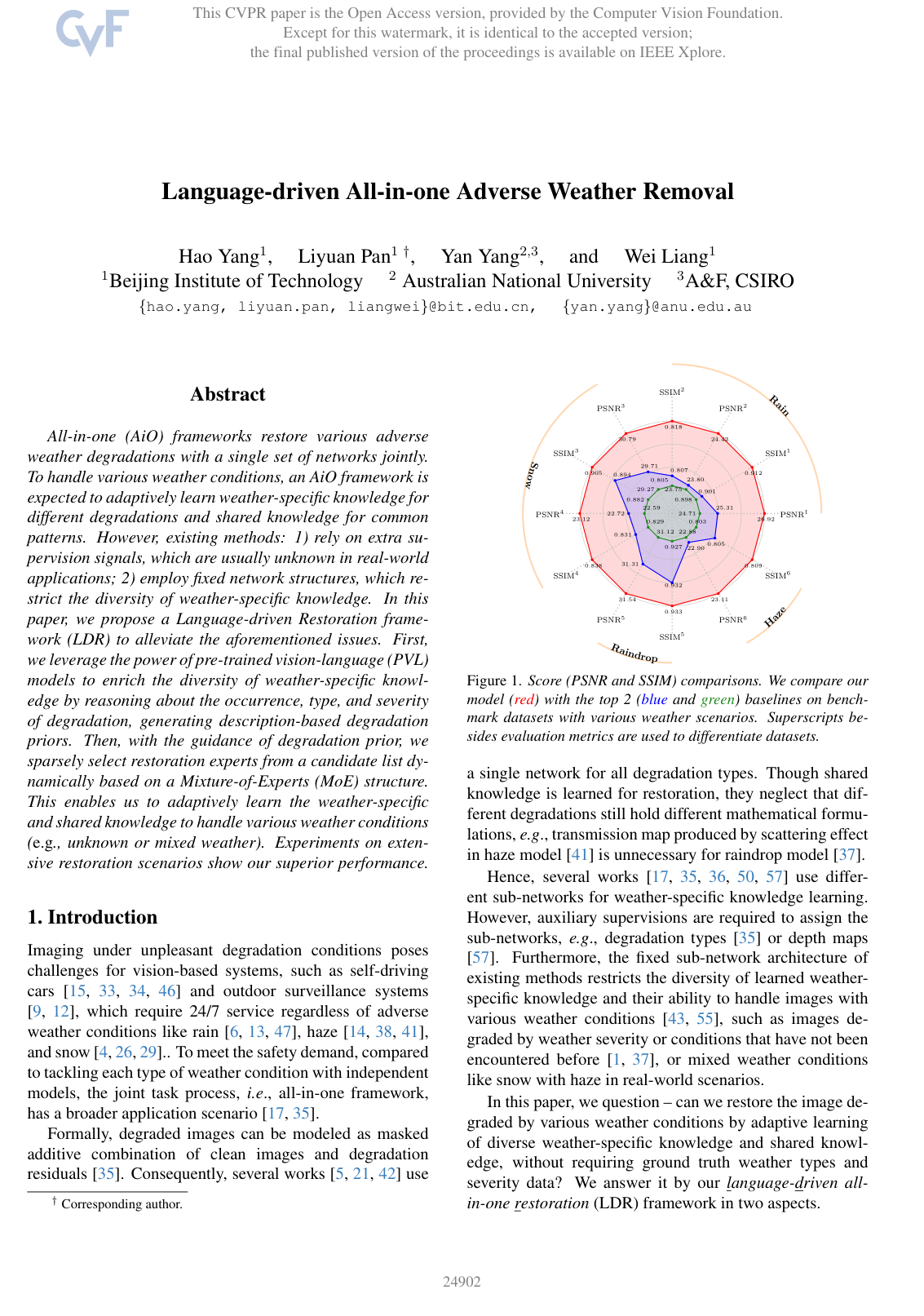
Language-driven All-in-one Adverse Weather Removal
Hao Yang, Liyuan Pan, Yan Yang, Wei Liang
Why you should read this
Proposes an all-in-one adverse weather restoration framework that queries pre-trained vision-language models for textual degradation priors and dynamically routes features through sparse mixture-of-experts modules to clean complex and mixed weather artifacts without requiring explicit ground-truth weather labels.
All-in-one (AiO) frameworks restore various adverse weather degradations with a single set of networks jointly. To handle various weather conditions, an AiO framework is expected to adaptively learn weather-specific knowledge for different degradations and shared knowledge for common patterns. However, existing methods: 1) rely on extra supervision signals, which are usually unknown in real-world applications; 2) employ fixed network structures, which restrict the diversity of weather-specific knowledge. In this paper, we propose a Language-driven Restoration framework (LDR) to alleviate the aforementioned issues. First, we leverage the power of pre-trained vision-language (PVL) models to enrich the diversity of weather-specific knowledge by reasoning about the occurrence, type, and severity of degradation, generating description-based degradation priors. Then, with the guidance of degradation prior, we sparsely select restoration experts from a candidate list dynamically based on a Mixture-of-Experts (MoE) structure. This enables us to adaptively learn the weather-specific and shared knowledge to handle various weather conditions (e.g., unknown or mixed weather). Experiments on extensive restoration scenarios show our superior performance.
Added
2026-09-26
Bidirectional Cross-Modal Knowledge Exploration for Video Recognition with Pre-trained Vision-Language Models
Wenhao Wu, Xiaohan Wang, Haipeng Luo, Jingdong Wang, Yi Yang, Wanli Ouyang
Why you should read this
Proposes a bidirectional framework called BIKE that transfers pre-trained vision-language knowledge into video recognition by retrieving complementary textual attributes and using category concepts to capture frame-level temporal saliency.
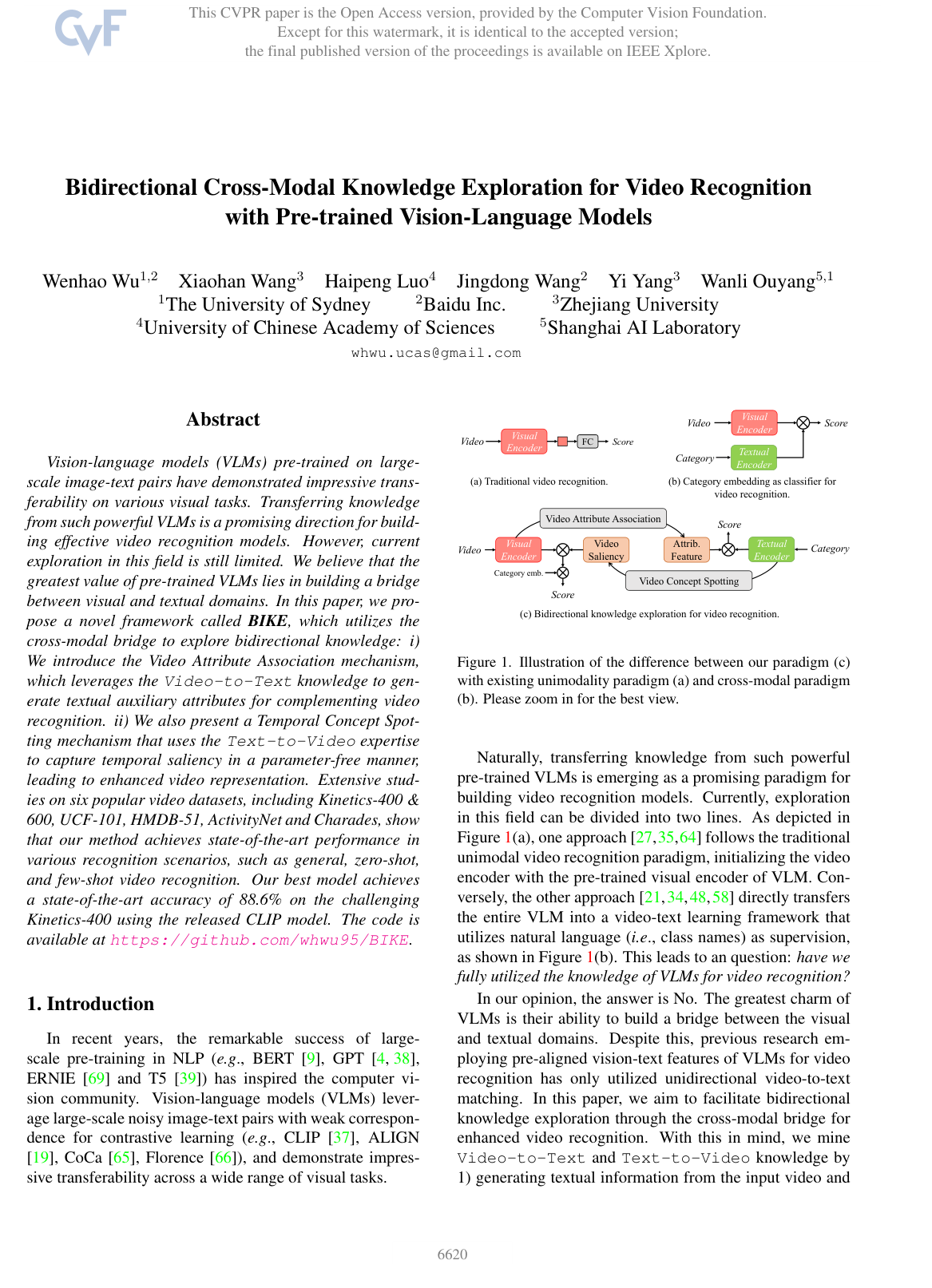
Vision-language models (VLMs) pre-trained on large-scale image-text pairs have demonstrated impressive transferability on various visual tasks. Transferring knowledge from such powerful VLMs is a promising direction for building effective video recognition models. However, current exploration in this field is still limited. We believe that the greatest value of pre-trained VLMs lies in building a bridge between visual and textual domains. In this paper, we propose a novel framework called BIKE, which utilizes the cross-modal bridge to explore bidirectional knowledge: i) We introduce the Video Attribute Association mechanism, which leverages the Video-to-Text knowledge to generate textual auxiliary attributes for complementing video recognition. ii) We also present a Temporal Concept Spotting mechanism that uses the Text-to-Video expertise to capture temporal saliency in a parameter-free manner, leading to enhanced video representation. Extensive studies on six popular video datasets, including Kinetics-400 & 600, UCF-101, HMDB-51, ActivityNet and Charades, show that our method achieves state-of-the-art performance in various recognition scenarios, such as general, zero-shot, and few-shot video recognition. Our best model achieves a state-of-the-art accuracy of 88.6% on the challenging Kinetics-400 using the released CLIP model. The code is available at https://github.com/whwu95/BIKE.
Added
2026-09-26
π0.5: a Vision-Language-Action Model with Open-World Generalization
Physical Intelligence, Kevin Black, Noah Brown, James Darpinian, Karan Dhabalia, Danny Driess, Adnan Esmail, Michael Equi, Chelsea Finn, Niccolo Fusai, Manuel Y. Galliker, Dibya Ghosh, Lachy Groom, Karol Hausman, Brian Ichter, Szymon Jakubczak, Tim Jones, Liyiming Ke, Devin LeBlanc, Sergey Levine, Adrian Li-Bell, Mohith Mothukuri, Suraj Nair, Karl Pertsch, Allen Z. Ren, Lucy Xiaoyang Shi, Laura Smith, Jost Tobias Springenberg, Kyle Stachowicz, James Tanner, Quan Vuong, Homer Walke, Anna Walling, Haohuan Wang, Lili Yu, Ury Zhilinsky
Why you should read this
Presents , an end-to-end vision-language-action model that leverages heterogeneous co-training across multi-robot and web data to perform dexterous, long-horizon manipulation tasks in previously unseen real-world homes.
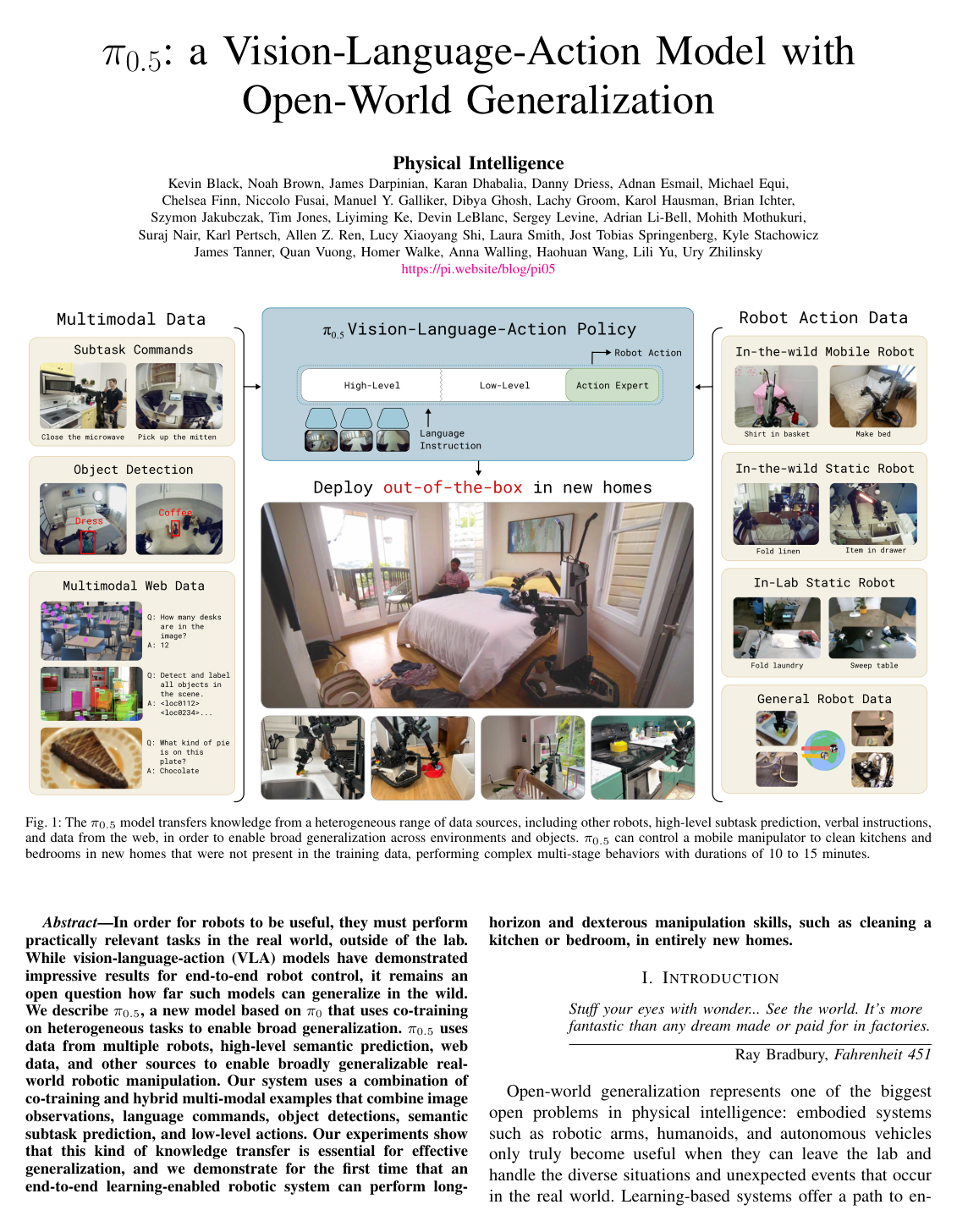
In order for robots to be useful, they must perform practically relevant tasks in the real world, outside of the lab. While vision-language-action (VLA) models have demonstrated impressive results for end-to-end robot control, it remains an open question how far such models can generalize in the wild. We describe , a new model based on that uses co-training on heterogeneous tasks to enable broad generalization. \ uses data from multiple robots, high-level semantic prediction, web data, and other sources to enable broadly generalizable real-world robotic manipulation. Our system uses a combination of co-training and hybrid multi-modal examples that combine image observations, language commands, object detections, semantic subtask prediction, and low-level actions. Our experiments show that this kind of knowledge transfer is essential for effective generalization, and we demonstrate for the first time that an end-to-end learning-enabled robotic system can perform long-horizon and dexterous manipulation skills, such as cleaning a kitchen or bedroom, in entirely new homes.
Added
2026-09-24
RT-2: Vision-Language-Action Models Transfer Web Knowledge to Robotic Control
Anthony Brohan, Noah Brown, Justice Carbajal, Yevgen Chebotar, K. Choromanski, Tianli Ding, Danny Driess, Kumar Avinava Dubey, Chelsea Finn, Peter R. Florence, Chuyuan Fu, Montse Gonzalez Arenas, K. Gopalakrishnan, Kehang Han, Karol Hausman, Alexander Herzog, Jasmine Hsu, Brian Ichter, A. Irpan, Nikhil J. Joshi, Ryan C. Julian, Dmitry Kalashnikov, Yuheng Kuang, Isabel Leal, S. Levine, H. Michalewski, Igor Mordatch, Karl Pertsch, Kanishka Rao, Krista Reymann, M. Ryoo, Grecia Salazar, Pannag R. Sanketi, P. Sermanet, Jaspiar Singh, Anikait Singh, Radu Soricut, Huong Tran, Vincent Vanhoucke, Q. Vuong, Ayzaan Wahid, Stefan Welker, Paul Wohlhart, Ted Xiao, Tianhe Yu, Brianna Zitkovich
Why you should read this
Introduces RT-2, a vision-language-action model that tokenizes robotic actions alongside web-scale text and images, enabling end-to-end robotic policies to inherit complex semantic reasoning and generalize to novel objects and commands.
We study how vision-language models trained on Internet-scale data can be incorporated directly into end-to-end robotic control to boost generalization and enable emergent semantic reasoning. Our goal is to enable a single end-to-end trained model to both learn to map robot observations to actions and enjoy the benefits of large-scale pretraining on language and vision-language data from the web. To this end, we propose to co-fine-tune state-of-the-art vision-language models on both robotic trajectory data and Internet-scale vision-language tasks, such as visual question answering. In contrast to other approaches, we propose a simple, general recipe to achieve this goal: in order to fit both natural language responses and robotic actions into the same format, we express the actions as text tokens and incorporate them directly into the training set of the model in the same way as natural language tokens. We refer to such category of models as vision-language-action models (VLA) and instantiate an example of such a model, which we call RT-2. Our extensive evaluation (6k evaluation trials) shows that our approach leads to performant robotic policies and enables RT-2 to obtain a range of emergent capabilities from Internet-scale training. This includes significantly improved generalization to novel objects, the ability to interpret commands not present in the robot training data (such as placing an object onto a particular number or icon), and the ability to perform rudimentary reasoning in response to user commands (such as picking up the smallest or largest object, or the one closest to another object). We further show that incorporating chain of thought reasoning allows RT-2 to perform multi-stage semantic reasoning, for example figuring out which object to pick up for use as an improvised hammer (a rock), or which type of drink is best suited for someone who is tired (an energy drink).
Added
2026-09-11
CoA-VLA: Improving Vision-Language-Action Models via Visual-Textual Chain-of-Affordance
Jinming Li, Yichen Zhu, Zhibin Tang, Junjie Wen, Minjie Zhu, Xiaoyu Liu, Chengmeng Li, Ran Cheng, Yaxin Peng, Yan Peng, Feifei Feng
Why you should read this
Introduces Chain-of-Affordance (CoA-VLA), a novel approach that significantly enhances robot models' performance, precision, and robustness in complex, multi-task environments by integrating visual and textual reasoning chains through four types of sequential robot affordances.
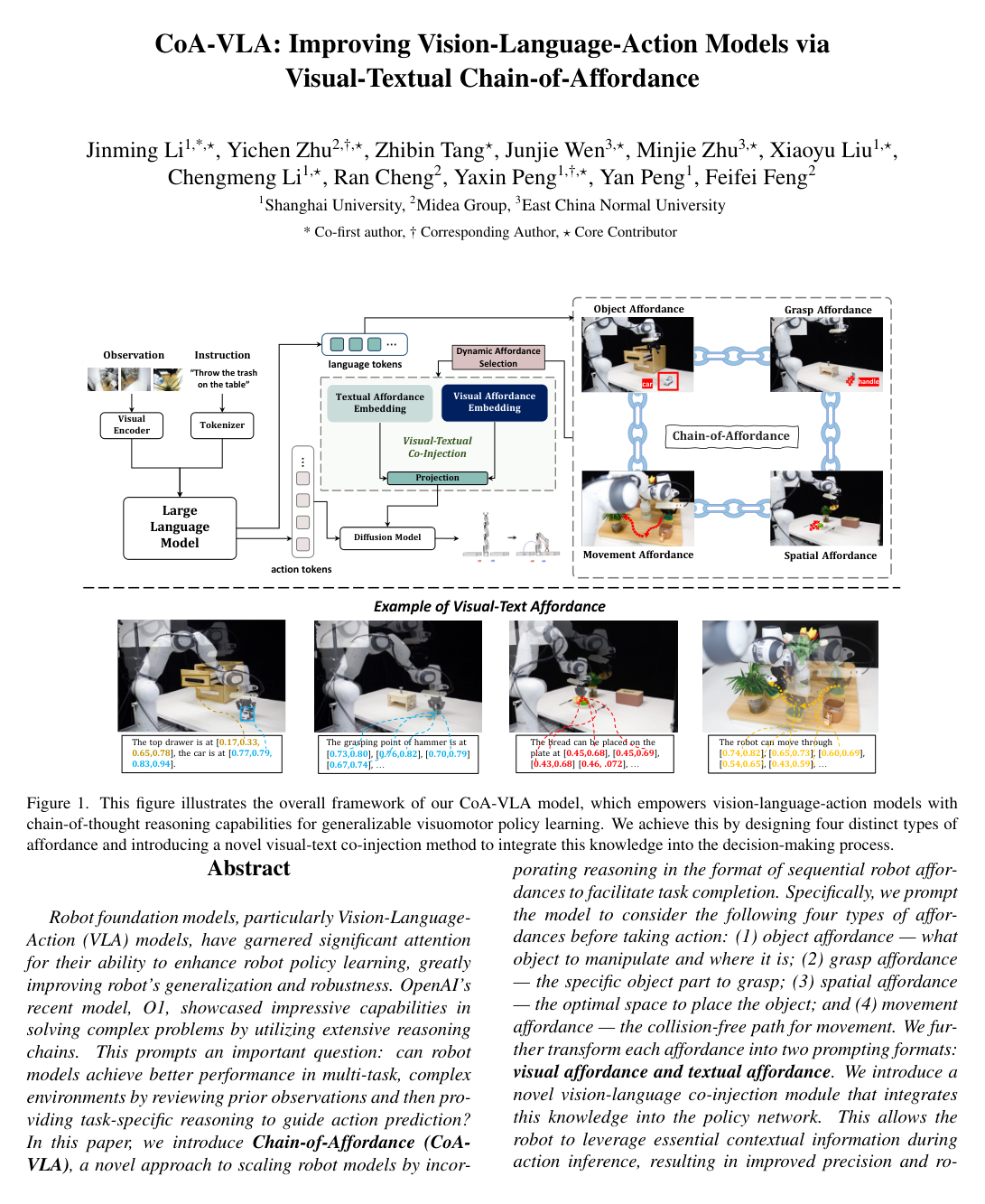
Robot foundation models, particularly Vision-Language-Action (VLA) models, have garnered significant attention for their ability to enhance robot policy learning, greatly improving robot's generalization and robustness. OpenAI's recent model, O1, showcased impressive capabilities in solving complex problems by utilizing extensive reasoning chains. This prompts an important question: can robot models achieve better performance in multi-task , complex environments by reviewing prior observations and then providing task-specific reasoning to guide action prediction? In this paper, we introduce Chain-of-Affordance (CoA-VLA) , a novel approach to scaling robot models by incorporating reasoning in the format of sequential robot affordances to facilitate task completion. Specifically, we prompt the model to consider the following four types of affordances before taking action: (1) object affordance - what object to manipulate and where it is ; (2) grasp affordance - the specific object part to grasp ; (3) spatial affordance - the optimal space to place the object ; and (4) movement affordance-the collision - free path for movement. We further transform each affordance into two prompting formats: visual affordance and textual affordance. We introduce a novel vision-language co-injection module that integrates this knowledge into the policy network. This allows the robot to leverage essential contextual information during action inference, resulting in improved precision and robustness. Our experiments demonstrate that CoA-VLA outperforms state-of-the-art robot foundation models, including OpenVLA and Octo, on a variety of tasks. Furthermore, CoA-VLA exhibits strong generalization capabilities, including recognizing unseen object poses, identifying free space, and avoiding obstacles in novel environments.
Added
2026-01-11
