
keyword
policy gradient
A policy gradient is a reinforcement learning method that directly optimizes an agent's decision-making strategy by calculating the gradient of expected cumulative rewards with respect to the parameters of that policy. Rather than learning intermediate value functions to infer optimal actions, policy gradient algorithms adjust the parameters of a stochastic or deterministic policy model through gradient ascent, thereby increasing the likelihood of actions that lead to higher returns. Grounded in the policy gradient theorem, these techniques allow an agent to update its policy directly from sampled interactions without needing explicit knowledge of the environment's transition dynamics. This makes policy gradient methods especially effective for complex, high-dimensional, and continuous action spaces, forming the foundation of algorithms such as REINFORCE, actor-critic frameworks, and trust-region policy optimization.
25 items
The RL/LLM Taxonomy Tree: Reviewing Synergies Between Reinforcement Learning and Large Language Models
Moschoula Pternea, Prerna Singh, Abir Chakraborty, Yagna D. Oruganti, Mirco Milletarí, Sayli Bapat, Kebei Jiang
Why you should read this
Establishes a three-part taxonomy classifying how reinforcement learning and large language models combine across model tuning, agent training, and joint planning systems while identifying current technical limitations and future research directions.
In this work, we review research studies that combine Reinforcement Learning (RL) and Large Language Models (LLMs), two areas that owe their momentum to the development of deep neural networks. We propose a novel taxonomy of three main classes based on the way that the two model types interact with each other. The first class, RL4LLM, includes studies where RL is leveraged to improve the performance of LLMs on tasks related to Natural Language Processing. L4LLM is divided into two sub-categories depending on whether RL is used to directly fine-tune an existing LLM or to improve the prompt of the LLM. In the second class, LLM4RL, an LLM assists the training of an RL model that performs a task that is not inherently related to natural language. We further break down LLM4RL based on the component of the RL training framework that the LLM assists or replaces, namely reward shaping, goal generation, and policy function. Finally, in the third class, RL+LLM, an LLM and an RL agent are embedded in a common planning framework without either of them contributing to training or fine-tuning of the other. We further branch this class to distinguish between studies with and without natural language feedback. We use this taxonomy to explore the motivations behind the synergy of LLMs and RL and explain the reasons for its success, while pinpointing potential shortcomings and areas where further research is needed, as well as alternative methodologies that serve the same goal.
Added
2026-10-05
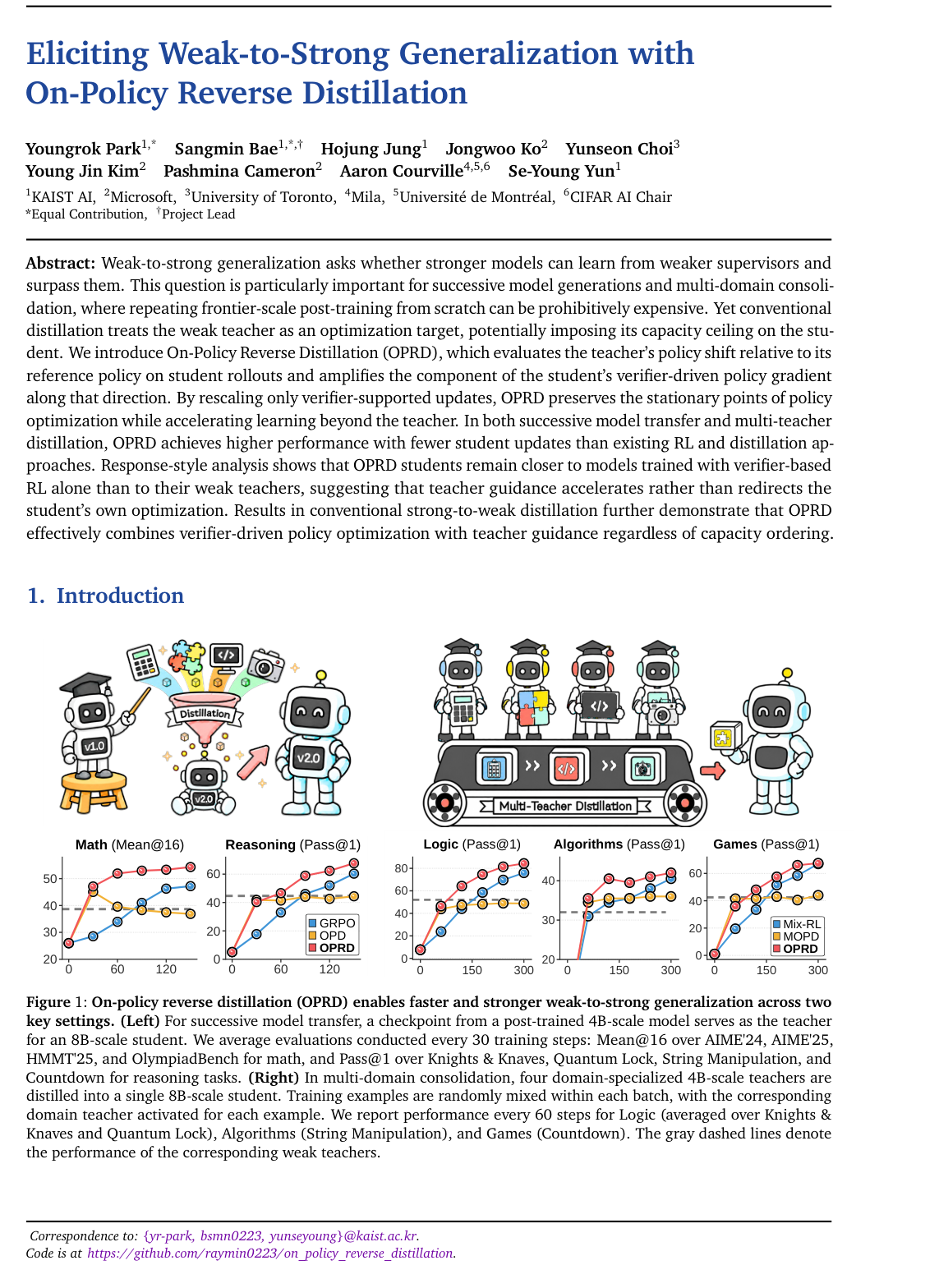
Eliciting Weak-to-Strong Generalization with On-Policy Reverse Distillation
Youngrok Park, Sangmin Bae, Hojung Jung, Jongwoo Ko, Yunseon Choi, Young Jin Kim, Pashmina Cameron, Aaron C. Courville, SeYoung Yun
Why you should read this
Proposes On-Policy Reverse Distillation to overcome the capacity limits of traditional distillation by using weak teacher guidance to accelerate verifier-driven policy gradients on student rollouts, allowing strong models to surpass their teachers with fewer training updates.
Weak-to-strong generalization asks whether stronger models can learn from weaker supervisors and surpass them. This question is particularly important for successive model generations and multi-domain consolidation, where repeating frontier-scale post-training from scratch can be prohibitively expensive. Yet conventional distillation treats the weak teacher as an optimization target, potentially imposing its capacity ceiling on the student. We introduce On-Policy Reverse Distillation (OPRD), which evaluates the teacher's policy shift relative to its reference policy on student rollouts and amplifies the component of the student's verifier-driven policy gradient along that direction. By rescaling only verifier-supported updates, OPRD preserves the stationary points of policy optimization while accelerating learning beyond the teacher. In both successive model transfer and multi-teacher distillation, OPRD achieves higher performance with fewer student updates than existing RL and distillation approaches. Response-style analysis shows that OPRD students remain closer to models trained with verifier-based RL alone than to their weak teachers, suggesting that teacher guidance accelerates rather than redirects the student's own optimization. Results in conventional strong-to-weak distillation further demonstrate that OPRD effectively combines verifier-driven policy optimization with teacher guidance regardless of capacity ordering.
Added
2026-10-05
Policy Gradient and Actor-Critic Learning in Continuous Time and Space: Theory and Algorithms
Yanwei Jia, Xun Yu Zhou
Why you should read this
Establishes a theoretical foundation for continuous-time and continuous-space policy gradient methods by reformulating the gradient estimation as a policy evaluation problem and deriving both offline and online actor-critic algorithms via martingale conditions.
We study policy gradient (PG) for reinforcement learning in continuous time and space under the regularized exploratory formulation developed by Wang et al. (2020). We represent the gradient of the value function with respect to a given parameterized stochastic policy as the expected integration of an auxiliary running reward function that can be evaluated using samples and the current value function. This representation effectively turns PG into a policy evaluation (PE) problem, enabling us to apply the martingale approach recently developed by Jia and Zhou (2022a) for PE to solve our PG problem. Based on this analysis, we propose two types of actor-critic algorithms for RL, where we learn and update value functions and policies simultaneously and alternatingly. The first type is based directly on the aforementioned representation, which involves future trajectories and is offline. The second type, designed for online learning, employs the first-order condition of the policy gradient and turns it into martingale orthogonality conditions. These conditions are then incorporated using stochastic approximation when updating policies. Finally, we demonstrate the algorithms by simulations in two concrete examples.
Added
2026-10-01
Dynamic Prompt Learning via Policy Gradient for Semi-structured Mathematical Reasoning
Pan Lu, Liang Qiu, Kai-Wei Chang, Ying Nian Wu, Song-Chun Zhu, Tanmay Rajpurohit, Peter Clark, Ashwin Kalyan
Why you should read this
Introduces TabMWP, a 38,431-question benchmark for mathematical reasoning over semi-structured tables, and develops PromptPG, a policy gradient technique that dynamically selects optimal in-context examples to improve large language model reasoning accuracy and stability.
Mathematical reasoning, a core ability of human intelligence, presents unique challenges for machines in abstract thinking and logical reasoning. Recent large pre-trained language models such as GPT-3 have achieved remarkable progress on mathematical reasoning tasks written in text form, such as math word problems (MWP). However, it is unknown if the models can handle more complex problems that involve math reasoning over heterogeneous information, such as tabular data. To fill the gap, we present Tabular Math Word Problems (TabMWP), a new dataset containing 38,431 open-domain grade-level problems that require mathematical reasoning on both textual and tabular data. Each question in TabMWP is aligned with a tabular context, which is presented as an image, semi-structured text, and a structured table. There are two types of questions: free-text and multi-choice, and each problem is annotated with gold solutions to reveal the multi-step reasoning process. We evaluate different pre-trained models on TabMWP, including the GPT-3 model in a few-shot setting. As earlier studies suggest, since few-shot GPT-3 relies on the selection of in-context examples, its performance is unstable and can degrade to near chance. The unstable issue is more severe when handling complex problems like TabMWP. To mitigate this, we further propose a novel approach, PromptPG, which utilizes policy gradient to learn to select in-context examples from a small amount of training data and then constructs the corresponding prompt for the test example. Experimental results show that our method outperforms the best baseline by 5.31% on the accuracy metric and reduces the prediction variance significantly compared to random selection, which verifies its effectiveness in selecting in-context examples.
Added
2026-09-26
Supported Policy Optimization for Offline Reinforcement Learning
Jialong Wu, Haixu Wu, Zihan Qiu, Jianmin Wang, Mingsheng Long
Why you should read this
Proposes a pluggable offline reinforcement learning algorithm that uses a VAE-based density estimator to explicitly enforce behavior policy support constraints, achieving state-of-the-art benchmark performance and efficient online fine-tuning without intrusive architectural modifications.
Policy constraint methods to offline reinforcement learning (RL) typically utilize parameterization or regularization that constrains the policy to perform actions within the support set of the behavior policy. The elaborative designs of parameterization methods usually intrude into the policy networks, which may bring extra inference cost and cannot take full advantage of well-established online methods. Regularization methods reduce the divergence between the learned policy and the behavior policy, which may mismatch the inherent density-based definition of support set thereby failing to avoid the out-of-distribution actions effectively. This paper presents Supported Policy OpTimization (SPOT), which is directly derived from the theoretical formalization of the density-based support constraint. SPOT adopts a VAE-based density estimator to explicitly model the support set of behavior policy and presents a simple but effective density-based regularization term, which can be plugged non-intrusively into off-the-shelf off-policy RL algorithms. SPOT achieves the state-of-the-art performance on standard benchmarks for offline RL. Benefiting from the pluggable design, offline pretrained models from SPOT can also be applied to perform online fine-tuning seamlessly.
Added
2026-09-26
Learning Multiagent Communication with Backpropagation
Sainbayar Sukhbaatar, Arthur Szlam, Rob Fergus
Why you should read this
Introduces CommNet, a neural model that enables cooperative agents to learn continuous, interpretable communication protocols end-to-end using backpropagation to solve collaborative tasks.
Many tasks in AI require the collaboration of multiple agents. Typically, the communication protocol between agents is manually specified and not altered during training. In this paper we explore a simple neural model, called CommNet, that uses continuous communication for fully cooperative tasks. The model consists of multiple agents and the communication between them is learned alongside their policy. We apply this model to a diverse set of tasks, demonstrating the ability of the agents to learn to communicate amongst themselves, yielding improved performance over non-communicative agents and baselines. In some cases, it is possible to interpret the language devised by the agents, revealing simple but effective strategies for solving the task at hand.
Added
2026-09-25
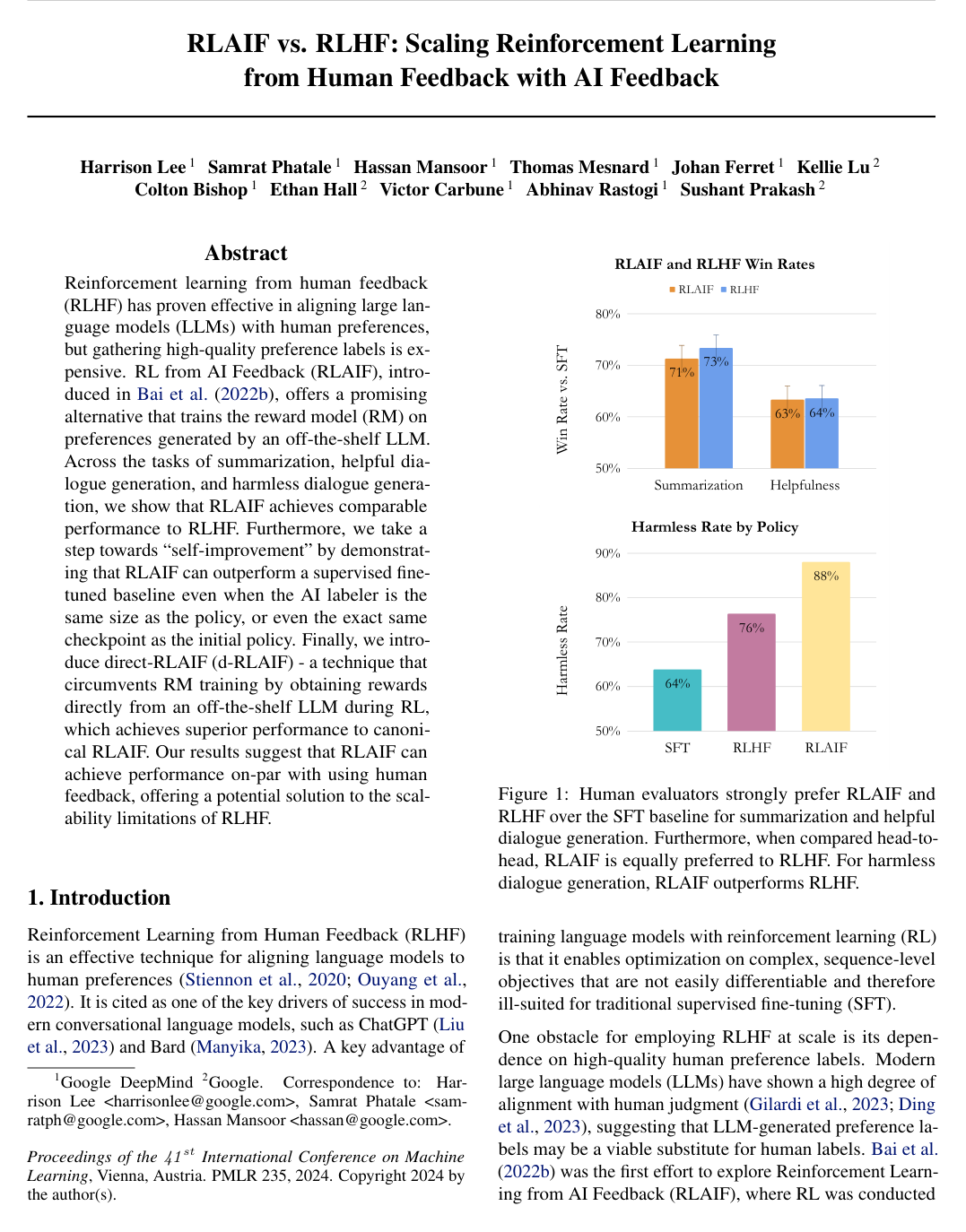
RLAIF vs. RLHF: Scaling Reinforcement Learning from Human Feedback with AI Feedback
Harrison Lee, Samrat Phatale, Hassan Mansoor, Thomas Mesnard, Johan Ferret, Kellie Lu, Colton Bishop, Ethan Hall, Victor Carbune, Abhinav Rastogi, Sushant Prakash
Why you should read this
Demonstrates that reinforcement learning from AI feedback achieves alignment performance comparable to human feedback across dialogue and summarization tasks, showing that language models can self-improve without costly human annotations and introducing direct-RLAIF to bypass reward model training.
Reinforcement learning from human feedback (RLHF) has proven effective in aligning large language models (LLMs) with human preferences, but gathering high-quality preference labels is expensive. RL from AI Feedback (RLAIF), introduced in Bai et al., offers a promising alternative that trains the reward model (RM) on preferences generated by an off-the-shelf LLM. Across the tasks of summarization, helpful dialogue generation, and harmless dialogue generation, we show that RLAIF achieves comparable performance to RLHF. Furthermore, we take a step towards "self-improvement" by demonstrating that RLAIF can outperform a supervised fine-tuned baseline even when the AI labeler is the same size as the policy, or even the exact same checkpoint as the initial policy. Finally, we introduce direct-RLAIF (d-RLAIF) - a technique that circumvents RM training by obtaining rewards directly from an off-the-shelf LLM during RL, which achieves superior performance to canonical RLAIF. Our results suggest that RLAIF can achieve performance on-par with using human feedback, offering a potential solution to the scalability limitations of RLHF.
Added
2026-09-22

Experience Replay for Continual Learning
David Rolnick, Arun Ahuja, Jonathan Schwarz, Timothy P. Lillicrap, Greg Wayne
Why you should read this
Demonstrates that combining experience replay with behavioral cloning effectively prevents catastrophic forgetting in continual reinforcement learning without requiring task boundary labels, matching the performance of specialized task-aware methods across Atari and DeepMind Lab.
Continual learning is the problem of learning new tasks or knowledge while protecting old knowledge and ideally generalizing from old experience to learn new tasks faster. Neural networks trained by stochastic gradient descent often degrade on old tasks when trained successively on new tasks with different data distributions. This phenomenon, referred to as catastrophic forgetting, is considered a major hurdle to learning with non-stationary data or sequences of new tasks, and prevents networks from continually accumulating knowledge and skills. We examine this issue in the context of reinforcement learning, in a setting where an agent is exposed to tasks in a sequence. Unlike most other work, we do not provide an explicit indication to the model of task boundaries, which is the most general circumstance for a learning agent exposed to continuous experience. While various methods to counteract catastrophic forgetting have recently been proposed, we explore a straightforward, general, and seemingly overlooked solution - that of using experience replay buffers for all past events - with a mixture of on- and off-policy learning, leveraging behavioral cloning. We show that this strategy can still learn new tasks quickly yet can substantially reduce catastrophic forgetting in both Atari and DMLab domains, even matching the performance of methods that require task identities. When buffer storage is constrained, we confirm that a simple mechanism for randomly discarding data allows a limited size buffer to perform almost as well as an unbounded one.
Added
2026-09-18
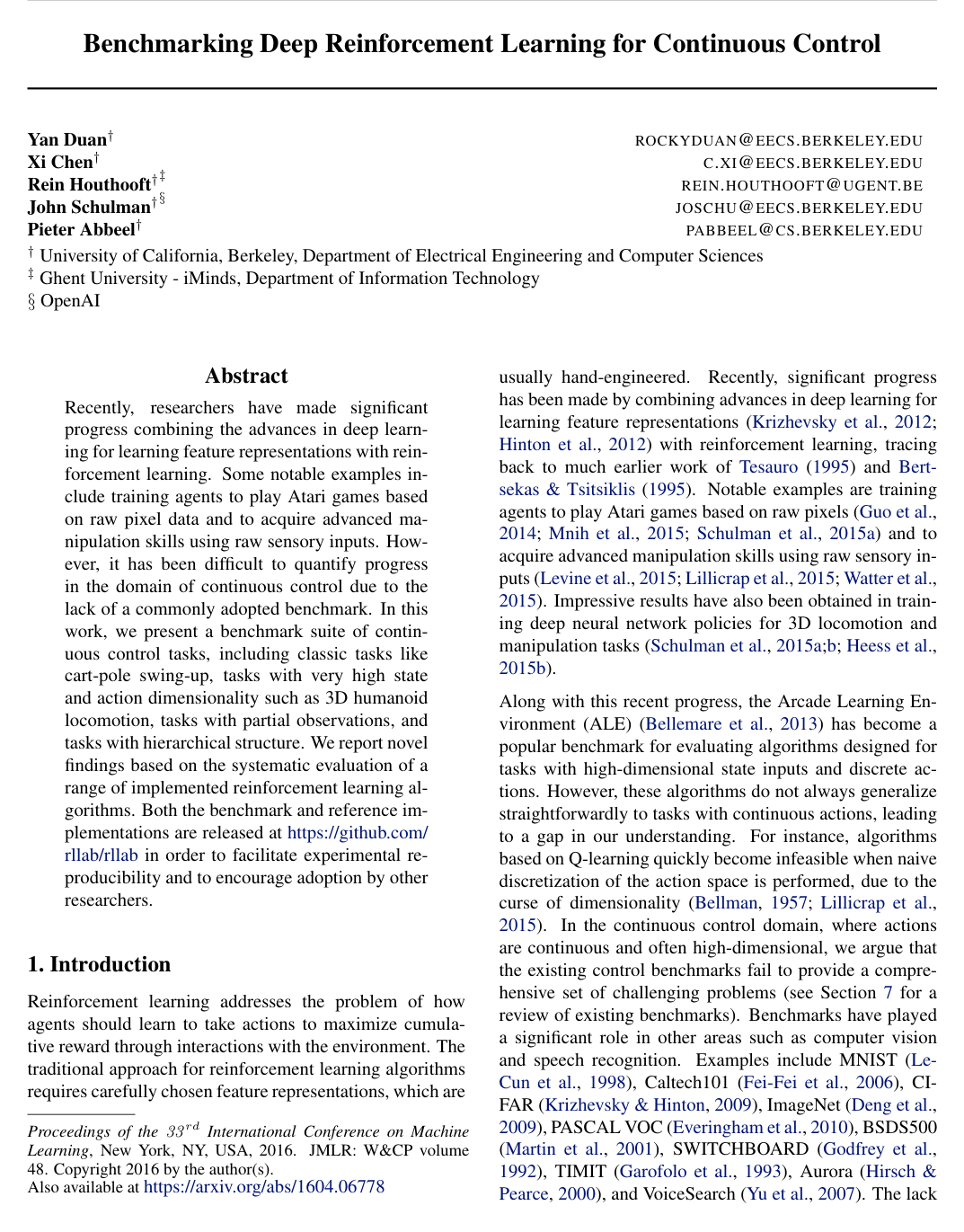
Benchmarking Deep Reinforcement Learning for Continuous Control
Yan Duan, Xi Chen, Rein Houthooft, John Schulman, Pieter Abbeel
Why you should read this
Presents a standardized continuous control benchmark suite and systematically evaluates prominent deep reinforcement learning algorithms across diverse tasks, establishing reproducible performance baselines for high-dimensional control problems.
Recently, researchers have made significant progress combining the advances in deep learning for learning feature representations with reinforcement learning. Some notable examples include training agents to play Atari games based on raw pixel data and to acquire advanced manipulation skills using raw sensory inputs. However, it has been difficult to quantify progress in the domain of continuous control due to the lack of a commonly adopted benchmark. In this work, we present a benchmark suite of continuous control tasks, including classic tasks like cart-pole swing-up, tasks with very high state and action dimensionality such as 3D humanoid locomotion, tasks with partial observations, and tasks with hierarchical structure. We report novel findings based on the systematic evaluation of a range of implemented reinforcement learning algorithms. Both the benchmark and reference implementations are released at this https URL in order to facilitate experimental reproducibility and to encourage adoption by other researchers.
Added
2026-09-18
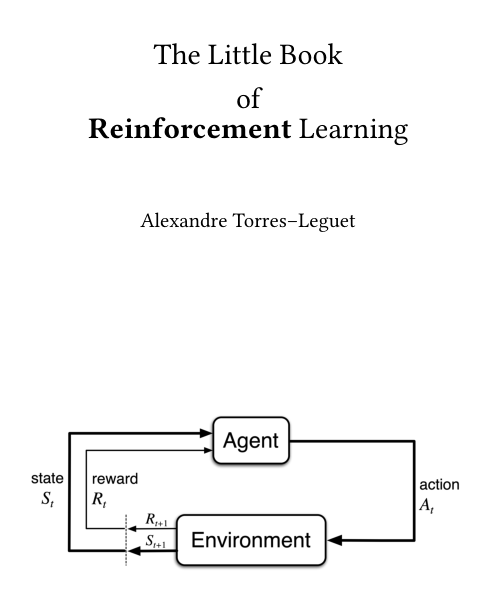
The Little Book of Reinforcement Learning
Alexandre Torres–Leguet
Why you should read this
Introduces fundamental reinforcement learning concepts in a clear and concise format.
An introductory guide to the core concepts and applications of reinforcement learning.
Added
2026-09-17

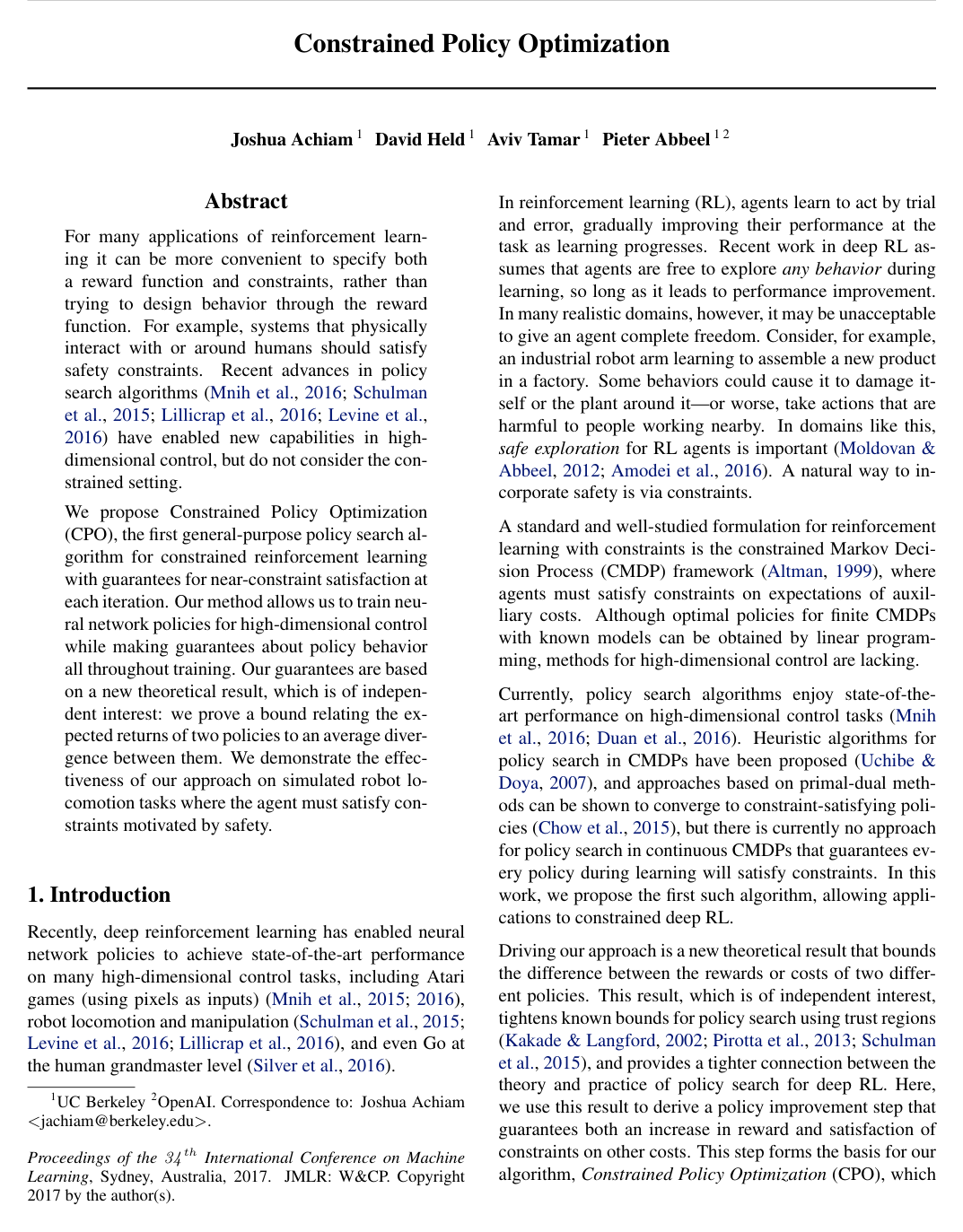
Constrained Policy Optimization
Joshua Achiam, David Held, Aviv Tamar, Pieter Abbeel
Why you should read this
Introduces Constrained Policy Optimization (CPO), the first general-purpose policy search algorithm for constrained reinforcement learning that provides theoretical guarantees of constraint satisfaction throughout the entire training process in high-dimensional control tasks.
For many applications of reinforcement learning it can be more convenient to specify both a reward function and constraints, rather than trying to design behavior through the reward function. For example, systems that physically interact with or around humans should satisfy safety constraints. Recent advances in policy search algorithms (Mnih et al., 2016, Schulman et al., 2015, Lillicrap et al., 2016, Levine et al., 2016) have enabled new capabilities in high-dimensional control, but do not consider the constrained setting. We propose Constrained Policy Optimization (CPO), the first general-purpose policy search algorithm for constrained reinforcement learning with guarantees for near-constraint satisfaction at each iteration. Our method allows us to train neural network policies for high-dimensional control while making guarantees about policy behavior all throughout training. Our guarantees are based on a new theoretical result, which is of independent interest: we prove a bound relating the expected returns of two policies to an average divergence between them. We demonstrate the effectiveness of our approach on simulated robot locomotion tasks where the agent must satisfy constraints motivated by safety.
Added
2026-09-17
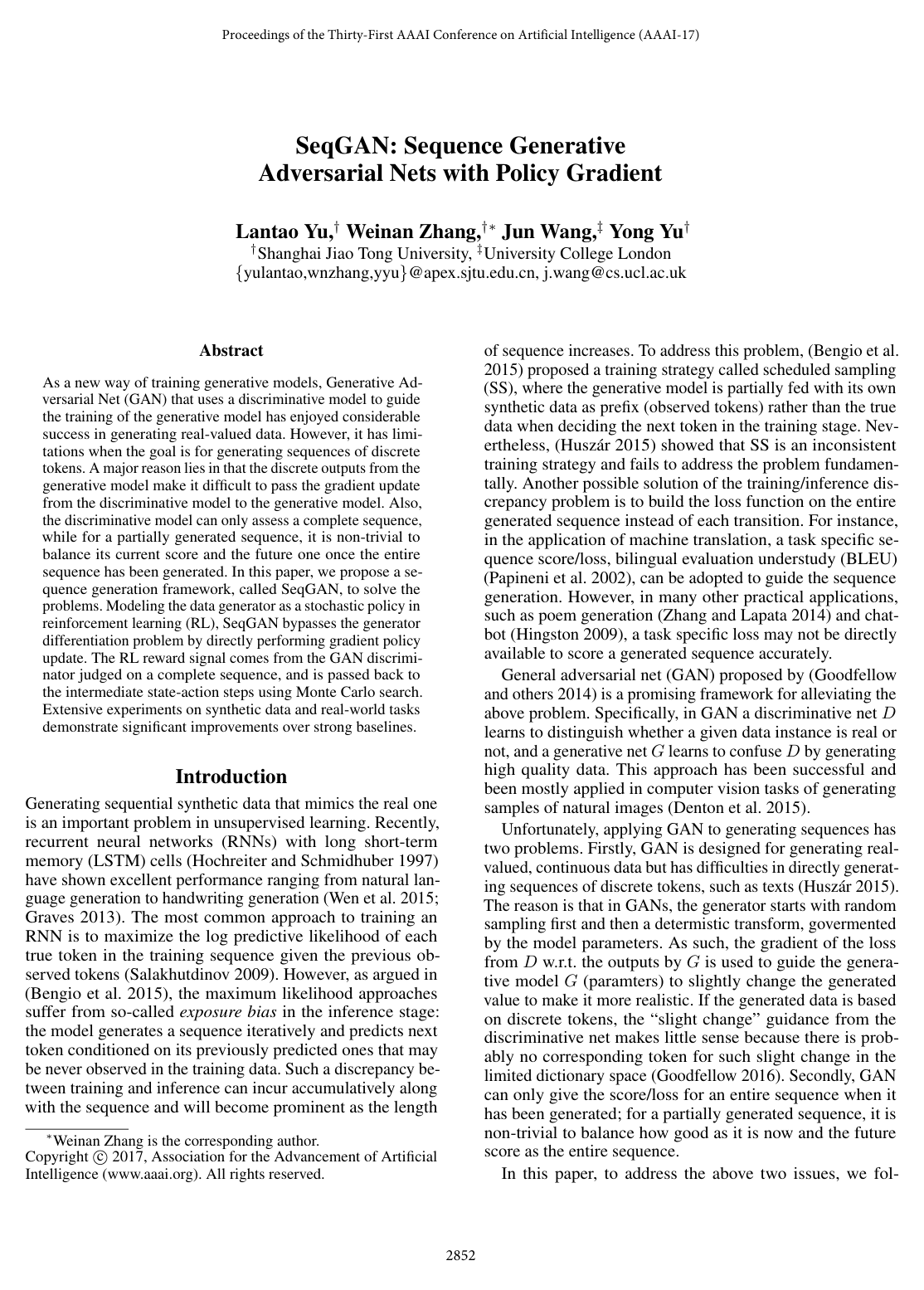
SeqGAN: Sequence Generative Adversarial Nets with Policy Gradient
Lantao Yu, Weinan Zhang, Jun Wang, Yong Yu
Why you should read this
Introduces SeqGAN to overcome the non-differentiability barrier of discrete sequence generation in generative adversarial networks by framing the generator as a reinforcement learning policy trained through policy gradients and Monte Carlo search.
As a new way of training generative models, Generative Adversarial Nets (GAN) that uses a discriminative model to guide the training of the generative model has enjoyed considerable success in generating real-valued data. However, it has limitations when the goal is for generating sequences of discrete tokens. A major reason lies in that the discrete outputs from the generative model make it difficult to pass the gradient update from the discriminative model to the generative model. Also, the discriminative model can only assess a complete sequence, while for a partially generated sequence, it is non-trivial to balance its current score and the future one once the entire sequence has been generated. In this paper, we propose a sequence generation framework, called SeqGAN, to solve the problems. Modeling the data generator as a stochastic policy in reinforcement learning (RL), SeqGAN bypasses the generator differentiation problem by directly performing gradient policy update. The RL reward signal comes from the GAN discriminator judged on a complete sequence, and is passed back to the intermediate state-action steps using Monte Carlo search. Extensive experiments on synthetic data and real-world tasks demonstrate significant improvements over strong baselines.
Added
2026-09-14
Generative Adversarial Imitation Learning
Jonathan Ho, Stefano Ermon
Why you should read this
Proposes a model-free imitation learning framework that bypasses the computational bottleneck of inverse reinforcement learning by directly matching expert state-action distributions using generative adversarial training.
Consider learning a policy from example expert behavior, without interaction with the expert or access to reinforcement signal. One approach is to recover the expert's cost function with inverse reinforcement learning, then extract a policy from that cost function with reinforcement learning. This approach is indirect and can be slow. We propose a new general framework for directly extracting a policy from data, as if it were obtained by reinforcement learning following inverse reinforcement learning. We show that a certain instantiation of our framework draws an analogy between imitation learning and generative adversarial networks, from which we derive a model-free imitation learning algorithm that obtains significant performance gains over existing model-free methods in imitating complex behaviors in large, high-dimensional environments.
Added
2026-09-11
Neural Architecture Search with Reinforcement Learning
Barret Zoph, Quoc V. Le
Why you should read this
Introduces a reinforcement learning framework that automates neural network design using a recurrent controller, producing vision models and recurrent cells that outperform human-engineered state-of-the-art architectures on CIFAR-10 and Penn Treebank.
Neural networks are powerful and flexible models that work well for many difficult learning tasks in image, speech and natural language understanding. Despite their success, neural networks are still hard to design. In this paper, we use a recurrent network to generate the model descriptions of neural networks and train this RNN with reinforcement learning to maximize the expected accuracy of the generated architectures on a validation set. On the CIFAR-10 dataset, our method, starting from scratch, can design a novel network architecture that rivals the best human-invented architecture in terms of test set accuracy. Our CIFAR-10 model achieves a test error rate of 3.65, which is 0.09 percent better and 1.05x faster than the previous state-of-the-art model that used a similar architectural scheme. On the Penn Treebank dataset, our model can compose a novel recurrent cell that outperforms the widely-used LSTM cell, and other state-of-the-art baselines. Our cell achieves a test set perplexity of 62.4 on the Penn Treebank, which is 3.6 perplexity better than the previous state-of-the-art model. The cell can also be transferred to the character language modeling task on PTB and achieves a state-of-the-art perplexity of 1.214.
Added
2026-09-09
Continuous control with deep reinforcement learning
T. Lillicrap, Jonathan J. Hunt, A. Pritzel, N. Heess, Tom Erez, Yuval Tassa, David Silver, Daan Wierstra
Why you should read this
Develops the Deep Deterministic Policy Gradient algorithm to extend deep Q-learning into continuous action spaces, enabling agents to learn complex physical control and locomotion policies directly from raw pixels.
We adapt the ideas underlying the success of Deep Q-Learning to the continuous action domain. We present an actor-critic, model-free algorithm based on the deterministic policy gradient that can operate over continuous action spaces. Using the same learning algorithm, network architecture and hyper-parameters, our algorithm robustly solves more than 20 simulated physics tasks, including classic problems such as cartpole swing-up, dexterous manipulation, legged locomotion and car driving. Our algorithm is able to find policies whose performance is competitive with those found by a planning algorithm with full access to the dynamics of the domain and its derivatives. We further demonstrate that for many of the tasks the algorithm can learn policies end-to-end: directly from raw pixel inputs.
Added
2026-09-06
License
Published with permission
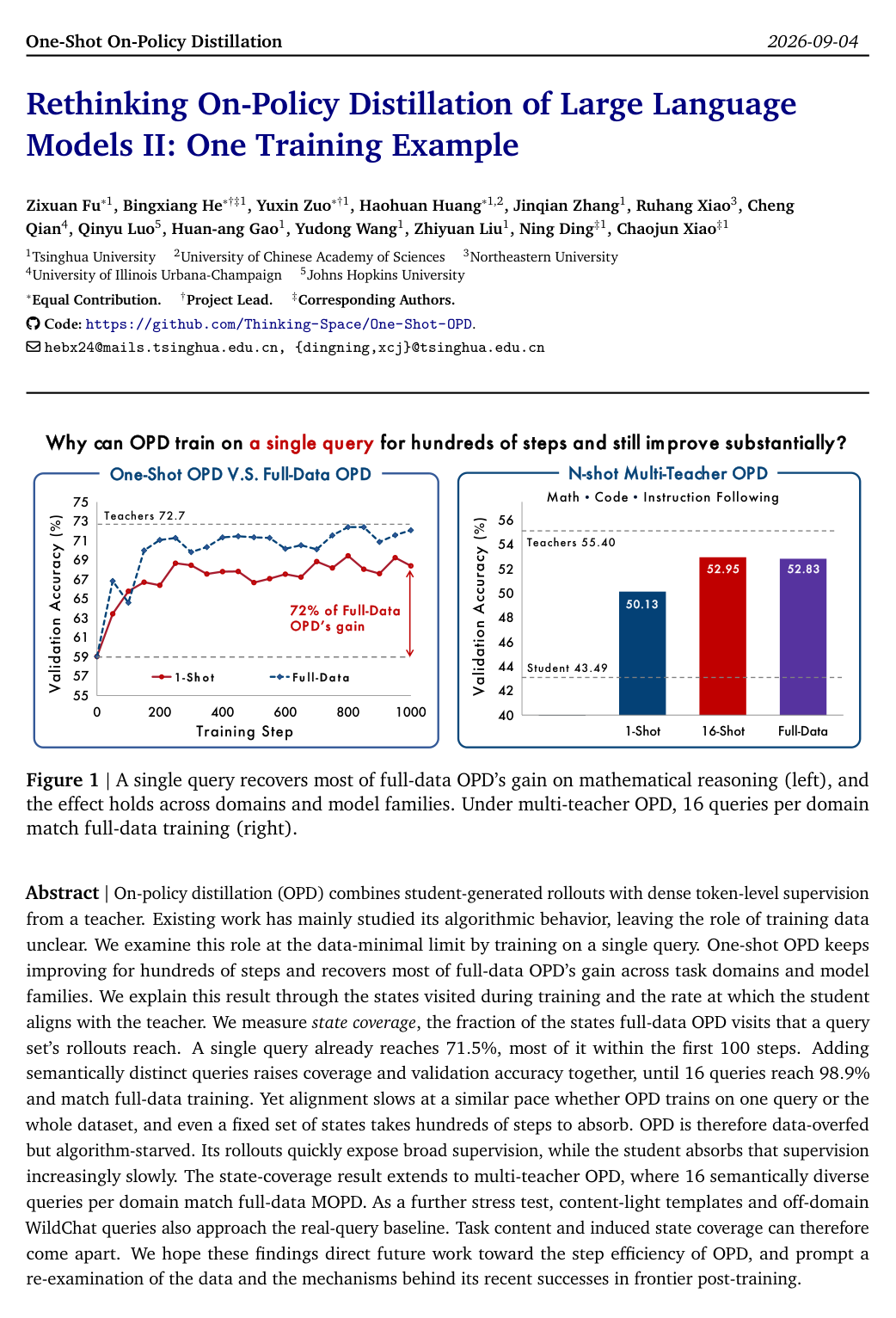
Rethinking On-Policy Distillation of Large Language Models II: One Training Example
Zixuan Fu, Bingxiang He, Yuxin Zuo, Haohuan Huang, Jinqian Zhang, Ruhang Xiao, Cheng Qian, Qinyu Luo, Huan-ang Gao, Yudong Wang, Zhiyuan Liu, Ning Ding, Chaojun Xiao
Why you should read this
Demonstrates that on-policy distillation requires as few as 16 training queries to match full-dataset performance, revealing that student rollouts rapidly achieve broad state coverage while slow student alignment—not data scarcity—is the true training bottleneck.
On-policy distillation (OPD) combines student-generated rollouts with dense token-level supervision from a teacher. Existing work has mainly studied its algorithmic behavior, leaving the role of training data unclear. We examine this role at the data-minimal limit by training on a single query. One-shot OPD keeps improving for hundreds of steps and recovers most of full-data OPD's gain across task domains and model families. We explain this result through the states visited during training and the rate at which the student aligns with the teacher. We measure \emph{state coverage}, the fraction of the states full-data OPD visits that a query set's rollouts reach. A single query already reaches \(71.5\%\), most of it within the first 100 steps. Adding semantically distinct queries raises coverage and validation accuracy together, until 16 queries reach \(98.9\%\) and match full-data training. Yet alignment slows at a similar pace whether OPD trains on one query or the whole dataset, and even a fixed set of states takes hundreds of steps to absorb. OPD is therefore data-overfed but algorithm-starved. Its rollouts quickly expose broad supervision, while the student absorbs that supervision increasingly slowly. The state-coverage result extends to multi-teacher OPD, where 16 semantically diverse queries per domain match full-data MOPD. As a further stress test, content-light templates and off-domain WildChat queries also approach the real-query baseline. Task content and induced state coverage can therefore come apart. We hope these findings direct future work toward the step efficiency of OPD, and prompt a re-examination of the data and the mechanisms behind its recent successes in frontier post-training.
Added
2026-09-05
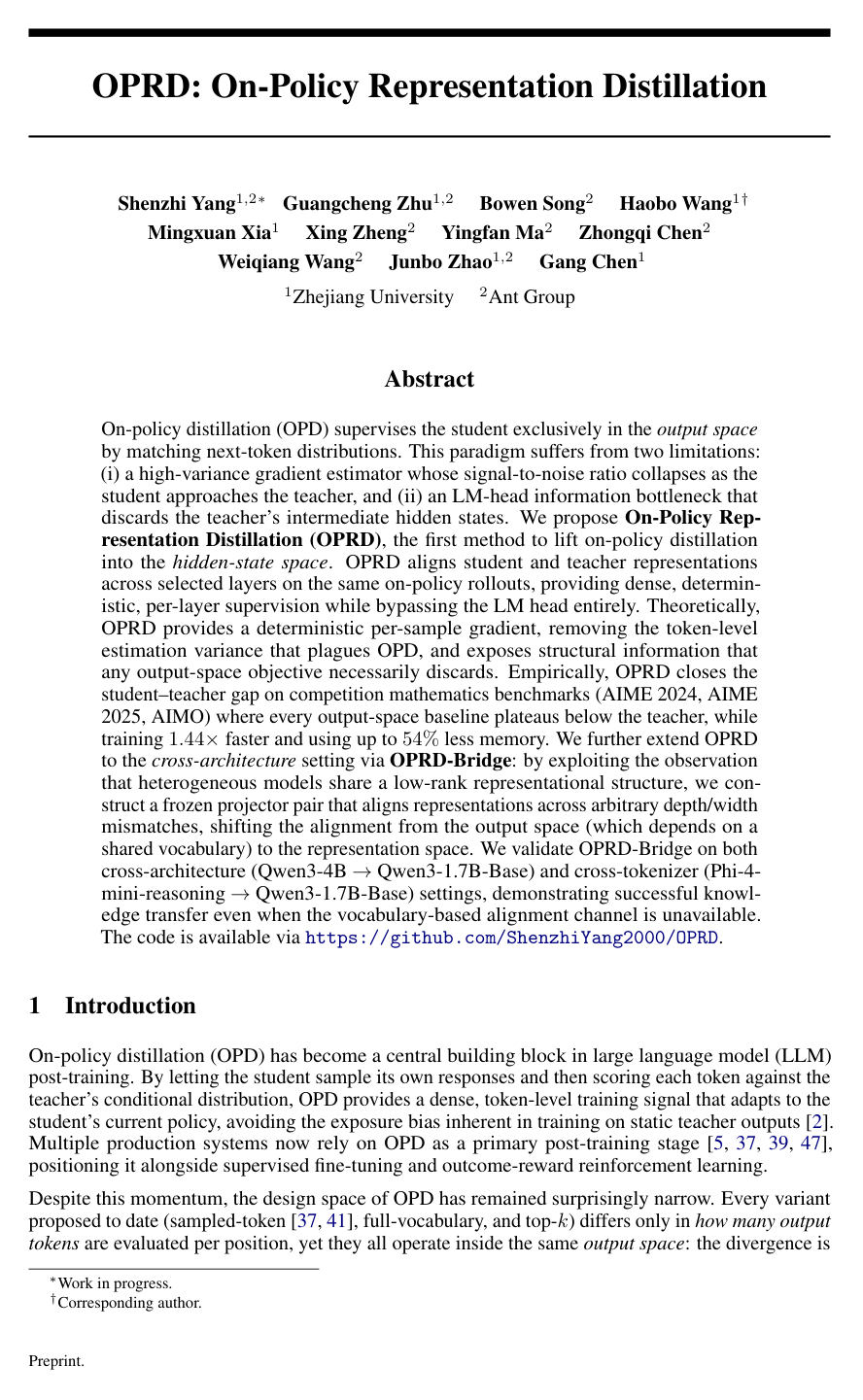
OPRD: On-Policy Representation Distillation
Shenzhi Yang, Guangcheng Zhu, Bowen Song, Haobo Wang, Mingxuan Xia, Xing Zheng, Yingfan Ma, Zhongqi Chen, Weiqiang Wang, Junbo Zhao, Gang Chen
On-policy distillation (OPD) supervises the student exclusively in the output space by matching next-token distributions. This paradigm suffers from two limitations: (i) a high-variance gradient estimator whose signal-to-noise ratio collapses as the student approaches the teacher, and (ii) an LM-head information bottleneck that discards the teacher's intermediate hidden states. We propose On-Policy Representation Distillation (OPRD), the first method to lift on-policy distillation into the hidden-state space. OPRD aligns student and teacher representations across selected layers on the same on-policy rollouts, providing dense, deterministic, per-layer supervision while bypassing the LM head entirely. Theoretically, OPRD provides a deterministic per-sample gradient, removing the token-level estimation variance that plagues OPD, and exposes structural information that any output-space objective necessarily discards. Empirically, OPRD closes the student-teacher gap on competition mathematics benchmarks (AIME 2024, AIME 2025, and AIMO), where every output-space baseline plateaus below the teacher, while training 1.44x faster and using up to 54% less memory. We further extend OPRD to the cross-architecture setting via OPRD-Bridge. By exploiting the observation that heterogeneous models share a low-rank representational structure, we construct a frozen projector pair that aligns representations across arbitrary depth and width mismatches, shifting the alignment from the output space (which depends on a shared vocabulary) to the representation space. We validate OPRD-Bridge on both cross-architecture (Qwen3-4B -> Qwen3-1.7B-Base) and cross-tokenizer (Phi-4-mini-reasoning -> Qwen3-1.7B-Base) settings, demonstrating successful knowledge transfer even when the vocabulary-based alignment channel is unavailable. Code: this https URL.
Added
2026-09-03
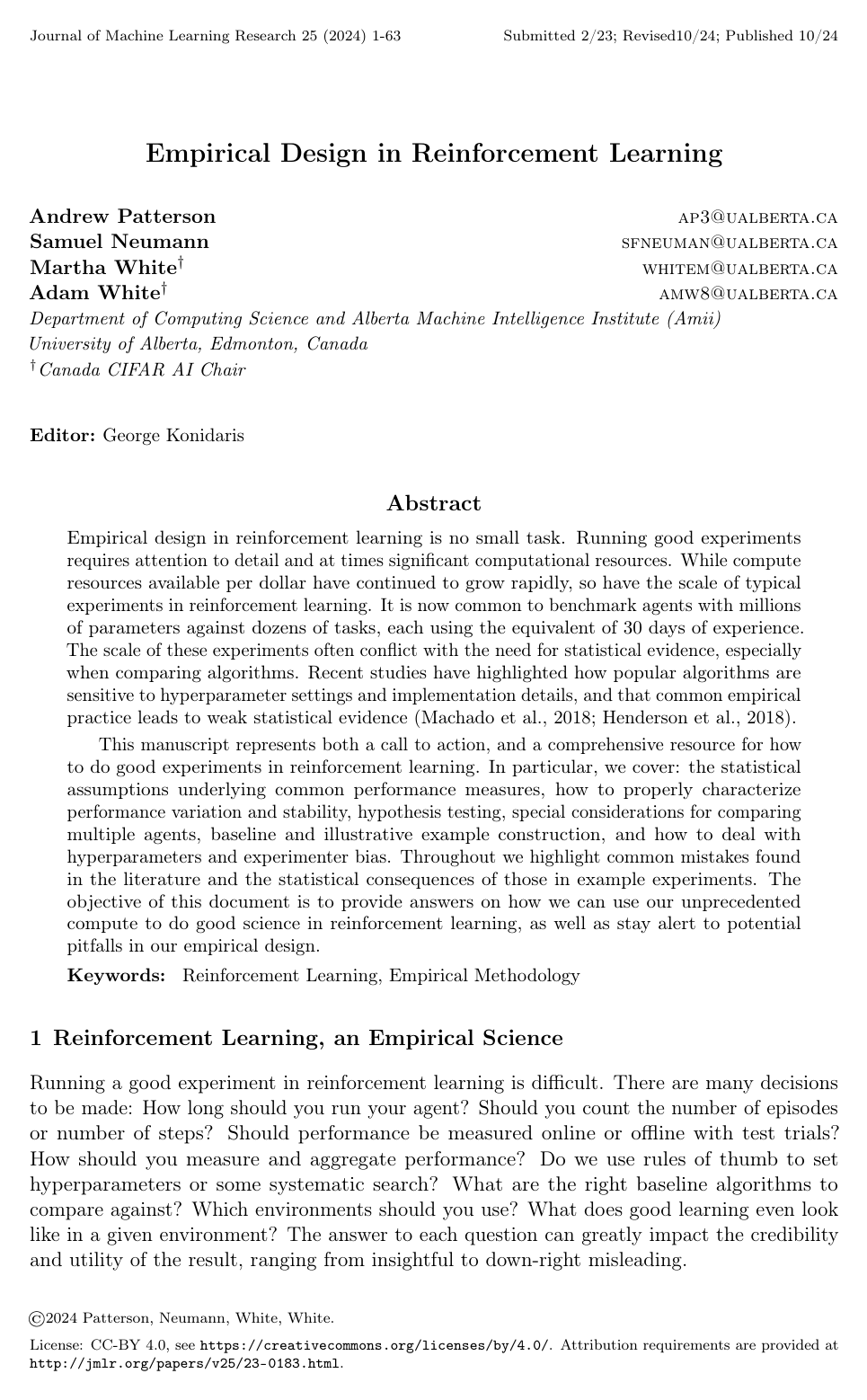
Empirical Design in Reinforcement Learning
Andrew Patterson, Samuel Neumann, Martha White, Adam White
Why you should read this
Presents a comprehensive guide to conducting statistically sound reinforcement learning experiments, exposing common methodological errors and providing clear protocols for hyperparameter tuning, baseline selection, and performance evaluation.
Empirical design in reinforcement learning is no small task. Running good experiments requires attention to detail and at times significant computational resources. While compute resources available per dollar have continued to grow rapidly, so have the scale of typical experiments in reinforcement learning. It is now common to benchmark agents with millions of parameters against dozens of tasks, each using the equivalent of 30 days of experience. The scale of these experiments often conflict with the need for proper statistical evidence, especially when comparing algorithms. Recent studies have highlighted how popular algorithms are sensitive to hyper-parameter settings and implementation details, and that common empirical practice leads to weak statistical evidence (Machado et al., 2018; Henderson et al., 2018). Here we take this one step further. This manuscript represents both a call to action, and a comprehensive resource for how to do good experiments in reinforcement learning. In particular, we cover: the statistical assumptions underlying common performance measures, how to properly characterize performance variation and stability, hypothesis testing, special considerations for comparing multiple agents, baseline and illustrative example construction, and how to deal with hyper-parameters and experimenter bias. Throughout we highlight common mistakes found in the literature and the statistical consequences of those in example experiments. The objective of this document is to provide answers on how we can use our unprecedented compute to do good science in reinforcement learning, as well as stay alert to potential pitfalls in our empirical design.
Added
2026-08-25
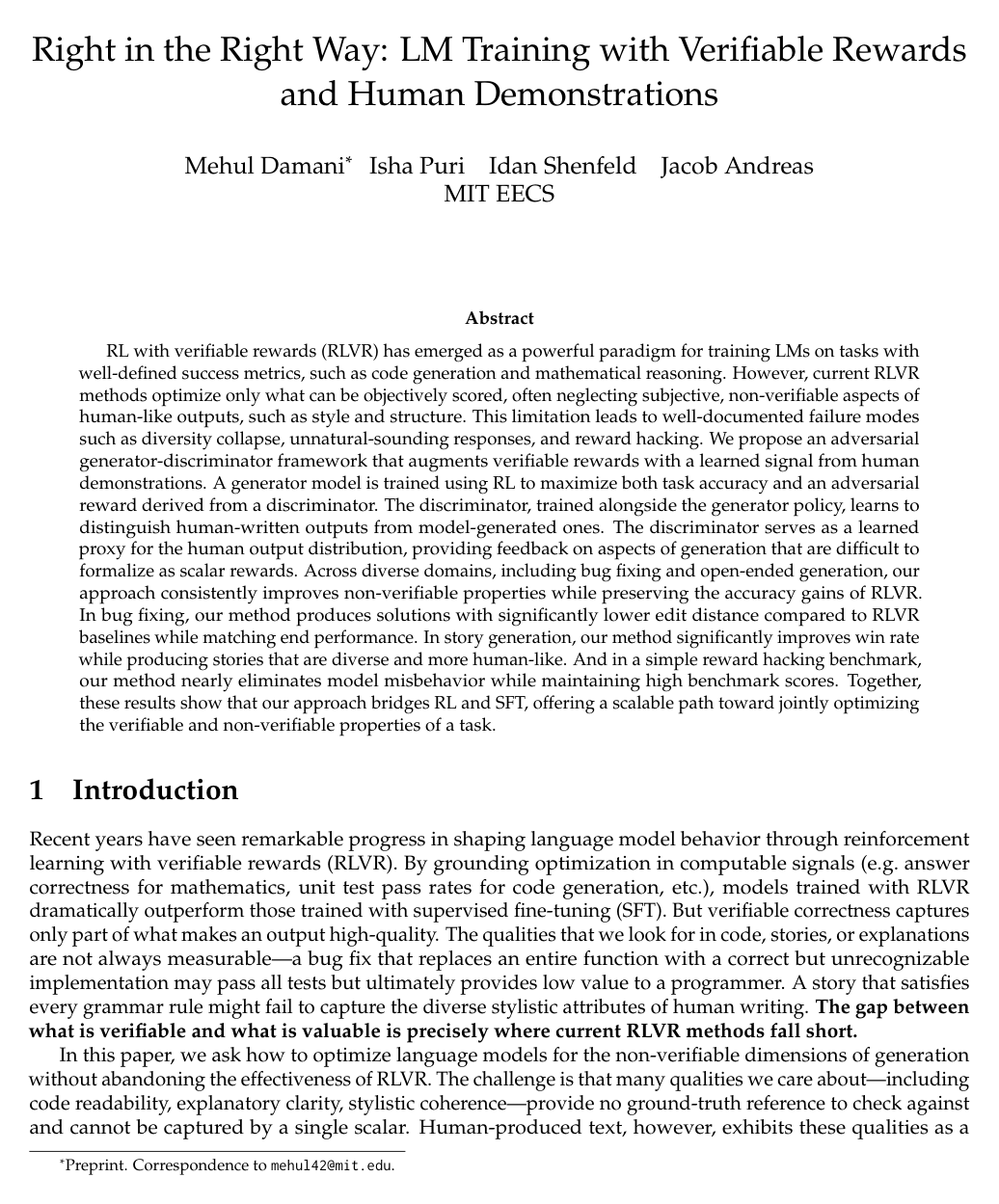
Right in the Right Way: LM Training with Verifiable Rewards and Human Demonstrations
Mehul Damani, Isha Puri, Idan Shenfeld, Jacob Andreas
Why you should read this
Develops an adversarial generator-discriminator framework that effectively integrates human demonstrations with verifiable rewards, enabling large language models to optimize for both objective task accuracy and subjective, non-verifiable human-like qualities.
RL with verifiable rewards (RLVR) has emerged as a powerful paradigm for training LMs on tasks with well-defined success metrics, such as code generation and mathematical reasoning. However, current RLVR methods optimize only what can be objectively scored, often neglecting subjective, non-verifiable aspects of human-like outputs, such as style and structure. This limitation leads to well-documented failure modes such as diversity collapse, unnatural-sounding responses, and reward hacking. We propose an adversarial generator-discriminator framework that augments verifiable rewards with a learned signal from human demonstrations. A generator model is trained using RL to maximize both task accuracy and an adversarial reward derived from a discriminator. The discriminator, trained alongside the generator policy, learns to distinguish human-written outputs from model-generated ones. The discriminator serves as a learned proxy for the human output distribution, providing feedback on aspects of generation that are difficult to formalize as scalar rewards. Across diverse domains, including bug fixing and open-ended generation, our approach consistently improves non-verifiable properties while preserving the accuracy gains of RLVR. In bug fixing, our method produces solutions with significantly lower edit distance compared to RLVR baselines while matching end performance. In story generation, our method significantly improves win rate while producing stories that are diverse and more human-like. And in a simple reward hacking benchmark, our method nearly eliminates model misbehavior while maintaining high benchmark scores. Together, these results show that our approach bridges RL and SFT, offering a scalable path toward jointly optimizing the verifiable and non-verifiable properties of a task.
Added
2026-07-13
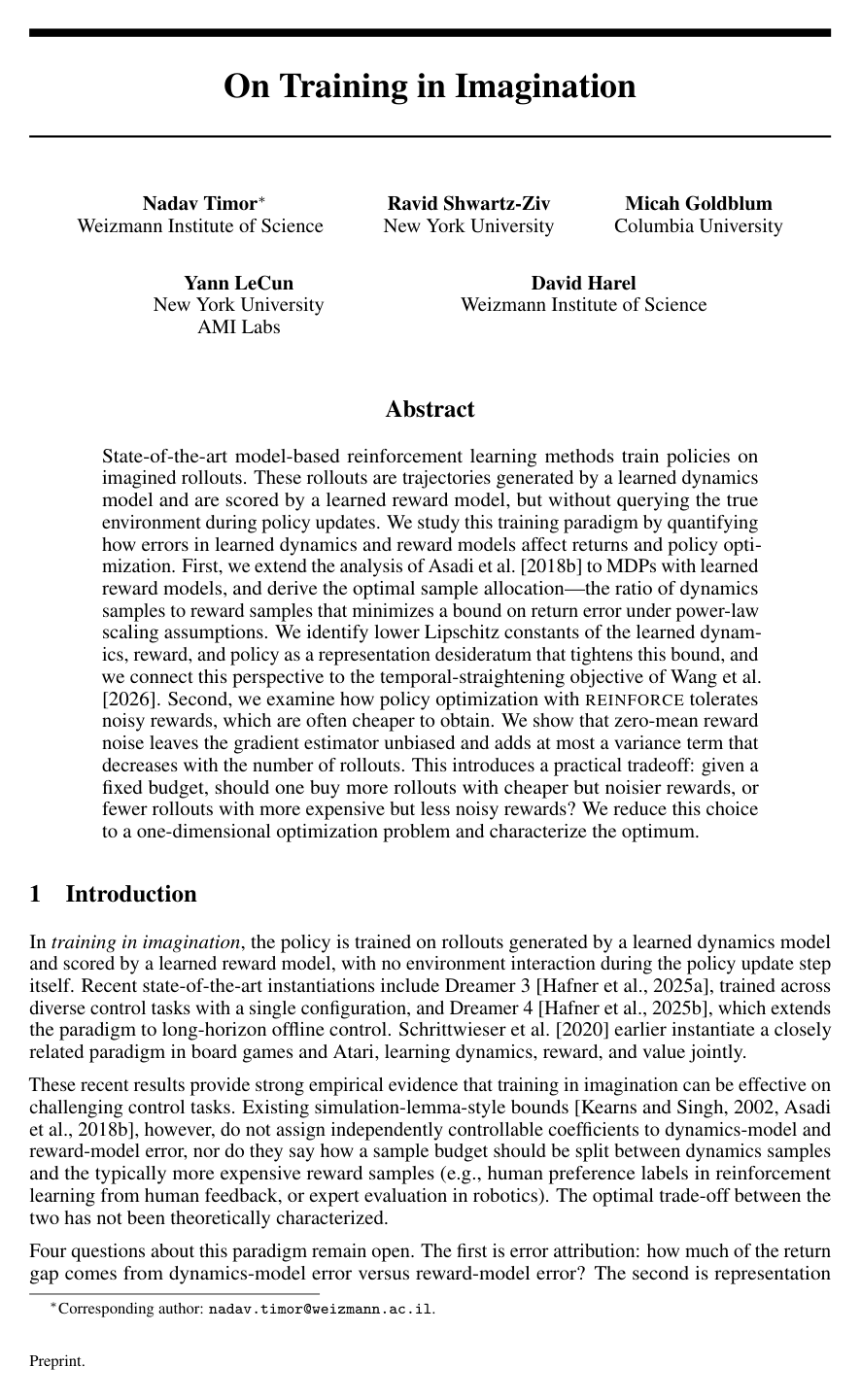
On Training in Imagination
Nadav Timor, Ravid Shwartz-Ziv, Micah Goldblum, Yann LeCun, David Harel
Why you should read this
Quantifies how errors in learned dynamics and reward models affect policy optimization, offering an optimal sample allocation strategy and analyzing the trade-off of using noisy rewards in imagination-based reinforcement learning.
State-of-the-art model-based reinforcement learning methods train policies on imagined rollouts. These rollouts are trajectories generated by a learned dynamics model and are scored by a learned reward model, but without querying the true environment during policy updates. We study this training paradigm by quantifying how errors in learned dynamics and reward models affect returns and policy optimization. First, we extend the analysis of Asadi et al. (2018) to MDPs with learned reward models, and derive the optimal sample allocation--the ratio of dynamics samples to reward samples that minimizes a bound on return error under power-law scaling assumptions. We identify lower Lipschitz constants of the learned dynamics, reward, and policy as a representation desideratum that tightens this bound, and we connect this perspective to the temporal-straightening objective of Wang et al. (2026). Second, we examine how policy optimization with REINFORCE tolerates noisy rewards, which are often cheaper to obtain. We show that zero-mean reward noise leaves the gradient estimator unbiased and adds at most a variance term that decreases with the number of rollouts. This introduces a practical tradeoff: given a fixed budget, should one buy more rollouts with cheaper but noisier rewards, or fewer rollouts with more expensive but less noisy rewards? We reduce this choice to a one-dimensional optimization problem and characterize the optimum.
Added
2026-05-18