Built independently by an author, for readers. Read the story and support ChapterPal

keyword

partially collapsed Gibbs sampling

Partially collapsed Gibbs sampling is a Markov chain Monte Carlo method that updates variables in turn, as in ordinary Gibbs sampling, but integrates out some variables when forming one or more conditional distributions. By reducing the number of variables conditioned on in selected updates, it can improve sampling efficiency; the update sequence must be arranged so the chain still targets the intended joint or marginal distribution.

1 item

GibbsDDRM: A Partially Collapsed Gibbs Sampler for Solving Blind Inverse Problems with Denoising Diffusion Restoration

GibbsDDRM: A Partially Collapsed Gibbs Sampler for Solving Blind Inverse Problems with Denoising Diffusion Restoration

Naoki Murata, Koichi Saito, Chieh-Hsin Lai, Yuhta Takida, Toshimitsu Uesaka, Yuki Mitsufuji, Stefano Ermon

OrganizationsSony CorporationStanford University

Why you should read this

Proposes a partially collapsed Gibbs sampling framework that enables pre-trained diffusion models to solve blind inverse problems like image deblurring and vocal dereverberation without requiring fine-tuning or specialized priors for the unknown measurement operator.

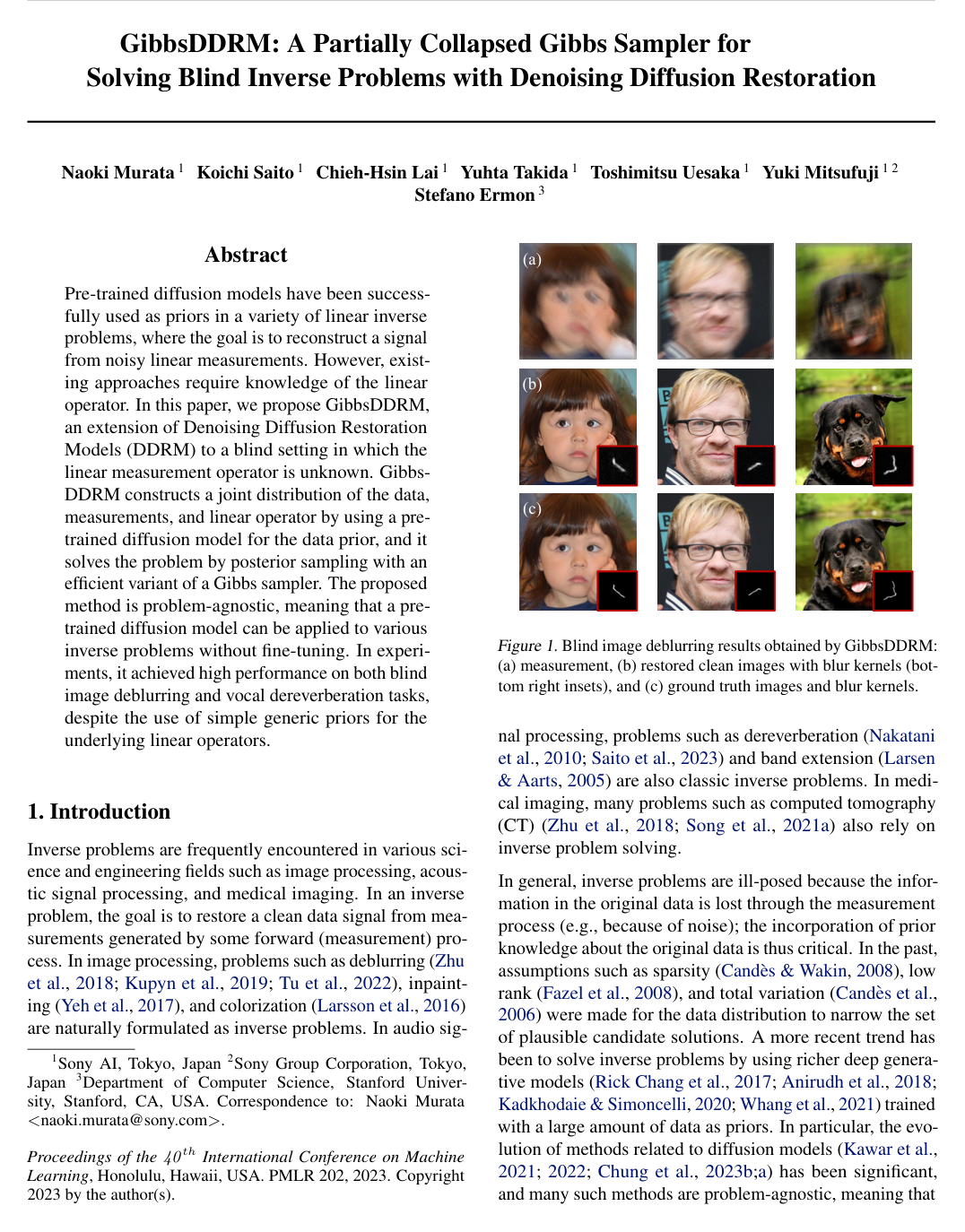
Pre-trained diffusion models have been successfully used as priors in a variety of linear inverse problems, where the goal is to reconstruct a signal from noisy linear measurements. However, existing approaches require knowledge of the linear operator. In this paper, we propose GibbsDDRM, an extension of Denoising Diffusion Restoration Models (DDRM) to a blind setting in which the linear measurement operator is unknown. GibbsDDRM constructs a joint distribution of the data, measurements, and linear operator by using a pre-trained diffusion model for the data prior, and it solves the problem by posterior sampling with an efficient variant of a Gibbs sampler. The proposed method is problem-agnostic, meaning that a pre-trained diffusion model can be applied to various inverse problems without fine-tuning. In experiments, it achieved high performance on both blind image deblurring and vocal dereverberation tasks, despite the use of simple generic priors for the underlying linear operators.

Added

2026-10-02