
Built independently by an author, for readers. Read the story and support ChapterPal

keyword

parametric classifiers

A parametric classifier is a machine learning and statistical pattern recognition model that assumes the underlying data follows a specific mathematical distribution or functional form defined by a fixed set of parameters. Rather than relying on individual training instances during prediction, the classifier estimates a finite number of parameters, such as class-conditional means and covariance matrices, to establish the decision boundaries separating different classes. Because the complexity of the model is predetermined and the number of parameters does not grow with the size of the training dataset, parametric classifiers are computationally efficient, straightforward to train, and require less memory than non-parametric alternatives. Common examples include linear discriminant analysis, quadratic discriminant analysis, and Gaussian naive Bayes, all of which perform well when the chosen distributional assumptions align with the true structure of the data.

1 item
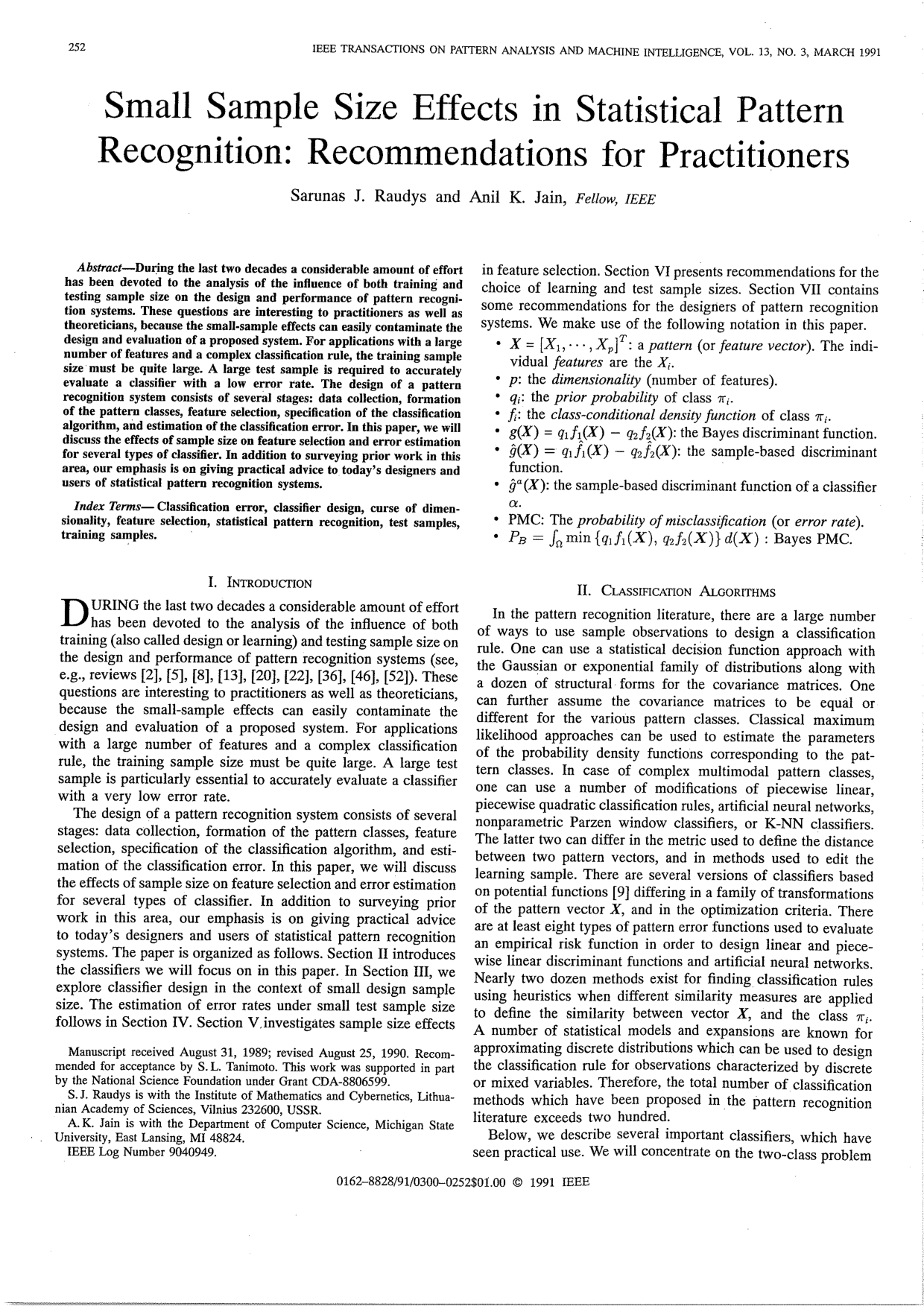
Small Sample Size Effects in Statistical Pattern Recognition: Recommendations for Practitioners

Small Sample Size Effects in Statistical Pattern Recognition: Recommendations for Practitioners

S. Raudys, Anil K. Jain

OrganizationsInstitute of Mathematics and Cybernetics, Lithuanian Academy of SciencesMichigan State University

Why you should read this

Presents practical guidelines and quantitative analyses to help practitioners choose appropriate training and test sample sizes, avoid small-sample bias in classifier design and feature selection, and accurately estimate classification error rates.

During the last two decades a considerable amount of effort has been devoted to the analysis of the influence of both training and testing sample size on the design and performance of pattern recognition systems. These questions are interesting to practitioners as well as theoreticians, because the small-sample effects can easily contaminate the design and evaluation of a proposed system. For applications with a large number of features and a complex classification rule, the training sample size must be quite large. A large test sample is required to accurately evaluate a classifier with a low error rate. The design of a pattern recognition system consists of several stages: data collection, formation of the pattern classes, feature selection, specification of the classification algorithm, and estimation of the classification error. In this paper, we will discuss the effects of sample size on feature selection and error estimation for several types of classifier. In addition to surveying prior work in this area, our emphasis is on giving practical advice to today's designers and users of statistical pattern recognition systems.

Added

2026-09-25