
keyword
orientation estimation
Orientation estimation is the computational process of determining the rotational alignment, angular direction, or heading of an entity relative to a specified reference frame or coordinate system. Within computer vision, robotics, and image processing, it involves calculating rotational parameters, such as Euler angles, rotation matrices, or directional vectors, for objects, sensors, local feature patches, or structural patterns from sensor data like digital images and point clouds. This estimation is critical for understanding spatial relationships, enabling accurate three-dimensional object detection, camera pose tracking, invariant feature matching, and the analysis of directional textures in automated systems.
4 items
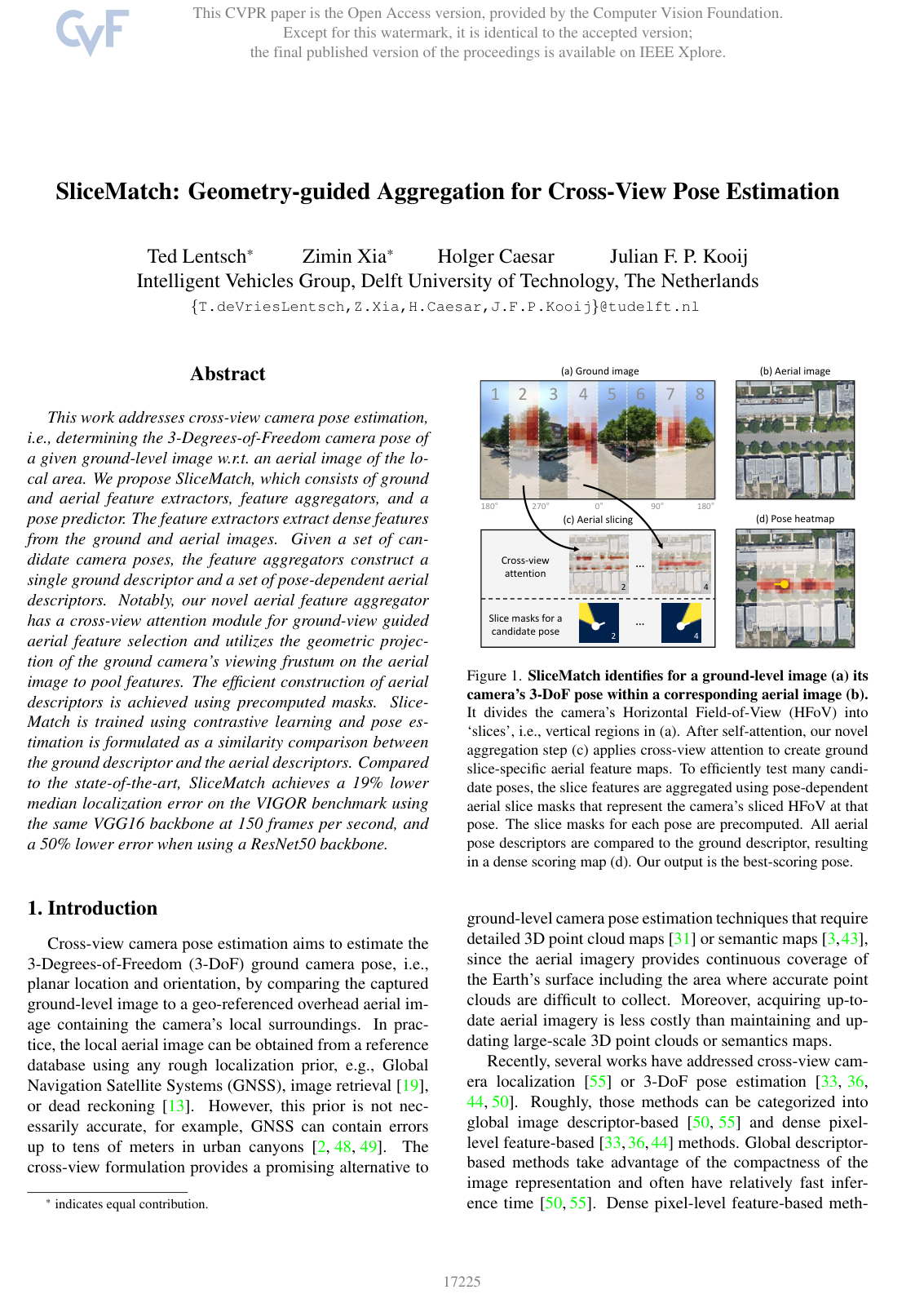
SliceMatch: Geometry-Guided Aggregation for Cross-View Pose Estimation
Ted de Vries Lentsch, Zimin Xia, Holger Caesar, Julian F. P. Kooij
Why you should read this
Proposes a geometry-guided cross-view camera pose estimation method that splits the field of view into directional slices to aggregate aerial features via precomputed masks, cutting median localization error on the VIGOR benchmark by up to 50% while running at 150 frames per second.
This work addresses cross-view camera pose estimation, i.e., determining the 3-Degrees-of-Freedom camera pose of a given ground-level image w.r.t. an aerial image of the local area. We propose SliceMatch, which consists of ground and aerial feature extractors, feature aggregators, and a pose predictor. The feature extractors extract dense features from the ground and aerial images. Given a set of candidate camera poses, the feature aggregators construct a single ground descriptor and a set of pose-dependent aerial descriptors. Notably, our novel aerial feature aggregator has a cross-view attention module for ground-view guided aerial feature selection and utilizes the geometric projection of the ground camera’s viewing frustum on the aerial image to pool features. The efficient construction of aerial descriptors is achieved using precomputed masks. SliceMatch is trained using contrastive learning and pose estimation is formulated as a similarity comparison between the ground descriptor and the aerial descriptors. Compared to the state-of-the-art, SliceMatch achieves a 19% lower median localization error on the VIGOR benchmark using the same VGG16 backbone at 150 frames per second, and a 50% lower error when using a ResNet50 backbone.
Added
2026-09-26
LIFT: Learned Invariant Feature Transform
Kwang Moo Yi, Eduard Trulls, Vincent Lepetit, Pascal Fua
Why you should read this
Presents the first fully differentiable deep network architecture that unifies keypoint detection, orientation estimation, and descriptor generation into an end-to-end trainable feature extraction pipeline that outperforms classical methods across standard benchmarks.
We introduce a novel Deep Network architecture that implements the full feature point handling pipeline, that is, detection, orientation estimation, and feature description. While previous works have successfully tackled each one of these problems individually, we show how to learn to do all three in a unified manner while preserving end-to-end differentiability. We then demonstrate that our Deep pipeline outperforms state-of-the-art methods on a number of benchmark datasets, without the need of retraining.
Added
2026-09-25
Joint 3D Proposal Generation and Object Detection from View Aggregation
Jason Ku, Melissa Mozifian, Jungwook Lee, Ali Harakeh, Steven L. Waslander
Why you should read this
Introduces AVOD, a real-time neural network that fuses high-resolution LiDAR and RGB features across shared proposal and detection stages to achieve accurate 3D bounding box estimation for autonomous driving.
We present AVOD, an Aggregate View Object Detection network for autonomous driving scenarios. The proposed neural network architecture uses LIDAR point clouds and RGB images to generate features that are shared by two subnetworks: a region proposal network (RPN) and a second stage detector network. The proposed RPN uses a novel architecture capable of performing multimodal feature fusion on high resolution feature maps to generate reliable 3D object proposals for multiple object classes in road scenes. Using these proposals, the second stage detection network performs accurate oriented 3D bounding box regression and category classification to predict the extents, orientation, and classification of objects in 3D space. Our proposed architecture is shown to produce state of the art results on the KITTI 3D object detection benchmark while running in real time with a low memory footprint, making it a suitable candidate for deployment on autonomous vehicles. Code is at: this https URL
Added
2026-09-24
Fingerprint Image Enhancement: Algorithm and Performance Evaluation
Lin Hong, Yifei Wan, Anil K. Jain
Why you should read this
Presents an adaptive ridge-frequency and orientation enhancement method that measurably improves fingerprint minutiae quality and verification accuracy.
A critical step in automatic fingerprint matching is to automatically and reliably extract minutiae from the input fingerprint images. However, the performance of a minutiae extraction algorithm relies heavily on the quality of the input fingerprint images. In order to ensure that the performance of an automatic fingerprint identification/verification system will be robust with respect to the quality of input fingerprint images, it is essential to incorporate a fingerprint enhancement algorithm in the minutiae extraction module. We present a fast fingerprint enhancement algorithm, which can adaptively improve the clarity of ridge and valley structures of input fingerprint images based on the estimated local ridge orientation and frequency. We have evaluated the performance of the image enhancement algorithm using the goodness index of the extracted minutiae and the accuracy of an online fingerprint verification system. Experimental results show that incorporating the enhancement algorithm improves both the goodness index and the verification accuracy.
Source
https://www.cse.msu.edu/~rossarun/BiometricsTextBook/Papers/Fingerprint/HongFpImageEnhancement.pdfAdded
2026-09-14