
keyword
open-world visual understanding
Open-world visual understanding is the capability of artificial intelligence systems to recognize, analyze, and reason about visual content beyond a fixed or predefined set of categories, enabling the interpretation of arbitrary and previously unseen real-world concepts. Unlike traditional closed-set computer vision systems that are restricted to identifying items within a limited, predetermined taxonomy, open-world approaches leverage multimodal models and natural language to connect visual representations with open-ended semantics. This allows systems to generalize across diverse images and videos, perform zero-shot recognition, answer open-ended questions, and generate detailed descriptions for rare, fine-grained, or novel entities in unconstrained environments.
2 items
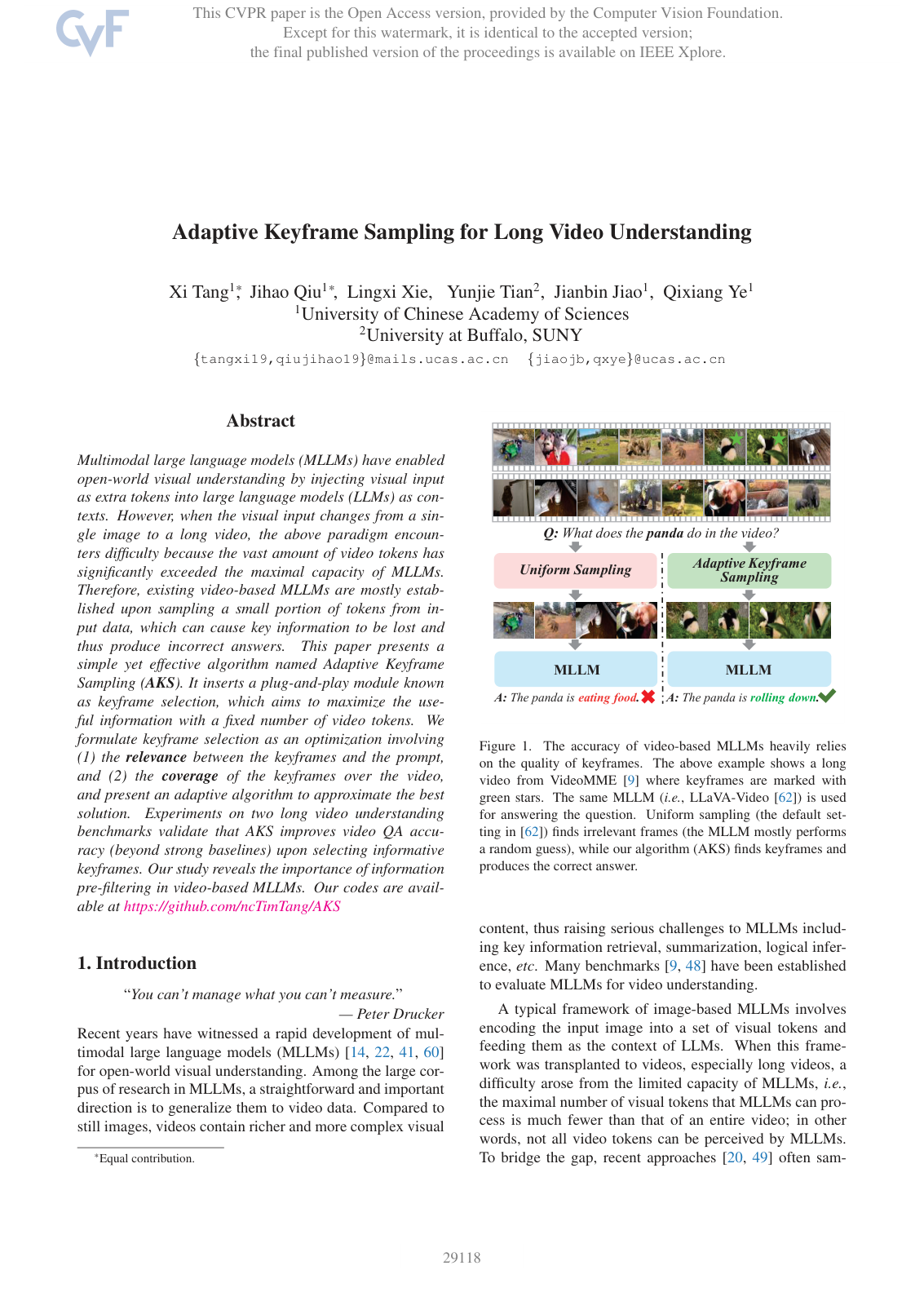
Adaptive Keyframe Sampling for Long Video Understanding
Xi Tang, Jihao Qiu, Lingxi Xie, Yunjie Tian, Jianbin Jiao, Qixiang Ye
Why you should read this
Proposes a plug-and-play keyframe selection algorithm that balances prompt relevance with temporal coverage to improve long video question-answering accuracy in multimodal large language models without exceeding token limits.
Multimodal large language models (MLLMs) have enabled open-world visual understanding by injecting visual input as extra tokens into large language models (LLMs) as contexts. However, when the visual input changes from a single image to a long video, the above paradigm encounters difficulty because the vast amount of video tokens has significantly exceeded the maximal capacity of MLLMs. Therefore, existing video-based MLLMs are mostly established upon sampling a small portion of tokens from input data, which can cause key information to be lost and thus produce incorrect answers. This paper presents a simple yet effective algorithm named Adaptive Keyframe Sampling (AKS). It inserts a plug-and-play module known as keyframe selection, which aims to maximize the useful information with a fixed number of video tokens. We formulate keyframe selection as an optimization involving (1) the relevance between the keyframes and the prompt, and (2) the coverage of the keyframes over the video, and present an adaptive algorithm to approximate the best solution. Experiments on two long video understanding benchmarks validate that AKS improves video QA accuracy (beyond strong baselines) upon selecting informative keyframes. Our study reveals the importance of information pre-filtering in video-based MLLMs. Our codes are available at https://github.com/ncTimTang/AKS
Added
2026-09-26
The All-Seeing Project: Towards Panoptic Visual Recognition and Understanding of the Open World
Weiyun Wang, Min Shi, Qingyun Li, Wenhai Wang, Zhenhang Huang, Linjie Xing, Zhe Chen, Hao Li, Xizhou Zhu, Zhiguo Cao, Yushi Chen, Tong Lu, Jifeng Dai, Yu Qiao
Why you should read this
Introduces a billion-region dataset covering 3.5 million concepts alongside a unified vision-language model that achieves strong zero-shot performance across region-level recognition, captioning, and question answering in the open world.
We present the All-Seeing (AS) project: a large-scale data and model for recognizing and understanding everything in the open world. Using a scalable data engine that incorporates human feedback and efficient models in the loop, we create a new dataset (AS-1B) with over 1 billion regions annotated with semantic tags, question-answering pairs, and detailed captions. It covers a wide range of 3.5 million common and rare concepts in the real world, and has 132.2 billion tokens that describe the concepts and their attributes. Leveraging this new dataset, we develop the All-Seeing model (ASM), a unified framework for panoptic visual recognition and understanding. The model is trained with open-ended language prompts and locations, which allows it to generalize to various vision and language tasks with remarkable zero-shot performance, including region-text retrieval, region recognition, captioning, and question-answering. We hope that this project can serve as a foundation for vision-language artificial general intelligence research. Models and the dataset shall be released at this https URL, and demo can be seen at this https URL.
Added
2026-09-26