
keyword
ODE solvers
An ODE solver is a numerical algorithm designed to calculate approximate solutions to ordinary differential equations when exact analytical solutions are difficult or impossible to obtain. Given a set of initial conditions and equations that describe how a system changes over continuous variables such as time, the solver estimates the evolution of the state by progressing through discrete intervals. These algorithms encompass a wide variety of approaches, ranging from simple first-order explicit techniques like the Euler method to advanced, adaptive, explicit, and implicit Runge-Kutta or multistep formulations that offer higher accuracy and numerical stability for stiff systems. Widely employed across engineering, the physical sciences, and computational fields, ODE solvers facilitate both the simulation of complex dynamical systems and the continuous modeling of states in modern machine learning architectures.
3 items
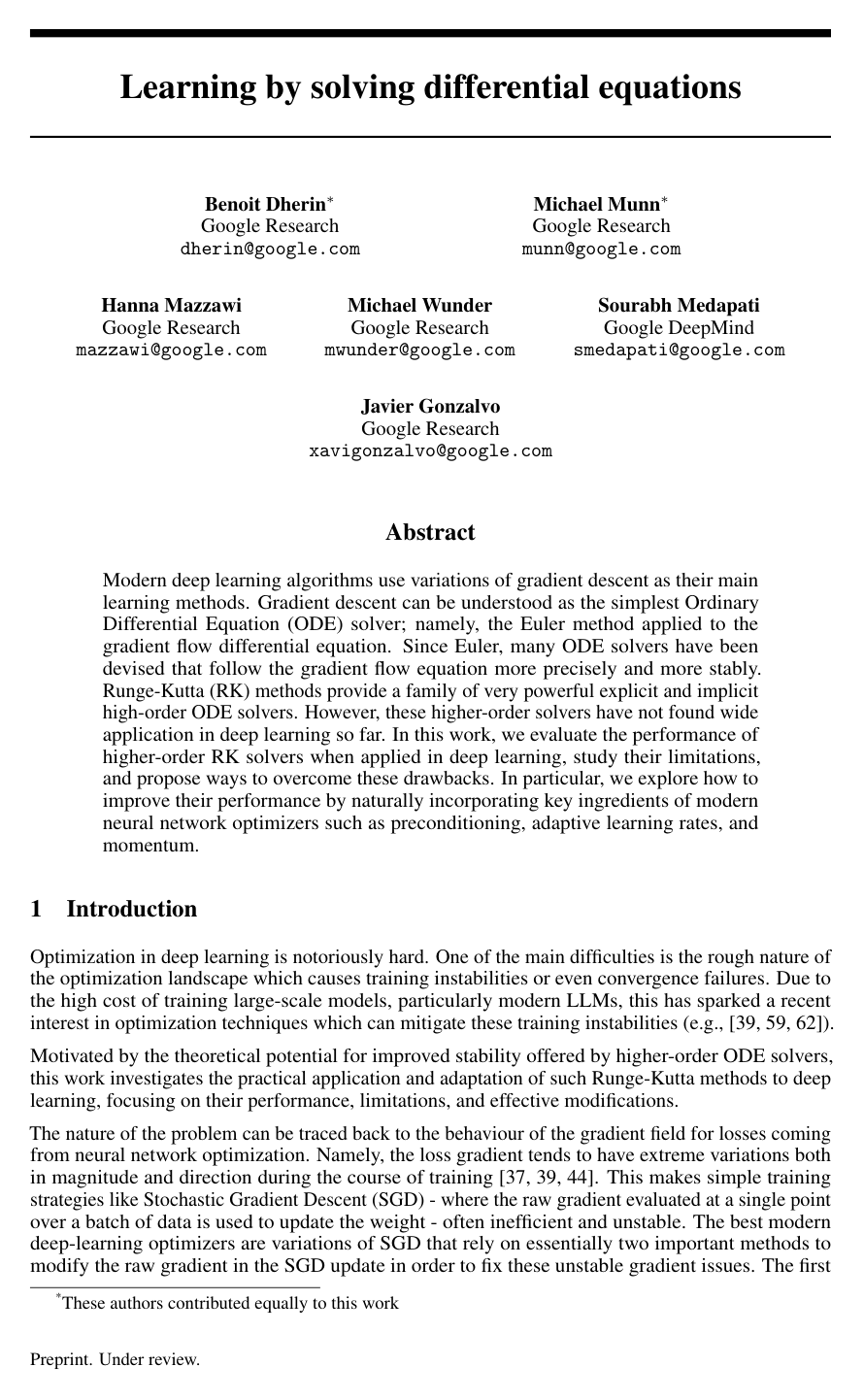
Learning by solving differential equations
Benoit Dherin, Michael Munn, Hanna Mazzawi, Michael Wunder, Sourabh Medapati, Xavi Gonzalvo
Why you should read this
Demonstrates how to adapt higher-order Runge-Kutta differential equation solvers for deep neural network training by integrating momentum, adaptive learning rates, and preconditioning to improve optimization stability beyond standard gradient descent.
Modern deep learning algorithms use variations of gradient descent as their main learning methods. Gradient descent can be understood as the simplest Ordinary Differential Equation (ODE) solver; namely, the Euler method applied to the gradient flow differential equation. Since Euler, many ODE solvers have been devised that follow the gradient flow equation more precisely and more stably. Runge-Kutta (RK) methods provide a family of very powerful explicit and implicit high-order ODE solvers. However, these higher-order solvers have not found wide application in deep learning so far. In this work, we evaluate the performance of higher-order RK solvers when applied in deep learning, study their limitations, and propose ways to overcome these drawbacks. In particular, we explore how to improve their performance by naturally incorporating key ingredients of modern neural network optimizers such as preconditioning, adaptive learning rates, and momentum.
Added
2026-09-30
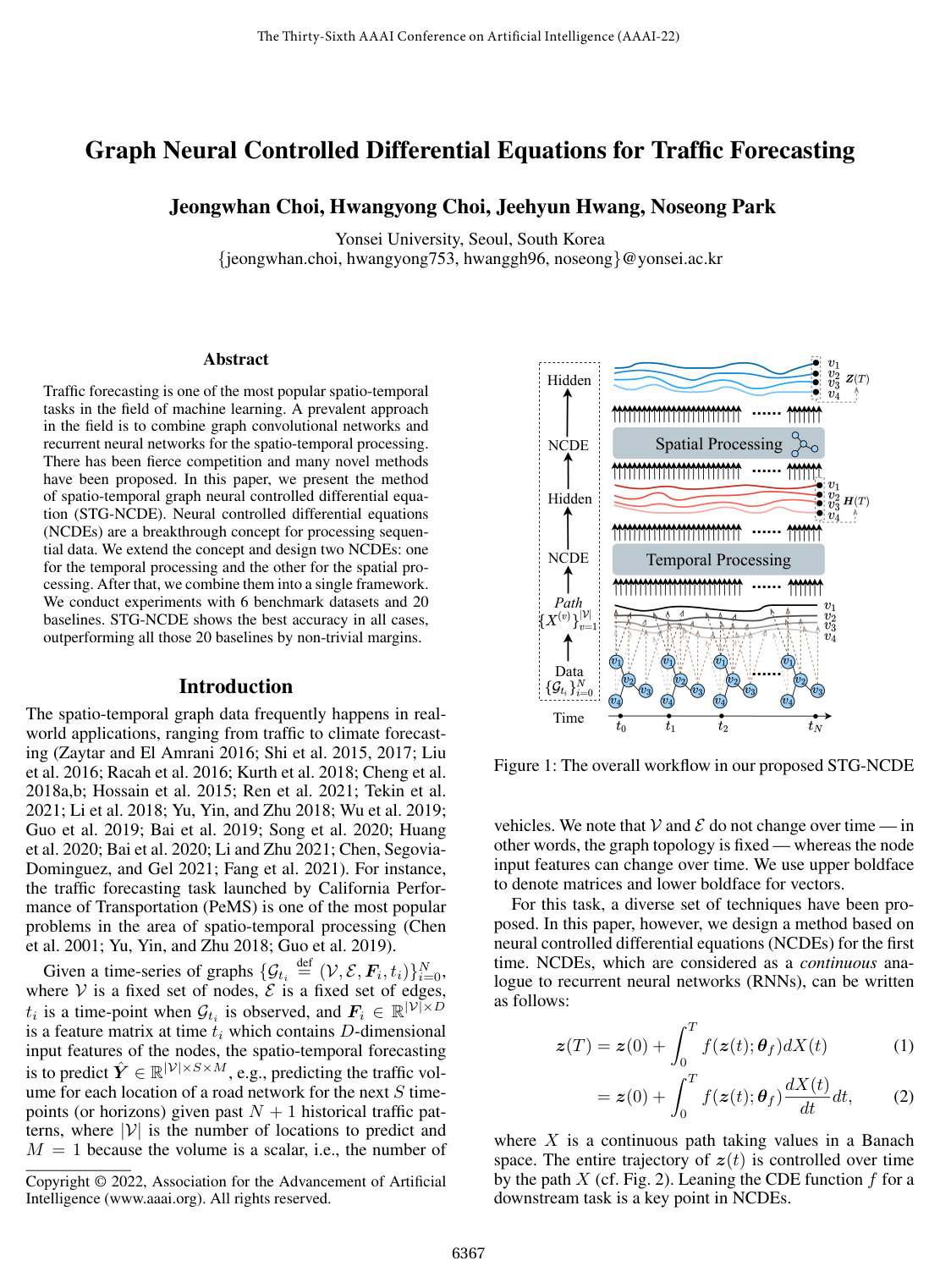
Graph Neural Controlled Differential Equations for Traffic Forecasting
Jeongwhan Choi, Hwangyong Choi, Jeehyun Hwang, Noseong Park
Why you should read this
Develops a unified spatio-temporal neural controlled differential equation framework that continuously models both spatial graph dynamics and temporal traffic patterns, significantly outperforming existing baselines across benchmark forecasting datasets.
Traffic forecasting is one of the most popular spatio-temporal tasks in the field of machine learning. A prevalent approach in the field is to combine graph convolutional networks and recurrent neural networks for the spatio-temporal processing. There has been fierce competition and many novel methods have been proposed. In this paper, we present the method of spatio-temporal graph neural controlled differential equation (STG-NCDE). Neural controlled differential equations (NCDEs) are a breakthrough concept for processing sequential data. We extend the concept and design two NCDEs: one for the temporal processing and the other for the spatial processing. After that, we combine them into a single framework. We conduct experiments with 6 benchmark datasets and 20 baselines. STG-NCDE shows the best accuracy in all cases, outperforming all those 20 baselines by non-trivial margins.
Added
2026-09-26
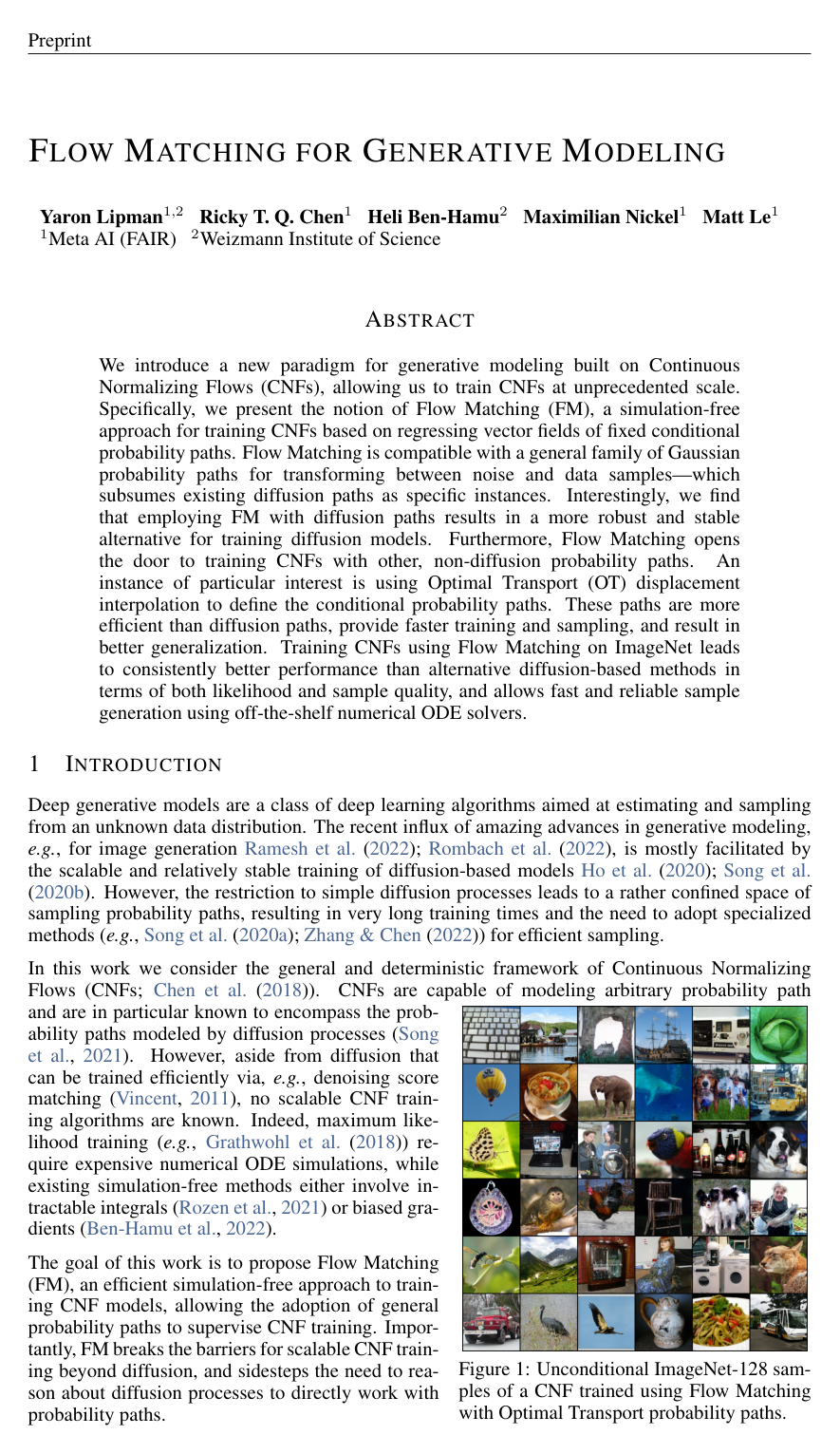
Flow Matching for Generative Modeling
Yaron Lipman, Ricky T. Q. Chen, Heli Ben-Hamu, Maximilian Nickel, Matt Le
Why you should read this
Generalizes diffusion into a Continuous Normalizing Flow (CNF) framework trained with a simulation-free objective.
We introduce a new paradigm for generative modeling built on Continuous Normalizing Flows (CNFs), allowing us to train CNFs at unprecedented scale. Specifically, we present the notion of Flow Matching (FM), a simulation-free approach for training CNFs based on regressing vector fields of fixed conditional probability paths. Flow Matching is compatible with a general family of Gaussian probability paths for transforming between noise and data samples -- which subsumes existing diffusion paths as specific instances. Interestingly, we find that employing FM with diffusion paths results in a more robust and stable alternative for training diffusion models. Furthermore, Flow Matching opens the door to training CNFs with other, non-diffusion probability paths. An instance of particular interest is using Optimal Transport (OT) displacement interpolation to define the conditional probability paths. These paths are more efficient than diffusion paths, provide faster training and sampling, and result in better generalization. Training CNFs using Flow Matching on ImageNet leads to consistently better performance than alternative diffusion-based methods in terms of both likelihood and sample quality, and allows fast and reliable sample generation using off-the-shelf numerical ODE solvers.
Added
2026-02-25