
keyword
object manipulation
Object manipulation refers to the process by which an autonomous agent, robot, or human physically interacts with objects in an environment to alter their spatial position, orientation, or physical state. It encompasses a wide variety of contact-driven actions, such as grasping, pushing, lifting, placing, and interacting with articulated mechanisms like drawers or doors. In robotics and embodied artificial intelligence, achieving effective object manipulation requires coordinating sensory perception, spatial reasoning, contact dynamics, and motor control policies to plan and execute goal-directed actions across diverse object geometries and physical conditions.
5 items
DINO-WM: World Models on Pre-trained Visual Features enable Zero-shot Planning
Gaoyue Zhou, Hengkai Pan, Yann LeCun, Lerrel Pinto
Why you should read this
Presents DINO-WM, a method that builds task-agnostic visual world models directly over frozen DINOv2 patch features to enable zero-shot, goal-directed planning from offline datasets without requiring image reconstruction, expert demonstrations, or reward modeling.
The ability to predict future outcomes given control actions is fundamental for physical reasoning. However, such predictive models, often called world models, remain challenging to learn and are typically developed for task-specific solutions with online policy learning. To unlock world models’ true potential, we argue that they should 1) be trainable on offline, pre-collected trajectories, 2) support test-time behavior optimization, and 3) facilitate task-agnostic reasoning. To this end, we present DINO World Model (DINO-WM), a new method to model visual dynamics without reconstructing the visual world. DINO-WM leverages spatial patch features pre-trained with DINOv2, enabling it to learn from offline behavioral trajectories by predicting future patch features. This allows DINO-WM to achieve observational goals through action sequence optimization, facilitating task-agnostic planning by treating goal features as prediction targets. We demonstrate that DINO-WM achieves zero-shot behavioral solutions at test time on six environments without expert demonstrations, reward modeling, or pre-learned inverse models, outperforming prior state-of-the-art work across diverse task families such as arbitrarily configured mazes, push manipulation with varied object shapes, and multi-particle scenarios.
Added
2026-09-30
DisCoScene: Spatially Disentangled Generative Radiance Fields for Controllable 3D-aware Scene Synthesis
Yinghao Xu, Menglei Chai, Zifan Shi, Sida Peng, Ivan Skorokhodov, Aliaksandr Siarohin, Ceyuan Yang, Yujun Shen, Hsin-Ying Lee, Bolei Zhou, Sergey Tulyakov
Why you should read this
Proposes a 3D-aware generative model that uses simple 3D bounding boxes as layout priors to spatially disentangle multi-object scenes into composable radiance fields from single-view 2D images, enabling high-fidelity scene synthesis and interactive object-level editing.
Existing 3D-aware image synthesis approaches mainly focus on generating a single canonical object and show limited capacity in composing a complex scene containing a variety of objects. This work presents DisCoScene: a 3D-aware generative model for high-quality and controllable scene synthesis. The key ingredient of our method is a very abstract object-level representation (i.e., 3D bounding boxes without semantic annotation) as the scene layout prior, which is simple to obtain, general to describe various scene contents, and yet informative to disentangle objects and background. Moreover, it serves as an intuitive user control for scene editing. Based on such a prior, the proposed model spatially disentangles the whole scene into object-centric generative radiance fields by learning on only 2D images with the global-local discrimination. Our model obtains the generation fidelity and editing flexibility of individual objects while being able to efficiently compose objects and the background into a complete scene. We demonstrate state-of-the-art performance on many scene datasets, including the challenging Waymo outdoor dataset. Project page can be found here.
Added
2026-09-26
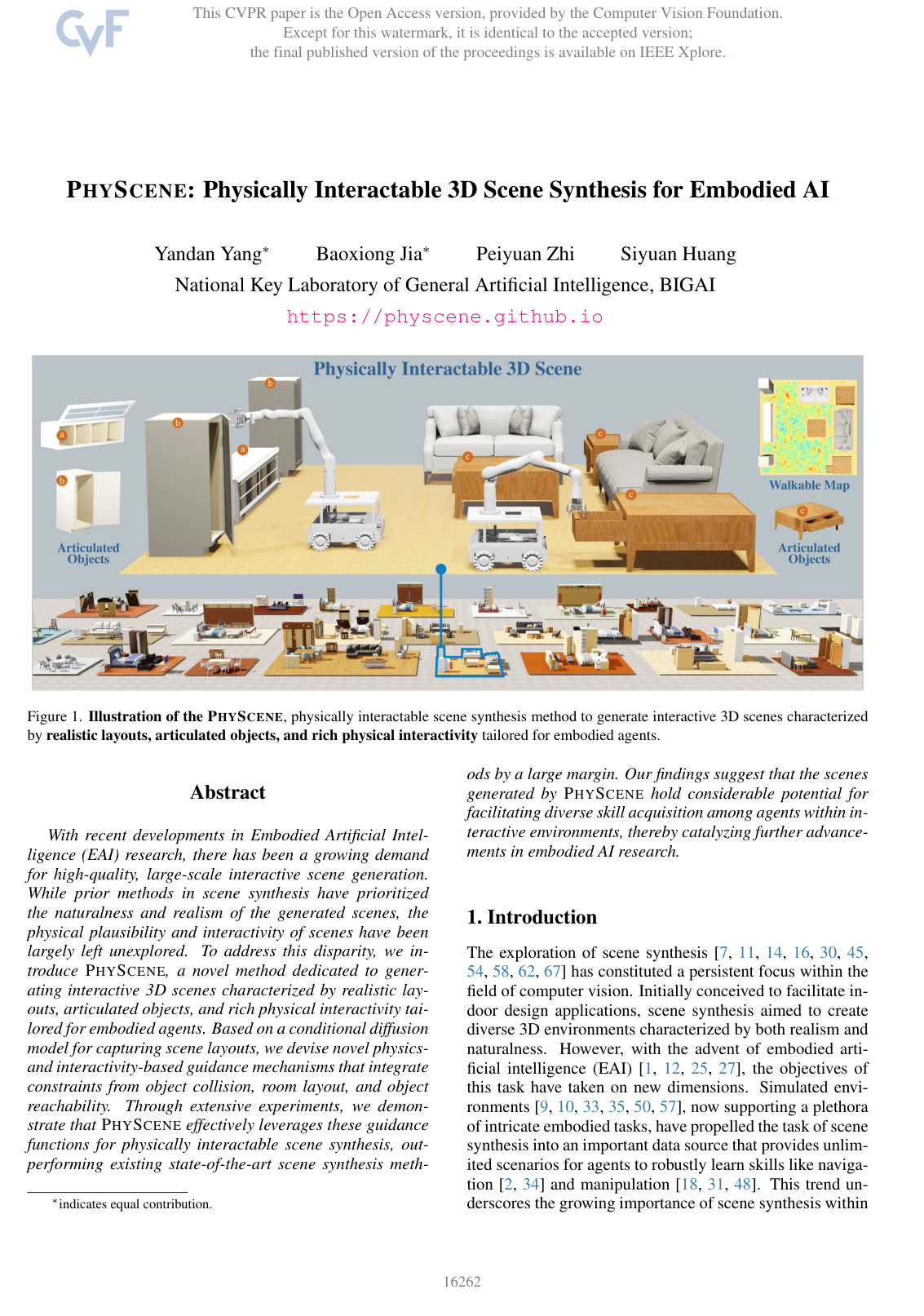
PhyScene: Physically Interactable 3D Scene Synthesis for Embodied AI
Yandan Yang, Baoxiong Jia, Peiyuan Zhi, Siyuan Huang
Why you should read this
Proposes a physics-guided diffusion model that synthesizes functional 3D indoor environments with articulated objects by directly enforcing collision avoidance, room boundaries, and agent reachability constraints during generation.
With recent developments in Embodied Artificial Intelligence (EAI) research, there has been a growing demand for high-quality, large-scale interactive scene generation. While prior methods in scene synthesis have prioritized the naturalness and realism of the generated scenes, the physical plausibility and interactivity of scenes have been largely left unexplored. To address this disparity, we introduce PHYSCENE, a novel method dedicated to generating interactive 3D scenes characterized by realistic layouts, articulated objects, and rich physical interactivity tailored for embodied agents. Based on a conditional diffusion model for capturing scene layouts, we devise novel physics- and interactivity-based guidance mechanisms that integrate constraints from object collision, room layout, and object reachability. Through extensive experiments, we demonstrate that PHYSCENE effectively leverages these guidance functions for physically interactable scene synthesis, outperforming existing state-of-the-art scene synthesis methods by a large margin. Our findings suggest that the scenes generated by PHYSCENE hold considerable potential for facilitating diverse skill acquisition among agents within interactive environments, thereby catalyzing further advancements in embodied AI research.
Added
2026-09-26
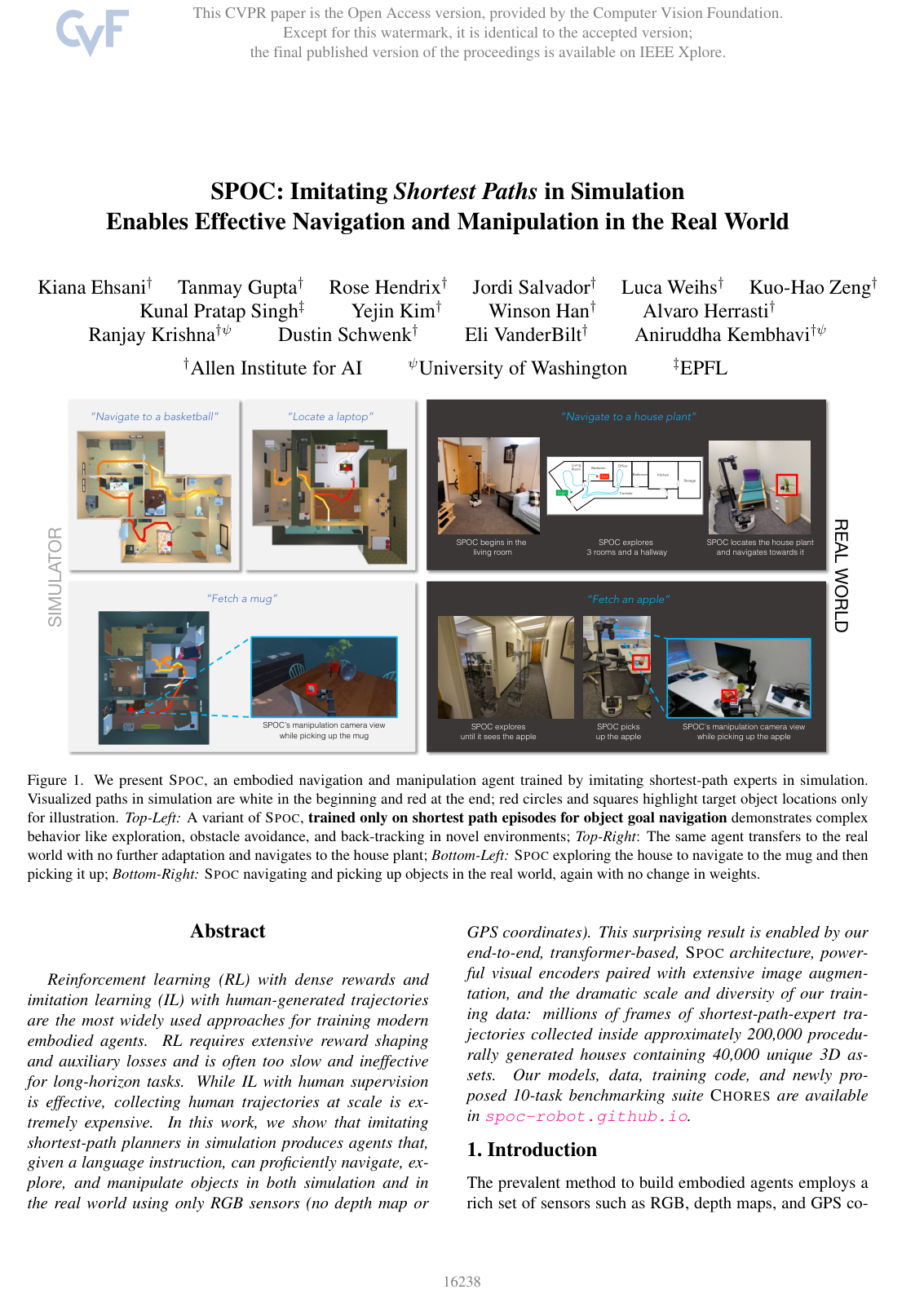
SPOC: Imitating Shortest Paths in Simulation Enables Effective Navigation and Manipulation in the Real World
Kiana Ehsani, Tanmay Gupta, Rose Hendrix, Jordi Salvador, Luca Weihs, Kuo-Hao Zeng, Kunal Pratap Singh, Yejin Kim, Winson Han, Alvaro Herrasti, Ranjay Krishna, Dustin Schwenk, Eli VanderBilt, Aniruddha Kembhavi
Why you should read this
Demonstrates that imitating simulated shortest-path heuristic planners across thousands of procedurally generated environments trains end-to-end RGB-only transformer agents that transfer directly to real-world mobile manipulation tasks without requiring reinforcement learning or costly human demonstrations.
Reinforcement learning (RL) with dense rewards and imitation learning (IL) with human-generated trajectories are the most widely used approaches for training modern embodied agents. RL requires extensive reward shaping and auxiliary losses and is often too slow and ineffective for long-horizon tasks. While IL with human supervision is effective, collecting human trajectories at scale is extremely expensive. In this work, we show that imitating shortest-path planners in simulation produces agents that, given a language instruction, can proficiently navigate, explore, and manipulate objects in both simulation and in the real world using only RGB sensors (no depth map or GPS coordinates). This surprising result is enabled by our end-to-end, transformer-based, SPOC architecture, powerful visual encoders paired with extensive image augmentation, and the dramatic scale and diversity of our training data: millions of frames of shortest-path-expert trajectories collected inside approximately 200,000 procedurally generated houses containing 40,000 unique 3D assets. Our models, data, training code, and newly proposed 10-task benchmarking suite CHORES are available in spoc-robot.github.io.
Added
2026-09-26
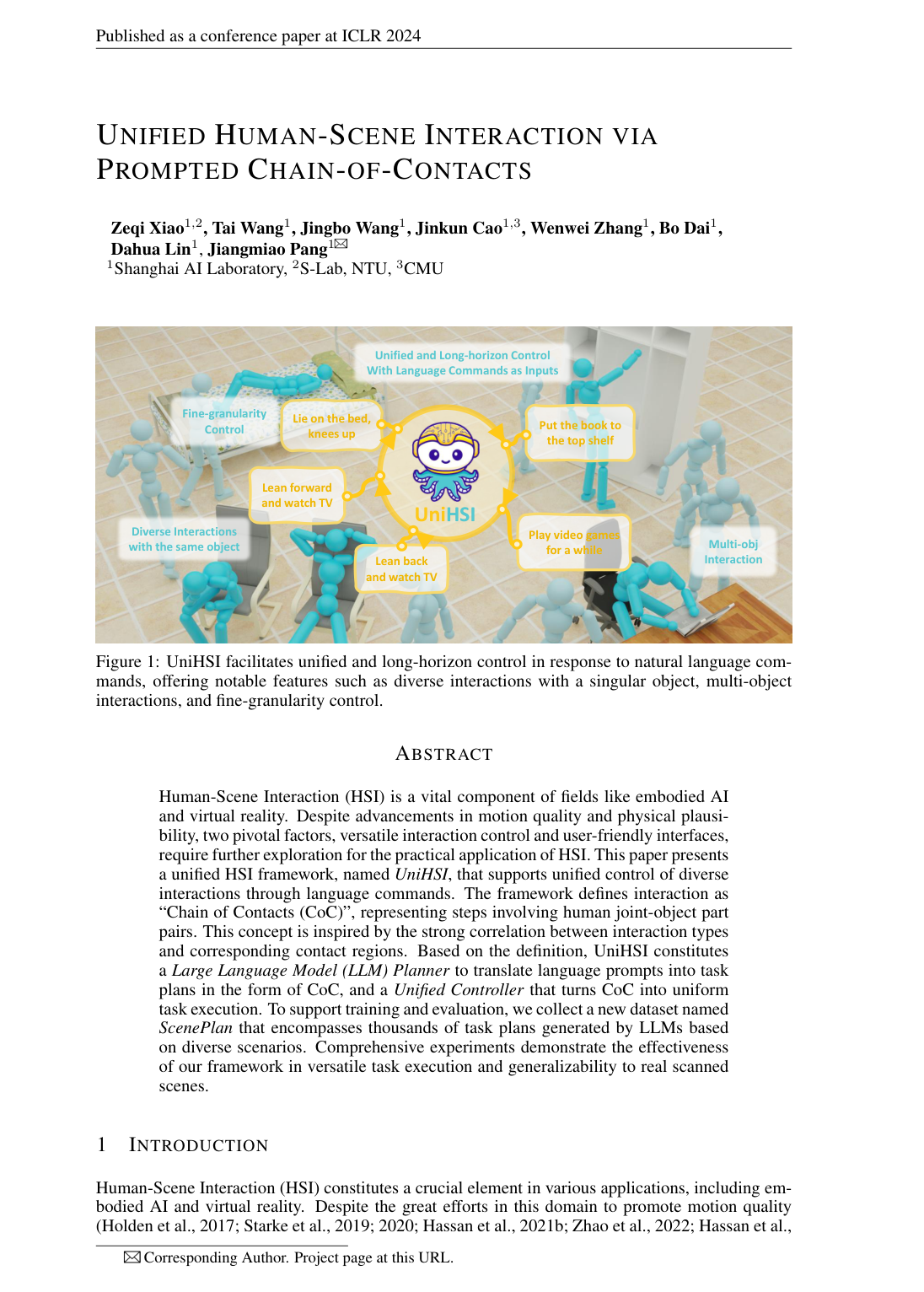
Unified Human-Scene Interaction via Prompted Chain-of-Contacts
Zeqi Xiao, Tai Wang, Jingbo Wang, Jinkun Cao, Wenwei Zhang, Bo Dai, Dahua Lin, Jiangmiao Pang
Why you should read this
Develops UniHSI, a framework that uses large language models to translate text commands into sequential joint-object contact plans, enabling versatile and controllable human-scene interactions across diverse 3D environments.
Human-Scene Interaction (HSI) is a vital component of fields like embodied AI and virtual reality. Despite advancements in motion quality and physical plausibility, two pivotal factors, versatile interaction control and the development of a user-friendly interface, require further exploration before the practical application of HSI. This paper presents a unified HSI framework, UniHSI, which supports unified control of diverse interactions through language commands. This framework is built upon the definition of interaction as Chain of Contacts (CoC): steps of human joint-object part pairs, which is inspired by the strong correlation between interaction types and human-object contact regions. Based on the definition, UniHSI constitutes a Large Language Model (LLM) Planner to translate language prompts into task plans in the form of CoC, and a Unified Controller that turns CoC into uniform task execution. To facilitate training and evaluation, we collect a new dataset named ScenePlan that encompasses thousands of task plans generated by LLMs based on diverse scenarios. Comprehensive experiments demonstrate the effectiveness of our framework in versatile task execution and generalizability to real scanned scenes. The project page is at this https URL .
Added
2026-09-26