
keyword
NYU Depth
NYU Depth is a standard computer vision benchmark and RGB-D dataset designed for 3D indoor scene understanding, monocular depth estimation, and semantic segmentation. Collected using Microsoft Kinect sensors, it contains synchronized color images paired with aligned, dense depth maps across diverse indoor environments, including residential and commercial spaces. In addition to raw video recordings, the dataset provides curated subsets featuring in-painted depth maps to fill sensor holes, accelerometer data, and detailed per-pixel object class annotations. Widely adopted across artificial intelligence research, NYU Depth serves as a primary standard for evaluating how effectively machine learning models can infer three-dimensional geometry, surface normals, and scene semantics from two-dimensional images.
4 items
3D Semantic Segmentation with Submanifold Sparse Convolutional Networks
Benjamin Graham, Martin Engelcke, Laurens van der Maaten
Why you should read this
Develops sparse convolutional operations that maintain spatial sparsity across network layers, enabling highly efficient and accurate 3D semantic segmentation on point cloud data.
Convolutional networks are the de-facto standard for analyzing spatio-temporal data such as images, videos, and 3D shapes. Whilst some of this data is naturally dense (e.g., photos), many other data sources are inherently sparse. Examples include 3D point clouds that were obtained using a LiDAR scanner or RGB-D camera. Standard "dense" implementations of convolutional networks are very inefficient when applied on such sparse data. We introduce new sparse convolutional operations that are designed to process spatially-sparse data more efficiently, and use them to develop spatially-sparse convolutional networks. We demonstrate the strong performance of the resulting models, called submanifold sparse convolutional networks (SSCNs), on two tasks involving semantic segmentation of 3D point clouds. In particular, our models outperform all prior state-of-the-art on the test set of a recent semantic segmentation competition.
Added
2026-09-18
Deeper Depth Prediction with Fully Convolutional Residual Networks
Iro Laina, Christian Rupprecht, Vasileios Belagiannis, Federico Tombari, Nassir Navab
Why you should read this
Proposes a fully convolutional residual network with novel up-sampling layers and a reverse Huber loss to achieve accurate, real-time monocular depth estimation without post-processing.
This paper addresses the problem of estimating the depth map of a scene given a single RGB image. We propose a fully convolutional architecture, encompassing residual learning, to model the ambiguous mapping between monocular images and depth maps. In order to improve the output resolution, we present a novel way to efficiently learn feature map up-sampling within the network. For optimization, we introduce the reverse Huber loss that is particularly suited for the task at hand and driven by the value distributions commonly present in depth maps. Our model is composed of a single architecture that is trained end-to-end and does not rely on post-processing techniques, such as CRFs or other additional refinement steps. As a result, it runs in real-time on images or videos. In the evaluation, we show that the proposed model contains fewer parameters and requires fewer training data than the current state of the art, while outperforming all approaches on depth estimation. Code and models are publicly available.
Added
2026-09-17
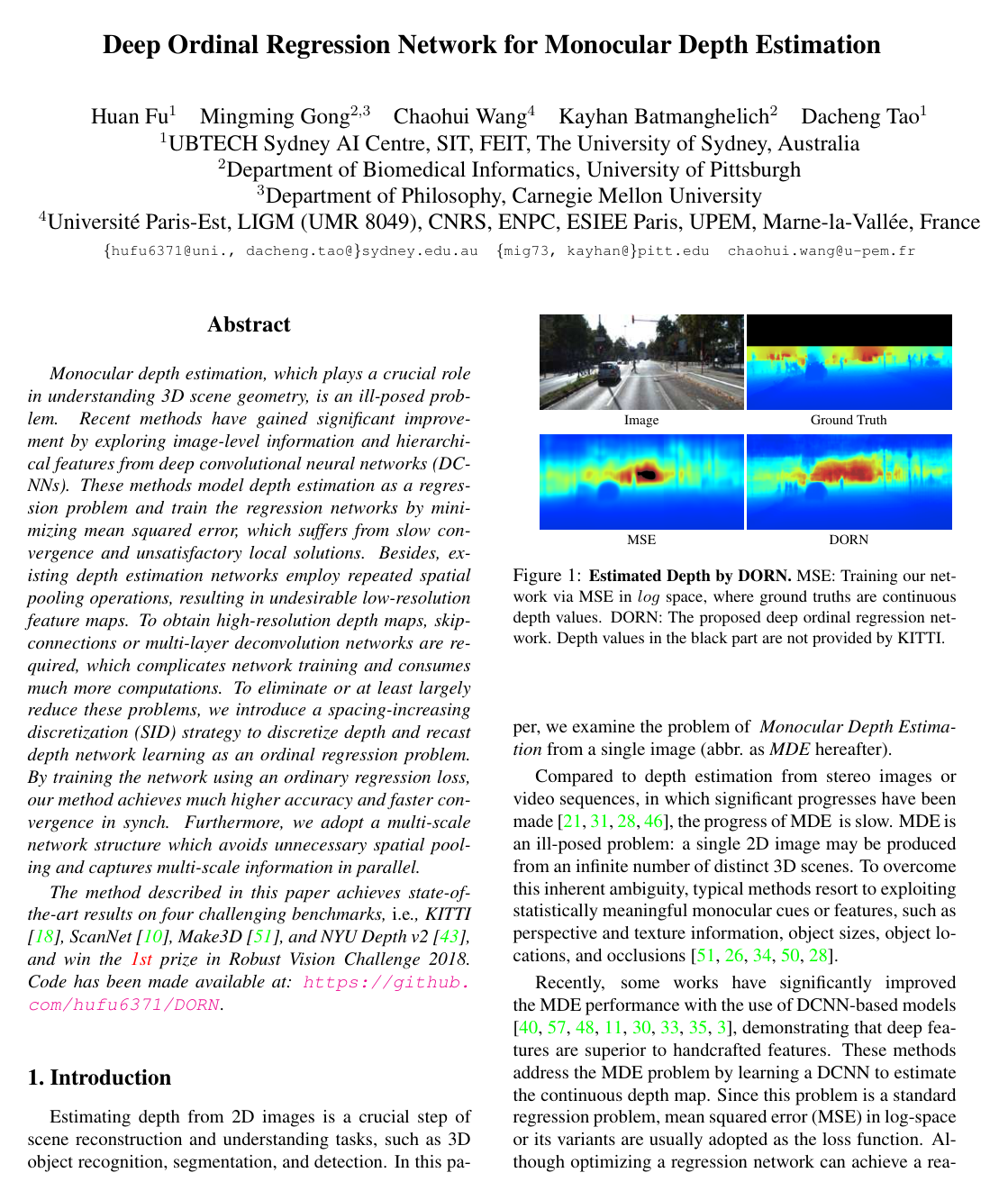
Deep Ordinal Regression Network for Monocular Depth Estimation
Huan Fu, Mingming Gong, Chaohui Wang, Kayhan Batmanghelich, Dacheng Tao
Why you should read this
Presents an ordinal regression framework for monocular depth estimation that combines spacing-increasing discretization with a multi-scale architecture to achieve faster training convergence and superior accuracy across major benchmarks.
Monocular depth estimation, which plays a crucial role in understanding 3D scene geometry, is an ill-posed problem. Recent methods have gained significant improvement by exploring image-level information and hierarchical features from deep convolutional neural networks (DCNNs). These methods model depth estimation as a regression problem and train the regression networks by minimizing mean squared error, which suffers from slow convergence and unsatisfactory local solutions. Besides, existing depth estimation networks employ repeated spatial pooling operations, resulting in undesirable low-resolution feature maps. To obtain high-resolution depth maps, skip-connections or multi-layer deconvolution networks are required, which complicates network training and consumes much more computations. To eliminate or at least largely reduce these problems, we introduce a spacing-increasing discretization (SID) strategy to discretize depth and recast depth network learning as an ordinal regression problem. By training the network using an ordinary regression loss, our method achieves much higher accuracy and \dd{faster convergence in synch}. Furthermore, we adopt a multi-scale network structure which avoids unnecessary spatial pooling and captures multi-scale information in parallel. The method described in this paper achieves state-of-the-art results on four challenging benchmarks, i.e., KITTI [17], ScanNet [9], Make3D [50], and NYU Depth v2 [42], and win the 1st prize in Robust Vision Challenge 2018. Code has been made available at: this https URL.
Added
2026-09-17
Depth Map Prediction from a Single Image using a Multi-Scale Deep Network
David Eigen, Christian Puhrsch, Rob Fergus
Why you should read this
Proposes a multi-scale deep network and a scale-invariant training objective that estimates accurate dense depth from a single image by integrating coarse global context with fine local refinements.
Predicting depth is an essential component in understanding the 3D geometry of a scene. While for stereo images local correspondence suffices for estimation, finding depth relations from a single image is less straightforward, requiring integration of both global and local information from various cues. Moreover, the task is inherently ambiguous, with a large source of uncertainty coming from the overall scale. In this paper, we present a new method that addresses this task by employing two deep network stacks: one that makes a coarse global prediction based on the entire image, and another that refines this prediction locally. We also apply a scale-invariant error to help measure depth relations rather than scale. By leveraging the raw datasets as large sources of training data, our method achieves state-of-the-art results on both NYU Depth and KITTI, and matches detailed depth boundaries without the need for superpixelation.
Added
2026-09-10