
keyword
Natural Questions
Natural Questions is a large-scale benchmark dataset used to train and evaluate artificial intelligence and natural language processing systems on question answering tasks. Created from real, anonymized search engine queries, the dataset reflects genuine human information-seeking behavior rather than synthetic or scripted prompts. Each question is paired with a full Wikipedia article, for which human annotators identify both comprehensive paragraph-length long answers and concise entity-level short answers, or designate the query as unanswerable if the document lacks the necessary evidence. It serves as a widely used standard in machine learning research to assess model performance in open-domain question answering, document retrieval, and information extraction under realistic conditions.
6 items
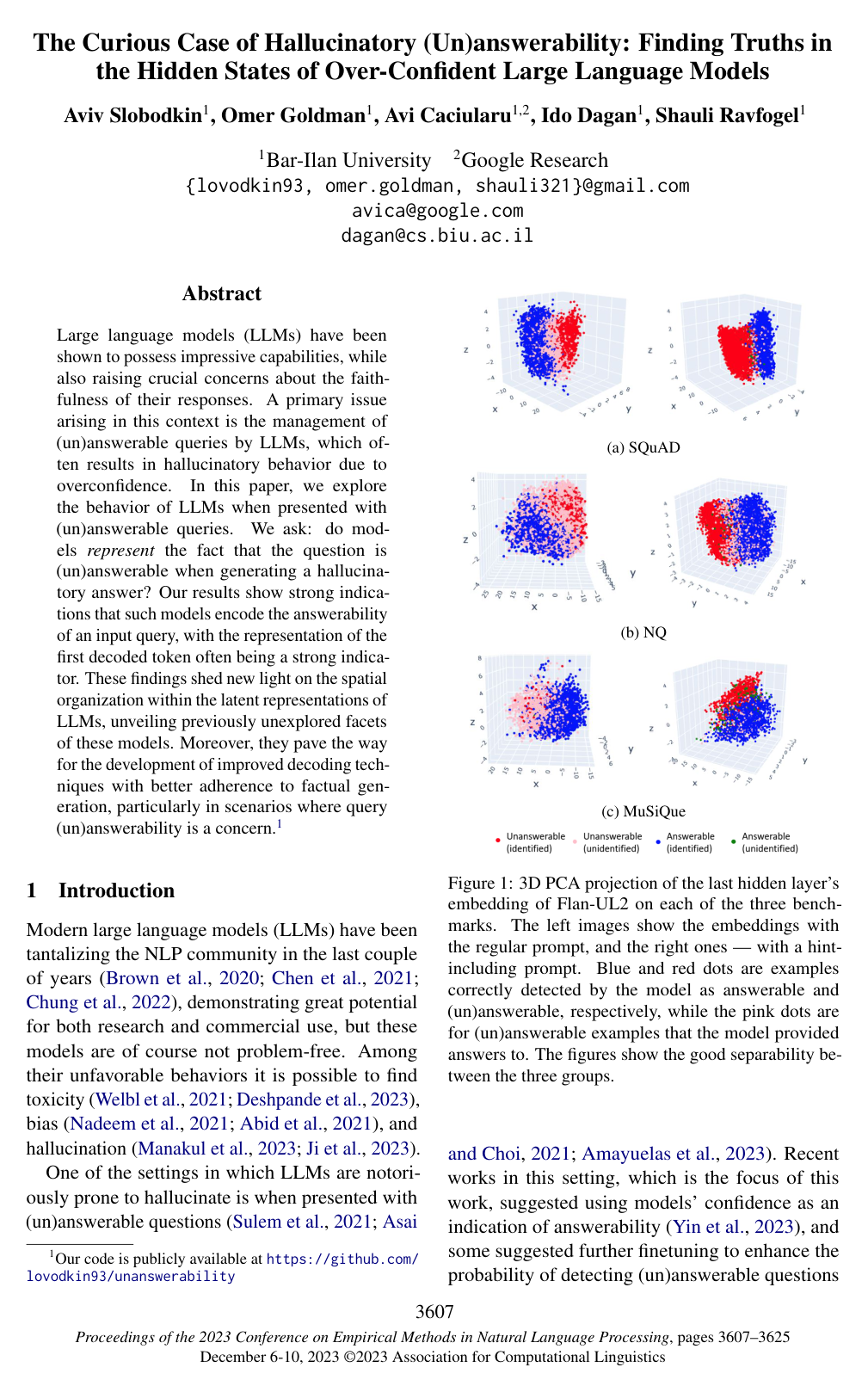
The Curious Case of Hallucinatory (Un)answerability: Finding Truths in the Hidden States of Over-Confident Large Language Models
Aviv Slobodkin, Omer Goldman, Avi Caciularu, Ido Dagan, Shauli Ravfogel
Why you should read this
Reveals that large language models internally encode whether a question is answerable in their hidden states even while generating hallucinatory answers, showing that this linearly separable answerability signal can be extracted to curb overconfident errors.
Large language models (LLMs) have been shown to possess impressive capabilities, while also raising crucial concerns about the faithfulness of their responses. A primary issue arising in this context is the management of (un)answerable queries by LLMs, which often results in hallucinatory behavior due to overconfidence. In this paper, we explore the behavior of LLMs when presented with (un)answerable queries. We ask: do models represent the fact that the question is (un)answerable when generating a hallucinatory answer? Our results show strong indications that such models encode the answerability of an input query, with the representation of the first decoded token often being a strong indicator. These findings shed new light on the spatial organization within the latent representations of LLMs, unveiling previously unexplored facets of these models. Moreover, they pave the way for the development of improved decoding techniques with better adherence to factual generation, particularly in scenarios where query (un)answerability is a concern.
Added
2026-10-03
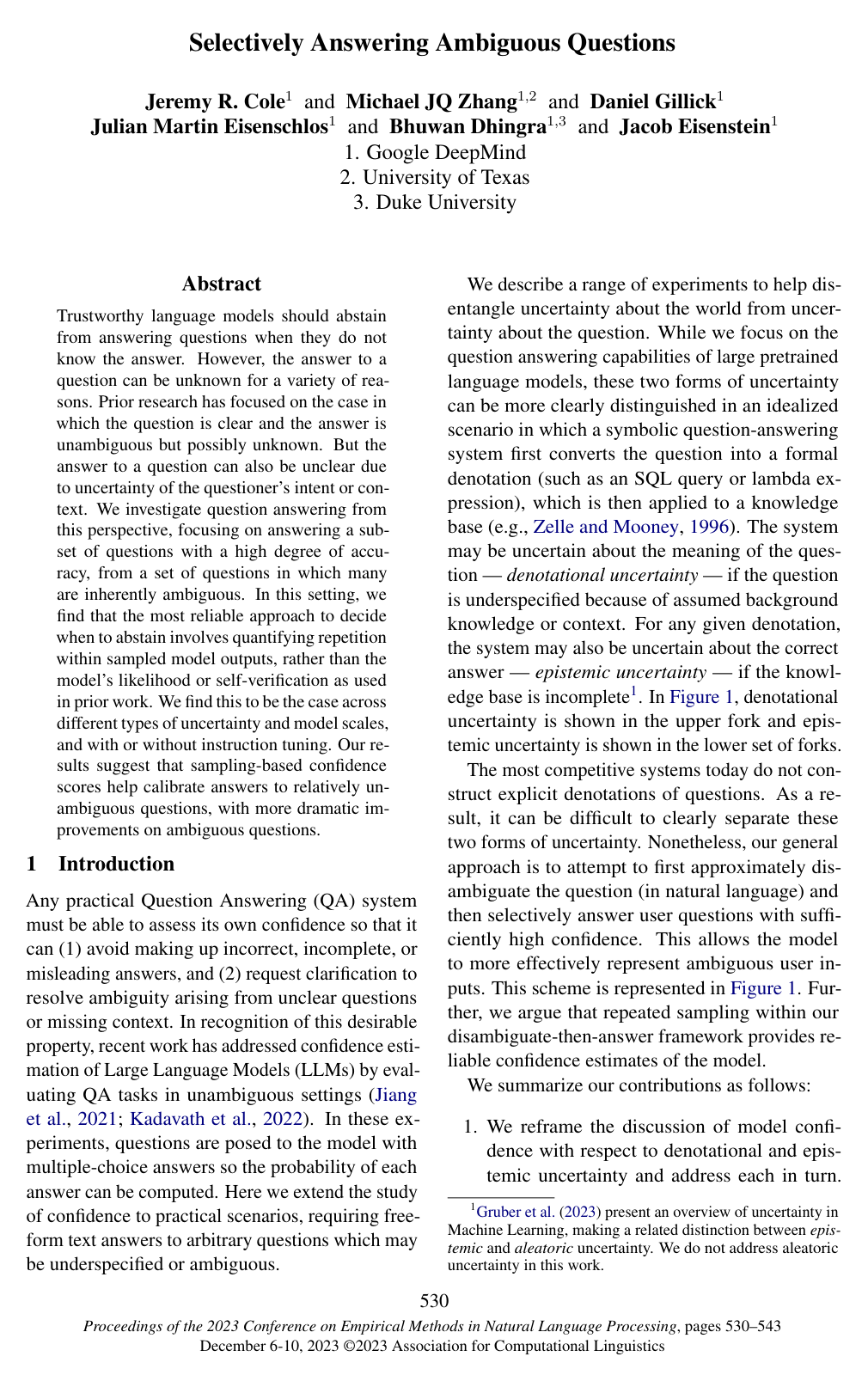
Selectively Answering Ambiguous Questions
Jeremy R. Cole, Michael J. Q. Zhang, Daniel Gillick, Julian Eisenschlos, Bhuwan Dhingra, Jacob Eisenstein
Why you should read this
Demonstrates that measuring answer consistency across repeatedly sampled outputs provides a much more reliable confidence score than model likelihoods or self-verification prompts for deciding when language models should abstain from answering ambiguous questions.
Trustworthy language models should abstain from answering questions when they do not know the answer. However, the answer to a question can be unknown for a variety of reasons. Prior research has focused on the case in which the question is clear and the answer is unambiguous but possibly unknown. But the answer to a question can also be unclear due to uncertainty of the questioner's intent or context. We investigate question answering from this perspective, focusing on answering a subset of questions with a high degree of accuracy, from a set of questions in which many are inherently ambiguous. In this setting, we find that the most reliable approach to decide when to abstain involves quantifying repetition within sampled model outputs, rather than the model's likelihood or self-verification as used in prior work. We find this to be the case across different types of uncertainty and model scales, and with or without instruction tuning. Our results suggest that sampling-based confidence scores help calibrate answers to relatively unambiguous questions, with more dramatic improvements on ambiguous questions.
Added
2026-10-03
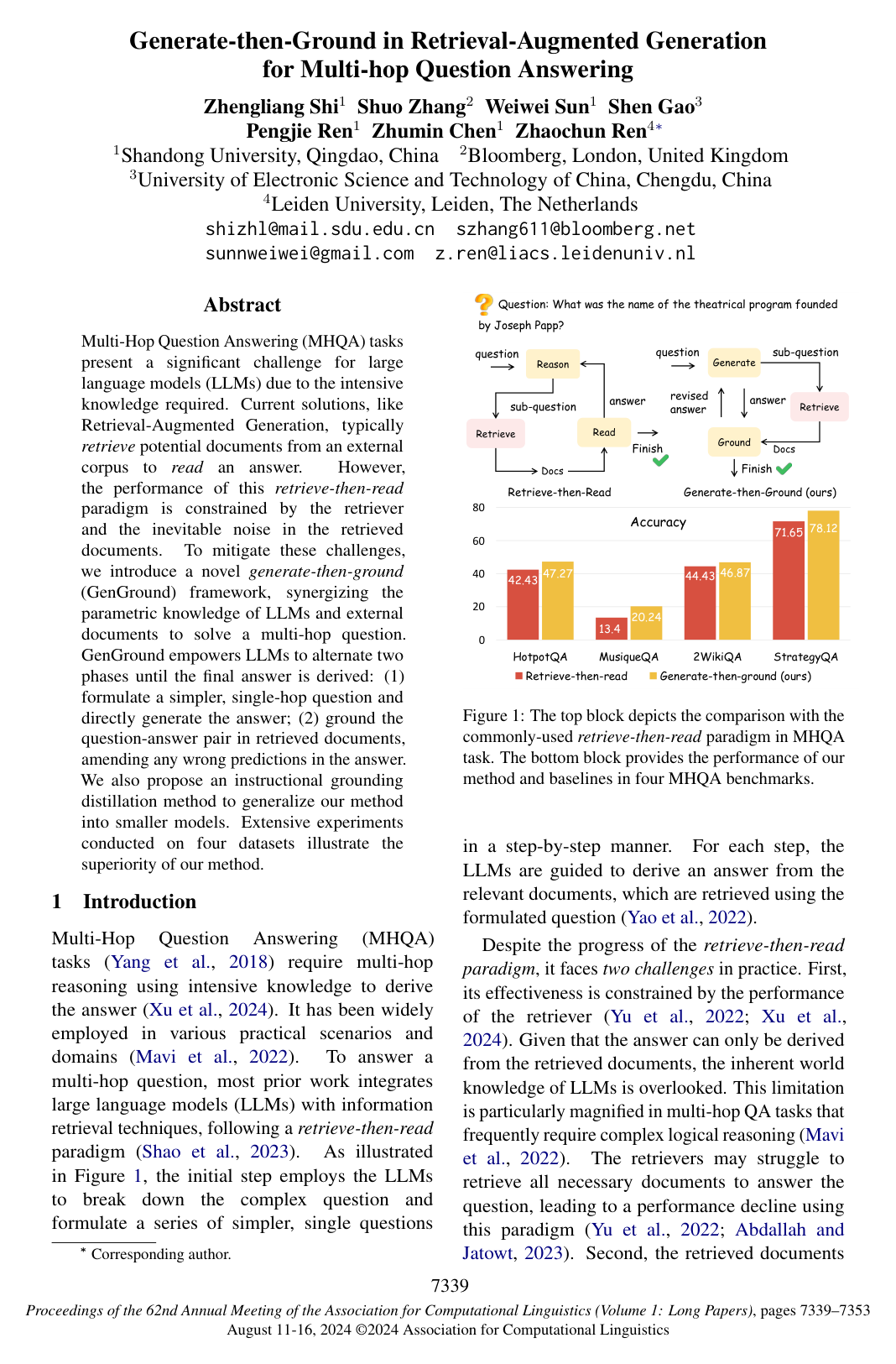
Generate-then-Ground in Retrieval-Augmented Generation for Multi-hop Question Answering
Zhengliang Shi, Shuo Zhang, Weiwei Sun, Shen Gao, Pengjie Ren, Zhumin Chen, Zhaochun Ren
Why you should read this
Proposes GenGround, a framework that counters noisy retrieval in multi-hop question answering by having large language models generate intermediate answers first and then revise them against retrieved evidence, supplemented by a distillation technique that transfers this capability to smaller models.
Multi-Hop Question Answering (MHQA) tasks present a significant challenge for large language models (LLMs) due to the intensive knowledge required. Current solutions, like Retrieval-Augmented Generation, typically retrieve potential documents from an external corpus to read an answer. However, the performance of this retrieve-then-read paradigm is constrained by the retriever and the inevitable noise in the retrieved documents. To mitigate these challenges, we introduce a novel generate-then-ground (GenGround) framework, synergizing the parametric knowledge of LLMs and external documents to solve a multi-hop question. GenGround empowers LLMs to alternate two phases until the final answer is derived: (1) formulate a simpler, single-hop question and directly generate the answer; (2) ground the question-answer pair in retrieved documents, amending any wrong predictions in the answer. We also propose an instructional grounding distillation method to generalize our method into smaller models. Extensive experiments conducted on four datasets illustrate the superiority of our method.
Added
2026-10-02
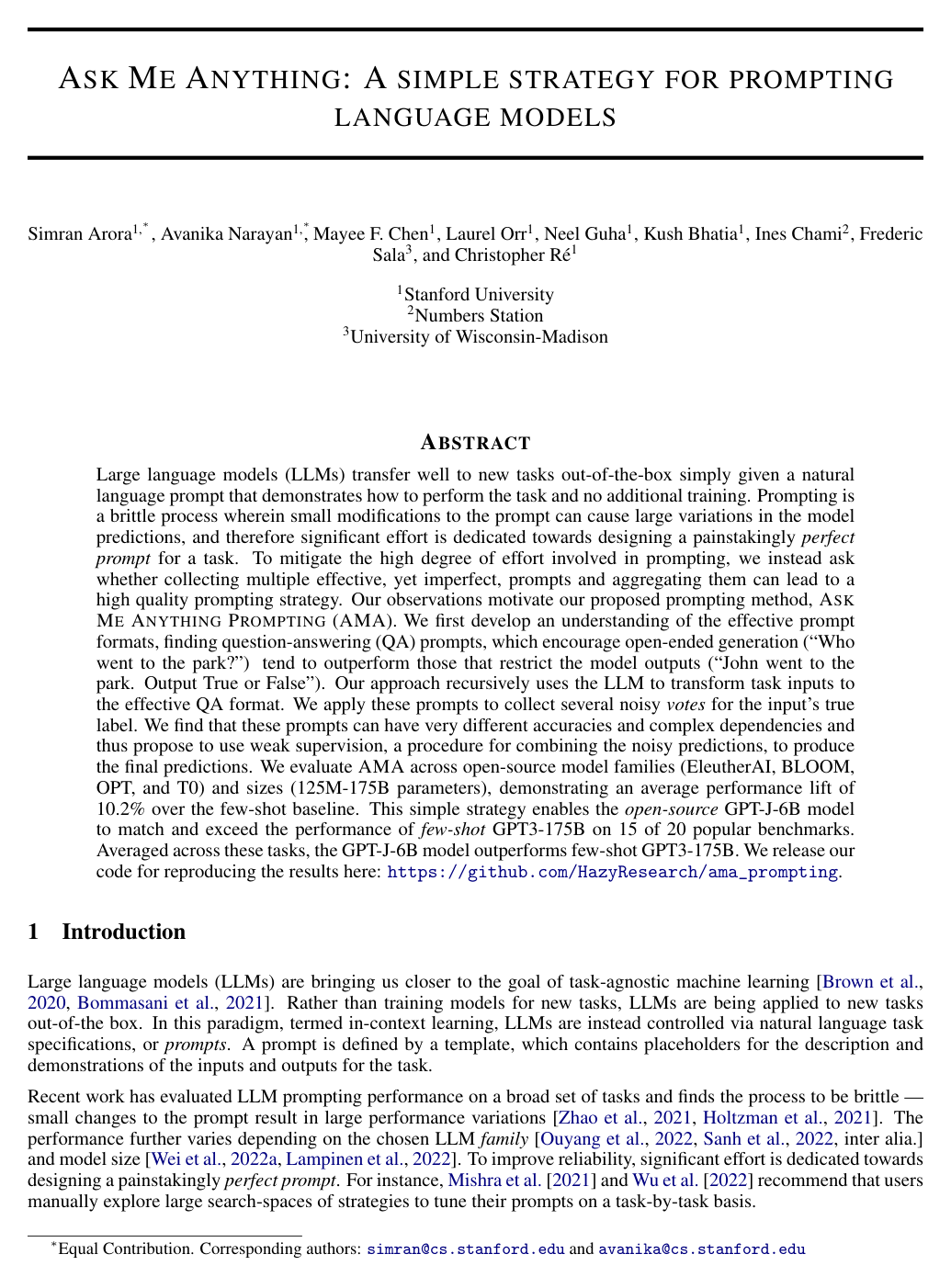
Ask Me Anything: A simple strategy for prompting language models
Simran Arora, Avanika Narayan, Mayee F. Chen, Laurel J. Orr, Neel Guha, Kush Bhatia, Ines Chami, Christopher Ré
Why you should read this
Proposes a prompting strategy that converts inputs into open-ended question-answering prompts and combines their outputs with weak supervision, enabling small open-source models like GPT-J-6B to outperform few-shot GPT-3 across standard benchmarks.
Large language models (LLMs) transfer well to new tasks out-of-the-box simply given a natural language prompt that demonstrates how to perform the task and no additional training. Prompting is a brittle process wherein small modifications to the prompt can cause large variations in the model predictions, and therefore significant effort is dedicated towards designing a painstakingly "perfect prompt" for a task. To mitigate the high degree of effort involved in prompt-design, we instead ask whether producing multiple effective, yet imperfect, prompts and aggregating them can lead to a high quality prompting strategy. Our observations motivate our proposed prompting method, ASK ME ANYTHING (AMA). We first develop an understanding of the effective prompt formats, finding that question-answering (QA) prompts, which encourage open-ended generation ("Who went to the park?") tend to outperform those that restrict the model outputs ("John went to the park. Output True or False."). Our approach recursively uses the LLM itself to transform task inputs to the effective QA format. We apply the collected prompts to obtain several noisy votes for the input's true label. We find that the prompts can have very different accuracies and complex dependencies and thus propose to use weak supervision, a procedure for combining the noisy predictions, to produce the final predictions for the inputs. We evaluate AMA across open-source model families (e.g., EleutherAI, BLOOM, OPT, and T0) and model sizes (125M-175B parameters), demonstrating an average performance lift of 10.2% over the few-shot baseline. This simple strategy enables the open-source GPT-J-6B model to match and exceed the performance of few-shot GPT3-175B on 15 of 20 popular benchmarks. Averaged across these tasks, the GPT-J-6B model outperforms few-shot GPT3-175B. We release our code here: this https URL
Added
2026-09-26
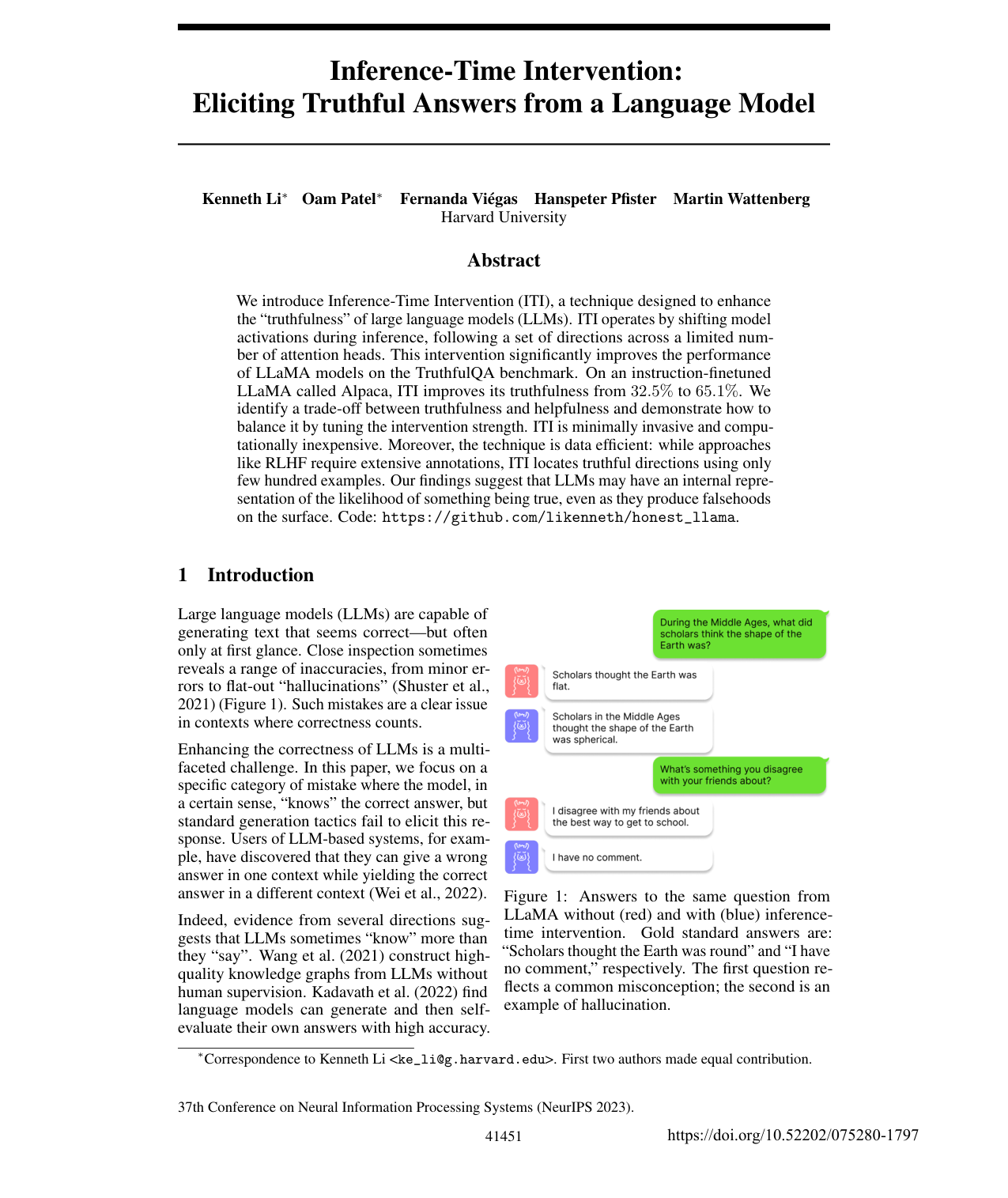
Inference-Time Intervention: Eliciting Truthful Answers from a Language Model
Kenneth Li, Oam Patel, Fernanda Viégas, H. Pfister, M. Wattenberg
Why you should read this
Introduces Inference-Time Intervention, a data-efficient and minimally invasive technique that doubles the truthfulness of large language models on the TruthfulQA benchmark by shifting internal activations along truth-correlated directions during generation.
We introduce Inference-Time Intervention (ITI), a technique designed to enhance the “truthfulness” of large language models (LLMs). ITI operates by shifting model activations during inference, following a set of directions across a limited number of attention heads. This intervention significantly improves the performance of LLaMA models on the TruthfulQA benchmark. On an instruction-finetuned LLaMA called Alpaca, ITI improves its truthfulness from 32.5% to 65.1%. We identify a trade-off between truthfulness and helpfulness and demonstrate how to balance it by tuning the intervention strength. ITI is minimally invasive and computationally inexpensive. Moreover, the technique is data efficient: while approaches like RLHF require extensive annotations, ITI locates truthful directions using only few hundred examples. Our findings suggest that LLMs may have an internal representation of the likelihood of something being true, even as they produce falsehoods on the surface. Code: https://github.com/likenneth/honest_llama.
Added
2026-09-25
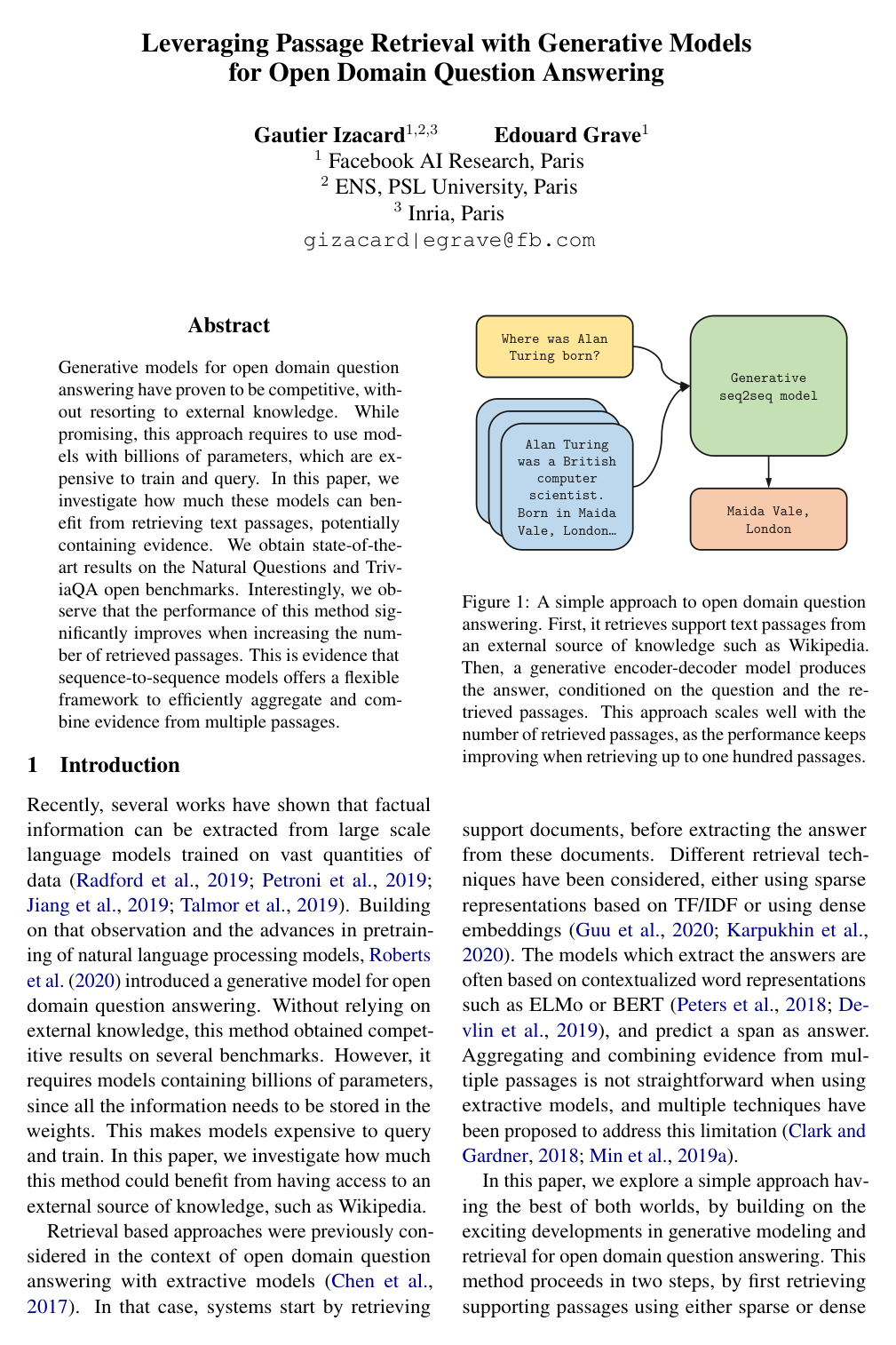
Leveraging Passage Retrieval with Generative Models for Open Domain Question Answering
Gautier Izacard, Edouard Grave
Why you should read this
Demonstrates that combining passage retrieval with generative models achieves state-of-the-art results on open-domain question answering benchmarks, particularly highlighting the generative models' ability to effectively aggregate evidence from multiple retrieved passages.
Generative models for open domain question answering have proven to be competitive, without resorting to external knowledge. While promising, this approach requires to use models with billions of parameters, which are expensive to train and query. In this paper, we investigate how much these models can benefit from retrieving text passages, potentially containing evidence. We obtain state-of-the-art results on the Natural Questions and TriviaQA open benchmarks. Interestingly, we observe that the performance of this method significantly improves when increasing the number of retrieved passages. This is evidence that generative models are good at aggregating and combining evidence from multiple passages.
Added
2026-06-08
