
keyword
multivariate time-series forecasting
Multivariate time-series forecasting is the process of predicting the future values of multiple interrelated, time-dependent variables simultaneously based on their historical observations. Unlike univariate forecasting, which analyzes a single variable in isolation, multivariate forecasting models both intra-series temporal dynamics, such as trends and seasonal variations over time, and inter-series dependencies, which are the static or dynamic correlations across different variables. By jointly capturing these temporal patterns and cross-variable interactions, forecasting methods can generate coordinated point predictions or multi-dimensional uncertainty regions across short-term and long-term horizons for complex systems in domains such as transportation, finance, energy, and meteorology.
5 items
Conformal prediction for multi-dimensional time series by ellipsoidal sets
Chen Xu, Hanyang Jiang, Yao Xie
Why you should read this
Develops MultiDimSPCI, a sequential conformal prediction framework that constructs compact ellipsoidal prediction regions for non-exchangeable multivariate time series while providing finite-sample conditional coverage guarantees.
Conformal prediction (CP) has been a popular method for uncertainty quantification because it is distribution-free, model-agnostic, and theoretically sound. For forecasting problems in supervised learning, most CP methods focus on building prediction intervals for univariate responses. In this work, we develop a sequential CP method called MultiDimSPCI that builds prediction regions for a multivariate response, especially in the context of multivariate time series, which are not exchangeable. Theoretically, we estimate finite-sample high-probability bounds on the conditional coverage gap. Empirically, we demonstrate that MultiDimSPCI maintains valid coverage on a wide range of multivariate time series while producing smaller prediction regions than CP and non-CP baselines.
Added
2026-10-05
Revitalizing Multivariate Time Series Forecasting: Learnable Decomposition with Inter-Series Dependencies and Intra-Series Variations Modeling
Guoqi Yu, Jing Zou, Xiaowei Hu, Angelica I. Avilés-Rivero, Jing Qin, Shujun Wang
Why you should read this
Proposes a learnable convolutional trend-seasonal decomposition paired with a dual attention module to capture cross-variable dependencies and temporal variations, reducing forecasting error by up to 48.56% across multiple benchmark datasets.
Predicting multivariate time series is crucial, demanding precise modeling of intricate patterns, including inter-series dependencies and intra-series variations. Distinctive trend characteristics in each time series pose challenges, and existing methods, relying on basic moving average kernels, may struggle with the non-linear structure and complex trends in real-world data. Given that, we introduce a learnable decomposition strategy to capture dynamic trend information more reasonably. Additionally, we propose a dual attention module tailored to capture inter-series dependencies and intra-series variations simultaneously for better time series forecasting, which is implemented by channel-wise self-attention and autoregressive self-attention. To evaluate the effectiveness of our method, we conducted experiments across eight open-source datasets and compared it with the state-of-the-art methods. Through the comparison results, our Leddam (LEarnable Decomposition and Dual Attention Module) not only demonstrates significant advancements in predictive performance but also the proposed decomposition strategy can be plugged into other methods with a large performance-boosting, from 11.87% to 48.56% MSE error degradation. Code is available at this link: https://github.com/Levi-Ackman/Leddam.
Added
2026-10-02
CATN: Cross Attentive Tree-Aware Network for Multivariate Time Series Forecasting
Hui He, Qi Zhang, Simeng Bai, Kun Yi, Zhendong Niu
Why you should read this
Proposes an end-to-end framework that constructs hierarchical tree structures to capture grouped correlations across variables and uses a cross-attention mechanism to jointly model dynamic inter-series and intra-series temporal dependencies for multivariate time series forecasting.
Modeling complex hierarchical and grouped feature interaction in the multivariate time series data is indispensable to comprehending the data dynamics and predicting the future condition. The implicit feature interaction and high-dimensional data make multivariate forecasting very challenging. Many existing works did not put more emphasis on exploring explicit correlation among multiple time-series data, and complicated models are designed to capture long- and short-range patterns with the aid of attention mechanisms. In this work, we think that a pre-defined graph or a general learning method is difficult due to its irregular structure. Hence, we present CATN, an end-to-end model of Cross Attentive Tree-aware Network to jointly capture the inter-series correlation and intra-series temporal patterns. We first construct a tree structure to learn hierarchical and grouped correlation and design an embedding approach that can pass a dynamic message to generalize implicit but interpretable cross features among multiple time series. Next in the temporal aspect, we propose a multi-level dependency learning mechanism including global&local learning and cross attention mechanism, which can combine long-range dependencies, short-range dependencies as well as cross dependencies at different time steps. The extensive experiments on different datasets from real-world show the effectiveness and robustness of the method we proposed when compared with existing state-of-the-art methods.
Added
2026-09-26
Multivariate Time-Series Forecasting with Temporal Polynomial Graph Neural Networks
Yijing Liu, Qinxian Liu, Jian-Wei Zhang, Haozhe Feng, Zhongwei Wang, Zihan Zhou, Wei Chen
Why you should read this
Proposes a temporal polynomial graph neural network that dynamically models time-varying variable correlations using matrix polynomials and cyclic timestamp embeddings, significantly reducing approximation errors in multivariate time-series forecasting.
Modeling multivariate time series (MTS) is critical in modern intelligent systems. The accurate forecast of MTS data is still challenging due to the complicated latent variable correlation. Recent works apply the Graph Neural Networks (GNNs) to the task, with the basic idea of representing the correlation as a static graph. However, predicting with a static graph causes significant bias because the correlation is time-varying in the real-world MTS data. Besides, there is no gap analysis between the actual correlation and the learned one in their works to validate the effectiveness. This paper proposes a temporal polynomial graph neural network (TPGNN) for accurate MTS forecasting, which represents the dynamic variable correlation as a temporal matrix polynomial in two steps. First, we capture the overall correlation with a static matrix basis. Then, we use a set of time-varying coefficients and the matrix basis to construct a matrix polynomial for each time step. The constructed result empirically captures the precise dynamic correlation of six synthetic MTS datasets generated by a non-repeating random walk model. Moreover, the theoretical analysis shows that TPGNN can achieve perfect approximation under a commutative condition. We conduct extensive experiments on two traffic datasets with prior structure and four benchmark datasets. The results indicate that TPGNN achieves the state-of-the-art on both short-term and long-term MTS forecastings. 1
Added
2026-09-26
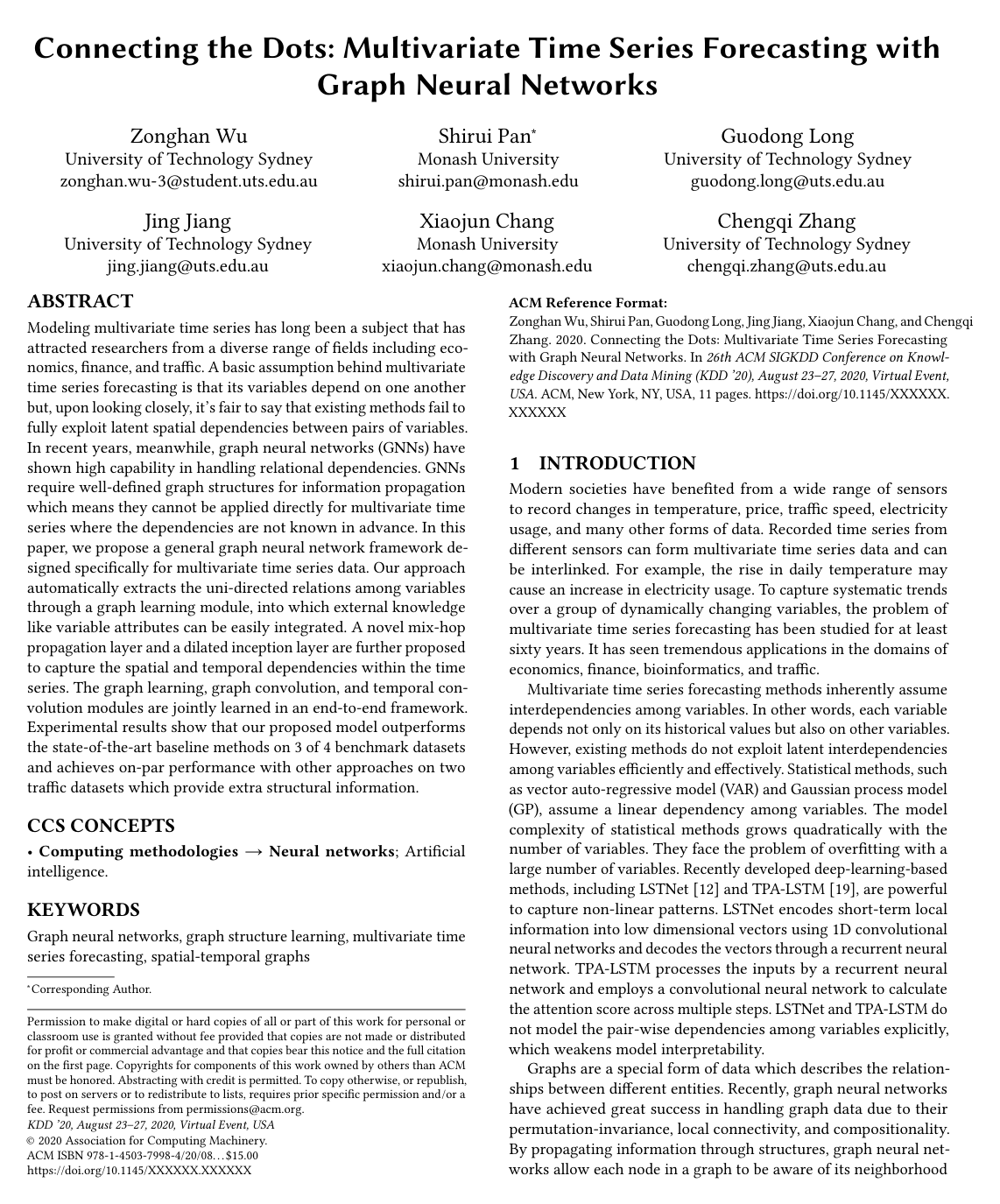
Connecting the Dots: Multivariate Time Series Forecasting with Graph Neural Networks
Zonghan Wu, Shirui Pan, Guodong Long, Jing Jiang, Xiaojun Chang, Chengqi Zhang
Why you should read this
Develops an end-to-end graph neural network framework that automatically learns latent relationships among variables without requiring predefined graph structures, effectively combining spatial and temporal convolutions for multivariate time series forecasting.
Modeling multivariate time series has long been a subject that has attracted researchers from a diverse range of fields including economics, finance, and traffic. A basic assumption behind multivariate time series forecasting is that its variables depend on one another but, upon looking closely, it is fair to say that existing methods fail to fully exploit latent spatial dependencies between pairs of variables. In recent years, meanwhile, graph neural networks (GNNs) have shown high capability in handling relational dependencies. GNNs require well-defined graph structures for information propagation which means they cannot be applied directly for multivariate time series where the dependencies are not known in advance. In this paper, we propose a general graph neural network framework designed specifically for multivariate time series data. Our approach automatically extracts the uni-directed relations among variables through a graph learning module, into which external knowledge like variable attributes can be easily integrated. A novel mix-hop propagation layer and a dilated inception layer are further proposed to capture the spatial and temporal dependencies within the time series. The graph learning, graph convolution, and temporal convolution modules are jointly learned in an end-to-end framework. Experimental results show that our proposed model outperforms the state-of-the-art baseline methods on 3 of 4 benchmark datasets and achieves on-par performance with other approaches on two traffic datasets which provide extra structural information.
Added
2026-09-16