
keyword
multimodal understanding
Multimodal understanding is the capability of an artificial intelligence system to simultaneously process, align, interpret, and reason across information derived from multiple distinct data modalities, such as text, images, video, audio, and physical sensory signals. Unlike unimodal systems that analyze a single data type in isolation, multimodal understanding requires models to identify cross-modal correlations, ground concepts across disparate representations, and synthesize a cohesive interpretation of complex, multi-source inputs. This capability enables computational systems to perform tasks such as visual question answering, cross-modal retrieval, scene interpretation, and embodied decision-making by constructing unified internal representations of diverse perceptual data.
9 items
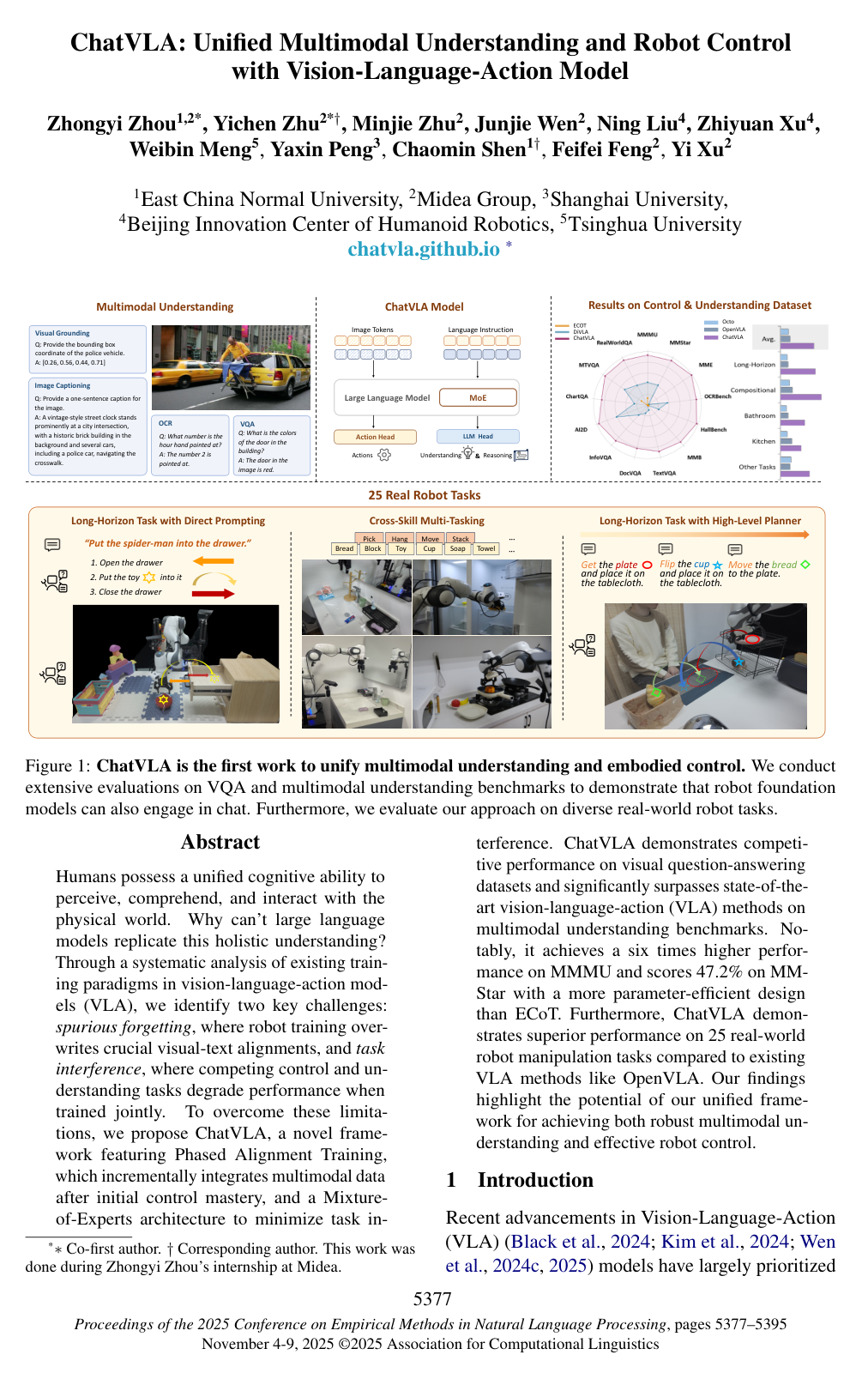
ChatVLA: Unified Multimodal Understanding and Robot Control with Vision-Language-Action Model
Zhongyi Zhou, Yichen Zhu, Minjie Zhu, Junjie Wen, Ning Liu, Zhiyuan Xu, Weibin Meng, Yaxin Peng, Chaomin Shen, Feifei Feng, Yi Xu
Why you should read this
Introduces ChatVLA, a framework combining Phased Alignment Training and a Mixture-of-Experts architecture to unify conversational multimodal understanding with physical robot manipulation in a single network without suffering from catastrophic forgetting or task interference.
Humans possess a unified cognitive ability to perceive, comprehend, and interact with the physical world. Why can't large language models replicate this holistic understanding? Through a systematic analysis of existing training paradigms in vision-language-action models (VLA), we identify two key challenges: spurious forgetting, where robot training overwrites crucial visual-text alignments, and task interference, where competing control and understanding tasks degrade performance when trained jointly. To overcome these limitations, we propose ChatVLA, a novel framework featuring Phased Alignment Training, which incrementally integrates multimodal data after initial control mastery, and a Mixture-of-Experts architecture to minimize task interference. ChatVLA demonstrates competitive performance on visual question-answering datasets and significantly surpasses state-of-the-art vision-language-action (VLA) methods on multimodal understanding benchmarks. Notably, it achieves a six times higher performance on MMMU and scores 47.2% on MM-Star with a more parameter-efficient design than ECOT. Furthermore, ChatVLA demonstrates superior performance on 25 real-world robot manipulation tasks compared to existing VLA methods like OpenVLA. Our findings highlight the potential of our unified framework for achieving both robust multimodal understanding and effective robot control.
Added
2026-10-02
MuseAgent-1: Interactive Grounded Multimodal Understanding of Music Scores and Performance Audio
Qihao Zhao, Yunqi Cao, Yangyu Huang, Hui Yi Leong, Fan Zhang, Kim-Hui Yap, Wei Hu
Why you should read this
Proposes MuseAgent, a multimodal agent that integrates optical music recognition and audio transcription to enable grounded reasoning over sheet music and performance audio, supported by the MuseBench evaluation benchmark.
Despite recent advances in multimodal large language models (MLLMs), their ability to understand and interact with music remains limited. Music understanding requires grounded reasoning over symbolic scores and expressive performance audio, which general-purpose MLLMs often fail to handle due to insufficient perceptual grounding. We introduce MuseAgent, a music-centric multimodal agent that augments language models with structured symbolic representations derived from sheet music images and performance audio. By integrating optical music recognition and automatic music transcription modules, MuseAgent enables multi-step reasoning and interaction over fine-grained musical content. To systematically evaluate music understanding capabilities, we further propose MuseBench, a benchmark covering music theory reasoning, score interpretation, and performance-level analysis across text, image, and audio modalities. Experiments show that existing MLLMs perform poorly on these tasks, while MuseAgent achieves substantial improvements, highlighting the importance of structured multimodal grounding for interactive music understanding.
Added
2026-09-29
AnyGPT: Unified Multimodal LLM with Discrete Sequence Modeling
Jun Zhan, Junqi Dai, Jiasheng Ye, Yunhua Zhou, Dong Zhang, Zhigeng Liu, Xin Zhang, Ruibin Yuan, Ge Zhang, Linyang Li, Hang Yan, Jie Fu, Tao Gui, Tianxiang Sun, Yu-Gang Jiang, Xipeng Qiu
Why you should read this
Presents AnyGPT, an any-to-any multimodal language model that unifies speech, text, images, and music using discrete sequence modeling without altering standard model architectures or training objectives.
We introduce AnyGPT, an any-to-any multi-modal language model that utilizes discrete representations for the unified processing of various modalities, including speech, text, images, and music. AnyGPT can be trained stably without any alterations to the current large language model (LLM) architecture or training paradigms. Instead, it relies exclusively on data-level preprocessing, facilitating the seamless integration of new modalities into LLMs, akin to the incorporation of new languages. We build a multimodal text-centric dataset for multimodal alignment pre-training. Utilizing generative models, we synthesize the first large-scale any-to-any multimodal instruction dataset. It consists of 108k samples of multi-turn conversations that intricately interweave various modalities, thus equipping the model to handle arbitrary combinations of multimodal inputs and outputs. Experimental results demonstrate that AnyGPT is capable of facilitating any-to-any multimodal conversation while achieving performance comparable to specialized models across all modalities, proving that discrete representations can effectively and conveniently unify multiple modalities within a language model. Demos are shown in https://junzhan2000.github.io/AnyGPT.github.io/.
Added
2026-09-29
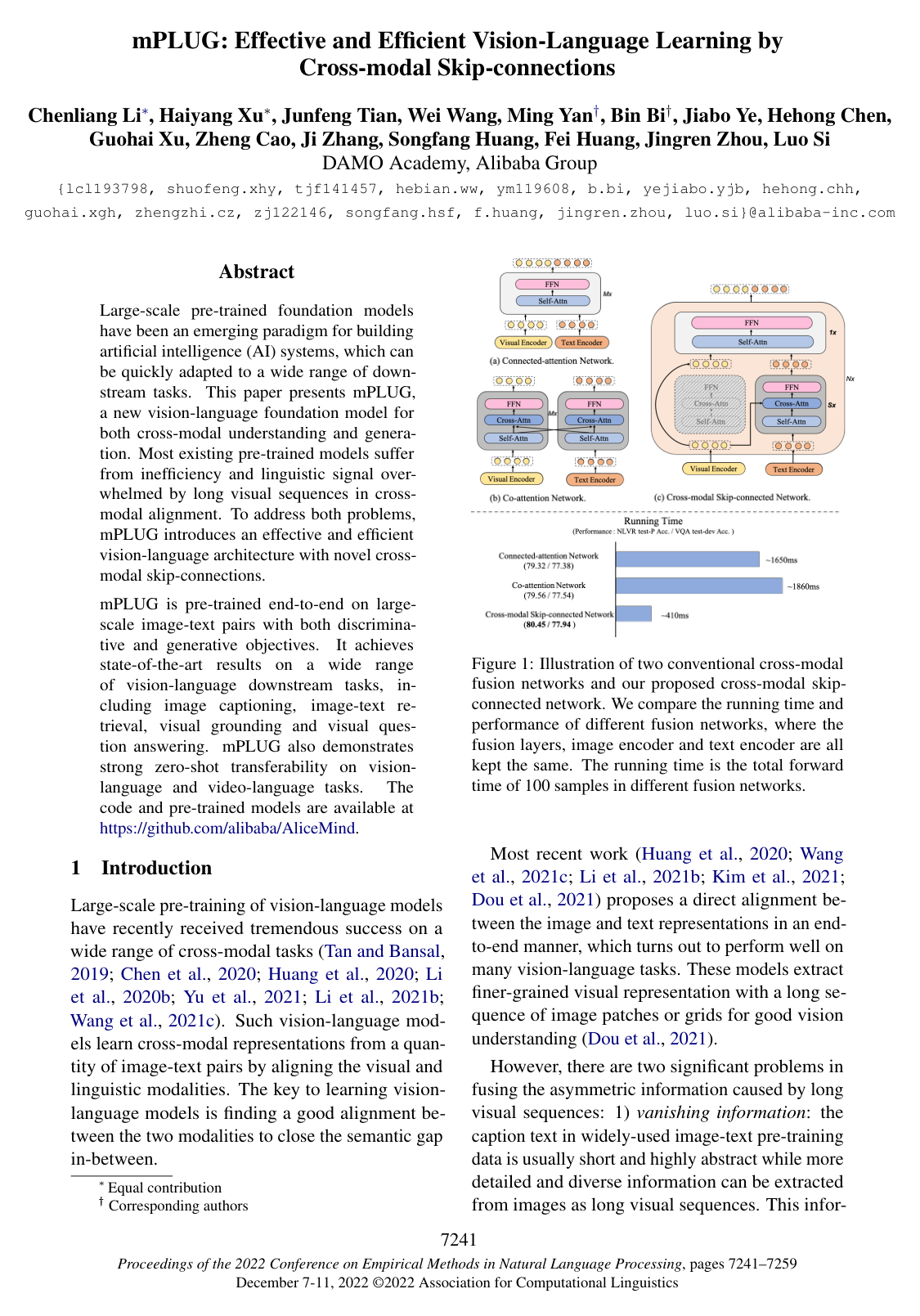
mPLUG: Effective and Efficient Vision-Language Learning by Cross-modal Skip-connections
Chenliang Li, Haiyang Xu, Junfeng Tian, Wei Wang, Ming Yan, Bin Bi, Jiabo Ye, He Chen, Guohai Xu, Zheng Cao, Ji Zhang, Songfang Huang, Fei Huang, Jingren Zhou, Luo Si
Why you should read this
Introduces a vision-language foundation model that uses cross-modal skip-connections to eliminate computational bottlenecks on long visual sequences and prevent image features from overwhelming linguistic signals during multi-modal fusion.
Large-scale pre-trained foundation models have been an emerging paradigm for building artificial intelligence (AI) systems, which can be quickly adapted to a wide range of downstream tasks. This paper presents mPLUG, a new vision-language foundation model for both cross-modal understanding and generation. Most existing pre-trained models suffer from inefficiency and linguistic signal overwhelmed by long visual sequences in cross-modal alignment. To address both problems, mPLUG introduces an effective and efficient vision-language architecture with novel cross-modal skip-connections. mPLUG is pre-trained end-to-end on large-scale image-text pairs with both discriminative and generative objectives. It achieves state-of-the-art results on a wide range of vision-language downstream tasks, including image captioning, image-text retrieval, visual grounding and visual question answering. mPLUG also demonstrates strong zero-shot transferability on vision-language and video-language tasks. The code and pre-trained models are available at https://github.com/alibaba/AliceMind.
Added
2026-09-28
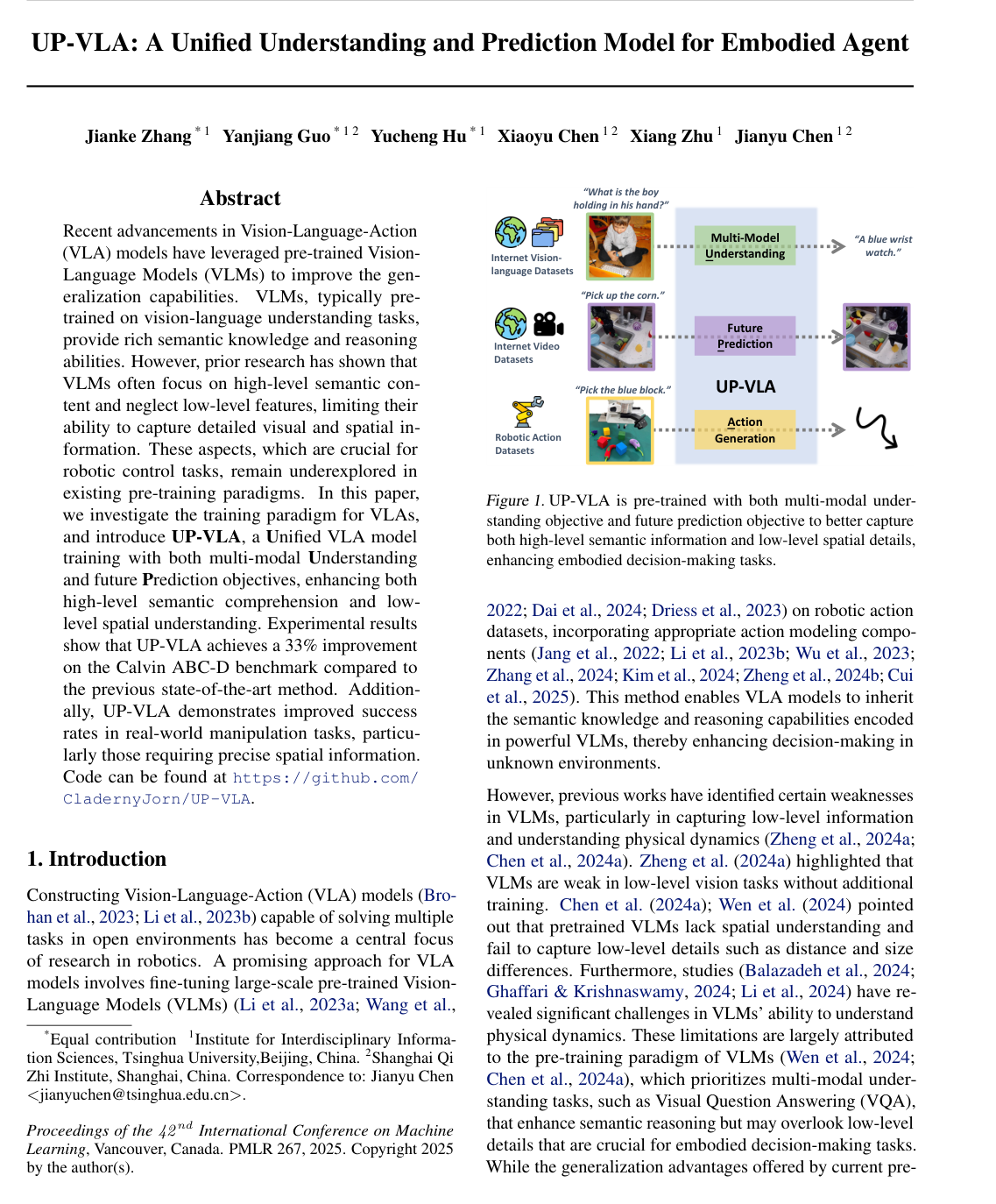
UP-VLA: A Unified Understanding and Prediction Model for Embodied Agent
Jianke Zhang, Yanjiang Guo, Yucheng Hu, Xiaoyu Chen, Xiang Zhu, Jianyu Chen
Why you should read this
Proposes a unified training paradigm for Vision-Language-Action models that couples multi-modal understanding with future visual prediction to capture both high-level semantics and low-level spatial details, boosting robot manipulation success on the Calvin benchmark by 33%.
Added
2026-09-26
Video-ChatGPT: Towards Detailed Video Understanding via Large Vision and Language Models
Muhammad Maaz, Hanoona Abdul Rasheed, Salman Khan, Fahad Khan
Why you should read this
Presents Video-ChatGPT to enable detailed conversational video understanding by combining a video-adapted visual encoder with a large language model, alongside a 100,000-sample instruction dataset and a standardized quantitative evaluation benchmark.
Conversation agents fueled by Large Language Models (LLMs) are providing a new way to interact with visual data. While there have been initial attempts for image-based conversation models, this work addresses the under-explored field of \emph{video-based conversation} by introducing Video-ChatGPT. It is a multimodal model that merges a video-adapted visual encoder with an LLM. The resulting model is capable of understanding and generating detailed conversations about videos. We introduce a new dataset of 100,000 video-instruction pairs used to train Video-ChatGPT acquired via manual and semi-automated pipeline that is easily scalable and robust to label noise. We also develop a quantitative evaluation framework for video-based dialogue models to objectively analyze the strengths and weaknesses of video-based dialogue models. Code: this https URL.
Added
2026-09-25
Gemma 3 Technical Report
Gemma Team Aishwarya Kamath, Johan Ferret, Shreya Pathak, Nino Vieillard, Ramona Merhej, Sarah Perrin, Tatiana Matejovicova, Alexandre Ram'e, Morgane Rivière, Louis Rouil-lard, Thomas Mesnard, Geoffrey Cideron, Jean-Bastien Grill, Sabela Ramos, Edouard Yvinec, M. Casbon, Etienne Pot, Ivo Penchev, Gael Liu, Francesco Visin, Kathleen Kenealy, Lucas Beyer, Xiaohai Zhai, Anton Tsitsulin, R. Busa-Fekete, Alex Feng, Noveen Sachdeva, Benjamin Coleman, Yi Gao, Basil Mustafa, Iain Barr, Emilio Parisotto, David Tian, Matan Eyal, Colin Cherry, Jan-Thorsten Peter, Danila Sinopalnikov, Surya Bhupatiraju, Rishabh Agarwal, Mehran Kazemi, Dan Malkin, Ravin Kumar, David Vilar, I. Brusilovsky, Jiaming Luo, A. Steiner, Abe Friesen, Abhanshu Sharma, Abheesht Sharma, Adi Mayrav Gilady, Adrian Goedeckemeyer, Alaa Saade, Alexander Kolesnikov, Alexei Bendebury, Alvin Abdagic, Amit Vadi, Andr'as Gyorgy, André Susano Pinto, Anil Das, Ankur Bapna, Antoine Miech, Antoine Yang, Antonia Paterson, Ashish Shenoy, Ayan Chakrabarti, Bilal Piot, Boxi Wu, Bobak Shahriari, Bryce Petrini, Charlie Chen, Charline Le Lan, Christopher A. Choquette-Choo, Cj Carey, C. Brick, Daniel Deutsch, Danielle Eisenbud, Dee Cattle, D. Cheng, Dimitris Paparas, Divyashree Shivakumar Sreepathihalli, Doug Reid, Dustin Tran, Dustin Zelle, Eric Noland, Erwin Huizenga, E. Kharitonov, Frederick Liu, G. Amirkhanyan, Glenn Cameron, Hadi Hashemi, Hanna Klimczak-Pluci'nska, Harman Singh, Harsh Mehta, Harshal Tushar Lehri, Hussein Hazimeh, Ian Ballantyne, Idan Szpektor, Ivan Nardini, Jean Pouget-Abadie, Jetha Chan, Joe Stanton, J. Michael Wieting, J. Lai, Jordi Orbay, Joe Fernandez, Joshua Newlan, Junsong Ji, Jyotinder Singh, Kat Black, Kathy Yu, Kevin Hui, Kiran Vodrahalli, Klaus Greff, Linhai Qiu, Marcella Valentine, Marina Coelho, Marvin Ritter, Matt Hoffman, Matthew Watson, Mayank Chaturvedi, Michael Moynihan, Min Ma, Nabila Babar, Natasha Noy, Nathan Byrd, Nick Roy, Nikola Momchev, Nilay Chauhan, Oskar Bunyan, Pankil Botarda, Paul Caron, P. Rubenstein, Phil Culliton, P. Schmid, Pier Giuseppe Sessa, Ping-mei Xu, P. Stańczyk, P. Tafti, Rakesh Shivanna, Renjie Wu, Renke Pan, R. Rokni, Rob Willoughby, Rohith Vallu, Ryan Mullins, Sammy Jerome, Sara Smoot, Sertan Girgin, Shariq Iqbal, Shashir Reddy, Shruti Sheth, Siim Põder, Sijal Bhatnagar, Sindhu Raghuram Panyam, Sivan Eiger, Susan Zhang, Tianqi Liu, Trevor Yacovone, T. Liechty, Uday Kalra, Utku Evci, Vedant Misra, Vincent Roseberry, Vladimir Feinberg, V. Kolesnikov, Woohyun Han, Woosuk Kwon, Xi Chen, Yinlam Chow, Yuvein Zhu, Zichuan Wei, Z. Egyed, Victor Cotruta, Minh Giang, Phoebe Kirk, Anand Rao, Jessica Lo, Erica Moreira, Luiz Gustavo Martins, Omar Sanseviero, Lucas Gonzalez, Zach Gleicher, T. Warkentin, V. Mirrokni, Evan Senter, Eli Collins, Joelle Barral, Z. Ghahramani, R. Hadsell, Y. Matias, D. Sculley, Slav Petrov, Noah Fiedel, Noam Shazeer, O. Vinyals, Jeffrey Dean, D. Hassabis, K. Kavukcuoglu, C. Farabet, Elena Buchatskaya, Jean-Baptiste Alayrac, Rohan Anil, Dmitry Lepikhin, Sebastian Borgeaud, Olivier Bachem, Armand Joulin, Alek Andreev, Cassidy Hardin, Robert Dadashi, L'eonard Hussenot
Why you should read this
Presents Gemma 3, an open family of lightweight multimodal models ranging from 1B to 27B parameters that combines vision understanding, 128K-token context processing, and memory-efficient attention to achieve performance competitive with much larger systems.
We introduce Gemma 3, a multimodal addition to the Gemma family of lightweight open models, ranging in scale from 1 to 27 billion parameters. This version introduces vision understanding abilities, a wider coverage of languages and longer context - at least 128K tokens. We also change the architecture of the model to reduce the KV-cache memory that tends to explode with long context. This is achieved by increasing the ratio of local to global attention layers, and keeping the span on local attention short. The Gemma 3 models are trained with distillation and achieve superior performance to Gemma 2 for both pre-trained and instruction finetuned versions. In particular, our novel post-training recipe significantly improves the math, chat, instruction-following and multilingual abilities, making Gemma3-4B-IT competitive with Gemma2-27B-IT and Gemma3-27B-IT comparable to Gemini-1.5-Pro across benchmarks. We release all our models to the community.
Added
2026-09-24
MMBench: Is Your Multi-modal Model an All-around Player?
Yuanzhan Liu, Haodong Duan, Yuanhan Zhang, Bo Li, Songyang Zhang, Wangbo Zhao, Yike Yuan, Jiaqi Wang, Conghui He, Ziwei Liu, Kai Chen, Dahua Lin
Why you should read this
Introduces MMBench, a bilingual benchmark that reliably assesses vision-language models across fine-grained perception and reasoning tasks using a circular evaluation strategy to eliminate option bias.
Large vision-language models (VLMs) have recently achieved remarkable progress, exhibiting impressive multimodal perception and reasoning abilities. However, effectively evaluating these large VLMs remains a major challenge, hindering future development in this domain. Traditional benchmarks like VQAv2 or COCO Caption provide quantitative performance measurements but lack fine-grained ability assessment and robust evaluation metrics. Meanwhile, subjective benchmarks, such as OwlEval, offer comprehensive evaluations of a model's abilities by incorporating human labor, which is not scalable and may display significant bias. In response to these challenges, we propose MMBench, a bilingual benchmark for assessing the multi-modal capabilities of VLMs. MMBench methodically develops a comprehensive evaluation pipeline, primarily comprised of the following key features: 1. MMBench is meticulously curated with well-designed quality control schemes, surpassing existing similar benchmarks in terms of the number and variety of evaluation questions and abilities; 2. MMBench introduces a rigorous CircularEval strategy and incorporates large language models to convert free-form predictions into pre-defined choices, which helps to yield accurate evaluation results for models with limited instruction-following capabilities. 3. MMBench incorporates multiple-choice questions in both English and Chinese versions, enabling an apples-to-apples comparison of VLMs' performance under a bilingual context. To summarize, MMBench is a systematically designed objective benchmark for a robust and holistic evaluation of vision-language models. We hope MMBench will assist the research community in better evaluating their models and facilitate future progress in this area. The evalutation code of MMBench has been integrated into VLMEvalKit: this https URL.
Added
2026-09-14
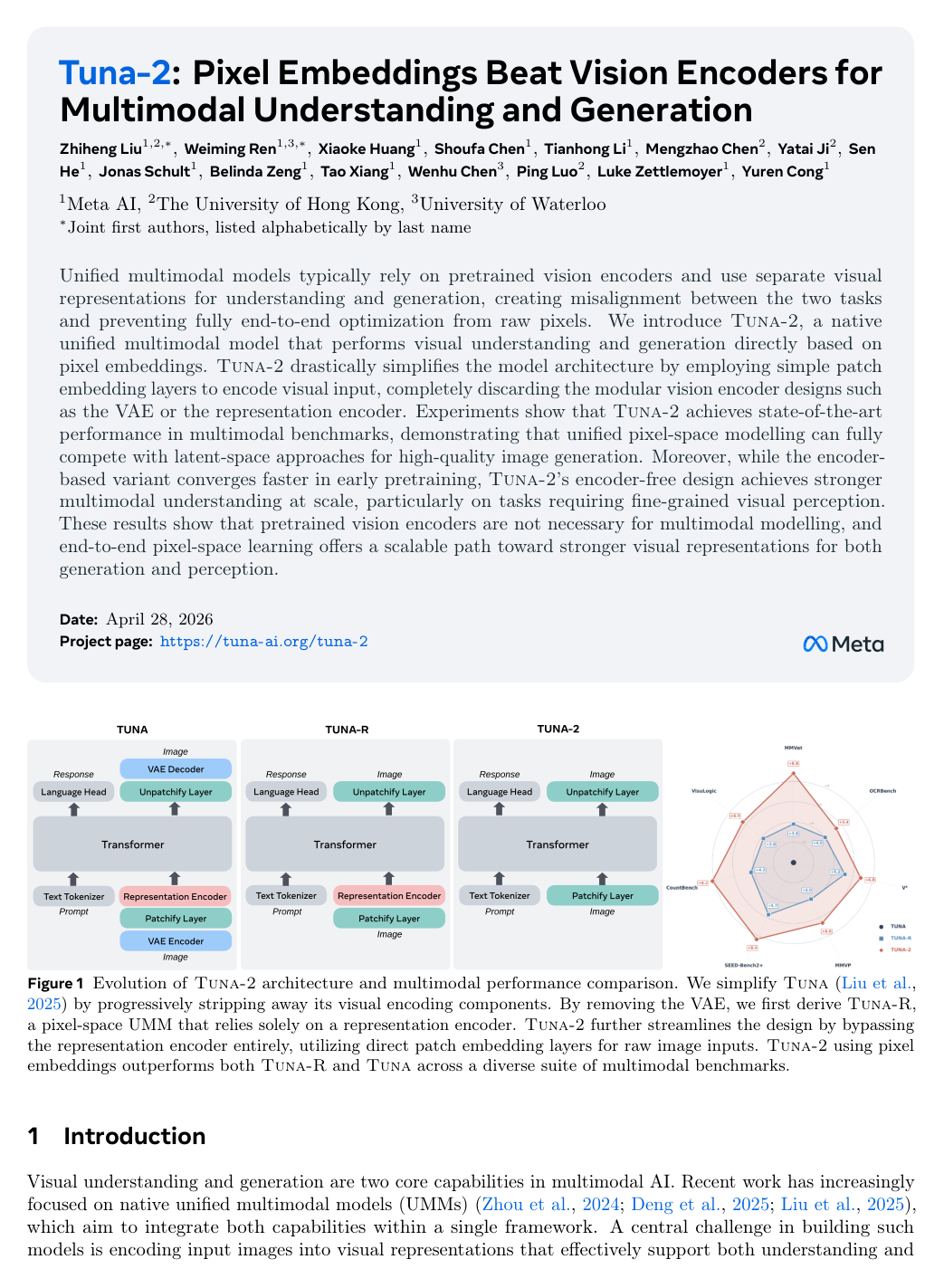
Tuna-2: Pixel Embeddings Beat Vision Encoders for Multimodal Understanding and Generation
Zhiheng Liu, Weiming Ren, Xiaoke Huang, Shoufa Chen, Tianhong Li, Mengzhao Chen, Yatai Ji, Sen He, Jonas Schult, Belinda Zeng, Tao Xiang, Wenhu Chen, Ping Luo, Luke Zettlemoyer, Yuren Cong
Why you should read this
Reveals that unified pixel-space modeling without pretrained vision encoders achieves state-of-the-art performance in multimodal tasks, demonstrating that direct pixel embeddings offer a scalable and simplified approach for both understanding and generation.
Unified multimodal models typically rely on pretrained vision encoders and use separate visual representations for understanding and generation, creating misalignment between the two tasks and preventing fully end-to-end optimization from raw pixels. We introduce Tuna-2, a native unified multimodal model that performs visual understanding and generation directly based on pixel embeddings. Tuna-2 drastically simplifies the model architecture by employing simple patch embedding layers to encode visual input, completely discarding the modular vision encoder designs such as the VAE or the representation encoder. Experiments show that Tuna-2 achieves state-of-the-art performance in multimodal benchmarks, demonstrating that unified pixel-space modelling can fully compete with latent-space approaches for high-quality image generation. Moreover, while the encoder-based variant converges faster in early pretraining, Tuna-2's encoder-free design achieves stronger multimodal understanding at scale, particularly on tasks requiring fine-grained visual perception. These results show that pretrained vision encoders are not necessary for multimodal modelling, and end-to-end pixel-space learning offers a scalable path toward stronger visual representations for both generation and perception.
Added
2026-05-10
