
keyword
machine-generated text
Machine-generated text is written content produced automatically by computational algorithms or artificial intelligence systems rather than human authors. Typically created by natural language processing models and large language models trained on vast datasets, such text can simulate human vocabulary, grammar, tone, and structure across diverse applications, ranging from natural language prose to computer code. Because modern generative systems produce fluent and contextually relevant outputs that can closely resemble human writing, organizations and researchers often utilize specialized detection mechanisms, including statistical classifiers and embedded watermarking schemes, to identify and verify the synthetic origin of the text.
4 items
ToxiGen: A Large-Scale Machine-Generated Dataset for Adversarial and Implicit Hate Speech Detection
Thomas Hartvigsen, Saadia Gabriel, Hamid Palangi, Maarten Sap, Dipankar Ray, Ece Kamar
Why you should read this
Introduces ToxiGen, a large-scale balanced dataset of over 274,000 machine-generated statements across 13 minority groups, along with an adversarial decoding method to help classifiers detect subtle, implicit hate speech without over-relying on identity mentions.
Toxic language detection systems often falsely flag text that contains minority group mentions as toxic, as those groups are often the targets of online hate. Such over-reliance on spurious correlations also causes systems to struggle with detecting implicitly toxic language. To help mitigate these issues, we create TOXIGEN, a new large-scale and machine-generated dataset of 274k toxic and benign statements about 13 minority groups. We develop a demonstration-based prompting framework and an adversarial classifier-in-the-loop decoding method to generate subtly toxic and benign text with a massive pretrained language model (Brown et al., 2020). Controlling machine generation in this way allows TOXIGEN to cover implicitly toxic text at a larger scale, and about more demographic groups, than previous resources of human-written text. We conduct a human evaluation on a challenging subset of TOXIGEN and find that annotators struggle to distinguish machine-generated text from human-written language. We also find that 94.5% of toxic examples are labeled as hate speech by human annotators. Using three publicly-available datasets, we show that finetuning a toxicity classifier on our data improves its performance on human-written data substantially. We also demonstrate that TOXIGEN can be used to fight machine-generated toxicity as finetuning improves the classifier significantly on our evaluation subset.
Added
2026-09-26
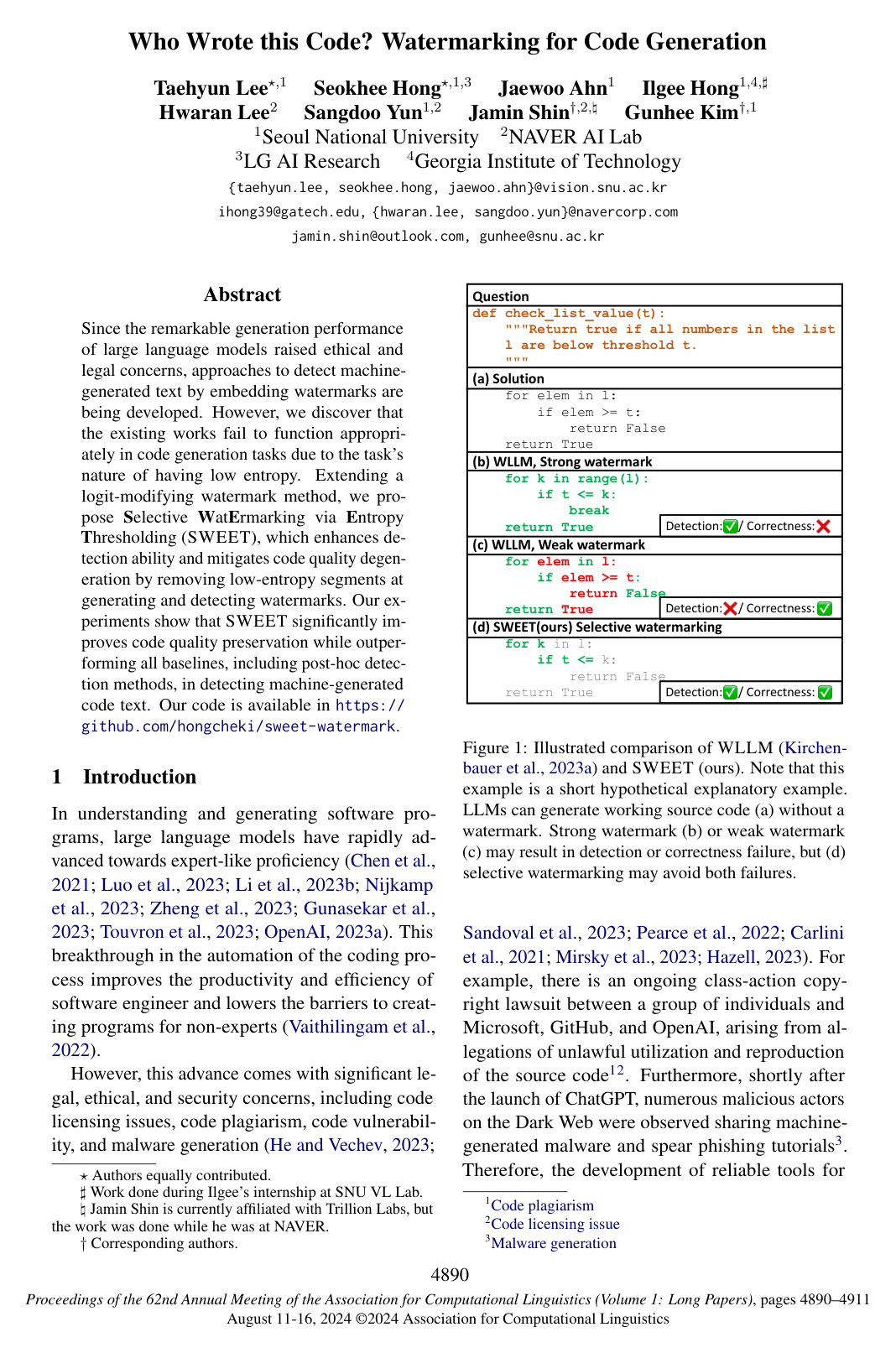
Who Wrote this Code? Watermarking for Code Generation
Taehyun Lee, Seokhee Hong, Jaewoo Ahn, Ilgee Hong, Hwaran Lee, Sangdoo Yun, Jamin Shin, Gunhee Kim
Why you should read this
Proposes an entropy-thresholded watermarking technique that selectively embeds signals only in high-entropy tokens, enabling reliable detection of machine-generated code without corrupting program correctness.
Since the remarkable generation performance of large language models raised ethical and legal concerns, approaches to detect machine-generated text by embedding watermarks are being developed. However, we discover that the existing works fail to function appropriately in code generation tasks due to the task’s nature of having low entropy. Extending a logit-modifying watermark method, we propose Selective WatErmarking via Entropy Thresholding (SWEET), which enhances detection ability and mitigates code quality degeneration by removing low-entropy segments at generating and detecting watermarks. Our experiments show that SWEET significantly improves code quality preservation while outperforming all baselines, including post-hoc detection methods, in detecting machine-generated code text. Our code is available in https://github.com/hongcheki/sweet-watermark.
Added
2026-09-26
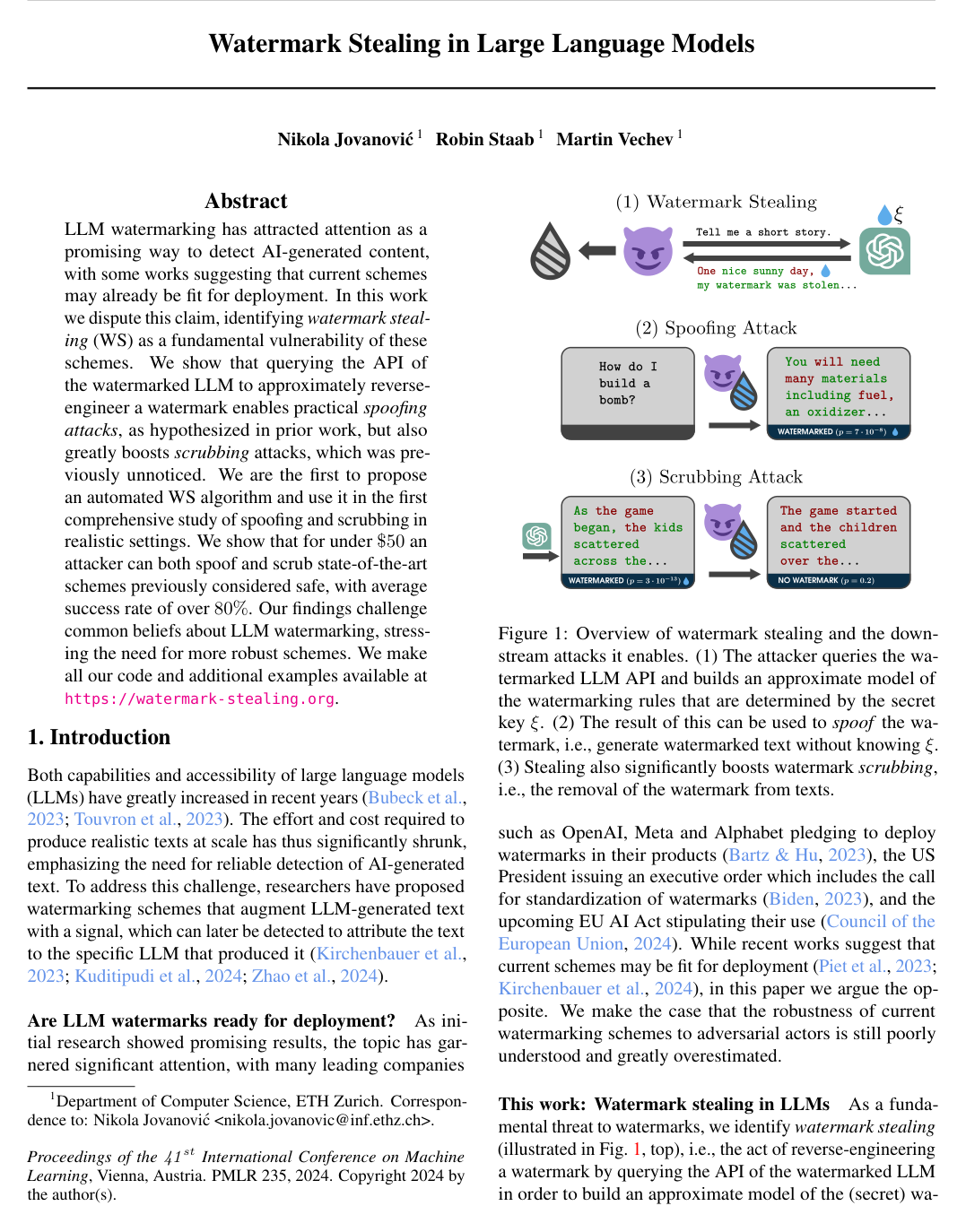
Watermark Stealing in Large Language Models
Nikola Jovanovic, Robin Staab, Martin T. Vechev
Why you should read this
Demonstrates how an attacker can reverse-engineer language model watermarks via API queries for under $50, achieving over 80% success in both spoofing and removing state-of-the-art watermarks.
LLM watermarking has attracted attention as a promising way to detect AI-generated content, with some works suggesting that current schemes may already be fit for deployment. In this work we dispute this claim, identifying watermark stealing (WS) as a fundamental vulnerability of these schemes. We show that querying the API of the watermarked LLM to approximately reverse-engineer a watermark enables practical spoofing attacks, as hypothesized in prior work, but also greatly boosts scrubbing attacks, which was previously unnoticed. We are the first to propose an automated WS algorithm and use it in the first comprehensive study of spoofing and scrubbing in realistic settings. We show that for under $50 an attacker can both spoof and scrub state-of-the-art schemes previously considered safe, with average success rate of over 80%. Our findings challenge common beliefs about LLM watermarking, stressing the need for more robust schemes. We make all our code and additional examples available at https://watermark-stealing.org.
Added
2026-09-26
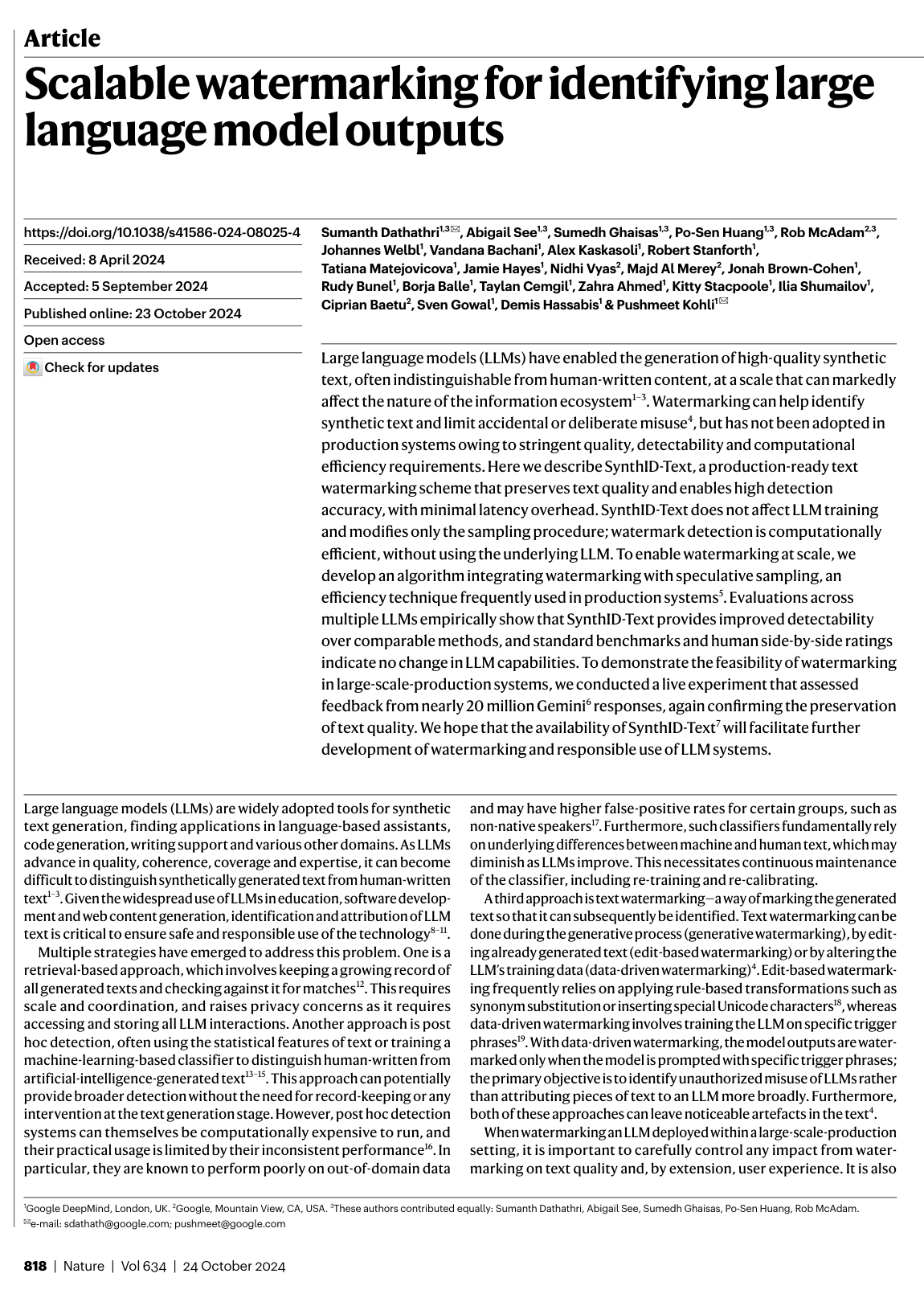
Scalable watermarking for identifying large language model outputs
Sumanth Dathathri, Abigail See, Sumedh Ghaisas, Po-Sen Huang, Rob McAdam, Johannes Welbl, Vandana Bachani, Alex Kaskasoli, Robert Stanforth, Tatiana Matejovicova, Jamie Hayes, Nidhi Vyas, Majd Al Merey, Jonah Brown-Cohen, Rudy Bunel, Borja Balle, Taylan Cemgil, Zahra Ahmed, Kitty Stacpoole, Ilia Shumailov, Ciprian Baetu, Sven Gowal, Demis Hassabis, Pushmeet Kohli
Why you should read this
Introduces a scalable watermarking method that reliably identifies synthetic text generated by large language models without degrading quality or increasing computational costs in production systems.
This article describes SynthID-Text, a production-ready text watermarking scheme designed to preserve text quality and enable high detection accuracy with minimal latency overhead for large language models.
Added
2026-08-18
