
Scalable watermarking for identifying large language model outputs
Sumanth Dathathri$^{1,3\dagger\star}$, Abigail See$^{1,3\dagger}$, Sumedh Ghaisas$^{1,3\dagger}$, Po-Sen Huang$^{1,3\dagger}$, Rob McAdam$^{2,3\dagger}$, Johannes Welbl$^1$, Vandana Bachani$^1$, Alex Kaskasoli$^1$, Robert Stanforth$^1$, Tatiana Matejovicova$^1$, Jamie Hayes$^1$, Nidhi Vyas$^2$, Majd Al Merey$^2$, Jonah Brown-Cohen$^1$, Rudy Bunel$^1$, Borja Balle$^1$, Taylan Cemgil$^1$, Zahra Ahmed$^1$, Kitty Stacpoole$^1$, Ilia Shumailov$^1$, Ciprian Baetu$^2$, Sven Gowal$^1$, Demis Hassabis$^1$ & Pushmeet Kohli$^{1\star}$
$^1$Google DeepMind, London, UK.
$^2$Google, Mountain View, CA, USA.
$^3$These authors contributed equally: Sumanth Dathathri, Abigail See, Sumedh Ghaisas, Po-Sen Huang, Rob McAdam.
$^\star$e-mail: [email protected]; [email protected]
Abstract
Large language models (LLMs) have enabled the generation of high-quality synthetic text, often indistinguishable from human-written content, at a scale that can markedly affect the nature of the information ecosystem$^{1-3}$. Watermarking can help identify synthetic text and limit accidental or deliberate misuse$^4$, but has not been adopted in production systems owing to stringent quality, detectability and computational efficiency requirements. Here we describe SynthID-Text, a production-ready text watermarking scheme that preserves text quality and enables high detection accuracy, with minimal latency overhead. SynthID-Text does not affect LLM training and modifies only the sampling procedure; watermark detection is computationally efficient, without using the underlying LLM. To enable watermarking at scale, we develop an algorithm integrating watermarking with speculative sampling, an efficiency technique frequently used in production systems$^5$. Evaluations across multiple LLMs empirically show that SynthID-Text provides improved detectability over comparable methods, and standard benchmarks and human side-by-side ratings indicate no change in LLM capabilities. To demonstrate the feasibility of watermarking in large-scale-production systems, we conducted a live experiment that assessed feedback from nearly 20 million Gemini$^6$ responses, again confirming the preservation of text quality. We hope that the availability of SynthID-Text$^7$ will facilitate further development of watermarking and responsible use of LLM systems.
Executive Summary: Large language models now produce text that is often indistinguishable from human writing, raising concerns about misuse in education, content creation, and information ecosystems. Identification of synthetic text is therefore essential for accountability and responsible deployment, yet existing detection methods either require heavy computation, suffer from inconsistent accuracy, or degrade output quality.
This document introduces and evaluates SynthID-Text, a generative watermarking scheme designed for production use. The work set out to create a method that embeds a detectable statistical signature during text generation while preserving quality, achieving high detection rates, and adding negligible computational cost.
The authors developed Tournament sampling, a new algorithm that selects tokens through layered comparisons against random watermark scores. They combined it with speculative sampling for efficiency and tested both non-distortionary and distortionary configurations. Evaluations covered multiple models including Gemma and Mistral, using thousands of prompts from the ELI5 dataset, standard benchmarks, perplexity metrics, and controlled human ratings. A live experiment collected user feedback on nearly 20 million Gemini responses, and results were compared against the strongest existing watermarking baselines.
Non-distortionary SynthID-Text produced no measurable drop in quality: thumbs-up and thumbs-down rates in the large-scale Gemini trial differed by less than 0.02 percent from the unwatermarked system, and smaller human preference tests plus automated benchmarks confirmed the same result. Detectability exceeded that of comparable methods across text lengths and entropy levels, while retaining more response diversity. Latency overhead remained under 0.6 percent even on production hardware, and the scheme integrated cleanly with speculative sampling without sacrificing speed.
These outcomes matter because they demonstrate that watermarking can be deployed at the scale of millions of daily users without harming experience or requiring model retraining. The approach therefore supports practical identification of AI-generated content in real services and reduces reliance on less reliable post-hoc detectors.
Production systems should adopt non-distortionary SynthID-Text where quality preservation is paramount, and consider the distortionary variant only when stronger detection is required. Further work is needed to improve robustness against paraphrasing and adversarial attacks, to handle open-source models, and to combine watermarking with complementary detection techniques. Results are robust for the tested models and settings, yet performance can vary with output entropy and text length, so organizations should validate the method on their specific workloads before broad rollout.
1. Introduction
Section Summary: Large language models now produce text that is often difficult to distinguish from human writing, raising concerns about responsible use in education, software, and web content. Existing detection strategies such as record-keeping, statistical classifiers, or post-generation edits have drawbacks including high cost, inconsistent accuracy, privacy risks, or visible artifacts. This paper presents SynthID-Text, a generative watermarking approach that subtly alters the model’s token sampling process to embed a detectable signature while preserving output quality and computational efficiency, and demonstrates its successful deployment at scale in Gemini.
Large language models (LLMs) are widely adopted tools for synthetic text generation, finding applications in language-based assistants, code generation, writing support and various other domains. As LLMs advance in quality, coherence, coverage and expertise, it can become difficult to distinguish synthetically generated text from human-written text$^{1-3}$. Given the widespread use of LLMs in education, software development and web content generation, identification and attribution of LLM text is critical to ensure safe and responsible use of the technology$^{8-11}$.
Multiple strategies have emerged to address this problem. One is a retrieval-based approach, which involves keeping a growing record of all generated texts and checking against it for matches$^{12}$. This requires scale and coordination, and raises privacy concerns as it requires accessing and storing all LLM interactions. Another approach is post hoc detection, often using the statistical features of text or training a machine-learning-based classifier to distinguish human-written from artificial-intelligence-generated text$^{13-15}$. This approach can potentially provide broader detection without the need for record-keeping or any intervention at the text generation stage. However, post hoc detection systems can themselves be computationally expensive to run, and their practical usage is limited by their inconsistent performance$^{16}$. In particular, they are known to perform poorly on out-of-domain data and may have higher false-positive rates for certain groups, such as non-native speakers$^{17}$. Furthermore, such classifiers fundamentally rely on underlying differences between machine and human text, which may diminish as LLMs improve. This necessitates continuous maintenance of the classifier, including re-training and re-calibrating.
A third approach is text watermarking—a way of marking the generated text so that it can subsequently be identified. Text watermarking can be done during the generative process (generative watermarking), by editing already generated text (edit-based watermarking) or by altering the LLM’s training data (data-driven watermarking)$^4$. Edit-based watermarking frequently relies on applying rule-based transformations such as synonym substitution or inserting special Unicode characters$^{18}$, whereas data-driven watermarking involves training the LLM on specific trigger phrases$^{19}$. With data-driven watermarking, the model outputs are watermarked only when the model is prompted with specific trigger phrases; the primary objective is to identify unauthorized misuse of LLMs rather than attributing pieces of text to an LLM more broadly. Furthermore, both of these approaches can leave noticeable artefacts in the text$^4$.
When watermarking an LLM deployed within a large-scale-production setting, it is important to carefully control any impact from watermarking on text quality and, by extension, user experience. It is also important that we are able to watermark with minimal computational costs. To meet both of these criteria, this work focuses on generative watermarking, which allows us to embed watermarks while carefully controlling the impact on quality and maintaining low computational cost. However, we note that no text detection method is foolproof, and many of the approaches discussed in this section are complementary and can be used in conjunction$^4$.
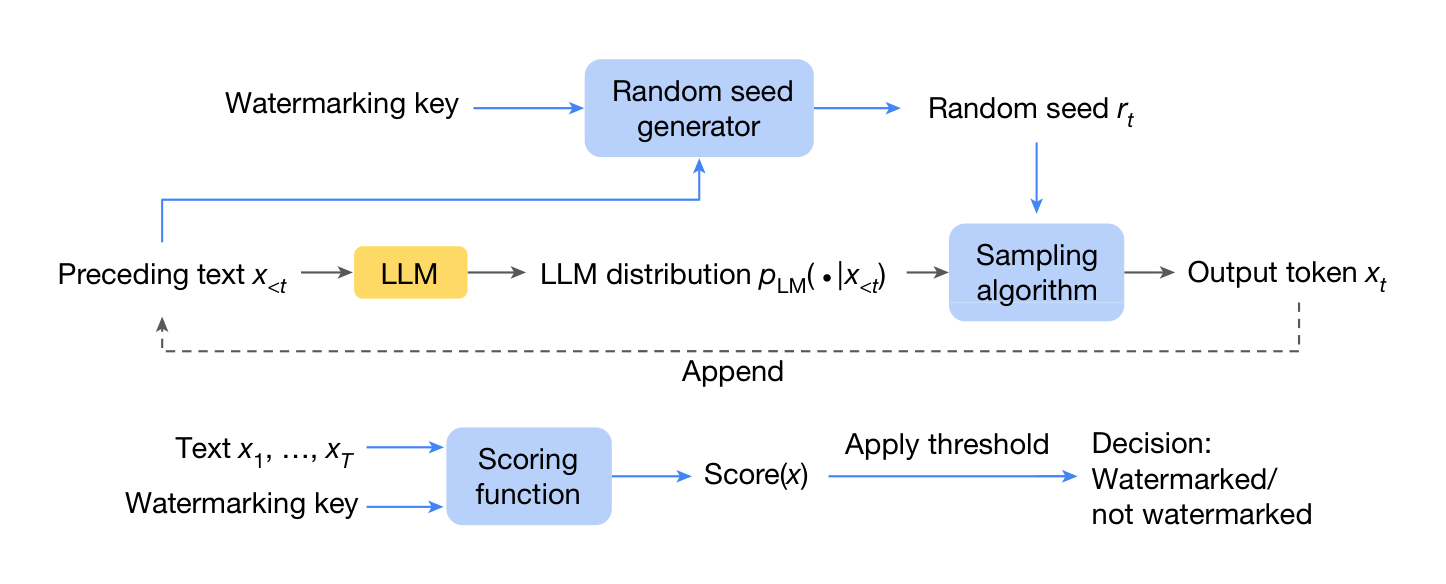
Generating text with an LLM is often autoregressive: the LLM assigns probabilities to the elements (tokens) of the vocabulary and then selects the next token by sampling according to these probabilities conditional on text generated so far (Fig. 1, top). Generative watermarking (Fig. 1, bottom) works by carefully modifying the next-token sampling procedure to inject subtle, context-specific modifications into the generated text distribution. Such modifications introduce a statistical signature into the generated text; during the watermark detection phase, the signature can be measured to determine whether the text was indeed generated by the watermarked LLM. A key benefit of the approach is that the detection process does not require performing computationally expensive operations or even access to the underlying LLM (which is often proprietary).
In this work, we propose a generative watermarking scheme, SynthID-Text, which builds on previous generative watermarking components, but uses a novel sampling algorithm, Tournament sampling. SynthID-Text can be configured to be non-distortionary (preserving text quality) or distortionary (improving watermark detectability at the cost of text quality). We show that in both settings, SynthID-Text provides improved detection rates, compared with the best existing approaches in each category. We show empirically that non-distortionary SynthID-Text preserves text quality, including through a large-scale user feedback assessment over nearly 20 million responses from live Gemini interactions. Consequently, SynthID-Text has been used to watermark Gemini and Gemini Advanced$^{20}$. This serves as practical proof that generative text watermarking can be successfully implemented and scaled to real-world production systems, serving millions of users and playing an integral role in the identification and management of artificial-intelligence-generated content.
Furthermore, we provide an algorithm to combine generative watermarking with speculative sampling$^5$—a frequently used technique to increase LLM text generation speed—allowing for the integration of SynthID-Text into large-scale production systems with negligible additional computational overhead.
2. Watermarking with SynthID-Text
Section Summary: SynthID-Text embeds a detectable watermark into text from large language models by combining a random seed (drawn from recent tokens and a secret key) with a new sampling method called Tournament sampling. This method runs multiple random scoring functions over candidate tokens and uses a bracket-style tournament to pick the next word, favoring those that score well under the functions while still drawing from the model’s normal probability distribution. The resulting text carries subtle statistical patterns that a scoring function can later measure against a threshold to confirm it originated from the watermarked model, with stronger evidence appearing in longer passages that had more varied word choices during generation.
LLMs generate text based on preceding context (for example, a response to a provided prompt). More precisely, given a sequence of input text $x_{<t} = x_1, \dots, x_{t-1}$ consisting of $t - 1$ tokens from a vocabulary $V$, the LLM computes the probability distribution $p_{\text{LM}}(\cdot \mid x_{<t})$ of the next token $x_t$ given the preceding text $x_{<t}$. To generate the full response, $x_t$ is sampled from $p_{\text{LM}}(\cdot \mid x_{<t})$, and the process repeats until either a maximum length is reached or an end-token is generated. The process is illustrated in Fig. 1 (top).
A generative watermarking scheme typically comprises three components: a random seed generator, a sampling algorithm and a scoring function$^{21}$. As shown in Fig. 1 (bottom), the random seed generator provides a random seed $r_t$ on each generation step $t$ (potentially based on the preceding text along with the watermarking key), and the sampling algorithm uses $r_t$ to sample the next token $x_t$ from $p_{\text{LM}}(\cdot \mid x_{<t})$. Importantly, the sampling algorithm introduces correlations between $r_t$ and $x_t$; during watermark detection, these correlations are measured by the scoring function. Given a piece of text and the watermarking key, the scoring function provides a score that quantifies the strength of the correlation (that is, the watermarking evidence); this can be compared with a threshold to determine whether the text originates from the watermarked LLM.
In this work, we present the sampling algorithm Tournament sampling, which is described in the following section. For the random seed generator, in our experiments we use the existing sliding-window method$^{22,23}$, where the random seed is a hash of the most recent $H$ tokens ($x_{t-H}, \dots, x_{t-1}$; we use $H = 4$) along with the watermarking key (Fig. 2, top); but we note that Tournament sampling can be paired with any random seed generator. We experiment with several scoring functions, some of which are from existing work and others are from this work; we discuss them in the following sections. Together, our generative watermarking scheme is called SynthID-Text.
2.1. SynthID-Text’s Tournament sampling approach
The key idea of Tournament sampling is to use a tournament-like process to choose an output token that scores highly with respect to some random watermarking functions. An illustration is given in Fig. 2 (top). First, we take the random seed $r_t$ provided by the random seed generator. This seed is passed to $m$ (in this case, $m = 3$) watermarking functions $g_1, g_2, g_3, \dots, g_m$—these are independent pseudorandom number functions that assign a score $g_\ell(x_t, r_t)$ (in this case, a 0 or 1) to any candidate token $x_t \in V$.
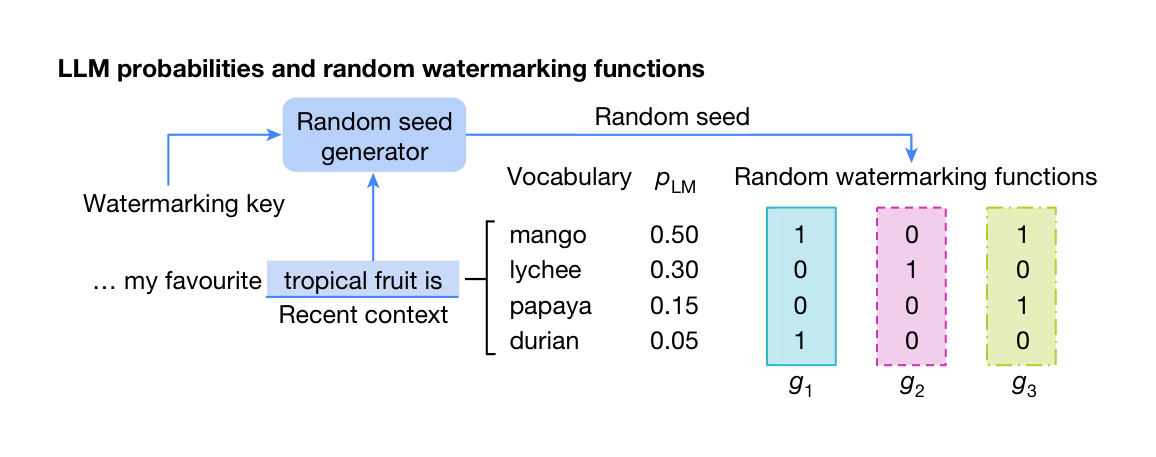
In the second stage (Fig. 2, bottom), we start by sampling $M = 2^m$ candidate tokens from the LLM distribution $p_{\text{LM}}(\cdot \mid x_{<t})$ (some tokens may appear multiple times): these are the initial participants of the $m$-layer tournament. We randomly divide these candidates into $M/2$ pairs, and, in the first tournament layer, in each pair the token with the higher score under $g_1(\cdot, r_t)$ is selected, and the other discarded (any ties are broken randomly). The remaining $M/2$ tokens are regrouped randomly into $M/4$ pairs, and the function $g_2(\cdot, r_t)$ determines the winners for this second tournament layer. This iterative process continues until one token emerges as the final winner, which becomes the output token $x_t$. A formal description of Tournament sampling is given in Algorithm 2 in Methods.
2.2. Watermark detection
By design, Tournament sampling selects a token from the LLM distribution that is likely to score higher under the random watermarking functions $g_1(\cdot, r_t), \dots, g_m(\cdot, r_t)$. To detect whether a piece of text $x = x_1, \dots, x_T$ is watermarked, we measure how highly $x$ scores with respect to these functions. Specifically, we compute the mean $g$-values of the text:
$ \text{Score}(x) = \frac{1}{mT} \sum_{t=1}^T \sum_{\ell=1}^m g_\ell(x_t, r_t).\tag{1} $
Given the selection of tokens $x_t$ based on higher $g$-values, we expect watermarked text generally to score higher under this score than unwatermarked text.
There are two primary factors that affect the detection performance of the scoring function. The first is the length of the text $x$: longer texts contain more watermarking evidence, and so we have more statistical certainty when making a decision. The second is the amount of entropy in the LLM distribution when it generates the watermarked text $x$. For example, if the LLM distribution is very low entropy, meaning it almost always returns the exact same response to the given prompt, then Tournament sampling cannot choose tokens that score more highly under the $g$ functions. In short, like other generative watermarks$^{21}$, Tournament sampling performs better when there is more entropy in the LLM distribution, and is less effective when there is less entropy. In Supplementary Information section H, we provide a theoretical analysis describing the watermarking strength of a layer of Tournament sampling as a function of a certain kind of entropy; similar analyses have been done for other generative watermarks$^{23-25}$. The entropy of the LLM distribution itself depends on several factors, including the model—for example, larger or more advanced models tend to be more certain and thus lower entropy$^{21}$, and reinforcement learning from human feedback can reduce entropy (also known as ‘mode collapse’)$^{26}$. Other factors that affect LLM distribution entropy include the prompts, the temperature and other decoding settings such as top-$k$ and top-$p$ sampling settings (see ‘The LLM distribution’ in Methods).
Increasing the number of tournament layers $m$ provides additional watermarking evidence per token, and decreases the variance of the score in equation (1). This allows SynthID-Text to provide better detectability than other methods (see ‘Evaluation’). However, detectability does not increase indefinitely with the number of layers. Each layer of the tournament uses some of the available entropy to embed a watermark, and the strength of the watermark corresponding to a layer diminishes deeper into the tournament. For our experiments, we generally use $m = 30$ layers unless otherwise stated; see Supplementary Information section C.1 for full details.
Finally, we note that there are other scoring functions beyond equation (1); in Supplementary Information section A, we describe several others, and find that some can improve detection performance.
2.3. Preserving the quality of generative text
As previously mentioned, a watermarking scheme can be non-distortionary, a property relating to quality preservation; however, the phrase and its variants have been used in the literature to mean several distinct definitions$^{24,25,27}$, causing some confusion. In this work, we resolve the confusion by providing clear definitions of non-distortion, from weakest to strongest. The weakest version is single-token non-distortion, which says that, on average over the random seed $r_t$, the distribution of the output token $x_t$ generated by the watermarking sampling algorithm is equal to the original LLM distribution $p_{\text{LM}}(\cdot \mid x_{<t})$ (Fig. 1). Stronger versions of non-distortion expand this definition to one or more sequences of text, ensuring that on average the probability of the watermarking scheme generating a particular text or sequence of texts is the same as for the original LLM. Full definitions are provided in Supplementary Information section G.
In Supplementary Information section G.1, we show that when Tournament sampling is configured with exactly two ‘competitors’ for each match in the tournament (as in the example in Fig. 2), then Tournament sampling is single-token non-distortionary. Furthermore, in Supplementary Information section G.2, we show that by applying repeated context masking$^{27}$, we can make the scheme non-distortionary for one or more sequences. Choosing the level of non-distortion involves a trade-off; weaker levels of non-distortion can reduce text quality and diversity, whereas stronger levels of non-distortion can reduce detectability and increase computational complexity (Supplementary Information section G.3). For our experiments, we configure SynthID-Text to be single-sequence non-distortionary; this preserves text quality and provides good detectability, while having some reduction to inter-response diversity. We call this configuration ‘non-distortionary SynthID-Text’ (and where not otherwise specified, ‘SynthID-Text’ also refers to this).
Alternatively, for instances where strong watermark detectability is critical, SynthID-Text can take a distortionary configuration that provides higher detectability, at the cost of some quality loss. In this configuration of Tournament sampling, there are more than two competitors in each match of the tournament (a formal definition is given in Algorithm 2 in Methods). We show that in this case, Tournament sampling is distortionary at the token level (Supplementary Information section G.1); however, it applies a stronger watermark (Supplementary Information section H.3). We call this configuration ‘distortionary SynthID-Text’.
In ‘Evaluation’, we compare non-distortionary and distortionary SynthID-Text to the best existing methods in each category and show that SynthID-Text provides better detectability in both categories.
2.4. Ensuring computational scalability
Generative watermarking schemes (Fig. 1, bottom) are typically computationally inexpensive as the text generation process involves a modification to only the sampling layer, which is often negligible in the context of the LLM’s forward pass. For Tournament sampling, in some cases, it is more efficient to use a vectorized implementation, which we describe in Supplementary Information section E. We provide a theoretical complexity analysis of both implementations, and existing baselines in Supplementary Information section F. Overall, we show empirically in ‘Evaluation’ that, in practice, SynthID-Text induces negligible additional latency.
In large-scale productionized systems, the text generation process is often more complex than the simple loop depicted in Fig. 1 (top). For example, productionized systems often use speculative sampling$^5$, a method to accelerate text generation from large models. Speculative sampling works by having a smaller draft model propose the next few tokens; these are then checked against the large target model, which either accepts or rejects the proposed tokens. Combining generative watermarking with speculative sampling is an important step to make watermarking practically useful to production systems; however, to our knowledge, it has not yet been investigated.
To make progress in this area, we propose two generative watermarking with speculative sampling algorithms, which can combine a generative watermarking scheme with speculative sampling (Supplementary Information section I). First, we propose high-detectability watermarked speculative sampling, which preserves the detectability of the watermark, but may decrease the efficiency (and thus increase the overall latency) of speculative sampling (Supplementary Information section I.4). Alternatively, we propose fast watermarked speculative sampling, which (provided the watermark is single-token non-distortionary) preserves the efficiency of speculative sampling, but may decrease the detectability of the watermark (Supplementary Information section I.5). For this approach, we also propose a learned Bayesian scoring function that improves the detectability of this method (Supplementary Information section I.5.2). Fast watermarked speculative sampling is most helpful when speed is important in production environments.
3. Evaluation
Section Summary: SynthID-Text was tested against leading alternative watermarking methods and showed stronger detection rates while maintaining text quality and output variety. Large-scale trials with the Gemini system, involving roughly 20 million real user interactions, found no meaningful difference in human ratings of watermarked versus unwatermarked responses, and smaller controlled studies plus automated checks confirmed the same result. The approach adds almost no computational cost and has already been rolled out in production for Gemini and Gemini Advanced.
We compare SynthID-Text to, at the time of writing, the best-performing non-distortionary and distortionary generative text watermarking schemes and show empirically that SynthID-Text provides superior detectability in both categories. In the non-distortionary category, we compare against Gumbel sampling$^{22,24}$, and in the distortionary category, we compare against the Soft Red List sampling algorithm$^{23}$; see Supplementary Information section B.1 for a full description and discussion of how we chose our baselines. To create a like-for-like comparison, we focus on comparing our sampling algorithm, Tournament sampling, against the Gumbel and Soft Red List sampling algorithms while keeping the other parts of the watermarking scheme the same (Fig. 1). Accordingly, for all baselines we use the same sliding-window random seed generator, and the same repeated context masking methodology as described in ‘Watermarking with SynthID-Text’—this means that (like non-distortionary SynthID-Text) the Gumbel baseline is single-sequence non-distortionary and preserves text quality. Furthermore, we note that the hashing and scoring schemes from refs. 24,25 can be directly adapted with SynthID-Text, and a detailed comparison of the benefits and drawbacks of various hashing and scoring procedures (for example, the edit-distance based scoring as in ref. 24) is beyond the scope of this work.
In the remainder of this section, we empirically demonstrate that SynthID-Text, like some other generative watermarks, has several key desirable properties (quality and scalability) that enable its deployment in large-scale production, while also offering additional desirable properties such as improved detectability and diversity of the generated text. First, we show that (like other non-distortionary watermarks) non-distortionary SynthID-Text preserves response quality; our evaluations include the first large-scale human evaluation in a productionized system. Then, across multiple models, we show that SynthID-Text provides improved detection performance while also preserving a greater amount of the underlying diversity within the LLM responses. We also show that SynthID-Text, similar to other generative watermarking schemes, has negligible computational impact in the context of a large-production LLM.
3.1. SynthID-Text preserves quality including in a large-scale-production system
To evaluate the production readiness of non-distortionary SynthID-Text, we ran a live experiment with the Gemini production system (previously known as Bard). A random fraction of queries were routed to a watermarked model and an equivalent number to the unwatermarked counterpart. The Gemini user interface allows users to provide feedback on model responses via a thumbs-up (good response) and a thumbs-down (bad response). We analysed approximately 20 million watermarked and unwatermarked responses and computed the thumbs-up and thumbs-down rates (both as a fraction of the total number of thumbs-up and thumbs-down feedback received). We found that the thumbs-up rate for the two models differed by 0.01% (with the watermarked model being higher); and the thumbs-down rate differed by 0.02% (with the watermarked model being lower). We found both of these differences to be statistically insignificant, and well within the 95% confidence intervals.
From this experiment, we conclude that over a wide variety of real chatbot interactions, the difference in response quality and utility, as judged by humans, is negligible. Subsequently, non-distortionary SynthID-Text has been productionized and is currently watermarking responses in Gemini and Gemini Advanced. To the best of our knowledge, this evaluation represents the first systematic watermarking investigation of its kind within a large-scale production system.
To provide a reproducible human evaluation, we also run a smaller-scale controlled human preference test, for which we also publish the collected data. In this experiment, we ask raters to compare watermarked versus unwatermarked Gemma 7B-IT responses to 3,000 ELI5 questions, assessing five aspects of response quality in a side-by-side comparison. For all five aspects—grammaticality/coherence, relevance, correctness, helpfulness and overall quality—we find no significant difference in rater preference (Extended Data Table 1). This holds both in a three-way analysis that includes tie ratings and conducts a trinomial test, as well as when restricting the analysis to the non-tie responses, using bootstrap resampling over the watermarked versus unwatermarked preference ratio (full details in Supplementary Information section C.4).
To further validate the quality-neutral property of non-distortionary SynthID-Text, we conduct additional automatic evaluations across different models and metrics. We find no significant difference between non-distortionary SynthID-Text and the equivalent unwatermarked model in terms of perplexity or performance on automated benchmarks. Full details are provided in Supplementary Information section C.5.
To summarize: human quality feedback, both from a large-scale live experiment and a small-scale controlled study, perplexity statistics and standard model capability benchmarks all indicate that non-distortionary SynthID-Text causes no loss in text quality.
3.2. SynthID-Text provides better detectability than existing watermarks
We evaluate watermark detectability empirically across several publicly available models, including the instruction-tuned (IT) variants of Gemma 2B and Gemma 7B$^{28}$, and the Mistral 7B-IT$^{29}$ model (see ‘LLMs and LLM configurations’ in Methods for details). We prompt the models with questions from the ELI5 dataset$^{30}$ (see ‘Data’ in Methods).
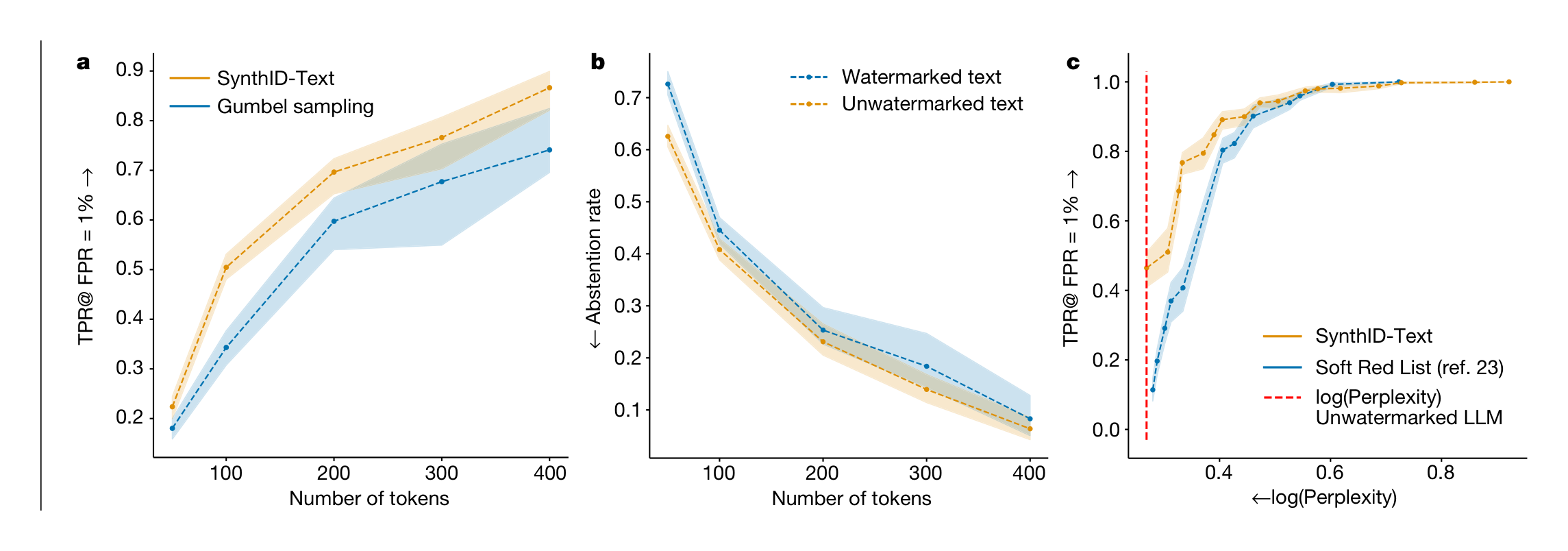
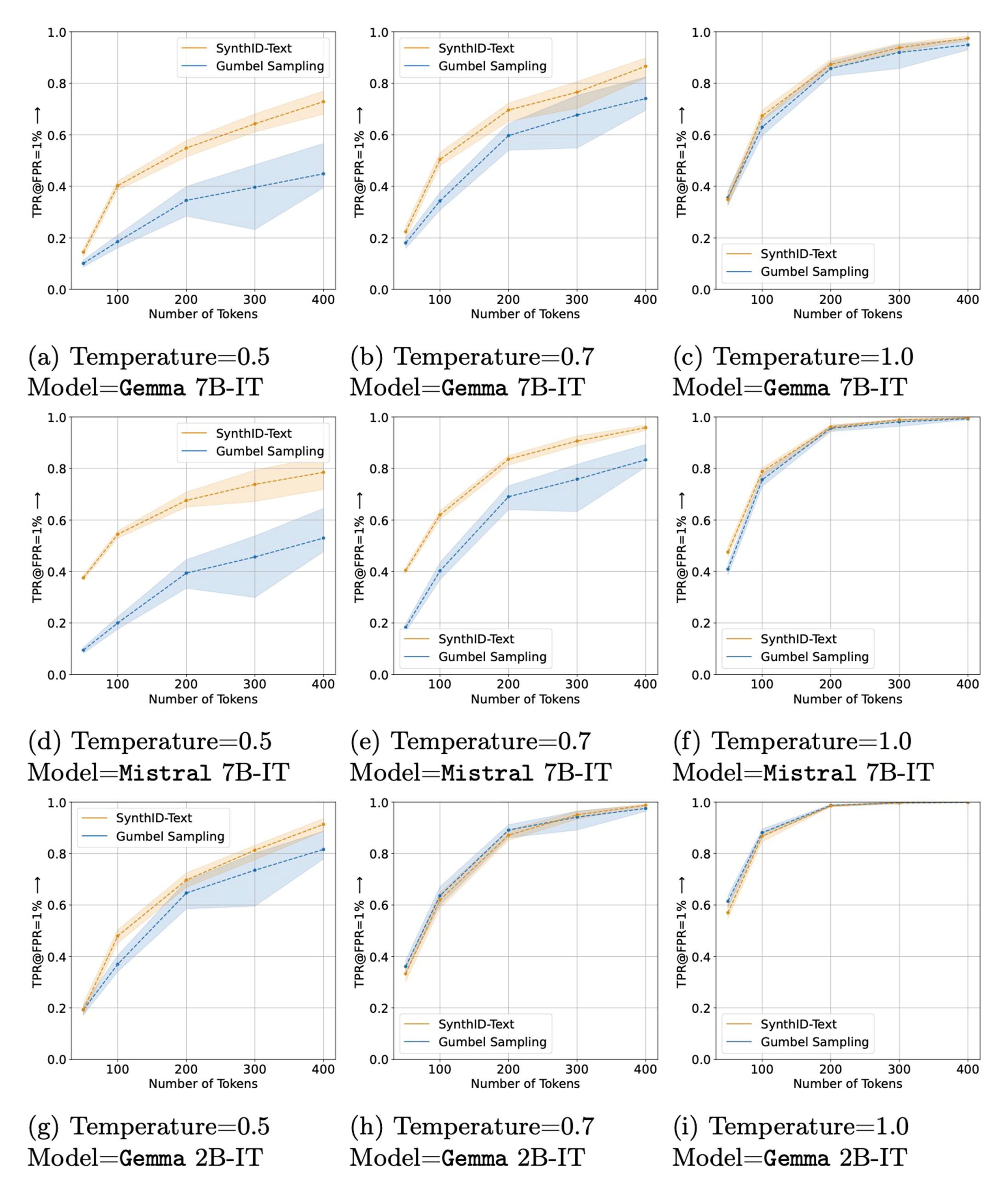
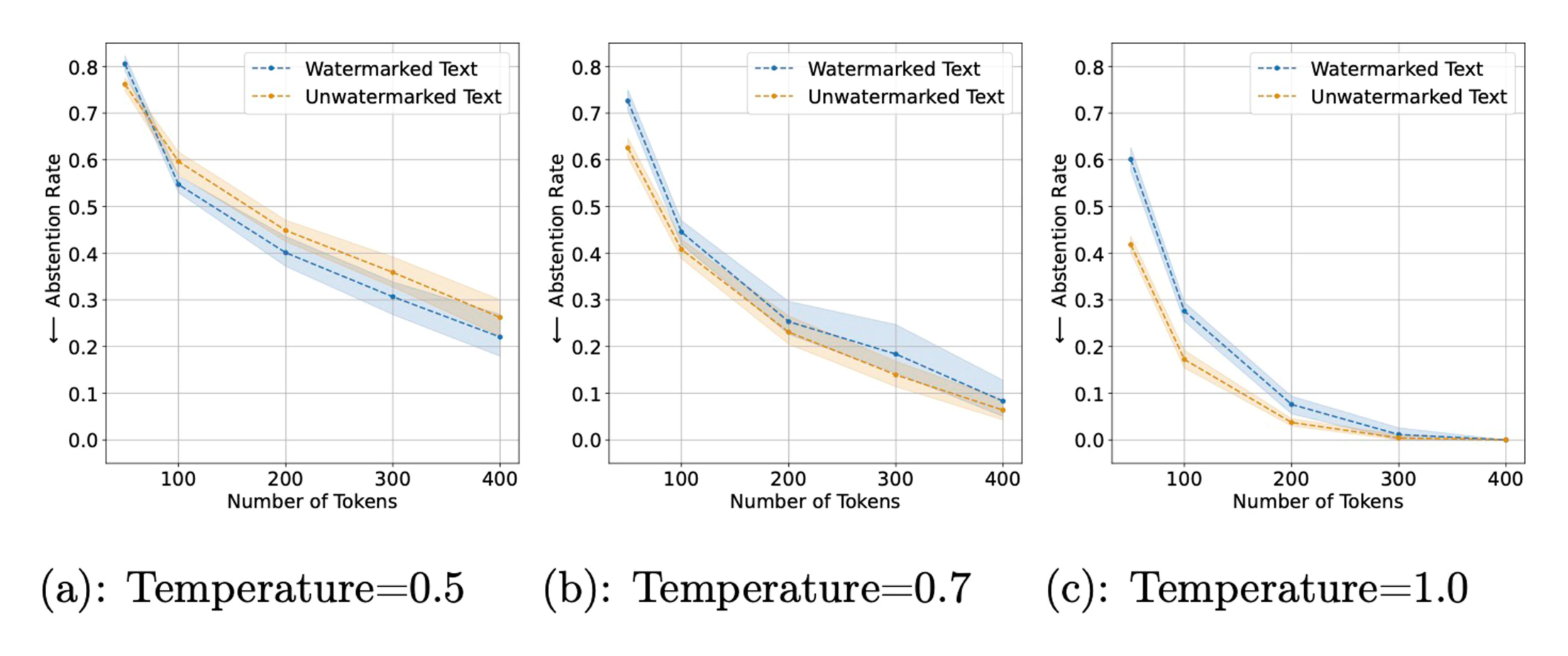
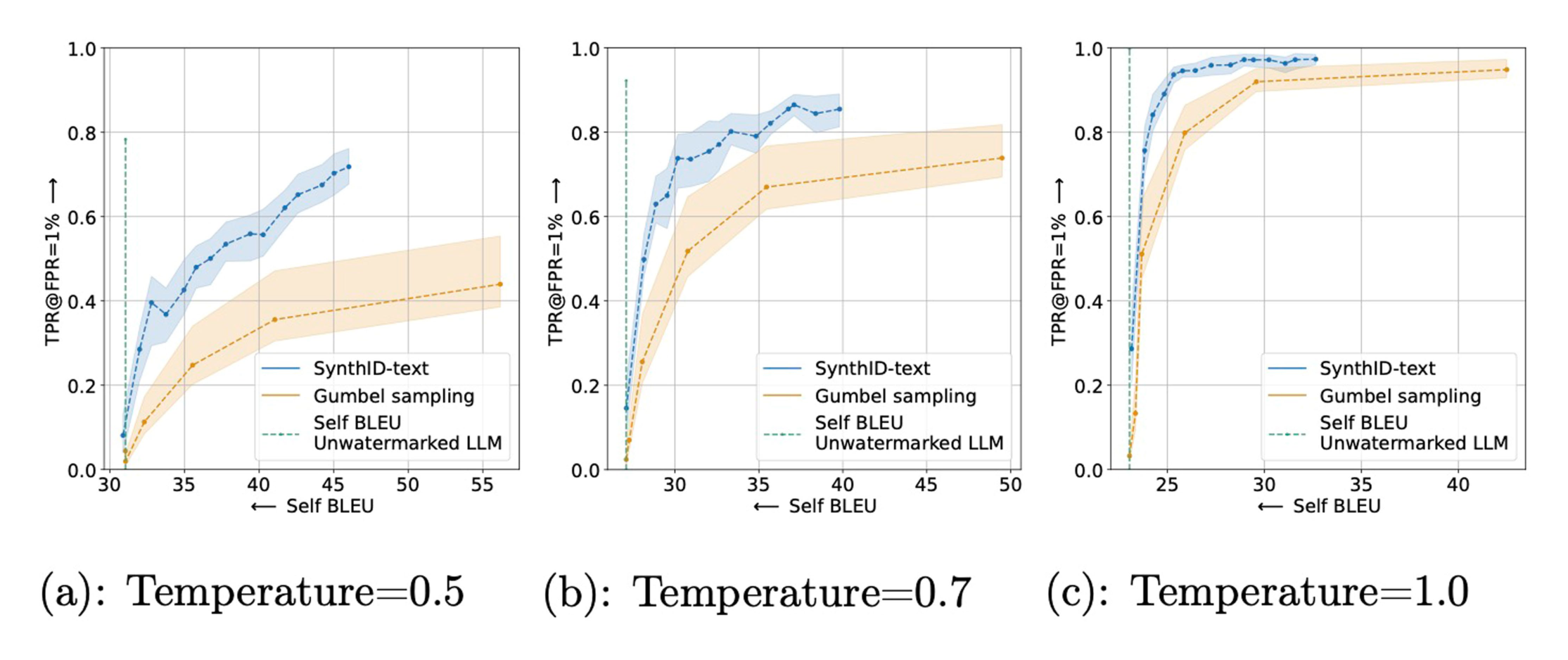
In the non-distortionary category, Fig. 3a shows that non-distortionary SynthID-Text provides better detectability than Gumbel sampling, for the same length text. We find that the SynthID-Text’s improvement over Gumbel sampling is greater in lower-entropy settings (for example, lower temperatures); when the entropy is higher, the detectability of the two methods is more comparable (Extended Data Fig. 1). In Extended Data Fig. 4, we also show that although both non-distortionary SynthID-Text and the Gumbel sampling baseline reduce inter-response diversity, SynthID-Text provides a better diversity/detectability trade-off than Gumbel sampling. In scenarios where low error rates are desirable, we can use a selective prediction mechanism (Supplementary Information section C.8) to abstain on samples for which the scoring function is uncertain, thus achieving the desired error rates on the remaining data (Fig. 3b).
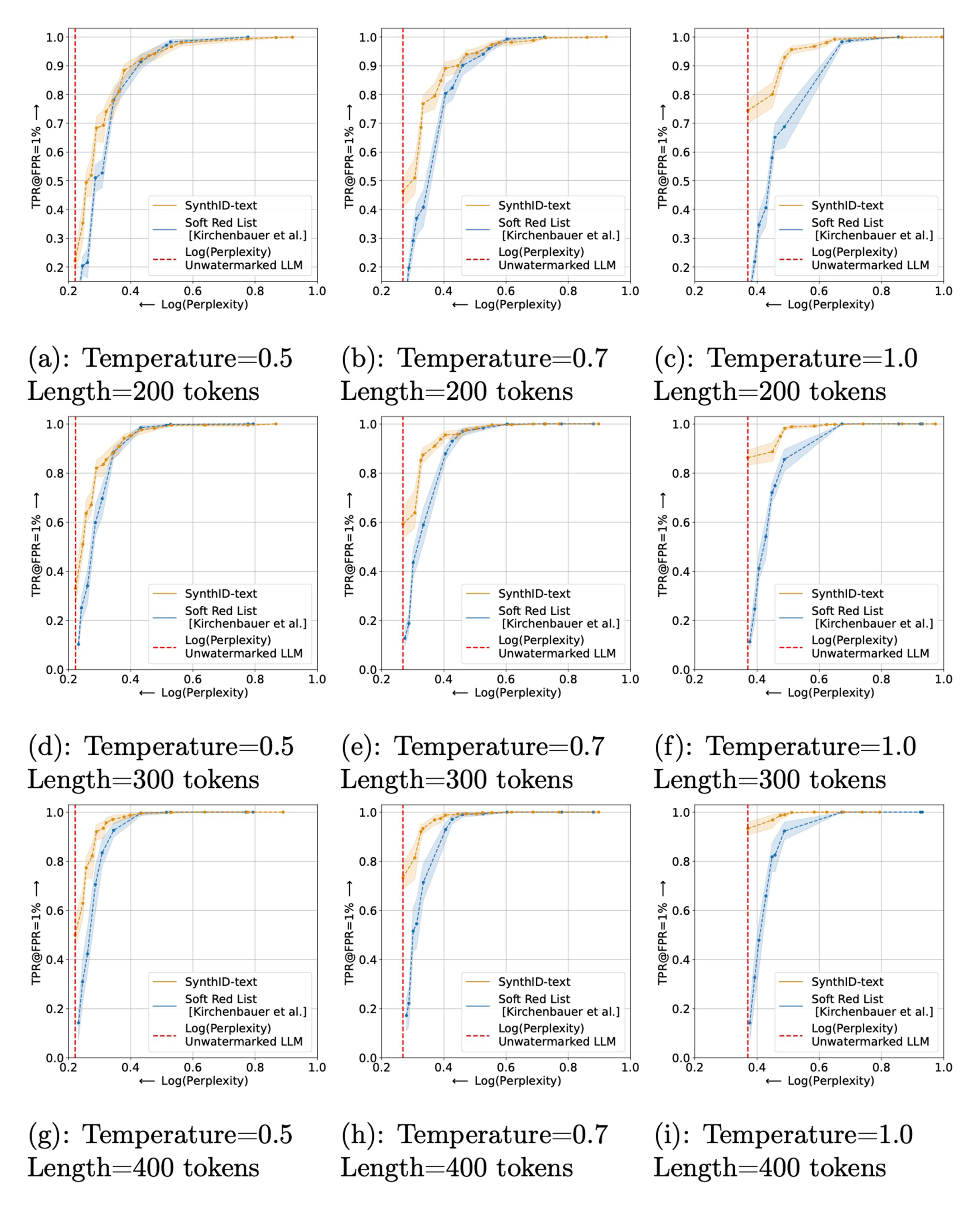
In the distortionary category, we compare the trade-off of detectability and text quality for distortionary SynthID-Text and Soft Red List. Both methods have a strength parameter that controls this trade-off; in Fig. 3c, we see that the trade-off is more favourable for distortionary SynthID-Text.
3.3. SynthID-Text has minimal computational impact
As discussed in ‘Watermarking with SynthID-Text’ and Supplementary Information section F, Tournament sampling does in some cases have greater computational complexity than Gumbel or Soft Red List sampling, but these differences are minimal relative to the cost of generating text from an LLM. For example, the Gemma 7B-IT model served on 4 v5e tensor processing units$^{31}$ generates text at a rate of $15.527\text{ ms}$ per token; this increases to $15.615\text{ ms}$ per token with 30-layer Tournament sampling, a latency increase of only $0.57%$. In comparison, Gumbel sampling increases latency by $0.26%$ and Soft Red List by $0.28%$. Furthermore, the computational complexity of all three watermarks remains constant even as the LLM grows. Thus, as large production models can grow by orders of magnitude larger than Gemma 7B in terms of computational complexity, so too does the relative complexity of watermarking shrink by orders of magnitude.
As described in ‘Watermarking with SynthID-Text’, we propose an algorithm—fast watermarked speculative sampling—to integrate generative watermarking with speculative sampling and thus enable fast deployment of watermarked LLMs at scale. We evaluate our algorithm with non-distortionary SynthID-Text, using Gemma 7B-IT as the target model and Gemma 2B-IT as the smaller draft model that proposes three ‘lookahead’ tokens at a time. When paired with a non-distortionary watermark (Supplementary Information section I.3), fast watermarked speculative sampling is theoretically guaranteed to preserve the acceptance rate (that is, the average number of lookahead tokens accepted by the target model). We confirm this experimentally, finding that the acceptance rate (and thus overall latency) is very similar with and without watermarking (Supplementary Information section I.5.3). Although we ran our experiment with non-distortionary SynthID-Text, we expect the same result would hold for any non-distortionary generative watermark.
4. Discussion
Section Summary: SynthID-Text is a watermarking technique for large language model outputs that relies on tournament sampling to improve detectability while allowing customizable settings that preserve text quality, as shown through large-scale user testing and an efficient integration with speculative sampling for real-world deployment. It performs consistently across languages and complements other detection methods, but requires coordination among providers to work and is harder to enforce on decentralized open-source models. The approach also remains vulnerable to attacks like text edits or paraphrasing.
We have introduced SynthID-Text, a method for watermarking LLM text. SynthID-Text uses certain elements introduced in previous work$^{22,23,27}$, but differs in the use of the sampling algorithm, Tournament sampling, which we find provides superior detectability compared with existing methods. SynthID-Text comes with rigorous and customizable non-distortion properties that can be configured to guarantee text quality preservation; we confirm this empirically, including via real user feedback measured over approximately 20 million Gemini chatbot interactions. We have also proposed an algorithm to combine generative watermarking with speculative sampling, thus enabling the efficient deployment of generative watermarks in high-performance, large-scale-production LLMs.
4.1. Limitations
Generative watermarks such as SynthID-Text provide several advantages compared with other approaches. For example, in Supplementary Information section C.7, we show that SynthID-Text performs consistently across different languages. In comparison, a post hoc detector performs poorly on languages that its underlying machine-learning model was not trained on. However, generative watermarks such as SynthID-Text do not offer a complete solution to artificial-intelligence text detection; rather they are complementary to other approaches. In particular, generative watermarks require coordination between actors running the LLM text generation services to apply the watermark. To detect artificial-intelligence-generated text produced by other actors who do not to implement watermarking, other approaches are required, such as post hoc detection. Furthermore, the rise of open-source models presents a challenge, as enforcing watermarking on these models deployed in a decentralized manner is difficult. Another limitation of generative watermarks is their vulnerability to stealing, spoofing and scrubbing attacks, which is an area of ongoing research$^{32}$. In particular, generative watermarks are weakened by edits to the text, such as through LLM paraphrasing$^{33}$—although this usually does change the text significantly. We provide evaluations of SynthID-Text’s performance under edits and paraphrasing in Supplementary Information section C.6.
5. Conclusion
Section Summary: This research shows that watermarks for AI-generated text can work reliably in real products rather than just lab tests. The team has rolled out their SynthID-Text system inside Google's Gemini and Gemini Advanced chatbots, serving millions of users and becoming the first large-scale deployment of its kind. In doing so, the work marks a concrete step toward more accountable and responsible use of large language models.
Overall, our work provides proof of the real-world viability of generative text watermarks. SynthID-Text has been productionized in the user-facing Gemini and Gemini Advanced chatbots, which is, to our knowledge, the first deployment of a generative text watermark at scale, serving millions of users. As such, our work sets a practical milestone for accountable, transparent and responsible LLM deployment.
Online content
Section Summary: The provided section directs readers to an online location for a range of supporting materials tied to the article. These materials include detailed methods, extra references, data summaries, author contribution details, and statements on competing interests and data availability. All of them can be found together at the listed web address.
Any methods, additional references, Nature Portfolio reporting summaries, source data, extended data, supplementary information, acknowledgements, peer review information; details of author contributions and competing interests; and statements of data and code availability are available at https://doi.org/10.1038/s41586-024-08025-4.
References
Section Summary: This section lists three academic papers cited elsewhere in the document. One examines challenges in generating coherent text with neural networks, another introduces an early learning method for Boltzmann machines, and the third explores hierarchical neural techniques for producing stories. Together they span foundational machine learning research from the 1980s through more recent work on language generation.
[1] Köbis, N. & Mossink, L. D. Artificial intelligence versus Maya Angelou: experimental evidence that people cannot differentiate AI-generated from human-written poetry. Comput. Hum. Behav. 114, 106553 (2021).
[2] Clark, E. et al. All that’s ‘human’ is not gold: evaluating human evaluation of generated text. In Proc. 59th Annual Meeting of the Association for Computational Linguistics and the 11th International Joint Conference on Natural Language Processing (Volume 1: Long Papers) (eds. Zong, C. et al.) 7282–7296 (Association for Computational Linguistics, 2021).
[3] Jakesch, M., Hancock, J. T. & Naaman, M. Human heuristics for AI-generated language are flawed. Proc. Natl Acad. Sci. USA 120, 2208839120 (2023).
[4] Wu, J. et al. A survey on LLM-generated text detection: necessity, methods, and future directions. Preprint at https://arxiv.org/abs/2310.14724 (2024).
[5] Chen, C. et al. Accelerating large language model decoding with speculative sampling. Preprint at https://arxiv.org/abs/2302.01318 (2023).
[6] Team, G. et al. Gemini: a family of highly capable multimodal models. Preprint at https://arxiv.org/abs/2312.11805 (2023).
[7] SynthID-Team Code and data. GitHub https://github.com/google-deepmind/synthid-text (2024).
[8] Shumailov, I. et al. AI models collapse when trained on recursively generated data. Nature 631, 755–759 (2024).
[9] Alemohammad, S. et al. Self-consuming generative models go MAD. In Proc. Twelfth International Conference on Learning Representations (ICLR, 2024).
[10] Taori, R. & Hashimoto, T. Data feedback loops: model-driven amplification of dataset biases. In Proc. 40th International Conference on Machine Learning 33883–33920 (JMLR, 2023).
[11] Wyllie, S., Shumailov, I. & Papernot, N. Fairness feedback loops: training on synthetic data amplifies bias. In Proc. 2024 ACM Conference on Fairness, Accountability, and Transparency 2113–2147 (Association for Computing Machinery, 2024).
[12] Krishna, K., Song, Y., Karpinska, M., Wieting, J. F. & Iyyer, M. Paraphrasing evades detectors of AI-generated text, but retrieval is an effective defense. In Proc. Thirty-seventh Conference on Neural Information Processing Systems (NeurIPS, 2023).
[13] Mitchell, E., Lee, Y., Khazatsky, A., Manning, C. D. & Finn, C. DetectGPT: zero-shot machine-generated text detection using probability curvature. In Proc. 40th International Conference on Machine Learning 24950–24962 (JMLR, 2023).
[14] Verma, V., Fleisig, E., Tomlin, N. & Klein, D. Ghostbuster: detecting text ghostwritten by large language models. In Proc. 2024 Conference of the North American Chapter of the Association for Computational Linguistics: Human Language Technologies (Volume 1: Long Papers) 1702–1717 (Association for Computational Linguistics, 2024).
[15] Hans, A. et al. Spotting LLMs with binoculars: zero-shot detection of machine-generated text. In Proc. 41st International Conference on Machine Learning 17519-17537 (PMLR, 2024).
[16] Elkhatat, A. M., Elsaid, K. & Almeer, S. Evaluating the efficacy of AI content detection tools in differentiating between human and AI-generated text. Int. J. Educ. Integrity 19, 17 (2023).
[17] Liang, W., Yuksekgonul, M., Mao, Y., Wu, E. & Zou, J. GPT detectors are biased against non-native English writers. Patterns 4, 100779 (2023).
[18] Kamaruddin, N. S., Kamsin, A., Por, L. Y. & Rahman, H. A review of text watermarking: theory, methods, and applications. IEEE Access 6, 8011–8028 (2018).
[19] Gu, C., Huang, C., Zheng, X., Chang, K.-W. & Hsieh, C.-J. Watermarking pre-trained language models with backdooring. Preprint at https://arxiv.org/abs/2210.07543 (2022).
[20] SynthID-Team Watermarking AI-generated text and video with SynthID. Google DeepMind Blog https://deepmind.google/discover/blog/watermarking-ai-generated-text-and-video-with-synthid (2024).
[21] Piet, J., Sitawarin, C., Fang, V., Mu, N. & Wagner, D. Mark my words: analyzing and evaluating language model watermarks. Preprint at https://arxiv.org/abs/2312.00273 (2023).
[22] Aaronson, S. & Kirchner, H. Watermarking of large language models. Scott Aaronson https://www.scottaaronson.com/talks/watermark.ppt (2022).
[23] Kirchenbauer, J. et al. A watermark for large language models. In Proc. 40th International Conference on Machine Learning 17061–17084 (PMLR, 2023).
[24] Kuditipudi, R., Thickstun, J., Hashimoto, T. & Liang, P. Robust distortion-free watermarks for language models. Trans. Mach. Learn. Res. https://openreview.net/pdf?id=FpaCL1MO2C (2024).
[25] Christ, M., Gunn, S. & Zamir, O. Undetectable watermarks for language models. In Proc. Thirty Seventh Conference on Learning Theory 1125–1139 (PMLR, 2024).
[26] Casper, S. et al. Open problems and fundamental limitations of reinforcement learning from human feedback. Trans. Mach. Learn. Res. https://openreview.net/pdf?id=bx24KpJ4Eb (2023).
[27] Hu, Z. et al. Unbiased watermark for large language models. In Proc. Twelfth International Conference on Learning Representations (ICLR, 2024).
[28] Team, G. et al. Gemma: open models based on Gemini research and technology. Preprint at https://arxiv.org/abs/2403.08295 (2024).
[29] Jiang, A. Q. et al. Mistral 7B. Preprint at https://arxiv.org/abs/2310.06825 (2023).
[30] Fan, A. et al. ELI5: long form question answering. In Proc. 57th Annual Meeting of the Association for Computational Linguistics (eds Korhonen, A. et al.) 3558–3567 (Association for Computational Linguistics, 2019).
[31] Cloud, G. TPU v5e. Google Cloud https://cloud.google.com/tpu/docs/v5e-inference (2024).
[32] Jovanović, N., Staab, R. & Vechev, M. Watermark stealing in large language models. In Proc. 41st International Conference on Machine Learning 22570–22593 (PMLR, 2024).
[33] Zhang, H. et al. Watermarks in the sand: impossibility of strong watermarking for language models. In Proc. 41st International Conference on Machine Learning 58851–58880 (PMLR, 2024).
Methods
Section Summary: SynthID-Text embeds a detectable watermark into text from autoregressive language models by adjusting how tokens are sampled from the model's probability distribution. It uses a secret key and hash function to derive random seeds from recent tokens, which then guide a tournament-style sampling process that favors certain tokens based on pseudorandom g-values drawn from a chosen distribution such as Bernoulli(0.5). The resulting text retains natural quality and randomness while allowing a separate scoring function to later confirm the watermark's presence.
Detailed SynthID-Text method
In this section, we provide a detailed description of SynthID-Text.
The LLM distribution
Most LLMs are autoregressive, providing the probability $p_{\text{LM}}(x_t \mid x_{<t})$ of the next token $x_t$ given the text so far $x_{<t}$. Text is typically generated from the LLM using an autoregressive decoding method, which optionally modifies the LLM distribution $p_{\text{LM}}(\cdot \mid x_{<t})$ before sampling from it. Such modifications include top-$k$ and top-$p^{34}$ sampling, which truncate $p_{\text{LM}}(\cdot \mid x_{<t})$ to the $k$ most likely tokens or the tokens covering the top-$p$ probability mass; this can be combined with applying a temperature parameter $\tau$ (ref. 35). Although these modifications increase or decrease the amount of entropy in $p_{\text{LM}}(\cdot \mid x_{<t})$, SynthID-Text is compatible with any autoregressive decoding method that has non-zero entropy in the modified distribution. Thus, SynthID-Text is compatible with top-$k$ sampling for all $k \ge 2$, top-$p$ sampling for all $p \in (0, 1]$, and all temperatures $\tau > 0$.
SynthID-Text is applied after any such modifications have been made, so for the purposes of this paper we define the LLM distribution $p_{\text{LM}}(\cdot \mid x_{<t})$ to be the distribution after any such modifications.
Definition 1 (LLM distribution). Given an autoregressive LLM, an autoregressive decoding method, and $x_{<t} = x_1, \dots, x_{t-1}$, a sequence of tokens from the vocabulary $V$, the LLM distribution $p_{\text{LM}}(\cdot \mid x_{<t})$ is the probability distribution from which the decoding method samples the next token $x_t \in V$.
Watermarking framework
We present SynthID-Text as comprising a random seed generator, a sampling algorithm and a scoring function; this is similar to the generative watermarking framework of ref. 21. Intuitively, the sampling algorithm samples text from the LLM in a way that is biased by random seeds provided on each step by the random seed generator; later we can identify the watermark by detecting this bias through the scoring function. We describe the random seed generator and sampling algorithm in this section and describe several scoring functions in Supplementary Information section A. See Supplementary Information section B for a detailed discussion of related generative watermarking approaches.
Random seed generator
To generate a piece of watermarked text $x_1, \dots, x_T$, we require a sequence of random seeds $r_1, \dots, r_T \in \mathcal{R}$ (where $\mathcal{R}$ is the space of all random seeds) to bias the sampling from the LLM distribution on each step. The random seed generator is the process by which we generate these random seeds. One approach is to make the random seed generator a deterministic function $f_r$ that takes as input the sequence of tokens so far $x_{<t} = x_1, \dots, x_{t-1}$ and a watermarking key $k$ and outputs a random seed $r_t := f_r(x_{<t}, k) \in \mathcal{R}$. Randomizing the key $k$ should randomize the seed; that is, for all $x_{<t}, [f_r(x_{<t}, k)]_{k \sim \text{Unif}(\mathcal{R})} = \text{Unif}(\mathcal{R})$.
There are several possible choices for $f_r$ (ref. 21); for our experiments, we use the sliding window $f_r(x_{<t}, k) \mathbin{:=} h(x_{t-H}, \dots, x_{t-1}, k)$, which is a hash function $h$ of the last $H$ tokens (for some context length $H \ge 1$) and of the key $k$. This random seed generator is the same as that used by refs. 22,23. In this work, we also assume the watermarking key $k$ and random seed $r_t$ exist in the same space of $n_{\text{sec}}$-bit integers, where $n_{\text{sec}}$ is the security parameter.
Definition 2 (random seed space, random seed distribution). Given a security parameter $n_{\text{sec}}$, the random seed space $\mathcal{R} = {0, 1}^{n_{\text{sec}}}$ is the space of all $n_{\text{sec}}$-bit integers. The random seed distribution is the uniform distribution over all such integers $\text{Unif}(\mathcal{R})$.
We also assume that the family of functions ${h_k(\cdot, \dots, \cdot)}{k \in \mathcal{R}}$ is a pseudorandom function family, meaning that (1) $h(x{t-H}, \dots, x_{t-1}, k)$ is efficiently computable for any $x_{t-H}, \dots, x_{t-1}$ and $k$, and (2) the distribution of ${h_k(\cdot, \dots, \cdot)}{k \sim \text{Unif}(\mathcal{R})}$ is computationally indistinguishable from a function sampled uniformly randomly from the set of all functions from $V^H$ to ${0, 1}^{n{\text{sec}}}$.
$g$-values
As illustrated in Fig. 2, Tournament sampling requires $g$-values to decide which tokens win each match in the tournament. Intuitively, we want a function that takes a token $x \in V$, a random seed $r \in \mathcal{R}$ and the layer number $\ell \in {1, \dots, m}$, and outputs a $g$-value $g_\ell(x, r)$ that is a pseudorandom sample from some probability distribution $f_g$ (the $g$-value distribution).
For example, in Fig. 2, the $g$-value distribution is $\text{Bernoulli}(0.5)$. Given the random seed $r$, $g_\ell(x, r)$ produces pseudorandom $g$-values of 0 or 1 for each token $x$ in the vocabulary, for each layer $\ell = 1, 2, 3$. In this paper, we primarily use the $\text{Bernoulli}(0.5)$ $g$-value distribution, although we also explore $\text{Uniform}[0, 1]$. In general, any $g$-value distribution can be chosen, as a hyperparameter of the Tournament sampling method.
Definition 3 ($g$-value distribution). The $g$-value distribution is a probability distribution of any real-valued random variable. We write $F_g$ to denote the cumulative distribution function, and $f_g$ to denote the probability density function (if continuous) or probability mass function (if discrete).
Next, we need a way to produce a hash $h(x, \ell, r) \in \mathcal{R}$ of a token $x \in V$, an integer $\ell \in {1, \dots, m}$ and a random seed $r \in \mathcal{R}$. Let’s assume we have a pseudorandom function family ${h_r(\cdot, \cdot)}{r \in \mathcal{R}}$ similar to the one described in the ‘Random seed generator’ section, such that the distribution of ${h_r(\cdot, \cdot)}{r \sim \text{Unif}(\mathcal{R})}$ is computationally indistinguishable from a function sampled uniformly randomly from the set of all functions from $V \times [m]$ to ${0, 1}^{n_{\text{sec}}}$.
Definition 4 ($g$-value). Given a $g$-value distribution with cumulative density function $F_g$, a random seed $r \in \mathcal{R}$, and integer $\ell \in {1, \dots, m}$, the layer-$\ell$ $g$-value of a token $x \in V$ is given by:
$ g_\ell(x, r) := F_g^{-1} \left( \frac{h(x, \ell, r)}{2^{n_{\text{sec}}}} \right) $
where $F_g^{-1}$ is the generalized inverse distribution function of $F_g$, and $h$ is a hash function as described above.
Intuitively, Definition 4 says that we take a hash $h(x, \ell, r)$ of $x, \ell$ and $r$, which gives us a uniformly distributed $n$-bit integer, and divide it by $2^n$ to get a number in $[0, 1]$. For large $n$, this converges to a uniformly distributed number in $[0, 1]$. We then perform inverse transform sampling to turn this number into a sample from the $g$-value distribution given by $F_g$.
Tournament sampling algorithm
Definition 5 (watermarking sampling algorithm). In a watermarking scheme, a sampling algorithm $\mathcal{S} : \Delta V \times \mathcal{R} \to V$ is an algorithm that takes as input a probability distribution $p \in \Delta V$ and a random seed $r \in \mathcal{R}$ and returns a token $\mathcal{S}(p, r) \in V$. If $\mathcal{S}$ always returns the same token given the same $p$ and $r$, it is deterministic. Otherwise, $\mathcal{S}$ is probabilistic.
We propose a new probabilistic sampling algorithm called Tournament sampling. We present the simplest, single-layer version of Tournament sampling in Algorithm 1. Instead of sampling directly from $p_{\text{LM}}(\cdot \mid x_{<t})$, we sample $N$ tokens from $p_{\text{LM}}(\cdot \mid x_{<t})$, compute their $g$-values as described in the previous section and choose uniformly among those that have the maximal $g$-value.
Algorithm 2 presents the full multilayer version of Tournament sampling, which has an additional hyperparameter $m$, the number of layers. The process can be thought of as a knockout tournament with $m$ stages, where each match is an instantiation of the single-layer algorithm; this continues until there is one winner. Importantly, each layer $\ell$ of the tournament uses different $g$-values $g_\ell(\cdot, r_t)$ to decide the winners. Figure 2 gives a concrete example for $m = 3$ layers, $N = 2$ samples and a $\text{Bernoulli}(0.5)$ $g$-value distribution.
Algorithm 1. Sampling a token with single-layer Tournament sampling
Require: LLM distribution $p_{\text{LM}}(\cdot \mid x_{<t})$, random seed $r_t \in \mathcal{R}$, number of samples $N \ge 2$, $g$ function with $g$-value distribution $f_g$ (see Definition 4).
1: Draw $Y = [y_1, y_2, \dots, y_N]$ containing $N$ independent samples from $p_{\text{LM}}(\cdot \mid x_{<t})$ (may contain repeats).
2: $Y^* := [y \in Y : g_1(y, r_t) = \max_{y' \in Y} g_1(y', r_t)]$ (may contain repeats).
3: Sample $x_t \sim \text{Unif}(Y^*)$
4: return $x_t$
Algorithm 2. Sampling a token with multilayer Tournament sampling.
Require: LLM distribution $p_{\text{LM}}(\cdot \mid x_{<t})$, random seed $r_t \in \mathcal{R}$, number of samples $N \ge 2$, $g$ function with $g$-value distribution $f_g$ (see Definition 4), number of layers $m \ge 1$.
1: Draw $N^m$ independent samples $y^0_0, y^0_1, \dots, y^0_{N^m-1} \sim p_{\text{LM}}(\cdot \mid x_{<t})$ (may contain repeats).
2: for $1 \le \ell \le m$ do
3:   for $0 \le j \le N^{m-\ell} - 1$ do
4:     $Y_{j}^{\ell-1} := [y_{jN}^{\ell-1}, y_{jN+1}^{\ell-1}, \dots, y_{jN+N-1}^{\ell-1}]$ (may contain repeats).
5:     $Y_{j}^{*\ell-1} := [y \in Y_{j}^{\ell-1} : g_\ell(y, r_t) = \max_{y' \in Y_{j}^{\ell-1}} g_\ell(y', r_t)]$ (may contain repeats).
6:     Sample $y_j^\ell \sim \text{Unif}(Y_{j}^{*\ell-1})$.
7:   end for
8: end for
9: return $x_t := y_0^m$
Repeated context masking
To generate a full response, we could simply apply Algorithm 2 on every decoding step, using the sliding-window random seed generator (‘Random seed generator’ section) to generate the random seed $r_t$ for each step. However, it is possible that the same window of context, and thus the same random seed might occur more than once (particularly if the sliding-window size $H$ is small or the response is long). It has been shown that in this scenario, the watermark can introduce a repeated bias that affects the quality of the text, for example, causing repeating loops$^{24,25}$. One way to avoid this problem is to apply repeated context masking$^{27}$, which prevents the watermark from being applied on step $t$ if the context window ($x_{t-H}, \dots, x_{t-1}$) has been used to watermark previously.
We present the method in Algorithm 3, which we call $K$-sequence repeated context masking. The integer parameter $K \ge 1$ controls for how long context windows are held in the history. In the simplest case of $K = 1$, we only hold the context history for the duration of generating a single response. For larger integers $K > 1$, we check against a history of contexts used in the last $K$ responses. In the extreme case, we could set $K = \infty$ and retain the context history indefinitely. In Supplementary Information section G.2, we show that applying $K$-sequence repeated context masking achieves $K$-sequence non-distortion, an important property for quality preservation. In Supplementary Information section G.3, we discuss the trade-offs of smaller and larger $K$. For most of our experiments we use $K = 1$.
Algorithm 3. Generating watermarked responses with sliding-window random seed generation and $K$-sequence repeated context masking.
Require: LLM $p_{\text{LM}}(\cdot \mid \cdot)$, context window size $H$, pseudorandom hash function $h$, watermarking key $k \in \mathcal{R}$, sampling algorithm $\mathcal{S} : \Delta V \times \mathcal{R} \to V$, integer $K \ge 1$, stream of prompts ($\mathbf{x}^1, \mathbf{x}^2, \dots$).
1: for $i \ge 1$ do
2:   $\mathcal{C}_i := \emptyset$
3:   $t \mathbin{:=} n$ where $n$ is the length of $\mathbf{x}^i = x_1^i, \dots, x_n^i$
4:   while $x_t^i \neq \text{EOS}$ do
5:     $t \mathbin{:=} t + 1$
6:     if $(x_{t-H}^i, \dots, x_{t-1}^i) \in \mathcal{C}_i \cup \mathcal{C}_{i-1} \cup \dots \cup \mathcal{C}_{i-K+1}$ then
7:       Sample $x_t^i \sim p_{\text{LM}}(\cdot \mid \mathbf{x}_{<t}^i)$
8:     else
9:       $r_t := h(x_{t-H}^i, \dots, x_{t-1}^i, k)$
10:      Sample $x_t^i \sim \mathcal{S}(p_{\text{LM}}(\cdot \mid \mathbf{x}_{<t}^i), r_t)$
11:      $\mathcal{C}_i := \mathcal{C}_i \cup \{(x_{t-H}^i, \dots, x_{t-1}^i)\}$
12:    end if
13:  end while
14:  return Response $\mathbf{y}^i := x_{n+1:t}^i$
15: end for
Scoring functions
A scoring function takes a piece of text $x_1, \dots, x_T$ along with the random seeds $r_1, \dots, r_T$ and computes a score, which can then be compared with a threshold to classify the text as watermarked or unwatermarked. Here the random seeds $r_t = f_r(x_{<t}, k)$ are from the random seed generator (‘Random seed generator’ section). It is noted that a scoring function only requires access to the tokenized text, the watermarking key $k$ and the random seed generator $f_r$; no access to the LLM is required.
For SynthID-Text, we propose several scoring functions, which are in Supplementary Information section A. All the scores are computed from the $g$-values of the text. The simplest of these is the mean score, which is simply the mean of the $g$-values across all timesteps and layers. We also propose a weighted mean score, which re-weights the evidence of each tournament layer. We propose frequentist versions of these scores, which perform a hypothesis test on these means to produce a $P$ value. Lastly, we propose a parameterized Bayesian scoring function, which achieves better performance by learning from data (watermarked and unwatermarked texts) to compute the posterior probability that a text is watermarked.
3.4. Experimental details
LLMs and LLM configurations
In our experiments, we use the IT variants of the Gemma 2B and 7B models$^{28}$. We also use the v0.2 Mistral 7B-IT model$^{29}$. To generate text, we use top-$k$ sampling$^{36}$. Following default settings, we use $k = 100$ for the IT models. We experiment with temperatures of 0.5, 0.7 and 1.0, as varying the temperature changes the entropy of the model, which affects watermark detectability.
Data
To prompt our models we use the ELI5$^{30}$ dataset, which consists of English questions that require explanatory multi-sentence answers. This simulates a more task-oriented setting. For experiments with non-distortionary watermarking, our ELI5 test set and the development set each contain sets of 10,000 disjoint prompts that are used to prompt the model to obtain watermarked responses. For experiments with distortionary watermarking, we use 1,500 prompts from ELI5 for the test set to prompt the watermarked model. For the unwatermarked samples used as negatives, we use two disjoint sets of human-written responses to 10,000 questions from the ELI5 for the development and test sets.
Text lengths
For some experiments, we evaluate texts of fixed length—for example, 200 tokens. To obtain text of length exactly 200 tokens, we select the subset of texts that are longer than 200 tokens and then truncate them to have exactly 200 tokens.
Detectability metric
To report detectability, we use the true-positive rate (TPR) for a fixed false-positive rate (FPR) of $x%$, measured empirically. We denote this metric as TPR @ FPR = $x%$. For example to compute TPR @ FPR = $1%$, we take the scores (under some scoring function) of the unwatermarked texts and compute a threshold corresponding to the top-1% highest scores. Then we compute the true-positive rate by measuring the fraction of watermarked texts that score above this threshold. Although some scoring functions allow a precise theoretical guarantee on the false-positive rate—for example, the frequentist scoring functions (Supplementary Information section A.3) which provide a $P$ value—in this work we take the empirical approach described above.
Random seed generator settings
For all watermarking experiments (including Tournament, Gumbel and Soft Red List sampling algorithms), we use the same sliding-window-based random seed generator described in the ‘Random seed generator’ section, with context window size $H = 4$. We apply one-sequence repeated context masking (‘Repeated context masking’ section).
SynthID-Text settings
Unless otherwise mentioned, for all SynthID-Text experiments, we use $m = 30$ tournament layers, a $\text{Bernoulli}(0.5)$ $g$-value distribution $f_g$ (Algorithm 2) and the Bayesian scoring function (Supplementary Information section A.4).
Data availability
The data from the human evaluation study described in Supplementary Information section C.4 (model responses and human annotations) is available in ref. 7.
Code availability
The code to generate and detect text with SynthID-Text watermarking is available in ref. 7.
References
Section Summary: This section lists three academic papers cited elsewhere in the document. One examines challenges in generating coherent text with neural networks, another introduces an early learning method for Boltzmann machines, and the third explores hierarchical neural techniques for producing stories. Together they span foundational machine learning research from the 1980s through more recent work on language generation.
[34] Holtzman, A., Buys, J., Du, L., Forbes, M. & Choi, Y. The curious case of neural text degeneration. In Proc. Eighth International Conference on Learning Representations (ICLR, 2020).
[35] Ackley, D. H., Hinton, G. E. & Sejnowski, T. J. A learning algorithm for Boltzmann machines. Cogn. Sci. 9, 147–169 (1985).
[36] Fan, A., Lewis, M. & Dauphin, Y. Hierarchical neural story generation. In Proc. 56th Annual Meeting of the Association for Computational Linguistics (Volume 1: Long Papers) (eds Gurevych, I. & Miyao, Y.) 889–898 (Association for Computational Linguistics, 2018).
Acknowledgements
Section Summary: The authors thank several named collaborators for their work integrating the product and for broader support from Google DeepMind, Google teams, and partners at Gemini and CoreML in moving the technology into production. They also credit D. Stutz for technical advice on the selective prediction approach and R. Mullins for help preparing the work for open release. M. Raykova is acknowledged for comments on the paper itself.
We thank N. Shabat, N. Dal Santo, V. Anklin and B. Hekman for their collaboration on product integration; A. Senoner, E. Hirst, P. Kirk, M. Trebacz and many others who contributed across Google DeepMind and Google, including our partners at Gemini and CoreML, for their support in bringing this technology to production; D. Stutz for technical inputs on the selective prediction mechanism; R. Mullins for helping with the open-sourcing of the work; and M. Raykova for feedback on the paper.
Author contributions
Section Summary: P.K. launched the project and assembled the team, while S.D. directed the overall research effort and contributed to nearly every stage. P.-S.H. and J.W. guided the work from initial ideas through large-scale testing, S. Ghaisas oversaw engineering and infrastructure, and other members led algorithm design, theoretical analysis, code development, experiments, and open-sourcing. S.D. and A.S. coordinated the writing, with many additional contributors handling evaluations, product delivery, and feedback.
P.K. initiated and framed the project and brought together the team. S.D. led the research, contributing critically to all parts of the project. P.-S.H. and J.W. led the project from conceptualization to the first large-scale system implementation and evaluation. S. Ghaisas was the engineering lead of the project. S.D. led the development of the algorithms, with contributions from B.B., P.-S.H., R.M., A.S. and J.W. A.S. led the theoretical analysis, with contributions from B.B., J.B.-C., S.D. and R.M. S. Ghaisas led the development of the codebase with contributions from V.B., R.B., S.D., P.-S.H., R.M., A.S. and R.S. S.D. and S. Ghaisas led the productionization of the algorithm with V.B., C.B., P.-S.H. and R.M. contributing critically to code development and evaluations, along with contributions from M.A.M., A.S. and R.S. S. Ghaisas and J.W. ran the smaller-scale human evaluations in the paper. C.B. ran the live experiment with the Gemini web application. S. Ghaisas and P.-S.H. led the infrastructure for the experiments in the paper, with contributions from S.D. S.D., S. Ghaisas and P.-S.H. led the experiments measuring the detectability and automated metrics presented in the paper, with contributions from V.B., R.M. and I.S. S. Ghaisas led the open-sourcing with contributions from S.D., T.M., R.M., A.S. and R.S. P.-S.H., A.K. and T.M. contributed to extended analysis of the system. S.D. and A.S. led the writing and revision of the paper, with contributions from B.B., P.-S.H., P.K., R.M., I.S. and J.W. T.C., S. Gowal, J.H. and P.K. provided feedback on the paper and technical advice on the project. Z.A., S.D., P.K., K.S. and N.V. coordinated the product delivery of SynthID-Text. D.H. provided strategic feedback and advice. The authorship order is randomized among A.K., R.S., T.M., J.H., N.V., M.A.M., J.B.-C., R.B., B.B., T.C., Z.A., K.S., I.S., C.B., S. Gowal and D.H. The authorship order is randomized among A.S., S. Ghaisas, P.-S.H. and R.M.
Competing interests
Section Summary: The research was funded and carried out by Google DeepMind, with additional help from collaborators at Google. Several of the listed authors have filed patent applications on behalf of DeepMind Technologies Limited covering the SynthID-Text watermarking method, and those applications remain pending.
Work funded and performed by Google DeepMind, with some collaborators at Google. S.D., A.S., B.B., S. Ghasias, P.K., P.-S. H. and J. W. have filed patent applications EP23162983.3, PCT/EP2024/057423 and US18611417, currently pending publication, on behalf of DeepMind Technologies Limited, relating to the SynthID-Text watermarking method.
Additional information
Section Summary: This section provides standard journal details on accessing supplementary materials online, contacting the corresponding authors Sumanth Dathathri or Pushmeet Kohli for further information, and obtaining reprints or permissions. It also includes extended data figures that compare the detectability, text quality, diversity, and abstention rates of the SynthID-Text watermarking approach against alternatives like Gumbel sampling across different models, temperatures, and text lengths. An accompanying table presents human preference ratings showing no statistically significant difference in perceived quality between watermarked and unwatermarked responses generated by Gemma 7B-IT.
Supplementary information The online version contains supplementary material available at https://doi.org/10.1038/s41586-024-08025-4.
Correspondence and requests for materials should be addressed to Sumanth Dathathri or Pushmeet Kohli.
Peer review information Nature thanks the anonymous reviewers for their contribution to the peer review of this work.
Reprints and permissions information is available at http://www.nature.com/reprints.
: Extended Data Table 1: Human preference ratings for unwatermarked responses vs. responses watermarked with non-distortionary SynthID-Text
\begin{tabular}{lcccc|cc}
\hline
\textbf{Quality Aspect} & \textbf{Prefer watm.} & \textbf{Prefer unwatm.} & \textbf{Tie: high quality} & \textbf{Tie: low quality} & \textbf{A:B [\%] excl. ties} & \textbf{Trinom. test p} \\
\hline
Gramm./Coher. & 369 & 328 & 2089 & 214 & $52.9\ [49.2, 56.7]$ & 0.12 \\
Relevance & 358 & 325 & 1931 & 386 & $52.4\ [48.6, 56.1]$ & 0.21 \\
Correctness & 450 & 460 & 1677 & 413 & $49.5\ [46.3, 52.8]$ & 0.75 \\
Helpfulness & 793 & 751 & 1011 & 445 & $51.4\ [48.8, 53.9]$ & 0.29 \\
Overall quality & 859 & 805 & 887 & 449 & $51.6\ [49.2, 54.1]$ & 0.19 \\
\hline
\end{tabular}
Responses are generated by Gemma 7B-IT in response to 3,000 ELI5 questions. We find no statistically significant difference in the preference for watermarked vs. unwatermarked responses. On the right, relative ratio of prefer watermarked vs. prefer unwatermarked outcomes with bootstrapped symmetric 95% confidence interval (A:B, excluding ties); and the p-value under a trinomial test for a symmetric distribution between watermarked and unwatermarked responses, in which ties are included and grouped as the third possible outcome. See Supplementary Information section C.4 for more details.