
Built independently by an author, for readers. Read the story and support ChapterPal

keyword

long multivariate time series

A long multivariate time series is a sequential dataset consisting of multiple interrelated variables recorded simultaneously across an extended temporal duration or over a large number of consecutive time steps. In data analysis and machine learning, such series are characterized by the presence of complex intra-series dynamics, such as long-range temporal dependencies, trends, and seasonal cycles, alongside inter-variable correlations among the distinct tracked features. Effectively modeling or forecasting long multivariate sequences requires computational techniques capable of scaling efficiently across extended historical lookback and future prediction horizons while simultaneously capturing temporal patterns over time and cross-dimensional interactions across variables.

1 item
Non-autoregressive Conditional Diffusion Models for Time Series Prediction

Non-autoregressive Conditional Diffusion Models for Time Series Prediction

Lifeng Shen, James T. Kwok

OrganizationsThe Hong Kong University of Science and Technology

Why you should read this

Proposes TimeDiff, a non-autoregressive diffusion framework featuring future mixup and autoregressive initialization to overcome error accumulation and outperform existing transformers and diffusion baselines in long-range time series forecasting.

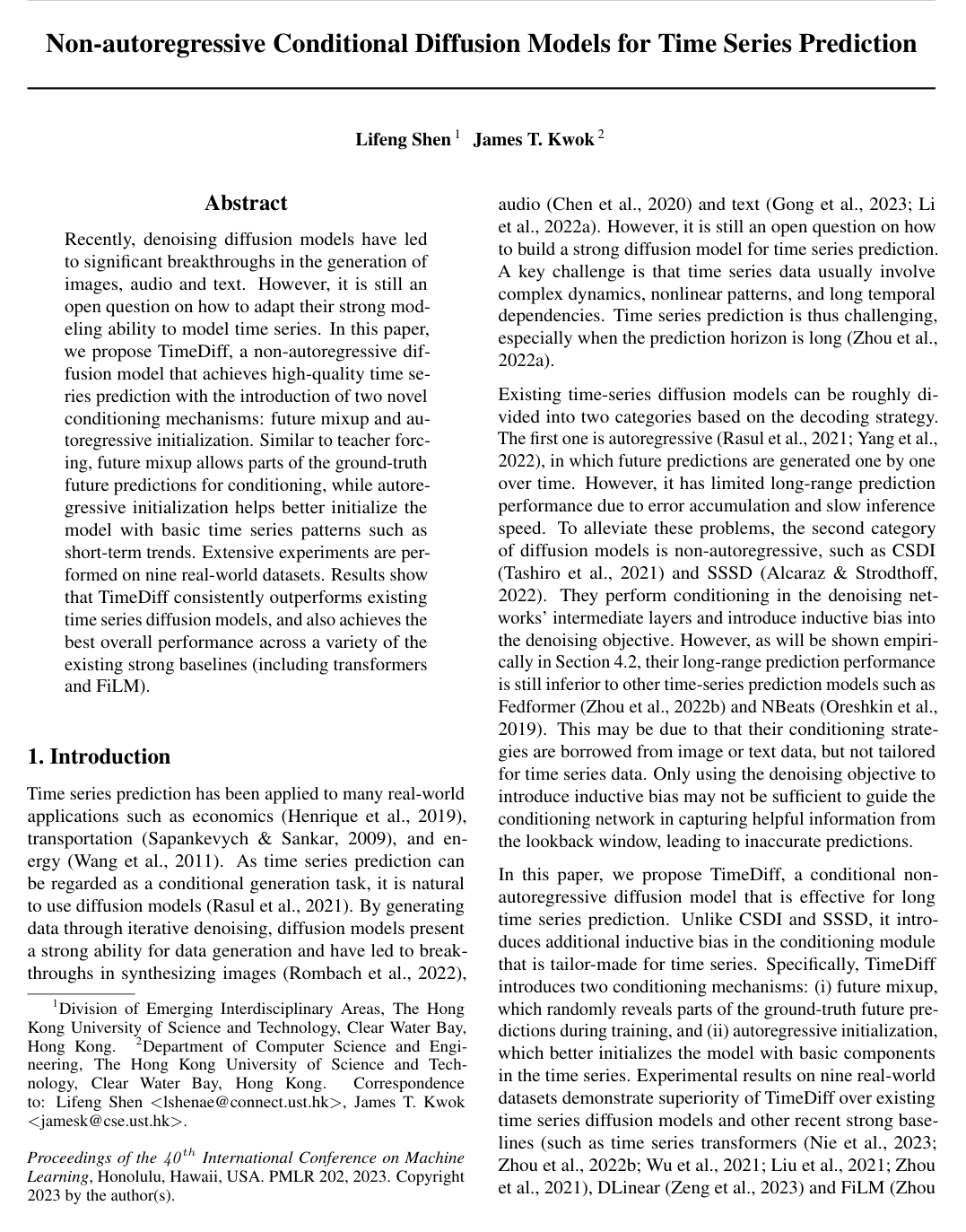
Recently, denoising diffusion models have led to significant breakthroughs in the generation of images, audio and text. However, it is still an open question on how to adapt their strong modeling ability to model time series. In this paper, we propose TimeDiff, a non-autoregressive diffusion model that achieves high-quality time series prediction with the introduction of two novel conditioning mechanisms: future mixup and autoregressive initialization. Similar to teacher forcing, future mixup allows parts of the ground-truth future predictions for conditioning, while autoregressive initialization helps better initialize the model with basic time series patterns such as short-term trends. Extensive experiments are performed on nine real-world datasets. Results show that TimeDiff consistently outperforms existing time series diffusion models, and also achieves the best overall performance across a variety of the existing strong baselines (including transformers and FiLM).

Added

2026-09-26