
keyword
long-horizon tasks
A long-horizon task is a complex, goal-oriented activity that requires an artificial intelligence system or autonomous agent to plan and execute an extended sequence of dependent decisions, actions, or sub-goals over a prolonged period of time to achieve a desired outcome. Unlike short-horizon or single-step objectives, solving these tasks requires sustained temporal reasoning, hierarchical decomposition of high-level goals into intermediate milestones, and the resilience to handle compounding errors and delayed or sparse feedback. Common in domains such as robotics, embodied navigation, physical manipulation, and automated software development, long-horizon tasks challenge agents to maintain context, coordinate multi-stage workflows, and adapt across hundreds or thousands of sequential decision steps.
10 items
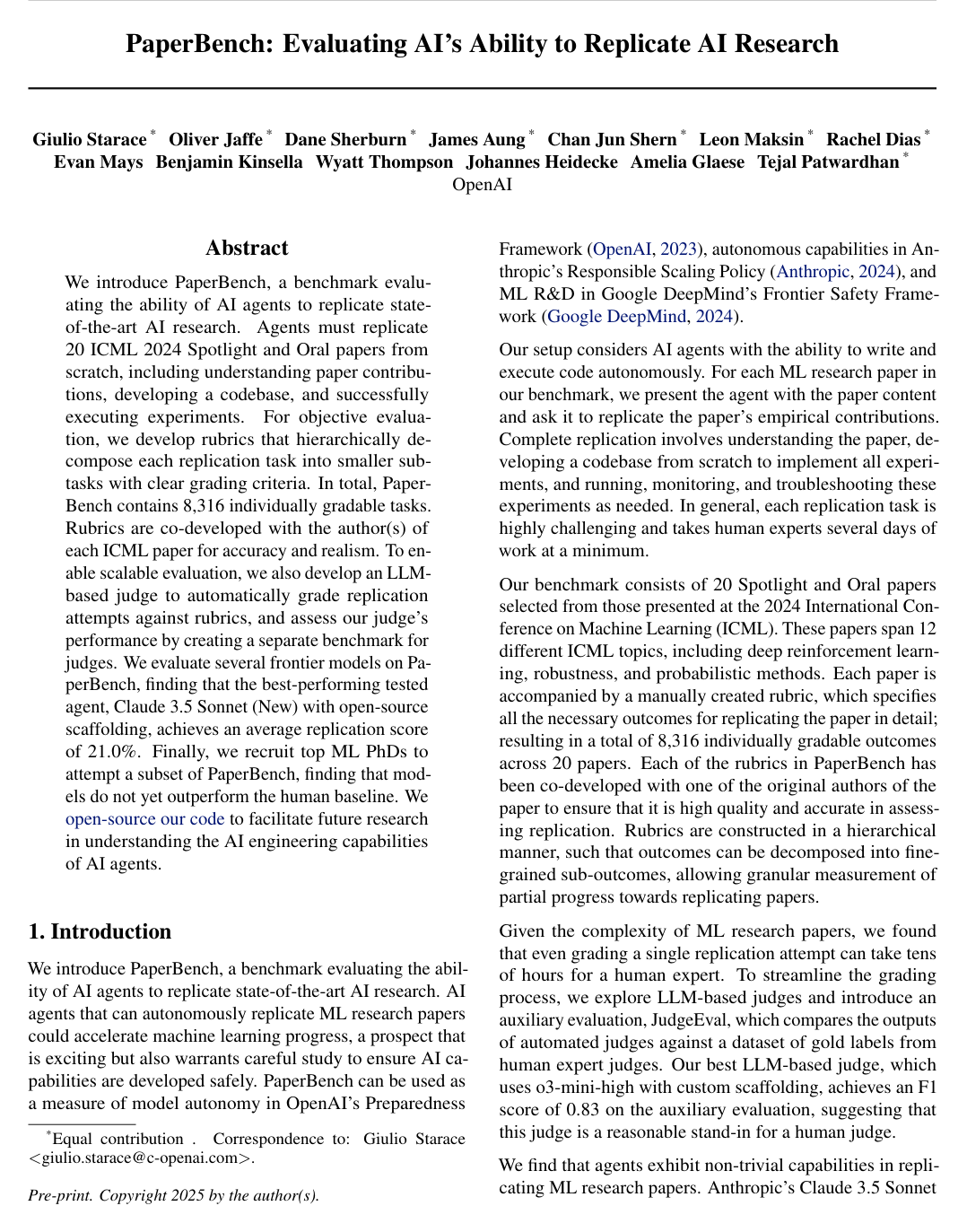
PaperBench: Evaluating AI’s Ability to Replicate AI Research
Giulio Starace, Oliver Jaffe, Dane Sherburn, James Aung, Jun Shern Chan, Leon Maksin, Rachel Dias, Evan Mays, Benjamin Kinsella, Wyatt Thompson, Johannes Heidecke, Amelia Glaese, Tejal Patwardhan
Why you should read this
Presents PaperBench, a benchmark spanning over 8,000 author-verified sub-tasks across 20 ICML 2024 papers to test whether AI agents can replicate end-to-end machine learning research from scratch, revealing that top frontier models achieve only a 21% success rate compared to human experts.
We introduce PaperBench, a benchmark evaluating the ability of AI agents to replicate state-of-the-art AI research. Agents must replicate 20 ICML 2024 Spotlight and Oral papers from scratch, including understanding paper contributions, developing a codebase, and successfully executing experiments. For objective evaluation, we develop rubrics that hierarchically decompose each replication task into smaller sub-tasks with clear grading criteria. In total, PaperBench contains 8,316 individually gradable tasks. Rubrics are co-developed with the author(s) of each ICML paper for accuracy and realism. To enable scalable evaluation, we also develop an LLM-based judge to automatically grade replication attempts against rubrics, and assess our judge's performance by creating a separate benchmark for judges. We evaluate several frontier models on PaperBench, finding that the best-performing tested agent, Claude 3.5 Sonnet (New) with open-source scaffolding, achieves an average replication score of 21.0%. Finally, we recruit top ML PhDs to attempt a subset of PaperBench, finding that models do not yet outperform the human baseline. We open-source our code (this https URL) to facilitate future research in understanding the AI engineering capabilities of AI agents.
Added
2026-10-05
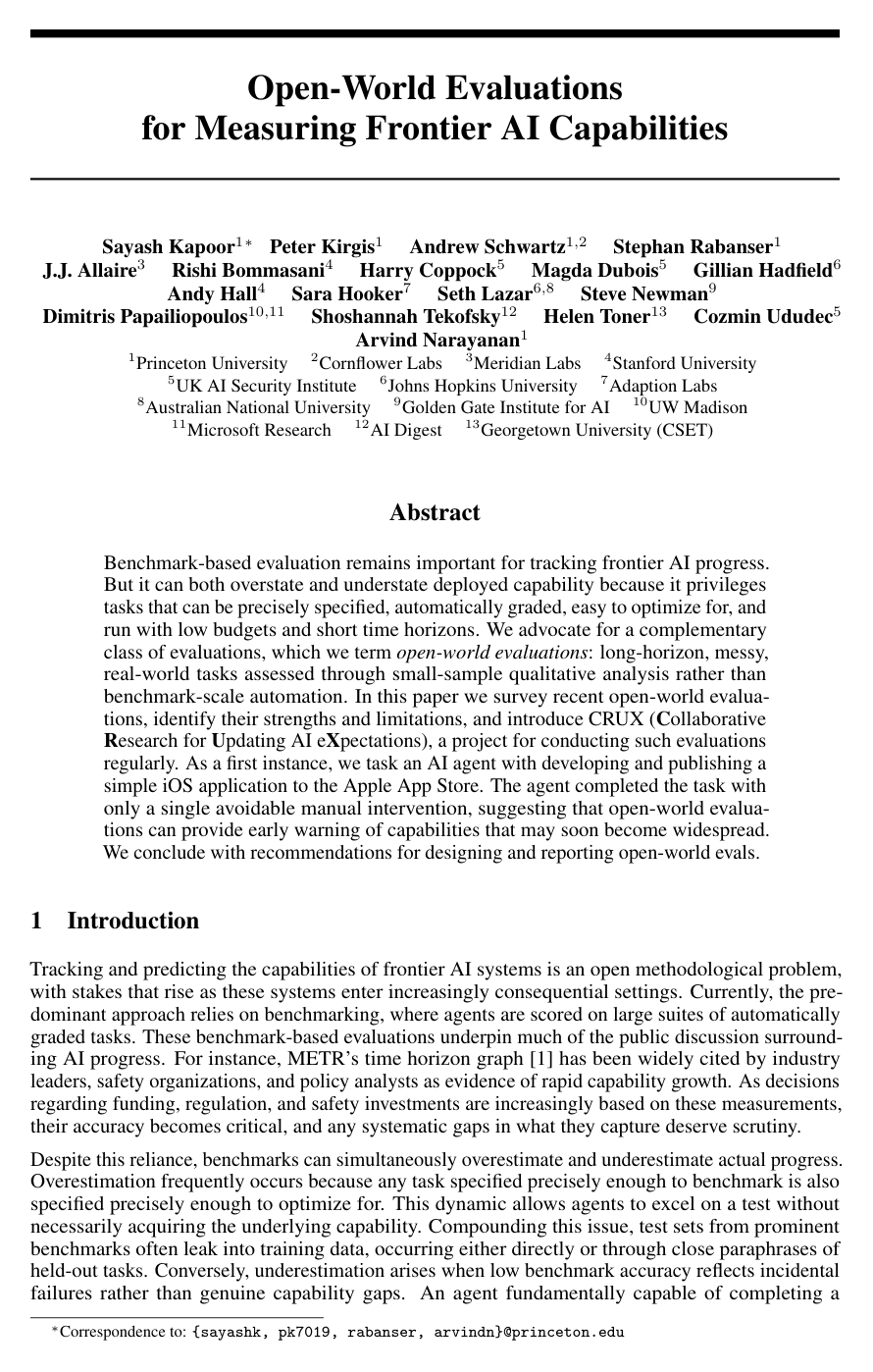
Open-World Evaluations for Measuring Frontier AI Capabilities
Sayash Kapoor, Peter Kirgis, Andrew Schwartz, Stephan Rabanser, J.J. Allaire, Rishi Bommasani, Harry Coppock, Magda Dubois, Gillian K. Hadfield, Andy Hall, Sara Hooker, Seth Lazar, Steve Newman, Dimitris Papailiopoulos, Shoshannah Tekofsky, Helen Toner, Cozmin Ududec, Arvind Narayanan
Why you should read this
Introduces open-world evaluations and the CRUX framework to assess messy, long-horizon AI capabilities overlooked by automated benchmarks, demonstrating how an AI agent can independently develop and deploy an iOS app to the App Store.
Benchmark-based evaluation remains important for tracking frontier AI progress. But it can both overstate and understate deployed capability because it privileges tasks that can be precisely specified, automatically graded, easy to optimize for, and run with low budgets and short time horizons. We advocate for a complementary class of evaluations, which we term open-world evaluations: long-horizon, messy, real-world tasks assessed through small-sample qualitative analysis rather than benchmark-scale automation. In this paper we survey recent open-world evaluations, identify their strengths and limitations, and introduce CRUX (Collaborative Research for Updating AI eXpectations), a project for conducting such evaluations regularly. As a first instance, we task an AI agent with developing and publishing a simple iOS application to the Apple App Store. The agent completed the task with only a single avoidable manual intervention, suggesting that open-world evaluations can provide early warning of capabilities that may soon become widespread. We conclude with recommendations for designing and reporting open-world evals.
Added
2026-09-30
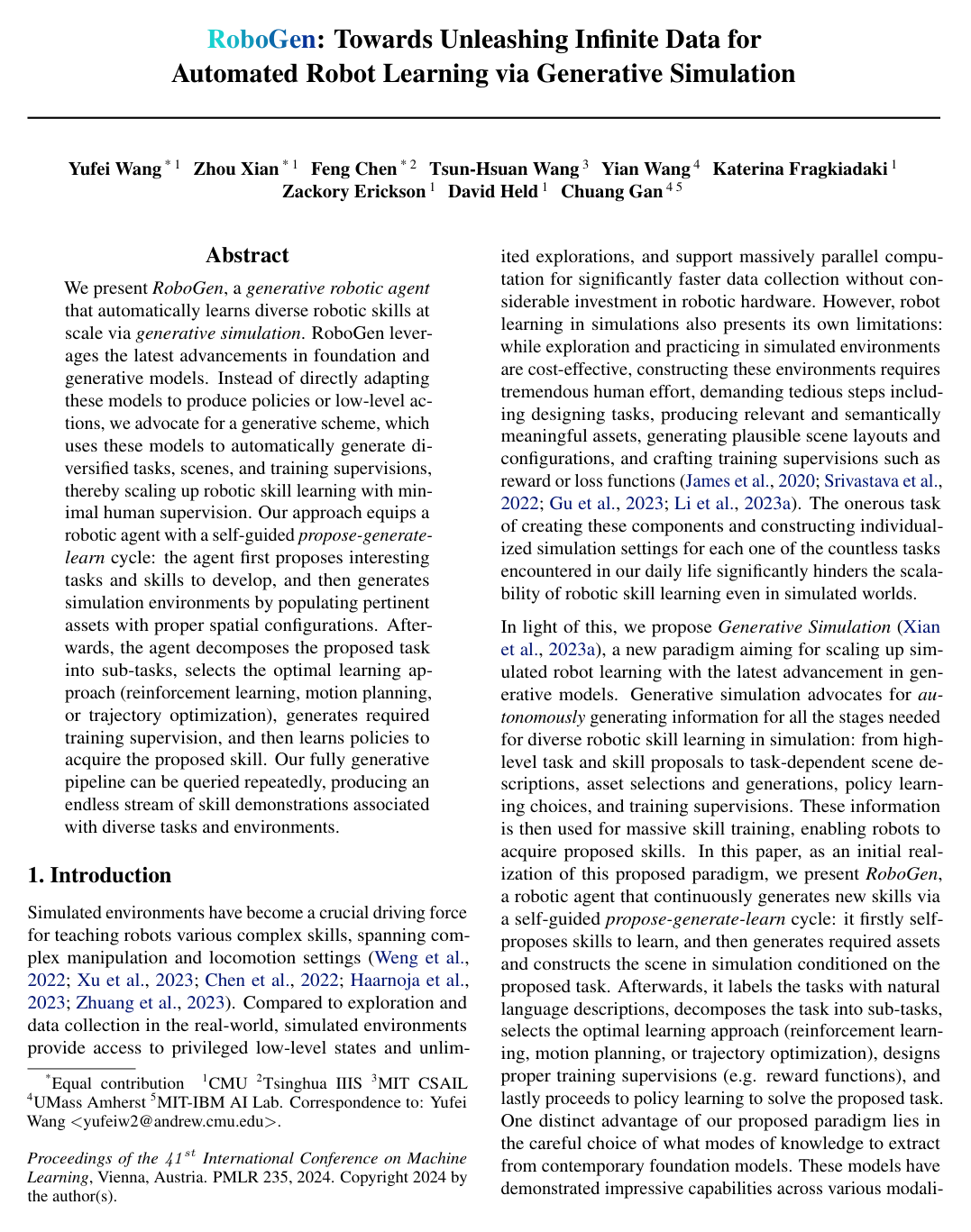
RoboGen: Towards Unleashing Infinite Data for Automated Robot Learning via Generative Simulation
Yufei Wang, Zhou Xian, Feng Chen, Tsun-Hsuan Wang, Yian Wang, Katerina Fragkiadaki, Zackory Erickson, David Held, Chuang Gan
Why you should read this
Introduces an automated robot learning framework that uses generative foundation models to propose tasks, construct simulation scenes, and produce training supervisions in an endless self-guided cycle with minimal human intervention.
We present RoboGen, a generative robotic agent that automatically learns diverse robotic skills at scale via generative simulation. RoboGen leverages the latest advancements in foundation and generative models. Instead of directly using or adapting these models to produce policies or low-level actions, we advocate for a generative scheme, which uses these models to automatically generate diversified tasks, scenes, and training supervisions, thereby scaling up robotic skill learning with minimal human supervision. Our approach equips a robotic agent with a self-guided propose-generate-learn cycle: the agent first proposes interesting tasks and skills to develop, and then generates corresponding simulation environments by populating pertinent objects and assets with proper spatial configurations. Afterwards, the agent decomposes the proposed high-level task into sub-tasks, selects the optimal learning approach (reinforcement learning, motion planning, or trajectory optimization), generates required training supervision, and then learns policies to acquire the proposed skill. Our work attempts to extract the extensive and versatile knowledge embedded in large-scale models and transfer them to the field of robotics. Our fully generative pipeline can be queried repeatedly, producing an endless stream of skill demonstrations associated with diverse tasks and environments.
Added
2026-09-28
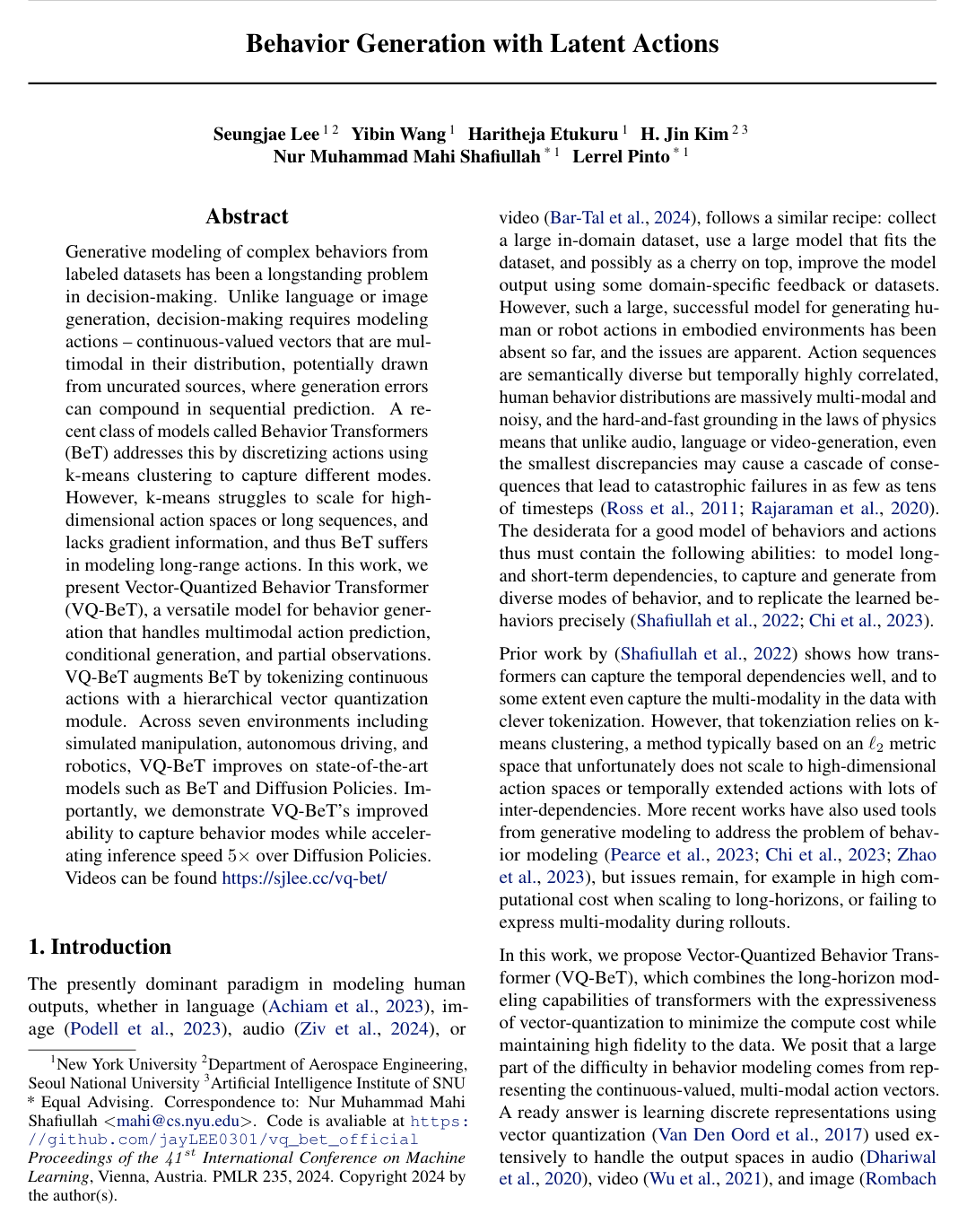
Behavior Generation with Latent Actions
Seungjae Lee, Yibin Wang, Haritheja Etukuru, H. Jin Kim, Nur Muhammad (Mahi) Shafiullah, Lerrel Pinto
Why you should read this
Proposes Vector-Quantized Behavior Transformer (VQ-BeT), a decision-making model that uses hierarchical vector quantization to capture complex multimodal action distributions while achieving competitive generation quality at five times the inference speed of diffusion policies.
Generative modeling of complex behaviors from labeled datasets has been a longstanding problem in decision-making. Unlike language or image generation, decision-making requires modeling actions — continuous-valued vectors that are multimodal in their distribution, potentially drawn from uncurated sources, where generation errors can compound in sequential prediction. A recent class of models called Behavior Transformers (BeT) addresses this by discretizing actions using k-means clustering to capture different modes. However, k-means struggles to scale for high-dimensional action spaces or long sequences, and lacks gradient information, and thus BeT suffers in modeling long-range actions. In this work, we present Vector-Quantized Behavior Transformer (VQ-BeT), a versatile model for behavior generation that handles multimodal action prediction, conditional generation, and partial observations. VQ-BeT augments BeT by tokenizing continuous actions with a hierarchical vector quantization module. Across seven environments including simulated manipulation, autonomous driving, and robotics, VQ-BeT improves on state-of-the-art models such as BeT and Diffusion Policies. Importantly, we demonstrate VQ-BeT's improved ability to capture behavior modes while accelerating inference speed 5× over Diffusion Policies. Videos can be found https://sjlee.cc/vq-bet/
Added
2026-09-26
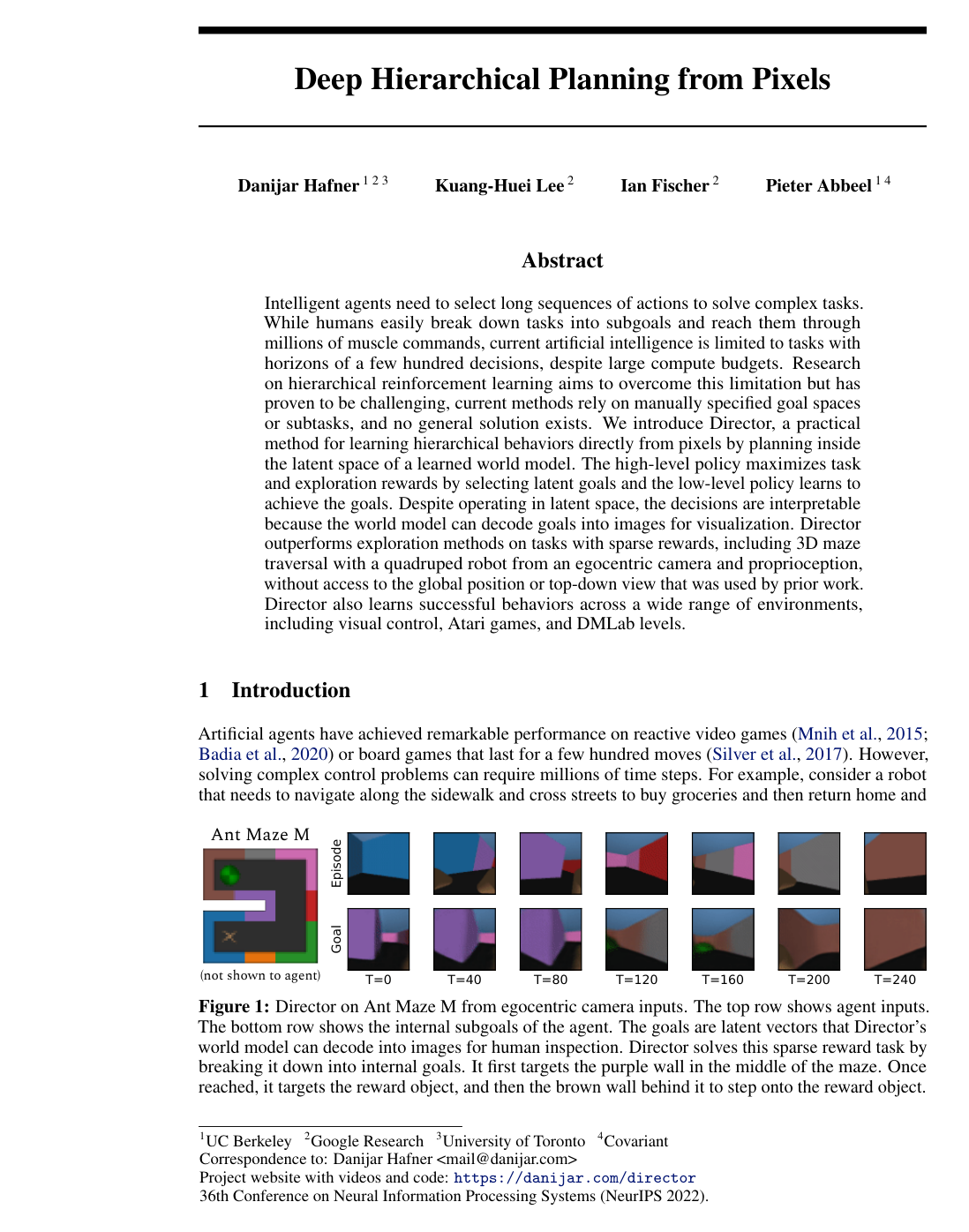
Deep Hierarchical Planning from Pixels
Danijar Hafner, Kuang-Huei Lee, Ian Fischer, Pieter Abbeel
Why you should read this
Introduces Director, a hierarchical reinforcement learning method that learns long-horizon behaviors directly from pixels by selecting interpretable subgoals within the discrete latent space of a learned world model, effectively solving sparse-reward 3D control tasks without manual goal engineering.
Intelligent agents need to select long sequences of actions to solve complex tasks. While humans easily break down tasks into subgoals and reach them through millions of muscle commands, current artificial intelligence is limited to tasks with horizons of a few hundred decisions, despite large compute budgets. Research on hierarchical reinforcement learning aims to overcome this limitation but has proven to be challenging, current methods rely on manually specified goal spaces or subtasks, and no general solution exists. We introduce Director, a practical method for learning hierarchical behaviors directly from pixels by planning inside the latent space of a learned world model. The high-level policy maximizes task and exploration rewards by selecting latent goals and the low-level policy learns to achieve the goals. Despite operating in latent space, the decisions are interpretable because the world model can decode goals into images for visualization. Director outperforms exploration methods on tasks with sparse rewards, including 3D maze traversal with a quadruped robot from an egocentric camera and proprioception, without access to the global position or top-down view that was used by prior work. Director also learns successful behaviors across a wide range of environments, including visual control, Atari games, and DMLab levels.
Added
2026-09-26
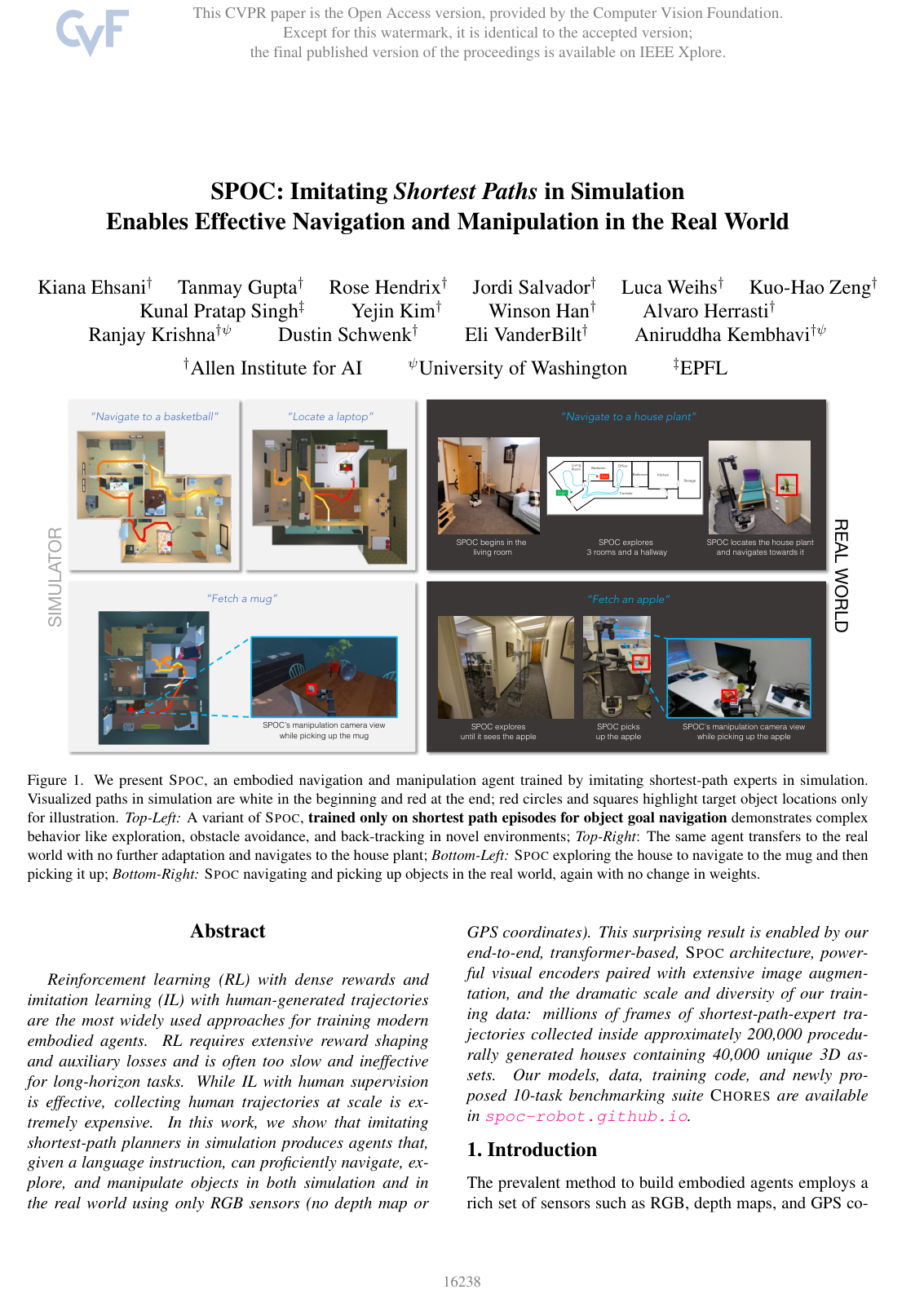
SPOC: Imitating Shortest Paths in Simulation Enables Effective Navigation and Manipulation in the Real World
Kiana Ehsani, Tanmay Gupta, Rose Hendrix, Jordi Salvador, Luca Weihs, Kuo-Hao Zeng, Kunal Pratap Singh, Yejin Kim, Winson Han, Alvaro Herrasti, Ranjay Krishna, Dustin Schwenk, Eli VanderBilt, Aniruddha Kembhavi
Why you should read this
Demonstrates that imitating simulated shortest-path heuristic planners across thousands of procedurally generated environments trains end-to-end RGB-only transformer agents that transfer directly to real-world mobile manipulation tasks without requiring reinforcement learning or costly human demonstrations.
Reinforcement learning (RL) with dense rewards and imitation learning (IL) with human-generated trajectories are the most widely used approaches for training modern embodied agents. RL requires extensive reward shaping and auxiliary losses and is often too slow and ineffective for long-horizon tasks. While IL with human supervision is effective, collecting human trajectories at scale is extremely expensive. In this work, we show that imitating shortest-path planners in simulation produces agents that, given a language instruction, can proficiently navigate, explore, and manipulate objects in both simulation and in the real world using only RGB sensors (no depth map or GPS coordinates). This surprising result is enabled by our end-to-end, transformer-based, SPOC architecture, powerful visual encoders paired with extensive image augmentation, and the dramatic scale and diversity of our training data: millions of frames of shortest-path-expert trajectories collected inside approximately 200,000 procedurally generated houses containing 40,000 unique 3D assets. Our models, data, training code, and newly proposed 10-task benchmarking suite CHORES are available in spoc-robot.github.io.
Added
2026-09-26
BAKU: An Efficient Transformer for Multi-Task Policy Learning
Siddhant Haldar, Zhuoran Peng, Lerrel Pinto
Why you should read this
Presents BAKU, an efficient transformer architecture for multi-task robot imitation learning that combines multi-sensory observation trunks with action chunking to achieve a 91% success rate on 30 real-world tasks using only 17 demonstrations per task.
Training generalist agents capable of solving diverse tasks is challenging, often requiring large datasets of expert demonstrations. This is particularly problematic in robotics, where each data point requires physical execution of actions in the real world. Thus, there is a pressing need for architectures that can effectively leverage the available training data. In this work, we present BAKU, a simple transformer architecture that enables efficient learning of multi-task robot policies. BAKU builds upon recent advancements in offline imitation learning and meticulously combines observation trunks, action chunking, multi-sensory observations, and action heads to substantially improve upon prior work. Our experiments on 129 simulated tasks across LIBERO, Meta-World suite, and the Deepmind Control suite exhibit an overall 18% absolute improvement over RT-1 and MT-ACT, with a 36% improvement on the harder LIBERO benchmark. On 30 real-world manipulation tasks, given an average of just 17 demonstrations per task, BAKU achieves a 91% success rate. Videos of the robot are best viewed at baku-robot.github.io.
Added
2026-09-26
EmbodiedGPT: Vision-Language Pre-Training via Embodied Chain of Thought
Yao Mu, Qinglong Zhang, Mengkang Hu, Wenhai Wang, Mingyu Ding, Jun Jin, Bin Wang, Jifeng Dai, Yu Qiao, Ping Luo
Why you should read this
Presents EmbodiedGPT, a vision-language foundation model that connects high-level chain-of-thought task planning to low-level robot control to substantially increase manipulation success rates across benchmarks like Franka Kitchen and Meta-World.
Embodied AI is a crucial frontier in robotics, capable of planning and executing action sequences for robots to accomplish long-horizon tasks in physical environments. In this work, we introduce EmbodiedGPT, an end-to-end multi-modal foundation model for embodied AI, empowering embodied agents with multi-modal understanding and execution capabilities. To achieve this, we have made the following efforts: (i) We craft a large-scale embodied planning dataset, termed EgoCOT. The dataset consists of carefully selected videos from the Ego4D dataset, along with corresponding high-quality language instructions. Specifically, we generate a sequence of sub-goals with the "Chain of Thoughts" mode for effective embodied planning. (ii) We introduce an efficient training approach to EmbodiedGPT for high-quality plan generation, by adapting a 7B large language model (LLM) to the EgoCOT dataset via prefix tuning. (iii) We introduce a paradigm for extracting task-related features from LLM-generated planning queries to form a closed loop between high-level planning and low-level control. Extensive experiments show the effectiveness of EmbodiedGPT on embodied tasks, including embodied planning, embodied control, visual captioning, and visual question answering. Notably, EmbodiedGPT significantly enhances the success rate of the embodied control task by extracting more effective features. It has achieved a remarkable 1.6 times increase in success rate on the Franka Kitchen benchmark and a 1.3 times increase on the Meta-World benchmark, compared to the BLIP-2 baseline fine-tuned with the Ego4D dataset.
Added
2026-09-26
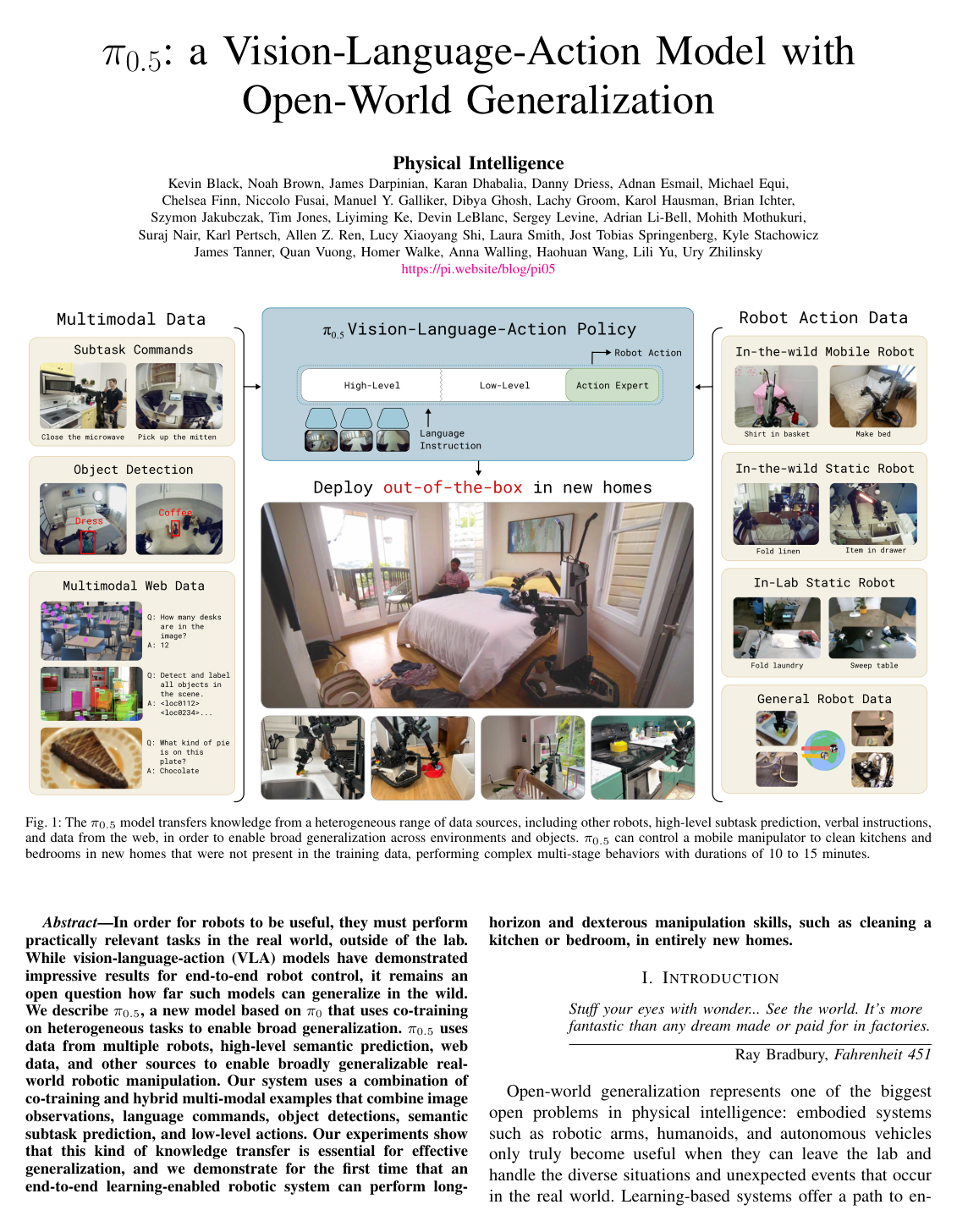
π0.5: a Vision-Language-Action Model with Open-World Generalization
Physical Intelligence, Kevin Black, Noah Brown, James Darpinian, Karan Dhabalia, Danny Driess, Adnan Esmail, Michael Equi, Chelsea Finn, Niccolo Fusai, Manuel Y. Galliker, Dibya Ghosh, Lachy Groom, Karol Hausman, Brian Ichter, Szymon Jakubczak, Tim Jones, Liyiming Ke, Devin LeBlanc, Sergey Levine, Adrian Li-Bell, Mohith Mothukuri, Suraj Nair, Karl Pertsch, Allen Z. Ren, Lucy Xiaoyang Shi, Laura Smith, Jost Tobias Springenberg, Kyle Stachowicz, James Tanner, Quan Vuong, Homer Walke, Anna Walling, Haohuan Wang, Lili Yu, Ury Zhilinsky
Why you should read this
Presents , an end-to-end vision-language-action model that leverages heterogeneous co-training across multi-robot and web data to perform dexterous, long-horizon manipulation tasks in previously unseen real-world homes.
In order for robots to be useful, they must perform practically relevant tasks in the real world, outside of the lab. While vision-language-action (VLA) models have demonstrated impressive results for end-to-end robot control, it remains an open question how far such models can generalize in the wild. We describe , a new model based on that uses co-training on heterogeneous tasks to enable broad generalization. \ uses data from multiple robots, high-level semantic prediction, web data, and other sources to enable broadly generalizable real-world robotic manipulation. Our system uses a combination of co-training and hybrid multi-modal examples that combine image observations, language commands, object detections, semantic subtask prediction, and low-level actions. Our experiments show that this kind of knowledge transfer is essential for effective generalization, and we demonstrate for the first time that an end-to-end learning-enabled robotic system can perform long-horizon and dexterous manipulation skills, such as cleaning a kitchen or bedroom, in entirely new homes.
Added
2026-09-24
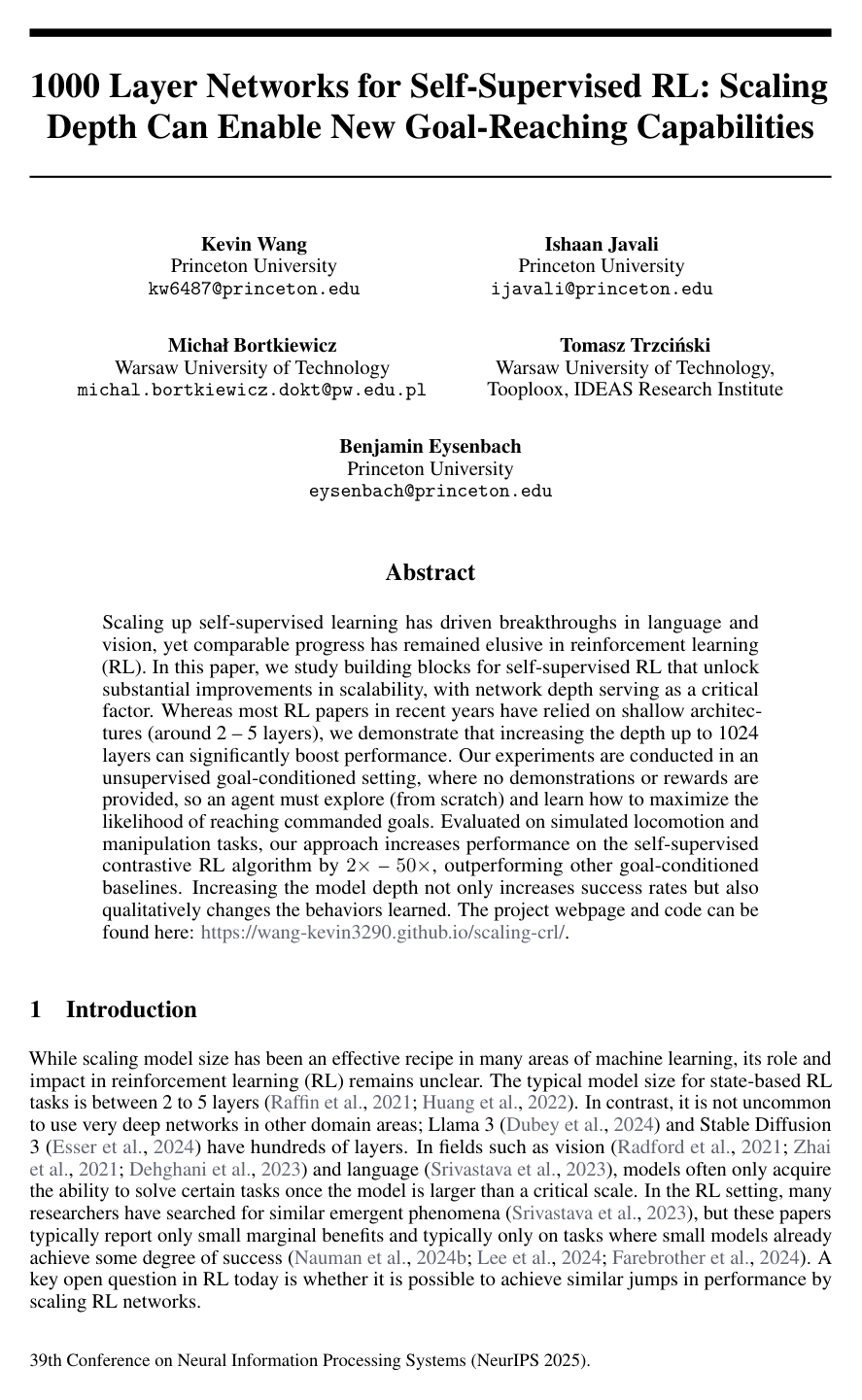
1000 Layer Networks for Self-Supervised RL: Scaling Depth Can Enable New Goal-Reaching Capabilities
Kevin Wang, Ishaan Javali, Michał Bortkiewicz, Tomasz Trzciński, Benjamin Eysenbach
Why you should read this
Demonstrates that significantly increasing neural network depth in self-supervised reinforcement learning (up to 1024 layers) can unlock substantial performance gains (2x-50x) and qualitatively new goal-reaching capabilities in challenging environments without demonstrations or rewards.
Scaling up self-supervised learning has driven breakthroughs in language and vision, yet comparable progress has remained elusive in reinforcement learning (RL). In this paper, we study building blocks for self-supervised RL that unlock substantial improvements in scalability, with network depth serving as a critical factor. Whereas most RL papers in recent years have relied on shallow architectures (around 2 - 5 layers), we demonstrate that increasing the depth up to 1024 layers can significantly boost performance. Our experiments are conducted in an unsupervised goal-conditioned setting, where no demonstrations or rewards are provided, so an agent must explore (from scratch) and learn how to maximize the likelihood of reaching commanded goals. Evaluated on simulated locomotion and manipulation tasks, our approach increases performance on the self-supervised contrastive RL algorithm by - , outperforming other goal-conditioned baselines. Increasing the model depth not only increases success rates but also qualitatively changes the behaviors learned. The project webpage and code can be found here: this https URL.
Added
2026-01-07
