
keyword
long-form video understanding
Long-form video understanding is a subfield of computer vision and multimodal artificial intelligence focused on analyzing, interpreting, and reasoning about extended video content that typically spans from several minutes to hours in duration. Unlike standard video processing that operates on short, isolated clips of a few seconds to recognize immediate actions, long-form video understanding requires capturing complex, long-range spatiotemporal dependencies and maintaining contextual coherence over broad time horizons. It encompasses tasks such as video summarization, long-term event localization, predictive and causal reasoning, and multimodal question answering. To address the significant computational and memory constraints inherent in processing large volumes of visual frames over extended durations, approaches in this area often utilize scalable sequence architectures, adaptive token selection, and efficient representation strategies.
5 items
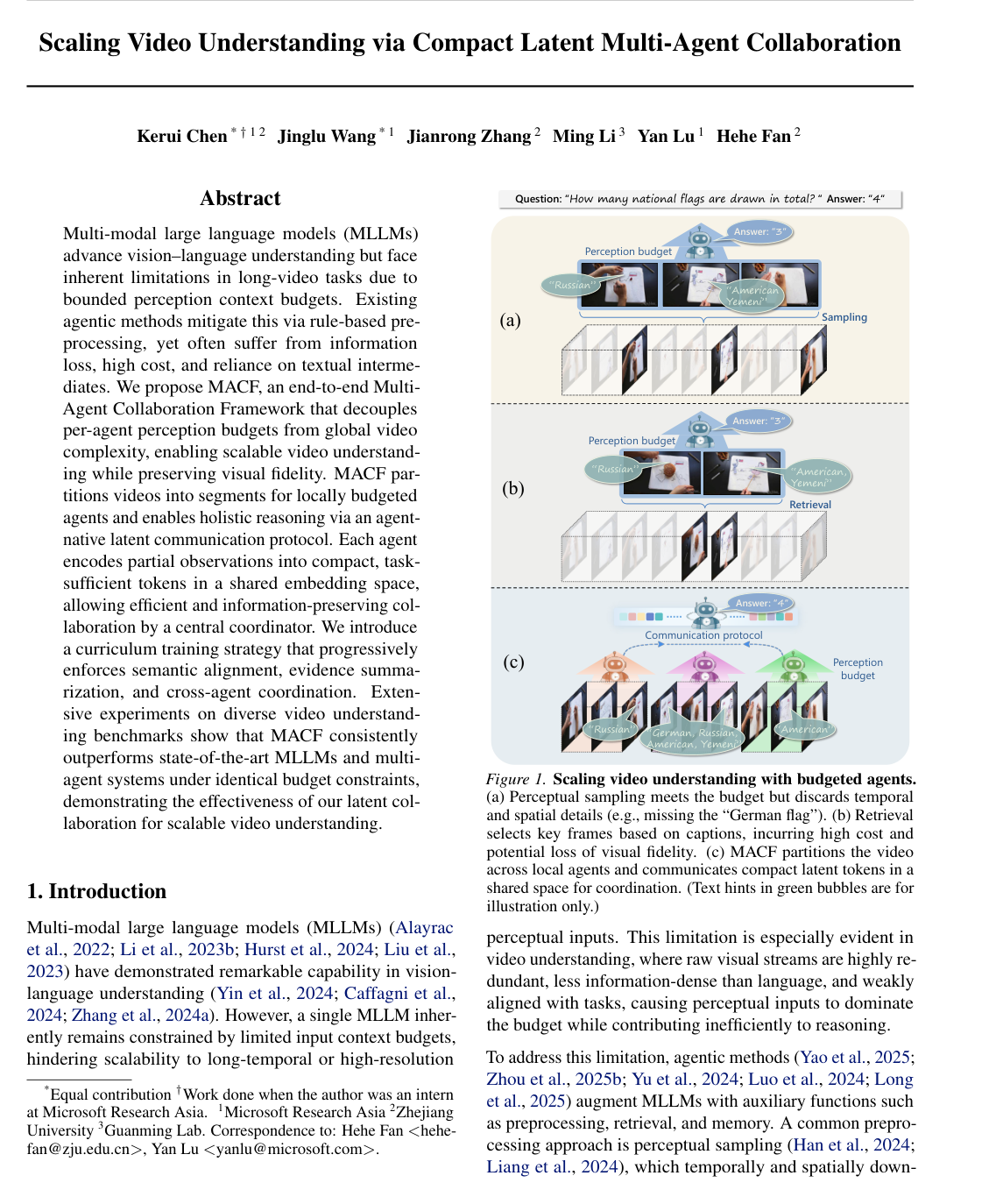
Scaling Video Understanding via Compact Latent Multi-Agent Collaboration
Kerui Chen, Jinglu Wang, Jianrong Zhang, Ming Li, Yang Lu, Hehe Fan
Why you should read this
Proposes a multi-agent framework that scales long-video understanding by coordinating video-segment agents through compact latent tokens rather than text summaries, outperforming existing vision-language models under tight context budgets.
Multi-modal large language models (MLLMs) advance vision language understanding but face inherent limitations in long-video tasks due to bounded perception context budgets. Existing agentic methods mitigate this via rule-based preprocessing, yet often suffer from information loss, high cost, and reliance on textual intermediates. We propose MACF, an end-to-end Multi-Agent Collaboration Framework that decouples per-agent perception budgets from global video complexity, enabling scalable video understanding while preserving visual fidelity. MACF partitions videos into segments for locally budgeted agents and enables holistic reasoning via an agent-native latent communication protocol. Each agent encodes partial observations into compact, task-sufficient tokens in a shared embedding space, allowing efficient and information-preserving collaboration by a central coordinator. We introduce a curriculum training strategy that progressively enforces semantic alignment, evidence summarization, and cross-agent coordination. Extensive experiments on diverse video understanding benchmarks show that MACF consistently outperforms state-of-the-art MLLMs and multi-agent systems under identical budget constraints, demonstrating the effectiveness of our latent collaboration for scalable video understanding.
Added
2026-09-29
S4ND: Modeling Images and Videos as Multidimensional Signals with State Spaces
Eric Nguyen, Karan Goel, Albert Gu, Gordon W. Downs, Preey Shah, Tri Dao, Stephen Baccus, Christopher Ré
Why you should read this
Extends deep state space models to multidimensional signals with S4ND, enabling continuous-signal modeling of images and videos that matches or exceeds standard vision architectures while supporting zero-shot resolution adaptation and faster training via progressive resizing.
Visual data such as images and videos are typically modeled as discretizations of inherently continuous, multidimensional signals. Existing continuous-signal models attempt to exploit this fact by modeling the underlying signals of visual (e.g., image) data directly. However, these models have not yet been able to achieve competitive performance on practical vision tasks such as large-scale image and video classification. Building on a recent line of work on deep state space models (SSMs), we propose S4ND, a new multidimensional SSM layer that extends the continuous-signal modeling ability of SSMs to multidimensional data including images and videos. We show that S4ND can model large-scale visual data in 1D, 2D, and 3D as continuous multidimensional signals and demonstrates strong performance by simply swapping Conv2D and self-attention layers with S4ND layers in existing state-of-the-art models. On ImageNet-1k, S4ND exceeds the performance of a Vision Transformer baseline by 1.5% when training with a 1D sequence of patches, and matches ConvNeXt when modeling images in 2D. For videos, S4ND improves on an inflated 3D ConvNeXt in activity classification on HMDB-51 by 4%. S4ND implicitly learns global, continuous convolutional kernels that are resolution invariant by construction, providing an inductive bias that enables generalization across multiple resolutions. By developing a simple bandlimiting modification to S4 to overcome aliasing, S4ND achieves strong zero-shot (unseen at training time) resolution performance, outperforming a baseline Conv2D by 40% on CIFAR-10 when trained on 8 × 8 and tested on 32 × 32 images. When trained with progressive resizing, S4ND comes within ~1% of a high-resolution model while training 22% faster.
Added
2026-09-26
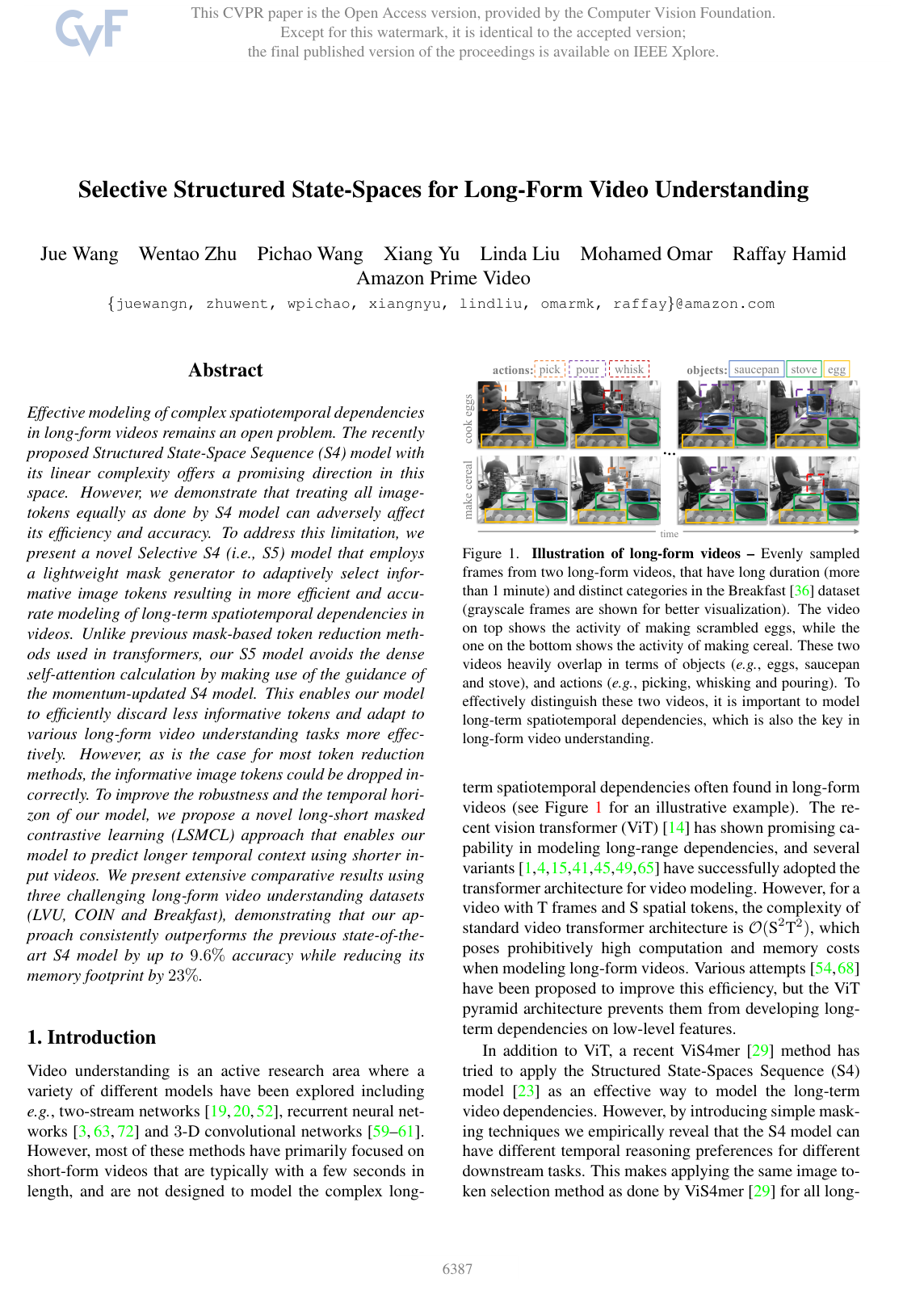
Selective Structured State-Spaces for Long-Form Video Understanding
Jue Wang, Wentao Zhu, Pichao Wang, Xiang Yu, Linda Liu, Mohamed Omar, Raffay Hamid
Why you should read this
Proposes a selective structured state-space architecture and masked contrastive pre-training strategy that adaptively discards uninformative visual tokens, cutting memory consumption by 23% while improving long-form video understanding accuracy by up to 9.6%.
Effective modeling of complex spatiotemporal dependencies in long-form videos remains an open problem. The recently proposed Structured State-Space Sequence (S4) model with its linear complexity offers a promising direction in this space. However, we demonstrate that treating all image-tokens equally as done by S4 model can adversely affect its efficiency and accuracy. To address this limitation, we present a novel Selective S4 (i.e., S5) model that employs a lightweight mask generator to adaptively select informative image tokens resulting in more efficient and accurate modeling of long-term spatiotemporal dependencies in videos. Unlike previous mask-based token reduction methods used in transformers, our S5 model avoids the dense self-attention calculation by making use of the guidance of the momentum-updated S4 model. This enables our model to efficiently discard less informative tokens and adapt to various long-form video understanding tasks more effectively. However, as is the case for most token reduction methods, the informative image tokens could be dropped incorrectly. To improve the robustness and the temporal horizon of our model, we propose a novel long-short masked contrastive learning (LSMCL) approach that enables our model to predict longer temporal context using shorter input videos. We present extensive comparative results using three challenging long-form video understanding datasets (LVU, COIN and Breakfast), demonstrating that our approach consistently outperforms the previous state-of-the-art S4 model by up to 9.6% accuracy while reducing its memory footprint by 23%.
Added
2026-09-26
HourVideo: 1-Hour Video-Language Understanding
Keshigeyan Chandrasegaran, Agrim Gupta, Lea M. Hadzic, Taran Kota, Jimming He, Cristóbal Eyzaguirre, Zane Durante, Manling Li, Jiajun Wu, Li Fei-Fei
Why you should read this
Presents a benchmark of nearly thirteen thousand questions across five hundred hour-long egocentric videos to expose the critical performance gap between state-of-the-art multimodal models and human-level long-form video comprehension.
We present HourVideo, a benchmark dataset for hour-long video-language understanding. Our dataset consists of a novel task suite comprising summarization, perception (recall, tracking), visual reasoning (spatial, temporal, predictive, causal, counterfactual), and navigation (room-to-room, object retrieval) tasks. HourVideo includes 500 manually curated egocentric videos from the Ego4D dataset, spanning durations of 20 to 120 minutes, and features 12,976 high-quality, five-way multiple-choice questions. Benchmarking results reveal that multimodal models, including GPT-4 and LLaVA-NeXT, achieve marginal improvements over random chance. In stark contrast, human experts significantly outperform the state-of-the-art long-context multimodal model, Gemini Pro 1.5 (85.0% vs. 37.3%), highlighting a substantial gap in multimodal capabilities. Our benchmark, evaluation toolkit, prompts, and documentation are available at hourvideo.stanford.edu.
Added
2026-09-26
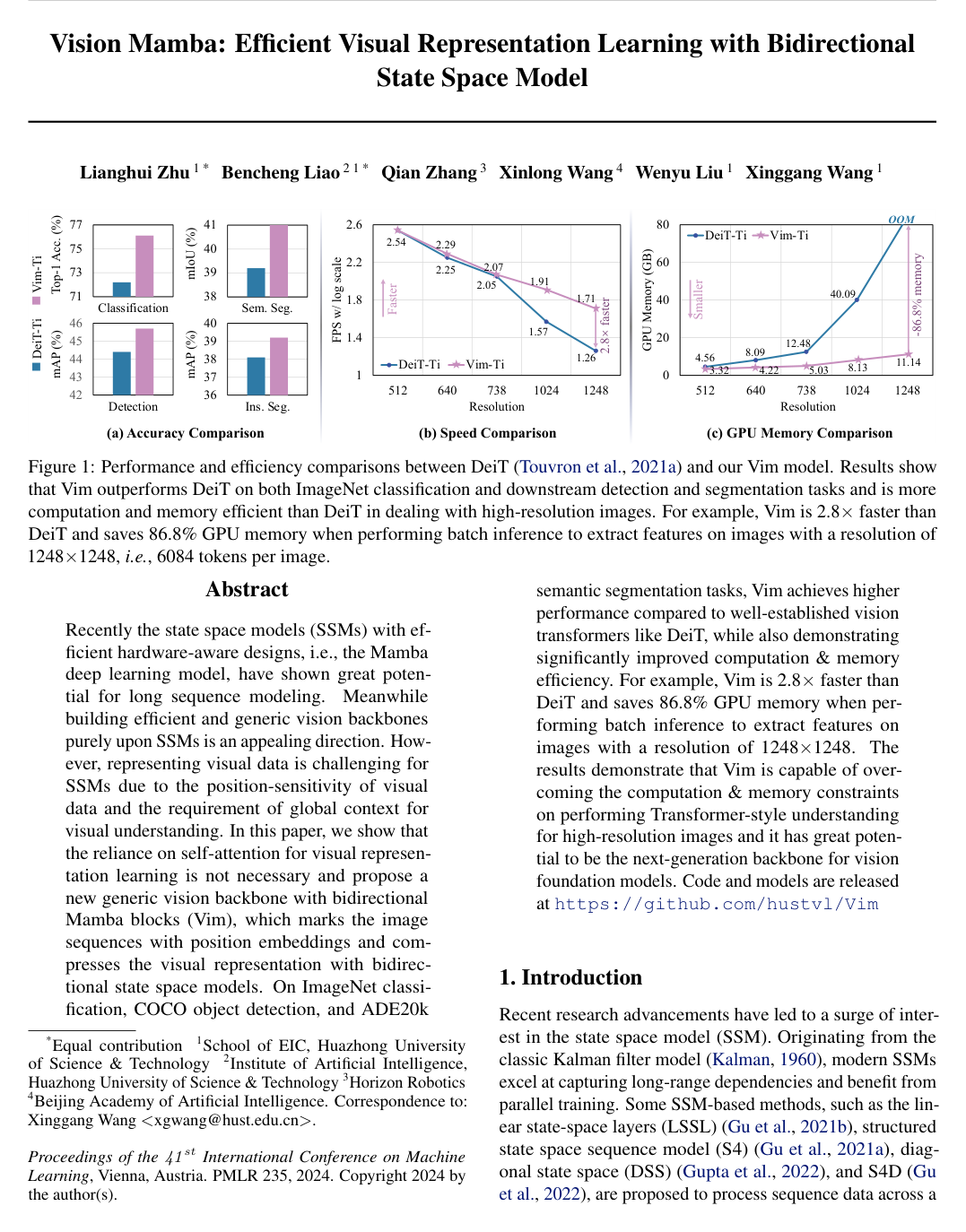
Vision Mamba: Efficient Visual Representation Learning with Bidirectional State Space Model
Lianghui Zhu, Bencheng Liao, Qian Zhang, Xinlong Wang, Wenyu Liu, Xinggang Wang
Why you should read this
Introduces Vision Mamba, a bidirectional state space backbone that replaces self-attention to achieve linear-time visual representation learning, outperforming standard vision transformers across core visual benchmarks while cutting GPU memory use by over 86% on high-resolution images.
Recently the state space models (SSMs) with efficient hardware-aware designs, i.e., the Mamba deep learning model, have shown great potential for long sequence modeling. Meanwhile building efficient and generic vision backbones purely upon SSMs is an appealing direction. However, representing visual data is challenging for SSMs due to the position-sensitivity of visual data and the requirement of global context for visual understanding. In this paper, we show that the reliance on self-attention for visual representation learning is not necessary and propose a new generic vision backbone with bidirectional Mamba blocks (Vim), which marks the image sequences with position embeddings and compresses the visual representation with bidirectional state space models. On ImageNet classification, COCO object detection, and ADE20k semantic segmentation tasks, Vim achieves higher performance compared to well-established vision transformers like DeiT, while also demonstrating significantly improved computation & memory efficiency. For example, Vim is 2.8 faster than DeiT and saves 86.8% GPU memory when performing batch inference to extract features on images with a resolution of 12481248. The results demonstrate that Vim is capable of overcoming the computation & memory constraints on performing Transformer-style understanding for high-resolution images and it has great potential to be the next-generation backbone for vision foundation models. Code is available at this https URL.
Added
2026-09-18