
keyword
load forecasting
Load forecasting is the technique of estimating the future demand for electrical power across a power grid or within a utility service area over various time horizons. It relies on statistical, mathematical, and machine learning models that analyze historical energy consumption data alongside influencing factors such as weather conditions, seasonal cycles, calendar events, and socioeconomic trends. System operators and power utilities categorize these predictions into short-term, medium-term, and long-term forecasts to balance power generation with consumer demand in real time, schedule maintenance, optimize energy trading, and guide infrastructure investments. By ensuring operational reliability and cost efficiency, load forecasting serves as an essential foundation for grid stability and power system planning.
3 items
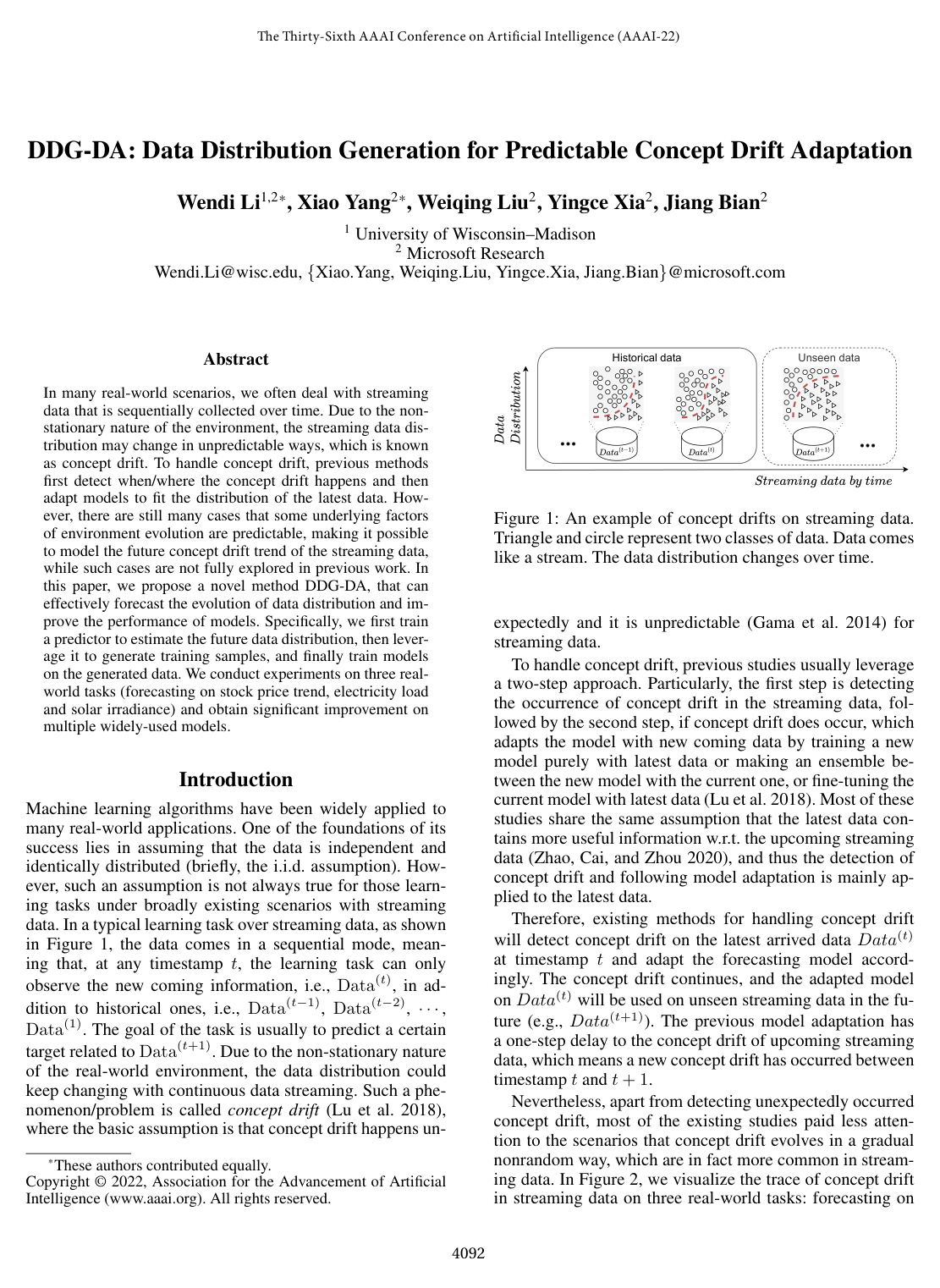
DDG-DA: Data Distribution Generation for Predictable Concept Drift Adaptation
Wendi Li, Xiao Yang, Weiqing Liu, Yingce Xia, Jiang Bian
Why you should read this
Proposes DDG-DA, a proactive adaptation framework that forecasts future streaming data distributions and resamples historical samples via a differentiable distribution distance to train predictive models before concept drift occurs.
In many real-world scenarios, we often deal with streaming data that is sequentially collected over time. Due to the non-stationary nature of the environment, the streaming data distribution may change in unpredictable ways, which is known as concept drift. To handle concept drift, previous methods first detect when/where the concept drift happens and then adapt models to fit the distribution of the latest data. However, there are still many cases that some underlying factors of environment evolution are predictable, making it possible to model the future concept drift trend of the streaming data, while such cases are not fully explored in previous work. In this paper, we propose a novel method DDG-DA, that can effectively forecast the evolution of data distribution and improve the performance of models. Specifically, we first train a predictor to estimate the future data distribution, then leverage it to generate training samples, and finally train models on the generated data. We conduct experiments on three real-world tasks (forecasting on stock price trend, electricity load and solar irradiance) and obtain significant improvement on multiple widely-used models.
Added
2026-09-26
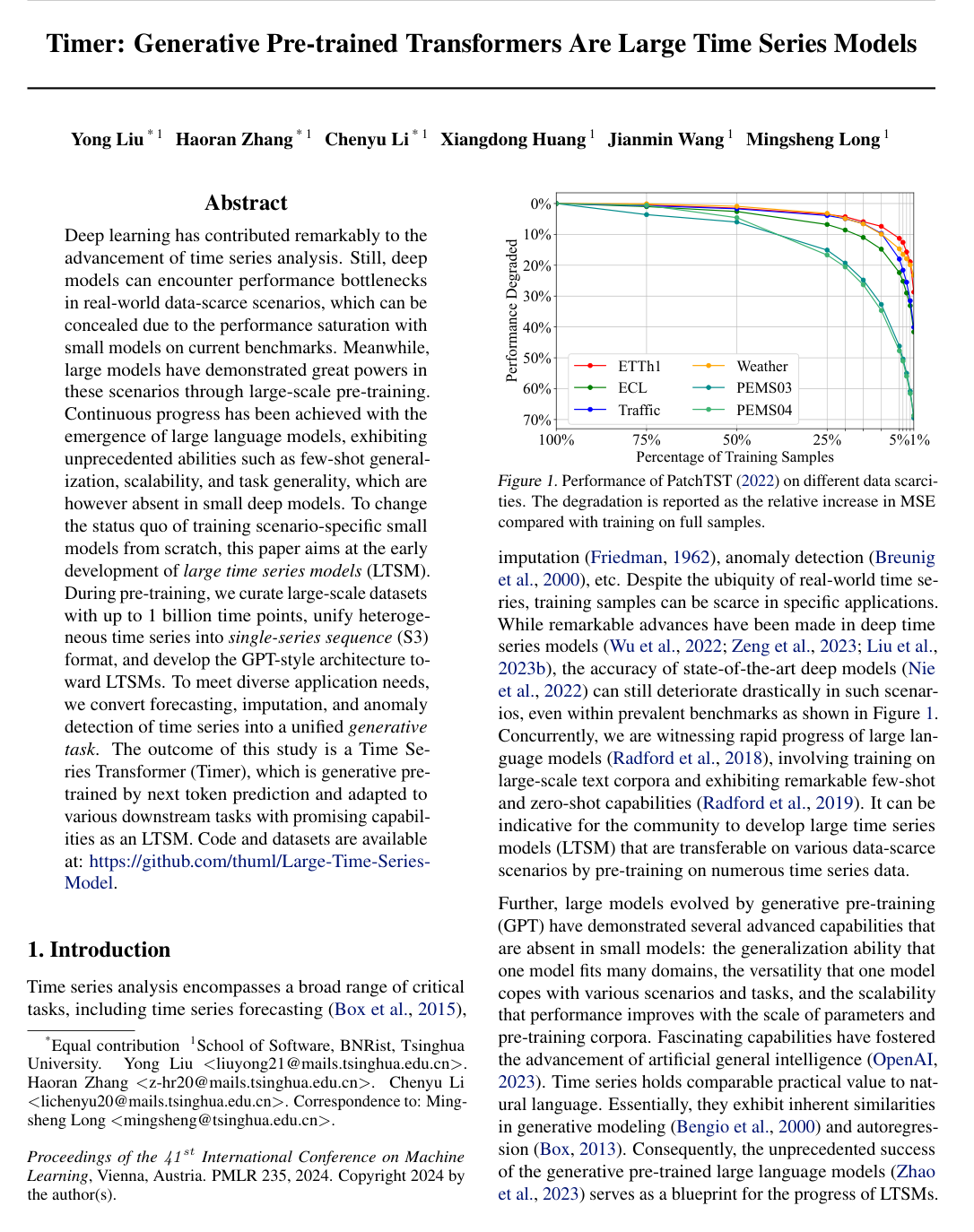
Timer: Generative Pre-trained Transformers Are Large Time Series Models
Yong Liu, Haoran Zhang, Chenyu Li, Xiangdong Huang, Jianmin Wang, Mingsheng Long
Why you should read this
Presents a billion-point pre-trained GPT-style model that unifies diverse time series forecasting, imputation, and anomaly detection into next-token prediction to deliver strong few-shot and zero-shot performance across heterogeneous domains.
Deep learning has contributed remarkably to the advancement of time series analysis. Still, deep models can encounter performance bottlenecks in real-world data-scarce scenarios, which can be concealed due to the performance saturation with small models on current benchmarks. Meanwhile, large models have demonstrated great powers in these scenarios through large-scale pre-training. Continuous progress has been achieved with the emergence of large language models, exhibiting unprecedented abilities such as few-shot generalization, scalability, and task generality, which are however absent in small deep models. To change the status quo of training scenario-specific small models from scratch, this paper aims at the early development of large time series models (LTSM). During pre-training, we curate large-scale datasets with up to 1 billion time points, unify heterogeneous time series into single-series sequence (S3) format, and develop the GPT-style architecture toward LTSMs. To meet diverse application needs, we convert forecasting, imputation, and anomaly detection of time series into a unified generative task. The outcome of this study is a Time Series Transformer (Timer), which is generative pre-trained by next token prediction and adapted to various downstream tasks with promising capabilities as an LTSM. Code and datasets are available at: https://github.com/thuml/Large-Time-Series-Model.
Added
2026-09-26
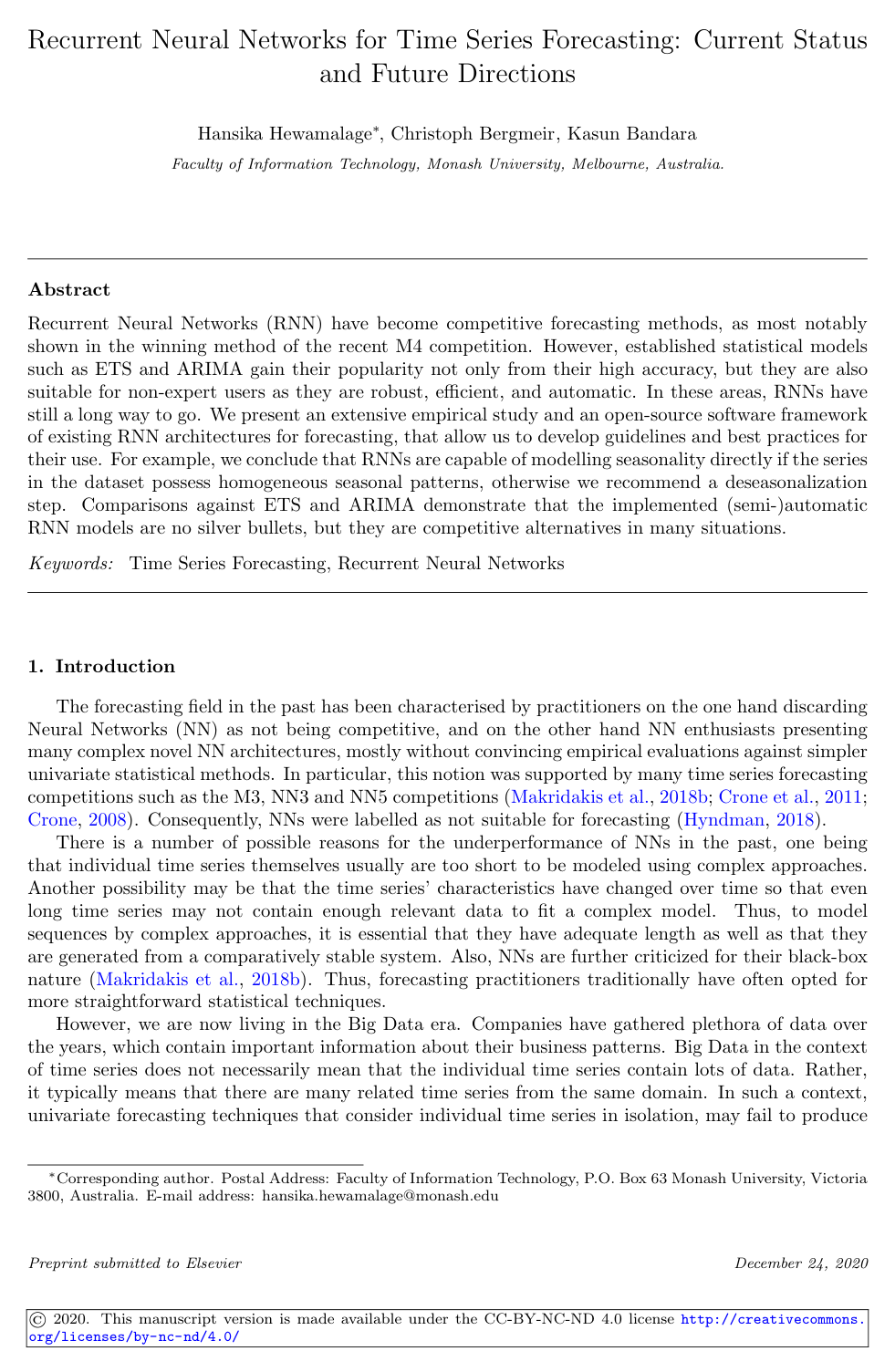
Recurrent Neural Networks for Time Series Forecasting: Current Status and Future Directions
Hansika Hewamalage, Christoph Bergmeir, Kasun Bandara
Why you should read this
Establishes practical guidelines and an open-source framework for time series forecasting with recurrent neural networks through extensive empirical comparisons against standard statistical baselines like ARIMA and ETS.
Recurrent Neural Networks (RNN) have become competitive forecasting methods, as most notably shown in the winning method of the recent M4 competition. However, established statistical models such as ETS and ARIMA gain their popularity not only from their high accuracy, but they are also suitable for non-expert users as they are robust, efficient, and automatic. In these areas, RNNs have still a long way to go. We present an extensive empirical study and an open-source software framework of existing RNN architectures for forecasting, that allow us to develop guidelines and best practices for their use. For example, we conclude that RNNs are capable of modelling seasonality directly if the series in the dataset possess homogeneous seasonal patterns, otherwise we recommend a deseasonalization step. Comparisons against ETS and ARIMA demonstrate that the implemented (semi-)automatic RNN models are no silver bullets, but they are competitive alternatives in many situations.
Added
2026-09-25